seamus dubhghaill

Promoting Irish Culture and History from Little Rock, Arkansas, USA


Leave a comment

The Battle of Newtownbutler

The Battle of Newtownbutler takes place on July 31, 1689, near EnniskillenCounty Fermanagh. It is part of the Williamite War in Ireland between the forces of William III and Mary II and those of King James II.

In Enniskillen, armed Williamite civilians drawn from the local Protestant population organise a formidable irregular military force. The armed civilians of Enniskillen ignore an order from Robert Lundy that they should fall back to Derry and instead launch guerrilla attacks against the Jacobites. Operating with Enniskillen as a base, they carry out raids against the Jacobite forces in Connacht and Ulster, plundering Trillick, burning Augher Castle, and raiding Clones.

A Jacobite army of about 3,000 men, led by Justin McCarthy, Viscount Mountcashel (in the Jacobite peerage), advance on them from Dublin. Lord Mountcashel’s men consist of three regiments of infantry and two of dragoons. The regiments include his own regiment, Mountcashel (approx. 650 men in 13 companies), The O’Brien regiment (also 13 companies of 650 men), and the Lord Bophin (Burke) regiment. He also has the dragoon regiments of Cotter and Clare, each with seven companies of about 350 dragoons. On July 28, 1689, Mountcashel’s force encamps near Enniskillen and bombards the Williamite outpost of Crom Castle to the southeast of Enniskillen. Crom Castle is almost 20 miles (32 km) from Enniskillen by road and about 5 miles (8.0 km) from Newtownbutler.

Two days later, they are confronted by about 2,000 Williamite ‘Inniskilliniers’ under Colonel Berry, Colonel William Wolseley and Gustave Hamilton. The Jacobite dragoons under Antoine Hamilton stumble into an ambush laid by Berry’s men near Lisnaskea and are routed, taking 230 casualties. Mountcashel manages to drive off Berry’s cavalry with his main force but is then faced with the bulk of the Williamite strength under Wolseley. There is some debate in the sources over troop numbers, though it is believed that Mountcashel has a large number of poorly armed conscripts. Unwisely, Mountcashel halts and draws up his men for battle about a mile south of Newtownbutler.

Williamite histories claim that many of the Jacobite troops flee as the first shots are fired. Up to 1,500 of them are hacked down or drowned in Upper Lough Erne when pursued by the Williamite cavalry. Of the 500 men who try to swim across the Lough, only one survives. Approximately 400 Jacobite officers, along with Lord Mountcashel, the Jacobite commander, are captured and later exchanged for Williamite prisoners, with the other Jacobites being killed. These claims seem unlikely, for several reasons. Each Irish regiment includes approximately 40 officers. The entire force, therefore, would include only about 200 officers. Many of these officers are accounted for in an October 1689 roll call, which shows approximately a 15–20% change in the officer roll call since July for the infantry regiments and 5% for the dragoons. This totals some 20–30 officers in all. Also, the Mountcashel regiment’s roll call for October shows that companies which would normally have 50–60 men, have around 25, which results in a loss of approximately 300–400 men for this regiment. The Cotter and Clare dragoons who ride away from the battle do not have significant losses, based on the October 1689 roll call. Assuming the other two infantry regiments suffer similar losses, gives a total loss of 1,200–1,300. Given their officers are recorded in the October roll and show fewer losses than the Mountcashel regiment among officers, there may be fewer losses in the ranks as well. The Williamite histories acknowledge that they captured approximately 400, including men who are later sent to Derry, which would indicate a total loss of killed, wounded, and missing of 800–900, and likely less. This number is necessarily an estimate based on the available data but should be contrasted with Williamite claims that they killed and drowned 2,000. It appears likely that a couple of hundred men from Mountcashel’s regiment may have fled into the bogs toward Lough Erne, and some of them who made it to the river tried to swim and were drowned, leading to the story of the hundreds drowned.

Lord Mountcashel is wounded by a bullet and narrowly avoids being killed. He later escapes from Enniskillen and returns to lead the Irish Brigade in the French Royal Army. The Jacobite colonel, Sir Thomas Newcomen, 5th Baronet, is killed.

The Williamite victory at Newtownbutler ensures that a landing by Frederick Schomberg, 1st Duke of Schomberg, in County Down in August 1689 is unopposed.

The battle is still commemorated by the Orange Order in Ulster and is mentioned in the traditional unionist song, “The Sash.”

The battle is significant in another way: the regiments on both sides go on to have long and famous histories. On the Williamite side, the Innsikilling Regiment (27th Foot), and on the Jacobite side, the Clare and Mountcashel/Lee/Bulkeley regiments of the Irish Brigade. The two Irish regiments face off again at the Battle of Fontenoy in 1745, where the Irish Brigade famously drives the British army from the battlefield with a charge in the final stage of the battle.
Leave a comment

The Break of Dromore

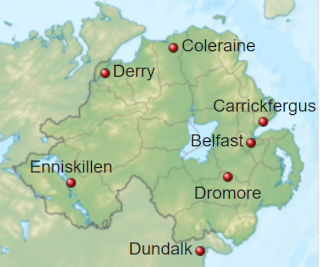
The Break of Dromore takes place on March 14, 1689, near Dromore, County Down in the early stages of the Williamite War in Ireland. It features Catholic Jacobite troops under Richard Hamilton and Protestant Williamite militia led by Hugh Montgomery and Arthur Rawdon.

The Protestant forces are taken by surprise and there is little fighting, reflected in the term “Break,” a Scottish word for rout. Victory secures eastern Ulster for the Jacobites but they fail to fully exploit their success.

While much of the Protestant population of east Ulster supports the claim of William III to thrones of Ireland, England and Scotland, the rest of Ireland, including the Lord Deputy of Ireland, Richard Talbot, 1st Earl of Tyrconnell, and the army, support James II. As a result, war breaks out in Ireland after James is deposed in the Glorious Revolution. At the start of the conflict, the Jacobites are left in control of two fortified positions at Carrickfergus and Charlemont in territory which is predominantly Williamite in sympathy. The local Williamites raise a militia and meet in a council at Hillsborough. They make an ineffective assault on Carrickfergus. However, this is easily beaten off and a local Catholic cleric named O’Hegarty reports that the Williamite are badly armed and trained.

The Jacobite commander in the north is Richard Hamilton, an experienced soldier who serves with the French military from 1671 to 1685, when he is appointed a colonel in the Irish Army. In September 1688, he and his regiment are transferred to England. When James flees into exile, he is held in the Tower of London. Released on parole by William in February, he is sent to negotiate with Talbot but drops this mission once back in Ireland. Alexander Osbourne, a Presbyterian clergyman, is sent to offer the Hillsborough council a pardon in return for surrender but they refuse, reportedly encouraged by Osbourne. On March 8, Hamilton marches north from Drogheda with 2,500 men to subdue the Williamites by force.

On March 14 Hamilton crosses the River Lagan and attacks a 3,000 strong Williamite force under Lord Mount Alexander at Dromore. Alexander’s cavalry falls back in disorder following a charge by the Jacobite dragoons. Seeing this, Hamilton orders a general advance of his infantry and the Williamite foot flee toward Dromore itself. They are overtaken in the village by the Jacobite cavalry and slaughtered, roughly 400 being killed and the rest fleeing for their lives.

Lord Mount Alexander rides to Donaghadee and takes a ship to England, while many other Protestants leave for Northern England or Scotland. Hamilton’s men capture Hillsborough, along with £1,000 and large stocks of food but fail to pursue their opponents. This allows the bulk of the militia under Rawdon and Henry Baker to reach Coleraine, then make their way to Derry, where they take part in the successful defence of the city.


Leave a comment

Birth of Peter Lacy, Irish-born Officer in the Imperial Russian Army

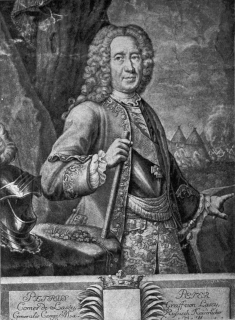
Peter Lacy, Irish-born soldier who later serves in the Imperial Russian Army, is born Pierce Edmond de Lacy into a noble Irish family on September 26, 1678, in Killeedy near Limerick, County Limerick. Considered one of the most successful Russian Imperial commanders before Pyotr Rumyantsev and Alexander Suvorov, in a military career that spans half a century, he claims to have participated in 31 campaigns, 18 battles, and 18 sieges.

At the age of 13, during the Williamite War in Ireland, Lacy is attached to the Jacobite defence of Limerick against the Williamites with the rank of Lieutenant. The Flight of the Wild Geese follows, with him, his father and his brother joining the Irish Brigade in France. After his relatives lose their lives fighting for Louis XIV in Italy, he is induced to seek his fortune elsewhere. After two years of service in the Austrian army, he follows his commander, Charles Eugène de Croÿ, into the Russian service.

Lacy’s first taste of land battle in Russia is the disastrous defeat at Narva, in which he commands a unit of musketeers, holding the rank of poruchik. During the Great Northern War he is seriously wounded on two occasions, also gaining the rank of colonel in 1706. In the same year, Peter the Great gives him command of the Polotskii regiment and three new regiments raising him to colonel status. The following year he leads his brigade at Poltava and in the ensuing battle he greatly distinguishes himself. In the 1708 battle of Rumna, he attacks and captures the headquarters of Charles XII of Sweden. He gains fame at this stage by advising the Czar that musketeers should wait until they were within a few yards of the enemy before opening fire. Prior to this, the Russians were known for uncoordinated fire. From this point begins his fame as a soldier. His next active service, still under Prince Anikita Repnin, is the siege of Riga. He is reputedly the first Russian officer to enter the capital of Livland and he is appointed the first Russian chatelain of Riga Castle in the aftermath.

In 1719, Major General Fyodor Apraksin‘s fleet lands Lacy with 5,000 infantry and 370 cavalry near Umeå in Sweden, where they proceed to devastate a dozen iron foundries and a number of mills. Two years later he leads a similar action against Sundsvall. Soon promoted to General, he enters the Military Collegium, as the Russian Ministry of Defense was then known, in 1723. Three years later, he succeeds Repnin in command of the Russian forces quartered in Livland, and in 1729 he is appointed Governor of Riga. These positions bring him in contact with the Duchess of Courland, who before long ascends the Russian throne as Empress Anna. During her reign, Lacy’s capacity for supreme command is never doubted.

Lacy is one of the first recipients of the Order of Saint Alexander Nevsky when it is established, furthermore, he is given command of all infantries in Saint Petersburg, Ingria and Novgorod. By 1728 he is ranked third of only six full generals in the Russian Army and the only foreigner. As a foreigner, his salary is 3,600 Roubles a year, 15% higher than Russian generals. Higher salaries for foreign-born generals are seen in other ranks too. His signature, even on documents in Cyrillic script, always appear in English and Latin script which suggests he never gains proficiency in the Russian language.

When Catherine is Empress, Lacy is given responsibility for removing Maurice de Saxe from Courland. Saxe had managed to gain support and was even mentioned as marrying Anna, Duchess of Courland.

Having saved her from marriage to Saxe, Anna is very familiar with Lacy, and he becomes one of her most trusted generals. The War of the Polish Succession again calls him into the field. In 1733, he and Burkhard Christoph von Münnich expel the Polish king, Stanisław I, from Warsaw to Danzig, which is besieged by them in 1734. Thereupon the Irishman is commanded to march toward the Rhine and join his 13,500-strong contingent with the forces of Eugene of Savoy. To that end, his corps advances into Germany and, meeting the Austrians on August 16, returns to winter quarters in Moravia with exemplary discipline. In 1734, he commands Russian forces at the Siege of Danzig in which French and Polish forces are defeated. Lacy leads the Russians in two other decisive battles of the conflict, Wisiczin and Busawitza. In the latter battle, he is outnumbered ten to one but nevertheless prevails. For this victory, he is awarded Order of the White Eagle. After Busawitza Lacy is ordered to reinforce the Austrians at Mannheim. however, when he reaches Mannheim peace has been declared. He is received by Emperor Charles and Viennese society. On his return from Vienna, he is met by a courier from Saint Petersburg who delivers to him his patent honouring him as Field Marshal.

With the patent of Field Marshal is the news that Russia is at war with Turkey and Lacy is ordered at once to capture Azov Fortress. This he does despite being wounded in the fray. His rival, Burkhard Christoph von Münnich, had been campaigning in the Crimea with little success. Thus, after taking Azov, Lacy is ordered to capture Crimea. He bridges the Sea of Azov at a narrow point near Perekop. Within four days, aided by favourable winds and tides, his entire army crosses it and begins marching on Arabat. The Russians meet the Khan’s much larger Crimean army and rout them in two battles, on June 12 and 14. In 1738, his corps again land in Crimea and take the fortress of Chufut-Kale near the Khan’s capital, Bakhchisaray. For his success in Poland and Crimea he is awarded the Order of St. Andrew.

As soon as peace has been restored, Lacy is reinstated as the Governor of Livland, while Emperor Charles VI confers on him the title of an imperial count. His indifference to politics prevents his downfall following Anna’s death, when other foreign commanders, most notably von Münnich, fall into disgrace and are expelled from active service.

In December 1741, Elizabeth seizes power. Lacy is roused from bed in the early hours of the morning in a test of his loyalty. He is not aware if the men sent to him are from Elizabeth or Grand Duchess Anna. He is asked what party he is of, Anne or Elizabeth, and he answers, “Of the party of the reigning Empress.” A period of unrest follows, and he is called upon to restore order. Most of what is known as the German Faction falls out of favour at this stage. The restoration of order in Saint Petersburg is largely down to the prompt actions of Lacy.

When the Russo-Swedish War breaks out in 1741, the government of Anna Leopoldovna appoints Lacy Commander-in-Chief as the most experienced among Russian generals. He quickly strikes against Finland and wins his last brilliant victory at Lappeenranta in August 1741. His force, however, is poorly supplied and he is forced to withdraw to Saint Petersburg. The following year he rallies his forces and proceeds to capture Hamina, Porvoo and Hämeenlinna, by August encircling more than 17,000 Swedes near Helsinki and effectively bringing the hostilities to an end.

The war over, Lacy withdraws to Riga and resumes the command of the Russian forces stationed in Livland. He administers what is now northern Latvia and southern Estonia until his death on his private estate in Riga on April 30, 1751. His son, Franz Moritz von Lacy, enters the Austrian service in 1743 and becomes one of the most successful imperial commanders of the 18th century and also a Count of the Holy Roman Empire. His nephew, George Browne, is also a general in the Russian army.


1 Comment

Death of Simon Luttrell, 1st Earl of Carhampton

Simon Luttrell, 1st Earl of Carhampton, Anglo-Irish politician who sits in the House of Commons of Great Britain from 1754 to 1780, dies on January 14, 1787.

Luttrell is born in 1713, the second son of Henry Luttrell, of Luttrellstown Castle (whose family had held Luttrellstown Castle and the demesne and adjoining lands since the land had been granted to Sir Geoffrey de Luterel in about 1210 by King John of England) and his wife Elizabeth Jones. His father is a noted commander in the Jacobite Irish Army between 1689 and 1691. He later receives a pardon from the Williamite authorities and is accused by his former Jacobite comrades of having betrayed them. He is murdered when his sedan chair is attacked in Dublin on October 22, 1717.

Luttrell serves as a Member of Parliament in the House of Commons of Great Britain for four constituencies: Mitchell (1755–1761), Wigan (1761–1768), Weobley (1768–1774) and Stockbridge (1774–1780).

On October 13, 1768, Luttrell is created Baron Irnham of Luttrellstown in the Peerage of Ireland. As his title is an Irish peerage, he is able to keep his seat in the British House of Commons. He is elevated to the title of Viscount Carhampton on January 9, 1781, and is made Earl of Carhampton on June 23, 1785. He lives at Four Oaks Hall, Four Oaks, Sutton Coldfield, from 1751 to 1766.

On January 22, 1735, Luttrell marries Judith Maria Lawes, daughter of Sir Nicholas Lawes, Governor of Jamaica and Elizabeth Cotton (née Lawley), by whom he has eight children:

Luttrell’s rakish behaviour earns him the nickname “King of Hell,” with “Hell” being a district of Dublin notorious for its brothels. He reputedly starts the courtesan Mary Nesbitt in her career by seducing her.

Luttrell dies at Four Oaks, Warwick, England, on January 14, 1787. He is buried at Kingsbury, Warwick, England.


Leave a comment

John Asgill Expelled from the Irish House of Commons

John Asgill, eccentric English writer and newly elected Member of Parliament (MP) for Enniscorthy, is expelled from the Irish parliament on October 11, 1703, on account of a pamphlet he published in Dublin in 1698, arguing that man may pass into eternal life without dying. The pamphlet is burned by the common hangman and he spends much of the rest of his life in prison in England for blasphemy or for matters arising from land speculation in Ireland.

John Asgill is born at Hanley Castle, Worcestershire, England, on March 25, 1659, the son of Edward and Hester Asgill. Little is known of his early life but in 1686 he becomes a student at the Middle Temple and is called to the bar in 1692. He founds the first land bank in 1695 with Nicholas Barbon, which, after proving to be a profitable venture, merges with the land bank of John Briscoe in 1696. However, after profits drop, the bank closes in 1699. He is then elected that year as Member of Parliament for Bramber.

In 1700 Asgill publishes An Argument Proving, that … Man may be Translated, a pamphlet aiming to prove that death is not obligatory upon Christians. Within days of its publication, he leaves England to travel to Ireland, where he hopes to profit from the Williamite confiscation, acting on behalf of individuals affected by the 1699 resumption act. He is reasonably successful but is unable to gain the profits that he had anticipated. He becomes involved in lengthy litigation with the estate of the Jacobite Nicholas Browne, which continues until the early 1730s.

In an attempt to further his interests Asgill enters the Irish House of Commons in 1703, representing Enniscorthy. His Irish parliamentary career is to be short. On September 25, the first day of the session, his pamphlet on death is discussed and voted “wicked and blasphemous” and ordered to be burned by the common hangman. He is allowed to make a personal defence of his work on October 11, but this proves insufficient. He is expelled and the Commons order that “he be forever hereafter incapable of being chosen, returned or sitting a member of any succeeding parliament in this kingdom.”

While in Ireland Asgill is re-elected to the English House of Commons for Bramber in 1702 and so returns to England. On June 12, 1707 he is arrested and imprisoned at Fleet Prison for debt. He claims parliamentary immunity as a member of a current parliament despite the confusion whether the last English parliament and the first Parliament of Great Britain are the same body, and in December the House of Commons agrees. Nevertheless, two days after ordering his release from prison, he is expelled from the Commons both for his religious views and because he is a declared bankrupt.

Asgill falls on hard times and spends the rest of his life imprisoned in the Fleet or within the bounds of the King’s Bench but his zeal as a pamphleteer continues unabated.

Asgill dies on November 10, 1738, in the parish of Southwark, and is survived by his sister Martha.


Leave a comment

Death of Novelist Shan Fadh Bullock

Novelist Shan Fadh Bullock dies in Sutton, Surrey, on February 27, 1935. His works include fourteen novels set in Ulster and he is admired by James Matthew Barrie and Thomas Hardy.

Bullock is born on May 17, 1865 at Inisherk, County Fermanagh just outside the County Cavan border near Belturbet, in what is now Northern Ireland. His father, Thomas Bullock, is a strict man who has eleven children and drives several to emigration because of his stern demeanour. Thomas Bullock works on the Crom Castle estate which runs along the Cavan/Fermanagh border and has both Catholic and Protestant workers. Protestant workers have the prime jobs and are employed as craftsmen and supervisors while Catholics work in the outer area of the estate at unskilled jobs. Folk memories of the Battle of Newtownbutler in 1689 remain long in the memory in the area where up to 1,500 Jacobite troops are hacked down or drowned in Upper Lough Erne when pursued by the Williamite cavalry. Many of the Williamite army is drawn from the local Protestant population.

Bullock is educated at Crom estate primary school run by the Church of Ireland and Farra School near Bunbrosna, County Westmeath. He fails the entrance exams at the University of Dublin. He tries his hand at farming but finds he is not suited. He moves to London in 1883 and becomes a Civil Service clerk. He takes to journalism to supplement his salary and publishes his first book of stories, The Awkward squads, in 1893. His stories are centered on Irish Catholic and Protestant small farmers and labourers and their struggles and tensions. He marries Emma Mitchell in 1899 and they have a son and daughter.

Bullock is well respected in literary circles but his books are never successful enough for him to become a full time writer. He says that the English are not interested in Irish stories and that there is no reading public in Ireland. He dislikes Orange sectarianism and is ambivalent to Irish nationalism. His novel The Red Leaguers looks at sectarianism conflict and Robert Thorne examines the lives of London clerks which is a popular theme at the time. His last and best novel The Loughsiders is published in 1924 and is the story of a conniving smallholder based on William Shakespeare’s Richard III.

Bullock’s wife dies in 1922. He spends the final years of his life in Sutton, Surrey and dies there on February 27, 1935.

Bullock’s daughter presents his literary papers, including two unpublished novels, two plays, numerous short stories and essays, and some correspondence to the Queen’s University Belfast library in the 1960s. A portrait of Bullock by Dermod O’Brien, RHA, is also at Queen’s University Belfast. His correspondence with Sir Horace Plunkett is in the archives of the Plunkett Foundation, Long Hanborough Business Park, Woodstock, Oxfordshire. Enniskillen public library has a collection of cuttings on Bullock, including some photocopied letters.


Leave a comment

The Fall of Athlone

siege-of-athlone

The fall of Athlone occurs on June 30, 1691 during the Williamite War in Ireland. Despite the bravery of legendary Sergeant Custume and others, severely outnumbered, the Connacht side of the town falls. The remainder of the Irish garrison retreats to Limerick.

The first assault on Athlone comes in 1690 after the defeat of the Irish at the Battle of the Boyne. General Douglas, leading a substantial force of possibly ten thousand consisting mostly of Ulster regiments, is the Williamite commander. When he arrives at Athlone he is confident that he will quickly conquer the town for King William III. However, he had not reckoned on the spirited defence of Athlone by Colonel Richard Grace. Grace, who is at that time over seventy years of age and a veteran of the Irish Confederate Wars and Governor of Athlone, refuses to surrender. After a week the Williamite army retreats.

In 1691, determined to capture Athlone, the Williamites return with their full army of almost 25,000 men. The army is under the command of a Dutch general, Goderd de Ginkell. The Jacobite forces are under the command of a French general, the Marquis de St. Ruth. The Williamites breach the town wall and capture the Leinster town. The Jacobites, in a desperate attempt to keep the enemy at bay, break down several arches of the bridge and the Williamites quickly attempt to repair them. Sergeant Custume leads his men onto the bridge to dislodge the Williamite repair work. They succeed in doing so before meeting their death at the hands of enemy fire.

Ironically the capture of Athlone comes when the Williamites discover the ford that gave Athlone its name and in a surprise attack dislodge the Jacobites and take the castle by storm resulting in wholesale carnage and slaughter. For his services to King William III, but certainly not to Athlone, Ginkle is given the title Earl of Athlone. The bravery of Sergeant Custume has not been forgotten as the military barracks in Athlone is called Custume Barracks in his honour, the only barracks in Ireland named after a non-commissioned officer. A street adjoining the town bridge is named Custume Place.


Leave a comment

Birth of Novelist Shan Fadh Bullock

shan-fadh-bullock

Novelist Shan Fadh Bullock is born on May 17, 1865, at Inisherk, County Fermanagh just outside the County Cavan border near Belturbet. His works include fourteen novels set in Ulster and he is admired by James Matthew Barrie and Thomas Hardy.

Bullock’s father, Thomas Bullock, is a strict man who has eleven children and drives several to emigration because of his stern demeanour. Thomas Bullock works on the Crom Castle estate which runs along the Cavan/Fermanagh border and has both Catholic and Protestant workers. Protestant workers have the prime jobs and are employed as craftsmen and supervisors while Catholics work in the outer area of the estate at unskilled jobs. Folk memories of the Battle of Newtownbutler in 1689 remain long in the memory in the area where up to 1,500 Jacobite troops are hacked down or drowned in Upper Lough Erne when pursued by the Williamite cavalry. Many of the Williamite army is drawn from the local Protestant population.

Bullock is educated at Crom estate primary school run by the Church of Ireland and Farra School near Bunbrosna, County Westmeath. He fails the entrance exams at the University of Dublin. He tries his hand at farming but finds he is not suited. He moves to London in 1883 and becomes a Civil Service clerk. He takes to journalism to supplement his salary and publishes his first book of stories, The Awkward squads, in 1893. His stories are centered on Irish Catholic and Protestant small farmers and labourers and their struggles and tensions. He marries Emma Mitchell in 1899 and they have a son and daughter.

Bullock is well respected in literary circles, but his books are never successful enough for him to become a full-time writer. He says that the English are not interested in Irish stories and that there is no reading public in Ireland. He dislikes Orange sectarianism and is ambivalent to Irish nationalism. His novel The Red Leaguers looks at sectarianism conflict and Robert Thorne examines the lives of London clerks which is a popular theme at the time. His last and best novel The Loughsiders is published in 1924 and is the story of a conniving smallholder based on William Shakespeare’s Richard III.

Shan Bullock’s wife dies in 1922. He spends the final years of his life in Sutton, Surrey and dies there on February 27, 1935.


Leave a comment

Coronation of James II as King of England & Ireland

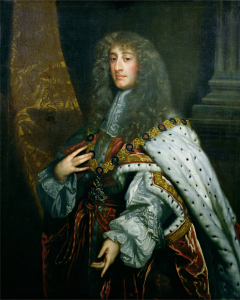
The coronation of James II as King of England and Ireland takes place at Westminster Abbey on April 23, 1685. He is also crowned King of Scotland as James VII. He is the last Roman Catholic monarch of EnglandScotland and Ireland.

The second surviving son of Charles I, James ascends the throne upon the death of his brother, Charles II. There is little initial opposition to his accession, and there are widespread reports of public rejoicing at the orderly succession. The new Parliament that assembles in May 1685, which gains the name of “Loyal Parliament,” is initially favourable to James, and the new King sends word that even most of the former exclusionists will be forgiven if they acquiesce to his rule.

Members of Britain’s Protestant political elite increasingly suspect him of being pro-French and pro-Catholic and of having designs on becoming an absolute monarch. When he produces a Catholic heir, leading nobles call on his Protestant son-in-law and nephew William of Orange to land an invasion army from the Dutch Republic, which he does in the Glorious Revolution of 1688. James flees England and thus is held to have abdicated. He is replaced by his eldest, Protestant daughter Mary and her husband William of Orange.

James makes one serious attempt to recover his crowns from William and Mary when he lands in Ireland in 1689. After the defeat of the Jacobite forces by the Williamites at the Battle of the Boyne in July 1690, James returns to France. He lives out the rest of his life as a pretender at a court sponsored by his cousin and ally, King Louis XIV.

James is best known for his struggles with the English Parliament and his attempts to create religious liberty for English Roman Catholics and Protestant nonconformists, against the wishes of the Anglican establishment. This tension makes James’s four-year reign a struggle for supremacy between the English Parliament and the Crown, resulting in his deposition, the passage of the Bill of Rights, and the accession of his daughter and her husband as king and queen.


Leave a comment

The Siege of Limerick

cittie-of-limerick

Siege of Limerick commences on August 9, 1690, when William of Orange and his army of 25,000 men reach Limerick and occupy Ireton’s fort and Cromwell’s fort outside the city. His siege cannons are still making their way from Dublin with a light escort so all he has available is his field artillery. The siege train is intercepted by Patrick Sarsfield’s cavalry at Ballyneety in County Limerick and destroyed, along with the Williamites‘ siege guns and ammunition. This forces William to wait another ten days before he can start bombarding Limerick in earnest while another siege train is brought up from Waterford.

By this time, it is late August. Winter is approaching and William wants to finish the war in Ireland so he can return to the Netherlands and proceed with the main business of the War of the Grand Alliance against the French. For this reason, he decides on an all-out assault on Limerick.

His siege guns blast a breach in the walls of the “Irish town” section of the city and William launches his assault on August 27. The breach is stormed by Danish grenadiers, but the Jacobite’s French officer Boisseleau has built an earthwork or coupure inside the walls and has erected barricades in the streets, impeding the attackers. The Danish grenadiers, and the eight regiments who follow them into the breach, suffer terribly from musketry and cannon fire at point blank range. Jacobite soldiers without arms and the civilian population, including women, line the walls and throw stones and bottles at the attackers. A regiment of Jacobite dragoons also make a sortie and attack the Williamites in the breach from the outside. After three and a half hours of fighting, William finally calls off the assault.

William’s men suffer about 3,000 casualties, including many of their best Dutch, Danish, German, and Huguenot troops. The Jacobites lose only 400 men in the battle. Due to the worsening weather, William calls off the siege and puts his troops into winter quarters, where another 2,000 of them die of disease. William himself leaves Ireland shortly afterwards, returning to London. He subsequently leaves London to take command of Allied forces fighting in Flanders and leaves Godert de Ginkell to command in Ireland. The following year Ginkell wins a significant victory at the Battle of Aughrim.

Limerick is to remain a Jacobite stronghold until it surrenders after another Williamite siege the following year. Following the loss of this last major stronghold, Patrick Sarsfield leads the army into exile in the Flight of the Wild Geese to the Continent, where they continue to serve the cause of James II and his successors.