seamus dubhghaill

Promoting Irish Culture and History from Little Rock, Arkansas, USA


Leave a comment

Birth of Irish Revolutionary Maud Gonne

maud-gonne

Maud Gonne, Irish revolutionary, romantic muse for William Butler Yeats, and mother to Nobel Peace Prize-winner Seán MacBride, is born at Tongham, England on December 21, 1866.

Gonne is born into a distinguished and wealthy family, and her father serves as an army captain. Her mother dies of tuberculosis when she is a child, and she and her sister are raised and educated by a French nanny. This cosmopolitan upbringing is furthered by travels throughout Europe with her father, then a military attaché.

In 1884, Gonne’s father dies of typhoid fever, and she receives a considerable inheritance. After moving to France to be with her aunt, she meets and falls in love with right wing politician Lucien Millevoye. Though he is already married, he instills Gonne with his political passions. She begins a nearly lifelong fight for Irish freedom from England and the release of political prisoners. She and Millevoye have two children, one of whom survives, before their relationship ends.

Moved by the plight of those evicted in the Land Wars, Gonne continues to campaign for the Irish nationalist cause. While living in Paris, she is introduced to Fenianism by John O’Leary, a veteran of the Young Ireland Rebellion of 1848. In 1889, O’Leary introduces her to a man whose infatuation with her would last most of his life, poet William Butler Yeats. She begins a relationship with Yeats, though she refuses his many marriage proposals. She is the inspiration for many of Yeats’s poems. In 1900, she founds the Daughters of Ireland, which provides a home for Irish nationalist women.

In 1918, Gonne is arrested for being a political agitator. She becomes severely ill in prison and after her release, she begins a crusade for improved conditions for Ireland’s political prisoners. In 1903, she marries Major John MacBride, who had led the Irish Transvaal Brigade against the British in the Second Boer War, in Paris in 1903. After the birth of their son, Seán, Gonne and her husband agree to end their marriage. She demands sole custody of their son but MacBride refuses, and a divorce case begins in Paris on February 28, 1905. The only charge against MacBride substantiated in court is that he was drunk on one occasion during the marriage. A divorce is not granted, and MacBride is given the right to visit his son twice weekly.

The couple’s son, Seán MacBride, is active in politics in Ireland and in the United Nations. He is a founding member and Chairman of Amnesty International and is awarded the Nobel Peace Prize in 1974.

Gonne dies in Clonskeagh on April 27, 1953, at the age of 86 and is buried in Glasnevin Cemetery, Dublin. Maud Gonne’s autobiography, A Servant of the Queen, is published in 1938.
Leave a comment

Annie Moore Departs Queenstown for the United States

annie-moore

Fifteen-year-old Annie Moore departs Queenstown, now Cobh, County Cork, on December 20, 1891, and becomes the first immigrant to the United States to pass through the Ellis Island facility in New York Harbor.

Her parents, Matthew and Julia Moore, had come to the United States in 1888 and are living at 32 Monroe Street in Manhattan. Moore departs from Queenstown aboard the S.S. Nevada, one of 148 steerage passengers. Accompanied by her brothers, Anthony and Philip, she spends twelve days at sea, including Christmas Day, arriving in New York City on Thursday evening, December 31. It is reported that her arrival is on her 15th birthday, but records in Ireland reveal that her birthday is in May, and she is actually seventeen.

Ellis Island officially opens on January 1, 1892, and, as the first person to be processed at the newly opened facility, Moore is presented with an American $10 gold piece from an American official. All three children are soon reunited with their parents in New York. From 1820 to 1920, more than 4 million people leave their native shores of Ireland bound for the Port of New York and a new life in America.

Moore marries a son of German immigrants, Joseph Augustus Schayer, an employee at Manhattan’s Fulton Fish Market, with whom she has at least eleven children. She dies of heart failure on December 6, 1924, and is buried in Calvary Cemetery, Queens. Her previously unmarked grave is identified in August 2006. On October 11, 2008, a dedication ceremony is held at Calvary which celebrates the unveiling of a marker for her grave, a Celtic cross made of Irish Blue Limestone.

The Irish American Cultural Institute presents an annual Annie Moore Award “to an individual who has made significant contributions to the Irish and/or Irish American community and legacy.” Moore’s story is told in the song “Isle of Hope, Isle of Tears,” written by Brendan Graham. The song has been performed by Ronan Tynan and by The Irish Tenors, of which Tynan was formerly a member. Other artists performing the song include Seán Keane, Sean & Dolores Keane, Daniel O’Donnell, Celtic Thunder, Irish tenor Brian Dunphy, Celtic Woman, and Tommy Fleming.

A woman named “Annie Moore” who died near Fort Worth, Texas in 1924 had long been thought to be the one whose arrival marked the beginning of Ellis Island. Further research, however, established that the Annie Moore in Texas was born in Illinois.


Leave a comment

Birth of Eamonn Andrews, Radio & Television Presenter

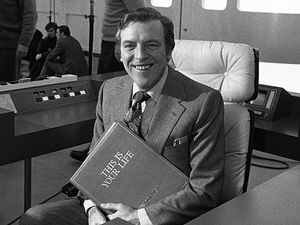
eamonn-andrewsEamonn Andrews, radio and television presenter considered to be Ireland’s first media superstar, is born in Synge Street, Dublin, on December 19, 1922.

Andrews is educated at Synge Street CBS and begans his career as a clerk in an insurance office. He is a keen amateur boxer and wins the Irish junior middleweight title in 1944.

In 1946, he becomes a full-time freelance sports commentator, working for Radio Éireann, Ireland’s national broadcaster. In 1950, he begins presenting programmes for the BBC, being particularly well known for boxing commentaries, and soon becomes one of television’s most popular presenters. He begins hosting the game show What’s My Line? in 1951.

Throughout the 1950s, he commentates on the major British heavyweight fights on the BBC Light Programme, with inter-round summaries by W. Barrington Dalby. On January 20, 1956, he reaches No. 18 in the UK Singles Chart with a “spoken narrative” recording named “The Shifting Whispering Sands (Parts 1 & 2),” which is produced by George Martin with musical backing by the Ron Goodwin Orchestra. The song later reappears on Kenny Everett‘s compilation album The World’s Worst Record Show, which is released in June 1978.

Between 1955 and 1964, Andrews presents the long-running Sports Report on BBC’s Light Programme, now Radio 2. In 1965, he leaves the BBC to join the ITV contractor ABC, where he pioneers the talk show format in the UK. He hosts a chat show on ITV, The Eamonn Andrews Show, for five years. He is known for coming up with off-the-cuff linkings that do not work such as, “Speaking of cheese sandwiches, have you come far?” This is parodied by the character Seamus Android on Round the Horne in the 1960s, performed by Bill Pertwee. In the 1960s he presents Thames Television‘s Today news magazine programme.

Andrews is probably best known as the presenter of the UK’s version of This Is Your Life, between its inception in 1955 and his death in 1987, when he is succeeded by Michael Aspel, who had also succeeded Andrews as host of Crackerjack more than two decades earlier. Andrews becomes the very first This Is Your Life subject on British television when he is surprised by the show’s creator, Ralph Edwards. Andrews also creates a long-running panel game called Whose Baby? that originally runs on the BBC and later on ITV. He is a regular presenter of the early Miss World pageants.

Andrews’ chairs the Radio Éireann Authority, now the RTÉ Board, between 1960 and 1964, overseeing the introduction of State television to Ireland and establishing the Irish State broadcaster as an independent semi-state body. About this time, he also acquires a number of business interests in Ireland, including recording studios and a dance hall.

After months of illness during 1987, originally caused by a virus contracted during an airline flight, but which is not recognised at the time, he dies from heart failure on November 5, 1987, at the age of 64, at Cromwell Hospital, London. He had recorded his last edition of This Is Your Life six days previously on October 30, 1987, surprising Crossroads actress Jane Rossington. After his death, the show, and two others that have yet to be broadcast, are postponed until, with his widow’s permission, they are broadcast in January 1988. His widow, Gráinne, whom he married in 1951, dies 18 months later. They had three adopted children.

His contribution to U.K. radio is commemorated in the The Radio Academy Hall of Fame. Andrews appears as the linking narrator who introduces the unrelated segments that comprise the portmanteau film, Three Cases of Murder (1955).


Leave a comment

Death of Singer & Songwriter Kirsty MacColl

kirsty-maccollKirsty Anna MacColl, English singer and songwriter, dies on December 18, 2000, at the age of 41 after being hit by a powerboat while on holiday in Cozumel, Mexico.

MacColl records several pop hits between the early 1980s and the 1990s, including “There’s a Guy Works Down the Chip Shop Swears He’s Elvis” and cover versions of Billy Bragg‘s “A New England” and The Kinks‘ “Days.” She also sings on recordings produced by her husband Steve Lillywhite, most notably “Fairytale of New York” by The Pogues.

Early in her career, MacColl signs a solo deal with Stiff Records. She moves to Polydor Records in 1981 but they drop her just as she has completed recording the songs for a planned second album. She returns to Stiff Records however, following their 1986 bankruptcy, MacColl is left unable to record in her own right, as no record company buys her contract from the Official Receiver. She has regular session work as a backing vocalist, and she frequently sings on records produced or engineered by her husband including tracks for Robert Plant, The Smiths, Alison Moyet, Shriekback, Simple Minds, Talking Heads, Big Country, Anni-Frid Lyngstad (of ABBA), and The Wonder Stuff among others.

MacColl re-emerges in the British charts in December 1987, reaching Number 2 with The Pogues on “Fairytale of New York,” a duet with Shane MacGowan. This leads to her accompanying The Pogues on their British and European tour in 1988.

After the contract issue is resolved, MacColl returns to recording as a solo artist and receives critical acclaim upon the release of Kite in 1989. While continuing to write and record, she is also featured on the British sketch comedy French and Saunders.

In 2000, following her participation in the presentation of a radio programme for the British Broadcasting Corporation in Cuba, MacColl takes a holiday in Cozumel, Mexico, with her sons and her partner, musician James Knight. On December 18, she and her sons go diving at the Chankanaab reef, part of the National Marine Park of Cozumel, in a designated diving area that watercraft are restricted from entering. With the group is a local veteran divemaster, Iván Díaz. As the group is surfacing from a dive, a powerboat moving at high speed enters the restricted area. MacColl sees the boat coming before her sons. Louis, then 13, is not in its path, but 15-year-old Jamie is. She is able to push him out of the way but in doing so she is struck by the boat and dies instantly. MacColl’s body is repatriated to the United Kingdom and is cremated after a humanist funeral at Mortlake Crematorium in South-West London.

empty-bench-in-soho-squareIn 2001, a bench is placed by the southern entrance to London’s Soho Square as a memorial to MacColl, after a lyric from one of her most poignant songs: “One day I’ll be waiting there / No empty bench in Soho Square.” Every year on the Sunday nearest her October 10 birthday, fans from all over the world hold a gathering at the bench to pay tribute to her and sing her songs.

MacColl’s collaboration with the Pogues, “Fairytale of New York,” remains a perennial Christmas favourite. In 2004, 2005, and 2006, it is voted favourite Christmas song in a poll by music video channel VH1. The song is re-released in the United Kingdom in December 2005, with proceeds being split between the Justice for Kirsty Campaign and charities for the homeless. The re-release reaches number 3 on the U.K. charts, and spends five weeks in the top 75 over the Christmas and New Year period. It reaches the top 10 for the third time in its history in 2006, peaking at number 6, and charts yet again in December 2007. The song also makes the Top 20 in subsequent years, and has spent more time in the top 20 than any other song.


Leave a comment

Last British Troops Leave the Irish Free State

british-troops-leave-ireland

The last British troops leave the Irish Free State on December 17, 1922. They are the remnants of a 5,000 strong garrison maintained up to that point in Dublin, commanded by Nevil Macready.

It appears to be a friendly farewell, even while Ireland is embroiled in its own Civil War. The Union Jack is lowered at the hospital and Macready goes to review the final contingent of troops as they leave the Royal barracks, later known as the Collins barracks. He then motors to Kingstown, now Dún Laoghaire, where he receives a 17-gun salute and joins Admiral Cecil Fox, the Sligo-born naval commander in the area, on board the cruiser HMS Dragon to sail home to England and retirement.

Meanwhile, the troops, 3,500 men mostly from the Leicester, Worchester, and Border regiments, march to the port. At Beresford Place they are greeted by 500 members of the Legion of Irish Ex-Servicemen, in civilian clothes but wearing their decorations. Thousands of other people line the quays and the armoured cars and the Dublin Metropolitan Police stand by, but there is no trouble. Embarkation onto six ships begins around 1:15 PM. At 3:10 PM, the last ship to leave, the steamer Arvonia chartered from the London and North Western Railway, weighs anchor while a band on deck plays “God Save the King” and a crowd breaks into the North Wall Extension to wave a final farewell as it enters Alexandra Basin.

The armoured cars them drive north to Ulster and the evacuation of the Irish Free State, apart from the Treaty ports, is over. General Richard Mulcahy, who takes over the Royal barracks that day, claims “the incubus of occupation that has lain as a heavy hand on the country for years has been removed.”

In his memoirs, Macready expresses annoyance that a photograph of Fox and himself published in The Irish Times on December 18 has the caption “two gallant Irishmen.” Although he has an Irish grandfather, he cordially loathes Ireland.

The British leave fully outfitted barracks to the Irish Army and artifacts including a large card in the Headquarters in Parkgate Street printed with the admonition “LOVE ONE ANOTHER.”


2 Comments

Birth of John Gubbins, Racehorse Breeder & Owner

john-gubbins

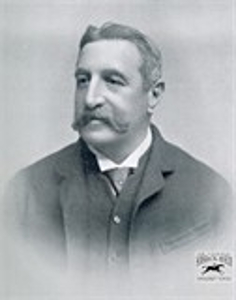
John Gubbins, breeder and owner of racehorses, is born on December 16, 1838 at the family home in Kilfrush, County Limerick. He is fourth son of Joseph Gubbins by his wife Maria, daughter of Thomas Wise of Cork.

Of three surviving brothers and five sisters, the third brother, Stamer, breeds horses at Knockany after distinguishing himself in the Crimean War. He dies at the age of 46 on August 7, 1879, after a horse falls on him while “schooling” over fences.

John Gubbins, after being educated privately, inherits the Knockany property from his brother and purchases the estate of Bruree, County Limerick. A fortune is also left him by an uncle, Francis Wise of Cork. Settling at Bruree in 1868, he builds kennels and stables and purchases horses and hounds. He hunts the Limerick country with both stag and fox hounds, and is no mean angler, until forced to stop by the operations of the Land League in 1882.

From his youth he takes a keen interest in horse racing. At first his attention is mainly confined to steeplechasers, and he rides many winners at Punchestown Racecourse and elsewhere in Ireland. He is the owner of Seaman when the horse wins the grand hurdle race at Auteuil, but sells him to Lord Manners before he wins the Grand National at Liverpool in 1882. Usna is another fine chaser in his possession. Buying the stallions Kendal and St. Florian, he breeds, from the mare Morganette, Galtee More by the former and Ard Patrick by the latter. Galtee More wins the 2000 Guineas Stakes and the St. Leger Stakes as well as the Epsom Derby in 1897, and is afterwards sold to the Russian government who later pass him on to the Prussian government. The Prussian government also purchases Ard Patrick just days before he wins the Eclipse Stakes in 1903, when he defeats Sceptre and Rook Sand after an exceptionally exciting contest.

Other notable horses bred by John Gubbins are Blairfinde, winner of the Irish Derby, and Revenue. In 1897 he heads the list of winning owners and is third in the list in 1903. In 1903 Gubbins is rarely seen on a racecourse due to failing health and sells his horses in training. In 1905, however, his health apparently improving, he sends some yearlings to Cranborne, Dorset, to be trained by Sir Charles Nugent, but before these horses can run he dies of bronchitis at Bruree on March 20, 1906.  His final instructions are, “As I aspired to breed fast horses, please see that my hearse is pulled at speed on my final journey.” Gubbins is buried in the private burial ground at Kilfrush.

In 1889 he marries Edith, daughter of Charles Legh, of Addington Hall, Cheshire. She predeceases him without issue. His estates pass to his nephew, John Norris Browning, a retired naval surgeon.


1 Comment

Execution of “Half-Hanged MacNaghten”

half-hanged-macnaghten

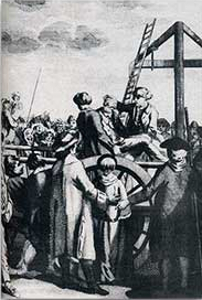
John MacNaghten, Anglo-Irish land owner, gambler, and convicted murderer also known as “Half-Hanged MacNaghten,” is hanged at Strabane jail on December 15, 1761, for his involvement in the killing of Mary Anne Knox, daughter of Andrew Knox MP.

MacNaghten is born into a landed Anglo-Irish family and attends Raphoe Royal school in County Donegal. In 1740, he inherits his family estate worth £500 a year and that same year enters Trinity College, Dublin. MacNaghten marries the sister-in-law of the first earl of Massereene. However, he is quickly enamoured of the extravagant lifestyle of Ascendancy Dublin where he becomes a popular and colourful character. He develops an addiction to gambling and squanders away a large part of his inheritance, running up substantial gaming debts and by 1750 is threatened with arrest.

Following the death of his wife in childbirth, he is appointed to the lucrative post of tax collector for Coleraine but gambles away £800 of the King’s money. His estate is sequestered and by 1760 he is penniless.

He gains support trying to help overcome his addiction from a childhood friend, Andrew Knox. Knox is a wealthy land-owner and Member of Parliament (MP) for Donegal who lives on an estate at Prehen about two miles outside the city of Derry. Mary Ann, Knox’s 15-year-old daughter, is already a substantial heiress, having received some £6,000, and would collect a further legacy if her brother dies without issue. MacNaghten and Mary Ann develop a relationship as the former visits Prehen regularly. Nonetheless by 1761 their relationship has run into difficulties.

The practice of abduction and marriage is prevalent in 18th century Ireland among young men of social standing but with little property and, within their society, it is tolerated. So, on November 10, 1761, MacNaghten and his followers attempt to abduct Mary Ann from a carriage on a family journey to Dublin Parliament with the intention of eloping with her. The attempt fails miserably as MacNaghten shoots and mortally wounds her by mistake. He is taken to Lifford Courthouse in County Donegal, where a court finds MacNaghten guilty of murder and he is sentenced to execution by hanging.

At Strabane jail on December 15, 1761, MacNaghten hurls himself from the gallows with such force that the rope breaks. He has the sympathy of the crowd who believe this is divine intervention for a man distraught with grief over the death of his love. Despite the belief that MacNaghten could not be hanged a second time, he fails to use the cover of a sympathetic crowd to make good his escape. Rather he defies the public mood of the people with the never-to-be-forgotten words, “I vow that no one will ever speak of me as Half-Hanged MacNaghten.” He returns himself to the jurisdiction of the hangman and, with a new rope, is dispatched into the arms of eternity.

John McNaghton is buried at Patrick Street graveyard, Strabane, County Tyrone.


1 Comment

Death of Grace Evelyn Gifford Plunkett

grace-gifford-plunkett

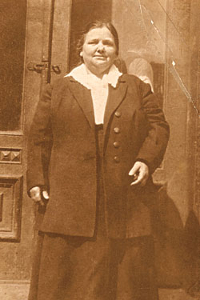
Grace Evelyn Gifford Plunkett, Irish artist and cartoonist who is active in the Republican movement, dies suddenly in her apartment in South Richmond Street, Portobello, Dublin, on December 13, 1955.

Gifford is the second youngest of twelve children born to Frederick Gifford, a solicitor and Roman Catholic, and Isabella Julia Burton Gifford, a Protestant. She grows up in the fashionable suburb of Rathmines in Dublin. The boys are baptised as Catholics and the girls as Protestant, but effectively the children are all raised as Protestants. The girls attend Alexandra College in Earlsfort Terrace, and the boys attend the The High School in Harcourt St.

At the age of 16, Gifford enters the Dublin Metropolitan School of Art, where she studies under the Irish artist William Orpen. Orpen regards Gifford as one of his most talented pupils. He often sketches her and eventually paints her as one of his subjects for a series on “Young Ireland.” Around this time, Gifford’s talent for caricature is discovered and developed. In 1907 she attends a course in Fine Art at the Slade School of Fine Art, London.

Gifford returns to Dublin in 1908 and, with great difficulty, attempts to earn a living as a caricaturist, publishing her cartoons in The Shanachie, Irish Life, Meadowstreet, and The Irish Review, which is edited from 1913 by Joseph Plunkett. She considers emigrating but gives up the idea. Later that year, she meets Plunkett for the first time at the opening of St. Edna’s School, a new bilingual school in Ranelagh, Dublin. Plunkett is a friend of her brother-in-law, another of the future leaders of the 1916 Easter Rising, Thomas MacDonagh, who is married to Gifford’s sister Muriel.

Her growing interest in the Roman Catholic religion leads to the deepening of Gifford and Plunkett’s relationship. Plunkett proposes to her in 1915. She accepts and takes formal instruction in Catholic doctrine. She is received into the Catholic Church in April 1916. The couple plan to marry on Easter Sunday that year, in a double wedding with his sister and her fiancé.

After the Rising, her brother-in-law Thomas MacDonagh is executed by firing squad along with Patrick Pearse and Thomas Clarke on May 3. That same day, Gifford learns that Plunkett is to be shot at dawn. She purchases a ring in a jeweler’s shop in Dublin city centre and, with the help of a priest, persuades the military authorities to allow them to marry. She and Plunkett are married on the night of May 3, 1916, in the chapel of Kilmainham Gaol, a few short hours before he is executed.

Grace Plunkett decides to devote herself through her art to the promotion of Sinn Féin policies and resumes her commercial work to earn a living. She is elected to the Sinn Féin executive in 1917.

During the Irish Civil War, Plunkett is arrested with many others in February 1923 and interned at Kilmainham Gaol for three months. She is released in May 1923.

When the Civil War ends, Plunkett has no home of her own and little money. Like many Anti-Treaty Republicans, she is the target of social ostracism and has difficulty finding work. She moves from one rented apartment to another and eats in the city-centre restaurants. She befriends many people and has many admirers but has no wish to remarry. Her material circumstances improve in 1932 when she receives a Civil List pension from Éamon de Valera‘s Fianna Fáil government. She lives for many years in a flat in Nassau St. with a balcony overlooking the sports ground of Trinity College.

Plunkett’s in-laws refuse to honour her husband’s will, which leaves everything to his widow. Legally, the will is invalid because there is only one of the required two witnesses and also the marriage takes place after the will is made, automatically revoking it. She begins legal proceedings against her in-laws in 1934. The Count and Countess Plunkett settle out of court and Plunkett is paid £700, plus costs.

From the late 1940s onwards, Plunkett’s health declines. In 1950 she is brought to St. Vincent’s Hospital, then in the city centre. She convalesces in a nursing home, which she does not like because it restricts her freedom.

After her sudden death on December 13, 1955, Grace Gifford Plunkett’s body is removed to St. Kevin’s Church, Harrington Street, and among the attendees at her funeral is President Seán T. O’Kelly. She is buried with full military honours near the republican plot in Glasnevin Cemetery.

Grace Gifford Plunkett is the subject of “Grace,” a song written in 1985 by Frank and Seán O’Meara, which becomes popular in Ireland and elsewhere and has been recorded by many musicians.


Leave a comment

Birth of Gerald Griffin, Novelist & Playwright

gerald-griffin

Gerald Griffin, Irish novelist, poet, and playwright, born in Limerick on December 12, 1803.

Griffin is the twelfth of the fifteen surviving children in his family. His father, Patrick Griffin, is a brewery farmer, and his mother, Ellen Griffin, of the ancient Gaelic family of the O’Briens, is very cultivated and much interested in literature.

Griffin goes to London in 1823 and becomes a reporter for one of the daily papers. He later turns to writing fiction. One of his most famous works is The Collegians, a novel based on a trial he has reported on, that of John Scanlan, a Protestant Anglo-Irish man who murdered Ellen Hanley, a young Irish Catholic girl. The novel is adapted to the stage as The Colleen Bawn, by Dion Boucicault.

In September 1838, Griffin informs his family of his intention of joining the Congregation of Christian Brothers. He enters the novitiate at North Richmond Street, Dublin, on September 8. He embarks on his new career with intense dedication, abandoning his literary work entirely. He is then admitted to the religious habit on the feast of St. Theresa and embarks on a two-year novitiate. His distaste for his earlier vocation is allayed to the extent that he is willing to undertake the composition of a few tales of a pious nature, but he is also desperately determined to avoid as much as possible the renewal of old contacts and the reopening of painful associations. Griffin burns most all of his unpublished manuscripts, preserving only a few poems and the tragedy, Gisippus.

Griffin dies at the North Monastery, Cork, from typhus fever on June 12, 1840. He is buried in the community’s graveyard on June 15.

Gerald Griffin has a street named after him in Limerick City and another in Cork City. Loughill/Ballyhahill GAA club in west Limerick plays under the name of Gerald Griffins.