seamus dubhghaill

Promoting Irish Culture and History from Little Rock, Arkansas, USA


Leave a comment

Death of Vincent “Mad Dog” Coll, Mob Hitman

vincent-mad-dog-coll

Vincent “Mad Dog” Coll, born Uinseann Ó Colla, Irish American mob hitman in the 1920s and early 1930s in New York City, dies on February 8, 1932.

Coll is born in Gweedore, County Donegal, on July 20, 1908. When he is not quite one year old, the Coll family emigrates to New York in search of a better life. At age 12, he is sent to a reform school. After being expelled from multiple Catholic reform schools, he joins The Gophers street gang. He joins up with Dutch Schultz‘s gang and quickly rises through the ranks. By the late 1920s he is working as an armed guard for the illegal beer delivery trucks of Schultz’s mob.

Coll is a loose cannon, and Schultz soon grows tired of his reckless behavior. In 1929, Coll robs a dairy in the Bronx of $17,000 without Schultz’s permission. When Schultz confronts him about the robbery, rather than being apologetic, Coll demands he be made an equal partner.

By January 1930 Coll has formed his own gang and is engaged in a shooting war with Schultz. One of the earliest victims is Peter Coll, shot dead on May 30, 1931, while driving down a Harlem street. Coll goes into a rage of grief and vengeance. Over the next three weeks he guns down four of Schultz’s men. In all, around 20 men are killed in the bloodletting. The exact figure is hard to pin down as New York is also in the midst of the vicious Castellammarese War at the same time. It is mayhem on the streets of Manhattan and the police often have difficulty in deciding which corpse belongs to which war.

On July 28, 1931, Coll allegedly participates in a kidnapping attempt that results in the shooting death of a child. His target is bootlegger Joseph Rao, a Schultz underling who is lounging in front of a social club. Several children are playing outside a nearby apartment house. A large touring car pulls up to the curb, and several men point shotguns and submachine guns towards Rao and start shooting. Rao throws himself to the sidewalk, however, and four young children are wounded in the attack. One of them, five-year-old Michael Vengalli, later dies at Beth David Hospital. After the Vengalli killing, New York City Mayor Jimmy Walker dubs Coll a “Mad Dog”.

On October 4, 1931, after an extensive manhunt, New York police arrest Coll at a hotel in the Bronx. He surrenders peacefully. On October 5, a grand jury in New York city indicts Coll in the Vengalli murder. The trial begins in December 1931. He retains famed defense lawyer Samuel Leibowitz. The prosecution case soon falls apart. At the end of December, the judge issues a directed verdict of not guilty.

It was said that both Dutch Schultz and Owney Madden put a $50,000 bounty on Coll’s head. On February 1, 1932, four or five gunmen invade a Bronx apartment which Coll is rumored to frequent and open fire with pistols and submachine guns. Three people, Coll gangsters Patsy Del Greco and Fiorio Basile and bystander Emily Tanzillo, are killed. Three others are wounded. Coll himself does not show up until 30 minutes after the shooting.

At 12:30 AM on February 8, one week after the Bronx shootings, Coll is using a phone booth at a drug store at Eighth Avenue and 23rd Street in Manhattan. He is reportedly talking to Madden, demanding $50,000 from the gangster under the threat of kidnapping his brother-in-law. Madden keeps Coll on the line while it is traced. Three men in a dark limousine soon arrive at the drug store. While one waits in the car, two others step out. One man waits outside while the other walks inside the store. The gunman tells the cashier to stay calm, draws a Thompson submachine gun from under his overcoat and opens fire on Coll in the glass phone booth. He dies instantly. The killers take off in their car and are chased unsuccessfully up Eighth Avenue.

A total of 15 bullets are removed from Coll’s body at the morgue and even more may have passed through him. He is buried next to his brother Peter at Saint Raymond’s Cemetery in the Bronx. Dutch Schultz sends a floral wreath bearing a banner with the message, “From the boys.”

Leave a comment

Cranberries Single to Benefit Chernobyl Children

hewson-roche-o-riordan-2002Irish rock band The Cranberries announce on February 7, 2002 that proceeds from their new single, Time Is Ticking Out, will be donated to the Chernobyl Children Project International.

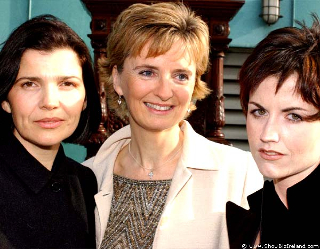
The band’s lead singer, Dolores O’Riordan, is joined by the project’s executive director and founder, Adi Roche, and patron Ali Hewson, wife of U2 frontman Bono, at the Clarence Hotel, Dublin, to make the announcement.

O’Riordan explains how she wrote the song in the Spring of 2001 after she had seen the children of Chernobyl. Having just given birth to her second child, the pictures of children born with so many illnesses moved her to tears, she said.

She says it is her hope that, as well as funds, the single will help raise awareness about the plight of the Chernobyl children. The band’s previous offering, Analyse, sold over 175,000 copies worldwide as of 2002.

Thanking the Cranberries, Roche says the song’s title is appropriate as the health problems caused by the Chernobyl nuclear disaster of April 26, 1986, are only beginning to emerge.

She says the effects are moving to the “next generation who are now witnessing soaring levels of infertility and genetic changes, especially among those who were less than six years of age when the accident happened.”

Founded in 1991, the Chernobyl Children Project International, now known as Chernobyl Children International, is an Irish charity that works to help the children who are living victims of the nuclear disaster. As of February 2002, it had sent €24 million in aid to the region.

(From “Cranberries single to benefit Chernobyl children”, The Irish Times, Thursday, February 7, 2002 | Pictured: (L to R) Ali Hewson, Adi Roche, and Dolores O’Riordan at the Clarence Hotel, February 7, 2002)


Leave a comment

Birth of Margo, Irish Country Music Singer

margaret-catherine-o-donnell

Irish singer Margo, born Margeret Catherine O’Donnell, is born on February 6, 1951 in County Donegal. She rises to prominence during the 1960s in the Irish country music scene and has had an extensive career since.

Margo is brought up in the small village of Kincasslagh, in The Rosses area of County Donegal. She grows up in a Catholic family, with her parents Francis and Julia (née McGonagle) O’Donnell, and her siblings: John, Kathleen, James, and Daniel, who is also a singer. Her father dies of a heart attack when she is a young woman.

Margo starts performing country music at a very young age in 1964 with a local showband, The Keynotes. She records her first single in 1968, Bonny Irish Boy/Dear God, which is a success as is her second single, If I Could See the World Through the Eyes of a Child/Road By the River, released in 1969. She has been a successful singer for five decades and has sold more than 1,000,000 records to date. She has performed with Johnny Cash, Loretta Lynn and Dolly Parton. She presents numerous TV shows for RTÉ in the 1970s and has collected many awards during her career.

Margo is sister to Irish singer Daniel O’Donnell, who got his start with Margo’s band in the early 1980s while attending college in Galway. Margo is named “2007 Donegal Person Of The Year” and spends most of 2007 traveling Ireland acting as an ambassador to her native county. She makes her home in Castleblayney, County Monaghan, where she has lived for several decades along with her partner.

Since 1977, Margo has been active in the search for Mary Boyle, a distant relative from Kincasslagh, who went missing at age six near Ballyshannon, County Donegal.


Leave a comment

Cumann na mBan Rejects Anglo-Irish Treaty

cumann-na-mban

Cumann na mBan (Irishwomen’s Council), at the behest of Constance Markievicz, votes overwhelmingly to reject the Anglo-Irish Treaty on February 5, 1922. During the Irish Civil War, over 400 members of the movement are arrested by the Irish Free State Government.

Cumann na mBan is an Irish republican women’s paramilitary organisation formed in Dublin on April 2, 1914, merging with and dissolving Inghinidhe na hÉireann and, in 1916, it becomes an auxiliary of the Irish Volunteers. Although it is otherwise an independent organisation, its executive is subordinate to that of the Volunteers.

On January 7, 1922 the Anglo-Irish Treaty is approved by the Second Dáil by a close vote of 64–57. On February 5 a convention is held to discuss this, and 419 Cumann na mBan members vote against as opposed to 63 in favour. In the ensuing Civil War, its members largely support the anti-Treaty Republican forces. Over 400 of its members are imprisoned by the forces of the Provisional government which becomes in December 1922 the Irish Free State. Some of those who support the Treaty change the name of their branches to Cumann na Saoirse, while others retain their name but give allegiance to the Free State Government.

Cumann na mBan continues to exist after the Treaty, forming (alongside Sinn Féin, the Irish Republican Army, Fianna Éireann and other groups) part of the Irish republican milieu. The government of the Irish Free State bans the organisation in January 1923 and opens up Kilmainham Gaol as a detention prison for suspect women.

Its membership strength is adversely affected by the many splits in Irish republicanism, with sections of the membership resigning to join Fianna Fáil, Clann na Poblachta and other parties. Máire Comerford, a lifelong member from 1914, reflects in later years that it became a “greatly weakened organisation” that “gathered speed downhill” from the founding of Fianna Fáil in 1926.


Leave a comment

Death of Robert Hobart, 4th Earl of Buckinghamshire

robert-hobart-4th-earl-of-buckinghamshire

Robert Hobart, 4th Earl of Buckinghamshire and former Member of Parliament (MP) for Portarlington and Armagh Borough, dies from a fall from his horse in St. James’s Park, London on February 4, 1816. He is styled Lord Hobart from 1793 to 1804.

Hobart is born at Hampden House on May 6, 1760, the son of George Hobart, 3rd Earl of Buckinghamshire and Albinia, daughter of Lord Vere Bertie, younger son of Robert Bertie, 1st Duke of Ancaster and Kesteven. He is educated at Westminster School, London, and later serves in the American Revolutionary War. He acts as aide-de-camp to successive lord lieutenants of Ireland from 1784 onwards.

Hobart is a Member of Parliament (MP) in the Irish House of Commons for Portarlington from 1784 to 1790 and thereafter for Armagh Borough from 1790 to 1797. He sits also in the House of Commons of the United Kingdom for the rotten borough of Bramber in 1788, a seat he holds until 1790, and then for Lincoln from 1790 to 1796. In 1793 he is invested a member of the Privy Council, and appointed Governor of Madras. In 1798 he is recalled to England by the President of the Board of Control responsible for Indian affairs, Henry Dundas, and summoned to the House of Lords through a writ of acceleration in his father’s junior title of Baron Hobart.

Hobart later serves as Secretary of State for War and the Colonies from 1801 to 1804 when it is said he had “a better grasp of the local or colonial conditions, and a more active spirit than did some of his successors.” He is Chancellor of the Duchy of Lancaster in 1805 and again in 1812, Postmaster General from 1806 to 1807 and President of the Board of Control from 1812 to 1816. Hobart, the capital of Tasmania, is named after him.

Hobart marries firstly Margaretta, daughter of Edmund Bourke, in 1792. They have one son, who dies in infancy, and a daughter, Lady Sarah, who marries Prime Minister Lord Goderich and is the mother of George Robinson, 1st Marquess of Ripon. After Margaretta’s death in 1796 he marries secondly the Hon. Eleanor Agnes, daughter of William Eden, 1st Baron Auckland, in 1799. There are no children from this marriage.

Robert Hobart dies at Hamilton Place, London, on February 4, 1816 at the age of 55, after falling from his horse. He is succeeded in the earldom by his nephew, George. Lady Buckinghamshire dies in October 1851, at the age of 74.


Leave a comment

Laying of the Foundation Stone of Parliament House

parliament-house

The foundation stone of Parliament House in College Green is laid on February 3, 1729, by Thomas Wyndham, 1st Baron Wyndham, the Lord Chancellor of Ireland. Parliament House is initially home to the Parliament of Ireland and later houses the Bank of Ireland. It is the world’s first purpose-built bicameral parliament house. The current parliament building is Leinster House.

The building is home to the two Houses of Parliament, serving as the seat of both chambers, the House of Lords and House of Commons, of the Parliament of the Kingdom of Ireland for most of the 18th century until that parliament is abolished by the Acts of Union 1800, when Ireland becomes part of the United Kingdom of Great Britain and Ireland.

In the 17th century, parliament settles at Chichester House, a town house in Hoggen Green (later College Green) formerly owned by Sir George Carew, Lord President of Munster and Lord High Treasurer of Ireland, which had been built on the site of a nunnery disbanded by King Henry VIII at the time of the dissolution of the monasteries. Carew’s house, named Chichester House after its later owner Sir Arthur Chichester, is a building of sufficient importance to have become the temporary home of the Kingdom of Ireland’s law courts during the Michaelmas law term in 1605. Most famously, the legal documentation facilitating the Plantation of Ulster is signed there on November 16, 1612.

Chichester House is in a dilapidated state, allegedly haunted and unfit for official use. In 1727 parliament votes to spend £6,000 on a new building on the site. It is to be the world’s first purpose-built two-chamber parliament building.

The then ancient Palace of Westminster, the seat of the English before 1707 and, later, British Parliament, is a converted building. The House of Commons‘s odd seating arrangements is due to the chamber’s previous existence as a chapel. Hence MPs face each other from former pews.

The design of the new building, one of two purpose-built Irish parliamentary buildings (along with Parliament Buildings, Stormont), is entrusted to an architect, Edward Lovett Pearce, who is a member of parliament and a protégé of the Speaker of the Irish House of Commons, William Conolly of Castletown House. During construction, Parliament moves into the Blue Coat Hospital on Dublin‘s Northside.

The original, domed House of Commons chamber is destroyed by fire in the 1790s, and a less elaborate new chamber, without a dome, is rebuilt in the same location and opened in 1796, four years before the Parliament’s ultimate abolition.

Pearce’s designs come to be studied and copied both at home and abroad. The Viceregal Apartments in Dublin Castle imitate his top-lit corridors. The British Museum in Bloomsbury in London copies his colonnaded main entrance. His impact reaches Washington, D.C., where his building, and in particular his octagonal House of Commons chamber, is studied as plans are made for the United States Capitol building. While the shape of the chamber is not replicated, some of its decorative motifs are, with the ceiling structure in the Old Senate Chamber and old House of Representatives chamber (now the National Statuary Hall) bearing a striking resemblance to Pearce’s ceiling in the House of Commons.

(Pictured: Architectural drawing of the front of Parliament House by Peter Mazell based on the drawing by Rowland Omer, 1767)


Leave a comment

Birth of James Joyce, Novelist, Short Story Writer & Poet

james-joyce

James Augustine Aloysius Joyce, Irish novelist, short story writer, and poet, is born in 41 Brighton Square, Rathgar, Dublin on February 2, 1882. He contributes to the modernist avant-garde and is regarded as one of the most influential and important authors of the 20th century.

Joyce is one of the ten children of Mary Jane “May” Murray and John Stanislaus Joyce, a professional singer and later rate-collector from a bourgeois Catholic family. He attends Clongowes Wood College, a Jesuit boarding school, until 1891, when his father’s financial worries mean they can no longer afford to send him there. He is temporarily home-schooled and spends a short time at a Christian Brothers school, before starting at Belvedere College, a Jesuit day school run by his old Clongowes headmaster, Father John Conmee.

Much of Joyce’s childhood is influenced by his charismatic, but increasingly alcohol-dependent and difficult father, whose ongoing financial troubles led to regular domestic upheaval. However, John Joyce’s passions, eccentricities, as well as his gift as a singer are celebrated in his son’s work. The death of the Irish Home Rule movement leader Charles Stewart Parnell in 1891 is a watershed moment in Joyce’s life and is the subject of an inflammatory argument during a Christmas dinner, in which John Joyce and his friend John Kelly passionately defend Parnell from the accusations of the pious Elizabeth Conway. Joyce recreates the scene in A Portrait of the Artist as a Young Man, portraying Kelly’s character, Mr. Casey, crying loudly with a “sob of pain,” “Poor Parnell! … My dead king!”

Joyce attends University College Dublin in 1899-1902, where he studies modern languages, with Latin and logic. In 1902 he goes to Paris with an intent of studying medicine but discovers, on arrival, that he does not have the necessary qualifications. He constantly struggles for money, relying on irregular work as a teacher, bank employee, cinema-owner and tweed-importer, and on patrons and supporters such as Harriet Shaw Weaver and Ezra Pound.

Joyce returns to Ireland in 1903 after his mother falls ill. She dies in August 1903. He refuses to take the sacraments or kneel at her deathbed, and the guilt he later feels is depicted in Ulysses when the ghost of Stephen’s mother returns to haunt him. On June 16, 1904, he meets Nora Barnacle, the woman with whom he spends the rest of his life. By autumn, he is convinced of the impossibility of remaining in Ireland and persuades Nora to travel with him. They arrive in Paris on October 9, 1904. He would not return to Ireland to live. He cultivates a sense of himself as an exile, living in Trieste, Zürich, Rome and Paris.

Joyce’s first publication in 1907 is the poetry collection Chamber Music. When he sends Pound a revised first chapter of Portrait of an Artist as a Young Man, along with the manuscript of his short story collection Dubliners, Pound arranges for Portrait to be published serially in the modernist magazine The Egoist between 1914 and 1915. His short story collection, Dubliners, had been delayed by years of arguments with printers over its contents, but is also published in 1914.

Joyce then begins work on Ulysses, an experimental account of a single day in Dublin. The novel is serialised between 1918 and 1920, but full publication is delayed due to problems with American obscenity laws. The work is finally published in book form by his friend Sylvia Beach in Paris in 1922. His play Exiles is first performed in German in 1919, and English in 1926. His last novel, Finnegans Wake (1939), is an innovative language experiment that contains over 40 languages and a huge variety of popular and arcane references.

On January 11, 1941, Joyce undergoes surgery in Zürich for a perforated duodenal ulcer. He falls into a coma the following day. He awakes at 2:00 AM on January 13, 1941, and asks a nurse to call his wife and son, before losing consciousness again. They are en-route when he dies 15 minutes later, less than a month short of his 59th birthday. He is buried in the Fluntern Cemetery, Zürich.


Leave a comment

Ahern Meets Paisley in County Antrim

paisley-and-ahern-2008

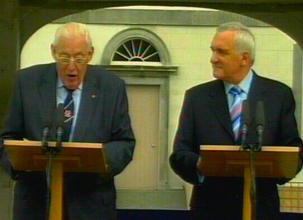
Taoiseach Bertie Ahern visits Ballymena on February 1, 2008, to meet Northern Ireland First Minister Ian Paisley in his County Antrim constituency. Paisley says the Taoiseach’s visit to north Antrim is a historic day, and Ahern says his visit is another tangible benefit of the ongoing peace process.

Ahern and Paisley discuss political and economic developments in Northern Ireland and increasing cross-Border co-operation. The Taoiseach says he is honoured to visit the north Antrim heartland of the Democratic Unionist Party (DUP) leader.

“I do not believe even a year back it could have been envisaged we would have been together here,” Ahern says. “It is an honour to be here with the First Minister to talk about progress.”

Paisley jokes that Ahern and his entourage had held a prayer meeting in their helicopter hoping that they would not be pelted with snowballs by him, a reference to his famous protest when former Taoiseach Seán Lemass visited Stormont in 1965.

When asked about welcoming the Fianna Fáil leader to his constituency Paisley quips, “What I am saying is he is in under my control. This is a good day for work. It is a good day for our province. It is a good day for the whole of Ireland because we need help from outside. We cannot live on our own.”

Ahern and Paisley meet again the following week at the Dublin Chamber of Commerce AGM dinner where Paisley has been invited to be a guest speaker.

The engagement is the latest visit to the Republic by the DUP leader since the Assembly was restored in Stormont the previous May. The Taoiseach invites Paisley to the historic Battle of the Boyne battle site in County Louth in July where the DUP leader presents a 17th-century musket to Ahern.

In October 2007, Paisley addresses the Trinity College Historical Society in Dublin and also attends an event in the Royal College of Physicians of Ireland in the city in November.

(From The Irish Times, Friday, February 1, 2008)