seamus dubhghaill

Promoting Irish Culture and History from Little Rock, Arkansas, USA


Leave a comment

Birth of “Jem” Finer, Founding Member of The Pogues

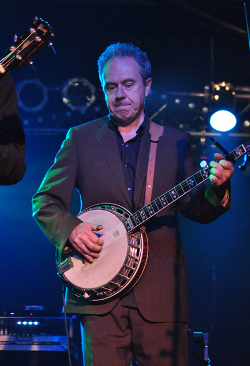
jem-finerJeremy Max “Jem” Finer, English musician, artist, composer, and one of the founding members of The Pogues, is born in Stoke-on-Trent, England on July 20, 1955.

After college at Keele University, Finer travels around Europe and spends some time working on a barge in France. He settles in London and becomes the bass player in a group called The Petals and lives in 32 Burton Street, a house which he sometimes shares with Spider Stacey and Shane MacGowan. Together with James Fearnley they found The Pogues. Primarily a banjoist, he also plays other instruments, including mandola, saxophone, hurdy-gurdy, and the guitar. Apart from Shane MacGowan, Finer is the most prolific composer for the band.

Finer appears on all the band’s albums until their breakup in 1996. He continues working as a musician and composer after leaving The Pogues.

On January 1, 2000, the Finer-composed Longplayer piece of music is started and is designed to last 1,000 years without ever repeating itself. It currently exists in both computer-generated and live versions. Longplayer represents a convergence of many of his concerns, particularly those relating to systems, long-durational processes, and extremes of scale in both time and space.

Finer serves as “Artist in Residence” at the Astrophysics Sub-department of the University of Oxford between October 2003 and June 2005. Finer and Hamburg-based swamp pop legend DM Bob begin recording and performing together in 2005, releasing their album Bum Steer in August of that year and co-producing the debut album by experimental pop band Marseille Figs. In July 2005, Finer wins the PRS Foundation New Music Award on the basis of his proposal to build a device that will automatically “compose” a song of indeterminate length by harnessing the creative force of the weather.

In March 2012, Mobile Sinfonia, a global composition for ringtones is launched, developed during a year Finer spends as a non-resident artist at the University of Bath. This piece concerns mutual invasion of soundscape via ringtones.

Finer is currently working on a number of new projects continuing his interest in long-term sustainability and the reconfiguring of older technologies, including Spiegelei, a spherical camera obscura featuring Finer’s innovative 360-degree projection system and the Supercomputer in Cambridge, a 5-bit mechanical sculpture which will compute minimal musical scores.


Leave a comment

The Abbey Theatre Destroyed by Fire

abbey-theatre-fire-1951Fire destroys the Abbey Theatre in Dublin on July 17, 1951, with only the Peacock, a small experimental theatre in the ground floor of the main theatre surviving intact. The play earlier in the evening closes with soldiers on stage singing Keep the Home Fires Burning.

In February 1961, the ruins of the Abbey are demolished. The board has plans for rebuilding with a design by the Irish architect Michael Scott. On September 3, 1963, the President of Ireland, Éamon de Valera, lays the foundation stone for the new theatre. The Abbey reopens on July 18, 1966, at its new location at 26 Lower Abbey Street, Dublin 1.

The Abbey Theatre first opens its doors to the public on December 27, 1904. Despite the loss of the original building to the 1951 fire, it has remained active to the present day. The Abbey is the first state-subsidized theatre in the English-speaking world. From 1925 onwards it receives an annual subsidy from the Irish Free State.

In its early years, the theatre is closely associated with the writers of the Irish Literary Revival, many of whom are involved in its founding and most of whom have plays staged there. The Abbey serves as a nursery for many of the leading Irish playwrights and actors of the 20th century, including William Butler Yeats, Lady Gregory, Seán O’Casey, and John Millington Synge. In addition, through its extensive programme of touring abroad and its high visibility to foreign, particularly American, audiences, it has become an important part of the Irish tourist industry.


Leave a comment

Birth of Irish Dancer & Choreographer Michael Ryan Flatley

michael-flatley

Michael Ryan Flatley, Irish American dancer, choreographer, and musician, is born to Irish parents in Chicago, Illinois on July 16, 1958. He becomes internationally known for Irish dance shows Riverdance, Lord of the Dance, Feet of Flames, and Celtic Tiger.

Flatley begins dancing lessons at age 11 and, at age 17, is the first American to secure a World Irish Dance title at the World Irish Dance Championships, the Oireachtas Rince na Cruinne. He is also an accomplished flautist, having won twice in the All-Ireland Fleadh Cheoil Concert Flute competitions from 1975-1976.

Flatley is taught dance by Dennis Dennehy at the Dennehy School of Irish Dance in Chicago. After graduating from Brother Rice High School, on Chicago’s Southwest Side, he opens a dance school but later closes it to focus on performing.

In 1978 and 1979 Flatley tours with Green Fields of America and then with The Chieftains in the 1980s. In May 1989, Flatley sets a Guinness Book world record for tapping speed at 28 taps per second, and subsequently breaks his own record in 1998 with 35 taps per second.

Flatley creates and choreographs the original Riverdance and leads the show to great success as the intermission act in the Eurovision Song Contest staged in Ireland on April 30, 1994. Flatley abruptly leaves the show over creative control disputes in October 1995.

Shortly after the Riverdance split, Flatley creates Lord of the Dance, which plays mostly in arenas and stadiums instead of stage theaters. He also puts together a dance production called Feet of Flames in 1998. Flately’s Irish dance show Celtic Tiger opens in July 2005. The show explores the history of the Irish people and Irish emigration to the United States, fusing a wide range of dance styles, including jazz.

Flatley returns to the stage in 2009 for a limited run of the “Hyde Park” version of Feet of Flames in Taiwan. His return is met with multiple standing ovations and the run of shows has to be extended to meet the demand for tickets.

Flatley premiers Lord of the Dance: Dangerous Games at the celebrated Palladium Theatre on London’s West End in 2014 and moves to the Dominion Theatre in 2015 where he makes his final appearance on the West End stage before revisiting another sold out Wembley Arena for his final performance in the United Kingdom.

Flatley embarks on his final tour on February 19, 2016 and performs on stage for the last time at The Colosseum at Caesar’s Palace in Las Vegas, NV, on March 17, 2016. He continues as the show’s creator, producer, and choreographer.


Leave a comment

Birth of The Pogues’ Guitarist Philip Chevron

philip-chevron

Philip Ryan, Irish singer-songwriter and guitarist professionally known as Philip Chevron and best known as a member of The Pogues, is born on June 17, 1957. He is regarded as one of the most influential figures in Irish punk music.

Chevron grows up in Santry, a suburb of Dublin. Beginning in the late 1970s, he is lead singer and co-founder of the punk rock group The Radiators from Space, receiving some critical acclaim but little widespread popularity or financial success. Following a temporary breakup of the band in 1981, he lives in London for a while where he meets and befriends Shane MacGowan through time spent working together at a record shop. Following the release of the Pogues’ 1984 debut album Red Roses For Me, Chevron is invited to join the band as a temporary replacement for banjo player Jem Finer while on paternity leave. He takes over as guitarist following MacGowan’s decision to concentrate on singing, thereby becoming a full-time member of the band in time for the recording of its second album, Rum, Sodomy and the Lash.

Chevron proves himself as a singer-songwriter, writing the songs Thousands Are Sailing and Lorelei among others. He leaves The Pogues in 1994 following problems with drugs and alcohol. In 2003, he reforms The Radiators (Plan 9) with ex-Pogues bassist Cait O’Riordan. They release the album Trouble Pilgrim in 2006.

In later years, he becomes The Pogues’ unofficial spokesperson and resident expert on the reclusive MacGowan, frequently visiting online fora and directly answering questions from fans. In 2004, he personally oversees the remastering and re-release of The Pogues’ entire back catalogue on CD. He tours regularly with The Pogues, who reunite after a successful reunion tour in 2001.

In June 2007, The Pogues’ website announces that Chevron has been diagnosed with oesophageal cancer. In early 2008, the website announces that Chevron has recovered, and to his surprise and joy, his hearing has returned to almost pre-treatment levels. He embarks on the March 2008 tour of the United States and manages to sing Thousands Are Sailing at each performance. By 2009, Chevron appears to have recovered from the cancer.

However, in May 2013, it is announced that the cancer has returned, and it is “lethal.” In June he stoically tells the Irish Daily Mail, “I am a gay, Irish, Catholic, alcoholic Pogue who is about to die from cancer – and don’t think I don’t know it.” Chevron dies on October 8, 2013, in Dublin at the age of 56. His last public appearance is at the Olympia Theatre in Dublin for a fundraiser in August of that same year.


Leave a comment

Birth of Tenor John McCormack

john-mccormack

John McCormack, an Irish tenor celebrated for his performances of the operatic and popular song repertoires and renowned for his diction and breath control, is born in Athlone, County Westmeath, on June 14, 1884.

McCormack receives his early education from the Marist Brothers in Athlone, and later attends Summerhill College in Sligo. He sings in the choir of the old St. Peters church in Athlone under choirmaster Michael Kilkelly. When the family moves to Dublin, he sings in the choir of St. Mary’s Pro-Cathedral where he is discovered by composer Vincent O’Brien. In 1903 he wins the coveted gold medal of the Dublin Feis Ceoil.

Fundraising activities on his behalf enable McCormack to travel to Italy in 1905 to receive voice training by Vincenzo Sabatini in Milan. In 1906, he makes his operatic début at the Teatro Chiabrera, Savona. The next year he begins his first important operatic performance at Covent Garden in Mascagni‘s Cavalleria rusticana, becoming the theatre’s youngest principal tenor.

In less than three years he is singing opera in the United States, as well as beginning a career on the recital stage that makes him one of the most successful singers of all time. In 1917 he becomes a citizen of the United States, his adopted country, where his concert appeal has proven to be nearly universal and unrelenting.

McCormack originally ends his career in 1938 at the Royal Albert Hall in London. However, one year after that farewell concert he is back singing for the Red Cross and in support of the war effort. He concertizes, tours, broadcasts, and records in this capacity until 1943 when failing health forced him to permanently retire.

Ill with emphysema, he purchases a house near the sea at Booterstown, County Dún Laoghaire–Rathdown, just south of Dublin. After a series of infectious illnesses, including influenza and pneumonia, McCormack dies on September 16, 1945. He is mourned by his countrymen, his English public who had taken him to their hearts as well, a vast number of his fellow citizens in the United States, and music lovers all over the world. He is buried in Deansgrange Cemetery.


Leave a comment

Molly Malone Day

molly-malone-statue

The Dublin Millennium Commission proclaims in 1988 that June 13 is to be designated as “Molly Malone Day.”

Molly Malone is a popular song, set in Dublin, which has become the unofficial anthem of Dublin City. The song tells the fictional tale of a fishmonger who plies her trade on the streets of Dublin, but who dies of a fever at a young age. In the late 20th century a legend grows that there is a historical Molly, who lived in the 17th century. She is typically represented as a hawker by day and part-time prostitute by night. In contrast she has also been portrayed as one of the few chaste female street-hawkers of her day. However, there is no evidence that the song is based on a real woman of the 17th century or any other time for that matter. The name “Molly” originated as a familiar version of the names Mary and Margaret. While many such “Molly” Malones are born in Dublin over the centuries, no evidence connects any of them to the events in the song. Nevertheless, in 1988 the Dublin Millennium Commission endorses claims about a Mary Malone who died on June 13, 1699, and proclaims June 13 to be “Molly Malone Day.”

Artists who have recorded versions of Molly Malone include Heino, U2, The Saturdays, Danny Kaye, Pete Seeger, Frank Harte, Sinéad O’Connor, Johnny Logan, Ian McCulloch, Paul Harrington, and Damien Leith. However, the best-known version is recorded by The Dubliners.

Molly Malone is commemorated in a statue designed by Jeanne Rynhart and unveiled by then Lord Mayor of Dublin, Alderman Ben Briscoe during the 1988 Dublin Millennium celebrations. The statue is presented to the city by Jury’s Hotel Group to mark the Millennium. Originally placed at the bottom of Grafton Street in Dublin, the statue is known colloquially as “The Tart With The Cart,” “The Dish with the Fish,” and “The Trollop With The Scallops.” The statue portrays Molly as a busty young woman in seventeenth-century dress. Her low-cut dress and large breasts were justified on the grounds that as “women breastfed publicly in Molly’s time, breasts were popped out all over the place.”

The statue is later removed and placed in storage to make way for new tracks for Luas, Dublin’s tram/light rail system. On July 18, 2014, it is temporarily placed outside the Dublin Tourist Office on Suffolk Street. The statue is expected to be returned to its original location in late 2017.


Leave a comment

Birth of Henry Vivien Pierpont Conyngham

henry-vivien-pierpont-conyngham

Henry Vivien Pierpont Conyngham, 8th Marquess Conyngham, Anglo-Irish nobleman who holds titles in the Peerages of Ireland and the United Kingdom, is born on May 25, 1951.

The eldest son of Frederick Conyngham, 7th Marquess Conyngham by his wife, Eileen Wren Newsom, he attends Harrow School before studying at Harvard University.

Styled Viscount Slane until 1974 and Earl of Mount Charles from 1974 until 2009, he succeeds his father in the marquessate and other titles in 2009. However, in the Republic of Ireland frequently, and erroneously, he remains referred to as Lord Mountcharles, his former courtesy title. He also inherits the U.K. peerage title Baron Minster, of Minster Abbey in the County of Kent, created in 1821 for his ancestor, the 1st marquess thereby giving the Marquesses Conyngham the automatic right to sit in the British House of Lords until 1999.

As Earl of Mount Charles, he unsuccessfully contests the Louth seat in 1992 for Fine Gael. In 1997 he stands for election to Seanad Éireann for Trinity College Dublin and runs again without success as a Fine Gael candidate for the European Parliament in 2004.

Lord and Lady Conyngham divide their time between Beauparc House and Slane Castle in County Meath. The latter is the family’s principal ancestral seat until it is badly damaged by fire in 1992. The castle has now been restored.

The Marquess Conyngham enjoys a high profile in Ireland as the author of a weekly column in the Daily Mirror. He has been dubbed the rock and roll aristocrat or the rock and roll peer owing to the very successful series of rock concerts he has hosted since 1981, held in the natural amphitheatre on the grounds of Slane Castle. These concerts have included performances by The Rolling Stones, Thin Lizzy, Queen, U2, Bob Dylan, Bruce Springsteen, David Bowie, Guns N’ Roses, Oasis, and Madonna. Lord Conyngham receives the Industry Award at the 2010 Meteor Awards. In his autobiography Public Space–Private Life: A Decade at Slane Castle, he describes his business career and the challenges of being an Anglo-Irish peer in modern Ireland, and how being Anglo-Irish has gradually become more accepted there.


Leave a comment

Birth of Irish Folk Singer Christy Moore

Christopher Andrew “Christy” Moore, Irish folk singer, songwriter, and guitarist, is born in Newbridge, County Kildare, on May 7, 1945.

After attending Newbridge College, Moore works as a bank employee and has a desire to express himself using traditional music. During a twelve-week bank strike in 1966, he goes to England, as do many striking officials, but he does not return when the strike is settled. Doing general labouring work, he frequents the folk clubs and the Irish music pubs where he meets Séamus Ennis, Margaret Barry, Luke Kelly, Martin Byrnes, and many other traditional musicians.

Moore’s first album, Paddy on the Road, a minor release of 500 copies, is recorded with Dominic Behan in 1969. In 1972, his first major release, Prosperous, brings him together with three musicians, Liam O’Flynn, Andy Irvine, and Dónal Lunny, who shortly thereafter form the Irish folk music band Planxty. For a short time, they called themselves “CLAD,” an acronym of their names, but soon decide on Planxty.

After leaving Planxty in 1975, Moore continues his solo career, reforming his old band on occasion. He also forms the band Moving Hearts with Lunny and five other musicians in 1980. In 1987, he appears on Gay Byrne‘s The Late Late Show performing with The Dubliners for their 25th anniversary. In 2000, he publishes his autobiography, One Voice.

Moore’s earlier years of heavy drinking, sleeping dysfunctional hours, continual traveling, and often eating takeout foods results in a decline in health and several operations. Moore’s battle with alcohol and subsequent heart operations takes their toll. At the end of the 1990s, Moore reduces his workload for medical reasons.

Moore releases his first new studio album in four years on April 17, 2009, entitled Listen, and promotes it through a series of live gigs. In December 2011, he releases the album, Folk Tale. His most recent album, Where I Come From, is released in November 2013 and features a new protest song called Arthur’s Day. The album peaks at No. 3 on the Irish album charts.

Moore is best known for his political and social commentary which reflects a left-wing, Irish republican perspective, despite the fact that his mother was a Fine Gael county councillor and parliamentary candidate in Kildare. He supports the republican H-Block protestors with the albums H-Block in 1978, the launch of which is raided by the police, and The Spirit of Freedom. He also records songs by hunger striker Bobby Sands, including Back Home in Derry. Moore ceases support of the military activities of the Irish Republican Army (IRA) in 1987 as a result of the Enniskillen bombing.

Political songs Moore has performed throughout his career include Mick Hanly’s On the Blanket about the protests of republican prisoners, Viva la Quinta Brigada about Irish volunteers who fought against the Fascists in the Spanish Civil War, and Minds Locked Shut about Bloody Sunday in Derry.

In 2007, Moore is named Ireland’s greatest living musician in RTÉ‘s People of the Year Awards.


Leave a comment

Birth of Sculptor John Edward Jones

john-edward-jones-busts

John Edward Jones, noted Irish civil engineer and sculptor in Dublin and London, is born in Dublin on May 2, 1806.

Jones is the son of miniature painter Edward Jones. Under the identity of “J. Jones,” architect, 7 Amiens Street, North Strand, Dublin, he exhibits several watercolors at the Royal Hibernian Academy in 1828 and 1829, including his View of the Town of Youghall, showing the proposed Chain Bridge (1828) and Design for a Viaduct (1829). He studies engineering under Alexander Nimmo and works for him on major engineering projects in Ireland including the building of the bridge at Waterford from 1829-1832, which he directs. He is listed as a civil engineer in Wilson’s Dublin Directory for the years 1833-35 with an office address at the Commercial Buildings, Dame Street. In 1839, he is awarded a Telford Medal in silver and 20 guineas for his paper and drawings on the sewage in Westminster.

In 1840, Jones ceases his engineering practice to become a sculptor in London, with considerable success, particularly in portrait busts of notables. Among his sitters are Queen Victoria, Albert, Prince Consort, Louis-Philippe, Napoleon III, the Duke of Cambridge, the Duke of Wellington, Lord Brougham, the Earl of Clarendon, Lord Palmerston, Daniel O’Connell, and Lord Gough. Among his few full-length statues is one of Sir R. Ferguson at Londonderry. He exhibits at the Royal Academy of Arts from 1854-1862.

Jones dies on July 25, 1862, while visiting Finglas, near Dublin, and is buried in Mount Jerome Cemetery.


Leave a comment

“Riverdance” Performed for the First Time

riverdance-1994

Riverdance, a theatrical show consisting of traditional Irish music and dance and featuring Irish dancing champions Jean Butler and Michael Flatley and a score composed by Limerick native Bill Whelan, is performed for the first time on April 30, 1994, as an interval performance act during the 1994 Eurovision Song Contest at the Point Theatre in Dublin.

Riverdance is rooted in a three-part suite of baroque-influenced traditional music called Timedance composed, recorded, and performed for the 1981 Eurovision Song Contest, which is hosted by Ireland. At the time, Bill Whelan and Dónal Lunny compose the music, augmenting the Irish folk band Planxty with a rock rhythm section of electric bass and drums and a four-piece horn section. The piece is performed, with accompanying ballet dancers, during the interval of the contest, and later released as a Planxty single. Whelan has previously produced EastWind, an album by Planxty member Andy Irvine with Davy Spillane who’s cross between Irish and Southeastern European folk music proves an influence on Riverdance. Thirteen years later, Bill Whelan is invited to do the intermission piece for another Eurovision Song Contest in Dublin and composes Riverdance. In the book The Humours of Planxty by Leagues O’Toole, Whelan says, “It was no mistake of mine to call it Riverdance because it connected absolutely to Timedance.”

The 1994 performance earns a standing ovation from the packed theatre of 3,000 people. As a result of this success, Riverdance is invited to perform at the prestigious Royal Variety Performance at Dominion Theatre, London, in the presence of Prince Charles on November 28, 1994.

At Congratulations: 50 Years of the Eurovision Song Contest and Eurovision Song Contest’s Greatest Hits events, the seven-minute performance is named as one of the most popular interval acts in the history of the contest.

An audio recording of Riverdance enters the Irish Singles Chart at number one on May 5, 1994, and remains there throughout the summer, eventually totalling a record eighteen weeks at #1. In response to the Rwandan genocide of May/June 1994, a video of the Eurovision interval performance is released by the Irish broadcaster Raidió Teilifís Éireann under the title Riverdance for Rwanda with all proceeds going to the Rwanda Appeal Disasters Joint Appeal Committee.

The success of the Eurovision performance leads husband and wife production team John McColgan and Moya Doherty to consider how to develop the piece. They decide to produce and direct a stage show, expanding the Eurovision piece and Bill Whelan’s composition. In November 1994, tickets are sold in Dublin for the first full-length performance of Riverdance, which opens at the Point Theatre on February 9, 1995. The show runs for five weeks and is a sell out with over 120,000 tickets sold. It stars the original lead dancers from the Eurovision performance as well as many from the dance troupe featured in the Eurovision performance.

Riverdance continues to be performed all over the world, in a diminished format and in smaller venues. Current productions are geared towards smaller theatres, whereas past productions have been performed in large theatres and arenas. Sets have been simplified, and some numbers contain fewer performers than in past productions.