seamus dubhghaill

Promoting Irish Culture and History from Little Rock, Arkansas, USA


Leave a comment

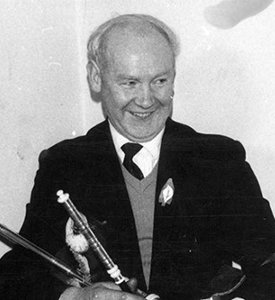
The Death of Bobby Clancy of The Clancy Brothers

bobby-clancy

Robert Joseph “Bobby” Clancy, Jr., singer and musician best known as a member of The Clancy Brothers, one of the most successful and influential Irish folk groups, dies on September 6, 2002, in Carrick-on-Suir, County Tipperary. He plays the five-string banjo, guitar, bodhrán, and harmonica.

Bobby Clancy is born on May 11, 1927, in Carrick-on-Suir. He leaves home in the late 1940s to join the Royal Air Force (RAF) where he travels all over Europe, including Greece and Egypt where he learns many folk songs. He later joins his older brothers Paddy Clancy and Tom Clancy in New York City, where they work as actors. The trio sometimes sing, informally beginning the group later known as The Clancy Brothers.

In 1955, Bobby returns to Ireland to settle down and run his father’s insurance business. His youngest brother Liam Clancy takes his place in America and officially forms The Clancy Brothers and Tommy Makem with Paddy, Tom Clancy, and friend Tommy Makem. Bobby forges his own solo career, as well as performing the other half of two duos with sister Peg Clancy and an American folk singer named Sharon Collen. As a solo artist, Bobby brings his show to the small screen with his own TV series, When Bobby Clancy Sings, on Irish television.

When Tommy Makem leaves in 1969, Bobby takes his place and becomes a member of The Clancy Brothers. The four brothers, Paddy, Tom, Bobby, and Liam release three studio albums, Clancy Brothers Christmas, Flowers in the Valley, and Welcome to Our House.

Bobby’s initial tenure with The Clancy Brothers was short-lived. Bobby resumes his solo work, releasing a solo album Good Times When Bobby Clancy Sings and appearing live on a compilation album from a 1974 German Folk Festival, both in 1974.

In 1976, The Clancy Brothers disband for a few months. Liam Clancy and Louis Killen leave the group and remaining brothers Paddy and Tom decide to go on a hiatus. In 1977, plans are set into motion to regroup and Paddy and Tom ask Bobby to join. The three brothers recruit their nephew, singer-songwriter Robbie O’Connell.

The quartet tours part-time, performing three-month-long tours each year in March, August, and November only in the United States. They release two live albums, one in 1982 and the other in 1988. During the remaining part of the year, Bobby continues running the insurance business in Carrick-on-Suir and continues his solo career in Ireland.

Youngest brother Liam Clancy rejoins Bobby, Paddy, and Robbie in 1990 when brother Tom is diagnosed with stomach cancer and dies in November 1990. The Clancy Brothers now perform more frequently than they had in the 1970s and 1980s, appearing on numerous TV shows in America and Ireland. The quartet releases the group’s first studio album in over 20 years, Older But No Wiser, in late 1995, an title coined by Bobby’s wife Moira. Soon after the album’s release, Liam Clancy and Robbie O’Connell leave the group. Bobby and Paddy continue performing with Bobby’s son Finbarr Clancy and friend Eddie Dillon from Boston. This new line-up tours until November 1998 when Paddy dies from lung cancer. Now as a trio, the Clancys and Eddie Dillon record two live albums and Bobby Clancy releases an additional two solo albums.

In 1999 Bobby is diagnosed with pulmonary fibrosis and by 2000 he is unable to perform on his feet and the trio performs while sitting down. By March 2002, Bobby is unable to perform and has to quit a scheduled tour. On September 6, 2002, Bobby Clancy dies at the age of 75. At the time of his death he is back home in Ireland, long since living at the home of his parents on William Street in Carrick-on-Suir, the home where he was born.


Leave a comment

Final Concert by Phil Lynott & Thin Lizzy

thin-lizzy-1983

Although a version of the band still tours today, the definitive Thin Lizzy lineup, according to the official Thin Lizzy website, plays its last concert at the Monsters Of Rock festival in Nuremburg, Germany, on September 4, 1983. Afterwards the band members go their separate ways.

Formed in 1969 featuring bass guitarist and lead vocalist Phil Lynott and drummer Brian Downey, the band goes through various members including Gary Moore before Scott Gorham and Brian Robertson join the band in the mid-1970s. Thin Lizzy’s big breakthrough comes with the Jailbreak album in 1976 featuring the hit single The Boys Are Back In Town.

After the success of the Jailbreak album, Thin Lizzy’s popularity begins to subside in the United States, with each successive album finding less success. They manage, however, to maintain a presence in the United Kingdom. Another problem contributing to the band’s demise is Lynott’s drug use, which begins to escalate around this time and eventually ruins his marriage.

Two more Thin Lizzy albums, Renegade and Thunder and Lightning, follow over the next two and half years, as does a second solo offering by Lynott, The Phillip Lynott Album. Despite this, things continue to unravel for Lynott and company.

They plan a farewell tour to coincide with the March 1983 release of Thunder and Lightning, which features a heavier approach and proves to be their most popular album in some time. This ends up being a year-long adventure whose high point is a special performance at the legendary Hammersmith Odeon. For the show, Lynott brings in former band members Brian Robertson, Eric Bell, and Gary Moore as special guests.

The final concert in the United Kingdom takes place on August 28, 1983, at the Reading Festival, while their final concert with Lynott in the lineup finds them in Nuremberg on a bill that includes Whitesnake, Ozzy Osbourne, Blue Öyster Cult, Motörhead, and others. Lizzy’s set features old favorites along with a few new songs.

Lynott dies on January 4, 1986, of heart failure and pneumonia. Although the band eventually regroups with various ex-members trying to sail the ship, it never rekindles its past success without their leader.


Leave a comment

Birth of Soloist & Songwriter Órlagh Mary Louise Fallon

orlagh-fallonÓrlagh Mary Louise Fallon, soloist and songwriter professionally known as Órla Fallon, is born in Knockananna, County Wicklow, on August 24, 1974. She is a former member of the group Celtic Woman and the chamber choir Anúna.

Fallon plays the harp and sings traditional Irish music, most often in the Irish language. Fallon studies at Mater Dei Institute of Education in Dublin. She has performed for the Pope, the President of Ireland, and at Carnegie Hall.

Her debut album, The Water is Wide, is released in Europe in 2000 and in North America in 2006. In 2005, she is featured on The Duggans album Rubicon along with peers Moya Brennan and other members of Clannad.

In 2004, Fallon sends a demo offer to composer David Downes, who is then working on the concept of Celtic Woman. Due to her unique vocal abilities, Downes contacts Fallon and asks if she would like to be a part of Celtic Woman, at the time envisaged to be only a one-night show. Fallon agrees, and becomes one of the founding members of the group. In some songs, such as Isle of Innisfree and Carrickfergus, Fallon plays the harp as well as sings. She also plays the harp in fellow Celtic Woman member Chloë Agnew‘s performance of Guun’s Ave Maria.

Fallon is featured in the self-titled debut album Celtic Woman, Celtic Woman: A Christmas Celebration, and Celtic Woman: A New Journey, as well as in the tie-in PBS television specials and DVDs filmed in 2004, 2007, and 2006 respectively. She also tours with the group in 2005 on the inaugural North American Tour, the 2006-2007 A New Journey tour, and again in 2007-2008 on the second A New Journey tour.

In 2009, Fallon announces that she is leaving Celtic Woman to have a full break and spend time with her family. She is replaced by actress and vocalist Alex Sharpe.

In 2009, Fallon appears as a guest vocalist on Jim Brickman‘s It’s a Beautiful World tour and PBS special, and releases her second album Distant Shore in September of that year. This is followed in March 2010 with her third album Music of Ireland: Welcome Home. Fallon’s first Christmas album, Winter, Fire & Snow: A Celtic Christmas Collection, is released in September 2010. In December 2010, Fallon releases a PBS Celtic Christmas special and tie-in CD, titled Órla Fallon’s Celtic Christmas, the first time any former Celtic Woman member has starred in their own PBS special.

In March 2011, Fallon releases another album, Órla Fallon: My Land, which ties in with another PBS special. Another solo album, Lullaby Time, is released in 2012.


Leave a comment

Birth of U2’s The Edge, David Howell Evans

the-edge

David Howell Evans, British-born Irish musician and songwriter best known by his stage name The Edge and as the lead guitarist, keyboardist, and backing vocalist of the rock band U2, is born at the Maternity Hospital in Barking, Essex, England on August 8, 1961. A member of U2 since its inception, he has recorded 13 studio albums with the band as well as one solo record.

The Edge is raised in Ireland after the Evans family relocates there while he is still an infant. He receives his initial formal education at St. Andrew’s National School in Dublin. As a child he also receives piano and guitar lessons, and practises music with his elder brother Richard. In 1976, at Mount Temple Comprehensive School, he goes to a meeting in response to an advert posted by another pupil, Larry Mullen Jr., on the school’s noticeboard seeking musicians to form a new band with him. Among the other pupils who respond to the note are Paul Hewson (Bono) and Adam Clayton. The band goes through a number of versions before becoming known as U2 in March 1978.

U2 begins its public performance life in small venues in Dublin, occasionally playing at other venues elsewhere in Ireland. In December 1979 they perform their first concerts outside Ireland, in London, and in 1980 begin extensive touring across the British Isles. Their debut album Boy is released in 1980.

In 1981, leading up to the October Tour, Evans comes very close to leaving U2 for religious reasons, but he decides to stay. During this period, he becomes involved with a group called Shalom Tigers, in which bandmates Bono and Larry Mullen Jr. are also involved. Shortly after deciding to remain with the band, he writes a piece of music that later becomes Sunday Bloody Sunday.

U2 eventually becomes one of the most popular acts in popular music, with successful albums such as 1987’s The Joshua Tree and 1991’s Achtung Baby. Over the years, the Edge has experimented with various guitar effects and introduced influences from several genres of music into his own style, including American roots music, industrial music, and alternative rock. With U2, the Edge also plays keyboards, co-produced their 1993 record Zooropa, and occasionally contributes lyrics.

In addition to his regular role within U2, The Edge has also recorded with such artists as Johnny Cash, B. B. King, Tina Turner, Ronnie Wood, Jah Wobble, Holger Czukay, Jay-Z, and Rihanna. He has collaborated with U2 bandmate Bono on several projects, including the soundtracks to the musical Spider-Man: Turn Off the Dark and the Royal Shakespeare Company‘s London stage adaptation of A Clockwork Orange.

The Edge, Bob Ezrin, and Henry Juszkiewicz co-found Music Rising in 2005, a charity that helps provide replacement instruments for those that were lost in Hurricane Katrina. The instruments are originally only replaced for professional musicians, but they soon realise the community churches and schools need instruments as well. The charity’s slogan is “Rebuilding the Gulf Region note by note” and has helped over a hundred musicians who were affected by the hurricane. The Edge also serves on the board of The Angiogenesis Foundation, a 501(c)(3) nonprofit organisation dedicated to improving global health by advancing angiogenesis-based medicine, diets, and lifestyle.

In 2011, Rolling Stone magazine places him at number 38 on its list of “The 100 Greatest Guitarists of All Time.” In 2012, Spin ranks him 13th on their own list.


1 Comment

Birth of Irish Folk Singer Moya Brennan

moya-brennan

Moya Brennan, born Máire Ní Bhraonáin, Irish folk singer, songwriter, harpist, and philanthropist, is born in Dublin on August 4, 1952.

After leaving secondary school, Brennan spends a few years at the Royal Irish Academy of Music in Dublin studying the harp, the piano, and singing. She has also taught music at Holy Cross College in Falcarragh, County Donegal.

In 1970 Brennan joins her two brothers, Pól and Ciarán, and their mother’s twin brothers, Noel and Pádraig Ó Dúgáin, and form the band Clannad. They are identified and introduced to television by Tony MacMahon. After enjoying a decade of being among the world’s foremost Irish musical groups, Clannad graduates to chart success in 1982 with the album Magical Ring. Brennan is at the forefront of the group’s success and her voice suddenly becomes synonymous with Celtic music and Irish music at the time. Brennan records 17 albums with Clannad and wins a Grammy Award, a BAFTA, and an Ivor Novello award with the quintet. Her sister, Eithne Ní Bhraonáin, who spends some time with Clannad, continues to pursue a very successful solo career under the name Enya.

Brennan releases her first solo album in 1992, Máire, on Atlantic Records. Misty Eyed Adventures on BGM follows three years later. In 1998, Brennan signs with Word Records and releases Perfect Time, and Whisper to the Wild Water a year later. The album is nominated for the Grammy Award for Best New Age Album in 2001.

Brennan’s autobiography, The Other Side of the Rainbow, is published in 2000 and she performs her song Perfect Time live at World Youth Day in Rome in front of crowds of pilgrims and Pope John Paul II. There are 2.1 million people present, making it the largest crowd ever gathered in the Northern Hemisphere.

In film, Brennan is a featured vocalist on King Arthur (2004), co-writing the title theme Tell Me Now (What You See) with Hans Zimmer. She also writes an additional music score for To End All Wars (2001). In 1995, she duets with Shane MacGowan on You’re the One for the movie Circle of Friends. Brennan has collaborated with many other musicians, including Chicane, Alan Parsons, Bono, Robert Plant, Van Morrison, Michael McDonald from the Doobie Brothers, Bruce Hornsby, Joe Elliott, The Chieftains, Paul Young, Paul Brady, Michael Crawford, Joe Jackson, and Ronan Keating.

In total Brennan has recorded 25 albums, and has sold 20 million records. Brennan and Clannad are credited with the creation of contemporary Celtic music and are held in high esteem for their vast contribution to bringing new life to old Irish songs. They have been compared to Seán Ó Riada, in that they brought the Irish language into popular culture through their music. One critic said, “Clannad’s music offers a terrific fusion between traditional and modern influences.” U2 front man Bono says of her voice, “I think Máire has one of the greatest voices the human ear has ever experienced.”


Leave a comment

Birth of Seán Ó Riada, Composer of Irish Traditional Music

seán-o-riada

Seán Ó Riada, Irish composer and arranger of Irish traditional music, is born John Reidy in Cork City on August 1, 1931. Through his incorporation of modern and traditional techniques he becomes the single most influential figure in the revival of Irish traditional music during the 1960s.

Ó Riada receives his primary education at St. Finbarr’s College, Farranferris. He moves to St. Munchin’s College in Limerick where he completes his Leaving Certificate in 1948. He plays violin, piano, and organ, and studies Greek and Latin classics at University College Cork, with Aloys Fleischmann and graduates in 1952. While at College, Ó Riada is the auditor of the UCC Philosophical Society.

Ó Riada’s career begins in 1954 as a music director at Radio Éireann, after which he works at the Abbey Theatre from 1955 to 1962. He lectures in music at University College Cork from 1963 until his death in 1971. He leaves a lasting influence as founder and director of the ensemble Ceoltóirí Chualann beginning in 1961. Ó Riada becomes a household name in Ireland through his participation in Ceoltóirí Chualann, compositions, writings, and broadcasts. His best-known pieces in the classical tradition include Nomos No. 1: Hercules Dux Ferrariae (1957), but he becomes particularly famous for his film scores Mise Éire (1959) and Saoirse? (1960).

In 1963 Ó Riada is appointed lecturer in music at University College Cork. He moves to Cúil Aodha in West Cork, an Irish-speaking area, where he establishes Cór Chúil Aodha, a male voice choir.

He becomes involved in Irish politics and is a friend of several influential leaders. Ó Riada drinks regularly at a local pub which still advertises itself as being his local. He develops cirrhosis of the liver. He is flown to King’s College Hospital in London for treatment and dies there on October 3, 1971, two months after his 40th birthday. He is buried in St. Gobnait‘s graveyard, Baile Bhuirne, County Cork. Willie Clancy played at his funeral.

Two schools are named “Scoil Uí Riada” after him – a Gaelscoil in Kilcock, County Kildare, and another in Bishopstown, Cork City. In 2008, a life-sized statue is erected in the grounds of Sépéil Naomh Gobnait, Cúil Aodha.


Leave a comment

Birth of “Jem” Finer, Founding Member of The Pogues

jem-finerJeremy Max “Jem” Finer, English musician, artist, composer, and one of the founding members of The Pogues, is born in Stoke-on-Trent, England on July 20, 1955.

After college at Keele University, Finer travels around Europe and spends some time working on a barge in France. He settles in London and becomes the bass player in a group called The Petals and lives in 32 Burton Street, a house which he sometimes shares with Spider Stacey and Shane MacGowan. Together with James Fearnley they found The Pogues. Primarily a banjoist, he also plays other instruments, including mandola, saxophone, hurdy-gurdy, and the guitar. Apart from Shane MacGowan, Finer is the most prolific composer for the band.

Finer appears on all the band’s albums until their breakup in 1996. He continues working as a musician and composer after leaving The Pogues.

On January 1, 2000, the Finer-composed Longplayer piece of music is started and is designed to last 1,000 years without ever repeating itself. It currently exists in both computer-generated and live versions. Longplayer represents a convergence of many of his concerns, particularly those relating to systems, long-durational processes, and extremes of scale in both time and space.

Finer serves as “Artist in Residence” at the Astrophysics Sub-department of the University of Oxford between October 2003 and June 2005. Finer and Hamburg-based swamp pop legend DM Bob begin recording and performing together in 2005, releasing their album Bum Steer in August of that year and co-producing the debut album by experimental pop band Marseille Figs. In July 2005, Finer wins the PRS Foundation New Music Award on the basis of his proposal to build a device that will automatically “compose” a song of indeterminate length by harnessing the creative force of the weather.

In March 2012, Mobile Sinfonia, a global composition for ringtones is launched, developed during a year Finer spends as a non-resident artist at the University of Bath. This piece concerns mutual invasion of soundscape via ringtones.

Finer is currently working on a number of new projects continuing his interest in long-term sustainability and the reconfiguring of older technologies, including Spiegelei, a spherical camera obscura featuring Finer’s innovative 360-degree projection system and the Supercomputer in Cambridge, a 5-bit mechanical sculpture which will compute minimal musical scores.


Leave a comment

The Abbey Theatre Destroyed by Fire

abbey-theatre-fire-1951

Fire destroys the Abbey Theatre in Dublin on July 17, 1951, with only the Peacock, a small experimental theatre in the ground floor of the main theatre surviving intact. The play earlier in the evening closes with soldiers on stage singing Keep the Home Fires Burning.

In February 1961, the ruins of the Abbey are demolished. The board has plans for rebuilding with a design by the Irish architect Michael Scott. On September 3, 1963, the President of Ireland, Éamon de Valera, lays the foundation stone for the new theatre. The Abbey reopens on July 18, 1966, at its new location at 26 Lower Abbey Street, Dublin 1.

The Abbey Theatre first opens its doors to the public on December 27, 1904. Despite the loss of the original building to the 1951 fire, it has remained active to the present day. The Abbey is the first state-subsidized theatre in the English-speaking world. From 1925 onwards it receives an annual subsidy from the Irish Free State.

In its early years, the theatre is closely associated with the writers of the Irish Literary Revival, many of whom are involved in its founding and most of whom have plays staged there. The Abbey serves as a nursery for many of the leading Irish playwrights and actors of the 20th century, including William Butler Yeats, Lady Gregory, Seán O’Casey, and John Millington Synge. In addition, through its extensive programme of touring abroad and its high visibility to foreign, particularly American, audiences, it has become an important part of the Irish tourist industry.


Leave a comment

Birth of Irish Dancer & Choreographer Michael Ryan Flatley

michael-flatley

Michael Ryan Flatley, Irish American dancer, choreographer, and musician, is born to Irish parents in Chicago, Illinois on July 16, 1958. He becomes internationally known for Irish dance shows Riverdance, Lord of the Dance, Feet of Flames, and Celtic Tiger.

Flatley begins dancing lessons at age 11 and, at age 17, is the first American to secure a World Irish Dance title at the World Irish Dance Championships, the Oireachtas Rince na Cruinne. He is also an accomplished flautist, having won twice in the All-Ireland Fleadh Cheoil Concert Flute competitions from 1975-1976.

Flatley is taught dance by Dennis Dennehy at the Dennehy School of Irish Dance in Chicago. After graduating from Brother Rice High School, on Chicago’s Southwest Side, he opens a dance school but later closes it to focus on performing.

In 1978 and 1979 Flatley tours with Green Fields of America and then with The Chieftains in the 1980s. In May 1989, Flatley sets a Guinness Book world record for tapping speed at 28 taps per second, and subsequently breaks his own record in 1998 with 35 taps per second.

Flatley creates and choreographs the original Riverdance and leads the show to great success as the intermission act in the Eurovision Song Contest staged in Ireland on April 30, 1994. Flatley abruptly leaves the show over creative control disputes in October 1995.

Shortly after the Riverdance split, Flatley creates Lord of the Dance, which plays mostly in arenas and stadiums instead of stage theaters. He also puts together a dance production called Feet of Flames in 1998. Flately’s Irish dance show Celtic Tiger opens in July 2005. The show explores the history of the Irish people and Irish emigration to the United States, fusing a wide range of dance styles, including jazz.

Flatley returns to the stage in 2009 for a limited run of the “Hyde Park” version of Feet of Flames in Taiwan. His return is met with multiple standing ovations and the run of shows has to be extended to meet the demand for tickets.

Flatley premiers Lord of the Dance: Dangerous Games at the celebrated Palladium Theatre on London’s West End in 2014 and moves to the Dominion Theatre in 2015 where he makes his final appearance on the West End stage before revisiting another sold out Wembley Arena for his final performance in the United Kingdom.

Flatley embarks on his final tour on February 19, 2016 and performs on stage for the last time at The Colosseum at Caesar’s Palace in Las Vegas, NV, on March 17, 2016. He continues as the show’s creator, producer, and choreographer.


Leave a comment

Birth of The Pogues’ Guitarist Philip Chevron

philip-chevron

Philip Ryan, Irish singer-songwriter and guitarist professionally known as Philip Chevron and best known as a member of The Pogues, is born on June 17, 1957. He is regarded as one of the most influential figures in Irish punk music.

Chevron grows up in Santry, a suburb of Dublin. Beginning in the late 1970s, he is lead singer and co-founder of the punk rock group The Radiators from Space, receiving some critical acclaim but little widespread popularity or financial success. Following a temporary breakup of the band in 1981, he lives in London for a while where he meets and befriends Shane MacGowan through time spent working together at a record shop. Following the release of the Pogues’ 1984 debut album Red Roses For Me, Chevron is invited to join the band as a temporary replacement for banjo player Jem Finer while on paternity leave. He takes over as guitarist following MacGowan’s decision to concentrate on singing, thereby becoming a full-time member of the band in time for the recording of its second album, Rum, Sodomy and the Lash.

Chevron proves himself as a singer-songwriter, writing the songs Thousands Are Sailing and Lorelei among others. He leaves The Pogues in 1994 following problems with drugs and alcohol. In 2003, he reforms The Radiators (Plan 9) with ex-Pogues bassist Cait O’Riordan. They release the album Trouble Pilgrim in 2006.

In later years, he becomes The Pogues’ unofficial spokesperson and resident expert on the reclusive MacGowan, frequently visiting online fora and directly answering questions from fans. In 2004, he personally oversees the remastering and re-release of The Pogues’ entire back catalogue on CD. He tours regularly with The Pogues, who reunite after a successful reunion tour in 2001.

In June 2007, The Pogues’ website announces that Chevron has been diagnosed with oesophageal cancer. In early 2008, the website announces that Chevron has recovered, and to his surprise and joy, his hearing has returned to almost pre-treatment levels. He embarks on the March 2008 tour of the United States and manages to sing Thousands Are Sailing at each performance. By 2009, Chevron appears to have recovered from the cancer.

However, in May 2013, it is announced that the cancer has returned, and it is “lethal.” In June he stoically tells the Irish Daily Mail, “I am a gay, Irish, Catholic, alcoholic Pogue who is about to die from cancer – and don’t think I don’t know it.” Chevron dies on October 8, 2013, in Dublin at the age of 56. His last public appearance is at the Olympia Theatre in Dublin for a fundraiser in August of that same year.