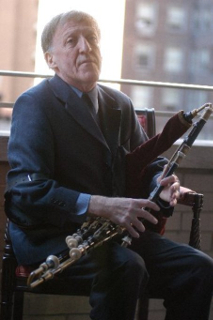
Paddy Moloney, musician, composer and producer who is the founder and leader of the Irish musical group The Chieftains, is born at Donnycarney, Dublin on August 1, 1938. He has played on every one of The Chieftains albums.
Moloney’s mother purchases him a tin whistle when he is six years old, and he starts to learn the Uilleann pipes at the age of eight. In addition to the tin whistle and the Uilleann pipes, he also plays button accordion and bodhrán.
Together with Garech de Brun (anglicised to Garech Browne) of Luggala, Moloney founds Claddagh Records in 1959. In 1968 he becomes a producer for the label and supervises the recording of 45 albums.
Moloney is married to artist Rita O’Reilly and has three children, Aonghus Moloney, Padraig Moloney and actress producer Aedin Moloney. He is a fluent speaker of the Irish language.
On September 13, 2012, Moloney receives Mexico‘s Ohtli Award, the country’s highest cultural award.
Chapman has to wait two years for a donor to come forward. The hospital releases pictures of Adele in March 1998 in a bid to get donors to come forward. Her donor is of a similar age to her and also donates her heart and kidneys for transplants.
The youngest of five children, Chapman says the first thing she plans to do when she gets home is to “give my daddy and brothers and sisters a hug and a kiss.” Her mother Doreen says the family has been on a “roller coaster of emotion” over the past two years. At times, they had thought Adele would not survive. “Three months ago she was lying absolutely devastated on the bed and could not move. The transformation is just wonderful,” she said. “Now we are looking to the future.”
Chapman’s complex 10-hour operation is carried out by a team led by Jean de Ville de Goyet from Birmingham Children’s Hospital and David Mayer from the Queen Elizabeth Hospital in Birmingham. The Children’s Hospital is the only centre in the United Kingdom which can perform small intestine and liver transplants on children.
Chapman had a rare bowel disease which prevented her from eating solid food for two years. But only four weeks after her operation she is tucking into toast and doughnuts. Shortly after the surgery, the hospital says there has been no major medical or surgical problems as a result of the operation, although she still has a single feeding tube attached to her nose.
Chapman’s family calls for more donors to come forward. Donor organisations are trying to get more people signed up to the national organ donor register. The number of transplants has fallen by 10% in the years prior to 1998. Beverley Cornforth, a transplant educationalist, says the real problem is the 30% who say no to donating organs. This is often because people who die have not stated in advance that they would like to donate their organs and families are too distressed to decide for them.
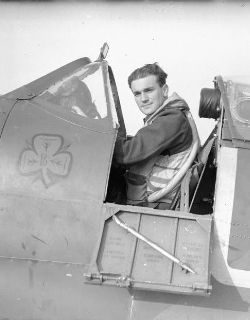
Finucane, born on October 16, 1920 in Rathmines, Dublin, is credited with 28 aerial victories, five probably destroyed, six shared destroyed, one shared probable victory, and eight damaged. Included in his total are twenty-three Messerschmitt Bf 109s, four Focke-Wulf Fw 190s and one Messerschmitt Bf 110. Official records differ over the exact total. After the war, two of Finucane’s victories that had been credited as probables had, in fact, been destroyed, but are not officially included. His total victory count could be as high as 32.
On July 15, Finucane is killed at the age of 21 while leading the Hornchurch Wing in a fighter “Ramrod” operation targeting a German Army camp at Étaples, France. He takes off with his wing at 11:50 AM. The attack is timed to hit the Germans at lunchtime. Crossing the beach at Le Touquet, they target machine gun positions. His plane is hit in the radiator at 12:22 PM. His wingman, Alan Aikman, notifies him of the white plume of smoke and Finucane acknowledges it with a thumbs up. Standard regulations insist the wing carry on the mission even if the leader is in trouble. Radio silence is maintained so the enemy radio-interception services do not become aware that a person of importance has been hit.
Finucane flies slowly out to sea, talking calmly to Aikman as he glides along in his stricken fighter. Finally, some 8 miles off Le Touquet on the French coast, he breaks radio silence and sends his last message. Aikman, flying alongside Finucane, sees him pull back the canopy, and before taking off his helmet, say “This is it Butch.” It is a well–executed landing, but the waves are difficult to predict and the Spitfire‘s nose strikes the water and disappears in a wall of spray. Before he hits the water, witnesses Aikman and Keith Chisholm of 452 Squadron see him release, or perhaps tighten, his parachute release harness and straps. If Finucane did release them, it is possible he could have been thrown forward onto the gun-sight and killed, or knocked unconscious and drowned. The exact circumstances remain unknown.
On the same day, concerts inspired by the initiative take place in other countries, such as the Soviet Union, Canada, Japan, Yugoslavia, Austria, Australia and West Germany. It was one of the largest-scale satellite link-ups and television broadcasts of all time. An estimated global audience of 1.9 billion, across 150 nations, watch the live broadcast. If accurate, this would be nearly 40% of the world population at the time.
In October 1984, images of millions of people starving to death in Ethiopia were shown in the UK in Michael Buerk‘s BBC News reports on the 1984 famine. The report shocks Britain, motivating its citizens to inundate relief agencies, such as Save the Children, with donations, and to bring the world’s attention to the crisis in Ethiopia. Bob Geldof also sees the report, and calls Midge Ure from Ultravox, and together they quickly co-write the song, “Do They Know It’s Christmas?” in the hope of raising money for famine relief. Geldof then contacts colleagues in the music industry and persuades them to record the single under the title “Band Aid” for free. On November 25, 1984, the song is recorded at SARM West Studios in Notting Hill, London and is released four days later. It stays at number-one on the UK Singles Chart for five weeks, is Christmas number one, and becomes the fastest-selling single ever in Britain and raises £8 million, rather than the £70,000 Geldof and Ure had initially expected.
The 1985 Live Aid concert is conceived as a follow-up to the successful charity single. The idea to stage a charity concert to raise more funds for Ethiopia originally comes from Boy George, the lead singer of Culture Club. On Saturday, December 22, 1984, an impromptu gathering of some of the other artists from Band Aid join Culture Club on stage at the end of their concert at Wembley Stadium for an encore of “Do They Know It’s Christmas?” George is so overcome by the occasion he tells Geldof that they should consider organising a benefit concert.
The concert begins at noon at Wembley Stadium in London. It continues at John F. Kennedy Stadium in the United States, starting at 8:51 EDT. The overall concert continues for just over 16 hours, but since many artists’ performances are conducted simultaneously in Wembley and JFK, the total concert’s length is much longer.
Throughout the concerts, viewers are urged to donate money to the Live Aid cause. Three hundred phone lines are manned by the BBC, so that members of the public can make donations using their credit cards. The phone number and an address that viewers can send cheques to are repeated every twenty minutes.
The following day, news reports state that between £40 and £50 million had been raised. It is now estimated that around £150m has been raised for famine relief as a direct result of the concerts. Geldof mentions during the concert that the Republic of Ireland had given the most donations per capita, despite being in the threat of a serious economic recession at the time. The single largest donation comes from the Al Maktoum, who is part of the ruling family of Dubai, who donates £1M during a phone conversation with Geldof.
Doyle is born at 11 Picardy Place, Edinburgh, Scotland, on May 22, 1859. His father, Charles Altamont Doyle, is an Englishman of Irish Catholic descent and his mother, Mary (née Foley), is Irish Catholic. Charles dies in 1893, in the Crichton Royal Hospital, Dumfries, after many years of psychiatric illness. Supported by wealthy uncles, Doyle is sent to the Jesuit preparatory school Hodder Place, Stonyhurst, at the age of nine. He then goes on to Stonyhurst College until 1875. From 1875 to 1876, he is educated at the Jesuit school Stella Matutina in Feldkirch, Austria. Doyle later rejects the Catholic faith and becomes an agnostic. He also later becomes a spiritualist mystic.
From 1876 to 1881 Doyle studies medicine at the University of Edinburgh Medical School. While studying, he begins writing short stories. His first published piece, The Mystery of Sasassa Valley, is printed in Chambers’s Edinburgh Journal on September 6, 1879. After stints as a ship’s doctor and a failed medical practice with former classmate George Turnavine Budd, Doyle arrives in Portsmouth in June 1882 and sets up a medical practice at 1 Bush Villas in Elm Grove, Southsea. The practice is slow to develop and while waiting for patients, Doyle again begins writing fiction. In 1890, Doyle studies ophthalmology in Vienna and moves to London.
A sequel to A Study in Scarlet is commissioned and The Sign of the Four appears in Lippincott’s Magazine in February 1890, the last under agreement with the Ward Lock company. Short stories featuring Sherlock Holmes are published in TheStrand Magazine.
In December 1893, wanting to dedicate more time to historical novels, Doyle has Holmes and Professor Moriarty plunge to their deaths together down the Reichenbach Falls in the The Final Problem. Public outcry, however, leads him to feature Holmes in 1901 in the novel The Hound of the Baskervilles. Holmes is ultimately featured in a total of 56 short stories, the last published in 1927, and four novels by Doyle.
Between 1888 and 1906, Doyle writes seven historical novels, which many critics regard as his best work. He also authors nine other novels and, later in his career between 1912 and 1929, five stories, two of novella length, featuring the irascible scientist Professor Challenger.
Doyle is a supporter of the campaign for the reform of the Congo Free State, led by the journalist E. D. Morel and diplomat Roger Casement. He becomes acquainted with Morel and Casement and, together with Bertram Fletcher Robinson, they inspire several characters in the 1912 novel The Lost World. When Casement is found guilty of treason against the Crown during the 1916 Easter Rising, Doyle tries unsuccessfully to save him from facing the death penalty, arguing that Casement has been driven mad and cannot be held responsible for his actions.
Found clutching his chest in the hall of Windlesham Manor, his house in Crowborough, East Sussex, on July 7, 1930, Doyle dies of a heart attack at the age of 71. At the time of his death there is some controversy concerning his burial place, as he is avowedly not a Christian, but rather considers himself a Spiritualist. He is first buried on July 11, 1930, in Windlesham rose garden. He is later reinterred together with his wife in Minstead churchyard in the New Forest, Hampshire.
Millmount has been fortified in historical times since the early 12th century when invading Normans built a mote and bailey on what was probably originally a neolithic passage grave similar to Newgrange. In Irish cosmology, it is often assumed to be the burial place of Amergin Glúingel, whose name indicates that in ancient Irish mythology he was regarded as the originator of the arts of song, poetry and music.
Hugh de Lacy, one of the Normans who comes to Ireland after Strongbow, builds the original fort circa 1172, having been granted the Kingdom of Meath by Henry II of England. Later a stone castle is built on the site. This castle forms part of the defences of the town during the Siege of Drogheda during the Cromwellian conquest of Ireland in 1649. The fort’s English defenders attempt to surrender to Parliamentarian troops under Oliver Cromwell but are massacred when they give themselves up on September 11, 1649. The complex is later called Richmond Barracks. Some of the present buildings, in the courtyard, are built circa 1714. After the unrest and rebellions of the 1790s and the Acts of Union 1800 the complex is re-fortified, and the Martello tower is built.
The fort suffers considerable damage during the Irish Civil War. It is occupied by Anti-Treaty forces and on July 4, 1922, it becomes the target of shelling by the army of the Irish Free State. The Free State Forces under Michael Collins have been given extensive support by the British Army at the express wish of Winston Churchill who insists that the Republican Forces be crushed. Using the same British Army 18-pounder artillery piece which had shelled the Republican H.Q. in the Four Courts in Dublin some days earlier the Free State Forces bombard Millmount fort for several hours before the Republican garrison retreats. The famous Martello tower is all but destroyed during the shelling.
Today, after being restored in 2000, the complex houses the Millmount Museum which houses a wide variety of artifacts of local and national importance. The complex is Drogheda’s most dominant feature, clearly visible from all parts of the town. The Martello tower is affectionately known as “The Cup and Saucer” by locals. The whole fort is a national monument and has been designated as Drogheda’s Cultural Quarter.
After serving for four years on the Roscommon County Council, Doherty is elected as a Fianna Fáil TD for the Roscommon–Leitrim constituency at the 1977 general election.
Doherty’s brother-in-law, Garda Thomas Nangle, is charged with assaulting James McGovern, a native of County Fermanagh, in a public house in December 1981. On September 27, 1982, hours before the case is due to be heard in District Court in the small village of Dowra, County Cavan, McGovern is arrested by the Special Branch of the Royal Ulster Constabulary (RUC) on the basis of entirely false Garda intelligence that he is involved in terrorism. The case against Nangle is dismissed because the principal witness, McGovern, fails to appear in court. The solicitor representing Nangle is Kevin Doherty, Seán Doherty’s brother. This questionable use of Garda/RUC Special Branch liaison, set up under the 1985 Hillsborough Anglo-Irish Agreement, prevents meetings between the Garda commissioner and the RUC chief constable for almost three years.
After Doherty leaves office it is revealed in The Irish Times that he ordered the tapping of three journalists home telephones. The newspaper also discloses that he has been interfering in the workings of the Garda and the administration of justice for both political and personal reasons. He immediately resigns from the party only to rejoin it in 1984.
At the 1989 general election his loses his seat in Dáil Éireann to the independent candidate Tom Foxe. He is also an unsuccessful candidate in the elections on the same day to the European Parliament, but he is later elected instead to the Seanad on the Administrative Panel and becomes the Cathaoirleach (Chairman) of the 19th Seanad.
In January 1992 the phone tapping scandal returns to haunt Fianna Fáil. Doherty announces in a television interview that he had shown transcripts of the conversations to Charles Haughey while Haughey was Taoiseach in 1982 although he had previously denied this. Haughey denies the claim also, but is forced to resign from the government, and then resigns as leader of Fianna Fáil. Doherty then regains his seat at the 1992 general election and holds it until his retirement at the 2002 general election.
On April 14, 1922, a column of 200 men led by Rory O’Connor occupies the Four Courts, hoping to provoke an armed confrontation with British forces which are in the process of evacuating from Ireland following the signing of the Anglo-Irish Treaty the previous winter which had split the Irish Republican Army (IRA) into two opposing factions. The occupation is a direct challenge to the legitimacy of the Provisional government who seeks a smooth transition to a viable independent Irish state in the 26 counties of southern Ireland.
On June 22 Field MarshalSir Henry Wilson is gunned down by two IRA assassins and on June 26, the Free State Army Deputy Chief of Staff General J.J. O’Connell is kidnapped by the Four Courts IRA garrison. Michael Collins has also shipped guns issued by the British to arm the new Irish Army to Northern IRA units to defend themselves from Ulster loyalists.
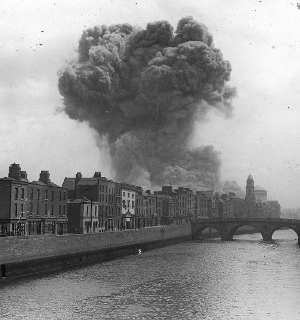
Collins, no longer able to resist British pressure, receives two 18-pounder artillery guns and a stock of 200 artillery shells from the store at Kilmainham. The guns are set up at Parliament Street and Winetavern Street and Bridgefoot Street and Usher’s Quay across the River Liffey from the facade of the heavily fortified Four Courts where the Anti-Treaty IRA has barricaded themselves. Free State troops establish a cordon around the building, closing streets with riflemen and machine gunners occupying windows and rooftops. Among the IRA leaders inside are Chief-of-Staff Joe McKelvey, Director of Engineering Rory O’Connor, Quarter Master General Liam Mellows, commander of the IRA’s 2nd Southern Division Ernie O’Malley, Commandant Paddy O’Brien, Commandant Tom Barry and many others. The IRA mostly drawn from 1st and 2nd Battalions of the 1st Dublin Brigade are armed with rifles, five Thompson submachine guns and two Lewis machine guns as well as an armoured car nicknamed “The Mutineer.”
The bombardment begins on June 28 as artillery guns supervised by Emmet Dalton begin blasting the Four Courts at point blank range every fifteen minutes from across the River Liffey. The complex of buildings also comes under a hail of rifle and machine gun fire. However, the strong stone walls of the 18th century Four Courts hold out. A number of the shells overshoot their target and land near General McCready’s British Army headquarters. IRA leader Ernie O’Malley later claims to have witnessed a gun crew fighting a duel with a sniper in the dome of the courts. The failures of the first day lead the impatient British to offer two more 18-pounders as well as heavy howitzers and aircraft in order to destroy the Four Courts once and for all.
On the 29th, Free State troops storm the eastern wing of the Four Courts, suffering three fatalities, 14 wounded and taking 33 prisoners. The republicans’ armored car, “The Mutineer,” is disabled and abandoned by its crew. Early the following day Paddy O’Brien is injured by shrapnel and Ernie O’Malley takes over military command in the Four Courts. By this time the shelling has caused the Four Courts to catch fire. In addition, orders arrive from Oscar Traynor, the anti-treaty IRA commander in Dublin, for the Four Courts garrison to surrender, as he is unable to reach their position to help them. At 3:30 PM on June 30, O’Malley surrenders the Four Courts to Brig. Gen. Paddy Daly of the Free State’s Dublin Guard unit.
O’Sullivan is born in Boyle, County Roscommon on May 17, 1911, the daughter of Evangeline “Mary Eva” Lovatt and Charles Joseph O’Sullivan, an officer in the Connaught Rangers who serves in World War I. She attends a convent school in Dublin, then the Convent of the Sacred Heart at Roehampton, England. One of her classmates there is Vivian Mary Hartley, future Academy Award-winning actress Vivien Leigh. After attending finishing school in France, O’Sullivan returns to Dublin to work with the poor.
O’Sullivan’s film career begins when she meets motion picture director Frank Borzage, who is doing location filming on Song o’ My Heart for 20th Century Fox. He suggests she take a screen test, which she does, and wins a part in the movie, which stars Irish tenor John McCormack. She travels to the United States to complete the movie in Hollywood. O’Sullivan appears in six movies at Fox, then makes three more at other movie studios.
In 1932, she signs a contract with Metro-Goldwyn-Mayer. After several roles there and at other movie studios, she is chosen by Irving Thalberg to appear as Jane Parker in Tarzan the Ape Man, opposite co-star Johnny Weissmuller. She is one of the more popular ingenues at MGM throughout the 1930s and appears in a number of other productions with various stars. In all, O’Sullivan plays Jane in six features between 1932 and 1942.
She plays another Jane in Pride and Prejudice (1940) with Laurence Olivier and Greer Garson and supports Ann Sothern in Maisie Was a Lady (1941). After appearing in Tarzan’s New York Adventure (1942), O’Sullivan asks MGM to release her from her contract so she can care for her husband who has just left the Navy with typhoid. She retreats from show business, devoting her time to her family. In 1948, she re-appears on the screen in The Big Clock, directed by her husband for Paramount Pictures. She continues to appear occasionally in her husband’s movies and on television. However, by 1960 she believes she has permanently retired. In 1958, Farrow’s and O’Sullivan’s eldest son, Michael, dies in a plane crash in California.
Actor Pat O’Brien encourages her to take a part in summer stock, and the play A Roomful of Roses opens in 1961. That leads to another play, Never Too Late, in which she co-stars with Paul Ford in what is her Broadway debut. Shortly after it opens on Broadway, John Farrow dies of a heart attack. O’Sullivan sticks with acting after Farrow’s death. She is also an executive director of a bridal consulting service, Wediquette International. In June and July 1972, O’Sullivan is in Denver, Colorado, to star in the Elitch Theatre production of Butterflies are Free with Karen Grassle and Brandon deWilde. The show ends on July 1, 1972. Five days later, while still in Denver, deWilde is killed in a motor vehicle accident.
When her daughter, actress Mia Farrow, becomes involved with Woody Allen both professionally and romantically, she appears in Hannah and Her Sisters, playing Farrow’s mother. She has roles in Peggy Sue Got Married (1986) and the science fiction oddity Stranded (1987). Mia Farrow names one of her own sons Ronan O’Sullivan Farrow for her mother. In 1994, she appears with Robert Wagner and Stefanie Powers in Hart to Hart: Home Is Where the Hart Is, a feature-length made-for-TV movie with the wealthy husband-and-wife team from the popular weekly detective series Hart to Hart.
Maureen O’Sullivan dies in Scottsdale, Arizona, of complications from heart surgery on June 23, 1998, at the age of 87. O’Sullivan is buried at Most Holy Redeemer Cemetery, Niskayuna, New York. She is survived by six of her children, 32 grandchildren, and 13 great-grandchildren. Michael, her oldest son, is killed at age 19 in a plane crash in 1958.
Biden then travels to Government Buildings where he is formally welcomed by TaoiseachEnda Kenny. Kenny says he hopes Biden enjoyed his visit and Biden says that he himself has visited Ireland several times privately, but never as vice president. He adds that he had promised his late son Beau that he would make a family trip to Ireland, “Unfortunately Beau didn’t make it, but we decided that we would bring the whole family.”
Biden, an Irish American, speaks of his great-grandfather who emigrated from Ireland, and he also speaks of the pride his family feels in their Irish heritage.
Kenny presents Biden with a hurley and a sliotar, to which the Vice President responds, “I have witnessed one game and I have one regret, that they don’t have this in the United States. I played American football and American baseball in high school and college, but this would have been … this is a dangerous game.”
Biden holds a bilateral meeting with Kenny in the evening and meets with the President of Ireland, Michael D. Higgins, the following day at his official residence, Áras an Uachtaráin in Dublin‘s Phoenix Park. As he signs the visitors’ book, he paraphrases another famous Irish American, former U.S. PresidentJohn F. Kennedy, who had visited the Republic of Ireland 53 years earlier. His written entry makes reference to a speech made to Dáil Éireann in June 1963, when Kennedy said, “our two nations, divided by distance, have been united by history.”
During his visit Biden visits County Mayo and County Louth, where his ancestors originated, in addition to several engagements in Dublin and a stop at Newgrange. He also arranges to fit in a round of golf with Kenny.
Biden speaks at an event at Trinity College, Dublin on the morning of Friday, June 24 and delivers a keynote address to an American Ireland Fund event in Dublin Castle in the evening. He addresses the Irish American experience, the shared heritage of the two nations, and the values of tolerance, diversity and inclusiveness.
On Saturday, June 25, Biden visits various locations in County Louth including the Kilwirra Cemetery and Newgrange in County Meath.
Biden returns to the United States following a lunch with Kenny on Sunday, June 26.
(Pictured: U.S. Vice President Joe Biden signing the visitor’s book as Irish President Michael D. Higgins look on at his official residence, Áras an Uachtaráin)






 seamus dubhghaill