seamus dubhghaill

Promoting Irish Culture and History from Little Rock, Arkansas, USA


Leave a comment

Death of Sculptor John Henry Foley

john-henry-foley

John Henry Foley, Irish sculptor often referred to as J. H. Foley, dies in London on August 27, 1874. He is best known for his statues of Daniel O’Connell in Dublin and of Prince Albert for the Albert Memorial in London.

Foley is born May 24, 1818, at 6 Montgomery Street, Dublin, in what is then the city’s artists’ quarter. The street has since been renamed Foley Street in his honour. His father is a glassblower and his step-grandfather Benjamin Schrowder is a sculptor. At the age of thirteen he begins to study drawing and modelling at the Royal Dublin Society, where he takes several first-class prizes. In 1835 he is admitted as a student in the schools of the Royal Academy of Arts in London. He exhibits there for the first time in 1839, and comes to fame in 1844 with his Youth at a Stream. Thereafter commissions provide a steady career for the rest of his life. In 1849 he is made an associate, and in 1858 a full member of the Royal Academy of Arts.

In 1851, inspired by the recently closed Great Exhibition, the Corporation of London votes a sum of £10,000 to be spent on sculpture to decorate the Egyptian Hall in the Mansion House. Foley is commissioned to make sculptures of Caractacus and Egeria.

In 1864 Foley is chosen to sculpt one of the four large stone groups, each representing a continent, at the corners of George Gilbert Scott‘s Albert Memorial in Kensington Gardens. His design for Asia is approved in December of that year. In 1868, he is also asked to make the bronze statue of Prince Albert himself, to be placed at the centre of the memorial, following the death of Carlo Marochetti, who had originally received the commission but had struggled to produce an acceptable version.

Foley exhibits at the Royal Academy of Arts between 1839 and 1861. Further works are shown posthumously in 1875. His address is given in the catalogues as 57, George St., Euston Square, London until 1845, and 19, Osnaburgh Street from 1847.

John Henry Foley dies at Hampstead, north London on August 27, 1874, and is buried in St. Paul’s Cathedral on September 4. He leaves his models to the Royal Dublin Society, where he had his early artistic education, and a large part of his property to the Artists’ Benevolent Fund. He does not see the Albert Memorial completed before his death. A statue of Foley himself, on the front of the Victoria and Albert Museum, depicts him as a rather gaunt figure with a moustache, wearing a floppy cap.

Foley’s pupil Thomas Brock brings several of Foley’s works to completion after his death, including his statue of Prince Albert for the Albert Memorial. Foley’s articled pupil and later studio assistant Francis John Williamson becomes a successful sculptor in his own right, reputed to have been Queen Victoria‘s favourite. Other pupils and assistants are Charles Bell Birch, Samuel Ferris Lynn, Charles Lawes, and Richard Belt.

Following the creation of the Irish Free State in 1922, a number of Foley’s works are removed, or destroyed without notice, because the persons portrayed are considered hostile to the process of Irish independence. They include those of George Howard, 7th Earl of Carlisle, Ulick de Burgh, 1st Marquess of Clanricarde in Galway and Hugh Gough, 1st Viscount Gough in the Phoenix Park. The statue of Ulick de Burgh is decapitated and dumped in the river as one of the first acts of the short-lived “Galway Soviet” of 1922.
Leave a comment

Killing of Bernard Daly, Seán Cole & Alf Colley

sean-cole-and-alf-colley

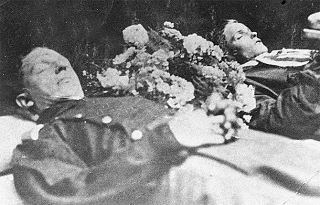
Fianna Éireann members Seán Cole and Alf Colley and Anti-Treaty Irish Republican Army (IRA) member Bernard Daly, are abducted and killed in Dublin on August 26, 1922 by the Criminal Investigation Department (CID) police unit based in Oriel House allegedly in revenge for Michael Collinsassassination four days earlier, although possibly in retaliation for the death of a CID man the previous day.

By the middle of August, the Provisional Government of the Irish Free State under Collins has control of Dublin. Collins himself has established a Criminal Investigation Department based at Oriel House, Westland Row. These former IRA Volunteers, turned Free Staters, acquire a ruthless reputation and become known to republicans as the Oriel House Gang. They are plain-clothed and heavily armed and Oriel House is notorious for ill-treatment of republican prisoners held there. Accounts of the killings of August 26 indicate that the Oriel House Gang is responsible.

The day after Collins is assassinated, Richard Mulcahy, Chief of Staff of the Free State Army, sends a message to his soldiers. He urges them to “stand calmly by your posts” and says, “Let no cruel act of reprisal blemish your bright honour.” Yet in Dublin, within days of that message, and as the body of Collins lay in state in City Hall, Free State forces carry out atrocities which have been almost totally forgotten.

Following the assassination at Béal na mBláth on August 22, Collins’s body is brought to Dublin and lay in state in City Hall. On August 26, a short distance away from City Hall where crowds are still filing past the coffin, Bernard Daly is working as a bartender in Hogan’s licensed premises in Suffolk Street. At about 3:30 PM three armed men enter the pub and arrest Daly at gunpoint. He is dragged to the cellar and then taken away in a Ford car.

Daly’s body is brought to the City Morgue that evening by Free State troops who claim to have found it. Daly had been shot dead near St. Doulagh’s Church on the Malahide Road in what is then rural North County Dublin.

Plain-clothed, armed men travelling in a large Ford car, possibly some or all of the same individuals, are responsible for the second summary execution of August 26. Seán Cole of Lower Buckingham Street and Alf Colley of Parnell Street are officers of Fianna Éireann, the republican youth organisation. They are arrested at Annesley Bridge and taken to Yellow Lane, Whitehall. They suffer the same fate as Bernard Daly, only this time there are witnesses.

The Irish News reports that soon after 6:00 PM, a group of children and young people playing on the road are surprised when a large Ford car comes to a sharp halt. There are five or six men inside – Cole and Colley and their abductors. The two Fianna members are forced out of the car while the crowd is held back at gunpoint. One of the Free Staters tries to open a gate to a field, which is presumably to be the site of the executions, but the gate is locked.

Cole and Colley are placed with their backs to the gate, held in position and killed with revolver shots to the body and head. Their killers then drive away from the scene.

The sites of the executions of Bernard Daly, Seán Cole and Alf Colley are marked by small memorials.

(Pictured: Seán Cole and Alf Colley – summarily executed in revenge for death of Michael Collins)


Leave a comment

Birth of James Hope, United Irishmen Leader

james-hope

James “Jemmy” Hope, Society of United Irishmen leader who fights in the Irish Rebellions of 1798 and 1803 against British rule in Ireland, is born in Templepatrick, County Antrim on August 25, 1764.

Hope is born to a Presbyterian family originally of Covenanter stock. He is apprenticed as a linen weaver but attends night school in his spare time. Influenced by the American Revolution, he joins the Irish Volunteers, but upon the demise of that organisation and further influenced by the French Revolution, he joins the Society of the United Irishmen in 1795.

Hope quickly establishes himself as a prominent organiser and is elected to the central committee in Belfast, becoming close to leaders such as Samuel Neilson, Thomas Russell, and Henry Joy McCracken. He is almost alone among the United Irish leaders in targeting manufacturers as well as landowners as the enemies of all radicals. In 1796, he is sent to Dublin to assist the United Irish organisation there to mobilise support among the working classes, and he is successful in establishing several branches throughout the city and especially in The Liberties area. He also travels to counties in Ulster and Connacht, disseminating literature and organizing localities.

Upon the outbreak of the 1798 rebellion in Leinster, Hope is sent on a failed mission to Belfast by Henry Joy McCracken to brief the leader of the County Down United Irishmen, Rev. William Steel Dickson, with news of the planned rising in County Antrim, unaware that Dickson had been arrested only a couple of days before. He manages to escape from Belfast in time to take part in the Battle of Antrim where he plays a skillful and courageous role with his “Spartan Band,” in covering the retreat of the fleeing rebels after their defeat.

Hope manages to rejoin McCracken and his remaining forces after the battle at their camp upon Slemish mountain, but the camp gradually disperses, and the dwindling band of insurgents are then forced to go on the run. He successfully eludes capture, but his friend McCracken is captured and executed on July 17. Upon the collapse of the general rising, he refuses to avail of the terms of an amnesty offered by Charles Cornwallis, 1st Marquess Cornwallis on the grounds that to do so would be “not only a recantation of one’s principles, but a tacit acquiescence in the justice of the punishment which had been inflicted on thousands of my unfortunate associates.”

Hope lives the years following 1798 on the move between counties Dublin, Meath and Westmeath but is finally forced to flee Dublin following the failure of Robert Emmet‘s rebellion in 1803. He returns to the north and evades the authorities attentions in the ensuing repression by securing employment with a sympathetic friend from England. He is today regarded as the most egalitarian and socialist of all the United Irish leadership.

James Hope dies in 1846 and is buried in the Mallusk cemetery, Newtownabbey. His gravestone features the outline of a large dog, which supposedly brought provisions to him and his compatriots when they were hiding following the Battle of Antrim.


Leave a comment

Death of Actress Maureen Toal

maureen-toal

Maureen Toal, stage and television actress whose professional career lasts for more than sixty years, dies on August 24, 2012.

Toal is born in Fairview, Dublin on September 7, 1930. She begins performing at the Abbey Theatre in Dublin in 1946, when she is just sixteen years old. She becomes a fixture at the theater, portraying some of the strongest roles on the stage including Bessie Burgess in The Plough and the Stars and the Widow Quinn in The Playboy of the Western World. She also appears in several one woman shows, including Baglady, which is written by Irish playwright Frank McGuinness.

In 1952, Toal marries fellow Irish actor Milo O’Shea. They divorce in 1974.

Playwright John B. Keane writes the role of Mame Fadden in his play The Change in Mame Fadden specifically for Toal. Hugh Leonard also pens characters in his plays A Life and Great Big Blonde with the intention of casting Toal in the roles. Toal is best known to Irish television audiences for her role as Teasy McDaid on RTÉ One‘s Glenroe during the 1990s.

In 2010, Toal is awarded an honorary doctorate in literature at University College Dublin for which McGuinness delivers the citation, describing her as “our greatest actress.” He also praises her performances including Maggie in Arthur Miller‘s After the Fall and particularly her lead roles in his own plays, The Factory Girls and Baglady, where, he says, she tells the toughest of stories with devastating honesty. “Hers is the look out of which were fashioned the masks of comedy and tragedy.”

Maureen Toal dies in her sleep at her home in Sandycove, Dublin, on August 24, 2012, two weeks before her 82nd birthday. She is survived by her son, Colm O’Shea, two sisters, one brother, and three grandchildren.


Leave a comment

Death of Maurice Dease, Victoria Cross Recipient

maurice-dease

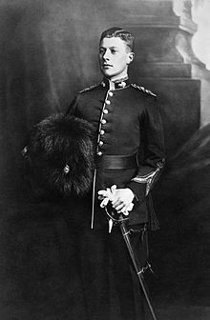
Maurice James Dease, British Army officer during World War I, dies in Mons, Belgium on August 23, 1914. He is one of the first British officer battle casualties of the war and the first posthumous recipient of the Victoria Cross in the war.

Dease is born on September 28, 1889 in Gaulstown, Coole, County Westmeath to Edmund Fitzlaurence and Katherine Murray Dease. He is educated at Stonyhurst College and the Army Department of Wimbledon College before attending the Royal Military College, Sandhurst. He is 24 years old, and a lieutenant in the 4th Battalion, the Royal Fusiliers, and is awarded the Victoria Cross for his actions on 23 August 1914, at Mons, Belgium.

Nimy Bridge is being defended by a single company of the 4th Royal Fusiliers and a machine-gun section with Dease in command. The gunfire is intense and the casualties very heavy, but the lieutenant continues to fire in spite of his wounds, until he is hit for the fifth time and is carried away.

Dease wins the first Victoria Cross to be awarded in the Great War and he receives it on the first day of the first significant British encounter in that war.

When Lieutenant Dease has been mortally wounded, Private Sidney Godley offers to defend the Railway Bridge while the rest of the section retreats and is also awarded the Victoria Cross. He is taken prisoner of war.

Dease is buried at St. Symphorien Military Cemetery, 2 kilometres east of Mons, Belgium. He is remembered with a plaque under the Nimy Railway Bridge, Mons and in Westminster Cathedral. His name is on the wayside cross in Woodchester, Stroud, Gloucestershire, on a cross at Exton, Rutland and on a plaque installed in St. Martin’s Church, Culmullen, County Meath. His Victoria Cross is displayed at the Royal Fusiliers Museum in the Tower of London. Victoria Cross holders are being honoured with commemorative paving stones. Dease’s is the first to be unveiled on August 23, 2014 at Glasnevin Cemetery, Dublin.

Dease is portrayed in the BBC Three series Our World War (2014) by Dominic Thorburn.


Leave a comment

St. Columba Encounters Monster in Loch Ness

columba-and-loch-ness-monster

St. Columba is said to have encountered the Loch Ness Monster on August 22, 565.

Columba is trained by Irish monks. However, his youthful Christianity is skin-deep while his passions are strong. He is partly responsible for the battle of Cul-drebene in which many men lose their lives. Repentant, he sails to Britain as “a pilgrim for Christ” and founds the monastery of Iona, from which Christianity spreads across North Britain. He himself travels and preaches, establishing several churches and monasteries.

Revered as a saint, his life is written by Adomnán. In reporting Columba’s life, Adomnán gives what appears to be the first written account of the Loch Ness Monster.

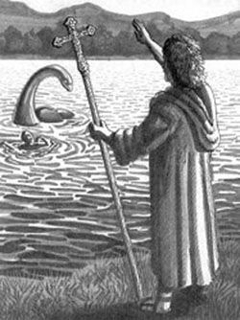
Traveling in Scotland, Columba has to cross the Loch Ness. On its banks, he sees some of the Picts burying a man who had been bitten by a water monster while swimming. The body had been pulled from the loch with the aid of a hook by rescuers who had come to his assistance in a boat.

Despite the danger, Columba orders one of his followers to swim across the loch and bring back a boat that is moored on the other side. This man’s name was Lugne Mocumin. Without hesitation, Lugne strips for the swim and plunges in.

The monster, robbed of its earlier feast, surfaces and darts at Lugne with a roar, its jaws open. Everyone on the bank is stupefied with terror, everyone except Columba, that is. A firm believer in the authority of the crucified Christ, he raises his hand, making the sign of the cross. Invoking the name of God, he commands the beast, saying, “You will go no further, and won’t touch the man; go back at once.”

At the voice of the saint, the monster flees as if terrified, “more quickly than if it had been pulled back with ropes,” says Adomnán. The heathens are amazed. Everyone who witnesses the sight gives glory to the God of the Christians.

The authenticity of this event remains in doubt. To begin with, Adomnán’s account is written over a hundred years after the alleged events. Furthermore, different versions of the story disagree with one another. One has Columba raising the monster’s first victim from the dead by laying his staff across his chest.

This is only one of many extraordinary events in Adomnán’s account. According to him, Columba drips with prophecies and predictions that come true. He makes water into wine like Jesus, draws water from a rock like Moses, calms a storm at sea, provides a miraculous draught of fishes, multiplies a herd of cattle, drives a demon out of a milk pail, and cures the sick. A book owned by Columba could not be destroyed by water. Through his prayers he kills a wild boar, stops serpents from harming the inhabitants of a certain island. Angels and manifestations of divine light attend him throughout his life. Adomnán’s account has so many incredible tales that it is unbelievable.

(From “Columba Encountered Loch Ness Monster” by Dan Graves, MSL published on Christianity.com)


Leave a comment

Death of Denis Devlin, Poet & Diplomat

denis-devlin

Denis Devlin, one of the major figures and influences of modern and modernist Irish poetry, dies in Dublin on August 21, 1959. Along with Samuel Beckett and Brian Coffey, he is one of the generation of Irish modernist poets to emerge at the end of the 1920s. He is also a career diplomat.

Devlin is born in Greenock, Scotland of Irish parents on April 15, 1908. His family returns to live in Dublin in 1918. He studies at Belvedere College and, from 1926, as a seminarian for the Roman Catholic priesthood at Clonliffe College. As part of his studies, he attends a degree course in modern languages at University College Dublin (UCD), where he meets and befriends Brian Coffey. Together they publish a joint collection, Poems, in 1930.

In 1927, Devlin abandons the priesthood and leaves Clonliffe College. He graduates from UCD with his BA in 1930 and spends that summer on the Blasket Islands to improve his spoken Irish. Between 1930 and 1933, he studies literature at Ludwig Maximilian University of Munich and the University of Paris, meeting, amongst others, Beckett and Thomas MacGreevy. He then returns to UCD to complete his MA thesis on Michael de Montaigne.

Devlin joins the Irish Diplomatic Service in 1935 and spends a number of years in Rome, New York and Washington, D.C. During this time, he meets the French poet Saint-John Perse, and the Americans Allen Tate and Robert Penn Warren. He goes on to publish a translation of Exile and Other Poems by Saint-John Perse, and Tate and Warren edit his posthumous Selected Poems.

Denis Devlin dies suddenly at the age of 51 in Dublin on August 21, 1959. Since his death, there have been two Collected Poems published; the first in 1964 is edited by Coffey and the second in 1989 by J.C.C. Mays.

Devlin’s personal papers are held in University College Dublin Archives.


Leave a comment

The Burke and Wills Expedition

burke-and-wills-statue

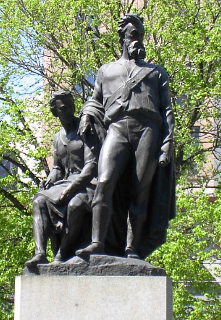
The Burke and Wills expedition, led by Robert O’Hara Burke, an Irish soldier and police officer, leaves Melbourne on August 20, 1860, ultimately becoming the first expedition to cross Australia from south to north, finding a route across the continent from the settled areas of Victoria to the Gulf of Carpentaria.

Burke is born in St. Clerens, County Galway on May 6, 1821. He migrates to Australia in 1853 arriving in Hobart, Tasmania on February 12, 1853, and promptly sailing for Melbourne.

After the South Australian explorer John McDouall Stuart reaches the centre of Australia, the Parliament of South Australia offers a reward of £2,000 for the promotion of an expedition to cross the continent from south to north, generally following Stuart’s route.

In June 1860, Burke is appointed to lead the Victorian Exploring Expedition with William John Wills, his third-in-command, as surveyor and astronomical observer.

The expedition leaves Melbourne on Monday, August 20, 1860, with a total of 19 men, 27 camels and 23 horses. They reach Menindee on September 23, 1860, where several people resign, including the second-in-command, George James Landells, and the medical officer, Dr. Hermann Beckler.

Cooper Creek, 400 miles further on, is reached on November 11, 1860, by the advance group, the remainder being intended to catch up. After a break, Burke decides to make a dash to the Gulf of Carpentaria, leaving on December 16, 1860. William Brahe is left in charge of the remaining party. The small team of Burke, William Wills, John King and Charley Gray reach the mangroves on the estuary of the Flinders River, near where the town of Normanton now stands, on February 9, 1861. Flooding rains and swamps prevent them from seeing the open ocean.

Already weakened by starvation and exposure, progress on the return journey is slow and hampered by the tropical monsoon downpours of the wet season. Gray dies four days before they reach the rendezvous at Cooper Creek. The other three rest for a day when they bury him. They eventually reach the rendezvous point on April 21, 1861, nine hours after the rest of the party had given up waiting and left, leaving a note and some food, as they had not been relieved by the party supposed to be returning from Menindee.

They attempt to reach Mount Hopeless, the furthest outpost of pastoral settlement in South Australia, which is closer than Menindee, but fail and return to Cooper Creek. While waiting for rescue Wills dies of exhaustion and starvation. Soon after, Burke also dies, at a place now called Burke’s Waterhole on Cooper Creek in South Australia. The exact date of Burke’s death is uncertain but has generally been accepted to be June 28, 1861.

King survives with the help of Aborigines until he is rescued in September by Alfred William Howitt. Howitt buries Burke and Wills before returning to Melbourne. In 1862 Howitt returns to Cooper Creek and disinters the bodies of Burke and Wills, taking them first to Adelaide and then by steamer to Melbourne where they are laid in state for two weeks. On January 23, 1863, Burke and Wills receive a state funeral and are buried in Melbourne General Cemetery.

(Pictured: Burke and Wills Statue on the corner of Collins and Swanston Street, Melbourne)


Leave a comment

The Catalpa Rescue

catalpa

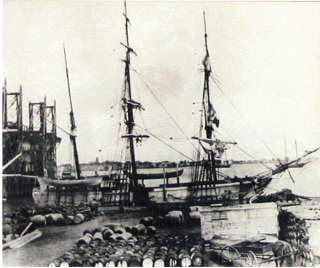
The whaling ship Catalpa is given a tumultuous welcome as it sails into New York harbor on August 19, 1876. She has no whales on board, but a far more valuable cargo, six Fenian prisoners from the British penal colony of Western Australia.

Clan na Gael‘s John Devoy, with the help of his friend John Boyle O’Reilly, a Fenian who had once escaped from Australia himself and editor of the Boston newspaper The Pilot, plan the escape. Somehow maintaining the secrecy of the mission, the two arrange to buy and crew the whaler Catalpa, purchased in New Bedford, Massachusetts, for the attempt.

The Catalpa sets out in April 1875 with most of the crew unaware of their actual mission. They reach western Australia in March 1876.

The first intended day for escape from the penal colony is April 6, but the appearance of HMS Convict and other Royal Navy ships and customs officers quickly lead to a postponement. The escape is rearranged for April 17, when most of the Convict Establishment garrison is watching the Royal Perth Yacht Club regatta.

Catalpa drops anchor in international waters off Rockingham and dispatches a whaleboat to shore. At 8:30 AM, six Fenians, Thomas Darragh, Martin Hogan, Michael Harrington, Thomas Hassett, Robert Cranston and James Wilson, who are working in work parties outside the prison walls abscond. They are met by Fenian agents John Breslin and Thomas Desmond and picked up in horse traps. A seventh Fenian, James Kiely, is left behind. The men race 12 miles south to Rockingham pier where Captain George Smith Anthony awaits them with the whaleboat. A local named Bell he had spoken to earlier sees the men and quickly alerts the authorities.

As they row to the Catalpa a fierce squall strikes, breaking the whaleboat’s mast. The storm lasts until dawn on April 18 and is so intense that Anthony later states that he did not expect the small boat to survive. At 7:00 AM, with the storm over, they again make for the Catalpa but an hour later spot the screw steamer SS Georgette, which has been commandeered by the colonial governor, heading for the whaler. The men lay down in the whaleboat and it is not seen by the SS Georgette. The SS Georgette finds the Catalpa, but in Captain Anthony’s absence the First Mate refuses to allow the colonial police to board as the ship is outside the colony’s three-mile limit. The steamer is forced to return to Fremantle for coal after following the Catalpa for several hours.

As the whaleboat again makes for the ship a police cutter with 30 to 40 armed men is spotted. The two boats race to reach the Catalpa first, with the whaleboat winning, and the men climbing aboard as the police cutter passes by. The cutter turns, lingers briefly beside the Catalpa, and then heads to shore.

Early on April 19 the refuelled and now heavily armed SS Georgette returns and comes alongside the whaler, demanding the surrender of the prisoners and attempting to herd the ship back into Australian waters. They fire a warning shot with the 12-pounder cannon that had been installed the night before. Ignoring the demand to surrender, Anthony raises and then points towards the U.S. flag, informing the SS Georgette that an attack on the Catalpa will be considered an act of war against the United States, and proceeds westward.

Governor William Cleaver Robinson has ordered the police on the SS Georgette not to create an incident outside territorial waters. After steaming around threateningly for about an hour, the SS Georgette heads back to Fremantle and Catalpa slips away into the Indian Ocean.

The Catalpa does its best to avoid Royal Navy ships on its way back to the United States. O’Reilly receives the news of the escape on June 6 and releases the news to the press. The news sparks celebrations in the United States and Ireland and anger in Britain and Australia, although there is also sympathy for the cause within the Australian population. The Catalpa arrives in New York Harbor on August 19, 1876. Clan na Gael and the Fenians achieve one of their greatest victories over the British Empire.


Leave a comment

Birth of James Caulfeild, 1st Earl of Charlemont

james-caulfeild

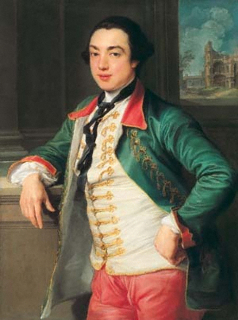
James Caulfeild, 1st Earl of Charlemont, Irish statesman, soldier and nationalist, is born in Dublin on August 18, 1728.

Caulfeild, the son of the 3rd Viscount Charlemont, succeeds his father as 4th Viscount in 1734. The title of Charlemont descends from Sir Toby Caulfeild, 1st Baron Caulfeild (1565–1627) of Oxfordshire, England, who is given lands in Ireland, and creates Baron Charlemont (the name of a fort on the Blackwater), for his services to King James I in 1620. The 1st Viscount is the 5th Baron (d. 1671), who is advanced by Charles II.

Lord Charlemont is well known for his love of Classical art and culture and spends nine years on the Grand Tour in Italy, Greece, Turkey and Egypt. He returns to Dublin and employs the Scottish architect Sir William Chambers to remodel his main residence Marino House, to design his town house Charlemont House and the unique Neoclassical Garden pavilion building, the Casino at Marino.

Lord Charlemont is historically interesting for his political connection with Henry Flood and Henry Grattan. He is a cultivated man with literary and artistic tastes, and both in Dublin and in London he has considerable social influence. He is the first President of the Royal Irish Academy and is a member of the Royal Dublin Society. He is appointed Custos Rotulorum of County Armagh for life in 1760. For various early services in Ireland, he is made an earl in 1763, but he disregards court favours and cordially joins Grattan in 1780 in the assertion of Irish independence. In 1783 he is made a founding Knight of the Order of St. Patrick.

Lord Charlemont is president of the volunteer convention in Dublin in November 1783, having taken a leading part in the formation of the Irish Volunteers, and he is a strong opponent of the proposals for the Acts of Union 1800. His eldest son, who succeeds him, is subsequently created an English Baron in 1837.

Lord Charlemont dies on August 4, 1799.

(Pictured: Charlemont as painted by Pompeo Batoni, c. 1753-56)