seamus dubhghaill

Promoting Irish Culture and History from Little Rock, Arkansas, USA


1 Comment

Birth of Joseph Stock, Bishop of Waterford & Lismore

joseph-stock

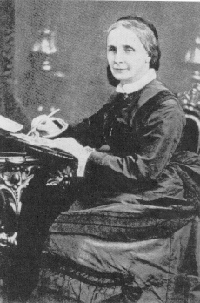
Joseph Stock, Irish Protestant churchman and writer, Bishop of Killala and Achonry, and afterwards Bishop of Waterford and Lismore, is born at 1 Dame Street, Dublin, on December 22, 1740.

Stock is the son of Luke and Ann Stock. He is educated at Mr. Gast’s school in his native city and at Trinity College, Dublin. He obtains a scholarship in 1759, graduates B.A. in 1761, and gains a fellowship in 1763. Having taken orders, Stock retires on the college living of Conwall in the diocese of Raphoe.

Stock is a classical scholar, a linguist, and a man of general culture. In 1776 he publishes anonymously a life of George Berkeley, subsequently republished in the Biographia Britannica, the only memoir on Berkeley based on contemporary information.

In 1793 Stock is collated prebendary of Lismore, but resigns this preferment in 1795, on his appointment to the head-mastership of Portora Royal School. In January 1798 he succeeds John Porter as Bishop of Killala and Achonry. Shortly after his consecration, and while holding his first visitation at the castle of Killala, the bishop becomes a prisoner of the French army under General Jean Joseph Amable Humbert, when French forces land in support of the Irish Rebellion of 1798. Of his experiences as a prisoner of the French he leaves a partial record in his private diary — August 23 to September 15, 1798 — which is printed in William Hamilton Maxwell‘s History of the Rebellion of 1798, and in two letters to his brother Stephen, published in the Auckland Correspondence.

In 1799 Stock publishes a more complete account of the French invasion of County Mayo in his Narrative of what passed at Killala in the Summer of 1798. By an Eyewitness. The impartiality of this work is said to have been a bar to the bishop’s advancement. He also writes The Book of the Prophet Isaiah in Hebrew and English, with Notes (Bath, 1803) and The Book of Job metrically arranged and newly translated into English, with Notes (Bath, 1805).

Stock also publishes school editions of Tacitus and Demosthenes, and is an active contributor to the controversial theology of his day. He leaves two manuscript volumes of correspondence which are preserved in the library of Trinity College, Dublin. They consist chiefly of letters written from Killala and Waterford between 1806 and 1813 to his son Henry in Dublin.

In 1810 Stock is translated to the diocese of Waterford and Lismore, and dies at Waterford on August 13, 1813.


Leave a comment

Birth of Gerald Griffin, Novelist & Playwright

gerald-griffin

Gerald Griffin, Irish novelist, poet, and playwright, born in Limerick on December 12, 1803.

Griffin is the twelfth of the fifteen surviving children in his family. His father, Patrick Griffin, is a brewery farmer, and his mother, Ellen Griffin, of the ancient Gaelic family of the O’Briens, is very cultivated and much interested in literature.

Griffin goes to London in 1823 and becomes a reporter for one of the daily papers. He later turns to writing fiction. One of his most famous works is The Collegians, a novel based on a trial he has reported on, that of John Scanlan, a Protestant Anglo-Irish man who murdered Ellen Hanley, a young Irish Catholic girl. The novel is adapted to the stage as The Colleen Bawn, by Dion Boucicault.

In September 1838, Griffin informs his family of his intention of joining the Congregation of Christian Brothers. He enters the novitiate at North Richmond Street, Dublin, on September 8. He embarks on his new career with intense dedication, abandoning his literary work entirely. He is then admitted to the religious habit on the feast of St. Theresa and embarks on a two-year novitiate. His distaste for his earlier vocation is allayed to the extent that he is willing to undertake the composition of a few tales of a pious nature, but he is also desperately determined to avoid as much as possible the renewal of old contacts and the reopening of painful associations. Griffin burns most all of his unpublished manuscripts, preserving only a few poems and the tragedy, Gisippus.

Griffin dies at the North Monastery, Cork, from typhus fever on June 12, 1840. He is buried in the community’s graveyard on June 15.

Gerald Griffin has a street named after him in Limerick City and another in Cork City. Loughill/Ballyhahill GAA club in west Limerick plays under the name of Gerald Griffins.


Leave a comment

Birth of Kate O’Brien, Novelist and Playwright

kate-obrien

Kathleen Mary Louise “Kate” O’Brien, novelist and playwright, is born in Limerick, County Limerick, on December 3, 1897. She becomes best known for her 1934 novel The Ante-Room, her 1941 novel The Land of Spices, and the 1946 novel That Lady.

Following the death of her mother when she is five, O’Brien becomes a boarder at Laurel Hill Convent. She graduates in English and French from the newly established University College Dublin, and then moves to London, where she works as a teacher for a year.

In 1922–23, she works as a governess in the Basque Country, in the north of Spain, where she begins to write fiction. Upon her return to England, O’Brien works at the Manchester Guardian. After the success of her play Distinguished Villa in 1926, she takes to full-time writing and is awarded both the 1931 James Tait Black Memorial Prize and the Hawthornden Prize for her debut novel Without My Cloak.

Many of her books deal with issues of female agency and sexuality in ways that are new and radical at the time. Her 1936 novel, Mary Lavelle, is banned in Ireland and Spain, while The Land of Spices is banned in Ireland upon publication. In addition to novels, she writes plays, film scripts, short stories, essays, copious journalism, two biographical studies, and two very personal travelogues.

Throughout her life, O’Brien feels a particular affinity with Spain. While her experiences in the Basque Country inspire Mary Lavelle, she also writes a life of the Spanish mystic Teresa of Ávila, and she uses the relationship between the Spanish king Philip II and Maria de Mendoza to write the anti-fascist novel That Lady.

O’Brien writes a political travelogue, Farewell Spain, to gather support for the leftist cause in the Spanish Civil War, and it is believed that she is close to anarchism in the 1930s. A feminist, her novels promote gender equality and are mostly protagonised by young women yearning for independence. With several of her books including positive gay/lesbian characters, O’Brien’s determination to encourage a greater understanding of sexual diversity makes her a pioneer in gay literary representation. She is very critical of conservatism in Ireland, and by spearheading a challenge to the Irish Censorship Act, she helps bring to an end the cultural restrictions of the 1930s and 1940s in the country. She lives much of her life in England and died in Faversham, near Canterbury, on August 13, 1974.

The Glucksman Library at the University of Limerick holds an important collection of O’Brien’s writings. The Limerick Literary Festival in honour of Kate O’Brien, formerly the Kate O’Brien Weekend, takes place in Limerick every year, attracting academic and non-academic audiences.


Leave a comment

Birth of Writer John McGahern

John McGahern, regarded as one of the most important Irish writers of the latter half of the twentieth century, is born in Knockanroe about half a mile from Ballinamore, County Leitrim, on November 12, 1934. Known for the detailed dissection of Irish life found in works such as The Barracks, The Dark, and Amongst Women, The Observer hails him as “the greatest living Irish novelist” before his death in 2006.

McGahern is the eldest child of seven. Raised alongside his six young siblings on a small farm in Knockanroe, McGahern’s mother runs the farm with some local help whilst maintaining a job as a primary school teacher in the local school. His father, a Garda sergeant, lives in the Garda barracks at Cootehall in County Roscommon, a somewhat sizeable distant away from his family at the time. In 1944, when McGahern is ten years old, his mother dies of cancer, resulting in the unrooting of the McGahern children to their new home with their father in the Garda barracks at Cootehall.

In the years following his mother’s death, McGahern completes his primary schooling in the local primary school, and ultimately wins a scholarship to the Presentation Brothers secondary school in Carrick-on-Shannon. Having travelled daily to complete his second level education, McGahern continues to accumulate academic accolades by winning the county scholarship in his Leaving Certificate enabling him to continue his education to third level.

Following his second level success, McGahern is offered a place at St. Patrick’s College of Education in Drumcondra where he trains to be a teacher. Upon graduation from third level education, McGahern begins his career as a primary schoolteacher at Scoil Eoin Báiste primary school in Clontarf where, for a period, he teaches the eminent academic Declan Kiberd, before returning to third level education in University College Dublin where he graduates in 1957. He is first published by the London literary and arts review magazine, X, which publishes in 1961 an extract from his unpublished first novel, The End or Beginning of Love.

McGahern’s first published novel, The Barracks (1963), chronicles the life of the barrack’s Garda sergeant’s second wife, Elizabeth Reegan, who is in the decline of health due to cancer. The Barracks is adapted for the stage in 1969 by Hugh Leonard.

McGahern marries his first wife, Finnish-born Annikki Laaski, in 1965 and in the same year publishes his second novel, The Dark, which is banned by the Irish Censorship Board for its alleged pornographic content along with its implied sexual abuse by the protagonist’s father. Due to the controversy, which is stirred by the book’s publication, McGahern is dismissed from his teaching post and forced to move to England where he works in a variety of jobs, including on building sites, before returning to Ireland to live and work on a small farm near Fenagh in County Leitrim.

After the publications of The Leavetaking (1974) and The Pornographer (1975), his fifth and perhaps best-known novel, Amongst Women, is published in 1990. The novel details the story of Michael Moran, an Irish Republican Army (IRA) veteran of the Irish War of Independence and the Irish Civil War, who now dominates his family in the unforgiving farmlands of County Leitrim, near Mohill.

John McGahern dies from cancer at the age of 71 in the Mater Hospital in Dublin on March 30, 2006. He is buried in St. Patrick’s Church Aughawillan alongside his mother.


Leave a comment

Samuel Beckett Awarded the 1969 Nobel Prize for Literature

samuel-beckett

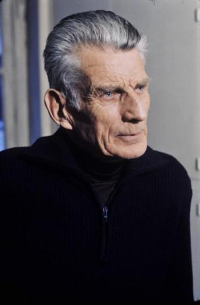
Samuel Barclay Beckett, Irish avant-garde novelist, playwright, theatre director, and poet, is awarded the Nobel Prize in Literature on October 23, 1969. Beckett lives in Paris for most of his adult life and writes in both English and French. He is widely regarded as among the most influential writers of the 20th century. He is elected Saoi of Aosdána in 1984.

Beckett’s work offers a bleak, tragicomic outlook on human existence, often coupled with black comedy and gallows humour, and becomes increasingly minimalist in his later career. He is considered one of the last modernist writers, and one of the key figures in what Martin Esslin calls the “Theatre of the Absurd.” Waiting for Godot is generally regarded as his best-known play.

In October 1969 while on holiday in Tunis with his wife Suzanne, Beckett hears that he has won the Nobel Prize for Literature. Anticipating that her intensely private husband would be saddled with fame from that moment on, Suzanne calls the award a “catastrophe.” In true ascetic fashion, he gives away all of the prize money. While Beckett does not devote much time to interviews, he sometimes meets the artists, scholars, and admirers who seek him out in the anonymous lobby of the Hotel PLM St. Jacques in Paris near his Montparnasse home. Although Beckett is an intensely private man, a review of the second volume of his letters by Roy Foster in the December 15, 2011 issue of The New Republic reveals Beckett to be not only unexpectedly amiable but frequently prepared to talk about his work and the process behind it.

Confined to a nursing home and suffering from emphysema and possibly Parkinson’s disease, Beckett dies on 22 December 22, 1989, just five months after the passing of Suzanne. The two are interred together in the Cimetière du Montparnasse in Paris and share a simple granite gravestone that follows Beckett’s directive that it should be “any colour, so long as it’s grey.”

Of all the English-language modernists, Beckett’s work represents the most sustained attack on the realist tradition. He opens up the possibility of theatre and fiction that dispense with conventional plot and the unities of time and place in order to focus on essential components of the human condition.

On December 10, 2009, a new bridge across the River Liffey in Dublin is opened and named the Samuel Beckett Bridge in his honour. Reminiscent of a harp on its side, it is designed by the celebrated Spanish architect Santiago Calatrava, who also designed the James Joyce Bridge further upstream. The newest ship of the Irish Naval Service, the LÉ Samuel Beckett (P61), is named for Beckett. An Ulster History Circle blue plaque in his memory is located at Portora Royal School, Enniskillen, County Fermanagh.


Leave a comment

Birth of Oscar Wilde

oscar-wilde

Oscar Fingal O’Flahertie Wills Wilde, playwright, novelist, essayist, and poet, is born on October 16, 1854, at 21 Westland Row, Dublin, now home of the Oscar Wilde Centre, Trinity College. After writing in different forms throughout the 1880s, he becomes one of London‘s most popular playwrights in the early 1890s. He is remembered for his epigrams, his novel The Picture of Dorian Gray, his plays, as well as the circumstances of his imprisonment and early death.

Wilde’s parents are successful Anglo-Irish Dublin intellectuals. Their son becomes fluent in French and German early in life. At university, Wilde read Greats and proves himself to be an outstanding classicist, first at Dublin, then at Magdalen College, Oxford. He becomes known for his involvement in the rising philosophy of aestheticism, led by two of his tutors, Walter Pater and John Ruskin. After university, Wilde moves to London into fashionable cultural and social circles.

As a spokesman for aestheticism, Wilde tries his hand at various literary activities. He publishes a book of poems, lectures in the United States and Canada on the new “English Renaissance in Art,” and then returns to London where he works prolifically as a journalist. Known for his biting wit, flamboyant dress and glittering conversation, Wilde becomes one of the best-known personalities of his day.

At the turn of the 1890s, he refines his ideas about the supremacy of art in a series of dialogues and essays, and incorporates themes of decadence, duplicity, and beauty into his only novel, The Picture of Dorian Gray (1890). The opportunity to construct aesthetic details precisely, and combine them with larger social themes, draws Wilde to write drama. He writes Salome (1891) in French in Paris, but it is refused a licence for England due to the absolute prohibition of Biblical subjects on the English stage. Unperturbed, Wilde produces four society comedies in the early 1890s, which make him one of the most successful playwrights of late Victorian London.

At the height of his fame and success, while his masterpiece, The Importance of Being Earnest (1895), is still on stage in London, Wilde has the John Douglas, 9th Marquess of Queensberry prosecuted for libel. The Marquess is the father of Wilde’s lover, Lord Alfred Douglas. The charge carries a penalty of up to two years in prison. The trial unearths evidence that causes Wilde to drop his charges and leads to his own arrest and trial for gross indecency with men. After two more trials he is convicted and imprisoned for two years’ penal labour.

In 1897, in prison, he writes De Profundis, which is published in 1905, a long letter which discusses his spiritual journey through his trials, forming a dark counterpoint to his earlier philosophy of pleasure. Upon his release he leaves immediately for France, never to return to Ireland or Britain. There he writes his last work, The Ballad of Reading Gaol (1898), a long poem commemorating the harsh rhythms of prison life.

Wilde dies destitute of cerebral meningitis in Paris on November 30, 1900. at the age of 46. He is initially buried in the Cimetière parisien de Bagneux outside Paris. In 1909 his remains are disinterred and transferred to Père Lachaise Cemetery, inside the city.


Leave a comment

Seamus Heaney Awarded Nobel Prize in Literature

seamus-heaney

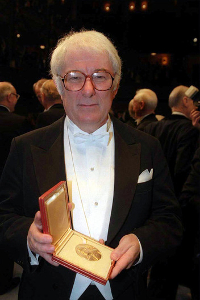
Seamus Heaney, poet, playwright, translator, and lecturer, is awarded the Nobel Prize in Literature on October 15, 1995.

Heaney is born in April 1939 near Castledawson, County Derry, Northern Ireland, where his family engages in farming and selling cattle. His education includes studies at Queen’s University Belfast, where he also serves as a lecturer in the late 1960s. He makes his debut as a poet then, but continues to divide his time between his own writing and academia. He works at Carysforth College in Dublin, at Harvard University in Cambridge, Massachusetts, and at Oxford University.

Heaney’s poetry is often down-to-earth. For him, poetry is like the earth – something that must be plowed and turned. Often he paints the gray and damp landscape from the British Isles. Peat moss has a special place in his poetry. The poems often are connected with daily experiences, but they also derive motifs from history, all the way back to prehistoric times. Heany’s profound interest in the Celtic and the pre-Christian as well as in Catholic literary tradition has found expression in a number of essays and translations.

Heaney is awarded the Nobel Prize in Literature in 1995 for what the Nobel committee describes as “works of lyrical beauty and ethical depth, which exalt everyday miracles and the living past.” He is on holiday in Greece with his wife, Marie, when the news breaks. No one, not even journalists or his own children, can locate him until he appears at Dublin Airport two days later, though an Irish television camera traces him to Kalamata. Asked how it feels having his name added to the Irish Nobel pantheon featuring William Butler Yeats, George Bernard Shaw, and Samuel Beckett, Heaney responds, “It’s like being a little foothill at the bottom of a mountain range. You hope you just live up to it. It’s extraordinary.” He and Marie are immediately whisked straight from the airport to Áras an Uachtaráin for champagne with President Mary Robinson.


Leave a comment

Death of Novelist Edith Anna Œnone Somerville

edith-somerville

Edith Anna Œnone Somerville, Irish novelist who habitually signs herself as “E. Œ. Somerville,” dies at Castletownshend, County Cork, at the age of 91 on October 8, 1949. She writes in collaboration with her second cousin, Violet Florence Martin, who writes under the pseudonym Martin Ross. Together they publish a series of fourteen stories and novels under the pseudonym Somerville and Ross, the most popular of which are The Real Charlotte and Some Experiences of an Irish R. M., published in 1899.

The eldest of eight children, Somerville is born on the island of Corfu, then part of the United States of the Ionian Islands, a British protectorate where her father is stationed. A year later, her father retires to Drishane, Castletownshend, County Cork, where Somerville grows up. She receives her primary education at home, and then attends Alexandra College in Dublin. In 1884 she studies art in Paris, and then spends a term at the Westminster School of Art in Dean’s Yard, Westminster. At home, riding and painting are her absorbing interests.

In January 1886, she meets her second cousin, Violet Martin, and their literary partnership begins the following year. Their first book, An Irish Cousin, appears in 1889, under the names Geilles Herring (from the maiden name of her ancestor, the wife of Sir Walter de Somerville of Linton and Carnwath) and Martin Ross, though the pen names are dropped after the first edition. In 1898, Edith Somerville goes to paint at the Etaples art colony, accompanied by Violet. There they profit from their stay by conceiving together the stories later gathered in Some Experiences of an Irish R. M., completed the following year. By the time Violet dies in 1915, they have published fourteen books together. Her cousin’s death stuns Edith, who continues to write as “Somerville and Ross,” claiming that they keep in contact through spiritualist séances.

Somerville is a devoted sportswoman who in 1903 has become master of the Carbery West Foxhounds. She is also active in the suffragist movement, corresponding with Dame Ethel Smyth. She is in London still recovering from the shock of Violet’s death when the 1916 Easter Rising breaks out. On May 9 she writes a letter to The Times, blaming the British government for the state of affairs in Ireland. After that she tends towards Nationalism and, as an adept musician at parties, she specializes in Irish tunes and Nationalist songs.

She has exhibitions of her pictures in Dublin and in London between 1920 and 1938 and is active as an illustrator of children’s picture books and sporting picture books.

In 1936, her brother Henry Boyle Townsend Somerville, a retired Vice-Admiral in the Royal Navy, is killed by the Irish Republican Army (IRA) at the family home of Castletownshend. She finishes his book Will Mariner after his death.


Leave a comment

Birth of Irish-Australian Novelist Thomas Michael Keneally

thomas-michael-keneally

Thomas Michael Keneally, Irish-Australian novelist, playwright, and author of non-fiction, is born in Sydney, New South Wales, Australia, on October 7, 1935.

The son of Edmund Thomas and Elsie Margaret (Coyle) Keneally, he grows up in Kempsey and is educated at St. Patrick’s College, Strathfield where, subsequently, a writing prize has been named after him. Keneally enters St. Patrick’s Seminary, Manly to train as a Catholic priest. Although he is ordained as a deacon while at the seminary, he leaves without being ordained into the priesthood. He works as a Sydney schoolteacher before his success as a novelist and is a lecturer at the University of New England from 1968–1970.

Keneally is known as “Mick” until 1964 but, upon the advice of his publisher to use his real first name, begins using the name Thomas when he starts publishing. He is most famous for writing Man Booker Prize winner Schindler’s Ark (1982) which is later republished as Schindler’s List, and is later adapted to Steven Spielberg‘s Schindler’s List, which wins the Academy Award for Best Picture. Many of Keneally’s novels are reworkings of historical material, although modern in their psychology and style.

Keneally also acts in a handful of films. He has a small role in The Chant of Jimmie Blacksmith, based on his novel, and plays Father Marshall in the award-winning Fred Schepisi film The Devil’s Playground (1976).

Keneally is a strong advocate of an Australian republic, meaning the abolition of the Australian monarchy, and publishes a book, Our Republic, on the subject in 1993. Several of his Republican essays appear on the web site of the Australian Republican Movement.

Keneally is a keen supporter of rugby league football, in particular the Manly Warringah Sea Eagles club of the National Rugby League. In 2004 he gives the sixth annual Tom Brock Lecture and makes an appearance in the 2007 rugby league drama film The Final Winter.

In March 2009, the Prime Minister of Australia, Kevin Rudd, gives an autographed copy of Keneally’s biography Lincoln to President Barack Obama as a state gift. Recently Keneally has been a featured writer in the critically acclaimed Australian drama Our Sunburnt Country.


Leave a comment

Birth of Playwright & Poet Lennox Robinson

lennox-robinson

Esmé Stuart Lennox Robinson, playwright, poet, theatre producer, and director who is involved with the Abbey Theatre, is born in Westgrove, Douglas, County Cork, on October 4, 1886.

Robinson is raised in a Protestant and Unionist family in which he is the youngest of seven children. His father, Andrew Robinson, is a middle-class stockbroker who in 1892 decides to become a clergyman in the Church of Ireland in the small Ballymoney parish, near Ballineen in West Cork. A sickly child, Robinson is educated by private tutor and at Bandon Grammar School. In August 1907, his interest in the theatre begins after he goes to see an Abbey production of plays by W.B. Yeats and Lady Gregory at the Cork Opera House. He publishes his first poem that same year. His first play, The Cross Roads, is performed in the Abbey in 1909 and he becomes manager of the theatre towards the end of that year. He resigns in 1914 as a result of a disastrous tour of the United States but returns in 1919. He is appointed to the board of the theatre in 1923 and continues to serve in that capacity until his death. His Abbey career and production involvement can be found in the Abbey archives.

As a playwright, Robinson shows himself as a nationalist with plays like Patriots (1912) and Dreamers (1915). On the other hand, he belongs to a part of Irish society which is not seen as fully Irish. This division between the majority native Irish (Roman Catholics) on one side and the Anglo-Irish (Protestants) on the other can be seen in a play such as The Big House (1926), which depicts the burning of a Protestant manor home by the Irish Republican Army (IRA). Robinson’s most popular play is The Whiteheaded Boy (1916).

Other plays include Crabbed Youth and Age (1924), The Far Off Hills (1928), Drama at Inish (1933), and Church Street (1935). Drama at Inish, which is presented in London and on Broadway as Is Life Worth Living?, is revived as part of the 2011 season at the Shaw Festival at Niagara-on-the-Lake, Ontario, Canada, with Mary Haney in the role of Lizzie Twohig. Robinson’s fiction includes Eight Short Stories (1919). In 1931 he publishes a biography of Bryan Cooper, who had recently died. In 1951, he publishes Ireland’s Abbey Theatre, the first full-length history of the company.

He publishes an edited edition of Lady Gregory’s diaries in 1947. In 1958 he co-edits with Donagh MacDonagh The Oxford Book of Irish Verse. He is also a director and producer, in 1930 producing a play by Irish playwright Teresa Deevy called The Reapers. In 1931 he is co-director of A Disciple along with W.B. Yeats and Walter Starkie.

Melancholic and alcoholic in later years, Lennox Robinson dies in Monkstown, County Dublin, on October 15, 1958. He is buried St. Patrick’s Cathedral.