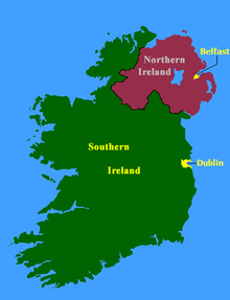
The Northern Ireland Assembly Bill resulting from the White paper becomes law on May 3, 1973, and elections for the new assembly are held on June 28. Republicans boycott the elections and the Irish Republican Army (IRA) continued its campaign of opposition throughout the outcome.
After the Assembly elections, negotiations between the pro-White Paper parties on the formation of a “power-sharing Executive” begin. The main concerns are internment, policing, and the question of a Council of Ireland. On November 21, an agreement is reached on a voluntary coalition of pro-agreement parties. This new power-sharing Executive take up office and have its very first meeting on January 1, 1974. The Ulster Unionist Party (UUP) is deeply divided – its Standing Committee votes to participate in the executive by a margin of only 132 to 105.
Provisions for a Council of Ireland exist in the Government of Ireland Act 1920, but these have never been enacted. Unionists resent the idea of any “interference” by the Republic of Ireland in their newly established region. In 1973, after agreement has been reached on the formation of an executive, agreement is sought to re-establish a Council of Ireland to stimulate co-operation with the Republic of Ireland. Talks are held between December 6-9 in the Berkshire town of Sunningdale between the British Prime MinisterEdward Heath, the Irish TaoiseachLiam Cosgrave and the three pro-agreement parties. On December 9, a communiqué announcing the agreement is issued, which later becomes known as the “Sunningdale Agreement.”
In January 1974, the Ulster Unionist Party narrowly votes against continued participation in the Assembly and Brian Faulkner resigns as leader. He is succeeded by the anti-Sunningdale Harry West. In March 1974, pro-agreement unionists withdraw their support for the agreement, calling for the Republic of Ireland to remove the Articles 2 and 3 of its constitution first. These Articles are not revised until the Good Friday Agreement of 1998.
Following the defeat of a motion condemning power-sharing in the Northern Ireland Assembly, the Ulster Workers’ Council, a loyalist organisation, calls a general strike for May 15. After two weeks of barricades, shortages, rioting, and intimidation, Faulkner resigns as chief executive and the Sunningdale Agreement collapses on May 28, 1974.
(Pictured: Unionist Party leader and designated leader of Ulster’s new executive, Brian Faulkner, sits with SDLP leader Gerry Fitt and John Hume, during talks at Sunningdale, Berkshire, to establish a Council of Ireland.)
The amendment deletes the entirety of Article 44.1.2 which allowed the State to recognise the special position of the Holy Catholic Apostolic and Roman Church as the guardian of the Faith professed by the great majority of the citizens.
In drafting the Irish constitution in 1936 and 1937, Éamon de Valera and his advisers choose to reflect what has been a contemporary willingness by constitution drafters and lawmakers in Europe to mention and in some ways recognise religion in explicit detail. This contrasts with many 1920s constitutions, notably the Constitution of the Irish Free State of 1922, which, following the secularism of the initial period following World War I, simply prohibits any discrimination based on religion or avoids religious issues entirely.
De Valera, his advisers, and the men who put words to de Valera’s concepts for the constitution face conflicting demands in his drafting of the article on religion. In contemporary terms, the Amendment marks a defeat for conservative Catholics and Pope Pius XI explicitly withholds his approval from it.
Though perceived in retrospect as a sectarian article, Article 44 is praised in 1937 by leaders of Irish Protestant churches, notably the Church of Ireland Archbishop of Dublin, and by Jewish groups. Conservative Catholics condemn it as “liberal.”
When the contents of Article 44 are put to Pope Pius XI by Cardinal Eugenio Pacelli, then Cardinal Secretary of State, later Pope Pius XII, the pope states in diplomatic language, “We do not approve, nor do we not disapprove – we will remain silent.” It is said that the Vatican is privately more appreciative of the constitution, and Pius XII later praises it.
The Fifth Amendment is introduced by the Fianna Fáil government of Jack Lynch and supported by every other major political party. The Catholic Church does not voice any objection to the amendment, but it is opposed by some conservative Catholics. Some leading members of the Church of Ireland and the Jewish Community say during the campaign that while they appreciate the Article’s recognition of their existence in 1937, it is no longer needed in the 1970s and has lost its usefulness.
The referendum on the amendment occurs on the same day as the referendum on the Fourth Amendment which lowers the voting age to eighteen. The Fifth Amendment is approved by 721,003 (84.4%) in favour and 133,430 (15.6%) against.
Having completed its passage through the Oireachtas and been adopted by the people, it is enacted by being signed into constitutional law by the President of Ireland, the man who had drafted the original article, Éamon de Valera.
The Free State is established as a Dominion of the British Commonwealth of Nations. For one day, it encompasses all thirty-two counties of Ireland. Northern Ireland, which is comprised of the six northernmost counties, exercises its right under the Treaty to opt out of the new state on December 7.
The Free State government consists of the Governor-General, the representative of the king, and the Executive Council, which replaces both the revolutionary Dáil Government and the Provisional Government set up under the Treaty. W. T. Cosgrave, who had led both of these governments since August 1922, becomes the first President of the Executive Council. The legislature consists of Dáil Éireann, the lower house, and Seanad Éireann, also known as the Senate. Members of the Dáil are required to take an Oath of Allegiance, swearing fidelity to the king. The oath is a key issue for opponents of the Treaty, who refuse to take the oath and therefore do not take their seats. Pro-Treaty members, who form Cumann na nGaedheal in 1923, hold an effective majority in the Dáil from 1922 to 1927, and thereafter rule as a minority government until 1932.
In the first months of the Free State, the Irish Civil War is waged between the newly established National Army and the anti-Treaty IRA, who refuse to recognise the state. The Civil War ends in victory for the government forces, with the anti-Treaty forces dumping its arms in May 1923. The anti-Treaty political party, Sinn Féin, refuses to take its seats in the Dáil, leaving the relatively small Labour Party as the only opposition party. In 1926, when Sinn Féin president Éamon de Valera fails to have this policy reversed, he resigns from Sinn Féin and founds Fianna Fáil. Fianna Fáil enters the Dáil following the 1927 general election, and enters government after the Irish general election of 1932, when it becomes the largest party.
De Valera abolishes the Oath of Allegiance and embarks on an economic war with Britain. In 1937 he drafts a new constitution, which is passed by a referendum in July of that year. The Free State comes to an end with the coming into force of the new constitution on December 29, 1937. Under the new constitution the Irish state is named Ireland.
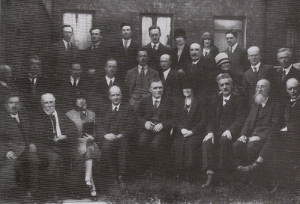
(Pictured: The Executive Council of the Irish Free State, October 1928)
The Good Friday Agreement, a major political development in the Northern Ireland peace process, comes into operation on December 2, 1999, as the British and Irish governments formally notify each other that all the necessary arrangements are in place.
Northern Ireland‘s present devolved system of government is based on the agreement. The agreement also creates a number of institutions between Northern Ireland and the Republic of Ireland, and between the Republic of Ireland and the United Kingdom.
The agreement is made up of two inter-related documents, both agreed upon in Belfast on Good Friday, April 10, 1998. The first is a multi-party agreement by most of Northern Ireland’s political parties. The second is an international agreement between the British and Irish governments, known as the British-Irish Agreement.
The agreement sets out a complex series of provisions, or strands, relating to a number of areas:
Strand 1 addresses the status and system of government of Northern Ireland within the United Kingdom and establishes two major institutions – the Northern Ireland Assembly and the Northern Ireland Executive.
The agreement is approved by voters across the island of Ireland in two referendums held on May 22, 1998. In Northern Ireland, voters are asked whether they support the multi-party agreement. In the Republic of Ireland, voters are asked whether they will allow the state to sign the agreement and allow necessary constitutional changes to facilitate it. The people of both jurisdictions need to approve the agreement in order to give effect to it.
The Good Friday Agreement comes into force on December 2, 1999. The Democratic Unionist Party (DUP) is the only major political group in Northern Ireland to oppose the Good Friday Agreement.
(Pictured: British Prime Minister Tony Blair and Irish Taoiseach Bertie Ahern sign the Good Friday Agreement)
Poynings’ Parliament is called by Sir Edward Poynings in his capacity as Lord Deputy of Ireland, appointed by King Henry VII of England in his capacity as Lord of Ireland. Coming in the aftermath of the divisive Wars of the Roses, Poynings’ intention is to make Ireland once again obedient to the English monarchy. Assembling the Parliament on December 1, 1494, he declares that the Parliament of Ireland is thereafter to be placed under the authority of the Parliament of England. This marks the beginning of Tudor direct rule in Ireland, although Henry VII is still forced to rely on Old English nobles (such as Gerald FitzGerald, 8th Earl of Kildare, despite his support for Lambert Simnel) as his deputies in Ireland through the intervening years.
The working of Poynings’ Law takes place in several steps. The first step is for the lieutenant governor and the Irish council, or Irish executive, to decide that a parliament is needed, usually for the purpose of raising funds. At this point the council and lieutenant write drafts of legislation to be proposed to the king and his council. After this has been completed, the lieutenant and council, according to the act, are required to certify the request for parliament “under the great seal of that land [Ireland],” and then forward it to England for approval. Once the request arrives in England, it is reviewed by the King and his council, and a formal licence approving the request for parliament and the draft bills are returned to Ireland. Once the licence is received in Ireland, the governor summons parliament and the bills are passed.
The two important aspects of the procedure presented by Poynings’ Law are transmission and certification. Both of these requirements place limits on various parties within the law-making process in Ireland. The combination of these processes creates a situation where bills can be sent, along with the request for parliament, and the king can amend and remove such bills as he wishes, however he cannot add new bills himself.
Furthermore, the two processes make it impossible for the Irish to add more bills or amendments to a request, after the initial licence request has been granted. This means that any additional bills or amendments that they wish to pass in parliament have to be re-sent along with an entirely new request for parliament. Clearly this creates severe inefficiencies in the legislative process and thus gives the executive in Ireland as well as the Crown an interest in relaxing procedure.
Poynings’ Law is a major rallying point for later groups seeking self-government for Ireland, particularly the Confederate Catholics in the 1640s and Henry Grattan‘s Patriot Party in the late 18th century, who consistently seek a repeal of Poynings’ Law. The Act remains in place until the Constitution of 1782 gives the Irish parliament legislative independence. The Acts of Union 1800 render most of the Constitution of 1782 and Poynings’ Law moot. Poynings’ Law is formally repealed as obsolete by the Statute Law Revision (Ireland) Act 1878.
In early 1901 he accompanies his father on a special diplomatic mission to announce the accession of King Edward to the governments of Denmark, Sweden and Norway, Russia, Germany, and Saxony.
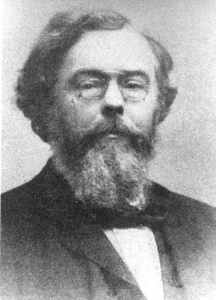
After the death of his mother in 1739, Thomson’s father emigrates to the British colonies in America with Charles and two or three brothers. The father dies at sea, and the penniless boys are separated in America. Charles is cared for by a blacksmith in New Castle, Delaware, and is educated in New London, Pennsylvania. In 1750 he becomes a tutor in Latin at the Philadelphia Academy.
Thomson is a leader in the revolutionary crisis of the early 1770s. John Adams calls him the “Samuel Adams of Philadelphia.” Thomson serves as the secretary of the Continental Congress through its entirety. Through those 15 years, the Congress sees many delegates come and go, but Thomson’s dedication to recording the debates and decisions provides continuity. Along with John Hancock, president of the Congress, Thomson’s name appears on the first published version of the Declaration of Independence in July 1776.
Thomson’s role as secretary to Congress is not limited to clerical duties. According to biographer Boyd Schlenther, Thomson “took a direct role in the conduct of foreign affairs.” Fred S. Rolater has suggested that Charles Thomson was essentially the “Prime Minister of the United States.” Thomson is also noted for designing, with William Barton, the Great Seal of the United States. The Great Seal plays a prominent role in the January 14, 1784, ratification of the Treaty of Paris (1783). Britain’s representatives in Paris initially dispute the placement of the Great Seal and Congressional President Thomas Mifflin‘s signature, until mollified by Benjamin Franklin.
But Thomson’s service is not without its critics. James Searle, a close friend of John Adams, and a delegate, begins a cane fight on the floor of Congress against Thomson over a claim that he was misquoted in the “Minutes” that results in both men being slashed in the face. Such brawls on the floor are not uncommon, and many of them are promoted by argument over Thomson’s recordings. Political disagreements prevent Thomson from getting a position in the new government created by the United States Constitution. Thomson resigns as secretary of Congress in July 1789 and hands over the Great Seal, bringing an end to the Continental Congress.
Thomson spends his final years at Harriton House in Bryn Mawr, Pennsylvania, working on a translation of the Bible. He also publishes a synopsis of the four evangelists in 1815. In retirement, Thomson also pursues his interests in agricultural science and beekeeping. Charles Thomson dies on August 16, 1824, in Lower Merion Township, Pennsylvania. He is buried at Laurel Hill Cemetery in Philadelphia.
At 12:30 PM CST, as Kennedy’s uncovered 1961 Lincoln Continental four-door convertible limousine enters Dealey Plaza, Nellie Connally, the First Lady of Texas, turns around to President Kennedy, who is sitting behind her, and comments, “Mr. President, you can’t say Dallas doesn’t love you,” to which President Kennedy acknowledges by saying “No, you certainly can’t.” These are the last words ever spoken by John F. Kennedy.
From Houston Street, the presidential limousine makes the planned left turn onto Elm Street, allowing it access to the Stemmons Freeway exit. As it turns onto Elm, the motorcade passes the Texas School Book Depository. Shots are fired at Kennedy as the motorcade continues down Elm Street. About 80% of the witnesses recall hearing three shots.
A minority of the witnesses recognize the first gunshot they hear as weapon fire, but there is hardly any reaction to the first shot from a majority of the people in the crowd or those riding in the motorcade. Many later say they heard what they first thought to be a firecracker, or the backfire of a vehicle, just after the President started waving.
Within one second of each other, Kennedy, Texas Governor John Connally, and First Lady Jacqueline Kennedy, all turn abruptly from looking to their left to looking to their right. Connally, like the President a World War II military veteran, testifies that he immediately recognizes the sound of a high-powered rifle. He also testifies that when his head is facing about 20 degrees left of center, he is hit in his upper right back by a bullet he does not hear fired. After Connally is hit he shouts, “Oh, no, no, no. My God. They’re going to kill us all!”
Mrs. Connally testifies that just after hearing a loud, frightening noise that comes from somewhere behind her and to her right, she turns toward President Kennedy and sees him with his arms and elbows raised high, with his hands in front of his face and throat. She then hears another gunshot and then Governor Connally yelling. Mrs. Connally then turns away from Kennedy toward her husband, at which point another gunshot sounds and she and the limousine’s rear interior are covered with fragments of skull, blood, and brain.
According to the Warren Commission and the House Select Committee on Assassinations, as President Kennedy waves to the crowds on his right with his right arm upraised on the side of the limo, a shot enters his upper back, penetrates his neck, slightly damages a spinal vertebra and the top of his right lung, and exits his throat nearly centerline just beneath his larynx, nicking the left side of his suit tie knot. He raises his elbows and clenches his fists in front of his face and neck, then leans forward and left. Mrs. Kennedy, facing him, then puts her arms around him in concern.
A second shot strikes the President as the presidential limousine is passing in front of the John Neely Bryan north pergola concrete structure. Both the Warren Commission and the House Select Committee on Assassinations concludes that the second shot to hit the president enters the rear of his head and passing in fragments through his head, created a large, roughly oval hole on the rear, right side. The president’s blood and fragments of his scalp, brain, and skull land on the interior of the car, the inner and outer surfaces of the front glass windshield and raised sun visors, the front engine hood, the rear trunk lid, the follow-up Secret Service car and its driver’s left arm, and motorcycle officers riding on both sides of the President behind him.
After the President has been shot in the head, Mrs. Kennedy begins to climb out onto the back of the limousine, though she later has no recollection of doing so. United States Secret ServiceSpecial AgentClint Hill, who is riding on the left front running board of the follow-up car, believes she is reaching for something, perhaps a piece of the President’s skull. He jumps onto the back of the limousine while at the same time Mrs. Kennedy returns to her seat. He clings to the car as it exits Dealey Plaza and accelerates, speeding to Parkland Memorial Hospital.
After Mrs. Kennedy crawls back into her limousine seat, both Governor Connally and Mrs. Connally hear her say more than once, “They have killed my husband,” and “I have his brains in my hand.”
The staff at Parkland Hospital’s Trauma Room 1 who treat President Kennedy observe that his condition is “moribund,” meaning that he has no chance of survival upon arriving at the hospital. George Burkley, the President’s personal physician, states that a gunshot wound to the skull is the cause of death. Burkley signs President Kennedy’s death certificate.
At 1:00 PM, CST (19:00 UTC), after all heart activity has ceased and after Father Oscar Huber has administered last rites, the President is pronounced dead.
Jones attends grammar school in Dublin for three years until emigrating with his family to the United States in 1840. They settle on a farm in Cattaraugus County, New York where Jones spends most of his childhood. Because of his poor background, he receives only a limited education at the Union School in Ellicottville. In 1850, the 20-year-old Jones becomes involved in journalism and travels as a correspondent throughout the Western States for a leading New York journal. He later becomes the local editor for the Buffalo Republic and one of the editors of the Buffalo Sentinel.
Eventually, Jones decides to pursue a career in law and later studies under the firm of Addison Rice. He is admitted to the bar in 1856 and afterwards practices law with Addison in Ellicottville as a full partner. By 1860, he has established himself as one of the most prominent lawyers in western New York. A lifelong Democrat, he becomes disillusioned by the party’s support of Southern succession from the Union and, in May 1861, decides to join the military in defense of the United States.
Upon the outbreak of the American Civil War, Jones readily joins the Union Army. On July 7, 1861, he enlisted with the 37th New York Volunteers, popularly known as the “Irish Rifles”, under Colonel John H. McCunn. Jones has a successful career serving in the Union Army, being involved in thirty major battles and countless skirmishes, and reaching the rank of brigadier general. He remains at that rank for the rest of the war and resigns on June 17, 1865. He is one of ten Irish Americans to become brigade commanders and one of four Irish-born officers to become a divisional commander.
After his resignation, Jones resumes his law practice in Ellicottville and in November 1865 is elected on the Republican ticket as Clerk of the New York Court of Appeals. On August 13, 1868, Jones is appointed by Gov. Reuben E. Fenton as Register of New York City to fill the vacancy resulting from the death of Charles G. Halpine. On April 1, 1869, Jones is appointed by President Ulysses S. Grant as Postmaster of New York City. From 1875 to 1877, Jones is again Register of New York City, elected in November 1874 on the Republican ticket. Afterwards he resumes his private practice.
In 1878, Jones is involved in the Alexander T. Stewart bodysnatching case when he is contacted by the kidnappers to act as an intermediary between themselves and the Stewart estate. When negotiations stall between the Stewart family’s lawyer Henry Hilton, he assists Stewart’s widow in negotiating for the return of her husband’s body.
Jones suffers serious medical problems in his old age, specifically deafness and chronic diarrhea, which his physician blames on his exposure to artillery fire and his time in the swamps along the Chickahominy River during his military service. He also suffered from constant pain in his right sciatic nerve, attributed to his old war wound suffered at Chancellorsville, as well as his wound in the gluteal region.
In early July 1900, Jones begins suffering from severe gastroenteritis. His condition does not respond to therapeutic treatments as he loses control of his bowels and is unable to keep down solid food, living on scalded milk and brandy. On July 18, 1900, Jones dies from cardiac failure, indirectly caused by his gastroenteritis, at his home in Port Richmond, New York. His funeral is held at St. Mary’s Church two days later and he is buried in St. Peter’s Cemetery.
Patrick Henry Pearse, teacher, barrister, poet, writer, nationalist, and political activist who is one of the leaders of the 1916 Easter Rising, is born in Dublin on November 10, 1879. Pearse’s father, James, is a stone worker who works on church buildings in Dublin and his mother, Margaret, comes from a family that has endured the Great Famine in 1846 and has left County Meath for Dublin. Here she brings up four children, Patrick being the second. Pearse has a comfortable childhood as his father is in constant work.
It is at school that Pearse first develops a love of Irish history. He is also taught the Irish language for the first time and while still a teenager, Patrick joins the Gaelic League, an organisation that wants to promote the Irish language and Irish literature. Pearse graduates with a law degree from the King’s Inns and, in 1901, he starts a BA course in modern languages but is called to the Bar in Dublin.
Regardless of his law training, Pearse is more interested in what he is learning about Ireland as a nation. All his knowledge about law has been based around the English language and he wants to know more about what he considers to be the rightful language of Ireland. This is not the Gaelic used in Dublin. Pearse has convinced himself that the real Irish language is based in Connaught, and he teaches himself the dialect of the area. Connaught is also a region that has been severely affected by the Great Famine. Therefore, the number of people who speak what Pearse considers to be proper Gaelic have been greatly reduced. From 1903 to 1909, Pearse develops his involvement in the Gaelic League’s An Claidheamh Soluis (The Sword of Light) which seeks to expand the use of Gaelic in Irish life, and, in particular, literature.
By 1909, Pearse has developed some political leanings. He cannot accept the impact England, and all things English have on Ireland and the Irish people, but his concern is more for Irish culture rather than Irish politics. Pearse wants Irish history and culture taught as compulsory subjects in both Irish schools and colleges. He breaks with the Roman Catholic Church when its national college, St. Patrick’s College, Maynooth, demotes courses in Irish history/culture to topics for trainee priests. He is keen for Maynooth to have compulsory Irish courses simply because priests then have a major influence in the areas where they work. However, all of Pearse’s protests fall on deaf ears. As a result, he founds his own school in Dublin, an “Irish-Ireland” school called St. Enda’s School.
Between 1909 and 1912, Pearse becomes more interested and involved in politics. Despite a limited income and the problems of keeping St. Edna’s on an even financial keel, Pearse launches his own newspaper called An Barr Buadh (The Trumpet of Victory). At this time the Home Rule issue has reared its head again. Sinn Féin and other republican movements have far more impact than Pearse, who seems to many to be no more than a political maverick. Many feel that Pearse is out of his depths in politics and that his input into Irish politics is no more than romanticism with an Irish slant.
By 1913, Pearse has become more depressed about the way Ireland is going under the rule of London. Those who know him, describe him as becoming more and more melancholy as the year progresses. Others believe that he is becoming more fanatical. He helps to organise the Irish Volunteers, the public face of the outlawed Irish Republican Brotherhood, before the outbreak of World War I. In 1914, he is sent on a fund-raising tour of America by Clan na Gael, an organisation that aids the Irish Republican Brotherhood. While the tour is a reasonable success financially, not many Americans are swayed by Pearse’s speeches.
By the time World War I starts, Pearse has taken an extreme political stance. He wants full Irish independence – not what the suspended Home Rule Bill of 1912 offers. He does not support the part Ireland plays in the war effort. He also splits the Irish Volunteers. He takes a small number of these men with him when John Redmond gives his agreement to suspend the Home Rule Bill until the war is over. By now, Pearse has become extreme. He publishes a pamphlet called The Murder Machine which is a severe condemnation of the Irish educational system. He also realises that with London totally focused on the war in Europe, the time is ripe to overthrow British rule in Ireland.
However, in this respect, Pearse is totally wrong. The young men who have volunteered to fight in the war have done so because they want to. Pearse has no mass support in Ireland whereas John Redmond has far more public support in the south. He also assumes incorrectly that all those in southern Ireland are completely against British rule. What Pearse fails to recognise, is that many people in Dublin itself rely on the British for work. They may not like this, but work brings in money regardless of where or who it comes from.
Those who participate in the Easter Uprising of 1916 are in the minority. Pearse decides to take command of the rebellion, and he reads aloud the declaration of independence at the General Post Office. Pearse also is one of the signatories of “Poblacht na hÉireann” (To the People of Ireland).
If Pearse expects the actions of the rebels in Dublin to spark off other uprisings in other Irish cities and towns, he is mistaken. In Dublin, the people of the city fail to offer the rebels any support. In fact, some Dubliners take the opportunity of the rebellion to loot the shops in Sackville Street. The Uprising is doomed from the start.
During the rebellion, Pearse says, “When we are all wiped out, people will blame us for everything, condemn us…. (but) in a few years they will see the meaning of what we tried to do.” Ironically, he is correct in this assessment.
On Friday, April 28, 1916, Pearse surrenders to the British army. By the following day all the rebels have surrendered. As they are paraded through the streets of Dublin before going to Kilmainham Gaol, they are jeered and verbally abused by Dubliners who have seen parts of their city destroyed. They blame Pearse and his followers rather than the British.
At Kilmainham Gaol, Pearse is charged with treason by a military court and sentenced to death. On May 16, Pearse is shot by firing squad. Eventually fourteen other rebel leaders are also executed by firing squad. Pearse’s body, and those of the other leaders, are thrown into a pit without a coffin or a burial service. Ironically, it is in death that Pearse finds real fame.
No one knows the fate of the rebel leaders until after the executions. Many in Ireland are horrified at the way they have been treated. If Pearse had not received national support during his life, his movement certainly received it after his death. Pearse had written that he wanted his fame and deeds to “live after me.” In death, Patrick Pearse is known as the “First President of Ireland” and Irish history and culture become part of the educational system after 1922.