Nicholas “Nicky” Rackard, Irish hurler whose league and championship career with the Wexford senior team spans seventeen years from 1940 to 1957, dies from cancer at St. Vincent’s Hospital in Dublin on April 10, 1976. He establishes many championship scoring records, including being the top championship goal-scorer of all time with 59 goals. He is widely regarded as one of the greatest hurlers in the history of the game.
Rackard is born on April 28, 1922, in Killanne, County Wexford, the eldest son of five boys and four girls born to Robert (Bob) Rackard and Anastasia Doran, who had been married in 1918. He is introduced to sport by his father who had hoped he would become a cricketer. His uncle, John Doran, won an All-Ireland medal as a Gaelic footballer with Wexford in 1918 and it is hurling and Gaelic football that Rackard develops a talent for.
Rackard plays his club hurling with his local Rathnure club and enjoys much success. He wins his first senior county title in 1948. It was Rathnure’s first ever championship triumph. Two years later in 1950 he captures a second county title, a victory which allows him to take over the captaincy of the county senior team for the following year. He wins his third and final county medal in 1955.
Rackard makes his debut on the inter-county scene when he is selected for the Wexford minor panel. He is just out of the minor grade when he is selected for the Wexford senior team in 1940. Over the course of the next seventeen years, he wins two All-Ireland medals as part of the Wexford hurling breakthrough in 1955 and 1956. He also wins four Leinster Senior Hurling Championship medals, one National Hurling League medal and one Leinster Senior Football Championship medal as a Gaelic footballer. He plays his last game for Wexford in August 1957.
By the late 1940s, Rackard is a regular in the full-forward line on the Leinster inter-provincial team. Success comes in the twilight of his career and he claims his sole Railway Cup medal in 1956.
Rackard’s brothers, Billy and Bobby, also experience All-Ireland success with Wexford.
In retirement from playing Rackard becomes involved in team management and coaching. It is with the Wexford senior team that he enjoys his greatest successes as a selector when he helps the team secure the 1968 All-Ireland Senior Hurling Championship title.
Rackard is most famous for his scoring prowess and is the all-time top championship scorer at the time of his retirement from hurling. His private life is marred by periods of excessive drinking, which had started during his university studies, and eventually develops into alcoholism. After quitting drinking completely in 1970, he travels the country as a counsellor with Alcoholics Anonymous. In an interview in The Irish Press in 1975, he details his life as a recovering alcoholic and becomes one of the first sportspeople to break the taboo of alcoholism in Ireland.
Rackard death from cancer at St. Vincent’s Hospital in Dublin on April 10, 1976, sees a huge outpouring of grief among the hurling community. He is posthumously honoured by being named on the Hurling Team of the Century in 1984, however, he is sensationally omitted from the Hurling Team of the Millennium in favour of Ray Cummins. His scoring prowess has also earned him a place on the top ten list of all-time scoring greats. In 2005 the GAA further honours him by naming the Nicky Rackard Cup, the hurling competition for Division 3 teams, in his honour.
In 2006, a Wexford author, Tom Williams, writes a long-overdue biography of Rackard entitled Cuchulainn’s Son – The Story of Nickey Rackard. The same author also pens a now well-known song about Rackard many years earlier. It too is called Cuchulainn’s Son and has been recorded by various artists over the last 20 years and is a lament for the great sportsman.
In Wexford town, there is a statue to commemorate Rackard, erected in 2012.
Morris’s twin brother John (Johnny) becomes a photographer and marries Thelma Mansfield. Their elder brother, George Redmond, follows in the footsteps of their father, Lord Killanin, by becoming a film producer. His credits include The Reader. They also have one sister, Monica Deborah.
At the age of fifteen Morris’s formal education ends following his diagnosis with dyslexia. He then begins working at racing stables. He earns the nickname “Mouse” when he is an amateur rider.
Initially, Morris comes to prominence as an amateur jockey. In 1974 he rides Mr. Midland to victory at Cheltenham Racecourse giving Edward O’Grady his first Festival winner. In 1975 he turns professional. He rides Skymas in his successive victories in the 1976 and 1977 Queen Mother Champion Chase at Cheltenham. He rides Billycan to victory in the 1977 Irish Grand National, a race he is subsequently to win twice as a trainer. His career as a rider ends after a fall in South Carolina‘s Colonial Cup.
Morris is based in Fethard, County Tipperary. In 1981, he takes out a licence and begins his National Hunt training career. Hus first major breakthrough comes when Buck House wins the 1983 Supreme Novices’ Hurdle, giving him his first winner at Cheltenham.
The 1990s start brightly for the “Mouse” Morris yard when Trapper John, ridden by jockey Charlie Swan, wins the Stayers’ Hurdle at the 1990 Cheltenham Festival. The following year, Cahervillahow is beaten by a short head in the Irish Grand National and merely three weeks later in the Whitbread Gold Cup he is controversially judged to have interfered with runner-up Docklands Express in the closing stages. As a result, Docklands Express is awarded the race. He finishes second in the 1993 Grand National which is voided after a false start. He trains His Song who is one of the best novice hurdlers of the period. His Song finishes second behind the J. P. McManus owned Istabraq in the 1998 AIG Irish Champion Hurdle on his fourth race outing before again finishing second in the Supreme Novice Hurdle at Leopardstown Racecourse. One of his most important wins as a trainer comes in 2006 when he sends out the seven-year-old geldingWar Of Attrition to win the 2006 Cheltenham Gold Cup, beating another Irish challenger, Hedgehunter, on Saint Patrick’s Day. In 2008, he trains Hear The Echo to victory in the Irish Grand National. In 2011, he trains the winner of the Grade 1 Neptune Investment Management Novices’ Hurdle at Cheltenham, First Lieutenant, ridden by Davy Russell. In 2016, he wins the Irish Grand National again this time with Rogue Angel. Also in 2016, he wins the Grand National for the first time with Rule The World.
Morris is married to Susanna Felicity Clark. They have two sons, James (Jamie) born in 1983 and Christopher (Tiffer) born in 1985. Tiffer dies at the age of 30 in June 2015 of carbon monoxide poisoning while traveling in Argentina.
O’Malley is born on January 18, 1921, in Limerick, one of eight surviving children of Joseph O’Malley, civil engineer, and his wife, Mary “Cis” (née Tooher). Born into a wealthy middle-class family, he is educated by the Jesuits at Crescent College and later at Clongowes Wood College, County Kildare. He later studies at University College Galway (UCG), where he is conferred with a degree in civil engineering in 1943. He later returns to Limerick, where he works as an engineer before becoming involved in politics.
O’Malley plays rugby at provincial level for Munster, Leinster and Connacht and at club level for Bohemians and Shannon RFC. His chances at an international career are ruined by the suspension of international fixtures during World War II. It is at a rugby match in Tralee that he first meets Dr. Hilda Moriarty, who he goes on to marry in August 1947.
Although O’Malley runs as a Fianna Fáil candidate, he is born into a politically active family who supports Cumann na nGaedheal until a falling-out with the party in the early 1930s. He first becomes involved in local politics as a member of Limerick Corporation. He becomes Mayor of Limerick in 1961, the third O’Malley brother to hold the office (Desmond from 1941-43 and Michael from 1948-49). He is a strong electoral performer, topping the poll in every general election he runs in.
O’Malley is first elected to Dáil Éireann as a Fianna Fáil TD for Limerick East at the 1954 Irish general election. Fianna Fáil is not returned to government on that occasion. He spends the rest of the decade on the backbenches. However, his party is returned to power in 1957. Two years later, the modernising process begins when Seán Lemass takes over from Éamon de Valera as Taoiseach. Lemass introduces younger cabinet ministers, as the old guard who has served the party since its foundation in 1926 begin to retire.
In 1961, O’Malley joins the government as Parliamentary Secretary to the Minister for Finance. He is part of a new, brasher style of politician that emerges in the 1960s, sometimes nicknamed “the men in the mohair suits.” It is expected that this generation of politician, born after the Irish Civil War, will be a modernising force in post-de Valera Ireland.
Although his sporting background is in rugby and swimming, it is association football which O’Malley gets involved in at a leadership level, becoming President of the Football Association of Ireland despite never having played the sport.
Following Fianna Fáil’s retention of power in the 1965 Irish general election, O’Malley joins the cabinet as Minister for Health. He spends just over a year in this position before he is appointed Minister for Education, a position in which he displays renowned dynamism. Having succeeded Patrick Hillery, another dynamic young minister, he resolves to act swiftly to introduce the recommendations of an official report on education.
As Minister for Education, O’Malley extends the school transport scheme and commissions the building of new non-denominational comprehensive and community schools in areas where they are needed. He introduces Regional Technical Colleges (RTCs), now called Institutes of Technology, in areas where there is no third level college. The best example of this policy is the University of Limerick, originally an Institute of Higher Education, where O’Malley is credited with taking the steps to ensure that it becomes a university. His plan to merge Trinity College Dublin and University College Dublin arouses huge controversy, and is not successful, despite being supported by his cabinet colleague Brian Lenihan. Access to third-level education is also extended, the old scholarship system being replaced by a system of means-tested grants that give easier access to students without well-off parents.
Mid-twentieth century Ireland experiences significant emigration, especially to the neighbouring United Kingdom where, in addition to employment opportunities, there is a better state provision of education and healthcare. Social change in Ireland and policies intending to correct this deficit are often met with strong resistance, such as Noël Browne‘s proposed Mother and Child Scheme. As a former Health Minister, O’Malley has first-hand experience of running the department which had attempted to introduce this scheme and understood the processes that caused it to fail, such as resistance from Department of Finance and John Charles McQuaid. This influences his strategy in presenting the free-education proposal.
Shortly after O’Malley is appointed, he announces that from 1969 all education up to Intermediate Certificate level will be without cost, and free buses will bring students in rural areas to their nearest school, seemingly making this decision without consulting other ministers. However, he does discuss it with Lemass. Jack Lynch, who, as Minister for Finance, has to find the money to pay for the programme, is not consulted and is dismayed at the announcement.
By announcing the decision first to journalists and on a Saturday (during a month when the Dáil is in recess), the positive public reaction tempers resistance to the idea before the next cabinet meeting. O’Malley’s proposals are hugely popular with the public, and it is impossible for the government to go back on his word.
Some Irish commentators consider that O’Malley’s extension of education, changing Ireland from a land where the majority are schooled only to the age of 14 to a country with universal secondary-school education, indirectly leads to the Celtic Tiger boom of the 1990s-2000s when it is followed for some years by an extension of free education to primary degree level in university, a scheme that is launched in 1996 by the Labour Party and axed in 2009 by Fianna Fáil’s Batt O’Keeffe.
In 1967, O’Malley appoints Justice Eileen Kennedy to chair a committee to carry out a survey and report on the reformatory and industrial school systems. The report, which is published in 1970, is considered ground-breaking in many areas and comes to be known as the Kennedy Report. The Report makes recommendations about a number of matters, including the Magdalene laundries, in relation to which they are not acted upon. The report recommends the closure of a number of reformatories, including the latterly infamous reformatory at Daingean, County Offaly.
O’Malley’s reforms make him one of the most popular members of the government. He is affectionately known as “the School Man” for his work in education. His sudden death in Limerick on March 10, 1968, before his vision for the education system is completed, comes as a shock to the public. He is buried with a full Irish state funeral.
Following O’Malley’s death, his widow, Hilda O’Malley, does not run in the subsequent by-election for the seat he has left vacant. It is won narrowly by their nephew Desmond O’Malley. Hilda seeks the Fianna Fáil nomination for the 1969 Irish general election, but Fianna Fáil gives the party nomination to Desmond, as the sitting TD. Hilda runs as an Independent candidate in that election. After what proves a bitter campaign against her nephew, she fails to get the fourth seat in Limerick East by just 200 votes.
With little family background in racing, Elliott is sometimes described as Irish racing’s great “blow-in.” The son of a panel beater, he grows up in Summerhill, County Meath, and enters the racing world at the age of thirteen, working for trainer Tony Martin on weekends and holidays. He takes out a licence as an amateur jockey when he is sixteen and rides on the racecourse and in point-to-points. His first winner on the racecourse comes on Caitriona’s Choice in a bumper at Ballinrobe Racecourse. He goes on to ride a total of 200 point-to-point winners and 46 winners on the racecourse, with the highlight of his riding career being his win in the Champion INH Flat Race on the Nigel Twiston-Davies-trained King’s Road in 1998. He also has five winners in the United States. Although based mainly with Tony Martin during his riding career, he spends a year in England with trainer Martin Pipe. He retires as a jockey through injury in 2005.
Elliott takes out his trainer’s licence in 2006 and has his first winner at Perth Racecourse on June 11, 2006. On April 14, 2007, he becomes the youngest trainer ever to win the Grand National. The winner, Silver Birch, is owned by Brian Walsh of County Kildare, and ridden by Robbie Power. Despite having won the Grand National, Elliott has not at this stage trained a winner on the track back home in Ireland. The first winner he trains in Ireland is Toran Road at Kilbeggan Racecourse on May 5, 2007.
Although best known for his victories over jumps, Elliott has a major win on the flat in August 2010 when Dirar wins the Ebor Handicap at York Racecourse. He also has victories at Royal Ascot, with Commissioned winning the Queen Alexandra Stakes in 2016 and Pallasator winning the same race in 2018.
Originally based at Capranny Stables, a rented yard in Trim, County Meath, Elliott purchases the 78-acre Cullentra House Farm at Longwood, County Meath in 2011 and builds a training facility with stabling for over 200 horses, gallops, schooling grounds, and an equine pool.
Elliott’s first winner at the Cheltenham Festival as a trainer is Chicago Grey in the National Hunt Chase Challenge Cup in 2011. He wins the 2016 Cheltenham Gold Cup with Don Cossack. In 2017 he is top trainer at the Cheltenham Festival and the following year repeats the achievement.
On April 2, 2018, Elliott wins the Irish Grand National with General Principle, ridden by JJ Slevin. He has saddled 13 of the 30 horses in the field. That year he also wins the Aintree Grand National with his horse Tiger Roll, ridden by Davy Russell and owned by Michael O’Leary’s Gigginstown House Stud, narrowly beating the Willie Mullins runner Pleasant Company. He also trains the third place horse Bless The Wings. He wins the Aintree Grand National again in 2019 with Tiger Roll, only the sixth repeat winner in the race’s history.
On February 28, 2021, the Irish Horseracing Regulatory Board (IHRB) launches an investigation into an image of Elliott, which is widely circulated on social media, sitting on a dead horse and making a peace sign. Elliott confirms the photograph is genuine, issues an apology and says he is fully cooperating with the investigation. The animal rights organisation People for the Ethical Treatment of Animals (PETA) and the British Horseracing Authority condemn the photograph. On March 1, the British Horseracing Authority announces that Elliott will be banned from racing horses in Britain while the investigation in Ireland takes place, although the horses will be allowed to run if transferred to another trainer. It is confirmed that the photo was taken in 2019 and shows a horse owned by Gigginstown House Stud, Morgan, that had died while being ridden on the gallops.
Minister of State for SportJack Chambers says that Elliott must be “held fully accountable for his actions” and that the photograph shows “a complete and profound error of judgement.” He tells Morning Ireland that he is “shocked, appalled and horrified” by the image and that it is “really disturbing from an animal welfare perspective.”
On March 2, Cheveley Park Stud announces that they will move their horses Envoi Allen and Quilixios to Henry de Bromhead and Sir Gerhard to Willie Mullins. Elliott’s leading owners, Michael and Eddie O’Leary, through their Gigginstown House Stud, express their support for him despite being “deeply disappointed by the unacceptable photo.”
On March 5, 2021, the IHRB convenes a hearing and bans Elliott from racing for twelve months with six months suspended, leaving him unable to train or attend a race meeting or point-to-point until September. He is also ordered to pay costs of €15,000. He accepts the ruling. Later that month the stable employee who took the photograph is banned for nine months (with seven suspended).
In July 2021, Elliott is featured in a BBCPanorama programme that investigates the fate of British and Irish racehorses who end up in abattoirs. Three of the horses were formerly trained by Elliott, who denies having sent them to the abattoir. He says two of the horses were sent to a horse dealer to be re-homed or humanely euthanised, while the third was given to someone else at the owner’s request. The former horses were bay mare Kiss me Kayf, who had had no success on the racecourse, and bay gelding High Expectations, who had won seven races. The latter horse, owned by Simon Munir and Isaac Souede, was grey gelding Vyta Du Roc, who won the 2016 Reynoldstown Novices’ Chase. Following the programme, Munir and Souede remove their horses from Elliott’s yard.
In 2007, Elliott wins the inaugural Meath Sportsperson of the Year award. He wins the award again in 2018 and 2019.
Elliott is engaged to champion point-to-point rider Annie Bowles, with whom he sets up Cullentra House Stables. The couple separates and Bowles marries Ballarat trainer Archie Alexander.[28]
Rock attends the Catholic University School where he plays rugby union in the absence of a Gaelic football team. He simultaneously comes to prominence at juvenile and underage levels with the Ballymun Kickhams club before making his debut with the senior team in 2008. Since then he has won one Leinster medal and two county senior championship medals.
Rock makes his debut on the inter-county scene when he is selected for the Dublin minor team. After an unsuccessful tenure with the minor team, he later wins an All-Ireland medal as part of the Dublin under-21 team.
Rock represents Dublin at Junior level in the 2009 Leinster Junior Football Championship. Dublin is knocked out in the semi-final by Louth. He scores a total of 14 points for Dublin in his two appearances for Dublin Juniors.
Rock makes his senior debut during the 2012 league when he is introduced as a substitute against Donegal in March. He makes his championship debut the following year against Westmeath. Since then he wins six All-Ireland medals, beginning with his first title in 2013 and followed by five successive championships from 2015 to 2019. He also wins six Leinster Senior Football Championship medals and five National League medals. He is awarded two All Star awards for Dublin in 2017 and 2016, when he finishes the season as top scorer of the 2016 All-Ireland Senior Football Championship.
Rock starts his first league match for Dublin in 2015, after which he participates in 63 consecutive league and championship games.
Rock is noted for his taking Dublin’s frees, while attaining hitherto unimaginable levels of accuracy. Having spent to years as a substitute in 2013 and 2014, he studies placed-ball kicking and works with kicking expert Dave Alred, as he reveals in 2017.
Rock’s fifth point of the drawn 2019 All-Ireland Senior Football Championship Final (which gives Dublin a lead of 1–7 to 0–6) is his 411th point for his county in league and championship in his 88th game. Combined with his 14 Dublin goals, he passes Bernard Brogan Jnr. to become the second highest scorer ever in Dublin football. Unusually, he does this mostly through points; he has the lowest goal-scoring record among the top ten (with only Charlie Redmond‘s 15 goals within reach) and achieves the feat while making fewer appearances than those around him in the all-time list.
Rock holds the record for the fastest goal scored in the history of All-Ireland Senior Football Championship Finals, after sending the ball past David Clarke directly from the throw-in of the 2020 All-Ireland Senior Football Championship Final, breaking Kerryman Garry McMahon‘s record which had stood since the 1962 final. He debuts the “Dean Rock Free Taking Project” in mid-2020.
On January 16, 2024, Rock announces his retirement from inter-county football. After retiring, he contributes to the GAAGOpodcast.
In September 2025, it is announced that Rock is joining the backroom team of the recently appointed Dublin senior manager Ger Brennan.
Carey is also the first non-UK player and the first Irishman to captain a winning team in both an FA Cup Final and the First Division. Like his contemporary Con Martin, he is an extremely versatile footballer and plays in nine different positions throughout his career. He even plays in goal for United on one occasion.
One of Carey’s earliest experiences as a coach comes when he is still an active player. He takes charge of the Republic of Ireland national team at the 1948 Summer Olympics in London. Ireland loses 3–1 to the Netherlands in the opening round in a game played at Fratton Park. He retires as a player in 1953 and almost immediately accepts the position as manager of Blackburn Rovers. In 1958 he guides the Rovers into First Division. He then becomes manager at Everton but, despite leading them to fifth place in the 1960–61 season, their highest post-war position, he is sacked in the back of a taxi by director John Moores. As a result, the jibe, “Taxi for …!” has become a staple insult offered to any manager facing the threat of the sack. He next manages Leyton Orient and takes them into the First Division in 1962, their only season in the top division. However his greatest success as a manager comes with Nottingham Forest. In 1967, he guides them to the FA Cup semi-finals and to second place in the First Division behind his former club Manchester United. Between 1955 and 1967 Carey also serves as team manager of the Republic of Ireland national team. However he has very little power as the team itself is chosen by a selection committee. In October 1970, he returns to the manager’s role at Blackburn, after a spell as administrative manager. He is sacked on June 7, 1971.
By this time Carey has had enough of football management, and takes up a job in the treasurer’s office of Trafford Borough Council until his retirement in 1984. He continues to visit Old Trafford regularly, and during the 1970s acts as a scout for Manchester United.
Cusack achieves his most famous victory on April 15, 1974, by winning the Boston Marathon, becoming the first and only Irishman to do so. His time of 2:13:39 is the third-fastest in Boston Marathon history at that point. His Boston win is a source of immense pride for the Irish community, especially in Boston. He recalls receiving $10 and $20 bills from Irish Americans in the mail with notes like “Have a beer on us, we’re proud of you!” His victory helps soothe the disappointment of local Irish fans who had seen fellow Irish runner Pat McMahon come close in previous years.
In 2024, on the 50th anniversary of his Boston win, Cusack returns to serve as the official race starter for the professional men’s division of the Boston Marathon.
Now in his 70s, Cusack remains a celebrated figure in Irish athletics and marathon history.
In 1934, aged 16, McAlinden is playing for Glentoran Reserves, when after a game against their reserves, he is offered a professional contract by Belfast Celtic. Together with Jackie Vernon, Tommy Breen, Billy McMillan and Charlie Tully, he subsequently becomes a prominent member of the Celtic team managed by Elisha Scott. This team dominates the Irish League in the era before and during World War II. Among his most notable contributions is scoring in the 2–1 win against Bangor in the 1938 Irish Cup final.
In December 1938, McAlinden signs for Portsmouth for a fee of £7.500. He makes his debut for the club against Chelsea and goes on to become a regular in the side. Within six months of his arrival at the club, he helps them win the 1939 FA Cup final, beating Wolverhampton Wanderers 4–1. After the outbreak of World War II, he plays three times for Portsmouth in wartime regional leagues, but his first spell with the club ends when he then returns to Belfast Celtic in 1939. He returns to Portsmouth for a second stint in 1946. In September 1947, he leaves Portsmouth once again and joins Stoke City for a fee of £7,000.
Following the end of his second stint with Belfast Celtic and before he rejoins Portsmouth, McAlinden signs for Shamrock Rovers in September 1945. He makes his debut against Shelbourne at Glenmalure Park on September 16. While playing for Rovers his teammates include Paddy Coad, Peter Farrell and Tommy Eglington. During his one season with Rovers, he helps the club reach the 1946 FAI Cup final. However Rovers lose 3–1 to Drumcondra.
McAlinden joins Stoke City in September 1947 for a then club record fee of £7,000. He becomes regular inside forward under manager Bob McGrory in 1947–48, playing in 33 matches scoring just twice against Aston Villa and Huddersfield Town. His lack of goals sees him fall out of favour at the Victoria Ground and he is sold to Third Division South side Southend United in October 1948.
In 1948, Southend United signs McAlinden from Stoke City for a fee of £8,000. He continues to play for United until 1954 and during his time with the club he serves as club captain. He also becomes something of a cult hero among the club’s fans and is remembered as being possibly the best player ever to play for the club. In 1950, he is caught up in controversy after it is alleged that he received illegal payments during his second spell with Portsmouth. As a result, he is suspended for the first two months of the 1950–51 season. In April 1954, he makes his last home appearance for United in a 4–1 win over Queens Park Rangers.
When McAlinden begins his international career in 1937 there are in effect, two Ireland teams, chosen by two rival associations. Both associations, the Northern Ireland–based Irish Football Association (IFA) and the Irish Free State–based Football Association of Ireland (FAI), claim jurisdiction over the whole of Ireland and select players from the whole island. As a result, several notable Irish players from this era, including McAlinden play for both teams.
Between 1937 and 1948, McAlinden makes five appearances for the IFA XI, making his international debut in a 1–1 draw with Scotland at Pittodrie Stadium on November 10, 1937. His IFA XI appearances also include the 8–4 defeat against a Combined Services XI at Windsor Park on September 9, 1944. This team is basically a Great Britain XI and features, among others, Matt Busby, Stanley Matthews, Tommy Lawton and Stan Mortensen. He also plays against England in 7–2 defeat at Windsor Park on September 9, 1946. He makes his last appearance for the IFA XI on October 10, 1948, in a 6–2 defeat to England at Windsor Park. He makes his first three appearances for the IFA XI while with Belfast Celtic, his fourth while at Portsmouth and his fifth while at Southend United.
In 1946, while with Portsmouth, McAlinden also makes two appearances for the FAI XI. He is one of several players born in Northern Ireland who benefits from the FAI’s attempts to establish their all-Ireland influence. In June 1946, when the FAI organises an Iberian tour, he, together with Jackie Vernon, Billy McMillan and Paddy Sloan, is one of four Northern Irish players called up. He subsequently plays in both the 3–1 defeat to Portugal on June 16 and then helps Ireland gain a surprise 1–0 victory against Spain on June 23, 1946.
In 1955, McAlinden becomes player/manager of Glenavon. He continues playing for an additional year before finally retiring as a player to concentrate on management. During a thirteen-year stint with Glenavon, he guides them two Irish League titles, three Irish Cup victories and one Gold Cup. After leaving Glenavon, works as a full-time scout for Coventry City before taking charge at Lisburn Distillery in 1969. He subsequently guides a Distillery team that includes a young Martin O’Neill to a win in the 1971 Irish Cup. Later in his first season with Drogheda United, he guides them to the 1976 FAI Cup final, only to lose 1–0 to Bohemian.
McAlinden dies at the age of 75 on November 15, 1993.
Traynor is born in Dublin on March 21, 1886, into a strongly nationalist family. He is educated by the Christian Brothers. In 1899, he is apprenticed to John Long, a famous woodcarver. As a young man he is a noted footballer and tours Europe as a goalkeeper with Belfast Celtic F.C. whom he plays with from 1910 to 1912. He rejects claims soccer is a foreign sport calling it “a Celtic game, pure and simple, having its roots in the Highlands of Scotland.”
When the Irish Civil War breaks out in June 1922, Traynor takes the Anti-Treaty IRA side. The Dublin Brigade is split, however, with many of its members following Michael Collins in taking the pro-Treaty side. During the Battle of Dublin, he is in charge of the Barry’s Hotel garrison, before making their escape. He organises guerilla activity in south Dublin and County Wicklow, before being captured by Free State troops in September. He is then imprisoned for the remainder of the war.
In 1936, Traynor is first appointed to the Cabinet as Minister for Posts and Telegraphs. In September 1939, he is appointed Minister for Defence and holds the portfolio to February 1948. In 1948, he becomes President of the Football Association of Ireland, a position he holds until his death. He serves as Minister for Defence in several Fianna Fáil governments and as Minister for Justice, where he is undermined by his junior minister, and later Taoiseach, Charles Haughey, before he retires in 1961.
Traynor dies in Dublin at the age of 77 on December 14, 1963. He has a road named in his memory, running from the Malahide Road through Coolock to Santry in Dublin’s northern suburbs.
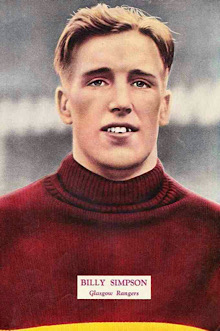
Simpson signs for Rangers from Linfield for a sum of £11,500 in 1950. He spends nine years (1950–59) at Rangers making 239 appearances and scoring 163 goals. He wins three championship medals and a Scottish Cup winners medal with Rangers to add to the two Northern Ireland Football League and two Irish Cups he wins with Linfield. He leaves Ibrox Stadium in 1959 and spends the last couple of years of his career with Stirling Albion, Partick Thistle and (then non-league) Oxford United.
As an illustration of his popularity, in the fictional song “A Trip to Ibrox,” Simpson is credited with scoring twice in a “Ne’erday” Old Firm Derby at Ibrox. Whereby Rangers are 1-0 down at halftime, and Simpson inspires his team to a second half comeback after Willie Waddell has scored an equaliser.
In recognition of his service to that club, Simpson is made a member of the Rangers F.C. Hall of Fame.
Simpson makes his debut for Northern Ireland in 1951 against Wales, scoring in the process. He represents his country twelve times in total between 1951 and 1958, scoring five goals. He is selected in Northern Ireland’s squad for the 1958 FIFA World Cup in Sweden but a late injury ensures he does not play at all during the finals.
In April 2015, the feature-length documentarySpirit of ’58 is screened as part of the Belfast Film Festival. It features Simpson prominently alongside the other surviving players (Billy Bingham, Peter McParland, Jimmy McIlroy and Harry Gregg) as it tells the story of Northern Ireland’s journey throughout the 1950s under the managership of Peter Doherty, culminating in the 1958 World Cup.


 seamus dubhghaill