When Clifford is three years old, his family moves to Limerick. He attends CBS Sexton Street secondary school, where he participates in the school hurling team.
Clifford, at the age of fifteen, makes his senior début for Young Munster at fullback in a friendly match against Constitution. He makes his Munster Senior Cup début in 1943 as a wing forward. During his time at the club, Young Munster wins the Munster Senior League on two occasions, 1944 and 1952 and twice reaches the final of the Munster Senior Cup in 1947 and 1948, but loses both times.
Clifford makes his début for Ireland against France at Landsdowne Road on January 29, 1949 in Ireland’s first game of the 1949 Five Nations Championship. He plays in all four of Ireland’s matches in the 1949 tournament which ends with Ireland being crowned the champions and winning the Triple Crown. He also plays in all of Ireland’s games during the 1950 Five Nations Championship.
Clifford is named in the squad for the 1950 British Lions tour to New Zealand and Australia, the first post-war tour by a British Isles combined team and the first where the team is officially called British Lions. The touring party travels by boat, departing in April and not returning until October. Out of the 29 games played during the tour, Clifford is featured in twenty of them, including all five test matches – three against New Zealand and two against Australia. On his return to Limerick, a crowd of around 8,000 people turn out at Limerick railway station to greet him.
The 1951 Five Nations Championship is again won by Ireland, with Clifford playing in the games against France and England. Clifford’s only appearance at home outside of the Five Nations Championship comes in December 1951, as South Africa plays Ireland as part of their European tour. His final international appearances come during the 1952 Five Nations Championship, with his last game being against Wales on March 8.
Clifford retires from playing rugby in 1957. He dies in Phippsboro on October 1, 1990, at the age of 66. Young Munster’s home group, Tom Clifford Park, is named after him.
After winning an FA Cup winner’s medal under Matt Busby at Manchester United F.C., Giles moves to Leeds in 1963 where he plays in midfield alongside captainBilly Bremner. The duo goes on to form a central midfield partnership which is one of the best in English club football. Their pairing helps yield several major trophies in the most successful era in Leeds’ history. By a strange coincidence, Giles and Bremner both score exactly 115 goals for the club.
In his later years in football, Giles pursues a managerial career which sees him installed as player-manager and manager of, among others, West Bromwich Albion F.C., the Republic of Ireland national football team, Vancouver Whitecaps F.C. and Shamrock Rovers F.C. Despite having an outstanding knowledge of the game, Giles personally never likes being a manager. He becomes disillusioned with aspects of the job, such as suffering at the hands of non-committal boardrooms and leaves management permanently in 1985. He later declares that he has no regrets about quitting managerial life.
Subsequently, after repeated encouragement from childhood friend Eamon Dunphy, Giles inadvertently enters the world of football punditry in 1986. He goes on to establish himself as the highly respected senior analyst on RTÉ Sport. In addition, he writes two columns per week for the Irish Evening Herald newspaper and offers his opinions about the game on radio station, Newstalk 106.
Giles resides in the Harborne area of the city of Birmingham, England. To coincide with his 70th birthday, Giles compiles a first ever autobiography chronicling his life in and outside of football which is released in November 2010. The autobiography, titled A Football Man, becomes the best-selling book in the Republic of Ireland.
Dunne is the first Irishman to figure prominently in the English Football League scoring records. In the 1930–1931 season he scores 41 league goals for Sheffield United. This becomes a club record and remains the most league goals scored by an Irishman during a single English League season.
In the 1931–1932 season, he scores in twelve consecutive matches. This is the all-time record of consecutive goals scored at the elite level of English football. Dunne also scores 30 or more First Division goals in three consecutive seasons between 1930 and 1933. He excels at either centre forward or inside forward and is outstanding with his head. On September 27, 1930, he scores a hat-trick of headers against Portsmouth F.C. He is a fringe member of the great Arsenal F.C. side of the 1930s before finishing his career at Shamrock Rovers F.C.
In November 1938, Lord Killanin is commissioned into the Queen’s Westminsters, a territorial regiment of the British Army, where he is responsible for recruiting fellow journalists, including future The Daily Telegraph editor Bill Deedes, and friends who are musicians and actors. He reaches the rank of major and takes part in the planning of D-Day and the Invasion of Normandy in 1944, acting as brigade major for the 30th Armoured Brigade, part of the 79th Armoured Division. He is appointed, due to the course of operations, a Member of the Order of the British Empire (MBE). After being demobilised, he goes to Ireland. He resigns his TA commission in 1951.
In 1950, Lord Killanin becomes the head of the Olympic Council of Ireland (OCI) and becomes his country’s representative in the IOC in 1952. He becomes senior vice-president in 1968, and succeeds Avery Brundage, becoming President-elect at the 73rd IOC Session (August 21–24) held in Munich prior to the 1972 Summer Olympics. He takes office soon after the Games.
Lord Killanin serves as Honorary Consul-General of Monaco in Ireland from 1961 to 1984 and as Chairman of the Race Committee for Galway Racecourse from 1970 to 1985. A keen horse racing enthusiast, he also serves as a steward of the Irish Turf Club on two occasions and on the National Hunt Steeplechase Committee. In his business life Lord Killanin is a director of many companies including Irish Shell, Ulster Bank, Beamish & Crawford and Chubb Ireland. He is a founder member of An Taisce (The National Trust for Ireland) and is chairman of the National Monuments Advisory Council until his death.
Lord Killanin dies at his home in Dublin on April 25, 1999, at the age of 84 and, following a bilingual funeral Mass at St. Enda’s Church in Spiddal, County Galway, he is buried in the family vault in the New Cemetery, Galway.
Con Houlihan, Irish sportswriter, dies in Dublin on August 4, 2012. Despite only progressing to national journalism at the age of 46, he becomes “the greatest and the best-loved Irish sports journalist of all.”
Houlihan is born on December 6, 1925, in Castleisland, County Kerry. Over a lengthy career, Houlihan covers many Irish and international sporting events, from Gaelic football and hurling finals, to soccer and rugby World Cups, the Olympic Games and numberless race meetings inside and outside Ireland.
Houlihan is a journalist with the Irish Press group writing for The Irish Press, Evening Press and sometimes The Sunday Press, until the group’s demise in 1995. He writes the “Tributaries” column and Evening Press back sports page “Con Houlihan” column.
Houlihan dies on the morning of August 4, 2012 in St. James’s Hospital in Dublin. Often considered one of Ireland’s finest writers, he leaves behind a legacy of immense sports journalism that spans over 60 years. A minute’s silence is observed in his memory ahead of Kerry GAA‘s All-Ireland Senior Football Championship quarter-final defeat to Donegal GAA at Croke Park the following day. His last column, in which he wishes Irish Olympic boxer Katie Taylor well, is published the day after his death. His funeral takes place on August 8, 2012.
Ireland’s president, Michael D. Higgins, leads the tributes to Houlihan, describing him as a “most original writer, with a unique style based on his extensive knowledge of literature, politics, life and sport.” He adds, “He had that special quality and ability to identify with the passion, pain and celebration of Irish community life.”
A bronze bust of Houlihan is unveiled in his hometown of Castleisland in 2004. In 2011, another sculpture is erected outside The Palace bar in Dublin.
O’Hehir is educated at St. Patrick’s National School in Drumcondra before later attending the O’Connell School. He later studies electrical engineering at University College Dublin, however, he abandons his studies after just one year to pursue a full-time career in broadcasting.
At the age of eighteen O’Hehir writes to Radio Éireann asking to do a test commentary. He is accepted and is asked to do a five-minute microphone test for a National Football League game between Wexford and Louth. His microphone test impresses the director of broadcasting so much that he is invited to commentate on the entire second half of the match.
Two months later, in August 1938, O’Hehir makes his first broadcast – the All-Ireland football semi-final between Monaghan and Galway. The following year he covers his first hurling final – the famous “thunder and lightning final” between Cork and Kilkenny.
By the mid-1940s O’Hehir is recognised as one of Ireland’s leading sports broadcasters. In 1947 he faces his most challenging broadcast to date when he has to commentate on the All-Ireland Football Final from the Polo Grounds in New York City with over 1,000,000 people listening to the broadcast back in Ireland.
In 1944 O’Hehir joins the staff of Independent Newspapers as a sports sub-editor, before beginning a seventeen-year career as racing correspondent in 1947.
In 1961 Ireland’s first national television station, Telefís Éireann, is founded and O’Hehir is appointed head of sports programmes. In addition to his new role O’Hehir continues to keep up a hectic schedule of commentaries.
O’Hehir’s skills do not just confine him to sports broadcasting and, in November 1963, he faces his toughest broadcast. By coincidence he is on holidays with his wife Molly in New York City when U.S. PresidentJohn F. Kennedy is assassinated. O’Hehir is asked by Telefís Éireann to provide the commentary for the funeral. The live five-hour broadcast proves a huge challenge for him, as he has had no association with political or current affairs broadcasting up to that point and lacks the resources available to more established television stations. O’Hehir’s commentary, however, wins widespread acclaim in Ireland and shows a different side of his nature.
In August 1985 O’Hehir is preparing to commentate on the All-Ireland hurling final between Offaly and Galway. It would be a special occasion as it would mark his 100th commentary on an All-Ireland final. Two weeks before the game he suffers a stroke which leaves him in a wheelchair and with some speaking difficulties. This denies him the chance to reach the century milestone. He hopes to return to broadcasting one day to complete his 100th final, however, this never happens.
In 1987, the centenary All-Ireland football final takes place Croke Park. The biggest cheer of the day is reserved for O’Hehir when he is pushed onto the field in a wheelchair by his son Peter. Nobody expects the standing ovation and the huge outpouring of emotion from the thousands of fans present and from O’Hehir himself.
Over the next few years O’Hehir withdraws from public life. He returns briefly in 1996 when his autobiography, My Life and Times, is published. Michael O’Hehir dies in Dublin on November 24, 1996.
Arkle, the greatest Irish steeplechaser of all time, dies at the early age of thirteen on May 31, 1970. A baygelding by Archive out of Bright Cherry, Arkle is the grandson of the unbeaten flat racehorse and prepotent sire Nearco.
At 212, his Timeform rating is the highest ever awarded to a steeplechaser. Only Flyingbolt, also trained by Dreaper, has a rating anywhere near his at 210. Next on their ratings are Sprinter Sacre on 192 and then Kauto Star and Mill House on 191. Despite his career being cut short by injury, Arkle wins three Cheltenham Gold Cups, the Blue Riband of steeplechasing, and a host of other top prizes.
In December 1966, Arkle races in the King George VI Chase at Kempton Park Racecourse but strikes the guard rail with a hoof when jumping the open ditch, which results in a fractured pedal bone. Despite this injury, he completes the race and finishes second. He is in plaster for four months and, though he makes a good enough recovery to go back into training, he never runs again. He is retired and ridden as a hack by his owner and then succumbs to what has been variously described as advanced arthritis or possibly brucellosis and is put down at the early age of thirteen.
Arkle becomes a national legend in Ireland. His strength is jokingly claimed to come from drinking Guinness twice a day. At one point, the slogan Arkle for President is written on a wall in Dublin. The horse is often referred to simply as “Himself,” and the story goes that he receives items of fan mail addressed to “Himself, Ireland.”
The government-owned Irish National Stud, at Tully, Kildare, County Kildare, has the skeleton of Arkle on display in its museum. A 1.1 scale bronze statue in his memory was erected in Ashbourne, County Meath on April 19, 2014.
Alexander Gordon “Alex” Higgins, Northern Irish professional snooker player, who is remembered as one of the most iconic figures in the game, is born in Belfast on March 18, 1949. He is nicknamed “Hurricane Higgins” because of his fast play.
Higgins starts playing snooker at the age of eleven, often in the Jampot club in his native Sandy Row area of south Belfast and later in the YMCA in the nearby city centre. At age fourteen and weighing seven and a half stone (47.6 kg), he leaves for England and a career as a jockey. However, he never makes the grade because, in his youth, he drinks a lot of Guinness and eats a lot of chocolate, making him too heavy to ride competitively. He returns to Belfast and by 1965, at the age of sixteen, he has compiled his first maximum break. In 1968 he wins the All-Ireland and Northern Ireland Amateur Snooker Championships.
Higgins turns professional at the age of 22, winning the World Snooker Championship at his first attempt in 1972, against John Spencer winning 37–32. Higgins is then the youngest ever winner of the title, a record retained until Stephen Hendry‘s 1990 victory at the age of 21. In April 1976, Higgins reaches the final again and faces Ray Reardon. Higgins leads 11–9, but Reardon makes four centuries and seven breaks over 60 to pull away and win the title for the fifth time with the score of 27–16. Higgins is also the runner-up to Cliff Thorburn in 1980, losing 18–16, after being 9–5 up. Higgins wins the world title for a second time in 1982 after beating Reardon 18–15 (with a 135 total clearance in the final frame). It was an emotional as well as professional victory for him. Higgins would have been ranked No. 1 in the world rankings for the 1982-1983 season had he not forfeited ranking points following disciplinary action.
Throughout his career, Higgins wins 20 other titles, one of the most notable being the 1983 UK Championship. In the final he trails Steve Davis 0–7 before producing a famous comeback to win 16–15. He also wins the Masters twice, in 1978 and in 1981, beating Cliff Thorburn and Terry Griffiths in the finals respectively. Another notable victory is his final professional triumph in the 1989 Irish Masters at the age of 40 when he defeats a young Stephen Hendry, which becomes known as “The Hurricane’s Last Hurrah.”
Higgins comes to be known as the “People’s Champion” because of his popularity, and is often credited with having brought the game of snooker to a wider audience, contributing to its peak in popularity in the 1980s. He has a reputation as an unpredictable and difficult character. He is a heavy smoker, struggles with drinking and gambling, and admits to using cocaine and marijuana.
First diagnosed with throat cancer in 1998, Higgins is found dead in bed in his flat on July 24, 2010. The cause of death is a combination of malnutrition, pneumonia, and a bronchial condition. Higgins’ funeral service is held in Belfast on August 2, 2010. He is cremated and his ashes are interred in Carnmoney Cemetery in Newtownabbey, County Antrim.
Horan emigrates to Australia with his parents and siblings as a small child. In Melbourne, he attends Bell Street School in Fitzroy and forms a friendship with Jack Blackham. Blackham encourages in Horan a love of cricket. Horan makes his first-class debut for Victoria in the 1874-1875 season.
The first of only two players born in Ireland to play Test cricket for Australia, Horan is the leading batsman in the colony of Victoria during the pioneering years of international cricket. He plays for Australia in the game against England subsequently designated as the first Test match, before touring England with the first representative Australian team, in 1878. Four years later, he tours England for the second time and plays in the famed Ashes Test match at The Oval.
An aggressive middle-order batsman renowned for his leg side play, Horan supplements his batting by bowling medium-pace in the roundarm style common to his era and once captures six wickets in a Test match innings. During a season disrupted by financial disputes and a strike by leading players, he captains Australia in two Test matches of the 1884–85 Ashes series but loses both games. Horan’s form peaks between the ages of 26 and 29 when he scores seven of his eight first-class centuries, including a score of 124 in a Test match on his home ground at the Melbourne Cricket Ground in January 1882.
In 1879, Horan begins writing a weekly newspaper column that continues until his death 37 years later. He establishes himself as the first Australian cricket writer who has played the game at the highest level, thus paving the way for many players to enter the media. Bill O’Reilly, the noted Australian player-writer of the twentieth century, describes him as, “the cricket writer par excellence.”
Horan’s documentation of the early years of Australian cricket are the basis for many works on the subject. Gideon Haigh writes that any, “serious scholar in the field…should probably acquaint himself with Tom Horan.” An anthology of his articles is published for the first time in 1989 when he is posthumously inducted into the Sport Australia Hall of Fame for his writing. In part, his citation reads, “…it was as the first nationally known cricket writer that he made his major contribution to the game.”
Thomas Patrick Horan dies on April 16, 1916, in Malvern, Victoria, Australia.
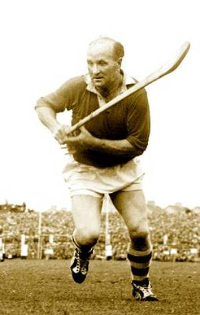
Ring establishes many championship records, including career appearances (65), scoring tally (33-208), and number of All-Ireland medals won (8), however, these records are subsequently bested by Brendan Cummins, Eddie Keher, and Henry Shefflin respectively. Ring is widely regarded as one of the greatest hurlers in the history of the game, with many former players, commentators, and fans rating him as the number one player of all time.
Born near Cloyne, County Cork, Ring first excels at hurling following encouragement from his local national schoolteachers Michael O’Brien and Jerry Moynihan. He first appears on the Cloyne GAA minor team at the age of twelve before later winning a county minor championship medal with the nearby St. Enda’s team. A Cork Junior Hurling Championship medal with Cloyne follows, however, a dispute with club officials sees Ring join Glen Rovers GAA in Blackpool in 1941. Over the next twenty-six years with the club, Ring wins one Munster Senior Club Hurling Championship medal and fourteen county senior championship medals. As a Gaelic footballer with the Glen’s sister club, St. Nicholas’ GAA, he also wins a county senior championship medal. He retires from club hurling at the age of forty-six following a victory over University College Cork GAA in the 1967 championship quarter final. Over the course of his senior championship career Ring estimates that he played in 1,200 games.
Ring makes his debut on the inter-county scene at the age of sixteen when he is picked on the Cork minor panel for the All-Ireland final. In spite of victory, he is denied an All-Ireland Minor Hurling Championship medal as he is Cork’s last non-playing substitute. Still eligible for the grade in 1938, Ring collects a set of All-Ireland and Munster Minor Hurling Championship medals as a member of the starting fifteen. An unsuccessful year with the Cork junior hurlers follows before he makes his senior debut during the 1939-40 league. Over the course of the next quarter century, Ring wins eight All-Ireland medals, including a record four consecutive championships from 1941 to 1944, a lone triumph in 1946 and three additional consecutive championships from 1952 to 1954. The only player to lift the Liam MacCarthy Cup three times as captain, he is denied a record-breaking ninth All-Ireland medal in 1956, his last All-Ireland final appearance. Ring also wins nine Munster medals, four National Hurling League medals, and is named Hurler of the Year at the age of thirty-eight. He plays his last game for Cork in June 1963. After indicating his willingness to line out for the team once again in 1964, Ring fails to be selected for the Cork team, a move which effectively brings his inter-county career to an end.
After being chosen as a substitute on the Munster GAA inter-provincial team in 1941, Ring is an automatic choice on the starting fifteen for the following twenty-two years. He scores 42-105 as he wins a record eighteen Railway Cup medals during that period, in an era when his skill and prowess draw crowds of up to 50,000 to Croke Park for the annual final on Saint Patrick’s Day. Ring’s retirement from the game is often cited as a contributory factor in the decline of the once prestigious championship.
In retirement from playing Ring becomes involved in team management and coaching. As a mentor to the St. Finbarr’s College senior team, he guides them to their first two All-Ireland and Harty Cup triumphs in 1963 and 1969. At club level Ring is instrumental as a selector with Glen Rovers when they claim their inaugural All-Ireland title in 1973, having earlier annexed the Munster and county senior championship titles. It is with the Cork senior team that he enjoys his greatest successes as a selector. After an unsuccessful campaign in his first season on the selection panel in 1973, Ring is dropped the following year before being reinstated in 1975. Over the next three years Cork claims three successive All-Ireland titles.
Ring is most famous for his scoring prowess, physical strength, and career longevity. He remains the only player to have competed at inter-county level in four different decades. Often the target of public attention for his hurling exploits, in private Ring is a shy and reserved individual. A teetotaller and non-smoker throughout his life, he is also a devout Roman Catholic.
On Friday, March 2, 1979, Ring has a scheduled appointment with his doctor and former teammate Dr. Jim Young in Cork city centre. As he is walking past the Cork College of Commerce on Morrisson’s Island at 3:30 PM he suffers a massive heart attack and collapses. He is taken by ambulance to the South Infirmary Hospital but is pronounced dead on arrival.


 seamus dubhghaill