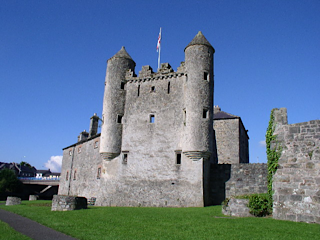
The first siege of Enniskillen takes place at Enniskillen in Fermanagh, present day Northern Ireland, beginning on January 25, 1594, during the Nine Years’ War. In February 1594, the English have captured Enniskillen Castle from the Irish after a waterborne assault and massacre the defenders after they surrender. From May 1594, an Irish army under Hugh Maguire and Cormac MacBaron O’Neill besiege the English garrison in the castle, and in August they defeat an English relief force. A second relief force is allowed to resupply the garrison, but the castle remains cut off. Eventually, in May 1595, the English garrison surrenders to the Irish and are then massacred.
In 1593, Hugh Maguire, Chief of the Name and Lord of Fermanagh, objects to the behaviour of the newly-appointed English Crown sheriff Humphrey Willis. As he had done before being expelled by Hugh Roe O’Donnell from Tyrconnell in 1592, Willis is cattle raiding and plundering throughout Clan Maguire territory. Maguire is not strong enough to resist the sheriff, but after receiving reinforcements from Hugh O’Neill, Earl of Tyrone, Maguire expelled Willis. In May and June 1593, Maguire and Brian Oge O’Rourke of West Breifne raids lands held by the English Lord President of Connaught, Richard Bingham. They destroy the town around Ballymote Castle. This is part of a proxy war waged to distract the Crown while Hugh O’Neill strengthens his position in Ulster. As hoped for, the Crown responds by sending an army under Sir Henry Bagenal and Gaelic leader Hugh O’Neill, Earl of Tyrone (outwardly still loyal to the Crown), who defeats Maguire’s force at the Battle of Belleek in October 1593. However, Maguire’s main force remains unscathed.
Enniskillen Castle sits on the River Erne and commands the strategic bottleneck between Upper and Lower Lough Erne. On January 25, 1594, English Captain John Dowdall arrives at Enniskillen by boat with three infantry companies. They dig trenches in which they place light cannons and musketeers, but the cannons are too small to make much of an impact on the castle walls. On January 30, Captain George Bingham arrives with 300 men.
They launch a waterborne assault on the castle. While musketeers in boats and artillery on land fire at the castle, a large boat holding 67 men anchors at a vulnerable part of the walls. They make a breach in the wall with pickaxes, forcing the Irish to take shelter in the keep. Dowdall threatens to destroy the castle with gunpowder if the garrison does not surrender. An Irish witness claims there are 36 fighting men and 40 women and children in the castle, while Dowdall claims there are 200. After they surrender, Dowdall has them put to the sword and claims to have killed 150. Captain Thomas Lee, who is present, describes this as a great dishonor to the Queen as the defenders had surrendered “uppon composicion, And your majesties worde being past to the poore beggars that kept it, they were all notwithstandinge dishonourably putt to the sworde in a most miserable state.”
Dowdall writes on February 2 to the Lord Deputy of Ireland that he has captured the castle from the “rebel” Hugh Maguire. An English garrison is left in place. A detailed coloured illustration of the siege was made shortly after.
A second siege begins on May 17, 1594. Now acting with the covert support of Hugh O’Neill, Hugh Maguire and Cormac MacBaron O’Neill lay siege to Enniskillen which is now isolated in hostile country. This siege ends on August 30 when Lord Deputy William Russell’s beleaguered garrison withdraws. Following this, there is a truce, but “subterfuge and deception were the hallmarks of this stage of the war.”
A third siege begins when Maguire raises the clan and attacks the castle again in January 1595. In May 1595 the garrison agrees to surrender Enniskillen to the Irish in exchange for their lives. However, the entire garrison is then massacred.
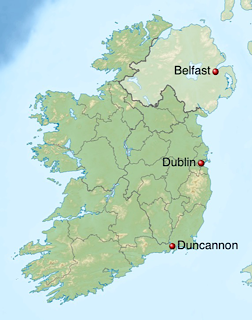
At the outbreak of the Irish Rebellion of 1641, most of south-eastern Ireland falls to the Catholic insurgents. Roughly 1,000 rebels blockade Duncannon, which is heavily fortified and contains an English garrison of about 300 men. Around 150 of the English troops are killed in forays against the Irish at nearby Redmond’s Hall, but without siege artillery, or expertise in siege warfare, the rebels are unable to take Duncannon.
Hostilities continue throughout 1642, as the Irish, now organised as the Irish Confederacy raid the town’s hinterland. As in much of Ireland, the conflict is bitter. In one incident, Laurence Esmonde, 1st Baron Esmonde, the Royalist commander, hangs 16 Irish prisoners who have been taken at nearby Ramsgrange. In response, the Irish execute 18 English prisoners whom they have been holding.
In 1643, because of his need for troops to fight in the English Civil War, Charles I signs a ceasefire with the Irish Confederates. As a result, hostilities between Duncannon and the Catholic-held surrounding area are suspended.
However, in 1644, the English garrison of Cork, under Murrough O’Brien, 1st Earl of Inchiquin, unhappy with the Royalist truce with the Irish Confederates, declares for the English Parliament, who are to remain hostile to Irish Catholic forces throughout the 1640s. Esmonde, under pressure from elements of his garrison, also changes to the side of Parliament and effectively re-declares war on the Catholic Confederates. His motives are unclear: though he is a Protestant convert, the Esmonde family are Anglo-IrishRoman Catholics, and he owes his entire advancement to the Crown.
Duncannon is a strategically important town for two reasons. Firstly, it has formidable defences. Secondly and more importantly, its guns overlook the sea route to Waterford and New Ross, two of the most important Catholic-held towns and also ports at which the Confederates receive military aid from Catholic Europe.
Needing to keep this channel open and also fearing the presence of an English garrison deep in their territory, the Confederates’ Supreme Council in Kilkenny despatches Thomas Preston, general of their Leinster Army, to take Duncannon in January 1645. Preston has at his disposal 1,300 men, four cannons and a mortar. The mortar, the first of its kind to be used in Ireland has been donated by Spain the previous year and is commanded by a French military engineer named Nicholas La Loue. La Loue had served with Preston in Flanders and is chief of engineering in the Leinster Army.
Duncannon possesses formidable defences. For one thing, it is located on a peninsula and can only be approached from the north, the other three sides jutting out into the sea. Just off the town are docked four Parliamentarian ships, which are supplying Duncannon with food and reinforcements. Secondly, it possesse two lines of fortifications, the outer line being a more modern low deep rampart protected by a dry ditch and the inner wall being a medieval curtain wall, complete with three towers. However, it has two grave weaknesses, first, it is overlooked by a hill to the north, from which an attacker can fire into the town and, secondly, the water supply is located outside the walls.
Preston arrives at Duncannon on January 20 and proceeds to construct a ring of trenches which cut off Duncannon on its landward side. From the hill that overlooks the town to the north, his guns are able to fire on a squadron of four Parliamentarian ships that are docked off Duncannon and providing the town with supplies. The flagship, the Great Louis, is badly damaged, its mast wrecked by cannon fire, and it takes several more hits from the mortar as it tries to get away. The ship sinks in deep water, drowning its crew and 200 soldiers who are on board.
Having cut off Duncannon’s supply from the sea, Preston proceeds to dig saps closer to the walls, the ultimate aim being to bring his cannon close enough to the walls in order to blast a breach and open the way for an assault. His engineers also dig a mine underneath one of the town’s bastions. All the while, the town’s defenders are kept under a bombardment by the mortar and, as the Confederate troops get closer to the walls, by sharpshooters. On March 12, one such sniper kills the fort’s second in command, one Captain Lurcan, who is hit in the head by a bullet.
On March 16, by which time the Irish trenches are “within pistol shot of the walls,” Preston orders the mine to be exploded, opening a breach in Duncannon’s outer walls. The Irish infantry then assault the town, but are beaten off with some losses. The following day, Saint Patricks Day, Preston tries again and this time his troops succeed in taking the town’s outer, more modern walls but are stopped at Duncannon’s inner, medieval ramparts. They succeed in occupying one of the town’s towers for an hour before being beaten back. Geoffrey Baron, a Confederate politician, who keeps a diary of the siege, reports that 24 Irish soldiers are killed in the two assaults.
At this point, Preston summons Esmonde to surrender, before he has to “proceed to extremities.” This is a delicate threat, implying that if the town falls to an assault, its defenders will be put to the sword – as is customary in contemporary siege warfare. Esmonde is also advised to surrender by the Parliamentarian vice admiral, William Smith, who is anchored offshore with seven ships, but cannot break through to relieve the town. In a letter that reaches Esmonde on March 11, Smith warns him that “if the rebels take the fort by storming it, they will undoubtedly put you all to death…you should agree with thy adversary while thou art in the way.” Esmond has Smith’s letter publicly read to his troops after the assaults of March 16-17 to discourage those who favour holding out.
Alongside the risk of massacre, the English garrison is also very low on gunpowder and water. The town’s only source of fresh water, a well, is behind the Confederate siege lines.
In light of these facts, Esmonde formally surrenders Duncannon to Preston on March 18. The Confederates take possession of the town but its garrison is allowed to march away to Youghal, which is in Protestant hands. However, they have to leave behind the town’s 18 artillery pieces. Esmonde himself dies a feways after the end of the siege. Preston goes on to briefly besiege Youghal, but bad weather, a lack of supplies and squabbling with James Tuchet, 3rd Earl of Castlehaven, the Confederate Munster general, puts an end to his campaign for the winter.
The siege is of importance in that it reopens the sea route into Waterford and eliminates a hostile English garrison in Confederate territory. Preston, who had for many years been the Spanish military governor of Leuven, is highly experienced in siege warfare and his conduct of the siege draws widespread praise. Not only does he take the town, but he does so at a relatively low cost. Sixty-seven Confederate soldiers die in the siege, of whom roughly 30 die of disease. Given that the campaign is conducted in mid-winter, in an age when disease routinely kills many more soldiers than combat, this represents a considerable logistical achievement on the part of the Irish general.
The Great Lewis, the Parliamentarian ship sunk during the siege, is rediscovered in 1999 and raised in 2004.
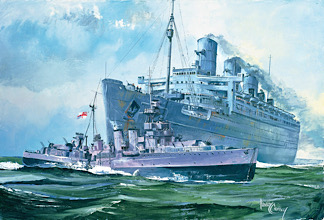
Twenty miles off the coast of County Donegal on October 2, 1942, the luxury Cunard liner RMS Queen Mary, converted into a troop carrier for World War II, smashes into her escort ship, the British Royal NavycruiserHMS Curaçoa (D41). The HMS Curacoa, which had connected with the RMS Queen Mary to escort her for the final two hundred miles to the port of Greenock, Scotland, sinks with the loss of 338 men. As are his orders, Captain Cyril Illingworth of the RMS Queen Mary, which is carrying an estimated 15,000 U.S. troops, does not stop to mount a rescue operation.
On a near perfect afternoon, the RMS Queen Mary is off the Irish coast. The vessel is setting a zigzag course to help evade U-boats and long-range Germanbombers. The RMS Queen Mary has caught up with her 4,290 tonne escort vessel, the HMS Curacoa, and is set to overtake her.
Aboard the HMS Curacoa, seaman Ernest Watson is admiring the RMS Queen Mary’s majestic lines when he notices the bow is swinging toward the cruiser. To his horror, she continues to swing and is soon on a collision course. The gap narrows inexorably as the stunned Watson finally finds his vocal cords and screams, “She’s going to ram us.” Later Watson describes how many of his mates are so shocked they cannot move.
Within seconds, there is a screech of twisted metal followed by the hiss of steam and the screams of those injured or trapped below. The RMS Queen Mary, twenty times larger than the cruiser, has been traveling at top revs giving her a speed of 28.5 knots. The impact swings the HMS Curacoa broadside on and the troopship slices through her 10 cm armour plating. It is all over in seconds, and the troopship continues on her zigzag course leaving the HMS Curacoa cut in two with the forward and aft sections separated by 100 metres of ocean.
At the moment of impact, as the HMS Curacoa reels in the water, Watson and many other seaman on deck are thrown into the freezing water. Even as they surface they watch in horror as the stern quickly sinks, taking with it the men trapped behind the water-tight doors. The forward section follows soon after, leaving the men in the murky water surrounded by debris, oil and drowned or mutilated bodies. It is every man for himself as survivors cling to floating wreckage. They are about 20 nautical miles off the Irish coast which, had boats or rafts been launched, would put them within easy reach of safety.
The survivors believe the RMS Queen Mary will turn back to pick them up, however, it is with obvious despair that they watch her disappear over the horizon. To sail on is probably the toughest decision Captain Illingworth ever has to make. The World War I veteran has many years of experience by the time he has risen to become Cunard-White Star Line’s senior commander and master of the RMS Queen Mary. He is obeying orders that under no circumstances is he to stop until the RMS Queen Mary has safely delivered the troops to Britain. His only option is to signal nearby British destroyers to rescue survivors.
Two destroyers react to Captain Illingworth’s message and steam toward the wreckage where two hours after the collision, they find many bodies of sailors who have died of hypothermia. Only the hardiest live long enough to land in Londonderry, County Londonderry, Northern Ireland, the next day. Of the HMS Curacoa’s 430 personnel, only 99 seamen and two officers survive. Because of war-time security the official inquiry is delayed until the war in Europe is over. Then, in June 1945, only a few weeks after VE Day, the Admiralty Commissioners sued Cunard-White Star Line claiming the RMS Queen Mary had been responsible.
It appears to be a clear-cut case. The HMS Curacoa’s captain, John Boutwood, gives evidence to a Royal Navy inquiry and is acquitted without a reprimand. Later he gains the Distinguished Service Order (DSO). Boutwood says the HMS Curacoa steamed at some 3 knots slower than the larger vessel which had been in the process of overtaking at the time of the collision. He says he had been amazed when the troopship continued turning to starboard and closed the gap between the vessels. When the collision occurred he, and all others on the bridge, had clung to whatever was nearest.
At first, Boutwood vainly hopes the damaged ship will stay afloat. He also says it was impossible to give orders because of the noise of escaping steam from the boiler room. The RMS Queen Mary’s first officer gives evidence that he had taken over the helm less than two minutes before she rams the cruiser. She is about 500m away and on the starboard bow. He is unconcerned at the narrow gap because he expects HMS Curacoa to take evasive action. He believes the cruiser, a more manoeuvrable vessel, would change course.
The first officer had also been reassured by Captain Illingworth, that the cruiser was “experienced in escorting and would keep out of the way.” At a later hearing some months after the opening, Illingworth says he had felt a bump at the time of the collision and had asked the quartermaster if they had been hit by a bomb. The answer was: “No sir, we have hit the cruiser.”
The judge holds the cruiser responsible saying the normal rules of an overtaking vessel keeping clear of the other does not apply in this case. He says the cruiser could have avoided the collision up to seconds before it occurred. The Admiralty, faced with huge compensation to the families of the dead sailors, appeals. In appeal the ruling is that the cruiser was responsible for two-thirds of the damage and the RMS Queen Mary for one-third. Still not satisfied, the case goes to the House of Lords where the verdict of the Appeal Court is upheld in February 1949. No survivor comes out unscathed but above all others, Illingworth has to live with the memory of leaving British sailors to fight for their lives in the ocean.
However, when asked at the first hearing if he felt Illingworth had made the right decision, the captain of the HMS Curacoa says, “I would say, yes.” The RMS Queen Mary continues as a troopship until August 11, 1945. The vessel is now a floating attraction at Long Beach, California.
(From: “SS Queen Mary & the loss of HMS Curacoa 1942” by A. N. Other and NHSA Webmaster, Naval Historical Society of Australia, https://navyhistory.au)
After the Battle of the Boyne, William occupies Dublin and the Jacobites retreat to the west of Ireland. William assaults and besieges Limerick in August 1690 but is repulsed. To secure the Jacobite-held ports of Cork and Kinsale on the southern coast, he dispatches a force under John Churchill, then 1st Earl of Marlborough.
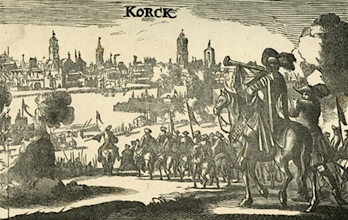
Marlborough reaches Cork by sea on September 21, 1690. His English forces are 5,000 strong and he also has at his disposal a fleet which blockades the port of Cork. He captures several of the harbour’s defences, including Fort Camden, and lands troops at Passage West on September 24, before setting up his base at Red Abbey, to the south of the walled city. Approaching from the northern, landward side are 4,000 Danish troops under the Ferdinand Willem, Duke of Württemberg-Neuenstadt.
The Williamites take the forts, such as Elizabeth Fort, which command the hills around Cork and commences a bombardment of the city from the heights. When a breach is opened in the city walls, the city’s garrison opens surrender negotiations, asking to be allowed to leave Cork and join the main Jacobite army at Limerick. Marlborough refuses the request, although Württemberg is in favour of granting the terms.
A few days later, the Williamites mount a joint English-Danish assault of the breach from the south. Henry FitzRoy, 1st Duke of Grafton, is reputedly mortally wounded while leading this assault. After the Williamites reach the walls, the Governor of Cork, Roger McElligott, opens new surrender talks and agrees that the garrison will become prisoners and will surrender their arms and stores. Marlborough accepts and the city surrenders.
In spite of this, the Williamite troops sack the city, do a great deal of damage, looting much property and abusing the Catholic inhabitants. Many civilians are killed before Württemberg and Marlborough restore order.
It remains for the Williamites to take nearby Kinsale, which is strongly defended by two forts, the Old Fort, also known as James’s Fort, and the New Fort or Charles Fort. Marlborough assaults these fortifications but is unable to take them by storm. The Old Fort, defended by the Governor Colonel Cornelius O’Driscoll, falls after an assault is made possible by an accidental explosion in its gunpowder magazine, which kills forty. After some 200 are slain in the following assault, including Colonel O’Driscoll, the rest surrender, receiving quarter. Charles Fort, however, holds out for ten days and surrenders only after receiving guarantees that its 1,200-strong garrison can march away to Limerick. It is defended by the elderly and experienced Governor Sir Edward Scott, and his Deputy Governor Colonel Donal IV O’Donovan.
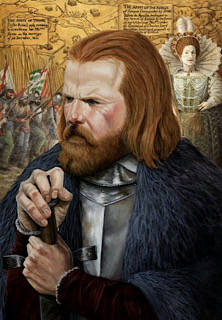
Doire Leathan is on the eastern shores of Teelin Bay, being just across from the village of Teelin. The battle is part of the ongoing succession dispute for the leadership of the Gaelic lordship of O’Donnell. A combined force of Irish clans and ScottishRedshankmercenaries hired by Iníon Dubh (pronounced “In-neen Doo”) defeat and kill Sir Domhnall Ó Domhnaill (Sir Donnell O’Donnell). The Tanist of Tír Conaill, Sir Domhnall’s younger half-brother and Iníon Dubh’s son, Red Hugh O’Donnell, is still imprisoned in Dublin Castle, but later rises following a subsequent escape to lead Clan O’Donnell and is a prominent figure during the Nine Years’ War.
According to the Annals of the Four Masters, “The son of O’Donnell, i.e. Donnell, the son of Hugh, son of Manus, son of Hugh Duv, son of Hugh Roe, son of Niall Garv, son of Turlough of the Wine, attempt to depose his father, after he had grown weak and feeble from age, and after his other son had been imprisoned in Dublin; so that Donnell brought under his power and jurisdiction that part of Tirconnell from the mountain westwards, i.e. from Bearnas to the River Drowes; and also the people of Boylagh and Tir-Boghaine. It was a cause of great anguish and sickness of mind to Ineenduv, the daughter of James Mac Donnell, that Donnell should make such an attempt, lest he might attain the chieftainship of Tirconnell in preference to her son, Hugh Roe, who was confined in Dublin, and who she hoped would become chief, whatever time God might permit him to return from his captivity; and she, therefore, assembled all the Kinel-Connell who were obedient to her husband, namely, O’Doherty, with his forces; Mac Sweeny-na dTuath (Owen Oge), with his forces; and Mac Sweeny Fanad, with his forces; with a great number of Scots along with them. After Donnell O’Donnell had received intelligence that this muster had been made to oppose him, he assembled his forces to meet them. These were they who rose up to assist him on this occasion: Mac SweenyBanagh (Donough, the son of Mulmurry); a party of the Clan Sweeney of Munster, under the conduct of the three sons of Owen, the son of Mulmurry, son of Donough, son of Turlough, and their forces; and O’Boyle (Teige Oge, the son of Teige, son of Turlough), with all his forces, assembled. The place where the son of O’Donnell happened to be stationed along with these chieftains was Doire-leathan at the extremity of Tir-Boghaine, to the west of Gleann Choluim Cille. The other party did not halt until they came to them to that place; and a battle ensued between them, which was fiercely fought on both sides. The Scots discharged a shower of arrows from their elastic bows, by which they pierced and wounded great numbers, and, among the rest, the son of O’Donnell himself, who, being unable to display prowess or defend himself, was slain at Doire-leathan, on one side of the harbour of Telinn, on the 14th of September. Seldom before that time had his enemies triumphed over him; and the party by whom he was slain had not been by any means his enemies until they encountered on this occasion; and although this Donnell was not the rightful heir of his father, it would have been no disgrace to Tirconnell to have elected him as its chief, had he been permitted to attain to that dignity. In this conflict were slain along with Donnell the three sons of Owen, son of Mulmurry, son of Donough above mentioned, together with two hundred others, around Donnell.”
(Pictured: Hugh Roe O’Donnell, otherwise known in history and lore as Red Hugh O’Donnell)
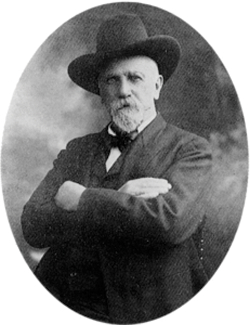
Rossa becomes a shopkeeper in Skibbereen where, in 1856, he establishes the Phoenix National and Literary Society, the aim of which is “the liberation of Ireland by force of arms.” This organisation later merges with the IRB, founded two years later in Dublin.
In December 1858, Roosa is arrested and jailed without trial until July 1859. He is charged with plotting a Fenian rising in 1865, put on trial for high treason, and sentenced to penal servitude for life due to previous convictions. He serves his time in Pentonville, Portland, and Chatham prisons in England.
After giving an understanding that he will not return to Ireland, Rossa is released as part of the Fenian amnesty of 1870. Boarding the S.S. Cuba, he leaves for the United States with his friend John Devoy and three other exiles. Together they were dubbed “The Cuba Five.”
In 1885, Rossa is shot outside his office near Broadway by an Englishwoman, Yseult Dudley, but his wounds are not life-threatening. He is allowed to visit Ireland in 1894, and again in 1904. On the latter visit, he is made a “Freeman of the City of Cork.”
Rossa is seriously ill in his later years and is finally confined to a hospital bed in St. Vincent’s Hospital, Staten Island, where he dies suddenly at the age of 83 on June 29, 1915. His body is returned to Ireland for burial and a hero’s welcome. The funeral at Glasnevin Cemetery on August 1, 1915, is a huge affair, garnering substantial publicity for the Irish Volunteers and the IRB at time when a rebellion, later to emerge as the Easter Rising, is being actively planned. The graveside oration given by Patrick Pearse remains one of the most famous speeches of the Irish independence movement stirring his audience to a call to arms.
Humbert crosses the River Shannon at Ballintra Bridge on September 7, destroying it behind them, and continues to Drumshanbo where they spend the night – halfway between his landing-point and Dublin. News reaches him of the defeat of the Westmeath and Longford rebels at Wilson’s Hospital School at Multyfarmham and Granard from the trickle of rebels who have survived the slaughter and reached his camp. With Cornwallis’ huge force blocking the road to Dublin, facing constant harassment of his rearguard and the pending arrival of General Gerard Lake‘s command, Humbert decides to make a stand the next day at the townland of Ballinamuck on the Longford/Leitrim county border.
Humbert faces over 12,000 Irishmen and English forces. General Lake is close behind with 14,000 men, and Cornwallis is on his right at Carrick-on-Shannon with 15,000. The battle begins with a short artillery duel followed by a dragoon charge on exposed Irish rebels. There is a brief struggle when French lines are breached which only ceases when Humbert signals his intention to surrender and his officers order their men to lay down their muskets. The battle lasts little more than an hour.
While the French surrender is being taken, the 1,000 or so Irish allies of the French under Colonel Bartholomew Teeling, an Irish officer in the French army, hold onto their arms without signaling the intention to surrender or being offered terms. An attack by infantry followed by a dragoon charge breaks and scatters the Irish who are pursued into a bog where they are either bayoneted or drowned.
A total of 96 French officers and 746 men are taken prisoner. British losses are initially reported as 3 killed and 16 wounded or missing, but the number of killed alone is later reported as twelve. Approximately 500 French and Irish lay dead on the field. Two hundred Irish prisoners are taken in the mopping-up operations, almost all of whom are later hanged, including Matthew Tone, brother of Wolfe Tone. The prisoners are moved to the Carrick-on-Shannon Gaol. The French are given prisoner or war status however the Irish are not and some are hanged and buried in St. Johnstown, today known as Ballinalee, where most are executed in a field that is known locally as Bully’s Acre.
Humbert and his men are transported by canal to Dublin and exchanged for British prisoners of war. Government forces subsequently slowly spread out into the rebel-held “Irish Republic,” engaging in numerous skirmishes with rebel holdouts. These sweeps reach their climax on September 23 when Killala is captured by government forces. During these sweeps, suspected rebels are frequently summarily executed while many houses thought to be housing rebels are burned. French prisoners of war are swiftly repatriated, while United Irishmen rebels are executed. Numerous rebels take to the countryside and continue guerrilla operations, which take government forces some months to suppress. The defeat at Ballinamuck leaves a strong imprint on Irish social memory and features strongly in local folklore. Numerous oral traditions are later collected about the battle, principally in the 1930’s by historian Richard Hayes and the Irish Folklore Commission.
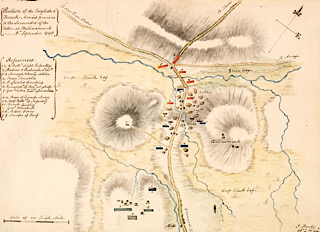
(Pictured: Watercolour plan by an I. Hardy of the Battle of Ballinamuck in County Longford on September 8, 1798, showing position of the English & French Armies previous to the surrender of the latter at Balinamuck)
Eugene welcomes the prospect of a decisive battle, and waits on the eastern side of the Oglio to be attacked. The Imperial commander has chosen his ground carefully, entrenching his troops and guns in front of the small fortress of Chiari. Streams protect his position on three sides so, as there is not enough room for a cavalry engagement, Eugene can count on a frontal attack by the French infantry. Two battalions and a few pieces of artillery are placed in Chiari itself.
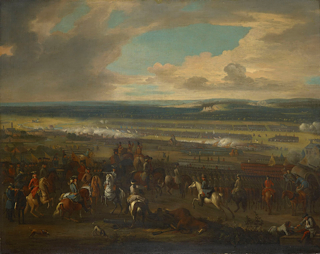
Villeroy ignores Catinat’s warning that Eugene is in a strong position, remarking that the King, “had not sent so many brave men just to look at the enemy through their spy glasses.” On September 1, the Franco-Spanish infantry advances. Deceived by the report of spies that the Imperialists are retiring, Villeroy crosse the Oglio and pushes on to Chiari expecting to attack their rearguard. The attack begins around 2:00 p.m. when three French brigades approach Chiari and overpower the Imperial troops there without much difficulty. However, instead of facing the rearguard, the French commander encounters the whole Imperial army securely entrenched in their positions. As the Bourbons’ army approaches the Imperial positions, Eugene forbids his men to fire. Loading their artillery with canister shot, they only unleash a withering fire when the Bourbon army enters point-blank range. This disorders the attackers and chaos ensues which the French and Spanish commanders cannot suppress. While this is going on, Chiari is recaptured by the Imperials after a fierce struggle. The Bourbons are driven back with heavy casualties in a contest as destructive as any battle during the war in Italy. With only minor losses, the Imperial army inflicts over 3,000 casualties in the ranks, and over 250 officers. This number grows rapidly as fever attacks the wounded.
Villeroy loses personal control during the battle, and Catinat, despite being wounded, has to organise a retreat. The French dig themselves in only a mile or so away from the Austrians on the same side of the Oglio. Here, the two opposing sides remain for the next two months: the French are too much discouraged by their repulse to resume the assault, and Eugene is unwilling to risk the advantages he had gained by attacking the French in their strong defensive position. However, as autumn advances, conditions deteriorate in both camps: fodder is so short that Eugene’s horses are forced to eat fallen leaves. But the French, whose camp is built on marshy ground, suffers most, and they move out first in mid-November, crossing the Oglio before entering winter quarters in the Duchy of Milan.
In Milan, the French presence proves increasingly unpopular: five million French livres for soldiers’ pay and lodgings, and two million for fodder, has soon been imposed on the local population, most of which has to be taken by force. For his winter quarters, Eugene proceeds to reduce the whole Duchy of Mantua, except the capital and Goito, which he closely blockades. Shortly after he occupies Mirandola and Guastalla. Eugene’s relationship with the local population has been good and he has kept a tight control: he has executed 48 of his men for looting, telling the Emperor that he had “imposed more severe discipline than has possibly ever been seen in an army.” Eugene receives little cash from the Emperor, far less than he expects, but he secures a sound footing in northern Italy and, as hoped, his success helps to encourage the Maritime Powers to come to the aid of Leopold I. Since the beginning of the year Count Johann Wenzel Wratislaw von Mitrowitz has been in London as Imperial minister, pressing for assistance. With Eugene’s two victories (Carpi and Chiari), Leopold I has proven he would fight to protect his interests, giving Wratislaw the arguments he needs to push through the alliance with the Maritime Powers. On September 7, 1701, within a week of the battle, England and the Dutch Republic sign the second treaty of the Grand Alliance, backing the Emperor’s claims to the Spanish possessions in Italy.
The French are still in Milan, but their position is weak: morale is poor and desertion is high. Louis XIV writes to Villeroy urging him to work closely with Catinat and “not again to attack the enemy without advantage.” “If you do … the King, my grandson, will lose Italy.” By October, French optimism for the campaign is gone, but Louis XIV hopes to send reinforcements for the next year’s campaign, believing the Emperor will not be able to make a comparable increase in Eugene’s strength. However, the campaign season is not yet over. As Villeroy settles down for the winter, Eugene is preparing to attack him at his headquarters in Cremona.
Nationalist forces enter Newcastle West, County Limerick, on Monday, August 7, 1922, after a twelve-hour battle, in which twelve anti-Treaty Irish Republican Army (IRA) members, sometimes referred to as Irregulars, are killed. The casualties of the Nationalists are less than those of the Irregulars.
Taking little respite after Sunday’s labors, the Nationals advance from Rathkele on Monday morning, and by midday are in sight of their fresh objective. Armored cars enter the town and machine gun fire is directed against a party of Irregulars, causing many casualties.
When the artillery goes into action against the headquarters of the Irregulars, the Irregulars flee precipitately along Cord road.
Owing to the slow progress in the operations in Southern Ireland, the meeting of Dáil Éireann, scheduled to open Saturday, is postponed again.
The official army bulletin announces that the Nationals captured Castle Island on Saturday, August 5. It says that the counties of Cork and Kerry with a part of South Tipperary and a small area in County Waterford are the only districts held by the Irregulars with any degree of security.
The streets of Dublin are lined with great crowds of people on Tuesday, August 8, for the military funeral of nine National Army soldiers who were killed in fighting the Republican Irregulars in County Kerry. Michael Collins, Chairman of the Provisional Government, and all the leading officers of the army in Dublin march beside the hearses. Each coffin is covered with the Republican tricolour. There are many clergymen and other civilians in the funeral procession.
Prominent Catholics of Dublin and Belfast are trying to effect a better understanding between the Ulster and Free State Governments, according to the Daily Mail. This newspaper further states that all efforts to this end, which have all been taken with the advice and approval of leading English Catholics, are without official character.
A message from Strabane, County Tyrone, received by the Exchange Telegraph Company on August 8 states that a settlement between the Ulster Government and the Free State authorities is imminent, the terms of agreement having been practically arranged in negotiations proceeding in London.
In Downing Street, however, all knowledge of any such Irish negotiations is disclaimed and a telegram from Belfast quotes Ulster Government officials as denying that a settlement with the Free State is imminent.
The Free State Government is also unaware of any negotiations for a settlement between the Ulster Government and the Free State authorities. It is further states that such negotiations are unlikely to take place.
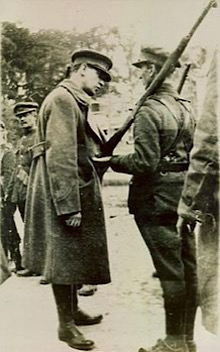
(From: “Irish Irregulars Routed With Loss,” The New York Times, August 9, 1922 | Pictured: General Michael Collins inspects a soldier at Newcastle West, County Limerick, August 8, 1922)
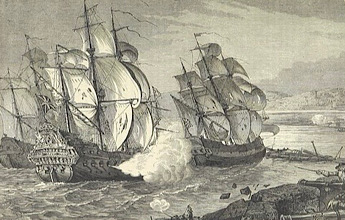
On July 28, 1689, two armed merchant ships, Mountjoy and Phoenix, sail toward the heavily defended defensive boom (floating barrier) across the River Foyle at Culmore, protected by the frigate HMS Dartmouth under Captain John Leake. Mountjoy rams and breaches the boom at Culmore fort and the ships move in, unloading many tons of food to relieve the Siege of Derry.
The Siege of Derry in 1689 is the first major event in the Williamite War in Ireland. The siege is preceded by an attempt against the town by Jacobite forces on December 7, 1688, that is foiled when thirteen apprentices shut the gates. This is an act of rebellion against James II.
The second attempt begins on April 18, 1689, when James himself appears before the Derry city walls with an Irish army led by Jacobite and French officers. The town is summoned to surrender but refuses. The siege begins. The besiegers try to storm the walls, but fail. They then resort to starving Derry. They raise the siege and do not leave until supply ships break through to the town.
Frederick Schomberg, having been appointed commander-in-chief by William III, orders Major-GeneralPercy Kirke to attack the boom. Thereupon, on July 28, Kirke sends four ships to the mouth of the River Foyle to try to bring food into Derry. These are HMS Dartmouth and three merchant ships: Mountjoy from Derry, Phoenix from Coleraine, and Jerusalem. Dartmouth, under Captain John Leake, engages the shore batteries, while Mountjoy, commanded by her Master Michael Browning, rams and breaches the boom, whereupon Mountjoy and Phoenix sail up to Derry, unloading many tons of food. Seeing that he can no longer starve out Derry and not having enough troops to storm the town, Conrad von Rosen, the commander of the Jacobite troops, decides to raise the siege. On August 1, the besieged discover that the enemy is gone. On August 3, Kirke reports the raising of the siege to London. On July 31, another Jacobite army is defeated at Newtownbutler by the armed citizens of Enniskillen.
The city endures 105 days of siege, from April 18 to August 1, 1689. Some 4,000 of its garrison of 8,000 are said to have died during this siege. The siege is commemorated annually by the Protestant community.
(Pictured: HMS Dartmouth fires at shore batteries while Mountjoy rams through the boom, from the 1873 book British Battles on Land and Sea, Volume 1)