After a month of intense IRA activity across the country, the War of Independence continues unabated in February 1920. Becoming more daring in the process, the IRA continues to target the RIC and their barracks. Elsewhere, local issues and tensions also surface, and in some cases, they become embroiled in the struggle for Independence. February 1920 is a month of chaos across the country.
Described by the newspapers of the day as a ‘fierce affray’ the three-hour assault on the RIC barracks at Ballytrain, County Monaghan is a significant engagement for the Monaghan IRA during the War of Independence. Launched at 2:00 AM on a Sunday morning and led by Eoin O’Duffy, later a Commissioner of An Garda Siochana, the attack had been carefully planned.
Located eight miles from Castleblayney, the RIC barracks in Ballytrain is manned by Sergeants Lawson and Graham and four constables, Roddy, Gallagher, Murtagh, and Nelson, all of whom it is said fight against the odds for over three hours. At 5:00 AM, when ‘the leader’ of the IRA party demands the officers surrender it is met by continued firing from the police. O’Duffy then gives the order to plant explosives at the gable wall, which instantly collapses. Four RIC officers are buried in the rubble of the building and are later transferred to Carrickmacross hospital for treatment. About fifty men then rush the building carrying off a quantity of weapons.
A house belonging to a man named Mitchell is raided before the attack, where four members of the family are held hostage throughout the night. The IRA smashes all of the windows in the house allowing them to fire on the barracks. As many as 150 men take part in the raid, which also sees some men taking up position in cattle byres, which had been cleaned out in order to give protection. It is later alleged that O’Duffy had told the RIC men that he was glad no one had been killed in the exchange, saying, “We did not come here to do injury, but only for arms.” It is hardly the welcome Sergeant Graham had expected having only arrived in the barracks three days earlier.
(From: Irish Newspaper Archives, irishnewsarchive.com, February 17, 2020)
Brady is raised in Dublin and attends St. Aidan’s C.B.S., leaving before his Intermediate Certificate. He alleges at the time that he had been expelled for missing a school Gaelic football match to play a schoolboy soccer international, however the school denies this.
Brady is a talented offensive midfielder renowned for his left foot and elegant technical skills such as his high-quality passing, vision, and close control, which makes him an excellent playmaker. He combines these abilities with significant tenacity, an eye for goal from midfield, and accurate penalty-taking. In addition to his footballing ability, he also stands out throughout his career for his professionalism.
Brady starts his career at Arsenal F.C., moving to London to join the side on schoolboy forms in 1971, at the age of 15. He turns professional on his 17th birthday in 1973, and makes his debut on October 6, 1973 against Birmingham City F.C. as a substitute for Jeff Blockley. Arsenal reaches three FA Cup finals in a row between 1978 and 1980. Arsenal wins only the 1979 final against Manchester United F.C., with Brady starting the move that ends in Alan Sunderland‘s famous last-minute winner.
Brady spends two seasons with Juventus F.C. in Italy, picking up two Italian Championship medals, in 1981 and 1982. He scores the only goal (a penalty) in the 1–0 win against Catanzaro that wins the 1982 title.
Brady makes his debut for the Republic of Ireland national football team on October 30, 1974, in a 3–0 win against the Soviet Union at Dalymount Park in a European Championship qualifier. Due to a suspension accrued before UEFA Euro 1988 he is not eligible to play within the tournament. During qualifications for the 1990 FIFA World Cup he retires from the international game. As Ireland advances to the World Cup he declares himself available to play once again. However, manager Jack Charlton goes on to declare that only those who played in the qualifiers will make the trip to Italy. Brady wins 72 international caps for the Republic of Ireland with 70 within the starting line-up, scoring 9 goals.
Brady goes on to manage two clubs – Celtic F.C. and then Brighton and Hove Albion F.C. – together with being the assistant manager of Ireland’s national football team. He also holds the post of Head of Youth Development at Arsenal F.C. from 1996 to 2013, and is a frequent television pundit with RTÉ Sport.
While at Arsenal F.C., and particularly early in his career, Brady is nicknamed “Chippy”, not for his ability to chip the ball but for his fondness for fish and chips. He also becomes involved in an anti-drugs campaign in the early 1990s, called “give drugs the boot”, encouraging young boys to play sport as a healthy pastime.
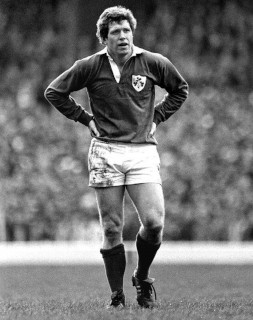
In 1971, Slattery first tours with the British and Irish Lions squad that toured New Zealand, missing out on a start in the third Test due to illness. With the back-row berths claimed by John Taylor, Peter Dixon and Mervyn Davies and still being a newcomer at international level he has to wait until 1974 for his shot at a Lions Test jersey. In the meantime, he plays for the Barbarian F.C. in the famous 1973 game against the All Blacks in Cardiff.
Slattery tours with the Lions again in 1974, playing in all four Tests and captaining the side for two provincial matches. In South Africa he is an invaluable member of the touring party that comes to be known as “the invincibles.” He starts all four Tests as the Lions win the series 3-0 and skippers the side twice during midweek tour matches.
For Ireland, Slattery captains their hugely successful touring side in Australia in 1979 when they win seven of the eight matches including the two Tests in Brisbane and Sydney. In 1982 he starts all four games of Ireland’s Triple Crown season, being denied the Grand Slam by France in the final game of the Five Nations Championship.
Oscar Wilde languishes in jail as his play Salomé opens in Paris on February 11, 1896. Salomé is a one act play based on the biblical tale of Salomé, stepdaughter of the tetrarchHerod Antipas, who asks for the head of Jokanaan (John the Baptist) on a platter as a reward for dancing the Dance of the Seven Veils. The original 1891 version of the play is in French. Three years later an English translation, with illustrations by Aubrey Beardsley, is published.
Rehearsals for the play’s debut on the London stage, for inclusion in Sarah Bernhardt‘s London season, begin in 1892, but are halted when the Lord Chamberlain‘s licensor of plays bans Salomé on the basis that it is illegal to depict Biblical characters on the stage. The play eventually premiers on February 11, 1896, while Wilde is in prison, in Paris at the Théâtre de la Comédie-Parisienne in a staging by Lugné-Poe‘s theatre group, the Théâtre de l’Œuvre.
In The Pall Mall Gazette of June 29, 1892 Wilde explains why he had written Salomé in French:
“I have one instrument that I know I can command, and that is the English language. There was another instrument to which I had listened all my life, and I wanted once to touch this new instrument to see whether I could make any beautiful thing out of it. […] Of course, there are modes of expression that a Frenchman of letters would not have used, but they give a certain relief or colour to the play. A great deal of the curious effect that Maeterlinck produces comes from the fact that he, a Flamand by grace, writes in an alien language. The same thing is true of Rossetti, who, though he wrote in English, was essentially Latin in temperament.”
A performance of the play is arranged by the New Stage Club at the Bijou Theatre in Archer Street, London, on May 10 and 13, 1905, starring Millicent Murby as Salomé and directed by Florence Farr. In June 1906 the play is presented privately with A Florentine Tragedy by the Literary Theatre Society at King’s Hall, Covent Garden. The Lord Chamberlain’s ban is not lifted for almost forty years. The first public performance of Salomé in England is produced by Nancy Price at the Savoy Theatre on October 5, 1931. She takes the role of Herodias herself and casts her daughter, Joan Maude, as Salomé.
By this time access to institutional power in Ireland was restricted to a small minority, the Anglo-Irish of the Protestant Ascendancy, and frustration at the lack of reform among the Catholic majority eventually led, along with other reasons, to the Irish Rebellion in 1798, involving a French invasion of Ireland and the seeking of complete independence from Great Britain. This rebellion was crushed with much bloodshed, and the subsequent drive for union between Great Britain and Ireland that passes in 1800 is motivated at least in part by the belief that the rebellion was caused as much by reactionary loyalist brutality as by the Society of United Irishmen.
Furthermore, Catholic emancipation is being discussed in Great Britain, and fears that a newly enfranchised Catholic majority will drastically change the character of the Irish government and parliament also contributes to a desire from London to merge the Parliaments.
Complementary acts have to be passed in the Parliament of Great Britain and in the Parliament of Ireland. The Parliament of Ireland had recently gained a large measure of legislative independence under the Constitution of 1782. Many members of the Irish Parliament jealously guard this autonomy and a motion for union is legally rejected in 1799.
Only Anglicans are permitted to become members of the Parliament of Ireland, though the great majority of the Irish population are Roman Catholic, with many Presbyterians in Ulster. In 1793 Roman Catholics regain the right to vote if they own or rent property worth £2 per acre. The Catholic hierarchy is strongly in favour of union, hoping for rapid emancipation and the right to sit as MPs, which is delayed after the passage of the acts until the passage of the Roman Catholic Relief Act 1829.
From the perspective of Great Britain, the union is desirable because of the uncertainty that followed the Irish Rebellion of 1798 and the French Revolution of 1789. If Ireland adopted Catholic Emancipation, willingly or not, a Roman Catholic Parliament could break away from Britain and ally with the French. Also the Irish and British Parliaments, when creating a regency during King George III‘s “madness”, gave the Prince Regent different powers. These considerations lead Great Britain to decide to attempt merger of the two kingdoms and their Parliaments.
The final passage of the Act in the Irish Parliament is achieved with substantial majorities, in part according to contemporary documents through bribery, namely the awarding of peerages and honours to critics to get their votes. Whereas the first attempt had been defeated in the Irish House of Commons by 109 votes against to 104 for, the second vote in 1800 produces a result of 158 to 115.
In the first Parliament of the United Kingdom of Great Britain and Ireland, the members of the House of Commons are not elected afresh. By royal proclamation authorised by the Act, all the members of the last House of Commons from Great Britain take seats in the new House, and from Ireland 100 members are chosen from the last Irish House of Commons: two members from each of the 32 counties and from the two largest boroughs, and one from each of the next 31 boroughs (chosen by lot) and from the University of Dublin. The other 84 Irish parliamentary boroughs are disfranchised, all being pocket boroughs, whose patrons receive £15,000 compensation for the loss of what is considered their property.
(Pictured: Coat of Arms of the United Kingdom from 1837 to 1952 used by Queen Victoria, King Edward VII, George V, Edward VIII and George VI)
Kiely is born in Dromore, County Tyrone on August 15, 1919, the youngest of six children. In 1920, the family moves from Dromore to Omagh. After living for a short time in Castle Street and Drumragh, the family finally settles in St. Patrick’s Terrace in the Gallows Hill area of Omagh. This area is to be a lasting inspiration for Kiely.
Kiely begins to feel the urge to become a writer during his teenage years. He has a keen interest in the work of George Bernard Shaw, H. G. Wells and Jonathan Swift. In 1936, after completing his education at Mount St. Columba Christian Brothers School in Omagh, he goes to work as a sorting clerk in the Omagh Post Office.
However, Kiely soon realises that the post office will not provide him with the life of the scholar which he so desires. In the spring of 1937, he leaves Omagh and begins a new life in Emo Park, Portarlington, County Laois, where he decides to train as a Jesuit priest. His life as a Jesuit is not meant to be for, exactly a year later, in the spring of 1938, he suffers a serious spinal injury, which results in a lengthy stay in Cappagh National Orthopaedic Hospital in Finglas, Dublin. During his hospitalisation, he is given plenty of time to think about the course his life has already taken, and about a course it might take. He also realises that he lacks a vocation to the priesthood and abandons his training as a Jesuit.
When Kiely gets out of hospital in 1939, he returns to Omagh to recover from his back problem. The following year, he begins working as a part-time journalist in the weekly Catholic Standard newspaper. In 1943, he graduates from National University of Ireland with a B.A. in History and Letters.
In 1945, Kiely begins working for the Irish Independent, where he is employed as a journalist and critic. In 1950, he joins The Irish Press as a literary editor. In 1964, he moves to the United States where, over a period of four years, he is a Writer-in-Residence at Emory University, visiting professor at the University of Oregon, and Writer-in-Residence at Hollins College (Virginia). In 1968, he returns to Ireland. In the spring of 1976, he is Distinguished Visiting Professor at the University of Delaware. He continues to receive acclaim for his writing and journalism, a career which spans over six decades, receiving the Award for Literature from the Irish Academy of Letters. By now, he is one of Ireland’s best-known writers. In 1996, he is named Saoi of Aosdána, the highest honour given by the Arts Council of Ireland.
Kiely visits Omagh in 2001 which is marked by the unveiling of a plaque outside his childhood home on Gallows Hill by Omagh’s Plain Speaking Community Arts group. Every September an event is held in Omagh called The Benedict Kiely Literary Weekend to celebrate his many achievements.
The last sketch by artist Jack B. Yeats, drawn while he lay dying in a Dublinnursing home, sells at auction in London on February 8, 2011, for £5,760. Roundabout Ponies far exceeds its estimate of £1,500- £2,000 at the inaugural Irish Sale at Bonhams, the New Bond Street fine art auctioneers.
The pen-and-ink drawing on writing paper, which measures just over 5 inches by 4 inches, is sold by a family who had inherited it from the matron of the Portobello Nursing Home. The artist had presented the sketch to Teresa O’Sullivan, with whom he had become friendly, two days before he died on March 28, 1957.
Bonhams says the picture had attracted considerable interest because it was the last work done by Yeats and described it as “a little gem [which] exhibits the unique artistic vitality he had right to the end.”
The sketch is bought by an unnamed “private London buyer.” The auction is the first test of the international demand for Irish art in 2011 and the overall results are disappointing. Among the unsold works are the two highest-priced paintings: The Cat Among the Stars, an oil-on-board, also by Jack B. Yeats, and Image of Francis Bacon No. 18, a watercolour by Louis le Brocquy.
Commenting afterwards, Penny Day, the County Laois-born head of Irish Art at Bonhams, says, “We have made a start in the toughest time imaginable and have had mixed results, but I am pretty confident we will be able to sell all the pictures that did not sell in the auction with post-sale deals.”
(From: “Jack B Yeats’ deathbed sketch sells for three times it estimate” by Michael Parsons, The Irish Times, February 10, 2011)
Beatty is the youngest of three sons born to Hetty and John Beatty, a banker and stockbroker. After studying engineering at the Columbia School of Mines and Princeton University, he helps to develop porphyry copper ores in the United States, first as a consulting engineer and later as a director on the boards of several copper-mining firms. In 1913 he relinquishes his mining interests in the United States and settles in Great Britain, becoming a naturalized British subject in 1933. In 1921 he forms a prospecting company that initiates the development of the Copperbelt region of Northern Rhodesia (now Zambia). For this, he becomes known as the “King of Copper.”
An early family anecdote recalls that, as a young boy, Beatty catches the collection bug, bidding at auction for mining samples. In 1931 an announcement in London‘s The Times casts him as a great collector. Between 1939 and 1949 he acquires over 140 nineteenth-century paintings to display in the Picture Gallery of his London home. These are now part of the collection of the National Gallery of Ireland.
Beatty supports the war effort, contributing a large number of raw materials to the Allies. He receives a belated knighthood by Queen Elizabeth II in the 1954 Birthday Honours list for his contribution to the wartime effort. By the late 1940s, however, he has become disillusioned with Britain. Political deviations from his free-market values, coupled with increased foreign exchange restrictions impacted both his personal and collecting interests in Britain.
In 1950, at the age of 75, Beattys over the reins of Selection Trust to his son Chester Jr. and relocates to Dublin. He purchases a large townhouse for himself on Ailesbury Road, in the Ballsbridge area of Dublin and a site on Shrewsbury Road for the construction of the Chester Beatty Library, which houses the collection, opening on August 8, 1953. The library is moved to its current location at Dublin Castle in 2000.
Beatty spends the remainder of his life between Dublin and the south of France. He is made a Freeman of the City of Dublin in 1954 and is the first person granted honorary citizenship of Ireland in 1957. He continues to collect in the 1950s and 1960s, acquiring important Ethiopian manuscripts and Japanese printed material during that period.
Beatty dies in Monte Carlo in Monaco on January 19, 1968. His Irish estate is valued at £7 million. He is accorded a state funeral by the Irish government, the first private citizen in Irish history to receive such an honour. He is buried in Glasnevin Cemetery in Dublin.
Robert William Gary Moore, Northern Irish musician, most widely recognised as a singer, songwriter, and virtuoso rock and blues guitarist, dies of a heart attack on February 6, 2011, in Estepona, Spain.
In a career dating back to the 1960s, Moore plays with musicians including Phil Lynott and Brian Downey during his teenage years, leading him to memberships of the Irish bands Skid Row and Thin Lizzy, and British band Colosseum II. Moore shares the stage with such blues and rock musicians as B. B. King, Albert King, Jack Bruce, Albert Collins, George Harrison, and Greg Lake, as well as having a successful solo career. He guests on a number of albums recorded by high-profile musicians.
Moore is born in Belfast, Northern Ireland on April 4, 1952. He starts performing at a young age, having picked up a battered acoustic guitar at the age of eight. He gets his first quality guitar at the age of 14, learning to play the right-handed instrument in the standard way despite being left-handed.
At the age of 16, aiming to become a musician, he moves to Dublin. Moore’s greatest influence in the early days is guitarist Peter Green of Fleetwood Mac who is a mentor to Moore when performing in Dublin. Other early musical influences are artists such as Albert King, Elvis Presley, Eric Clapton, The Shadows, and The Beatles. Later, having seen Jimi Hendrix and John Mayall’s Bluesbreakers in his hometown of Belfast, his own style develops into a blues-rock sound that becomes the dominant form of his career in music.
In Dublin, Moore joins the group Skid Row with Noel Bridgeman and Brendan “Brush” Shiels. It is with this group that he earns a reputation in the music industry, and his association with Phil Lynott begins.
Moore moves to England in 1970 and in 1973, under the name “The Gary Moore Band,” he releases his first solo album, Grinding Stone. Grinding Stone receives “Album of the Year” accolades on KTAC-FM/Seattle–Tacoma, Washington, in 1974.
In 1974 he joins Thin Lizzy after the departure of founding member Eric Bell. From 1975 to August 1978, he is a member of Colosseum II. In 1977, Moore rejoins Thin Lizzy, first as a temporary replacement for Brian Robertson, and on a permanent basis a year later.
Gary Moore dies of a heart attack in his sleep at the age of 58 during the early hours of February 6, 2011. At the time, he is on holiday with a girlfriend at the Kempinski Hotel in Estepona, Spain. Moore is laid to rest in St. Margaret’s Churchyard, Rottingdean, East Sussex, England, in a private ceremony with only family and close friends in attendance.
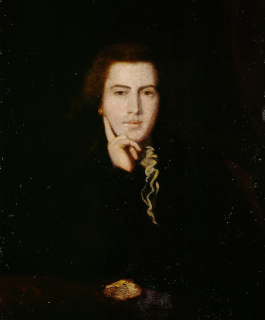
Drennan is born on May 23, 1754, in Belfast, the son the son of ReverendThomas Drennan (1696–1768), minister of Belfast’s First Presbyterian Church on Rosemary Street. Thomas Drennan is an educated man from the University of Glasgow and is ordained to the congregation of Holywood, County Down in 1731. Drennan is heavily influenced by his father, whose religious convictions serve as the foundation for his own radical political ideas. His sister, Martha, marries fellow future United Irishman Samuel McTier in 1773.
In 1769 Drennan follows in his father’s footsteps by enrolling in the University of Glasgow where he becomes interested in the study of philosophy. In 1772 he graduates in arts and then in 1773 he commences the study of medicine at Edinburgh. After graduating in 1778 he sets up practice in Belfast, specialising in obstetrics. He is credited with being one of the earliest advocates of inoculation against smallpox and of hand washing to prevent the spread of infection. He also writes much poetry, coining the phrase “Emerald Isle” and is the founder and editor of a literary periodical, Belfast Magazine. He moves to Newry in 1783 but eventually moves to Dublin in 1789 where he quickly becomes involved in nationalist circles.
Like many other UlsterPresbyterians, Drennan is an early supporter of the American Colonies in the American Revolution and joins the Volunteers who had been formed to defend Ireland for Britain in the event of French invasion. The Volunteer movement soon becomes a powerful political force and a forum for Protestant nationalists to press for political reform in Ireland eventually assisting Henry Grattan to achieve legislative independence for the Irish parliament in 1782. However, Drennan, like many other reformers, quickly becomes dismayed by the conservative and sectarian nature of the Irish parliament and in 1791 he co-founds the Society of United Irishmen with Wolfe Tone and Thomas Russell.
Drennan writes many political pamphlets for the United Irishmen and is arrested in 1794 for seditious libel, a political charge that is a major factor in driving the United Irishmen underground and into becoming a radical revolutionary party. Although he is eventually acquitted, he gradually withdraws from the United Irishmen but continues to campaign for Catholic Emancipation.
On February 8, 1800, Drennan marries Sarah Swanwick, “an English lady of some wealth” from Shropshire. They have one daughter and four sons.
Drennan settles in Belfast in 1807. In 1810 he co-founds the non-denominational Royal Belfast Academical Institution. As a poet, he is best remembered for his poem The Wake of William Orr, written in memory of a United Irishman executed by the British. Despite his links with revolutionary republicans, he gradually becomes alienated from the post-Union nationalism of the period. His abiding concern for Liberalism and post union realities make him contemplate his political ideas anew.
Drennan dies in Belfast on February 5, 1820. He directs that his coffin be carried by an equal number of Catholics and Protestants with clergy from different denominations in attendance.




 seamus dubhghaill