seamus dubhghaill

Promoting Irish Culture and History from Little Rock, Arkansas, USA


Leave a comment

Birth of Major General Patrick Ronayne Cleburne

patrick-ronayne-cleburne

Patrick Ronayne Cleburne, called the “Stonewall of the West” and one of the finest generals produced by either side during the American Civil War is born on March 17, 1828 at Bride Park Cottage in Ovens, County Cork, just outside Cork City.

Born on St. Patrick’s Day, this native Irishman is nevertheless extremely loyal to his adopted country, saying, “if this [Confederacy] that is so dear to my heart is doomed to fail, I pray heaven may let me fall with it, while my face is toward the enemy and my arm battling for that which I know to be right.” Sadly, Cleburne ultimately receives his wish.

Cleburne begins his military career in an unlikely manner. When he fails the entrance exam at Trinity College, Dublin, he cannot face his family. He enlists in the 41st Regiment of Foot in the British Army. In 1849 he purchases his discharge and leaves for the United States, eventually settling in Helena, Arkansas in June 1850 and earning his citizenship in 1855. He loves his new country, taking part in many community projects, and even being one of the few volunteers to care for the sick during a yellow fever outbreak.

In January 1861 Cleburne joins the local militia company, the Yell Rifles.  He leads the company in the seizure of the U.S. Arsenal in Little Rock in January 1861. When Arkansas left the Union, the Yell Rifles became part of the 1st Arkansas Infantry Regiment. By fall of 1861 he has risen to command the 2nd Brigade, Hardee’s Division, in the Army of Central Kentucky. His first major battle is at the Battle of Shiloh, April 6-7, 1862. At the Battle of Richmond (Kentucky) in August 1862, he is wounded in the mouth and loses several of his teeth. Still, he earns the thanks of the Confederate States Congress for his actions there. During the October 1862 Battle of Perryville he is wounded again – twice, yet stays in command during the battle. In December 1862 he is promoted to Major General.

At the December 1862 Battle of Stones River, Cleburne and his division earn the praise of General Braxton Bragg for their incredible skill and valor. Cleburne’s actions and character play a large role in his men’s determination during battle.

In 1863 Cleburne faces off against Union General George Henry Thomas at the Battle of Chickamauga. His and General John C. Breckinridge’s assaults force General Thomas to call repeatedly for reinforcements. In November 1863 the Confederate army is forced to retreat after the Chattanooga Campaign. However, Cleburne has defeated every assault against his men eventually charging his attackers. After the battle, he and his men are charged with covering the retreat.

On January 2, 1864, Cleburne makes his most controversial decision ever. He gathers the corps and division commanders in the Army of Tennessee to present his proposal. The Confederacy is unable to fill its ranks due to a lack of manpower. He states that slavery is their “most vulnerable point, a continued embarrassment, and in some respects an insidious weakness.” His proposed solution is for the Confederacy to arm slaves to fight in the army. In time, these soldiers would receive their freedom. The proposal is not well received at all. In fact, Jefferson Davis, President of the Confederate States of America, directs that the proposal be suppressed.

In the spring of 1864 the Army of Tennessee moves towards Atlanta, Georgia. Cleburne and his men fight at Dalton, Tunnel Hill, Resaca, Pickett’s Mill, Ringgold and Kennesaw. The Atlanta Campaign begins in the summer and lasts until September, when General John Bell Hood evacuates Atlanta. Hood had taken command from General Joseph E. Johnston, which Cleburne felt to be a disaster for the Confederacy.

General Hood hopes to stop Union General John Schofield and his men before they can reach Nashville to reinforce General Thomas. Due to poor communications and nightfall, Schofield slips past the Army of Tennessee into Franklin.

The November 30, 1864 Battle of Franklin is a tragic loss for the Confederacy. Hood throws his men into well-fortified Union troops. The results are disastrous. About 6,000 men are killed or wounded including six generals who are killed or mortally wounded. Cleburne is one of these six, killed while attacking Union breastworks. He is last seen advancing on foot toward the Union line with his sword raised, after his horse had been shot out from under him. Accounts later say that he is found just inside the Federal line and his body is carried back to an aid station along the Columbia Turnpike. Confederate war records indicate he died of a shot to the abdomen, or possibly a bullet that went through his heart. When Confederates find his body, he has been picked clean of any valuable items, including his sword, boots and pocket watch.

Cleburne’s remains are first laid to rest at Rose Hill Cemetery in Columbia, Tennessee. At the urging of Army Chaplain Biship Quintard, Judge Mangum, staff officer to Cleburne and his law partner in Helena, his remains are moved to St. John’s Episcopal Church near Mount Pleasant, Tennessee, where they remain for six years. In 1870, he is disinterred and returned to his adopted hometown of Helena, Arkansas, with much fanfare, and buried in the Helena Confederate Cemetery located in the southwest corner of the Maple Hill Cemetery, overlooking the Mississippi River.

Several geographic features are named after Patrick Cleburne, including Cleburne County in Alabama and Arkansas, and the city of Cleburne, Texas. The Patrick R. Cleburne Confederate Cemetery is a memorial cemetery in Jonesboro, Georgia that is named in honor of General Patrick Cleburne.


2 Comments

Battle at Marye’s Heights

battle-of-fredericksburg

Irish fight Irish in one of the bloodiest days in Irish military history at Marye’s Heights in Fredericksburg, Virginia on December 13, 1862, during the American Civil War. The Union Army’s Irish Brigade, the Fighting 69th, is decimated by the Confederate States Army during multiple efforts to take Marye’s Heights. In his official report Thomas Francis Meagher writes, “of the one thousand and two hundred I led into action, only two hundred and eighty appeared on parade next morning.”

The Battle of Fredericksburg, fought December 11-15, 1862, is one of the largest and deadliest of the war. It features the first major opposed river crossing in American military history. Union and Confederate troops fight in the streets of Fredericksburg, the war’s first urban combat. And with nearly 200,000 combatants, no other Civil War battle features a larger concentration of soldiers.

Major General Ambrose Burnside’s plan at Fredericksburg is to use the nearly 60,000 men in Major General William B. Franklin’s Left Grand Division to crush General Robert E. Lee’s southern flank on Prospect Hill while the rest of his army holds Lt. Gen. James Longstreet and the Confederate First Corps in position at Marye’s Heights.

The Union army’s main assault against Lt. Gen. Thomas J. “Stonewall” Jackson produces initial success and holds the promise of destroying the Confederate right, but lack of reinforcements and Jackson’s powerful counterattack stymies the effort. Both sides suffer heavy losses (totaling 9,000 in killed, wounded and missing) with no real change in the strategic situation.

In the meantime, Burnside’s “diversion” against veteran Confederate soldiers behind a stone wall produces a similar number of casualties but most of these are suffered by the Union troops. Wave after wave of Federal soldiers march forth to take the heights, but each is met with devastating rifle and artillery fire from the nearly impregnable Confederate positions.

As darkness falls on a battlefield strewn with dead and wounded, it is abundantly clear that a signal Confederate victory is at hand. The Army of the Potomac has suffered nearly 12,600 casualties, nearly two-thirds of them in front of Marye’s Heights. By comparison, Lee’s army has suffered some 5,300 losses. Lee, watching the great Confederate victory unfolding from his hilltop command post exclaims, “It is well that war is so terrible, or we should grow too fond of it.”

Roughly six weeks after the Battle of Fredericksburg, President Abraham Lincoln removes Burnside from command of the Army of the Potomac.


Leave a comment

Birth of Charles Monck, 1st Governor General of Canada

charles-stanley-monck

Charles Stanley Monck, 4th Viscount Monck GCMG PC, the last Governor-General of the Province of Canada and the first Governor General of Canada after Canadian Confederation, is born on October 10, 1819 in Templemore, County Tipperary. Prior to Confederation he is concurrently Lieutenant Governor of both Canada West and Canada East. He is the son of Charles Monck, 3rd Viscount Monck, and his wife Bridget née Willington.

Monck obtains a law degree from Trinity College, Dublin. He marries his first cousin Lady Elizabeth Louise Mary Monck on July 24, 1844, and in 1849 he inherits his father’s title of Viscount Monck. In 1852 he is elected MP for Portsmouth, and from 1855 to 1858 he serves as Lord of the Treasury under Henry John Temple, 3rd Viscount Palmerston.

In 1861 Monck is appointed Governor General of British North America as well as Governor of the Province of Canada. During this time, the Canadian colonies are beginning to organise themselves into a confederation. The American Civil War has just broken out, and the Trent Affair causes diplomatic tension between the United States and Britain. The Canadian government is eager to gain some measure of independence during this turbulent period. The Quebec Conference, the Charlottetown Conference, and the London Conference, at which the details of confederation are discussed, all take place during Monck’s time as governor. Monck supports the idea, and works closely with John A. Macdonald, George Brown, George-Étienne Cartier, and Étienne-Paschal Taché, who form the “Great Coalition” in 1864.

In 1866 Monck becomes a peer with the title Baron Monck. When the Canadian colonies become a semi-independent confederation the next year, he becomes the country’s first Governor General. He is also responsible for establishing Rideau Hall as the residence of the Governor General in Ottawa.

In 1869 Monck is succeeded by John Young, 1st Baron Lisgar. He returns home to Ireland, where he becomes Lord Lieutenant of Dublin in 1874. He dies in Enniskerry, County Wicklow on November 29, 1894.


Leave a comment

The Battle of Antietam

irish-brigade-at-antietam

The Irish Brigade of the Union Army fights in the Battle of Antietam, one of the most famous battles of the American Civil War, on September 17, 1862. The battle has the sad distinction of being the bloodiest single day of fighting in America’s bloodiest war. Combined casualties at the Battle of Antietam are 26,134. Few regiments suffered more than the Irish Brigade.

The Irish Brigade is the brainchild of their commanding officer Thomas Francis Meagher. The former Young Ireland rebel, creator of the Irish Tricolor of green, white and orange, escaped political prisoner, lawyer, newspaper editor and politician forms the brigade with the twin objectives of gaining respect for the Irish by their patriotism for their adopted country and developing a nucleus for a future fight for Ireland’s freedom. The Brigade is formed of the almost exclusively Irish American 69th, 63rd and 88th New York and the “honorary Irish” of the 29th Massachusetts. The regiments of the Irish Brigade had already earned a formidable reputation as a crack unit, having distinguished themselves in every battle of the earlier Seven Days Battles. It is small wonder, many in the Brigade’s ranks had already distinguished themselves in the Mexican-American War or in fighting with the Papal forces in Italy against Giuseppe Garibaldi.

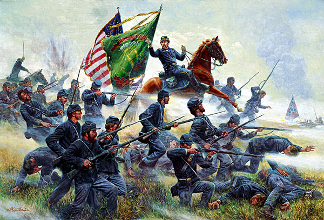
The Union Army is already heavily engaged, when the Irish Brigade is ordered to advance through an open field to take an area of high ground. Subjected to accurate Confederate rifle fire as they cross the field, the Brigade marches on in disciplined order, the National and the famed Green Regimental Colors (flags) fluttering overhead. When they encounter a fence across their line of march, eighty volunteers rush forward to knock it down, rather than see the whole Brigade slowed by the obstacle and exposed to fire. Over half of these volunteers are killed. Seeing the Irish continue to press forward, the Confederates fall back as the Irish advance up the hill.

What no one on the Union side knows is that on the other side of the hill is a farmer’s dirt road that years of rain has eroded into a ditch five feet below the surrounding ground level. The sunken road is a perfect rifle pit and is filled with Colonel John Brown Gordon’s Georgians. As the Irish crest the hill, they are met with a volley that decimates the Brigade, including killing or wounding every single standard-bearer. Seeing the flags fall from across the field, an aide to Union General George B. McClellan exclaims, “The battles lost, the Irish are fleeing!” only for McClellan to respond, “No, the flags are raised again, they are advancing.” Eight successive standard-bearers of the 69th New York alone fall that day as men pick up the flags from fallen comrades. Captain Patrick Clooney, though wounded himself, snatches up the colors from the 88th’s fallen standard-bearer only to be killed by multiple shots, the Green Flag wrapping around him like a shroud befitting a hero. Another standard-bearer, the staff of his Irish Brigade flag snapped in two by a rifle shot, drapes the flag over his shoulder like a sash and continues to move forward, personifying the Gaelic phrase on the flag he is carrying “Riamh Nar Dhruid O Spairn lann”, “Who never retreated from the clash of spears.”

The fire of the Confederates is so intense that the Irish Brigade cannot advance, but they do not flee either. Despite the failure of promised reinforcements that never materialize, the Brigade pours “Buck and Ball” (a 69-caliber ball and three 30 caliber buckshot) into the enemy at 300 paces, turning the “Sunken Road” into “Bloody Lane.” When their ammunition is depleted, the remnants of the Brigade, with drill ground precision, form and march back to the Union lines. The Irish Brigade never “ran” from the enemy. Another Union unit takes the “Bloody Lane,” but most credit the punishment that the Irish Brigade inflicted on the enemy, at a terrible cost to themselves, with making it possible. The New York Regiments take over 50% casualties. The Irish Brigade is now no bigger than a single regiment. As the depleted ranks of the 88th march passed, Union Major General Israel Bush Richardson salutes as it passes with the words “Bravo 88th, I shall never forget you!”

During the course of the War, the Irish Brigade suffers over 4,000 casualties, more men than the Brigade ever had at any one time. The Fighting 69th loses more men than any other New York regiment. The Battle of Antietam is remembered as the Union victory that allows President Abraham Lincoln to issue the Emancipation Proclamation, which frees the slaves in the Confederate states. It is all too often forgotten that this emancipation was secured in no small part with the blood of Irish immigrants, immigrants who were denied civil rights in their own country and faced discrimination in their adopted county before and after the Civil War.

In thinking of the Civil War, all Americans should remember the words of a defeated Confederate Officer to his Union counterpart at Appomattox, “You only won as you had more Irish than we did.”

(Credit: “The Irish Brigade at Antietam” by Neil F. Cosgrove, October 17, 2009)


Leave a comment

Death of U.S. President William McKinley

william-mckinley

William McKinley, the 25th President of the United States, dies on September 14, 1901, eight days after being shot by anarchist Leon Czolgozc and six months into his second term. McKinley leads the nation to victory in the Spanish American War, raises protective tariffs to promote American industry, and maintains the nation on the gold standard in a rejection of free silver.

McKinley is born on January 29, 1843, in Niles, Ohio, the seventh child of William McKinley Sr. and Nancy (née Allison) McKinley. The McKinleys are of English and Scots Irish descent and settled in western Pennsylvania in the 18th century, tracing back to a David McKinley who is born in Dervock, County Antrim, in present-day Northern Ireland.

McKinley is the last president to serve in the American Civil War and the only one to start the war as an enlisted soldier, beginning as a private in the Union Army and ending as a brevet major. After the war, he settles in Canton, Ohio, where he practices law and marries Ida Saxton. In 1876, he is elected to the United States Congress, where he becomes the Republican Party‘s expert on the protective tariff, which he promises will bring prosperity. His 1890 McKinley Tariff is highly controversial which, together with a Democratic redistricting aimed at gerrymandering him out of office, leads to his defeat in the Democratic landslide of 1890.

McKinley is elected Ohio’s governor in 1891 and 1893, steering a moderate course between capital and labor interests. With the aid of his close adviser Mark Hanna, he secures the Republican nomination for president in 1896, amid a deep economic depression. He defeats his Democratic rival, William Jennings Bryan, after a front porch campaign in which he advocates “sound money” and promises that high tariffs will restore prosperity.

Rapid economic growth marks McKinley’s presidency. He promotes the 1897 Dingley Act to protect manufacturers and factory workers from foreign competition, and in 1900, he secures the passage of the Gold Standard Act. He hopes to persuade Spain to grant independence to rebellious Cuba without conflict, but when negotiation fails, he leads the nation into the Spanish American War of 1898. The U.S. victory is quick and decisive. As part of the Treaty of Paris (1898), Spain turns over to the United States its main overseas colonies of Puerto Rico, Guam, and the Philippines. Cuba is promised independence, but at that time remains under the control of the U.S. Army. The United States annexes the independent Republic of Hawaii in 1898, and it became a U.S. territory.

Historians regard McKinley’s 1896 victory as a realigning election, in which the political stalemate of the post–Civil War era gives way to the Republican-dominated Fourth Party System, which begins with the Progressive Era.

McKinley defeats Bryan again in the 1900 presidential election, in a campaign focused on imperialism, protectionism, and free silver. However, his legacy is suddenly cut short when he is shot on September 6, 1901, by Leon Czolgosz, a second-generation Polish American with anarchist leanings. McKinley dies eight days later on September 14, 1901, and is succeeded by his Vice President, Theodore Roosevelt. He is buried at the McKinley National Memorial in Canton, Ohio.

As an innovator of American interventionism and pro-business sentiment, McKinley’s presidency is generally considered above average, though his highly positive public perception is soon overshadowed by Roosevelt.


Leave a comment

Birth of James Joseph Quinlan, Union Army Officer

james-joseph-quinlan

James Joseph Quinlan, Union Army officer during the American Civil War, is born in Clonmel, County Tipperary on September 13, 1833.

Quinlan is appointed as Major of the 88th New York Infantry in December 1861. He becomes the regiment’s Lieutenant Colonel in October 1862 and is discharged in February 1863.

Quinlan receives America’s highest military decoration, the Medal of Honor, on February 18, 1891, for his actions at the Battle of Savage’s Station in Henrico County, Virginia, the fourth of the Seven Days Battles (Peninsula Campaign). His citation states he “led his regiment on the enemy’s battery, silenced the guns, held the position against overwhelming numbers, and covered the retreat of the Second Army Corps.”

James Joseph Quinlan dies on August 29, 1906, in Queens, New York and is buried at Calvary Cemetery, Woodside, Queens County, New York.


2 Comments

Birth of Robert Nugent, Civil War and Indian Wars Officer

robert-nugent

Brigadier General Robert Nugent, Irish-born American United States Army officer during the American Civil War and the American Indian Wars, is born on June 27, 1824, in Kilkeel, County Down, in what is now Northern Ireland.

Nugent serves with the Irish Brigade‘s 69th Infantry Regiment, from its days as a National Guard unit and into its incorporation into the Union Army at the start of the war. He is one of its senior officers at the First Battle of Bull Run.

When the unit is originally mustered out of service, the 90-day enlistment terms having expired, Nugent accepts a commission as a captain in the regular army. He is immediately assigned to the 13th Infantry Regiment whose commanding officer, Colonel William Tecumseh Sherman, personally requests. Taking a leave of absence to return to New York, he assists Thomas Francis Meagher in organizing the Irish Brigade. The newly reformed 69th Infantry Regiment is the first unit assigned to the Irish Brigade and, with Nugent as its colonel, he leads the “Fighting 69th” at the Battles of Fair Oaks, Gaines’ Mill, Savage’s Station, White Oak Swamp, Glendale and Malvern Hill.

Nugent is shot in the stomach at the Battle of Fredericksburg and is eventually forced to resign his command. He is appointed acting assistant provost marshal for the southern district of New York, which includes New York City and Long Island, by the United States War Department. An Irishman and Democrat, his appointment is thought to assure the Irish American population that conscription efforts would be carried out fairly. The Irish American, a popular Irish language newspaper, writes that the selection is a “wise and deservedly popular one.” He encounters resistance from city officials wanting to remain uninvolved, however by mid-June reports to his superior officer and provost marshal general Colonel James Barnet Fry that conscription efforts are “nearing completion without serious incident.”

Understanding the seriousness of the situation, Nugent attempts to keep the draft selections quiet and in isolated parts of the city. In Manhattan however, lotteries are placed in the heart of Irish tenement and shanty neighborhoods where the draft is most opposed.

In the ensuing New York City draft riots, Nugent takes command of troops and attempts to defend the city against the rioters. Despite issuing the cancellation of the draft, the riots continue for almost a week. His home on West 86th Street is looted and burned by the rioters during that time, his wife and children barely escaping from their home. Upon breaking into his house, furniture is destroyed, and paintings of Nugent and Meagher are slashed, although a painting of Brigadier General Michael Corcoran is reportedly left untouched.

On October 28, Nugent is relieved of his post and succeeded by General William Hays. Returning to active duty, he assumes command of the Irish Brigade in November 1864, shortly after the death of Corcoran. He is present at the battle of Battle of Spotsylvania Court House, the Siege of Petersburg and the Appomattox Campaign. As its last commanding officer, he and the Irish Brigade also march in the victory parade held in Washington, D.C. following Robert E. Lee‘s surrender at Appomattox Court House.

Nugent is brevetted Brigadier General for distinguished leadership of the 69th Regiment on March 13, 1865. The veterans of the Irish Brigade are honorably discharged and mustered out three months later. Nugent remains in the regular U.S. Army for the next twenty years, a formidable “Indian fighter” during the American Indian Wars with the 13th and 24th Infantry Regiments. In 1879, he retires at the rank of major and resides in New York where he is involved in the Grand Army of the Republic, the War Veterans’ Association of the 7th Regiment and an honorary member of The Old Guard.

Nugent becomes ill in his old age, complications arising from his wounds suffered at Fredericksburg, and remains bedridden for two months before his death at his McDonough Street home in Brooklyn on June 20, 1901. In accordance with his last wishes, he is buried at Cypress Hills National Cemetery.


Leave a comment

Birth of Januarius MacGahan, Journalist & Correspondent

januarius-macgahan

Januarius Aloysius MacGahan, American journalist and war correspondent for the New York Herald and The Daily News, is born near New Lexington, Ohio on June 12, 1844. His articles describing the massacre of Bulgarian civilians by Turkish soldiers and irregular volunteers in 1876 creates public outrage in Europe and are a major factor in preventing Britain from supporting Turkey in the Russo–Turkish War of 1877–78, which leads to Bulgaria gaining independence from the Ottoman Empire.

MacGahan’s father is an immigrant from Ireland who had served on the Northumberland, the ship which took Napoleon into exile on Saint Helena. He moves to St. Louis, where he briefly works as a teacher and as a journalist. There he meets his cousin, General Philip Sheridan, an American Civil War hero also of Irish parentage, who convinces him to study law in Europe. He sails to Brussels in December 1868.

MacGahan does not get a law degree, but he discovers that he has a gift for languages, learning French and German. He runs short of money and is about to return to America in 1870 when the Franco-Prussian War breaks out. Sheridan happens to be an observer with the German Army, and he uses his influence to persuade the European editor of the New York Herald to hire MacGahan as a war correspondent with the French Army.

MacGahan’s vivid articles from the front lines describing the stunning defeat of the French Army win him a large following, and many of his dispatches to the Herald are reprinted by European newspapers. When the war ends, he interviews French leader Léon Gambetta and Victor Hugo and, in March 1871, he hurries to Paris and is one of the first foreign correspondents to report on the uprising of the Paris Commune. He is arrested by the French military and nearly executed and is only rescued through the intervention of the U.S. Minister to France Elihu B. Washburne.

In 1871 MacGahan is assigned as the Herald‘s correspondent to Saint Petersburg. He learns Russian, mingles with the Russian military and nobility, covers the Russian tour of General William Tecumseh Sherman and meets his future wife, Varvara Elagina, whom he marries in 1873. In 1874 he spends ten months in Spain, covering the Third Carlist War.

In 1876 MacGahan quarrels with James Gordon Bennett Jr., the publisher of the New York Herald, and leaves the newspaper. He is invited by his friend, Eugene Schuyler, the American Consul-General in Constantinople, to investigate reports of large-scale atrocities committed by the Turkish Army following the failure of an attempted uprising by Bulgarian nationalists in April 1876. He obtains a commission from The Daily News, then the leading liberal newspaper in England, and leaves for Bulgaria on July 23, 1876.

MacGahan reports that the Turkish soldiers have forced some of the villagers into the church, then the church is burned, and survivors tortured to learn where they have hidden their treasures. He says that of a population of seven thousand, only two thousand survive. According to his account, fifty-eight villages in Bulgaria are destroyed, five monasteries demolished, and fifteen thousand people in all massacred. These reports, published first in The Daily News, and then in other papers, cause widespread popular outrage against Turkey in Britain. The government of British Prime Minister Benjamin Disraeli, a supporter of Turkey, tries to minimize the massacres and says that the Bulgarians are equally to blame, but his arguments are refuted by the newspaper accounts of MacGahan.

In the wake of the massacres and atrocities committed by the Ottoman forces during the suppression of the April Uprising, as well as centuries-long conflicts between Russia and Turkey in Crimea, the Russian Government, stirred by anti-Turkish and Pan-Slavism sentiment, prepare to invade the Ottoman Empire, and declare war on it on April 24, 1877. The Turkish Government of Sultan Abdul Hamid II appeals for help to Britain, its traditional ally against Russia, but the British government responds that it cannot intervene “because of the state of public feeling.”

MacGahan is assigned as a war correspondent for The Daily News and, thanks to his friendship with General Skobelev, the Russian commander, rides with the first units of the Russian Army as it crosses the Danube into Bulgaria. He covers all the major battles of the Russo–Turkish War, including the Siege of Plevna and the Battle of Shipka Pass. He reports on the final defeat of the Turkish armies and is present at the signing of the Treaty of San Stefano, which ends the war.

MacGahan is in Constantinople, preparing to travel to Berlin for the conference that determines the final borders of Bulgaria, when he catches typhoid fever. He dies on June 9, 1878, and is buried in the Greek cemetery, in the presence of diplomats, war correspondents, and General Skobelev. Five years later his body is returned to the United States and reburied in New Lexington and a statue is erected in his honor by a society of Bulgarian Americans.


Leave a comment

Birth of John Brougham, Actor & Dramatist

john-brougham

John Brougham, Irish American actor and dramatist, is born in Dublin on May 9, 1814.

Brougham’s father is an amateur painter and dies young. His mother is the daughter of a Huguenot, whom political adversity has forced into exile. He is the eldest of three children. Both of his siblings die in youth, and the father being dead, and the widowed mother left penniless, he is reared in the family and home of an uncle.

Brougham is prepared for college at an academy at Trim, County Meath, twenty miles from Dublin, and subsequently is sent to the University of Dublin. There he acquires classical learning and forms interesting and useful associations and acquaintances. He also becomes interested in private theatricals. He falls in with a crowd that puts on their own shows, cast by drawing parts out of a hat. Though he most always trades off larger roles so he can pay attention to his studies, he takes quite an interest in acting. He is a frequent attendant, moreover, at the Theatre Royal in Hawkins Street.

Brougham is educated with the intention of his becoming a surgeon and walks the Peth Street Hospital for eight months. However, misfortune comes upon his uncle, so he is obliged to provide for himself. Before leaving the university he, by chance, becomes acquainted with the actress Lucia Elizabeth Vestris.

Brougham goes to London in 1830 and, after a brief experience of poverty, suddenly determines to become an actor. He is destitute of everything except fine apparel, and he has actually taken the extreme step of offering himself as a cadet in the service of the East India Company. But, being dissuaded by the enrolling officer, who lends him a guinea and advises him to seek other employment, and happening to meet with a festive acquaintance, he seeks recreation at the Tottenham Theatre where Madame Vestris is acting.

Brougham’s acquaintance with Madame Vestris leads to him being engaged at the theatre, and he thus makes his first appearance on the London stage in July in Tom and Jerry, in which he plays six characters. In 1831 he is a member of Madame Vestris’s company and writes his first play, a burlesque. He remains with Madame Vestris as long as she and Charles Mathews retain Covent Garden Theatre, and he collaborates with Dion Boucicault in writing London Assurance, the role of Dazzle being one of those with which he becomes associated. His success at small or “low” comic roles such as Dazzle earn him the nickname “Little Johnny Brougham,” a moniker which he embraces, and which boosts his popularity with working-class audiences.

In 1840 Brougham manages the Lyceum Theatre, for which he writes several light burlesques, but in 1842 he moves to the United States, where he becomes a member of William Evans Burton‘s company, for which he writes several comedies, including Met-a-mora; or, the Last of the Pollywogs, a parody of John A. Stone and Edwin Forrest’s Metamora; or The Last of the Wamponoags, and Irish Yankee; or, The Birthday of Freedom.

Later Brougham is the manager of Niblo’s Garden, and in 1850 opens Brougham’s Lyceum, which, like his next speculation, the lease of the Bowery Theatre, is not a financial success, despite the popularity of such works as Po-ca-hon-tas; or, The Gentle Savage. He is later connected with James William Wallack‘s and Augustin Daly‘s theatres and writes plays for both.

In 1860 Brougham returns to London, where he adapts or writes several plays, including The Duke’s Motto for Charles Fechter. In November 1864 he appears at the Theatre Royal in his native Dublin in the first performance of Dion Boucicault’s Arrah-na-Pogue with Boucicault, Samuel Johnson and Samuel Anderson Emery in the cast.

After the American Civil War Brougham returns to New York City. Brougham’s Theatre is opened in 1869 with his comedies Better Late than Never and Much Ado About a Merchant of Venice, but this managerial experience is also a failure due to disagreements with his business partner, James Fisk. He then takes to playing the stock market. His last appearance onstage is in 1879 as “O’Reilly, the detective” in Boucicault’s Rescued.

John Brougham dies in Manhattan on June 7, 1880.


Leave a comment

Birth of Civil War Officer John O’Neill

john-oneill

John Charles O’Neill, Irish-born officer in the American Civil War and member of the Fenian Brotherhood, is born on March 9, 1834, in Drumgallon, Clontibret, County Monaghan. He is best known for his activities leading the Fenian raids on Canada in 1866 and 1871.

O’Neill receives some schooling in Drumgallon. He emigrates to New Jersey in 1848 at the height of the Great Famine in Ireland. He receives an additional year of education there and works in a number of jobs. In 1857 he enlists in the 2nd United States Dragoons and serves in the Utah War (May 1857 – July 1858), apparently deserting afterwards to California.

In California, he joins the 1st Cavalry and serves as a sergeant in the American Civil War with this regiment until December 1862, at which time he is commissioned as an officer in the 5th Indiana Cavalry. He is credited as being a daring fighting officer, but believes he has not received due promotion, which leads to a transfer to the 17th United States Colored Infantry as captain. He leaves the Union Army prior to the end of the conflict, marrying Mary Crow, with whom he has several children.

While in Tennessee, O’Neill joins the militant Irish American movement, the Fenian Brotherhood, which eschews politics in favor of militant action to expel the British presence in Ireland. He attaches himself to the group led by William Randall Roberts, who wishes to attack Canada.

O’Neill, ranked as colonel, travels to the Canada–US border with a group from Nashville to participate in the Fenian raids. The assigned commander of the expedition does not appear, so O’Neill takes command. On June 1, 1866, he leads a group of six hundred men across the Niagara River and occupies Fort Erie.

The following day, north of Ridgeway, Ontario, O’Neill’s group encounters a detached column of Canadian volunteers, commanded by Lt-Col. Alfred Booker. The inexperienced Canadians are routed by the Civil War veterans. O’Neill withdraws back to Fort Erie and fights a battle against a detachment led by John Stoughton Dennis. With overwhelming numbers of Canadian forces closing in, O’Neill oversees a successful evacuation on the night of June 2-3 back to United States territory. He is later charged with violating the neutrality laws of the United States, but the charges are later dropped.

The penetration of O’Neill’s organisation by British and Canadian spies ensures that his next venture into Canada, the Battle of Eccles Hill, in 1870 is known in advance, and Canada is accordingly prepared. After the Battle of Trout River ends in a disorganized rout, O’Neill is arrested by United States Marshal George P. Foster and charged with violating neutrality laws. He is sentenced to two years in prison in July 1870 but he and other Fenians are pardoned by President Ulysses S. Grant that October.

Though he renounces the idea of further attacks on Canada, he changes his mind at the urging of an associate of Louis Riel, William Bernard O’Donoghue. With the latter, and without the backing of the bulk of the Fenians, he leads an attack on the Hudson’s Bay Company‘s post at Pembina, Manitoba, on October 5, 1871. The area is then disputed between America and Canada. He is arrested by American troops.

In 1874 O’Neill embarks on a lecture tour along the east coast, encouraging the poor Irish that they would have a better standard of living if they would resettle with him in Nebraska. The first Irish colony in Nebraska is set up in Holt County in the town that bears his name today – O’Neill, Nebraska. His legacy is in the communities that exist in Nebraska today. These settlements are thriving and successful farming communities. John O’Neill can claim credit for the spirit of generosity that is still part of these communities today.

In 1877, while on a speaking tour in Little Rock, Arkansas, O’Neill becomes ill and returns to his home in Nebraska. His condition continues to deteriorate and, after been admitted to St. Joseph’s Hospital Omaha in November 1877, suffers a paralytic stroke and dies on January 8, 1878.