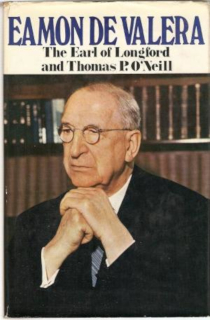
De Valera knows of O’Neill’s reputation as a historian and asks him to undertake the project. A contract is signed with the publishers in 1963, and O’Neill moves to Áras an Uachtaráin to work on the book. He is later joined by Lord Longford as co-author.
O’Neill’s other works include a biography in Irish of James Fintan Lalor and a major study of the Great Famine, which establishes his reputation as a historian.
After the completion of the de Valera work, O’Neill is appointed lecturer and later professor of history in University College, Galway. On his retirement, he returns to live in Dublin, where he renews his association with the National Library, becoming a strong supporter of its expansion.
O’Neill is survived by his wife, Marie, and six children. His funeral Mass takes place at St. Joseph’s Church on March 5, followed by his interment at Shanganagh Cemetery.
(From: “Biographer of de Valera dies at 74,” The Irish Times, Monday, March 4, 1996)
“You helped change and enhance the lives of hundreds of millions of people,” the Lord Mayor of Dublin, Cllr. Michael Mulcahy says as he presents the award. “There are few people in the history of the world of whom that can be stated.”
City councillors in their robes assemble for the occasion and the guests include CardinalDesmond Connell, the Papal Nuncio, Archbishop Giuseppe Lazzarotto, and other members of the diplomatic corps. Gorbachev is also presented with a dove of peace in Waterford Crystal.
In his acceptance speech, the former Communist leader says there have been many events in his life, big and small, joyful and sad. “The event that is happening today in this wonderful hall is very special.”
He says Ireland has taken the right road in emphasising knowledge, education and high technology. He quips that PresidentMary McAleese had said to him over lunch, “We don’t have any natural resources other than the rain.”
Gorbachev notes that as a Freeman of the City of Dublin he is entitled to graze sheep anywhere in Dublin. He assures his audience he will “buy a flock” to exercise that right. “I have seen some very, very nice places in the Park, near the President’s palace.”
At a news conference in the Mansion House earlier in the day, Gorbachev comes in for sharp questioning from Eoin Ó Murchú, a journalist, who asks “ex-Comrade Gorbachev” if he felt any sense of remorse or guilt when he “stood passively aside” while the Soviet Union was destroyed and ordinary people were reduced to poverty and prostitution. He also queries Gorbachev about his decision to take part in a television commercial for a chain of pizza restaurants.
Ignoring the suggestion that he has demeaned himself by appearing in the television advertisement, Gorbachev replies equally sharply, “My advice to you as a comrade – you used the word ‘comrade’ – is that you too should probably get rid of this kind of ideological straitjacket.”
Gorbachev denies having stood idly by while the USSR was dismantled. Commenting on the Northern Ireland situation he says, “This is one of those processes where people have to make difficult choices. You will see politicians who have a ready-made recipe for everything, in many cases to use force and bombs.”
It was good that, instead of bombing, there was a peace process. Bombing was not a solution and he welcomes the peace efforts being made and the fact that parties are acting “both prudently and responsibly.”
(From The Irish Times, January 10, 2002 | Pictured: Lord Mayor Michael Mulcahy and Mikhail Gorbachev, Doheny & Nesbitt’s Public House, January 8, 2002)
Biden then travels to Government Buildings where he is formally welcomed by TaoiseachEnda Kenny. Kenny says he hopes Biden enjoyed his visit and Biden says that he himself has visited Ireland several times privately, but never as vice president. He adds that he had promised his late son Beau that he would make a family trip to Ireland, “Unfortunately Beau didn’t make it, but we decided that we would bring the whole family.”
Biden, an Irish American, speaks of his great-grandfather who emigrated from Ireland, and he also speaks of the pride his family feels in their Irish heritage.
Kenny presents Biden with a hurley and a sliotar, to which the Vice President responds, “I have witnessed one game and I have one regret, that they don’t have this in the United States. I played American football and American baseball in high school and college, but this would have been … this is a dangerous game.”
Biden holds a bilateral meeting with Kenny in the evening and meets with the President of Ireland, Michael D. Higgins, the following day at his official residence, Áras an Uachtaráin in Dublin‘s Phoenix Park. As he signs the visitors’ book, he paraphrases another famous Irish American, former U.S. PresidentJohn F. Kennedy, who had visited the Republic of Ireland 53 years earlier. His written entry makes reference to a speech made to Dáil Éireann in June 1963, when Kennedy said, “our two nations, divided by distance, have been united by history.”
During his visit Biden visits County Mayo and County Louth, where his ancestors originated, in addition to several engagements in Dublin and a stop at Newgrange. He also arranges to fit in a round of golf with Kenny.
Biden speaks at an event at Trinity College, Dublin on the morning of Friday, June 24 and delivers a keynote address to an American Ireland Fund event in Dublin Castle in the evening. He addresses the Irish American experience, the shared heritage of the two nations, and the values of tolerance, diversity and inclusiveness.
On Saturday, June 25, Biden visits various locations in County Louth including the Kilwirra Cemetery and Newgrange in County Meath.
Biden returns to the United States following a lunch with Kenny on Sunday, June 26.
(Pictured: U.S. Vice President Joe Biden signing the visitor’s book as Irish President Michael D. Higgins look on at his official residence, Áras an Uachtaráin)
After finishing his education, Childers works for a period in a tourism board in Paris. In 1931, Éamon de Valera invites him to work for his recently founded newspaper, The Irish Press, where Childers becomes advertising manager. He becomes a naturalised Irish citizen in 1938. That same year, he is first elected as a Fianna Fáil Teachta Dála (TD) for Athlone–Longford. He remains in the Dáil Éireann until 1973, when he resigns to become President.
Childers joins the cabinet in 1951 as Minister for Posts and Telegraphs in the de Valera government. He then serves as Minister for Lands in de Valera’s 1957–59 cabinet, as Minister for Transport and Power under Seán Lemass, and, successively, as Transport Minister, Posts and Telegraphs Minister, and Health Minister under Jack Lynch. He becomes Tánaiste in 1969.
Fine Gael TD Tom O’Higgins, who had almost won the 1966 presidential election, is widely expected to win the 1973 election when he is again the Fine Gael nominee. Childers is nominated by Fianna Fáil at the behest of de Valera, who pressures Jack Lynch in the selection of the presidential candidate. He is a controversial nominee, owing not only to his British birth and upbringing but to his Protestantism. However, on the campaign trail his personal popularity proves enormous, and in a political upset, Childers is elected the fourth President of Ireland on May 30, 1973, defeating O’Higgins by 635,867 votes to 578,771.
Childers quickly gains a reputation as a vibrant, extremely hard-working president, and becomes highly popular and respected. However, he has a strained relationship with the incumbent government, led by TaoiseachLiam Cosgrave of Fine Gael. Childers had campaigned on a platform of making the presidency more open and hands-on, which Cosgrave views as a threat to his own agenda as head of government. Childers considers resigning from the presidency but is convinced to remain by Cosgrave’s Minister for Foreign Affairs and Trade, Garret FitzGerald.
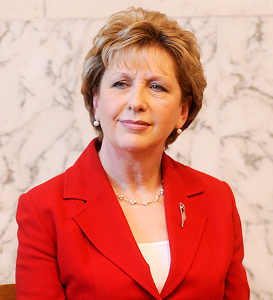
Mary Patricia McAleese, Irish Independent politician who serves as the 8th President of Ireland from November 1997 to November 2011, is born in Belfast, Northern Ireland on June 27, 1951. She is the second female president and is first elected in 1997 succeeding Mary Robinson, making McAleese the world’s first woman to succeed another as president. She is re-elected unopposed for a second term in office in 2004 and is the first President of Ireland to have come from either Northern Ireland or Ulster.
In 1975, McAleese is appointed Professor of Criminal Law, Criminology and Penology at Trinity College, Dublin and in 1987, she returns to her Alma Mater, Queen’s, to become Director of the Institute of Professional Legal Studies. In 1994, she becomes the first female Pro-Vice-Chancellor of Queen’s University. She works as a barrister and also works as a journalist with RTÉ.
McAleese uses her time in office to address issues concerning justice, social equality, social inclusion, anti-sectarianism and reconciliation. She describes the theme of her Presidency as “Building Bridges.” This bridge-building materialises in her attempts to reach out to the unionist community in Northern Ireland. These steps include celebrating The Twelfth at Áras an Uachtaráin and she even incurs criticism from some of the Irish Catholic hierarchy by taking communion in a Church of Ireland cathedral in Dublin. Despite being a practising Roman Catholic, she holds liberal views regarding homosexuality and women priests. She is a member of the Council of Women World Leaders and is ranked the 64th most powerful woman in the world by Forbes. In spite of some minor controversies, McAleese remains popular, and her Presidency is regarded as successful.
Incumbent president Éamon de Valera is 90 years old and constitutionally barred from seeking a third term. His party, Fianna Fáil, seeks to get former TánaisteFrank Aiken to run for the presidency, but he declines. Under pressure, former Tánaiste Erskine H. Childers agrees to run. The odds-on favourite is Fine Gael deputy leader, Tom O’Higgins, who had come within 1% of defeating Éamon de Valera in the 1966 presidential election.
Childers is a controversial nominee, owing not only to his British birth and upbringing but to his Protestantism. However, on the campaign trail his personal popularity proves enormous. In a political upset, Erskine H. Childers wins the presidency by 635,867 votes to 578,771.
Childers, though 67, quickly gains a reputation as a vibrant, extremely hard-working president, and becomes highly popular and respected. However, he has a strained relationship with the incumbent government, led by TaoiseachLiam Cosgrave of Fine Gael. Childers has campaigned on a platform of making the presidency more open and hands-on, which Cosgrave views as a threat to his own agenda as head of government. He refuses to co-operate with Childers’ first priority upon taking office, the establishment of a think tank within Áras an Uachtaráin to plan the country’s future. Childers considers resigning from the presidency, but is convinced to remain by Cosgrave’s Foreign Minister, Garret FitzGerald. However, Childers remains detached from the government. Whereas previously, presidents had been briefed by taoisigh once a month, Cosgrave briefs President Childers and his successor, Cearbhall Ó Dálaigh, on average once every six months.
Though frustrated about the lack of power he has in the office, Childers plays an important behind-the-scenes role in easing the Northern Ireland conflict as former Northern Ireland Prime MinisterTerence O’Neill meets secretly with Childers at Áras an Uachtaráin on at least one occasion.
Prevented from transforming the presidency as he desires, Childers instead throws his energy into a busy schedule of official visits and speeches, which is physically taxing. On November 17, 1974, just after making a speech to the Royal College of Physicians in Dublin, Childers suffers a heart attack. He dies the same day at Mater Misericordiae University Hospital.
Heaney’s poetry is often down-to-earth. For him, poetry is like the earth – something that must be plowed and turned. Often he paints the gray and damp landscape from the British Isles. Peat moss has a special place in his poetry. The poems often are connected with daily experiences, but they also derive motifs from history, all the way back to prehistoric times. Heany’s profound interest in the Celtic and the pre-Christian as well as in Catholic literary tradition has found expression in a number of essays and translations.
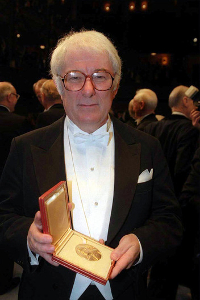
Heaney is awarded the Nobel Prize in Literature in 1995 for what the Nobel committee describes as “works of lyrical beauty and ethical depth, which exalt everyday miracles and the living past.” He is on holiday in Greece with his wife, Marie, when the news breaks. No one, not even journalists or his own children, can locate him until he appears at Dublin Airport two days later, though an Irish television camera traces him to Kalamata. Asked how it feels having his name added to the Irish Nobel pantheon featuring William Butler Yeats, George Bernard Shaw, and Samuel Beckett, Heaney responds, “It’s like being a little foothill at the bottom of a mountain range. You hope you just live up to it. It’s extraordinary.” He and Marie are immediately whisked straight from the airport to Áras an Uachtaráin for champagne with President Mary Robinson.
An Aer LingusBoeing 747, named the St. Patrick, brings Pope John Paul II from Rome to Dublin Airport. The Pope kisses the ground as he disembarks. After being greeted by the President of Ireland, Dr. Patrick Hillery, the Pope flies by helicopter to the Phoenix Park where he celebrates Mass for 1,250,000 people, one quarter of the population of the island of Ireland, one third of the population of the Republic of Ireland. Afterwards he travels to Killineer, near Drogheda, where he leads a Liturgy of the Word for 300,000 people, many from Northern Ireland. There the Pope appeals to the men of violence, “on my knees I beg you to turn away from the path of violence and return to the ways of peace.” The Pope has hopes of visiting Armagh, but the security situation in Northern Ireland renders it impossible. Drogheda is selected as an alternative venue as it is situated in the Catholic Archdiocese of Armagh. Returning to Dublin that evening, the Pope is greeted by 750,000 people as he travels in an open top popemobile through the city centre and visits Aras an Uachtarain, the residence of the Irish President.
The Pope begins the second day of his tour with a short visit to the ancient monastery at Clonmacnois in County Offaly. With 20,000 in attendance, he speaks of how the ruins are “still charged with a great mission.” Later that morning he celebrates a Youth Mass for 300,000 at Ballybrit Racecourse in Galway. It is here that the Pope utters perhaps the most memorable line of his visit, “Young people of Ireland, I love you.” That afternoon, he travels by helicopter to Knock Shrine in County Mayo which he describes as “the goal of my journey to Ireland.” The outdoor Mass at the shrine is attended by 450,000. The Pope meets with the sick and elevates the church to the title of Basilica.
The final day of the visit begins with a trip to St. Patrick’s College, Maynooth, the National Seminary, in County Kildare. Some 80,000 people pack the grounds of the college for the brief visit. A dense fog delays the Pope’s arrival from Dublin by helicopter. The final Mass of the Pope’s visit to Ireland is celebrated at Greenpark Racecourse in Limerick before 400,000 people, many more than had been expected. The Mass is offered for the people of Munster. Pope John Paul leaves Ireland from nearby Shannon Airport travelling to Boston where we begins a six-day tour of the United States.
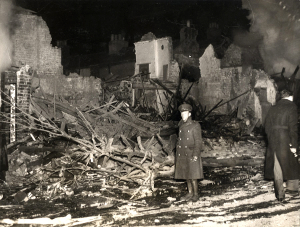
Four German bombs are dropped on north Dublin at approximately 2:00 AM on May 31, 1941. One bomb falls in the Ballybough area, demolishing the two houses at 43 and 44 Summerhill Park, injuring many but with no loss of life. A second bomb falls at the Dog Pond pumping works near the zoo in Phoenix Park, again with no casualties but damaging Áras an Uachtaráin, the official residence of the Irish President. A third bomb makes a large crater in the North Circular Road near Summerhill, again causing no injuries. A fourth bomb falls in North Strand destroying seventeen houses and severely damaging about fifty others, the worst damage occurring in the area between Seville Place and Newcomen Bridge. The raid claims the lives of 28 people, injures 90, destroys or damages approximately 300 houses, and leaves 400 people homeless.
The first bombing of Dublin during World War II occurs early on the morning of January 2, 1941, when German bombs are dropped on the Terenure area of south Dublin. This is followed, early on the following morning of January 3, 1941, by further German bombing of houses on Donore Terrace in the South Circular Road area of south Dublin. A number of people are injured, but no one is killed in these bombings.
After the war, what becomes West Germany accepts responsibility for the raid, and by 1958 it has paid compensation of £327,000. Over 2,000 claims for compensation are processed by the Irish government, eventually costing £344,000. East Germany and Austria, which are both part of Nazi Germany in 1941, make no contribution. The amounts are fixed after the 1953 London Agreement on German External Debts, allowing maximum compensation.
Several reasons for the raid have been asserted over time. German Radio, operated by the Ministry of Public Enlightenment and Propaganda, broadcasts that “it is impossible that the Germans bombed Dublin intentionally.” Irish airspace has been violated repeatedly, and both Allied and German airmen are being interned at the Curragh Camp. A possible cause is a navigational error or a mistaken target, as one of the pathfinders on the raid later recounts. Numerous large cities in the United Kingdom are targeted for bombing, including Belfast, which like Dublin, is across the Irish Sea from Great Britain. War-time Germany’s acceptance of responsibility and post-war Germany’s payment of compensation are cited as further indications that the causation is error on the part of the Luftwaffe pilots.
Another possible reason is that in April 1941, Germany has launched the Belfast blitz, which results in Belfast being heavily bombed. In response, Ireland sends rescue, fire, and emergency personnel to Belfast to assist the city. Éamon de Valera, the Taoiseach, formally protests the bombing to the German government, as well as making his famous “they are our people” speech. Some contend that the raid serves as a warning to Ireland to keep out of the war. This contention is given added credibility when Colonel Edward Flynn, second cousin of Ireland’s Minister for Coordination of Defensive Measures, recalls that Lord Haw Haw has warned Ireland that Dublin’s Amiens Street Railway Station, where a stream of refugees from Belfast is arriving, will be bombed. The station, now called Connolly Station, stands a few hundred metres from North Strand Road, where the bombing damage is heaviest. Flynn similarly contends that the German bombing of Dundalk on July 4 is also a pre-warning by Lord Haw Haw as a punishment for Dundalk being the point of shipment of Irish cattle sold to the United Kingdom.
An Irish general election is held on February 16, 1932, just over two weeks after the dissolution of the Dáil on January 29. The general election takes place in 30 parliamentary constituencies throughout the Irish Free State for 153 seats in the lower house of parliament, Dáil Éireann. The 1932 general election is one of the most important general elections held in Ireland in the 20th Century, resulting in the formation of the first Fianna Fáil government. Fianna Fáil becomes the largest party and would continue to be the largest party in Dáil Éireann and at every general election until 2011.
Cumann na nGaedheal fights the general election on its record of providing ten years of stable government. The party brings stability following the chaos of the Irish Civil War and provides honest government. However, by 1932 support of the government is wearing thin, particularly since the party has no solution to the collapse in trade which follows the depression of the early 1930s. Instead of offering new policies the party believes that its record in government will be enough to retain power. Cumann na nGaedheal also employs “red scare” tactics, describing Fianna Fáil as communists and likening Éamon de Valera to Joseph Stalin.
In comparison, Fianna Fáil has an elaborate election programme designed to appeal to a wide section of the electorate. It plays down its republicanism to avoid alarm but provides very popular social and economic policies. The party promises to free Irish Republican Army (IRA) prisoners, abolish the Oath of allegiance, and reduce the powers of the Governor-General and the Senate. It also promises the introduction of protectionist policies, industrial development, self-sufficiency, and improvements in housing and social security benefits.
The election campaign between the two ideologically opposed parties is reasonably peaceful. However, during the campaign the government prosecutes de Valera’s newly established newspaper, The Irish Press. The editor is also brought before a military tribunal. This is seen by many as a major blunder and a serious infringement on the belief of freedom of speech. The “red scare” tactics also seemed to backfire on the government, who seem to have little else to offer the electorate.
When the results are known Fianna Fáil is still 5 seats short of an overall majority but looks like the only party capable of forming a government. Discussions get underway immediately after the election and an agreement is reached in which the Labour Party would support Fianna Fáil. The party now has the necessary votes to form a minority government.
On March 9, 1932, the first change of government in the Irish Free State takes place. Similar to when the party first enters the Dáil in 1927, a number of Fianna Fáil Teachtaí Dála (TDs) have guns in their pockets. However, the feared coup d’état does not take place. W. T. Cosgrave is determined to adhere to the principles of democracy that he has practised while in government. Likewise, the army, Garda Síochána, and the civil service all accept the change of government, despite the fact that they will now be taking orders from men who had been their enemies less than ten years previously. After a brief and uneventful meeting in the Dáil chamber, Éamon de Valera is appointed President of the Executive Council of the Irish Free State by the Governor-General, James McNeill, who has come to Leinster House to make the appointment rather than require de Valera travel to the Viceregal Lodge, formerly a symbol of British rule. Fianna Fáil, the party most closely identified with opposing the existence of the state ten years earlier, is now the party of government. The 1932 general election is the beginning of a sixteen-year period in government for Fianna Fáil.