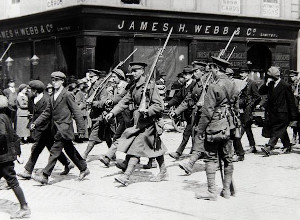
The United Kingdom declares martial law in Ireland for one month on April 25, 1916, the day after the commencement of the Easter Rising. A curfew is imposed from 8:30 PM until 5:00 AM. Anyone spotted on the streets during the hours of darkness are to be shot on sight. The trams stop running at 7:00 PM and the theatres and cinemas close by 8:00 PM. Those rushing for trams leaving the city centre have to pass through a stop-and-search military cordon.
With vastly superior numbers and artillery, the British army quickly suppresses the Rising and Pearse agrees to an unconditional surrender on Saturday, April 29, 1916. Most of the leaders are executed following courts-martial, but the Rising succeeds in bringing physical force republicanism back to the forefront of Irish politics. Support for republicanism continues to rise in Ireland in the context of the ongoing war in Europe and the Middle East and revolutions in other countries, and especially as a result of the Conscription Crisis of 1918 and the failure of the British-sponsored Irish Convention.
Dowling is born in the townland of Knockballyvishteal, Milltown, County Galway on January 14, 1837, the second of eight children, born to tenant farmer Patrick and Bridget Dowling (née Qualter). Following the eviction of his family from their home in 1845, the first year of the Great Famine, nine-year-old Dowling leaves Ireland in 1846 with his older sister Honora, bound for New Orleans in the United States.
As a teenager, Dowling displays his entrepreneurial skills by successfully running the Continental Coffeehouse, a saloon in the fashionable French Quarter. His parents and siblings follow from Ireland in 1851, but the joy of reunion is short-lived. In 1853, a yellow fever outbreak in New Orleans takes the lives of his parents and one of his younger brothers. With rising anti-Irish feeling growing in New Orleans, following local elections which see a landslide victory for the “Know Nothing” party, Dowling moves to Houston in 1857.
In 1857 Dowling marries Elizabeth Ann Odlum, daughter of Benjamin Digby Odlum, a Kildare-born Irishman, who had fought in the Texas Revolution, being captured at the Battle of Refugio in 1836.
By 1860, Dowling owns a number of saloons. His most successful is named the Bank of Bacchus, located on Courthouse Square in downtown Houston. “The Bank” as it is known locally becomes Houston’s most popular social gathering place in the 1860s and is renowned for its hospitality. He is also involved in setting up Houston’s first gaslight company and is first to have it installed in his home and “The Bank.” He is a founding member of Houston’s Hook and Ladder Company Number One fire department and is also involved in running the city’s first streetcar company.
Prior to the outbreak of the American Civil War, Dowling makes a name for himself as an able and successful entrepreneur. Among other things, he is involved with a predominantly Irish militia company which serves a more social than military role in Houston society. Upon Secession, this militia company is mustered straight into the Confederate States Army, with Dowling being elected First Lieutenant. The unit names themselves the “Jefferson Davis Guards” in honor of Confederate PresidentJefferson Davis. The Davis Guards are initially part of a Texas State Troops/Confederate expedition sent to take over Union Army forts and arsenals along the border with Mexico. The expedition is successfully completed without a shot being fired. They participate in the Battle of Galveston on New Year’s Day 1863, following which they are assigned to a newly constructed artillery post near the mouth of the Sabine River called Fort Sabine.
Sabine Pass was important as a point of arrival and departure for blockade runners. It is suspected that the Union Army will attempt an invasion of Texas via Sabine Pass because of its value as a harbor for blockade runners and its proximity 18 miles southeast of Beaumont, which lies on the railroad between Houston and the eastern part of the Confederacy.
To negotiate Sabine Pass all vessels except small boats take one of the two river channels. No seagoing ship can traverse the Pass without great risk of running aground should it stray from one of the channels. The inevitable course of any steam-powered warship, including shallow-draft gunboats then common to the U.S. Navy, would use one of the channels, both of which are within fair range of the fort’s six smoothbores.
Dowling spends the summer of 1863 at the earthen fort instructing his men in gunnery. On September 8, 1863, a Union Navyflotilla of some 22 gunboats and transports with 5,000 men accompanied by cavalry and artillery arrive off the mouth of Sabine Pass. The plan of invasion is sound, but monumentally mismanaged. Four of the flanking gunboats are to steam up the pass at speed and draw the fire of the fort, two in each channel, a tactic which had been used successfully in subduing the defensive fortifications of Mobile and New Orleans prior to this. This time, however, Dowling’s artillery drills pay off as the Confederates pour a rapid and withering fire onto the incoming gunboats, disabling and capturing two, while the others retreat in disarray. The rest of the flotilla retreats from the mouth of the pass and returns ignominiously to New Orleans, leaving the disabled ships with no option but to surrender to Dowling. With a command of just 47 men, Dowling had thwarted an attempted invasion of Texas, in the process capturing two gunboats, some 350 prisoners and a large quantity of supplies and munitions.
The Confederate government offers its gratitude and admiration to Dowling, now promoted to Major, and his unit, as a result of their battlefield prowess. In gratitude, the ladies of Houston present the unit with specially struck medals, which are actually Mexican eight reale coins with both faces sanded down and inscribed “Sabine Pass, 1864” on one side and a Maltese cross with the letters D and G on the other. Because of the official recognition given to the action, it is now accepted that these Davis Guard Medals are the only medals of honor issued by the Confederate government, and consequently are collector’s items today.
After the battle of Sabine Pass Dowling is elevated to hero status in his hometown of Houston. He subsequently serves as a recruiter for the Confederacy and is personally commended for his action at the battle by Jefferson Davis. After the war he returns to his saloon business and quickly becomes one of the city’s leading businessmen.
Dowling’s promising future is cut short by another yellow fever epidemic which devastates Houston in the late summer of 1867, and he dies on September 23, 1867. He is buried at St. Vincent’s Catholic Cemetery, the oldest Catholic cemetery in Houston.
The Royalist rebellion that breaks out in Ireland against the new English republic in 1649 is met by a prompt English response. On August 15 Oliver Cromwell and 15,000 troops land in Dublin. His merciless policy toward the Irish Royalists becomes brutally clear within a month.
The defeat of the Irish Royalists at Rathmines in early August is fortuitous for Cromwell, for without it, the English would have held only the small port of Derry (known as Londonderry from 1662) in the north, making his invasion almost impossible to effect. Cromwell quickly finds that the Irish Royalists have retreated into fortified towns. He therefore prepares for a series of sieges.
The first such siege occurs at Drogheda, 28 miles north of Dublin. Cromwell arrives at Drogheda on September 3. His siege guns, brought up by sea, arrive two days later. He finds the town surrounded by high but relatively thin walls and its governor, Sir Arthur Ashton, is confident of his defenses and refuses an order to surrender. On September 10 Cromwell begins an artillery bombardment of the walls. These are breached the following day, but the gap created is too small to allow troops to enter the city. Twice they are repelled until Cromwell himself leads an assault and overwhelms the defenders on September 11.
The carnage inside the city is appalling. Cromwell’s troops kill priests and monks on sight and set fire to a Catholic church sheltering some soldiers. Civilians as well as soldiers are massacred, and Ashton is bludgeoned to death with his own wooden leg. The few Royalist soldiers who survive are transported to Barbados. What happens at Drogheda is replicated at Wexford the following month and Clonmel the next May. By the time Cromwell has put down the rebellion and returned to England in that same month, he has become forever hated by Irish Catholics.
During the eight day siege the British lose 150 of their 12,000 men while 2,800 Irish are killed and 200 captured of the 3,100 at Drogheda.
(Pictured: St Laurence’s Gate – the last remaining of the ten original defensive gates at Drogheda)
In the fall of 1862, two Confederate armies move on separate paths into Kentucky, hoping to put the shadow Confederate government of Kentucky of that state into power, threaten Union cities along the Ohio River, and recruit men to join the army. First to move is Kirby Smith, departing Knoxville on August 13, leading the Confederate Army of Kentucky, whose ideas provide the initiative for the offensive. General Braxton Bragg, commanding the Army of Mississippi, leaves Chattanooga on August 27 and moves on a roughly parallel track to the west.
Brigadier General Patrick Cleburne leads Smith’s advance with Colonel John S. Scott’s cavalry out in front. The Confederate cavalry, while moving north from Big Hill on the road to Richmond, Kentucky, on August 29, encounters Union troopers and begin skirmishing. After noon, Union artillery and infantry join the fray, forcing the Confederate cavalry to retreat to Big Hill.
At that time, Brigadier General Mahlon Dickerson Manson, who commands Union forces in the area, orders a brigade to march to Rogersville, toward the rebels. Fighting for the day stops after pursuing Union forces briefly skirmish with Cleburne’s men in the late afternoon. That night, Manson informs his superior, Bull Nelson, of his situation, and he orders another brigade to be ready to march in support, when required.
Kirby Smith orders Cleburne to attack in the morning and promises to hurry reinforcements. Cleburne starts early, marching north, passes through Kingston, disperses Union skirmishers, and approaches Manson’s battle line near Zion Church. As the day progresses, additional troops join both sides. Following an artillery duel, the battle begins, and after a concerted Confederate attack on the Union right, the Union troops give way. Retreating into Rogersville, they make another futile stand at their old bivouac.
By this time, Smith and Nelson arrive and take command of their respective armies. Nelson rallies some troops in the cemetery outside Richmond, but they are routed.
Nelson and some of his men escape, but the Confederates capture over 4,300 Union troops. Total casualties are 5,353 (206 killed, 844 wounded, and 4,303 captured or missing) on the Union side, 451 (78 killed, 372 wounded, and one missing) for the Confederates. The way north towards Lexington and Frankfort is open.
During the battle Cleburne is wounded in the face when a Minié ball pierces his left cheek, smashes several teeth, and exits through his mouth. He recovers in time to re-join Bragg and William Joseph Hardee and participate in the Battle of Perryville.
The Civil War Trust, a division of the American Battlefield Trust, and its partners have acquired and preserved 365 acres of the Richmond Battlefield. The Mt. Zion Christian Church, which served as a hospital during the battle and has cannonballs embedded in its brick walls, is listed on the National Register of Historic Places. Two discontinuous areas totaling 214 acres are listed on the National Register of Historic Places as Battle of Richmond Historic Areas in 1996.
(Pictured: Major General Patrick Ronayne Cleburne, courtesy of Library of Congress)
When Lally is selected as commander-in-chief of the French expedition to India in 1756, he is one of the greatest living soldiers of France. Lally’s force is delayed and does not leave France until May 1757. Further delays occur en route and he finally lands at Pondicherry, India, on April 28, 1758. In less than two months, Lally clears the English forces from a huge area around Pondicherry and captures almost 300 pieces of artillery. Lally next lays siege to Madras, but his naval support abandons him, and, in January 1759, the English are reinforced, forcing Lally to retire toward Pondicherry. Forces away from India are conspiring against Lally now, as the merchant fleets of the French have been rendered useless by the English navy.
Lally’s army, burdened by a lack of naval support and funds resulting in his troops having not been paid in six months, attempts to regain the fort at Wandiwash, now in Tamil Nadu. He is attacked by Sir Eyre Coote’s forces and decisively defeated. The French general Marquis de Bussy-Castelnau and the French are then restricted to Pondicherry where, facing starvation, they surrender on January 16, 1761.
This is the Third Carnatic War fought between the French and the British. Having made substantial gains in Bengal and Hyderabad, the British, after collecting huge amount of revenue, are fully equipped to face the French in Wandiwash, whom they defeat.
According to the 19th century book Annals of the Wars of the Eighteenth Century by Author Eduard Cust, the French Army consists of 300 European Cavalry, 2,250 European infantry, 1,300 soldiers, 3,000 Marathas and 16 pieces of artillery while the English deploy about 80 European Horses, 250 Native horses, 1,900 European Infantry, 2,100 soldiers and 26 pieces of artillery. The Battle of Wandiwash involves the capture of Chettupattu, Thiruvannamalai, Tindivanam and Perumukkal.
(Pictured: The Vandavasi fort in Vandavasi, Tamil Nadu, India, where the decisive Battle of Wandiwash takes place.)
On July 3, 1863, at Gettysburg, Pennsylvania, as the sun rises behind the men of Colonel Dennis O’Kane’s Irish 69th Pennsylvania Volunteer Infantry on Cemetery Ridge, the most famous assault of the American Civil War is being prepared across the mile of open field in front of them. The 69th Pennsylvania will be at the very vortex of that assault, now known to posterity as Pickett’s Charge.
Pickett’s Charge is an infantry assault ordered by ConfederateGeneralRobert E. Lee against Major GeneralGeorge G. Meade‘s Union positions on the last day of the Battle of Gettysburg during the American Civil War. Its futility is predicted by the charge’s commander, Lt. GeneralJames Longstreet, and it is arguably an avoidable mistake from which the Southern war effort never fully recovers militarily or psychologically. The farthest point reached by the attack has been referred to as the high-water mark of the Confederacy. The charge is named after Maj. General George Pickett, one of three Confederate generals who lead the assault under Longstreet.
Pickett’s charge is part of Lee’s “general plan” to take Cemetery Hill and the network of roads it commands. On the night of July 2, Meade correctly predicts at a council of war that Lee will attack the center of his lines the following morning.
At 1:00 PM on July 3, a massive artillery bombardment by the Confederate guns sails mostly over the heads of the 69th. The bombardment is meant to soften up the Union defense and silence its artillery but is largely ineffective. About 3:00 PM the barrage slackens, and the rebel infantrymen begin their assault. “And let your work this day be for victory or to the death,” Colonel Dennis O’Kane tells his men as the furious rebel onslaught approaches. Approximately 12,500 men in nine infantry brigades advance over open fields for three-quarters of a mile under heavy Union artillery and rifle fire.
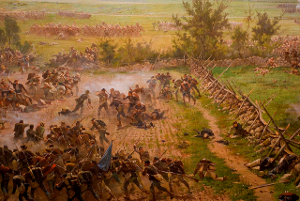
Soon the 69th is forced to refuse both flanks as the Confederate tide rolls up to them and laps around both sides. While many around them run, the 69th stands fast. Although some Confederates are able to breach the low stone wall that shields many of the Union defenders, they cannot maintain their hold and are repulsed with over 50% casualties. The regiment’s tenacious stand in front of the famous copse of trees is a pivotal part of the crucial Union victory and a decisive defeat for the Confederacy that ends the three-day battle and Lee’s campaign into Pennsylvania.
Good to his word, Colonel O’Kane is killed and, lying dead near the 69th’s position, wearing gray lay Pvt. Willie Mitchel of the 1st Virginia Infantry, son of Irish patriot John Mitchel. At the most crucial battle of America’s Civil War, Irish are killing Irish on a foreign field once again.
Years later, when asked why his charge at Gettysburg failed, Pickett replies, “I’ve always thought the Yankees had something to do with it.”
During the Irish Rebellion of 1798, the Battle of Foulksmills, known locally as the Battle of Horetown and also known as the Battle of Goff’s Bridge, takes place on June 20, 1798 between advancing British forces seeking to stamp out the rebellion in County Wexford and a rebel army assembled to oppose them.
By June 19 the threat of the United Irish rebellion spreading outside County Wexford had been largely contained and Crown forces were positioned to move against rebel held territory. A force of about 1,500 men under Sir John Moore move out of New Ross toward Wexford as part of an overall encirclement operation in conjunction with General Gerard Lake‘s forces moving from the north.
Moore’s force is to link up and combine with the isolated garrison holding Duncannon before moving deeper into County Wexford, but after waiting several hours with no sign of their arrival, Moore decides to press ahead to the village of Taghmon alone. Upon nearing Goff’s Bridge at Foulkesmill, his scouts report a rapidly moving rebel force of some 5,000 moving along the road with the intent to give battle. Moore despatches a force of riflemen from the 60th Regiment to hold the bridge until artillery can be brought up in support.
The rebels however, led by Father Philip Roche, spot this move and move away from the road to the high ground on the left intending to outflank Moore’s force. The 60th are forced to engage the rebels on the roads, fields and forests of the area and the rebel flanking move briefly threatens to overturn Moore’s left. Moore has to personally rally his fleeing troops to hold the line and lead them in a successful counter-attack. As more troops begin to arrive the rebels are flushed out of their concealed positions, allowing the artillery to be brought into play and the rebels’ move is foiled. The rebels are gradually pushed back field by field but are able to withdraw the bulk of their force safely.
The road to Wexford is opened and the town recaptured by the Crown the next day but during this battle followers of rebel captain Thomas Dixon massacre up to 100 loyalist prisoners at Wexford bridge.
Casualties are estimated at 500 on the rebel side and 100 of the military.
The crown forces are organized in six regiments — two forward, two centre, and two rear, and with cavalry at centre. As soon as they leave Armagh garrison, they are all harassed with gunfire from rebel forces concealed in the woods. As a result, the different regiments become separated from one another as they pause to deal with the hit and run attacks. The problem is accentuated when one of their ox-drawn artillery pieces becomes stuck in the bog with a damaged wheel and a rear regiment stays behind to guard it as it is slowly coaxed through the bog. The regiment at the front of the march encounters a mile-long trench, 4 feet wide and 5 feet deep. The regiment succeeds in crossing the trench but then comes under heavy attack from large forces and decides to retreat back across the trench, suffering significant losses during the retreat. This regiment then merges into the ranks of the other forward regiment.
At this point, Henry Bagenal is killed by a shot through the head. Command of the army is assumed by Thomas Maria Wingfield. Further demoralising the crown troops and causing chaos, their gunpowder store explodes, apparently ignited accidentally by the fuse of a matchlock musket. Daunted, Wingfield decides to retreat to Armagh. The commander of the forward part either doesn’t get the command or refuses to obey it or is unable to execute an orderly retreat and judges it necessary to maintain his forward position. Seeing their enemy in confusion, the O’Neill cavalry rushes at the head of the forward part, followed by swordsmen on foot. Crown troops in this part of the field are cut to pieces and any wounded left on the field after the battle are slain as well. The rest of the crown forces have to struggle their way back to the Armagh garrison. They reach it largely intact but are harried all the way by the Irish.
Crown forces lose approximately 1,500 men in the battle, including 18 “captains” or officers. Three hundred soldiers desert to the rebels including two English recruits. Out of 4,000 soldiers who set out from Armagh, just over 2,000 reach the town after the battle and become virtual prisoners inside. The cavalry breaks out and dashes south escaping the Irish.
After three days of negotiations, it is agreed that the crown troops can leave Armagh as long as they leave their arms and ammunition behind and that the garrison of the Blackwater Fort surrenders. O’Neill’s forces suffer perhaps 200 to 300 casualties in the battle, though sources for the number lost on O’Neill’s side are very scanty. In light of the battle’s outcome, the court at London greatly and rapidly increase its military forces in Ireland. Simultaneously, many in Ireland who have been neutral on the sidelines begin to support the rebellion. Thus, the ultimate outcome of the battle is an escalation of the war.