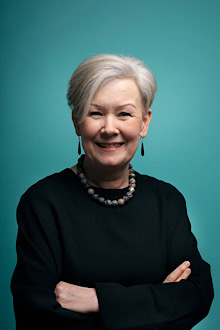
Clarke sings in a women’s choir from age 14 and is an outstanding piano pupil at the College of Music (now the DIT Conservatory of Music and Drama), Dublin. She studies music at University College Dublin (UCD), earning a Teacher’s Diploma in 1978 and a BMus in 1980. She teaches at a number of schools in the Dublin area. When she participates in the Ennis Composition Summer School in 1985, she is introduced to the music of continental composers such as Luciano Berio and Witold Lutoslawski, which leaves a lasting impression.
Some of Clarke’s early works receive awards, such as the Six Short Piano Pieces (1982), which wins the composition prize of the Feis Ceoil, and the choral work Suantraí Ghráinne (1983), which wins the Seán Ó Riada Memorial Trophy at the 1984 Cork International Choral Festival. For Sisyphus (1985) for flute, clarinet and string trio she receives the Varming Prize, which is awarded only every four years to an Irish composer under the age of thirty. She completes her first orchestral score in 1991 (A Great Rooted Tree). In 1992, she receives a Ph.D. from Queen’s University Belfast (QUB). She is a lecturer in music at St. Patrick’s College, Dublin City University (DCU).
Clarke receives commissions from RTÉ, the Cork International Choral Festival, Concorde, Music Network and the National Concert Hall, among others. Her work is performed and broadcast throughout Ireland and worldwide. In January 2014, she is the featured composer in the Horizon Series of contemporary music by the Irish national broadcaster RTÉ. For this event, the RTÉ National Symphony Orchestra commissions her orchestral composition SHIFT (2013). Since 2009 she has been collaborating with visual artist Marie Hanlon, including short experimental films with music, live music with visual projections and joint exhibitions, one example being the joint exhibition DIC TAT at the Gallery Draíocht, Blanchardstown, Dublin, July-September 2014.
Clarke is a member of Aosdána, Ireland’s state-sponsored academy of creative artists.
Clarke’s output includes choral, chamber, orchestral and electronic works. Her calm and evocative music in the early Suantraí Ghráinne creates some curiosity at its 1984 performance. Early chamber works such as Sisyphus (1985) and Purple Dust are characterised by wide-spaced harmonic settings of a rather sparse tonal material. Some aleatoric passages alternate with more strictly notated pitches and a rather limited degree of dissonance. In Gloria Deo (1988) for soprano, mixed chorus and orchestra she combines modal influences from Renaissance music with free atonality. Since the early 1990s she has been exploring the possibilities of electroacoustic music, winning an award at the 1992 Dublin Film Festival for her electronic score Whaling Afloat and Ashore. Her recent orchestral score SHIFT reflects her experiences in electroacoustic processes: “Extended techniques, deliberately avoided in previous work, are embraced here using harmonics and noise elements in strings, and bowed, timbral effects on percussion. In a single, fifteen-minute movement, transformations in colour and texture vary from slow and intense in the opening section, to sudden and harsh later in the piece.”
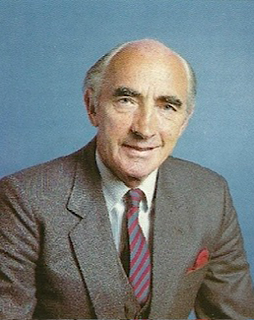
A snappy dresser who earns the nickname “the yellow rose of Finglas,” Tunney is sometimes seen as pompous, a perception possibly attributable to his acting background, which once leads to an audition at Dublin’s Abbey Theatre.
In 1963 Tunney joins Fianna Fáil, and stands for the party at the 1965 Irish general election but is not elected. He is elected to Dáil Éireann as a Fianna Fáil TD for the Dublin North-West constituency at the 1969 Irish general election. He serves continuously in the Dáil until losing his seat at the 1992 Irish general election, having been a TD for Dublin Finglas from 1977 to 1981 when Dublin constituencies are reconfigured as 3-seaters, before being returned for Dublin North-West in 1981.
During this period Tunney serves as Parliamentary Secretary to the Minister for Education (after 1978, Minister of State at the Department of Education) in three governments. He serves as Leas-Ceann Comhairle of Dáil Éireann from 1981 to 1982, and from 1987 to 1993. He is also chair of the Fianna Fáil parliamentary party for ten years. He is a member of Dublin City Council, and serves as Lord Mayor of Dublin from 1984 to 1985.
Following Tunney’s death, TaoiseachBertie Ahern describes him as “a parliamentarian and a gentleman who was passionately committed to serving his country.” Ahern adds, “he was not only a man of substance but one of style. From the flower that was always in his buttonhole to the elegance of his language in both Irish and English he had a commanding and stylish presence.”
Fine Gael leader Michael Noonan says Tunney had gained “the widespread affection and respect of colleagues of all political parties.”
Leader of the Labour PartyRuairi Quinn describes Tunney as a “thoughtful and courteous colleague” who carried out his duties with “fairness but also with wit and style.”
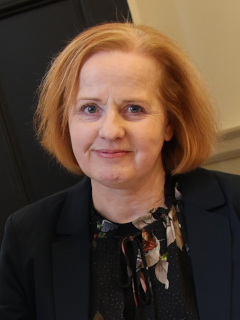
Coppinger is a member of Fingal County Council for the Mulhuddart local electoral area from 2003 to 2014. She is co-opted to the council in 2003, replacing Joe Higgins, and is elected in 2004 and re-elected in 2009. She is an unsuccessful candidate for the Socialist Party at the 2011 Dublin West by-election.
Following victory in the 2014 Dublin West by-election, Coppinger joins her party colleague Joe Higgins in the Dáil. After being elected, she calls for a mass campaign of opposition to water charges being implemented by the Fine Gael–Labour Partycoalition.
In November 2014, Coppinger calls for the gradual nationalisation of U.S. multinationals to prevent job losses. In response, Fianna Fáil’s jobs spokesperson Dara Calleary calls the idea “reckless and ludicrous,” as it would “place a massive burden on taxpayers and the public finances.”
In September 2015, Coppinger joins homeless families from Blanchardstown, in occupying a NAMA-controlled property as part of a campaign to raise awareness of the housing crisis. In October 2015, she joins families in their occupation of a show house in her constituency, to protest the lack of availability of affordable social housing. She also supports the tenants of Tyrrelstown, who are made homeless when a Goldman Sachsvulture fund sells their houses.
Coppinger is re-elected to the Dáil at the 2016 Irish general election, this time under the Anti-Austerity Alliance–People Before Profit banner. On March 10. 2016, at the first sitting of the 32nd Dáil, she nominates Richard Boyd Barrett for the office of Taoiseach, quoting James Connolly from a hundred years previously when she says, “The day has passed for patching up the capitalist system. It must go,” and declaring, “We will not vote for the identical twin candidates” of Fine Gael and Fianna Fáil after they “imposed austerity.” On April 6, 2016, following the failure of the Dáil to elect a Taoiseach at that first sitting, she is nominated for the role of Taoiseach, becoming the first female nominee in the history of the state.
In 2018 Coppinger praises the MeToo movement for exposing patterns of abuse and systemic inequality. However, she also notes the limitations of achieving justice through traditional channels and calls for a stronger focus on combating intimate partner violence and societal tolerance of such abuse.
In April 2018, in the lead-up to the repeal of the Eighth Amendment, Coppinger, along with her colleague Paul Murphy, holds up a Repeal sign during leader’s questions and is reprimanded by the Ceann Comhairle. She is an advocate for abortion rights in Ireland, and is a founding member of ROSA, a movement for reproductive justice in Ireland. Earlier, in 2016, she tables the private members’ motion to repeal the Eighth Amendment.
In November 2018, Coppinger protests in the Dáil against the conduct of a rape trial in Ireland. During the trial, the defence team, as part of their argument that the sex had been consensual, states that the 17-year-old victim had worn a thong with a lace front. The defendant is subsequently found not guilty. During a sitting of the Dáil, Coppinger holds up a similar pair of underwear and admonishes the conduct of the trial, suggesting victim blaming tactics had been used and suggests this is a routine occurrence in Irish courts. She calls on Taoiseach Leo Varadkar to support her party’s bill that would increase sex education in Irish schools and provide additional training to the Irish judiciary and jurors on how to handle cases of rape. Varadkar responds that victims should not be blamed for what happens to them, irrespective of how they are dressed, where they are or if they have consumed alcohol.
In 2019 Coppinger sponsors a private member’s bill – the Domestic Violence (No-contact order) (Amendment) Bill 2019. The bill lapses with the dissolution of the Dáil and Seanad.
In June 2024, Coppinger is elected to Fingal County Council for the Castleknock local electoral area on the 7th Count. At the 2024 Irish general election, she is re-elected to the Dáil.
Coppinger is an advocate of secularism and believes in abolishing both the Angelus and the Dáil prayer, viewing them as relics of an outdated intertwining of religion and governance. She supports the separation of Church and State, criticising the Catholic Church‘s historical influence in education and health, as well as its financial privileges, including exemptions from accountability under regulations like SIPO. She has called for the requisitioning of Church lands and property, citing the Church’s failure to meet commitments to abuse victims and the necessity of addressing historical injustices.
On drug policy, Coppinger supports decriminalisation and endorses the Portuguese model, which treats addiction as a health issue rather than a criminal matter. She emphasises the hypocrisy of criminalising drug use while overlooking the societal harm caused by alcohol and advocates for expanding access to medicinal cannabis, criticising the political inertia in addressing this need.
In 2013, during referendum to abolish the Irish senate, Coppinger campaigns for a yes vote, calling the institution elitist and undemocratic. However, in 2020, following the loss of her Dáil seat, she runs unsuccessfully for a seat in the Senate. Challenged by the Irish Examiner on this, she states that so long as the Senate continues to exist, it should be used to further progressive causes.
Coppinger lives in Mulhuddart and is a secondary school teacher. Her eldest brother, Eugene Coppinger, serves on Fingal County Council from 2011 to 2019.
On May 11, 2015, Alexion Pharmaceuticals announces plans to significantly expand its operations in Ireland by constructing the company’s first ever biologics manufacturing facility outside the United States. The new 20,000 sq. metre plant will manufacture biologic drugs for treatment of rare and severe diseases.
Alexion Pharmaceuticals, a subsidiary of AstraZeneca, is a pharmaceutical company headquartered in Boston, Massachusetts, that specializes in orphan drugs to treat rare diseases. With costs that can reach as much as $2 million per year, the drugs manufactured by Alexion are some of the most expensive drugs worldwide.
The four-year project, which will be constructed at Alexion’s College Park site in Blanchardstown, is expected to create approximately 200 additional full-time jobs on completion, which will bring Alexion’s total workforce in Ireland to almost 500 employees.
Since first entering Ireland in 2013, Alexion has invested €130m in two facilities – a vialfill and finish facility in Athlone and a global supply chain facility at College Park. Phase one of the College Park facility, comprising Global Supply Chain HQ, laboratories, packaging and warehousing operations is expected to be operational by year end. Approximately 560 construction workers are involved in the development of the current Athlone and College Park projects, and the planned expansion of College Park will also create over 800 construction jobs.
Alexion has worked closely with the Department of Jobs and IDA Ireland on the development of its operations in Ireland.
Julie O’Neill, EVP Global Operations, states, “Alexion is pleased to progress the development of our College Park facility with a significant expansion that will now include our first biologics manufacturing facility outside the United States. This project further underscores our commitment to Ireland and is enabled by our ability to recruit highly competent and professional personnel to support the production and distribution of our medicine, Soliris (Eculizumab), and our strong pipeline of biologics medicines. Alexion has a unique mission to develop life-transforming therapies for patients with severe and life-threatening ultra-rare disorders. We are already serving the very few patients in Ireland suffering from two very rare and devastating diseases; with this major expansion, our Irish operations, comprising biologics manufacturing, vial fill-finish and global supply chain, will be at the forefront of this vital work globally.”
Welcoming the announcement, Tánaiste and Minister for Social ProtectionJoan BurtonTD says, “Alexion’s latest expansion is an extremely strong endorsement for Ireland, and Dublin West in particular, as an attractive location for high-end investment from the pharmaceutical industry. It underlines the jobs-led recovery that is underway, with 90,000 jobs created and the Live Register down by a third since the peak of the crisis. We are determined to maintain this progress into the future. As Tánaiste and Social Protection Minister, my Department stands ready to assist Alexion with their recruitment needs, in particular through our Employer Engagement Unit.”
Speaking at College Park, the Minister for Jobs, Enterprise and InnovationRichard Bruton TD adds, “Biopharma is a sector which we have specifically targeted as part of the Action Plan for Jobs, due to the large potential for employment growth which it offers Ireland, and we have taken a number of steps to support the growth of this sector in Ireland. Today’s announcement by Alexion is a huge boost for west Dublin and the whole country, and huge credit is owed to Julie and her team as well as the IDA. Employment will be provided for 1,000 extra people, and the knock-on impact of this massive €450m investment for the wider economy will be enormous. We are developing a powerful cluster of biopharma plants in Ireland which I am determined now to build on.”
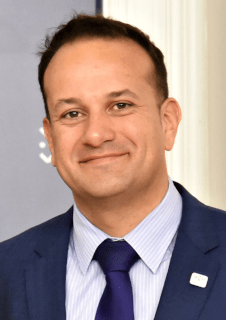
In May 2017, Kenny announces that he is planning to resign as Taoiseach and Fine Gael leader. Varadkar stands in the leadership election to replace him. Although more party members vote for his opponent, Simon Coveney, he wins by a significant margin among Fine Gael members of the Oireachtas and is elected leader on June 2. Twelve days later, he is appointed Taoiseach, and at 38 years of age becomes the youngest person to hold the office. He is Ireland’s first, and the world’s fourth, openly gay head of government and the first Taoiseach of Indian heritage.
In 2020, Varadkar calls a general election to be held in February. While polls in 2019 have suggested a favourable result for Fine Gael, they ultimately come in third in terms of seats and votes, behind Fianna Fáil and Sinn Féin, with 35 seats, a loss of 15 seats for the party from the previous general election, when it had finished in first position. He resigns and is succeeded by Micheál Martin as Taoiseach. He is subsequently appointed Tánaiste and Minister for Enterprise, Trade and Employment as part of a three-party coalition composed of Fianna Fáil, Fine Gael and the Green Party.
After the Belgian Congo becomes independent (as Republic of the Congo) in 1960, a civil war breaks out in Katanga, the southern, mineral-rich province of Congo. A local political leader, Moïse Tshombe, declares Katanga an independent state. United Nations peacekeeping troops are invited to help restore order and to end the Katanga secession.
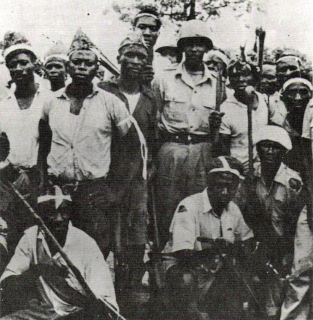
The Luba people or “Baluba” ethnic group do not support the Katangese secession. As a result, they come under attack from pro-Katangese and allied forces. On October 4, several villages are attacked by Katangese gendarmes and European mercenaries and many Baluba are massacred. This leaves them suspicious of and hostile to any white European troops. Irish troops are sent to the area to secure it and encourage local people to return.
On November 8, 1960, an eleven-man section from the Irish Army’s 33rd Battalion arrives at the bridge over the Luweyeye River. They are forced to leave their vehicles when they encounter a blockade on the road. While clearing it, they encounter about 100 Luba militiamen armed with bows, poison-tipped arrows, spears and clubs, as well as some guns. While the Irish troops had arrived to protect the Baluba, the militia undoubtedly mistakes them for Katangese mercenaries. Lieutenant Kevin Gleeson, advancing unarmed with his platoon sergeant, Hugh Gaynor, attempt to greet them peacefully, but is hit with a barrage of poison-tipped arrows.
Gleeson and Gaynor are overtaken, beaten and hacked to death. The surprised Irish soldiers, who had not been deployed in a defensive formation after dismounting from their vehicles, retreat behind trees on either side of the road and open fire on the tribesmen with their Gustav submachine guns, Lee–Enfield rifles and Bren light machine guns. The Baluba however advance on them, and the Irish are cut off from their vehicles. Despite taking heavy losses, the Baluba overrun the Irish soldiers, and fierce hand-to-hand fighting breaks out, during which most of the Irish troops are killed.
The surviving Irish troops regroup by a ridge but are surrounded by the Baluba. They fight to hold them off, but their position is rapidly overrun and all but three of them are killed. The three survivors manage to escape. One of them, Anthony Browne, reaches a nearby village and gives all the money he has to the village women, hoping they will get him help, but is instead mobbed and beaten to death by the village men. His body is recovered two years later. The two surviving soldiers manage to hide and are found by other UN troops the following day.
A total of nine Irish soldiers die: Lt. Kevin Gleeson of Carlow, Sgt. Hugh Gaynor of Blanchardstown, Cpl. Peter Kelly of Templeogue, Cpl. Liam Dougan of Cabra, Pt. Matthew Farrell of Jamestown, Dublin, Tpr. Thomas Fennell of Donnycarney, Tpr. Anthony Browne of Rialto, Pte. Michael McGuinn of Carlow, and Pte. Gerard Killeen of Rathmines. Some 25 Baluba are also killed.
The bodies of the Irish dead are flown to Casement Aerodrome in Baldonnel, where they lay in state. Lt. Kevin Gleeson’s coffin is placed on a gun carriage, while those of the rest are placed on army trucks. Following a funeral procession through Dublin, they are buried at Glasnevin Cemetery.
A stone commemorating Lt. Gleeson can be found in his hometown of Carlow while a plaque commemorating Sgt. Hugh Gaynor can be found in his hometown of Blanchardstown.
The notoriety of the attack, and the allegations of mutilation and cannibalism that circulate in the Irish popular press in its aftermath, lead to the word “baluba” (sometimes spelled “balooba”) becoming a synonym for any “untrustworthy and barbaric” individual in certain parts of Ireland.
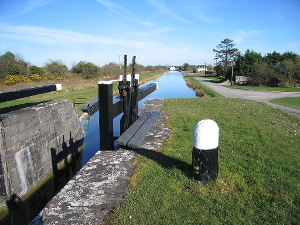
Construction begins on the Royal Canal on October 24, 1789. The canal is originally built for freight and passenger transportation from the River Liffey in Dublin to Longford.
In 1755, Thomas Williams and John Cooley make a survey to find a suitable route for a man-made waterway across north Leinster from Dublin to the River Shannon. They originally plan to use a series of rivers and lakes, including the Boyne, Blackwater, Deel, Yellow, Camlin, and Inny and Lough Derravaragh.
Work commences in 1789 and lasts 27 years before finally reaching the River Shannon in 1817, at a total cost of £1,421,954. Construction is unexpectedly expensive, and the project is riven with problems. In 1794 the Royal Canal Company is declared bankrupt. The Duke of Leinster, a board member, insists that the new waterway take in his local town of Maynooth. The builders have to deviate from the planned route and necessitate the construction of a ‘deep sinking’ between Blanchardstown and Clonsilla. The diversion also calls for the building of the Ryewater Aqueduct, at Leixlip.
The canal passes through Maynooth, Kilcock, Enfield, Mullingar and Ballymahon has a spur to Longford. The total length of the main navigation is 145 kilometres (90 miles), and the system has 46 locks. There is one main feeder, from Lough Owel, which enters the canal at Mullingar.
In 200 years, it has been maintained by eight successive agencies – the Royal Canal Company, the Commissioners of Inland Navigation, the New Royal Canal Company, Midland Great Western Railway Company, Great Southern Railways, CIÉ, and the Office of Public Works.
The canal falls into disrepair in the late 20th century, but much of the canal has since been restored for navigation. The length of the canal to the River Shannon is reopened on October 1, 2010, but the final spur branch of the canal to Longford Town remains closed.
(Pictured: Royal Canal as it enters Dublin city centre (left) and Royal Canal in rural County Westmeath north of Kinnegad (right)



 seamus dubhghaill