seamus dubhghaill

Promoting Irish Culture and History from Little Rock, Arkansas, USA


Leave a comment

Birth of Con Colbert, Irish Rebel & Fianna Éireann Pioneer

Cornelius Bernard “Con” Colbert, Irish rebel and pioneer of Fianna Éireann, is born on October 19, 1888, in the townland of Moanleana, Mahoonagh, County Limerick. For his part in the Easter Rising of 1916, he is shot by firing squad in Kilmainham Gaol, Dublin, on May 8, 1916.

Colbert is the fourth youngest of thirteen children of Michael Colbert, a farmer, and Honora McDermott. His family moves to the village of Athea when he is three years old. He is educated at the local national school. In 1901, his family is living in the townland of Templeathea West. A younger brother, James, and a cousin, Michael Colbert, later serve as Teachtaí Dála (TDs).

Colbert leaves Athea at the age of 16 and goes to live with his sister Catherine in Ranelagh, County Dublin. He continues his education at a Christian Brothers school in North Richmond Street. He is employed as a clerk in the offices of Kennedy’s Bakery in Dublin. In 1911, he is living with Catherine, two other siblings and two boarders at a house on Clifton Terrace, Rathmines. He is a deeply religious Catholic and refrains from smoking or drinking.

Colbert is sworn into the Irish Republican Brotherhood (IRB) by his cousin Art O’Donnell in Art’s home in 1908. He joins Fianna Éireann at its inaugural meeting in 1909 and rises to Chief Scout. The following year he becomes a drill instructor at St. Enda’s School, founded by Patrick Pearse. In 1912, he becomes head of an IRB circle within the Fianna started by Bulmer Hobson. During 1913 he is one of a number of Fianna who conduct military training at the Forester’s Hall in Rutland Square (now Parnell Square), and in November of that year he joins the Provisional Committee of the newly formed Irish Volunteers.

In the weeks leading up to the Rising, Colbert acts as bodyguard for Thomas Clarke. Before the Rising, because he lives out of the city, he stays with the Cooney family in the city centre. During Easter Week, he fights at Watkin’s Brewery, Jameson’s Distillery and Marrowbone Lane. Thomas MacDonagh surrenders to Brigadier General William Lowe at 3:15 p.m. on Sunday, April 30. MacDonagh then goes around the garrisons under his command to arrange for their surrender.

Colbert surrenders with the Marrowbone Lane Garrison along with the South Dublin Union Garrison, which had been led by Éamonn Ceannt. When the order to surrender is issued, he assumes the command of his unit to save the life of his superior officer, who is a married man.

They are marched to Richmond Barracks, where Colbert is later court-martialed. Transferred to Kilmainham Gaol, he is told on Sunday, May 7, that he is to be shot the following morning. He writes no fewer than ten letters during his time in prison. During this time in detention, he does not allow any visits from his family. Writing to his sister, he says a visit “would grieve us both too much.”

The night before his execution Colbert sends for Mrs. Ó Murchadha, who is also being held prisoner. He tells her he is “proud to die for such a cause. I will be passing away at the dawning of the day.” Holding his Bible, he tells her he is leaving it to his sister. He hands her three buttons from his volunteer uniform, telling her, “They left me nothing else.” He then asks her to say a Hail Mary for the souls of the departed when she hears the volleys of shots in the morning for Éamonn Ceannt, Michael Mallin and himself. The soldier who is guarding the prisoner begins crying according to Mrs. Ó Murchadha, and records him as saying, “If only we could die such deaths.”

The next morning, May 8, 1916, Colbert is shot by firing squad.

Colbert Railway Station in Limerick, Con Colbert Road in Dublin and the Fianna Fáil cumann in the University of Limerick are named in his honor. Colbert Street in his native Athea, County Limerick, is named after him, as is the local community hall. Colbert Avenue and Colbert Park Janesboro, Limerick, are also named after him.

On May 4, 1958, a plaque is erected over a bed in Barringtons Hospital, County Limerick. The plaque has since disappeared.

In May 2016, one hundred years after his execution, a full-scale limestone sculpture of Colbert is unveiled at the gable of his one-time house in Moanleana, County Limerick.


Leave a comment

Death of Major General William Hickie, Irish-Born British Army Officer

Major General Sir William Bernard Hickie, KCB, Irish-born senior British Army officer and Irish nationalist politician dies in Dublin on November 3, 1950. He sees active service in the Second Boer War from 1899 to 1902, is Assistant Quartermaster General in the Irish Command from 1912 to 1914 and serves in World War I from 1914 to 1918. He commands a brigade of the British Expeditionary Force in 1914 and is commander of the 16th (Irish) Division from 1915 on the Western Front.

Hickie is born on May 21, 1865, at Slevoir, Terryglass, near Borrisokane, County Tipperary, the eldest of the eight children of Colonel James Francis Hickie and his wife Lucila Larios y Tashara, originally of Castile. He is educated at St. Mary’s College, Oscott, Birmingham, England, a renowned seminary for training youths of prosperous Roman Catholic families.

Hickie attends the Royal Military College, Sandhurst, from 1882 to 1885. He is commissioned into his father’s regiment, the Royal Fusiliers at Gibraltar, in 1885 and serves with them for thirteen years in the Mediterranean, Egypt, and India, during which time he is promoted to captain on November 18, 1892. In 1899 he graduates as captain at the Staff College, Camberley, and is selected when the Second Boer War breaks out as a Special Service Officer in which capacity he acts in various positions of authority and command. He leaves Southampton for South Africa on board the SS Canada in early February 1900 and is promoted from captain of mounted infantry to battalion command as major on March 17, 1900. He is subsequently in command of a corps until eventually at the end of 1900 he is given command of an independent column of all arms. He holds this position for eighteen months. He serves with distinction at the Battle of Bothaville in November 1900 and receives the brevet promotion to lieutenant colonel on November 29, 1900. He serves in South Africa throughout the war, which ends with the Treaty of Vereeniging in June 1902. Four months later he leaves Cape Town on the SS Salamis with other officers and men of the 2nd battalion Royal Fusiliers, arriving at Southampton in late October, when the battalion is posted to Aldershot Garrison. In December 1902 he is elected a Fellow of the Royal Geographical Society (FRGS).

After the end of the war in South Africa there follows various staff appointments, the first from December 1902 as deputy-assistant adjutant general for district staff in the Cork district. In 1907 Hickie is back in regimental service in Dublin and Mullingar with the 1st Royal Fusiliers, where he is in command of the regiment for the last two years. From 1909 to 1912 is appointed to the Staff of the 8th Infantry Division in Cork where for four years he is well known in the hunting field and on the polo ground. In May 1912, he is promoted to colonel and becomes Quartermaster General of the Irish Command at Royal Hospital Kilmainham for which he is appointed a Companion of the Order of the Bath.

When war is declared, the Staff of the Irish Command becomes automatically the staff of the II Army Corps and accordingly with the outbreak of World War I in August 1914, Hickie is promoted to brigadier general and, as part of the British Expeditionary Force in France, takes charge of the Adjutant and Quartermaster-General’s Department during the retreat of the II Corps after the Battle of Mons, to Paris, and during the First Battle of the Marne. In mid-September 1914, he relieves one of the brigadiers in the fighting line as commander of the 13th Brigade (5th Infantry Division) and then commands the 53rd Brigade (18th Infantry Division) until December 1915, when he is ordered home to assume command of the 16th (Irish) Division at Blackburn.

Promoted to major general, Hickie takes over from Lieutenant General Sir Lawrence Parsons. It is politically a highly sensitive appointment which requires the professionalism and political awareness he, fortunately, possesses as the division is formed around a core of Irish National Volunteers in response to Edward Carson‘s Ulster Volunteers. He is much more diplomatic and tactful than his predecessors and speaks of the pride which his new command gives him but does not hesitate to make sweeping changes amongst the senior officers of the Irish Division. After putting the division through intensive training, it leaves under Irish command of which each man takes personal pride. It arrives in December 1915.

In the next two years and four months during which Hickie commands the 16th (Irish) Division, it earns a reputation for aggression and élan and wins many memorials and mentions for bravery in the engagements during the 1916 Battle of Guillemont and the capture of Ginchy, both of which form part of the Battle of the Somme, then during the Battle of Messines, the Third Battle of Ypres and in attacks near Bullecourt in the Battle of Cambrai offensive in November 1917.

During this period the Division makes considerable progress in developing its operational techniques but at a price in losses. The growing shortage of Irish replacement recruits, due to nationalist disenchantment with the war and the absence of conscription in Ireland, is successfully met by Hickie by integrating non-Irish soldiers into the division.

In February 1918, Hickie is invalided home on temporary sick leave, but when in the hospital the German spring offensive begins on March 21, with the result that after his division moves under the command of General Hubert Gough it is practically wiped out and ceases to exist as a division. Although promised a new command, this does not happen before the Armistice in November. He typifies the army’s better divisional commanders, is articulate, intelligent and is competent and resourceful during the BEF’s difficult period 1916–17, laying the foundations for its full tactical success in 1918. He is advanced to Knight Commander of the Order of the Bath in 1918.

Hickie retires from the army in 1922, when the six Irish line infantry regiments that have their traditional recruiting grounds in the counties of the new Irish Free State are all disbanded. He identifies himself strongly with the Home Rule Act and says that its scrapping is a disaster and is equally outspoken in condemning the activities of the Black and Tans. In 1925, he is elected as a member of Seanad Éireann, the Irish Free State Senate.

Hickie holds his seat until the Seanad is dissolved in 1936, to be replaced by Seanad Éireann in 1937. He is President of the Area Council (Southern Ireland) of the Royal British Legion from 1925 to 1948. He never marries.

Hickie dies on November 3, 1950, in Dublin and is buried in Terryglass, County Tipperary.


Leave a comment

Birth of Sir William Bernard Hickie, British Army General

Sir William Bernard Hickie, British Army general, commander of the 16th (Irish) Division (1915–18) and an Irish nationalist politician, is born on May 21, 1865, at Slevoir, Terryglass, near Borrisokane, County Tipperary.

Hickie is the eldest son of Colonel James Francis Hickie, JP, of Slevoir, former commanding officer of the 7th Royal Fusiliers, and Lucila Calista (de Tejada) Hickie, daughter of Don Pablo Lariosy Herreros de Tejada of Laguna de Cameros, Castile. He is educated at St. Mary’s College, Oscott, before attending the Royal Military College, Sandhurst, and is commissioned into the Royal Fusiliers in 1885, serving in Egypt and India.

A major at the outbreak of the Second Boer War in 1899, Hickie serves on the staff of Lieutenant-Colonel P. W. J. Le Gallais, commanding officer of the mounted infantry. On November 6, 1900, he is involved in an attempt to capture General Christiaan De Wet at the Battle of Bothaville, when a force led by Le Gallais and Lieutenant-Colonel Wally Ross storm De Wet’s camp. De Wet escapes, while a rearguard of 100 men engages the British force. In a fierce fight Le Gallais is killed, and Wally Ross is badly wounded. Hickie decides to charge the Boer position and leads his small force forward just as reinforcements under Major-General C. E. Knox arrive. The Boers immediately surrender, and some are found with explosive bullets. He wants to execute them immediately, but Knox insists that they be tried. Exasperated with the whole affair, Hickie gives a highly critical interview after the action which is later published in The Times History of the War in South Africa (7 vols, 1900–09), edited by Leo Amery.

Hickie is promoted to brevet lieutenant colonel in 1901 and appointed deputy-assistant adjutant general of the 8th division (1903–06). In 1906, he is given command of the 1st battalion of the Royal Fusiliers. Promoted to colonel in 1912, he serves as assistant quartermaster general of the Irish command (1912–14) and is appointed a Companion of the Order of the Bath in 1914. On the outbreak of World War I, he is promoted to brigadier general and serves in Belgium and France in command of the adjutant’s and quartermaster-general’s department of II Corps. In this capacity, he is involved in the retreat following the Battle of Mons and during the First Battle of the Marne (September 1914). In December 1915, he is appointed to command the 16th (Irish) Division, with the rank of major general, replacing General Sir Lawrence W. Parsons. The division is based around a core of Redmondite National Volunteers, and Hickie, a Catholic and a home ruler, is an acceptable commander to John Redmond and other Irish nationalists.

Hickie is professional, politically adept, and popular with his men, and under his leadership the 16th is renowned for its aggressive fighting spirit. He commands the division during the Battle of the Somme in 1916 and, while proud of his men’s success in capturing Guillemont and Ginchy (September 1916), is appalled by their losses. When the division is ordered to capture Messines (now Mesen) in June 1917, he gives Major Willie Redmond permission to advance as far as the first objective and, following Redmond’s death, reproaches himself bitterly. After this attack the division is transferred to the fifth army and provides assault troops for future attacks. During the Third Battle of Ypres, and especially during the attack on Langemarck in August 1917, the division suffers horrendous casualties, losing 221 officers and 4,064 men. Among the casualties is Fr. Willie Doyle, who Hickie unsuccessfully recommends for a Victoria Cross. The division’s losses at Langemarck are highlighted by Irish MPs in the House of Commons, and Hickie’s handling of the attack is criticised. By this time, nationalist disillusionment with the war means that few Irish replacements are available, and Hickie is forced to accept increasing numbers of non-Irish conscripts into the division. Worn down by years of command, his health finally breaks, and, in February 1918, he is sent home on sick leave, being replaced by Major-General Sir Richard Amyatt Hull.

In 1918, Hickie is created a Knight Commander of the Order of the Bath (KCB) and is also awarded the French Croix de Guerre. During the Irish War of Independence (1919–21), he is critical of the methods used by Crown forces, denouncing in particular the indiscipline of the Black and Tans. In 1921 he retires from the army and becomes a prominent figure in the Royal British Legion in Ireland, tirelessly campaigning on behalf of ex-servicemen. In the 1920s he is involved with the Irish battlefield memorial committee, which erects memorial crosses at Wytschaete, Guillemont, and Salonika, commemorating the 10th and 16th divisions. He later serves as a senator of the Irish Free State (1925–36). Retiring from public life in 1936 to his residence at Terryglass, County Tipperary, he devotes his last years to gardening and reading.

Hickie dies on November 3, 1950, in Dublin, and is buried at Terryglass. He marries a daughter of the novelist Rev. J. O. Hannay, who predeceases him. There is a small collection of his papers in the National Library of Ireland (NLI).

(From: “Hickie, Sir William Bernard” by David Murphy, Dictionary of Irish Biography, http://www.dib.ie, October 2009)


Leave a comment

Introduction of the Third Home Rule Bill

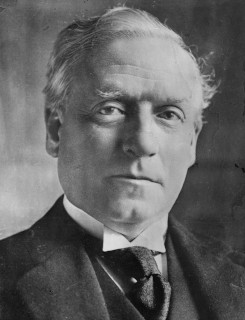
Prime Minister of the United Kingdom Herbert Henry Asquith, a member of the Liberal Party, introduces the Third Home Rule Bill on April 11, 1912, which would provide self-government for Ireland, an apparent triumph for Nationalist leader John Redmond.

As a minority party after 1910 elections, the Liberal Party depends on the Irish vote, controlled by John Redmond. To gain Irish support for the budget and the parliament bill, Asquith promises Redmond that Irish Home Rule will be the highest priority. It proves much more complex and time-consuming than expected. Support for self-government for Ireland had been a tenet of the Liberal Party since 1886, but Asquith has not been as enthusiastic, stating in 1903 (while in opposition) that the party should never take office if that government would be dependent for survival on the support of the Irish Nationalist Party. After 1910, though, Irish Nationalist votes are essential to stay in power. Retaining Ireland in the Union is the declared intent of all parties, and the Nationalists, as part of the majority that keep Asquith in office, are entitled to seek enactment of their plans for Home Rule, and to expect Liberal and Labour support. The Conservatives, with die-hard support from the Protestant Orange Order of Ulster, are strongly opposed to Home Rule. The desire to retain a veto for the House of Lords on such bills has been an unbridgeable gap between the parties in the constitutional talks prior to the December 1910 United Kingdom general election.

The cabinet committee (excluding Asquith) that in 1911 plans the Third Home Rule Bill opposes any special status for Protestant Ulster within majority-Catholic Ireland. In 1913, Asquith writes to Winston Churchill, stating that the Prime Minister has always believed and stated that the price of Home Rule should be a special status for Ulster. In spite of this, the bill as introduced in April 1912 contains no such provision and is meant to apply to all Ireland. Neither partition nor a special status for Ulster is likely to satisfy either side. The self-government offered by the bill is very limited, but Irish Nationalists, expecting Home Rule to come by gradual parliamentary steps, favours it. The Conservatives and Irish Unionists oppose it. Unionists begin preparing to get their way by force if necessary, prompting nationalist emulation. Though very much a minority, Irish Unionists are generally better financed and more organised.

Since the Parliament Act the Unionists can no longer block Home Rule in the House of Lords, but only delay Royal Assent by two years. Asquith decides to postpone any concessions to the Unionists until the bill’s third passage through the House of Commons, when he believes the Unionists will be desperate for a compromise. Biographer Roy Jenkins concludes that had Asquith tried for an earlier agreement, he would have had no luck, as many of his opponents wanted a fight and the opportunity to smash his government. Sir Edward Carson, MP for the University of Dublin and leader of the Irish Unionists in Parliament, threatens a revolt if Home Rule is enacted. The new Conservative leader, Bonar Law, campaigns in Parliament and in Northern Ireland, warning Ulstermen against “Rome Rule,” that is, domination by the island’s Catholic majority. Many who oppose Home Rule feel that the Liberals have violated the Constitution by pushing through major constitutional change without a clear electoral mandate, with the House of Lords, formerly the “watchdog of the constitution,” not reformed as had been promised in the preamble of the 1911 Act and thus justified actions that in other circumstances might be treason.

The passions generated by the Irish question contrast with Asquith’s cool detachment, and he writes about the prospective partition of the county of Tyrone, which has a mixed population, deeming it “an impasse, with unspeakable consequences, upon a matter which to English eyes seems inconceivably small, and to Irish eyes immeasurably big.” As the House of Commons debate the Home Rule bill in late 1912 and early 1913, unionists in the north of Ireland mobilise, with talk of Carson declaring a Provisional Government and Ulster Volunteer Forces (UVF) built around the Orange Lodges, but in the cabinet, only Churchill views this with alarm.

These forces, insisting on their loyalty to the British Crown but increasingly well-armed with smuggled German weapons, prepare to do battle with the British Army, but Unionist leaders are confident that the army will not aid in forcing Home Rule on Ulster. As the Home Rule bill awaits its third passage through the House of Commons, the so-called Curragh incident occurs in March 1914. With deployment of troops into Ulster imminent and threatening language by Churchill and the Secretary of State for War, John Seely, around sixty army officers, led by Brigadier General Hubert Gough, announce that they would rather be dismissed from the service than obey. With unrest spreading to army officers in England, the Cabinet acts to placate the officers with a statement written by Asquith reiterating the duty of officers to obey lawful orders but claiming that the incident had been a misunderstanding. Seely then adds an unauthorised assurance, countersigned by Sir John French, the professional head of the army, that the government has no intention of using force against Ulster. Asquith repudiates the addition, and requires Seely and French to resign, taking on the War Office himself, retaining the additional responsibility until hostilities against Germany begin.

Within a month of the start of Asquith’s tenure at the War Office, the UVF lands a large cargo of guns and ammunition at Larne, but the Cabinet does not deem it prudent to arrest their leaders. On May 12, Asquith announces that he will secure Home Rule’s third passage through the House of Commons (accomplished on May 25), but that there will be an amending bill with it, making special provision for Ulster. But the House of Lords make changes to the amending bill unacceptable to Asquith, and with no way to invoke the Parliament Act on the amending bill, Asquith agrees to meet other leaders at an all-party conference on July 21 at Buckingham Palace, chaired by King George V. When no solution can be found, Asquith and his cabinet plans further concessions to the Unionists, but this does not occur as the crisis in Europe erupts into war.

In September 1914, after the outbreak of the conflict, Asquith announces that the Home Rule bill will go on the statute book as the Government of Ireland Act 1914 but will not go into force until after the war. He adds that in the interim a bill granting special status to Ulster will be considered. This solution satisfies neither side.

(Pictured: H.H. Asquith, former Prime Minister of the United Kingdom)


Leave a comment

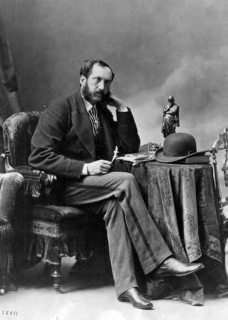
Birth of William Francis Butler, Army Officer & Writer

william-francis-butler

William Francis Butler, 19th-century British Army officer, writer, and adventurer, is born on October 31, 1838, at Ballyslatteen, Golden, County Tipperary.

Butler is the son of Richard and Ellen Butler. The great famine of 1847 and scenes of suffering and eviction are amongst his earliest recollections. He is educated chiefly by the Jesuits at Tullabeg College.

Butler enters the army as an ensign of the 69th Regiment of Foot at Fermoy Barracks in 1858, becoming captain in 1872 and major in 1874. He takes part with distinction in the Red River expedition (1870–71) and the Ashanti operations of 1873–1874 under Garnet Wolseley, 1st Viscount Wolseley and receives the Companion of the Order of the Bath in 1874.

On June 11, 1877, Butler marries Elizabeth Thompson, an accomplished painter of battle scenes, notably The Roll Call (1874), Quatre Bras (1875), Rorke’s Drift (1881), The Camel Corps (1891), and The Dawn of Waterloo (1895). They have six children. His daughter, Elizabeth Butler, marries Lt.-Col. Randolph Albert Fitzhardinge Kingscote (1867-1940) on July 24, 1903.

Butler again serves with General Wolseley in the Anglo-Zulu War, the Battle of Tell El Kebir (after which he is made an aide-de-camp to Queen Victoria) and the Sudan in 1884–1886, being employed as colonel on the staff in 1885 and brigadier general in 1885–1886. In the latter year, he is made a Knight Commander of the Order of the Bath. He serves as brigadier general on the staff in Egypt until 1892 when he is promoted to major general and stationed at Aldershot, subsequent to which he is given command of the South-Eastern District in March 1896.

In 1898 Butler succeeds General William Howley Goodenough as commander-in-chief in South Africa, with the local rank of lieutenant general. For a short period (December 1898 – February 1899), during the absence of Sir Alfred Milner in England, he acts as high commissioner, and as such, and subsequently in his military capacity, he expresses views on the subject of the probabilities of war which are not approved by the home government. He is consequently ordered home to command the Western District and holds this post until 1905. He also holds the Aldershot Command for a brief period from 1900 to 1901. He is promoted to lieutenant general in 1900 and continues to serve, finally leaving the King‘s service in 1905.

In October 1905, having reached the age limit of sixty-seven, Butler is placed on the retired list. The few years of life which remain to him he spends at Bansha Castle in Ireland, devoted chiefly to the cause of education. He is a frequent lecturer both in Dublin and the provinces on historical, social, and economic questions. He is known as a Home Ruler and an admirer of Charles Stewart Parnell. He is a member of the Senate of the National University of Ireland, and a commissioner of the Board of National Education. In June 1906, he is appointed Knight of the Grand Cross of the Order of the Bath, and in 1909 he is made a member of the Privy Council of Ireland.

William Butler dies at Bansha Castle in Bansha, County Tipperary, on June 10, 1910, and is buried at the cemetery of Killaldriffe, a few miles distant and not far from his ancestral home.

Butler had long been known as a descriptive writer, since his publication of The Great Lone Land (1872) and other works and he was the biographer (1899) of Sir George Pomeroy Colley. He had started work on his autobiography a few years before his death but died before it was completed. His youngest daughter, Eileen, Viscountess Gormanston, completes the work and has it published in 1911.

(Pictured: William Francis Butler, Source: Archives of Manitoba, Personalities – Butler, W. F. 1, N10492)


Leave a comment

The Clonbanin Ambush

*

The Irish Republican Army (IRA) ambush a British Army convoy near the townland of Clonbanin, County Cork on March 5, 1921, during the Irish War of Independence.

The IRA force is comprised of almost 100 volunteers from counties Cork and Kerry, armed with rifles, hand grenades and a machine gun. Their target is a British Army convoy of three lorries, an armoured car and a touring car carrying Brigadier General Hanway Robert Cumming. The convoy is travelling from Killarney to Buttevant and comprises almost 40 soldiers of the East Lancashire Regiment.

When the convoy enters the ambush position, IRA volunteers open fire from elevated positions on both sides of the road. The three lorries and touring car are disabled, and the armoured car becomes stuck in the roadside ditch, although those inside continue to fire its machine guns. As Cumming jumps from his car, he is shot in the head and dies instantly. He is one of the highest ranked British officers to die in the Irish War of Independence.

The battle lasts slightly over an hour. As the IRA forces withdraw from one side of the road, a British officer and six soldiers attempted to flank the IRA on the other side. After a brief exchange of fire, they retreat.

The IRA are not believed to have sustained any casualties.

(Pictured: Two British officers surnamed Lawson and Adams with Brigadier General H. R. Cumming in Kenmare County Kerry shortly before their deaths at the hands of the IRA in 1921)