On January 31, 1972, the day after Bloody Sunday, British Home SecretaryReginald Maudling announces a tribunal of inquiry “into the circumstances of the march and the incidents leading up to the casualties which resulted.”
The official British Army position, backed by Maudling in the House of Commons, is that the paratroopers reacted to gun and nail bomb attacks from suspected Irish Republican Army (IRA) members. Apart from the soldiers, all eyewitnesses — including marchers, local residents, and British and Irish journalists present — maintain that soldiers fired into an unarmed crowd or were aiming at fleeing people and those tending the wounded, whereas the soldiers themselves were not fired upon. No British soldier is wounded by gunfire or reports any injuries, nor are any bullets or nail bombs recovered to back up their claims.
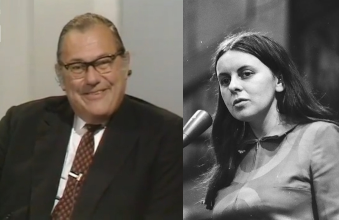
In the days following Bloody Sunday, Bernadette Devlin, the independent Irish nationalistMember of Parliament (MP) for Mid Ulster, expresses anger at what she perceives as British government attempts to stifle accounts being reported about the shootings. Having witnessed the events firsthand, she is infuriated that the Speaker of the House of Commons, Selwyn Lloyd, consistently denies her the chance to speak in Parliament about the shootings, although parliamentary convention decrees that any MP witnessing an incident under discussion will be granted an opportunity to speak about it in Parliament. Devlin slaps Reginald Maudling and calls him a “murdering hypocrite” when he makes a statement to Parliament that the British Army had fired only in self-defence. She is temporarily suspended from Parliament as a result.
An inquest into the deaths is held in August 1973. The city’s coroner, Hubert O’Neill, a retired British Army major, issues a statement at the completion of the inquest. He declares:
“This Sunday became known as Bloody Sunday and bloody it was. It was quite unnecessary. It strikes me that the Army ran amok that day and shot without thinking what they were doing. They were shooting innocent people. These people may have been taking part in a march that was banned but that does not justify the troops coming in and firing live rounds indiscriminately. I would say without hesitation that it was sheer, unadulterated murder. It was murder.”
(Pictured: Home Secretary Reginald Maudling (left) and Member of Parliament for Mid Ulster Bernadette Devlin)
Gearóid O’Sullivan, soldier and politician, is born on January 28, 1891, at Coolnagrane, near Skibbereen, County Cork, fourth son among six sons and three daughters of Michael O’Sullivan, farmer, of Loughine, and Margaret Sullivan (née McCarthy) of Coolnagrane.
Christened Jeremiah but known in later life as Gearóid, O’Sullivan is an outstanding pupil at national school and secondary school in Skibbereen. Encouraged by his teachers, he acquires a love of the Irish language. Not yet ten, he joins the Gaelic League in Skibbereen in October 1900. He takes part in the Oireachtas debates of 1909. In 1911 he qualifies at St. Patrick’s College, Dublin, as a national schoolteacher and teaches at Kildorrery, County Cork, but returns to Dublin in 1912 to take up a post at St. Peter’s National School, Phibsborough. He takes an honours degree in Celtic studies at University College Dublin (UCD) (1913), an H.Dip.Ed. (1914), and an M.Ed. (1915). At the same time, he is an organiser and teacher with the Gaelic League, a member of its Keating branch at Parnell Square, Dublin, and a founder of the League’s “fáinne” proficiency badge.
O’Sullivan joins the F Company, 1st Battalion, Dublin Brigade of the Irish Volunteers at their foundation in November 1913, is aide-de-camp to Seán Mac Diarmada during the 1916 Easter Rising and is ordered by Patrick Pearse to raise the flag of rebellion over the General Post Office (GPO) stronghold in Dublin. Interned at Frongoch internment camp in Wales after the rising, he belongs to the Irish Republican Brotherhood (IRB) group of prisoners closely linked with Michael Collins, a proximity that continues throughout the crisis years to follow. Released in the amnesty of December 1916, he intensifies his Volunteer activity, playing a prominent role in Carlow Brigade, for which he is briefly detained while working as a teacher at St. Mary’s Knockbeg College, County Carlow. When the Irish Volunteers become the Irish Republican Army (IRA) in 1919, he is arrested again and goes on hunger strike at Mountjoy Prison, which leads to his release. Active throughout the Irish War of Independence (1919–21) and narrowly avoiding recapture during meetings with Collins, he joins the supreme council of the IRB in November 1921, remaining there for the remainder of his military career.
From February 1920, O’Sullivan replaces Collins as adjutant general of the IRA, a position he retains until the Anglo–Irish Treaty of December 1921 (which he supports), resuming it a month later as a lieutenant general of the new National Army, responsible for personnel and promotions. He is also elected to Dáil Éireann for Carlow–Kilkenny in 1921 and again in 1922, retiring in 1923. His intellectual and organisational abilities guarantee that his position within the army is safe after the death in August 1922 of Collins, to whom he owes much for his initial rise to prominence. On August 28 he is appointed to the newly created army council, whose most draconian prerogative becomes the military execution of republican prisoners.
After the Irish Civil War (1922–23), wholesale demobilisation of officers and other ranks takes place, but O’Sullivan and his council colleagues Richard Mulcahy, Seán Mac Mahon, and Seán Ó Murthuile survive the fiscal axe. Their privileged position angers some officers, led by Major GeneralLiam Tobin, alarmed at the rate of demobilisation and the state’s apparent abandonment of Collins’s republican ideals. Through the Irish Republican Army Organisation, they deplore the devaluation of their pre-treaty IRA service and the retention of certain former British Army officers and instructors. O’Sullivan’s brief time as adjutant general places him in the role of personnel manager. As the Defence Forces (Temporary Provisions) Act, 1923, transforms the National Army into the defence forces of an Irish dominion, he is clearly in the sights of those who disagree with how these forces took shape.
As demobilisation continues and former British personnel become more evident, O’Sullivan and his colleagues become targets of suspicion that a hostile IRB clique had controlled the army council since its formation after the death of Collins. Exaggerated or not, such claims precipitate the army crisis of March 1924, in which O’Sullivan personally orders a raiding party under Colonel Hugo MacNeill to arrest its leaders. To defuse the crisis, he and his army council colleagues are forced to stand down, while the arrested dissidents are summarily retired. The subsequent army inquiry (April–June 1924) absolves him and his colleagues of any wrongdoing, but their active military careers are over. O’Sullivan, however, is for some time secretary of the military service pensions board.
Civilian life treats O’Sullivan well, as he enters a legal career and in 1926 is called to the bar. In 1927 he is appointed Judge Advocate General and remains so until 1932. After the assassination of Minister for JusticeKevin O’Higgins in July 1927, he fills the vacated Dublin County seat in a by-election in August, retaining it at subsequent elections until 1937. In August 1928 he is a Free State delegate to the Empire Parliamentary Association conference in Canada. Openly supporting Gen. Eoin O’Duffy and the short-lived ‘Blueshirts’ vanguard of the fledgling Fine Gael party during 1933–34, he pointedly refuses to surrender his legally held revolver when gardaí demand it as a precaution against a feared Blueshirt coup d’étât. In 1937 he becomes a barrister on the western circuit, and in 1940 commissioner for special purposes of the income tax acts, a post he holds for life.
O’Sullivan lives at St. Kevin’s Park, Dartry, Dublin, where he dies at the age of 57 on March 26, 1948. His military funeral to Glasnevin Cemetery, with his coffin draped in the same flag that had covered the coffin of Michael Collins, reflects his high national profile.
In 1922, O’Sullivan marries Maude Kiernan, sister of Kitty Kiernan and daughter of Peter and Bridget Kiernan, whose family is closely involved with the Irish political leadership, notably Michael Collins and Harry Boland. After Maude’s death he marries Mary Brennan of Belfast. They have three daughters and a son, all of whom survive him. O’Sullivan is commemorated in County Cork by a plaque at Skibbereen town hall.
In April 1916, during World War I, Irish republicans launch an uprising against British rule in Ireland, called the Easter Rising. They proclaim an Irish Republic. After a week of heavy fighting, mostly in Dublin, the rising is put down by British forces. About 3,500 people are taken prisoner by the British, many of whom had played no part in the Rising. Most of the Rising’s leaders are executed. The rising, the British response, and the British attempt to introduce conscription in Ireland, leads to an even greater public support for Irish republicanism.
In the 1918 Irish general election, the Irish republican party Sinn Féin wins a landslide victory in Ireland, gaining 73 out of 105 seats in the British Parliament. However, in its election manifesto, the party has vowed to set up a separate government in Ireland rather than sit in the British Parliament. At a meeting in Dublin on January 21, 1919, Sinn Féin establishes an independent parliament called Dáil Éireann and declares independence from the United Kingdom.
That same day, an ambush is carried out by Irish Volunteers from the 3rd Tipperary Brigade. It involves Seán Treacy, Dan Breen, Seán Hogan, Séumas Robinson, Tadhg Crowe, Patrick McCormack, Patrick O’Dwyer and Michael Ryan. Robinson is the commander of the group that carries out the attack and Treacy coordinates the planning of the attack. The unit involved acts on its own initiative as had they had to wait for a response, even if it is affirmative, it might come too late.
In December 1918, they receive information that there are plans to move a consignment of gelignite from TipperaryBritish Army barracks to the Soloheadbeg quarry. They begin plans to intercept the consignment and Dan Breen’s brother Lars, who works at the quarry, receives information that the consignment is to be moved around January 16, 1919. They anticipate that there would be between two and six armed escorts, and they discuss different plans. If the escort is small, they believe they can overpower the RIC officers without firing a shot. Gags and ropes are hidden in the quarry, so that should officers surrender they can be bound and gagged. The planning for the ambush takes place in the ‘Tin Hut,’ a deserted semi-derelict house at Greenane.
Each day from January 16 to 21, the men chosen for the ambush take up their positions from early in the morning to late afternoon and then spend the night at the deserted house. Seven of the Volunteers are armed with revolvers while Treacy is armed with a small automatic rifle. On a rainy January 21, around noon, Patrick O’Dwyer sees the transport leaving the barracks. The consignment of 160 lbs. of gelignite is on a horse-drawn cart, led by two council men and guarded by two RIC officers armed with carbine rifles. O’Dwyer cycles quickly to where the ambush party is waiting and informs them. Robinson and O’Dwyer hide about 20 yards in front of the main ambush party of six, in case they rush through the main ambush position.
When the transport reaches the position where the main ambush party is hiding, masked Volunteers step out in front of them with their guns drawn and call on the RIC to surrender. The officers can see at least three of the ambushers. One officer gets down behind the cart and the other apparently fumbles with his rifle. According to the Volunteers, the officers raise their rifles to fire at them, but the rifles do not fire. The Volunteers immediately fire at the officers, and it is believed that Treacy fires the first shot. Both officers, James McDonnell and Patrick O’Connell, native Roman Catholics, are killed. MacDonnell (50) of Belmullet, County Mayo, is a widower with five children. O’Connell is unmarried and a native of Coachford, County Cork.
As planned, Hogan, Breen and Treacy take the horse and cart with the explosives and speed off. Tadhg Crowe and Patrick O’Dwyer take the guns and ammunition from the dead officers, while Robinson, McCormack and Ryan guard the two council workers, Ned Godfrey and Patrick Flynn, before releasing them once the gelignite is far enough away. Initially the explosives are hidden in a field in Greenane. They are moved several times and are later divided up between the battalions of the brigade.
The ambush is later seen as the beginning of the Irish War of Independence. The British government declares South Tipperary a Special Military Area under the Defence of the Realm Act two days later. There is strong condemnation from the Catholic Church in Ireland. The parish priest of Tipperary calls the dead officers “martyrs to duty.”
A meeting of the Executive of the Irish Volunteers takes place shortly thereafter. On January 31, An t-Óglach, the official publication of the Irish Volunteers, states that the formation of Dáil Éireann “justifies Irish Volunteers in treating the armed forces of the enemy – whether soldiers or policemen – exactly as a National Army would treat the members of an invading army.”
In February 1919 at a Brigade meeting in Nodstown, Tipperary, Brigade officers draft a proclamation, signed by Séumas Robinson as OC, ordering all British military and police forces out of South Tipperary and, should they stay, they will be held to have “forfeited their lives.” GHQ refuses to sanction the proclamation and demands it not be publicly displayed. Despite this it is still posted in several places in Tipperary.
In order to avoid capture, Breen, Treacy, Hogan and the other participants are forced to stay on the move for the following months, often hiding in the barns and attics of sympathisers.
A monument (pictured) has been erected at the site of the ambush, and each year a ceremony of remembrance is held there.
The son of a docker, Doherty is born into an Irish republican family, his grandfather being a member of the Irish Citizen Army which fought against British rule in the 1916 Easter Rising. Doherty leaves school at the age of 14 and begins work on the docks and as an apprentice plumber, before being arrested in 1972 on his seventeenth birthday under the Special Powers Act. He is interned on the prison ship HMS Maidstone and at Long Kesh Detention Centre, and while interned hears of the events of Bloody Sunday in Derry, where 14 civil rights protesters were shot dead by the British Army. This leads to him joining the IRA after he is released in June 1972. In the mid-1970s he is convicted of possession of explosives and sentenced to six years imprisonment in Long Kesh. He is released in December 1979.
After his release, Doherty becomes part of a four-man active service unit nicknamed the “M60 gang” due to their use of an M60 heavy machine gun, along with Angelo Fusco and Paul Magee. On April 9, 1980, the unit lures the Royal Ulster Constabulary (RUC) into an ambush on Stewartstown Road, killing one constable and wounding two others. On May 2 the unit is planning another attack and has taken over a house on Antrim Road, when an eight-man patrol from the Special Air Service (SAS) arrive in plain clothes, after being alerted by the RUC. A car carrying three SAS members goes to the rear of the house, and another car carrying five SAS members arrives at the front of the house. As the SAS members at the front of the house exit the car, the IRA unit opens fire with the M60 machine gun from an upstairs window, hitting Captain Herbert Westmacott in the head and shoulder. Westmacott, who is killed instantly, is the highest-ranking member of the SAS killed in Northern Ireland. The remaining SAS members at the front, armed with Colt Commando automatic rifles, submachine guns and Browning pistols, return fire but are forced to withdraw. Magee is apprehended by the SAS members at the rear of the house while attempting to prepare the IRA unit’s escape in a transit van, while the other three IRA members remain inside the house. More members of the security forces are deployed to the scene and, after a brief siege, the remaining members of the IRA unit surrender.
The trial of Doherty and the other members of the M60 gang begins in early May 1981, on charges including three counts of murder. On June 10, Doherty and seven other prisoners, including Angelo Fusco and the other members of the IRA unit, take a prison officer hostage at gunpoint in Crumlin Road Gaol. After locking the officer in a cell, the eight take other officers and visiting solicitors hostage, also locking them in cells after taking their clothing. Two of the eight wear officers’ uniforms while a third wears clothing taken from a solicitor, and the group moves towards the first of three gates separating them from the outside world. They take the officer on duty at the gate hostage at gunpoint and force him to open the inner gate. An officer at the second gate recognises one of the prisoners and runs into an office and presses an alarm button, and the prisoners run through the second gate towards the outer gate. An officer at the outer gate tries to prevent the escape but is attacked by the prisoners, who escape onto Crumlin Road. As the prisoners are moving towards the car park where two cars are waiting, an unmarked RUC car pulls up across the street outside Crumlin Road Courthouse. The RUC officers open fire, and the prisoners return fire before escaping in the waiting cars. Two days after the escape, Doherty is convicted in absentia and sentenced to life imprisonment with a minimum recommended term of thirty years.
Doherty escapes across the border into the Republic of Ireland, and then travels to the United States on a false passport. He lives with an American girlfriend in Brooklyn and New Jersey, working on construction sites and as a bartender at Clancy’s Bar in Manhattan, where he is arrested by the Federal Bureau of Investigation (FBI) on June 28, 1983. He is imprisoned in the Metropolitan Correctional Center in Manhattan, and a legal battle ensues with the British government seeking to extradite him back to Northern Ireland. Doherty claims he is immune from extradition as the killing of Westmacott was a political act, and in 1985 federal judge John E. Sprizzo rules Doherty cannot be extradited as the killing was a “political offense.” His legal battle continues as the United States Department of Justice then attempts to deport him for entering the country illegally.
Doherty remains in custody at the Metropolitan Correctional Center and attempts to claim political asylum, and June 15, 1988, the United States Attorney GeneralEdwin Meese overturns an earlier ruling by the Federal Board of Immigration Appeals that Doherty can be deported to the Republic of Ireland and orders his deportation to Northern Ireland. In February 1989 new Attorney General Dick Thornburgh chooses not to support the decision made by his predecessor and asks lawyers for Doherty and the Immigration and Naturalization Service to submit arguments for a review of the decision and Doherty’s claim for asylum. By this time Doherty’s case is a cause célèbre with his sympathisers including over 130 Congressmen and a son of then President of the United StatesGeorge H. W. Bush, and in 1990 a street corner near the Metropolitan Correctional Center is named after him.
The Teebane bombing takes place on January 17, 1992, at a rural crossroads between Omagh and Cookstown in County Tyrone, Northern Ireland. A roadside bomb destroys a van carrying 14 construction workers who had been repairing a British Army base in Omagh. Eight of the men are killed and the rest are wounded. The Provisional Irish Republican Army (IRA) claims responsibility, saying that the workers were killed because they were “collaborating” with the “forces of occupation.”
Since the beginning of its campaign in 1969, the Provisional IRA has launched frequent attacks on British Army and Royal Ulster Constabulary (RUC) bases in Northern Ireland. In August 1985 it begins targeting civilians who offer services to the security forces, particularly those employed by the security forces to maintain and repair its bases. Between August 1985 and January 1992, the IRA kills 23 people who had been working for (or offering services to) the security forces. The IRA also alleges that some of those targeted had links with Ulster loyalistparamilitaries.
On the evening of January 17, 1992, the 14 construction workers leave work at Lisanelly British Army base in Omagh. They are employees of Karl Construction, based in Antrim. They travel eastward in a Ford Transit van towards Cookstown. When the van reaches the rural Teebane Crossroads, just after 5:00 PM, IRA volunteers detonate a roadside bomb containing an estimated 600 pounds (270 kg) of homemade explosives in two plastic barrels. Later estimates report a 1,500-pound (680 kg) device. The blast is heard from at least ten miles away. It rips through one side of the van, instantly killing the row of passengers seated there. The vehicle’s upper part is torn asunder, and its momentum keeps it tumbling along the road for 30 yards. Some of the bodies of the dead and injured are blown into the adjacent field and ditch. IRA volunteers had detonated the bomb from about 100 yards away using a command wire. A car travelling behind the van is damaged in the explosion, but the driver is not seriously injured. Witnesses report hearing automatic fire immediately prior to the explosion.
Seven of the men are killed outright. They are William Gary Bleeks (25), Cecil James Caldwell (37), Robert Dunseath (25), David Harkness (23), John Richard McConnell (38), Nigel McKee (22) and Robert Irons (61). The van’s driver, Oswald Gilchrist (44), dies of his wounds in hospital four days later. Robert Dunseath is a British soldier serving with the Royal Irish Rangers. The other six workers are badly injured; two of them are members of the Ulster Defence Regiment (UDR). It is the highest death toll from one incident in Northern Ireland since 1988.
The IRA’s East Tyrone Brigade claims responsibility for the bombing soon afterward. It argues that the men were legitimate targets because they were “collaborators engaged in rebuilding Lisanelly barracks” and vowed that attacks on “collaborators” would continue.
Both unionist and Irish nationalist politicians condemn the attack. Sinn Féin president Gerry Adams, however, describes the bombing as “a horrific reminder of the failure of British policy in Ireland.” He adds that it highlights “the urgent need for an inclusive dialogue which can create a genuine peace process.” British Prime MinisterJohn Major visits Northern Ireland within days and promises more troops, pledging that the IRA will not change government policy.
As all of those killed are Protestant, some interpret the bombing as a sectarian attack against their community. Less than three weeks later, the Ulster loyalist Ulster Defence Association (UDA) launches a ‘retaliation’ for the bombing. On February 5, two masked men armed with an automatic rifle and revolver enter Sean Graham’s betting shop on Ormeau Road in an Irish nationalist area of Belfast. The shop is packed with customers at the time. The men fire indiscriminately at the customers, killing five Irish Catholic civilians, before fleeing to a getaway car. The UDA claims responsibility using the cover name “Ulster Freedom Fighters,” ending its statement with “Remember Teebane.” After the shootings, a cousin of one of those killed at Teebane visits the betting shop and says, “I just don’t know what to say but I know one thing – this is the best thing that’s happened for the Provos [Provisional IRA] in this area in years. This is the best recruitment campaign they could wish for.”
The Historical Enquiries Team (HET) conducts an investigation into the bombing and releases its report to the families of the victims. It finds that the IRA unit had initially planned to carry out the attack on the morning of January 17 as the workers made their way to work but, due to fog, it was put off until the afternoon. Although suspects were rounded up and there were arrests in the wake of the attack, nobody has ever been charged or convicted of the bombing.
Karl Construction erects a granite memorial at the site of the attack and a memorial service is held there each year. In January 2012, on the 20th anniversary of the attack, Democratic Unionist Party (DUP) MLA, Trevor Clarke, whose brother-in-law Nigel McKee at age 22 was the youngest person killed in the bombing, demands that republicans provide the names of the IRA bombers.
Martha Nowlan, a cashier in a local restaurant, and James Brennan, a 10-year-old boy of Mary Street, are killed and five others are wounded when soldiers open fire on O’Connell Bridge, where they have been mounting checks for motor vehicle permits and licences. An English journalist who observes the incident says he saw a soldier on a lorry put his rifle to his shoulder and fire. Nowlan, 22, from Phibsborough, is shot through the left lung and is pronounced dead on arrival at Jervis Street Hospital. Brennan is shot through the centre of the forehead with the bullet coming through the top of his skull.
The incident follows an attack on a lorry carrying six Auxiliary cadets the day before on nearby Bachelor’s Walk. According to an official account, four bombs and a number of revolver shots were directed at the lorry, which was heading in the direction of the Phoenix Park. None of the cadets were killed and only one suffered minor injuries. Onlookers view the police officers’ escape as something of a miracle as the attack extended over a distance of 100 yards and involved two separate groups.
Women and men are seen throwing themselves on the path to avoid the bullets and splinters. A tram conductor named J. Doyle is also slightly wounded in the incident.
An attack is made on the RIC barracks in the town, and the British military garrison in Waterford quickly dispatches forty troops in four Crossley tenders. However the ambush has been badly planned with the result that the British troops are able to make a determined counterattack. Two IRA volunteers, Thomas O’Brien and Michael McGrath, are reportedly taken away and shot by members of the Devon Regiment. Two other volunteers are wounded. One British soldier and one Black and Tan are wounded.
A memorial is later erected on the ambush site. In later years, local Gaelic Athletic Association (GAA) fields are named after the two dead IRA men.
(Pictured: Members of the Irish Republican Army East Waterford Brigade)
Montgomery is born into a wealthy family in Swords, Dublin, on December 2, 1738. He attends Trinity College Dublin before dropping out to become a Junior Non-Commissioned Officer (NCO) in the British Army. He serves with distinction during the Seven Years’ War, more commonly known as the French and Indian War, and is promoted several times, finally attaining the rank of captain before the end of the war. He is released from duty due to his health and returns to Great Britain to recover. In Britain, he discusses politics and affiliates with the Whigs political party in Parliament, who later supports American independence. When his health finally recovers, he resigns his commission from the British Army and moves to New York, settling into the life of a farmer. On July 24, 1773, he marries Janet Livingston, who is from an anti-British patriot family. He continues to cement his beliefs and begins to identify as an “American” rather than a “Briton.”
Eventually, Montgomery’s political beliefs turn into political action. In May 1775, he is elected as one of the ten deputies to represent Dutchess County in the New York Provincial Congress and is chosen to organize the militias and defenses of New York. After George Washington is chosen to be the commander of the Continental Army in June of the same year, the New York Provincial Congress is asked to choose two people for the rank major general and brigadier general for service in the new army. Philip Schuyler is appointed to the rank of major general. Montgomery protests the promotion, arguing that Schuyler does not have enough combat experience to be an effective leader. Later, the New York Provincial Congress appoints Montgomery as brigadier general because of his military experience. General Washington personally appoints the reluctant Montgomery to be Schuyler’s second in command. This move is just in time as Schuyler falls ill during at the start of the invasion of Canada, thus giving Montgomery control of the campaign.
Once in command, Montgomery begins a successful campaign in Canada as General Benedict Arnold is marching through the wilderness of modern-day Maine to meet him in Quebec. He captures numerous strongpoints and eventually the city of Montreal falls to the Patriots. His numerous victories and kind treatment of British prisoners take a toll on the Patriot militias under his command, who demand rest and the same provisions given to the British prisoners. The commanding general is reluctant to lead his soldiers, who he has seen as undisciplined. It takes a personal letter from General Washington to reassure him that there is insubordination and lack of discipline all throughout the Continental Army and that resignation is not the answer. Nevertheless, he continues to Quebec to meet Arnold and his army.
When Montgomery and his men arrive outside Quebec, his force consists of some 300 men compared to Arnold’s 1,000 men. Now a major general, he establishes siege lines around the city of Quebec and demands the surrender of the defenders within. The terms of surrender are rejected numerous times, leaving him and Arnold with no other choice but to assault the city. He hopes that snow will hide the movement of his troops, thus, he plans on waiting for snowfall in order to attack. General Arnold, however, is worried about his men. A December 31 enlistment expiration is looming, that could drastically reduce the size of the assaulting force. Montgomery discovers waiting for the right time is not an option and coordinates an attack for the early hours of December 31, 1775. That morning, Montgomery leads a group of his men toward the interior of Quebec. With sword drawn and lantern out, the Patriots advance toward a blockhouse where the British and Canadian defenders notice this movement and let loose a volley of grapeshot and muskets, which instantly kills Montgomery and the men close to him.
Montgomery’s body is discovered after the failed attacks by the Continentals. The British defenders of Quebec bring his body to General Guy Carleton, who orders it be buried with respect and dignity. He is laid to rest in Quebec on January 4, 1776. News of his death causes widespread mourning, both in America and in the British Isles. Many Patriots elevate his status to a hero and martyr for independence and the American cause, while British members of parliament, especially the Whigs, use his death to mark the failures in the British response to the insurrection in their colonies. In July 1818 his remains are reinterred in New York.
McKearney joins the Provisional IRA and is first arrested in 1972 on charges of blowing up the post office in Moy. He spends six weeks on remand but is released due to insufficient evidence. In December 1973 he is arrested again and later sentenced to seven years for possession of a rifle. He is imprisoned in Long Kesh Detention Centre and later in Magilligan Prison. During this time, a younger brother, Seán, also an IRA paramilitary, is killed on May 13, 1974. He is released in 1977 but is sentenced to 14 years in August 1980 after being caught by the British Army with a loaded Sten gun along with fellow IRA member Gerard O’Callaghan. That same year an older brother, Tommy McKearney, who had been sentenced to life imprisonment for the murder of an off-duty Ulster Defence Regiment (UDR) soldier who worked as a postman in 1977, nearly dies on hunger strike after refusing food for 53 days. Another brother, Kevin, and an uncle, Jack McKearney, are both murdered by Loyalist paramilitaries in revenge attacks upon the family.
On September 25, 1983, McKearney takes part in the Maze Prison escape along with 37 other prisoners. At the beginning of 1984 he rejoins IRA activity in his native East Tyrone with the Provisional IRA East Tyrone Brigade. He advocates the commencement of the “third phase” of the armed struggle, the ‘strategic defensive,’ in which the Royal Ulster Constabulary (RUC), Ulster Defence Regiment and British Army would be denied all support in selected areas following repeated attacks on their bases. In 1985 Patrick Kelly becomes commander of the Provisional IRA East Tyrone Brigade, and it is under his leadership that this strategy is pursued. Remote Royal Ulster Constabulary bases are attacked and destroyed, and building contractors who try to repair them are targeted and sometimes murdered, as occurs with the attack on the Ballygawley barracks in December 1985, which results in the death of two policemen, and The Birches police station in August 1986.
McKearney is shot dead by the British Army on May 8, 1987, during an IRA attack that he is taking part in upon Loughgall police station, which also claims the lives of seven other IRA members. His body is buried at his hometown of Moy.
According to journalistEd Moloney, the IRA Army Council, suspecting a great deal of infiltration by double agents at the grassroots level of the IRA, decide to form an experimental flying column (rather than the usual active service unit) to mount a large-scale operation against a permanent vehicle checkpoint along the border. It hopes that this will prevent any information leak that might result in another fiasco like the Loughgall Ambush of 1987.
Moloney maintains that the planning is in the charge of Thomas Murphy, alleged leader of the South Armagh Brigade, and that the raid is to be led by East Tyrone Brigade member Michael “Pete” Ryan. Journalist Ian Bruce instead claims that the IRA unit is led by an Irish citizen who had served in the Parachute Regiment, citing intelligence sources. The column is made up of about 20 experienced IRA volunteers from throughout Northern Ireland, eleven of whom are to carry out the attack itself. Bruce reports that IRA members from County Monaghan, supported by local Fermanagh militants, carry out the raid.
The target is a permanent vehicle checkpoint at Derryard. Described as a “mini base,” it includes an accommodation block and defensive sangars. It is manned by eight soldiers of the 1st Battalion, King’s Own Scottish Borderers and a Royal Ulster Constabulary (RUC) officer. The eleven IRA members are driven to the checkpoint in the back of a makeshift Bedford armoured dumper truck. They are armed with 7.62mm AK-47s, 5.56mm ArmaLite AR-18s, two 12.7mm DShK heavy machine-guns, RPG-7s, different kinds of grenades, and a LPO-50 flamethrower. The heavy machine guns and the flamethrower are mounted on a tripod on the lorry bed. To assure widespread destruction, the column plan to detonate a van bomb after the initial assault.
The attack takes place shortly after 4:00 PM. IRA members seal off roads leading to the checkpoint in an attempt to prevent civilians from getting caught up in the attack. The truck is driven from the border and halted at the checkpoint. As Private James Houston begins to check the back of the truck, the IRA open fire with assault rifles and throw grenades into the compound. Two RPG-7s are fired at the observation sangar while the flamethrower stream is directed at the command sangar. Heavy shooting continues as the truck reverses and smashes through the gates of the compound. At least three IRA volunteers dismount inside the checkpoint and spray the portacabins with gunfire and the flamethrower’s fire stream, while throwing grenades and nail bombs. The defenders are forced to seek shelter in sangars, from where they fire into their own base. A farmer some distance away sees an orange ball of flames and hears gunfire ‘raking the fields.’ As the truck drives out of the now wrecked compound, a red transit van loaded with a 400-lb. (182 kg) bomb is driven inside and set to detonate once the IRA unit has made its escape. However, only the booster charge explodes.
The attack is finally repulsed by a four-men Borderers section from the checkpoint that is patrolling nearby, with the support of a Westland Wessex helicopter. The patrol fires more than 100 rounds at the IRA unit. The Wessex receives gunfire and is forced to take evasive action. The IRA column, at risk of being surrounded, flee toward the border in the armoured truck. It is found abandoned at the border with a 460-lb. (210 kg) bomb on board.
Two soldiers are killed in the attack: Private James Houston (22) from England and Lance-Corporal Michael Patterson (21) from Scotland. Corporal Whitelaw is badly wounded by shrapnel and later airlifted for treatment. Another soldier suffers minor injuries.
There is outrage in Westminster and among unionists, as a supposedly well-defended border post has been overrun by the IRA and two soldiers killed. On the other hand, according to Moloney, there is also some disappointment among republicans. Despite the positive propaganda effect, the quick and strong reaction from the outpost’s defenders convince some high-ranking IRA members that the Army Council has been infiltrated by a mole.
KOSB officers and security sources believe that the IRA unit involved was not locally recruited, putting the blame instead on IRA members from Clogher, County Tyrone and South Monaghan in the Republic. The same sources say that the attack was executed “in true backside-or-bust Para style.”
After the action of Derryard, the British Army in Northern ireland are issued the French designed Luchaire 40mm rifle grenade, fitted on the muzzle of the SA80 rifle. This gives the troops a lightweight armour piercing capability to deal with the threat imposed by improvised armoured vehicles. Permanent checkpoints along the border are also fitted with general-purpose machine guns. From 1990 until the end of the IRA campaign in 1997, there are a number of further bloodless, small-scale attacks against permanent vehicle checkpoints along this part of the border using automatic weapons, particularly in County Fermanagh and against a military outpost at Aughnacloy, County Tyrone.
Two soldiers, Corporal Robert Duncan and Lance Corporal Ian Harvey, are bestowed the Distinguished Conduct Medal (DCM), while Lance-Corporal Patterson receives a posthumous mention in dispatches for his actions during the attack. The checkpoint is dismantled in March 1991, as part of a major border security re-arrangement codenamed Operation Mutilate.
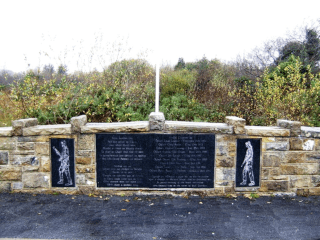
(Pictured: Republican memorial at Carragunt bridge, on the border between Northern Ireland and the Republic, often crossed by Provisional IRA forces during the Troubles to attack British targets inside County Fermanagh)



 seamus dubhghaill