seamus dubhghaill

Promoting Irish Culture and History from Little Rock, Arkansas, USA


Leave a comment

The Clonmult Ambush

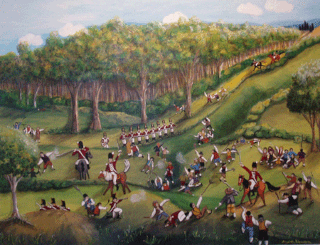
The Clonmult ambush takes place on February 20, 1921, during the Irish War of Independence.

Irish Republican Army (IRA) volunteers occupying a farmhouse in Clonmult, County Cork are surrounded by a force of British Army, Royal Irish Constabulary (RIC) and Auxiliaries. In the action that follows, twelve IRA volunteers are killed, four wounded and four captured. A total of 22 people die in the ambush and subsequent executions – fourteen IRA members, two Black and Tans and six suspected informers.

The 4th battalion of the IRA First Cork Brigade, under Diarmuid O’Hurley and based around Midleton, Youghal and Cobh, had been a successful unit up until the Clonmult ambush. They had captured three RIC barracks and carried out an ambush in Midleton itself. In January 1921, the unit takes possession of a disused farmhouse overlooking the village of Clonmult. O’Hurley plans to ambush a military train at Cobh Junction on Tuesday, February 22, 1921 and at the time of the Clonmult action is scouting a suitable ambush site. However, according to historian Peter Hart, they “had become over-confident and fallen into a traceable routine.” An intelligence officer of the British Army Hampshire Regiment traces them to their billet at a farmhouse in Clonmult.

British troops, a party of the 2nd Battalion, Hampshire Regiment under the command of Lieutenant A. R. Koe, surround the house. Two IRA volunteers notice the advancing troops and open fire. Both are killed, but the shooting warns those sheltering inside the house, and a siege begins. A sortie from the house is attempted in the hope of gaining reinforcements from the local IRA company.

The acting IRA commander, Captain Jack O’Connell, manages to get away but three other volunteers are killed in the attempt. But O’Connell is unable to bring help in time. The Volunteers trapped inside make a desperate but unsuccessful attempt to escape through a narrow opening in the gable. Their hopes are dashed when British reinforcements arrive instead — regular RIC police, Black and Tans and Auxiliaries. The police also bring petrol, which an Army officer uses to set the thatched roof of the farmhouse on fire. With the farmhouse burning around them, an attempt is then made by the IRA to surrender.

What happens next is disputed. In his after-action report, Lieutenant Koe reports that at 6:30 PM six or seven rebels come out of the house with their hands up. As the Crown Forces go to meet them the remaining rebels in the house open fire. Some of the rebels outside the house are killed or wounded by the crossfire that ensues. The Crown Forces rush the house and the eight rebels inside are taken prisoner. By contrast, the surviving Volunteers claim that their men had surrendered in good faith, and had come out with their hands up, only to be shot by the police without any provocation. Opinion is divided amongst historians as to which version of the story to believe.

A total of twelve IRA Volunteers are killed in the action, with four more wounded and only four taken prisoner unscathed. Two of the IRA prisoners, Maurice Moore and Paddy O’Sullivan, are later executed in the Cork military barracks on April 28. Patrick Higgins, an IRA man who survived the killings, is sentenced to death but is reprieved due to the truce that ends the war on July 11. Hampshire Regiment historian Scott Daniell notes on the action that “like all the Irish operations, it was hateful to the British troops.”

The IRA suspects that an informer had led the British to the billet of the column wiped out at Clonmult, and over the following week, six alleged spies are executed by the IRA in the surrounding area. Mick Leahy, a local IRA officer, states that “things went to hell in the battallion” after Clonmult. Diarmuid O’Hurley, the commander of the battalion, is not at Clonmult but is later killed on May 28, 1921.


Leave a comment

Birth of George Fitzmaurice, Playwright & Writer

George Fitzmaurice, Irish dramatist and short story writer, some of whose plays were broadcast on Radio Éireann, is born at Bedford House, Listowel, County Kerry on the January 28, 1877.

Fitzmaurice attends Duagh National School and later St. Michael’s College, Listowel. He is brought up in the Protestant faith as his father is a Protestant clergyman and is the vicar of St. John’s Church, Listowel. His father dies when he is fourteen years old and the family fortune declines. He takes a job in Dublin as a clerk in the Congested Districts Board for Ireland. In 1916 he enlists in the British Army and returns to Dublin after the war and is diagnosed with neurasthenia, rendering him fearful of crowds. On his return to Dublin, he takes up a position working for the Irish Land Commission.

Fitzmaurice and his eleven siblings are the children of a mixed marriage. He and his brothers are brought up as Protestants and his sisters are brought up as Roman Catholics. His family home at Bedford, together with its extensive lands has to be given up as collateral in respect of a £60 debt owed to the local butcher. Neither Fitzmaurice nor any of his eleven siblings are to marry or have any offspring. He is the last Fitzmaurice of Duagh. There are no photographs of him other than a sketch of him in later life.

Fitzmaurice’s first success was in 1907, with an Abbey Theatre production of his comedy The Country Dressmaker which features one of his most famous characters, Luke Quilter, “The man from the mountain.” This character proves to be a favourite with the audience, to the surprise of William Butler Yeats. The play’s commercial success brings necessary income to the Abbey Theatre in 1907. The play is ultimately broadcast by the Radio Éireann Players.

Fitzmaurice’s second play is a dramatic fantasy called The Pie Dish. It is heavily rejected and slated by critics and considered blasphemous. This leads to the rejection of another of his plays called The Dandy Dolls which is now understood as another of his best plays. It is produced in the Abbey Theatre in 1969, six years after his death.

During Fitzmaurice’s lifetime, some of his dramatic works are produced by poet Austin Clarke in Lyric Theatre, Dublin. In 1923 his play Twixt by Giltinans and the Carmodys is also performed on Abbey and eight more of his plays are printed in the literary journey The Dublin Magazine from 1924 to 1925.

The effects of having fought in World War I lead to Fitzmaurice becoming increasingly reclusive over time. With a fear of travelling and people or crowds, he spends his later years following “monotonous routines in Dublin.” On May 12, 1963, he dies in poverty at his home at 3 Harcourt Street and is buried in Mount Jerome Cemetery. In his room there are no pictures of himself, few personal mementos, but he does have a copy of almost every play he had published, as well as some unpublished drafts. Besides his personal clothing, there is little else. He dies without leaving a will.

In 1965, RTÉ reports that “the works of George Fitzmaurice are now undergoing something of a revival.” A fellow Kerry playwright, John B. Keane, states at the time that Fitzmaurice is increasingly being recognised as the great dramatist he truly was. He also describes his work as having “practical clarity of speech coupled with a great conciseness, and a tightness in his writing and in his construction.” Michael Connor, the man who owns the Fitzmaurice property in Daugh, recounts that he often saw Fitzmaurice in the town after his retirement from the civil service but by that time the dramatist had completely lost interest in seeing his own plays on the stage.

In his native Daugh, The George Fitzmaurice Library is founded, and on October 14, 1995, a headstone that is sculpted by a local and commissioned by the Duagh Historical Society, is placed over Fitzmaurice’s grave.


Leave a comment

Death of Lieutenant Colonel Abraham Boulger, Victoria Cross Recipient

Lieutenant Colonel Abraham Boulger VC, Irish recipient of the Victoria Cross, the highest and most prestigious award for gallantry in the face of the enemy that can be awarded to British and Commonwealth forces, dies in Moate, County Westmeath on January 23, 1900.

Boulger is born on September 4, 1835, in Kilcullen, County Kildare. He is 21 years old, and a Lance Corporal in the 84th Regiment of Foot (later 2nd Battalion, York and Lancaster Regiment), British Army during the Indian Rebellion of 1857 when the following deeds take place for which he is awarded the Victoria Cross:

Lance-Corporal Abraham Boulger
Date of Acts of Bravery, from 12th July to 25th September, 1857
For distinguished bravery and forwardness; a skirmisher, in all the twelve action’s fought between 12th July, and 25th September, 1857.
(Extract from Field Force Orders of the late Major-General Henry Havelock, dated October 17, 1857.)

Boulger serves as a quartermaster during the 1882 Anglo-Egyptian War and later achieves the rank of lieutenant colonel. He dies at the age of 64 in Moate, County Westmeath, on January 23, 1900. He is buried in the Ballymore Churchyard, County Westmeath. His Victoria Cross is displayed at the York & Lancaster Regiment Museum at Clifton Park in Rotherham, South Yorkshire, England.


Leave a comment

Assassination of Norman and James Stronge

Sir Charles Norman Lockhart Stronge and his son James, both former Ulster Unionist Party (UUP) Members of Parliament, are assassinated by the Provisional Irish Republican Army (IRA) at their home, Tynan Abbey, on January 21, 1981. The home is then burned to the ground.

Before his involvement in politics Stronge fights in World War I as a junior officer in the British Army. He fights in the Battle of the Somme in 1916 and is awarded the Military Cross. His positions after the war include Speaker of the House of Commons of Northern Ireland for twenty-three years.

Stronge (86) and his son, James (48), are watching television in the library of Tynan Abbey when members of the Provisional Irish Republican Army, armed with machine guns, use grenades to break down the locked heavy doors to the home.

The Stronge family home is then burned to the ground as a result of two bomb explosions. On seeing the explosions at the house, as well as a flare Stronge lit in an attempt to alert the authorities, the Royal Ulster Constabulary and British Army troops arrive at the scene and establish a roadblock at the gate lodge. They encounter at least eight fleeing gunmen. A twenty-minute gunfight ensues in which at least two hundred shots are fired. There are no casualties among the security forces but the gunmen escape. The bodies of the father and son are later discovered in the library of their burning home, each with gunshot wounds in the head. It is not known who died first, Norman or James. Under the legal fiction known as the doctrine of survival, James is still listed as succeeding to the baronetcy.

The village of Tynan is crowded for the joint funeral of Stronge and his son. Mourners come from throughout the province and from England, including lords, politicians, policemen, judges and church leaders. The coffin is carried by the 5th Battalion the Royal Irish Rangers, the successors to his old regiment. The sword and cap of the Lord Lieutenant of Tyrone, Major John Hamilton-Stubber, are placed on his coffin in lieu of his own, which had been destroyed with his other possessions in the fire. During the service, a telegram sent from Queen Elizabeth II to one of Sir Norman’s daughters, is read. After the service, the chief mourners move out into the churchyard where the “Last Post” is sounded, and a Royal British Legion farewell is given. The two coffins are laid in the family plot, where Lady Stronge, Sir Norman’s wife and mother of James, was buried a year previously.

The Secretary of State for Northern Ireland, Humphrey Atkins, is informed by friends of the Stronge family that he would not be welcome at the funeral because of government policy on Irish border security. Atkins leaves the Northern Ireland Office later that year, to be replaced by Jim Prior. Stronge is commemorated with a tablet in the Northern Ireland Assembly Chamber in Parliament Buildings on the Stormont Estate.

The IRA releases a statement in Belfast, quoted in The Times, claiming that “This deliberate attack on the symbols of hated unionism was a direct reprisal for a whole series of loyalist assassinations and murder attacks on nationalist peoples and nationalist activities.” This follows the loyalist attempted murder of Bernadette McAliskey and her husband Michael McAliskey on January 16, and the loyalist assassinations of four republican activists (Miriam Daly, John Turnley, Noel Lyttle and Ronnie Bunting) which had taken place since May 1980.

The killings are referred to as murder by multiple media sources including The Daily Telegraph, The Scotsman, The New York Times and Time magazine, by the Reverend Ian Paisley in the House of Commons and by Alec Cooke, Baron Cooke of Islandreagh in the House of Lords.

Stronge is described at the time of his death by Social Democratic and Labour Party politician Austin Currie as having been “even at 86 years of age … still incomparably more of a man than the cowardly dregs of humanity who ended his life in this barbaric way.”

The ruins of Tynan Abbey are demolished in 1998, having stood for 249 years.


Leave a comment

Birth of Iris Kellett, Show Jumper & Equestrian

Iris Kellett, international show jumper and equestrian, is born in Dublin on January 8, 1926.

Kellett is the only child of Harry and Dora Kellet. She is raised at Mespil Road, Dublin, where her father runs a riding school on the site of a former British Army cavalry stables, which he had purchased in 1924. Harry Kellett works as veterinary surgeon in the British Army, and passes his skills and ethos on the proper care of horses on to his daughter.

Kellett attends St. Margaret’s School, Mespil Road, and comes home each day to teach and help out at the stables. The Mespil Road stables are of such importance to her that she refuses an offer to study veterinary science at Trinity College, Dublin in order to fully commit herself to the school.

Kellett’s first appearance in equestrian competition is at the age of nine, when she wins ‘Best Girl Rider’ at the 1935 Dublin Horse Show and from then on she becomes a regular fixture in competition. She and her great horse Rusty compete as members of the first Irish all civilian Nations Cup team in 1947, and win the Princess Elizabeth Cup for the European Ladies Championship, at White City in 1949 and 1951. She proves the equal of top male riders, and is a fitting ambassador for the growing involvement of women in competitive show jumping.

A fall from a horse in 1952, resulting in a shattered ankle complicated by a bout of tetanus, puts a halt to Kellett’s show jumping career. It is almost ten years before she is back on top form, competing again for the Irish team in the Nations Cup during the 1960s and winning the European Ladies Championship, on Morning Light, at the Dublin Horse Show in 1969.

In 1969 Kellett retires from international competition to devote herself to teaching, training and breeding horses. In 1972 she sells the riding school on Mespil Road and moves to Kill in County Kildare. Here she goes on to train some of the greatest names in Irish show-jumping including Eddie Macken, Paul Darragh and Jack Doyle.

Kellett dies on March 11, 2011, leaving behind countless friends and a legacy as a competitor, teacher, and breeder that is unparalleled.

(From: “Iris Kellett Show Jumping Legend & Exhibition, Irish Horse Gateway (www.irishhorsegateway.ie), June 17, 2013, courtesy of RDS Archives)


Leave a comment

Ballinalee Raid in Search of Seán Mac Eoin

The Royal Irish Constabulary (RIC) raid a cottage near Ballinalee, County Longford, on January 7, 1921, looking for Seán Mac Eoin. Mac Eoin opens fire from the cottage, killing District Inspector Thomas McGrath, wounding a constable, and escaping.

Mac Eoin is a soldier and eventual politician of the Fine Gael party. He is commonly referred to as the “Blacksmith of Ballinalee.” He is born John Joseph McKeon on September 30, 1893, at Bunlahy, Granard, County Longford, the eldest son of Andrew McKeon and Catherine Treacy. He joins the United Irish League in 1908. His Irish nationalist activities begin in earnest in 1913, when he joins the Clonbroney Company of the Irish Volunteers. Late that year he is sworn into the Irish Republican Brotherhood and joins the Granard circle of the organization.

Mac Eoin comes to prominence in the Irish War of Independence as leader of an Irish Republican Army (IRA) flying column. On November 4, 1920, his column holds the village of Ballinalee situated on the Longford Road between Longford and Granard. They stand against superior British forces, forcing them to retreat and abandon their ammunition. In a separate attack on November 8, he leads his men against the RIC at Ballinalee. An eighteen-year-old Constable Taylor is killed. Constable E. Shateford and two others are wounded. The story is that the small garrison sings “God Save the King” as they take up positions to return fire.

On the afternoon of January 7, 1921, a joint RIC and British Army patrol consisting of ten policemen led by an Inspector, with a security detachment of nine soldiers, appears on Anne Martin’s street. Mac Eoin’s own testimony at his trial, which is not contested by any parties present, states, “I was at the table writing when I was informed of the advance of the party. My account books were left in this house for safety. I was in partial uniform, wearing Sam Browne belt and revolver with two Mills No. 4 bombs in my pocket. Owing to some females being in the house, I had to get out as I could not endanger them by putting up a defence in the house, and as this Officer and Police Force had already signified to my sister and mother their intention to shoot me on sight, I decided to give them a run for their money. I stepped out on the street, about three paces directly in front of the oncoming force and opened fire with my revolver. The leading file fell, and then the second file in the gateway brought their rifles to the ready. I then threw a bomb and jumped back behind the porch to let it burst. When it had burst and the smoke had lifted, I saw that the whole force had cleared away, save the officer who was dead or dying on the street.” The casualties from this incident are District Inspector Thomas McGrath killed, and a police constable wounded.

Mac Eoin is captured at Mullingar railway station in March 1921, imprisoned and sentenced to death for the murder of RIC District Inspector McGrath in the shooting at Anne Martin’s street in January 1921. Michael Collins organises a rescue attempt in June 1921. Six IRA Volunteers, led by Paddy Daly and Emmet Dalton, capture a British armoured car and, wearing British Army uniforms, gain access to Mountjoy Prison. However, Mac Eoin is not in the part of the jail they believed and, after some shooting, the party retreats.

Within days, Mac Eoin is elected to Dáil Éireann at the 1921 Irish elections, as a TD for Longford–Westmeath. He is eventually released from prison, along with all other members of the Dáil, after Collins threatens to break off treaty negotiations with the British government unless he is freed. It is rumoured that Sean Mac Eoin serves as the best man at Collins’ wedding.


Leave a comment

The Droppin’ Well Bombing

The Droppin’ Well bombing or Ballykelly bombing occurs on December 6, 1982, when the Irish National Liberation Army (INLA) explodes a time bomb at a disco in Ballykelly, County Londonderry, Northern Ireland. The disco, known as the Droppin’ Well, is targeted because it is frequented by British Army soldiers from nearby Shackleton Barracks. The bomb kills eleven soldiers and six civilians and 30 people are injured, making it the most deadly attack during the INLA’s paramilitary campaign and the most deadly attack during The Troubles carried out in County Londonderry.

The bomb is manufactured by the INLA in nearby Derry. One of those involved later reveals that the INLA unit had carried out reconnaissance missions to the Droppin’ Well to see if there were enough soldiers to justify the likelihood of civilian casualties.

On the evening of December 6, 1982, an INLA member leaves a bomb inside the pub. There are about 150 people inside. The Royal Ulster Constabulary (RUC) believe that the bomb, estimated to be 5 to 10 pounds of commercial (Frangex) explosives, is small enough to fit into a handbag. It has, however, been left beside a support pillar and, when it explodes at about 11:15 PM, the blast brings down the roof. Many of those killed and injured are crushed by fallen masonry.

Following the blast, it takes a few hours to pull survivors from the rubble. The last survivor is freed at 4:00 AM, but it is not until 10:30 AM that the last of the bodies is recovered. Ultimately, 17 people die and 30 are injured, some seriously. Five of the civilians are young women and three (Alan Callaghan, Valerie McIntyre and Angela Maria Hoole) are teenagers. Angela Hoole is celebrating her engagement to one of the soldiers who survives the incident. Of the eleven soldiers who die, eight are from the 1st Battalion Cheshire Regiment, two from the Army Catering Corps and one from The Light Infantry. One of those on the scene is Bob Stewart, then a company commander in the Cheshire Regiment. He loses six soldiers from his company and is deeply affected as he tends to the dead and injured.

Suspicion immediately falls upon the Provisional Irish Republican Army (IRA), who denies involvement. By December 8, the British Army is blaming the INLA on grounds that the IRA, in a mixed village, would have made greater efforts not to risk killing civilians. Shortly afterwards, the INLA issues a statement of responsibility.

The INLA describes the civilians killed as “consorts.” The attack is criticised by many on both sides of the conflict in Northern Ireland due to the high loss of civilian lives. Soon after the INLA had issued its statement, the government of the Republic of Ireland bans the INLA, making membership punishable by seven years imprisonment.

In an interview after the bombing, INLA leader Dominic McGlinchey says that the Droppin’ Well’s owner had been warned six times to stop offering entertainment to British soldiers. He adds that the owner, and those who socialise with the soldiers, “knew full well that the warnings had been given and that the place was going to be bombed at some stage.” It later emerges that the INLA may also have targeted Ballykelly because it believed that the military base was part of NATO‘s radar and communications network.

Six days after the bombing, RUC officers shoot dead INLA members Seamus Grew and Roddie Carroll near a vehicle checkpoint in Armagh. The officers say they believed that the two men were ferrying McGlinchey into Northern Ireland. Neither was armed, nor was McGlinchey in their car.

In June 1986, four INLA members, sisters Anna Moore and Helena Semple, Eamon Moore (no blood relation) and Patrick Shotter, receive life sentences for the attack. Anna Moore later marries loyalist Bobby Corry while both are in prison. Anna’s daughter, Jacqueline Moore, is given ten years for manslaughter as the court believes she had been coerced into involvement. She is pregnant during her arrest and later gives birth in jail. All of those convicted are from Derry.

(Pictured: The Droppin’ Well bar and disco in Ballykelly destroyed by a Irish National Liberation Army bomb in 1982. Credit: PA Wire)


Leave a comment

Bloody Sunday (1920)

More than 30 people are killed or fatally wounded in a day of violence in Dublin on November 21, 1920, during the Irish War of Independence. It goes down in Irish history as the first “Bloody Sunday,” though unfortunately not the last.

Through the centuries the British have crushed Irish revolutionary movements through the use of spies and informers. Michael Collins, Minister for Finance of the Irish Republic, head of the secretive Irish Republican Brotherhood and Irish Republican Army (IRA) Chief of Intelligence, is in the process of beating the British at their own game. The day begins in the early morning hours with an IRA operation, organised by Collins, to assassinate members of the “Cairo Gang” – a team of undercover British intelligence agents working and living in Dublin. IRA members go to a number of addresses and kill or fatally wounded 16 men, mostly British Army intelligence officers. Five other men are wounded.

When word of the success of the operation gets back to Collins, knowing the caliber of the men in England‘s infamous “Black and Tan” force, he sends a message to the Gaelic Athletic Association, telling them to cancel that day’s Gaelic football match between Dublin and Tipperary. However, it is too late, and the match goes on.

Later that afternoon, lashing out blindly, the Black and Tans surround Croke Park during the match and move in. Their supposed purpose is to attempt to capture members of Sinn Féin who might be in the crowd, but they soon open fire indiscriminately on the players and spectators. They kill or fatally wound fourteen civilians and wound at least sixty others before members of the Auxiliary Division, another brutal force created to crush the Irish insurrection, finally manages to get them to cease-fire.

That evening, two Irish republicans and members of Collins’ squad, Dick McKee and Peadar Clancy, who had helped plan the earlier assassinations, along with a third man, a civilian named Conor Clune, who happened to be caught with the others, are beaten and shot dead in Dublin Castle by their captors, who claim they were killed during an escape attempt.

Overall, Bloody Sunday is considered a victory for the IRA, as Collins’s operation severely damages British intelligence, while the later reprisals do no real harm to the guerrillas but increase support for the IRA at home and abroad.

(Pictured: The headline of the Dublin Evening Herald reads ‘Latest Stories about Irish Tragedies’, 22nd November 1920. The newspaper reports on the massacre at a Croke Park football match, shootings in Dublin, and the discovery of a priest’s corpse in a Galway bog. Photo by Hulton Archive/Getty Images)


Leave a comment

Remembrance Sunday Ceremonies 2016

Taoiseach Enda Kenny and Tánaiste Frances Fitzgerald attend Remembrance Sunday ceremonies in Northern Ireland on November 13, 2016, while a cross commemorating Irish soldiers in World War I is dedicated at Dublin‘s Glasnevin Cemetery.

Kenny, who has taken part in the ceremony every year since 2012, lays a wreath of green laurels alongside the many red poppies at the war memorial in Enniskillen, County Fermanagh. Northern Ireland’s First Minister Arlene Foster, a Member of the Legislative Assembly (MLA) for Fermanagh and South Tyrone, also attends the event.

Although there are no discussions between the pair, Kenny confirms he will meet with Foster in Dublin on Tuesday, November 15. The pair are also due to meet in Armagh on Friday, November 18 for a North/South ministerial meeting, where Brexit-related issues are expected to dominate the agenda.

Tánaiste Frances Fitzgerald travels to Belfast, where she lays a laurel wreath at the Cenotaph at city hall. Fitzgerald is joined at the ceremony by Secretary of State for Northern Ireland James Brokenshire.

Speaking afterwards, Fitzgerald, whose grandfather served as a soldier in the British army and whose father was a colonel in the Irish Army, says it has been an important engagement. “So many people across the island lost their lives; 50,000 families affected by loss of a loved one during the First World War. We have had a government minister here since 2012 and I think it is really important to come together, to remember together and to look at our shared histories.”

In England, British Prime Minister Theresa May is among those who gather at the Cenotaph in London for a commemoration ceremony.

Meanwhile, Heather Humphreys, the Minister for Arts, Heritage, Regional, Rural and Gaeltacht Affairs, dedicates the France-Ireland Memorial at Glasnevin Cemetery. Humphreys is joined by the French Minister of State for Veterans and Remembrance at the Ministry of Defence Jean-Marc Todeschini for the ceremony. The memorial is a gift to Ireland from France in recognition of Irish sacrifices made “in the defence and freedom of France, particularly in the First World War.”

(From: “Taoiseach, Tánaiste attend Remembrance Sunday ceremonies,” Raidió Teilifís Éireann (RTÉ), http://www.rte.ie, November 13, 2016 | Pictured: Taoiseach Enda Kenny lays a wreath of green laurels in Enniskillen)


Leave a comment

The Piltown Cross Ambush

Irish Republican Army (IRA) fighters from West Waterford, under Column O/C George Lennon, ambush a British army patrol at Piltown (Kinsalebeg), County Waterford, on November 1, 1920 during the Irish War of Independence. Two soldiers are killed, six wounded, and thirty captured although those captured are later released. Royal Irish Constabulary (RIC) Constable Maurice Prendiville promises to leave the RIC but is fatally shot the following month at the Youghal Bridge.

Involved is the IRA West Waterford Brigade, specifically the newly formed Deise Flying Column under O/C Lennon of Dungarvan, as well as Volunteers from the local Ardmore battalion. Returned Great War veteran John Riordan plans the successful engagement involving a feint attack on the RIC barracks in Ardmore.

The British garrison in Youghal subsequently dispatches nearly twenty troops in a single lorry. They are ambushed at Kinsalebeg and suffer two dead and six wounded. The ambush results in the capture of several rifles and a large quantity of ammunition which are used to equip the flying column. Captured are RIC constables O’Neill and Prendiville who give their word that they will resign. Prendiville is subsequently killed from a shot from the Waterford side of the Youghal Bridge.

(Pictured: Piltown Cross Ambush Memorial unveiled in 2008)