seamus dubhghaill

Promoting Irish Culture and History from Little Rock, Arkansas, USA


Leave a comment

The Droppin’ Well Bombing

The Droppin’ Well bombing or Ballykelly bombing occurs on December 6, 1982, when the Irish National Liberation Army (INLA) explodes a time bomb at a disco in Ballykelly, County Londonderry, Northern Ireland. The disco, known as the Droppin’ Well, is targeted because it is frequented by British Army soldiers from nearby Shackleton Barracks. The bomb kills eleven soldiers and six civilians and 30 people are injured, making it the most deadly attack during the INLA’s paramilitary campaign and the most deadly attack during The Troubles carried out in County Londonderry.

The bomb is manufactured by the INLA in nearby Derry. One of those involved later reveals that the INLA unit had carried out reconnaissance missions to the Droppin’ Well to see if there were enough soldiers to justify the likelihood of civilian casualties.

On the evening of December 6, 1982, an INLA member leaves a bomb inside the pub. There are about 150 people inside. The Royal Ulster Constabulary (RUC) believe that the bomb, estimated to be 5 to 10 pounds of commercial (Frangex) explosives, is small enough to fit into a handbag. It has, however, been left beside a support pillar and, when it explodes at about 11:15 PM, the blast brings down the roof. Many of those killed and injured are crushed by fallen masonry.

Following the blast, it takes a few hours to pull survivors from the rubble. The last survivor is freed at 4:00 AM, but it is not until 10:30 AM that the last of the bodies is recovered. Ultimately, 17 people die and 30 are injured, some seriously. Five of the civilians are young women and three (Alan Callaghan, Valerie McIntyre and Angela Maria Hoole) are teenagers. Angela Hoole is celebrating her engagement to one of the soldiers who survives the incident. Of the eleven soldiers who die, eight are from the 1st Battalion Cheshire Regiment, two from the Army Catering Corps and one from The Light Infantry. One of those on the scene is Bob Stewart, then a company commander in the Cheshire Regiment. He loses six soldiers from his company and is deeply affected as he tends to the dead and injured.

Suspicion immediately falls upon the Provisional Irish Republican Army (IRA), who denies involvement. By December 8, the British Army is blaming the INLA on grounds that the IRA, in a mixed village, would have made greater efforts not to risk killing civilians. Shortly afterwards, the INLA issues a statement of responsibility.

The INLA describes the civilians killed as “consorts.” The attack is criticised by many on both sides of the conflict in Northern Ireland due to the high loss of civilian lives. Soon after the INLA had issued its statement, the government of the Republic of Ireland bans the INLA, making membership punishable by seven years imprisonment.

In an interview after the bombing, INLA leader Dominic McGlinchey says that the Droppin’ Well’s owner had been warned six times to stop offering entertainment to British soldiers. He adds that the owner, and those who socialise with the soldiers, “knew full well that the warnings had been given and that the place was going to be bombed at some stage.” It later emerges that the INLA may also have targeted Ballykelly because it believed that the military base was part of NATO‘s radar and communications network.

Six days after the bombing, RUC officers shoot dead INLA members Seamus Grew and Roddie Carroll near a vehicle checkpoint in Armagh. The officers say they believed that the two men were ferrying McGlinchey into Northern Ireland. Neither was armed, nor was McGlinchey in their car.

In June 1986, four INLA members, sisters Anna Moore and Helena Semple, Eamon Moore (no blood relation) and Patrick Shotter, receive life sentences for the attack. Anna Moore later marries loyalist Bobby Corry while both are in prison. Anna’s daughter, Jacqueline Moore, is given ten years for manslaughter as the court believes she had been coerced into involvement. She is pregnant during her arrest and later gives birth in jail. All of those convicted are from Derry.

(Pictured: The Droppin’ Well bar and disco in Ballykelly destroyed by a Irish National Liberation Army bomb in 1982. Credit: PA Wire)


Leave a comment

Bloody Sunday (1920)

More than 30 people are killed or fatally wounded in a day of violence in Dublin on November 21, 1920, during the Irish War of Independence. It goes down in Irish history as the first “Bloody Sunday,” though unfortunately not the last.

Through the centuries the British have crushed Irish revolutionary movements through the use of spies and informers. Michael Collins, Minister for Finance of the Irish Republic, head of the secretive Irish Republican Brotherhood and Irish Republican Army (IRA) Chief of Intelligence, is in the process of beating the British at their own game. The day begins in the early morning hours with an IRA operation, organised by Collins, to assassinate members of the “Cairo Gang” – a team of undercover British intelligence agents working and living in Dublin. IRA members go to a number of addresses and kill or fatally wounded 16 men, mostly British Army intelligence officers. Five other men are wounded.

When word of the success of the operation gets back to Collins, knowing the caliber of the men in England‘s infamous “Black and Tan” force, he sends a message to the Gaelic Athletic Association, telling them to cancel that day’s Gaelic football match between Dublin and Tipperary. However, it is too late, and the match goes on.

Later that afternoon, lashing out blindly, the Black and Tans surround Croke Park during the match and move in. Their supposed purpose is to attempt to capture members of Sinn Féin who might be in the crowd, but they soon open fire indiscriminately on the players and spectators. They kill or fatally wound fourteen civilians and wound at least sixty others before members of the Auxiliary Division, another brutal force created to crush the Irish insurrection, finally manages to get them to cease-fire.

That evening, two Irish republicans and members of Collins’ squad, Dick McKee and Peadar Clancy, who had helped plan the earlier assassinations, along with a third man, a civilian named Conor Clune, who happened to be caught with the others, are beaten and shot dead in Dublin Castle by their captors, who claim they were killed during an escape attempt.

Overall, Bloody Sunday is considered a victory for the IRA, as Collins’s operation severely damages British intelligence, while the later reprisals do no real harm to the guerrillas but increase support for the IRA at home and abroad.

(Pictured: The headline of the Dublin Evening Herald reads ‘Latest Stories about Irish Tragedies’, 22nd November 1920. The newspaper reports on the massacre at a Croke Park football match, shootings in Dublin, and the discovery of a priest’s corpse in a Galway bog. Photo by Hulton Archive/Getty Images)


Leave a comment

Remembrance Sunday Ceremonies 2016

Taoiseach Enda Kenny and Tánaiste Frances Fitzgerald attend Remembrance Sunday ceremonies in Northern Ireland on November 13, 2016, while a cross commemorating Irish soldiers in World War I is dedicated at Dublin‘s Glasnevin Cemetery.

Kenny, who has taken part in the ceremony every year since 2012, lays a wreath of green laurels alongside the many red poppies at the war memorial in Enniskillen, County Fermanagh. Northern Ireland’s First Minister Arlene Foster, a Member of the Legislative Assembly (MLA) for Fermanagh and South Tyrone, also attends the event.

Although there are no discussions between the pair, Kenny confirms he will meet with Foster in Dublin on Tuesday, November 15. The pair are also due to meet in Armagh on Friday, November 18 for a North/South ministerial meeting, where Brexit-related issues are expected to dominate the agenda.

Tánaiste Frances Fitzgerald travels to Belfast, where she lays a laurel wreath at the Cenotaph at city hall. Fitzgerald is joined at the ceremony by Secretary of State for Northern Ireland James Brokenshire.

Speaking afterwards, Fitzgerald, whose grandfather served as a soldier in the British army and whose father was a colonel in the Irish Army, says it has been an important engagement. “So many people across the island lost their lives; 50,000 families affected by loss of a loved one during the First World War. We have had a government minister here since 2012 and I think it is really important to come together, to remember together and to look at our shared histories.”

In England, British Prime Minister Theresa May is among those who gather at the Cenotaph in London for a commemoration ceremony.

Meanwhile, Heather Humphreys, the Minister for Arts, Heritage, Regional, Rural and Gaeltacht Affairs, dedicates the France-Ireland Memorial at Glasnevin Cemetery. Humphreys is joined by the French Minister of State for Veterans and Remembrance at the Ministry of Defence Jean-Marc Todeschini for the ceremony. The memorial is a gift to Ireland from France in recognition of Irish sacrifices made “in the defence and freedom of France, particularly in the First World War.”

(From: “Taoiseach, Tánaiste attend Remembrance Sunday ceremonies,” Raidió Teilifís Éireann (RTÉ), http://www.rte.ie, November 13, 2016 | Pictured: Taoiseach Enda Kenny lays a wreath of green laurels in Enniskillen)


Leave a comment

The Piltown Cross Ambush

Irish Republican Army (IRA) fighters from West Waterford, under Column O/C George Lennon, ambush a British army patrol at Piltown (Kinsalebeg), County Waterford, on November 1, 1920 during the Irish War of Independence. Two soldiers are killed, six wounded, and thirty captured although those captured are later released. Royal Irish Constabulary (RIC) Constable Maurice Prendiville promises to leave the RIC but is fatally shot the following month at the Youghal Bridge.

Involved is the IRA West Waterford Brigade, specifically the newly formed Deise Flying Column under O/C Lennon of Dungarvan, as well as Volunteers from the local Ardmore battalion. Returned Great War veteran John Riordan plans the successful engagement involving a feint attack on the RIC barracks in Ardmore.

The British garrison in Youghal subsequently dispatches nearly twenty troops in a single lorry. They are ambushed at Kinsalebeg and suffer two dead and six wounded. The ambush results in the capture of several rifles and a large quantity of ammunition which are used to equip the flying column. Captured are RIC constables O’Neill and Prendiville who give their word that they will resign. Prendiville is subsequently killed from a shot from the Waterford side of the Youghal Bridge.

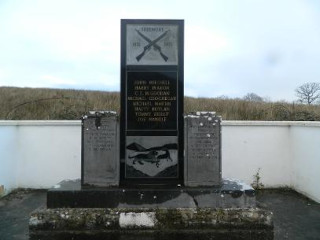
(Pictured: Piltown Cross Ambush Memorial unveiled in 2008)


Leave a comment

Birth of Morgan O’Connell, Soldier & Politician

Morgan O’Connell, soldier, politician and son of the Irish Nationalist leader Daniel O’Connell, the Liberator of Ireland, is born in Dublin on October 31, 1804. He serves in the Irish South American legion and the Imperial Austrian Army. He is MP for Meath from 1832 until 1840 and afterwards assistant registrar of deeds for Ireland from 1840 until 1868.

O’Connell, one of seven children (and the second of four sons) of Daniel and Mary O’Connell, is born at 30 Merrion Square, Dublin. His brothers Maurice, John and Daniel are also MPs.

In 1819, self-styled General John Devereux comes to Dublin to enlist military aid for Simón Bolívar‘s army to liberate Venezuela from Spanish rule. He succeeds in forming an Irish Legion, to be part of Bolivar’s British Legions. O’Connell, encouraged by his father, is one of the officers who purchases a commission in it even though he is only 15 years old. The enterprise is mismanaged; there is no commissariat organisation on board the ships, and a part of the force die on the voyage. The remainder are disembarked on the Spanish Main at Margarita Island, where many deaths take place from starvation eight days after the Irish mutineers leave for Jamaica.

Bolivar, who had noted his pleasure at the departure of “these vile mercenaries,” is too astute a diplomat to offend the son of his Irish counterpart. O’Connell is accorded the appropriate privileges of his rank, and toasts are drunk to the health of his father, the “most enlightened man in all Europe.” A portion of the expedition, under Francis O’ Connor, effects an alliance with Bolivar, and to the energy of these allies the republican successes are chiefly due.

Bolivar makes sure that the untrained Irish lad stays out of danger. “I have numberless hardships to go through,” said Bolivar, “which I would not bring him into, for the character of his father is well known to me.” But ceremonial duties soon bore the restless young Irishman. After a year at Bolivar’s headquarters Morgan leaves for Ireland.

If South America did not satisfy O’Connell’s taste for adventure, he has more than his fill on the return journey. He survives a bout of tropical fever and is shipwrecked twice in succession, ending up stranded in Cuba. A schooner captain, who turns out to be a long-lost Irish cousin, rescues him. After the captain is killed in a fight with his boatswain, he hitches a ride to Jamaica on a Danish ship commanded by a skipper from Cork. From Jamaica, another Irish officer offers Morgan passage home.

Arriving in January 1822, O’Connell is greeted by his proud father as a prodigal son returned. His South American adventure, declares Daniel O’Connell, has made a man of Morgan. Otherwise, said O’Connell, “it would have been difficult to tame him down to the sobriety of business.” After his return to Ireland, he again seeks foreign service in the Austrian army.

On December 19, 1832, O’Connell enters parliament in the Liberal interest, as one of the members for Meath, and continues to represent that constituency until January 1840, when he is appointed first assistant-registrar of deeds for Ireland, at a salary of £1,200 a year, a position he holds until 1868. In politics he is never in perfect accord with his father, and his retirement from parliament is probably caused by his inability to accept the Repeal movement.

During his parliamentary career O’Connell fights a duel with Lord William Arden, 2nd Baron Alvanley, a captain in the British Army, at Chalk Farm, on May 4, 1835. A challenge had been sent by Alvanley to O’Connell’s father, who, in accordance with a vow he had made after shooting John D’Esterre, declines the meeting. The younger O’Connell thereupon takes up the challenge on his father’s account. Two shots each are exchanged, but no one is hurt. Afterwards, in December 1835, he receives a challenge from Benjamin Disraeli, in consequence of an attack made on Disraeli by O’Connell’s father. He declines to meet Disraeli.

On July 23, 1840, O’Connell marries Kate Mary, youngest daughter of Michael Balfe of South Park, County Roscommon.

Morgan O’Connell dies at 12 St. Stephen’s Green, Dublin, on January 20, 1885. He is buried in Glasnevin Cemetery in Dublin on January 23.

(Pictured: Morgan O’Connell, oil on canvas, artist unknown, c. 1819/20)


Leave a comment

Assassination of Irish Republican Ronnie Bunting

Ronnie Bunting, a Protestant Irish republican and socialist activist, is assassinated on October 15, 1980, when several gunmen enter his home in the Downfine Gardens area of Andersonstown.

Bunting is born into an Ulster Protestant family in East Belfast. His father, Ronald Bunting, had been a major in the British Army and Ronnie grew up in various military barracks around the world. His father became a supporter and associate of Ian Paisley and ran for election under the Protestant Unionist Party banner.

Having completed his education and graduating from Queen’s University Belfast, Bunting briefly becomes a history teacher in Belfast, but later becomes involved in the Northern Ireland Civil Rights Association and then with Irish republican organisations.

Unlike most Protestants in Northern Ireland, Bunting becomes a militant republican. His father, by contrast, was a committed Ulster loyalist. Despite their political differences, they remain close.

Bunting joins the Official Irish Republican Army (OIRA) around 1970 as he is attracted to their left-wing and secular interpretation of Irish republicanism and believes in the necessity of armed revolution. The other wing of the IRA, the Provisional Irish Republican Army, is seen to be more Catholic and nationalist in its outlook. At this time, the communal conflict known as the Troubles is beginning and the Official IRA is involved in shootings and bombings. He is interned in November 1971 and held in Long Kesh until the following April.

In 1974, Bunting follows Seamus Costello and other militants who disagree with the Official IRA’s ceasefire of 1972, into a new grouping, the Irish National Liberation Army (INLA). Immediately, a violent feud breaks out between the Official IRA and the INLA.

In 1975, Bunting survives an assassination attempt when he is shot in a Belfast street. In 1977, Costello is killed by an Official IRA gunman in Dublin. Bunting and his family hide in Wales until 1978, when he returns to Belfast. For the remaining two years of his life, he is the military leader of the INLA. The grouping regularly attacks the British Army and Royal Ulster Constabulary (RUC) in Belfast. He calls in claims of responsibility to the media by the code name “Captain Green.”

At about 4:30 AM on October 15, 1980, several gunmen wearing balaclavas storm Bunting’s home in the Downfine Gardens area of Andersonstown. They shoot Bunting, his wife Suzanne and another Protestant INLA man and ex-member of the Red Republican Party, Noel Lyttle, who has been staying there after his recent release from detention.

Both Bunting and Lyttle are killed. Suzanne Bunting, who is shot in the face, survives her serious injuries. The attack is claimed by the Ulster Defence Association (UDA), but the INLA claims the Special Air Service are involved.

Upon his death, Bunting’s body is kept in a funeral parlour on the Newtownards Road opposite the headquarters of the UDA. On the day of the funeral, as the coffin is being removed, UDA members jeer from their building. The Irish Republican Socialist Party wants a republican paramilitary-style funeral for Bunting but his father refuses and has his son buried in the family plot of a Church of Ireland cemetery near Donaghadee.


Leave a comment

Sinking of the RMS Leinster

RMS Leinster, a ship operated by the City of Dublin Steam Packet Company and serving as the KingstownHolyhead mailboat, is torpedoed and sunk by the Imperial German Navy submarine SM UB-123, which is under the command of Oberleutnant zur See Robert Ramm, just outside Dublin Bay on October 10, 1918, while bound for Holyhead. The exact number of dead is unknown but researchers from the National Maritime Museum of Ireland believe it to be at least 564, making it the largest single loss of life in the Irish Sea.

In 1895, the City of Dublin Steam Packet Company orders four steamers for Royal Mail service, named for four provinces of Ireland: RMS Leinster, RMS Connaught, RMS Munster, and RMS Ulster. The RMS Leinster is a 3,069-ton packet steamship with a service speed of 23 knots. The vessel, which is built at Cammell Laird‘s in Birkenhead, England, is driven by two independent four-cylinder triple-expansion steam engines. During World War I, the twin-propellered ship is armed with one 12-pounder and two signal guns.

The ship’s log states that she carries 77 crew and 694 passengers on her final voyage under the command of Captain William Birch. The ship had previously been attacked in the Irish Sea but the torpedoes missed their target. Those on board include more than 100 British civilians, 22 postal sorters and almost 500 military personnel from the Royal Navy, British Army and Royal Air Force. Also aboard are nurses from the UK, Ireland, Australia, New Zealand, Canada and the United States.

Just before 10:00 AM as it is sailing east of the Kish Bank in a heavy swell, passengers see a torpedo approach from the port side and pass in front of the bow. A second torpedo follows shortly afterwards, and strikes the ship forward on the port side in the vicinity of the mail room. Captain Birch orders the ship to make a U-turn in an attempt to return to Kingstown as it begins to settle slowly by the bow. It sinks rapidly, however, after a third torpedo strikes her, causing a huge explosion.

Despite the heavy seas, the crew manages to launch several lifeboats and some passengers cling to life-rafts. The survivors are rescued by HMS Lively, HMS Mallard and HMS Seal. Among the civilian passengers lost in the sinking are socially prominent people such as Lady Alexandra Phyllis Hamilton, daughter of James Hamilton, 2nd Duke of Abercorn, Robert Jocelyn Alexander, son of Irish composer Cecil Frances Alexander, Thomas Foley and his wife Charlotte Foley (née Barrett) who was the brother-in-law of the world-famous Irish tenor John McCormack. The first member of the Women’s Royal Naval Service to die on active duty, Josephine Carr, is among the dead, as are two prominent officials of the Irish Transport and General Workers’ Union, James McCarron and Patrick Lynch.

Captain Birch who is wounded in the initial attack, drowns when his lifeboat is swamped in heavy seas and capsizes while attempting to transfer survivors to HMS Lively. Several of the military personnel who die are buried in Grangegorman Military Cemetery.

Survivors are brought to Kingstown harbour. Among them are Michael Joyce, an Irish Parliamentary Party MP for Limerick City, and Captain Hutchinson Ingham Cone of the United States Navy, the former commander of the USS Dale (DD-4).

One of the rescue ships is the armed yacht and former fishery protection vessel HMY Helga. Stationed in Kingstown harbour at the time of the sinking, she had shelled Dublin during the 1916 Easter Rising in Dublin two years earlier. She was later bought and renamed the Muirchú by the Irish Free State government as one of its first fishery protection vessels.

At October 18, 1918 at 9:10 AM SM UB-125, outbound from Germany, picks up a radio message requesting advice on the best way to get through the North Sea minefield. The sender is Oberleutnant zur See Robert Ramm aboard SM UB-123. Extra mines have been added to the minefield since SM UB-123 had made her outward voyage from Germany. As SM UB-125 had just come through the minefield, Vater radios back with a suggested route. SM UB-123 acknowledges the message and is never heard from again.

The following day, ten days after the sinking of the RMS Leinster, SM UB-123 accidentally detonates a mine while trying to cross the North Sea and return to base in Imperial Germany. It is October 19, 1918. Oberleutnant zur See Robert Ramm, who has a wife and children, never returns to them. Thirty-five other German families are similarly bereaved. No bodies are ever found.

In 1991, the anchor of the RMS Leinster is raised by local divers. It is placed near Carlisle Pier and officially dedicated on January, 28, 1996.


Leave a comment

Death of John Alexander, Victoria Cross Recipient

John Alexander VC, British Army soldier and an Irish recipient of the Victoria Cross (VC), the highest award for gallantry in the face of the enemy that can be awarded to a member of the British and Commonwealth forces, is killed during the Siege of Lucknow in India on September 24, 1857.

Born in Mullingar, County Westmeath, Alexander is a private in the 90th Perthshire Light Infantry, later known as the Cameronians (Scottish Rifles), during the Crimean War. He is awarded the Victoria Cross for bravery during the war. His citation reads:

“On 18 June 1855 after the attack on the Redan at Sevastopol, Crimea, Alexander went out from the trenches under very heavy fire and brought in several wounded men. On 6 September, when he was with a working party in the most advanced trench, he went out under heavy fire and helped to bring in a captain who was severely wounded.”

Alexander is later killed in action during the Siege of Lucknow during the Indian Rebellion of 1857 in British India on September 24, 1857.

Private Alexander’s Victoria Cross is displayed at the National War Museum at Edinburgh Castle in Scotland.

(Pictured: “The Battle of Sebastopol,” after 1856, Jean-Charles Langlois)


Leave a comment

Northern Ireland Forensic Science Laboratory Bombing

A Provisional Irish Republican Army (IRA) van bomb explodes outside the Northern Ireland Forensic Science Laboratory (NIFSL) on the Newtownbreda Road on the outskirts of Belfast late in the evening of September 23, 1992. It is one of the biggest bombs detonated in a residential area of Northern Ireland. The blast comes after a temporary lull in an IRA bombing campaign.

The 2,000 lb. (900kg) bomb goes off outside the laboratory at Newtownbreda while Army bomb disposal experts are moving in to investigate a large, abandoned van. The alarm is raised when the IRA makes a telephone warning saying that it has planted a “massive van bomb.”

The device reduces every room to rubble. It also causes damage, in some cases severe, to more than 700 homes and other premises. One estimate puts repair costs after the blast at about £20 million.

The wrecking of the laboratory is a blow to the authorities, because the blast destroys valuable forensic evidence for use in the prosecution of terrorist suspects. But on a personal level it is a traumatic night for hundreds of families who live through the explosion and face the task of repairing their homes.

The blast is unusually loud and destructive. It shakes Belfast and is heard for miles around. Many people living some distance away are convinced the explosion had been outside their door. One man who lives 10 miles away believes his home is under attack and goes outside with a golf club to investigate.

Emergency staff say the area affected is one of the largest they had ever known, with damage reported up to a radius of a mile and a half. But the brunt of the damage is suffered by Belvoir Park, a model and almost incident-free largely Protestant housing estate built by a public authority but now largely privately owned, which is separated from the laboratory by a dual carriageway.

Up to 50 homes are demolished. In one experience which is typical of many, a 65-year-old widow who lives alone is watching television when the bomb goes off. Much of the plaster ceiling collapses while the window shatters into fragments and showers the room. An immediate power cut plunges the house into darkness. She escapes with only a slight cut to the head.

After the explosion people roam the darkened estate in cars and on foot, checking for relatives and friends while police officers help tend those suffering from shock and injuries. No one is seriously hurt. A number of pet cats and dogs panic and run off into the night.

In the early hours of September 24, rain pours through damaged roofs, making life even more difficult for families involved in immediate repair work. At 5:00 AM, almost eight hours after the blast, workmen are still engaged in boarding up broken windows.

(From: “Damage in huge blast put at 20m pounds: A Belfast housing estate counts the cost of an IRA bomb which may have destroyed vital criminal evidence” by David McKittrick, Ireland Correspondent, The Independent, http://www.independent.co.uk)


2 Comments

Birth of Michael Corcoran, Union Army General

Michael Corcoran, Irish American general in the Union Army during the American Civil War and a close confidant of President Abraham Lincoln, is born in Carrowkeel, near Ballymote, County Sligo, on September 21, 1827. As its colonel, he leads the 69th Infantry Regiment (New York) to Washington, D.C. and is one of the first to serve in the defense of Washington by building Fort Corcoran. He then leads the 69th into action at the First Battle of Bull Run. After promotion to brigadier general, he leaves the 69th and forms the Corcoran Legion, consisting of at least five other New York regiments.

Corcoran is the only child of Thomas Corcoran, an officer in the British Army, and Mary McDonagh. Through his mother, he claims descent from Patrick Sarsfield, hero of the Williamite War in Ireland and leader of the Wild Geese. In 1846 he takes an appointment to the Revenue Police, enforcing the laws and searching for illicit stills and distilling activities in Creeslough, County Donegal. He also joins a guerrilla group called the Ribbonmen.

On August 30, 1849, Corcoran emigrates from Sligo to the United States and settles in New York City where he finds work as a clerk in the tavern owned by John Heaney, whose niece, Elizabeth, he marries in 1854.

Corcoran enlists as a Private in the 69th New York Militia. By 1859 he is appointed colonel of the regiment. The regiment is a state militia unit at the time composed of citizens, not soldiers, and is involved in the maintenance of public order. On October 11, 1860, he refuses to march the regiment on parade for the 19-year-old Prince of Wales, who is visiting New York City at the time, protesting the British imposition of the Irish Famine. He is removed from command and a court martial is pending over that matter when the Civil War begins.

Corcoran also becomes involved in Democratic politics at Tammany Hall. He becomes district leader, a member of the judicial nominations committee, an elected school inspector for his ward, and a member of the Fourteenth Ward General Committee. He is one of the founders of the Fenian Brotherhood in America.

With the outbreak of war, the court martial is dropped and Corcoran is restored to his command because he had been instrumental in bringing other Irish immigrants to the Union cause. He leads the 69th to Washington, D.C. and serves for a while in the Washington defenses building, Fort Corcoran. In July 1861 he leads the regiment into action at the First Battle of Bull Run and is taken prisoner.

While Corcoran is imprisoned, the United States makes threats to execute captured Confederate privateers. Corcoran and several other Union prisoners are selected by lot for execution if the United States carries out its threats against the privateers. This event is known as the Enchantress Affair, but no executions are ever carried out by either side. Corcoran is then offered a parole under the conditions that he does not take up arms against the Confederacy. Intending to resume his place in the Union army upon his release he refuses the offer of parole. He is appointed Brigadier General of volunteers in July and exchanged in August 1862. His role in the Enchantress Affair and his refusal for parole gains him some attention and upon his release he is invited to dinner with President Abraham Lincoln.

In April 1863 Corcoran is involved in an incident that ends with Corcoran shooting and killing Edgar A. Kimball, commander of the 9th New York Volunteer Infantry Regiment. Corcoran attempts to pass through the 9th New York’s area without giving the required password after receiving the challenge from a sentry. When Kimball intervenes on the side of the sentry, Corcoran shoots him. Corcoran is not charged with a crime or reprimanded and continues to serve.

Corcoran returns to the army and sets about recruiting more Irish volunteers. He raises and takes command of what becomes known as the Corcoran Legion. Placed in command of the 1st Division, VII Corps he is engaged in the Battle of Deserted House and takes part in the Battle of Suffolk. In late 1863 he is placed in command of a division in the XXII Corps and returns to serve in the Washington defenses. While riding alone in Fairfax, Virginia he is thrown from a runaway horse and suffers a fractured skull. He dies at the age of 36 at the William Gunnell House on December 22, 1863.

New York City Mayor Michael Bloomberg unveils Ireland’s national monument to the Fighting 69th in Ballymote on August 22, 2006. The monument is sculpted by Philip Flanagan. The inscription around the top of the monument reads “Michael Corcoran 1827–1863” Around the base is inscribed “New York Ballymote Creeslough Bull Run.” Underneath the monument is a piece of steel from the World Trade Center, donated by the family of Michael Lynch, who died in the tower on September 11, 2001. Lynch’s family are also from County Sligo.