seamus dubhghaill

Promoting Irish Culture and History from Little Rock, Arkansas, USA


Leave a comment

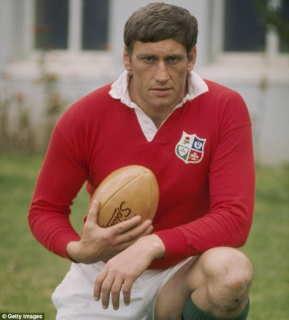
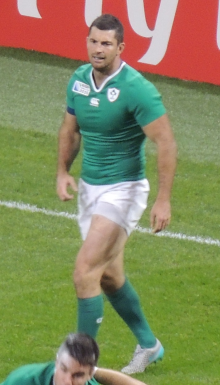
Birth of Rob Kearney, Former Rugby Union Player

Robert Kearney, former rugby union player, is born on a dairy farm on March 26, 1986, on the Cooley Peninsula in County Louth. He plays for 15 years for Leinster followed by a six-month stint in Australia, playing for Perth based side Western Force. He also plays over a decade for the Ireland national rugby union team with whom he earns 95 caps and goes on two British & Irish Lions tours in 2009 and 2013. As a youth he also plays rugby union for Clongowes Wood College and Gaelic football for Louth in the All-Ireland Minor Football Championship.

Kearney is the third of five children. He has an older brother, Richard, a younger brother Dave (who plays for Leinster) and a sister, Sara, the youngest of the five children. His elder brother Ross dies at the age of six following an accident in 1988. He is a seventh cousin of former U.S. President Joe Biden.

Like many of his peers, Kearney gets involved in athletics at an early age. The dominant sport in the area is Gaelic football. As a youth, he plays Gaelic for Naomh Muire, and in the Cooley Kickhams underage setup, before graduating to the Cooley senior football team at the age of 17 in 2004 and also Louth at minor level.

Kearney attends Clongowes Wood College in County Kildare for his secondary education. After his Leaving Certificate he moves to University College Dublin (UCD) on a sports scholarship, where he plays for the rugby team. He graduates in April 2010 with a Bachelor of Arts degree in economics. In 2005 he helps the U-20s team win the McCorry Cup, beating Dublin University Football Club (DUFC) in the final. In 2018, he is awarded the UCD Alumni Award in Sport.

Kearney plays for Leinster at both schoolboy and U-19 level before going on to represent them as a senior. He scores a hat-trick of tries on his debut for Leinster in a pre-season friendly win over Parma.

Kearney makes his Celtic League debut for Leinster in 2005 in a 22–20 defeat away to the Ospreys. He makes 32 appearances in the competition, scoring eight tries, with three penalties during a period in September 2006, when usual place kicker, Felipe Contepomi, is injured. He plays in his first Heineken Cup game in a 19–22 defeat against Bath at the Royal Dublin Society (RDS) on October 22, 2005. It is the first of ten appearances scoring ten tries in the process. He is part of Leinster’s Heineken Cup winning team in 2009 but misses the 2011 final due to injury. On May 21, 2012, the day after Leinster wins their second straight Heineken Cup, he is announced as the ERC Player of the Year for 2012. During the 2011–12 campaign he starts all nine European matches scoring six tries. He is crowned Leinster player of the year for the 2011–12 season. He confirms his departure from Leinster on September 24, 2020.

In late September 2020, it is confirmed that Kearney has signed a one-year contract with Australian side Western Force. He makes his Force debut in an 11–27 defeat to the Brumbies on February 19, 2021. He announces his retirement from rugby after one season with Western Force in Super Rugby AU and Super Rugby Trans-Tasman. Following his retirement, he returns to Louth GAA club Cooley Kickhams where he begins training in August 2021 for the first time since 2005.

Kearney represents Ireland at schoolboy and U-19 level, and tours with Ireland A in the 2006 Churchill Cup. He is first called into the Irish training squad for 2005’s autumn internationals but does not play. He is named in the Irish squad to the 2007 summer tour of Argentina and earns his first cap against Argentina on June 2, 2007, in a 16–0 defeat. During the 2008 Six Nations Championship he scores two tries, one against Scotland and one against England. He is a member of the victorious Ireland team that wins the 2009 Six Nations Championship, Triple Crown and Grand Slam. One of the most famous incidents in his career is a high tackle incident involving Italy‘s Andrea Masi in the first minute of a game. The incident is taken as an indication of the danger posed by Kearney in attack. He misses almost a year – from November 2010 until August 2011 – due to a knee injury that requires surgery.

In the 2011 Rugby World Cup, Kearney is selected but is injured for the first game against the United States. However, he plays in all the other matches which take Ireland through to the quarterfinals, in which they are knocked out by Wales, 22–10. He is selected in the Ireland squad for the 2012 Six Nations Championship and named in the starting team to play Wales in the opening match. He plays in all the other games, which see Ireland finish third in the table. He is also in the first Irish rugby team in 39 years to beat Australia on Australian soil, in the 2018 summer series. He is named in the Ireland squad for the 2019 Rugby World Cup in Japan, starting three of Ireland’s five matches and splitting time at fullback with Jordan Larmour.

Kearney is named in the British & Irish Lions squad for the 2009 tour to South Africa. He makes his Lions test debut as a substitute in the 26–21 first test defeat in Durban. Due to an injury to Lee Byrne, he is selected again for the second test in Pretoria. He scores the only try for the Lions in a 28–25 defeat. He then plays in the final test in Johannesburg which the Lions win 28–9. On April 30, 2013, he is named in his second British & Irish Lions squad.

Kearney marries Jess Redden in 2021, and their son is born in 2023.

Leave a comment

Birth of Karl Mullen, Rugby Union Player & Gynecologist

Dr. Karl Daniel Mullen, rugby union player and consultant gynecologist who captains the Irish rugby team and captains the British Lions on their 1950 tour to Australia and New Zealand, is born on November 26, 1926, in Courtown Harbour, County Wexford.

Mullen is one of three sons and seven daughters of Daniel Mullen, an officer of the customs and excise, and his wife Annie (née Hargrove). After his parents move to Home Farm Road, Drumcondra, Dublin, he is educated at the Dominican St. Thomas’s Academy, Eccles Street, the Jesuit Belvedere College, Great Denmark Street, and the Royal College of Surgeons in Ireland (RCSI). He plays rugby and cricket at school, association football with Home Farm F.C., and golf in the summer months. Initially a centre, he becomes a prop on the Belvedere junior cup team and, after injury to a teammate, hooker on the senior cup team, which loses the Leinster Schools Rugby Senior Cup final to Castleknock College in 1944.

On January 25, 1947, Mullen makes his formal Irish debut in a 12–8 loss to France. He plays as hooker, winning 25 caps for Ireland from 1947 to 1952. A year later, on January 31, 1948, he plays his first game for Barbarian F.C. in a 9–6 victory over Australia in Cardiff, Wales. After helping Ireland to victory over France on January 1, 1948, at the age of 21, he captains Ireland for the first time, on February 14, 1948, leading them to an 11–10 victory over England at Twickenham Stadium.

Mullen captains the Irish team to their first Grand Slam in the 1948 Five Nations Championship and is one of eight players from that team who live to see the country’s next Grand Slam in 2009.

Ireland retains the triple crown in 1949 by beating Wales 5–0 in Swansea, ending a run of defeats on Welsh soil lasting fourteen years. The following season Ireland suffers from injuries and loses to both England and Wales, the latter securing the triple crown.

Mullen is selected to captain the 1950 Lions Tour to Australia and New Zealand. After appearing in the first two tests against New Zealand, a 9–9 draw and an 8–0 loss, he sustains an ankle injury in the latter game and concedes his place to Dai Davies of Wales. Returning for the second test against Australia, a resounding 24–3 victory, he also plays in a semi-official “British Isles RFU” team against Ceylon during their return journey in September.

Under Mullen’s captaincy Ireland regains the international championship in 1951. His last cap comes in a 14–3 loss to Wales at Lansdowne Road on March 8, 1952. In twenty-five successive appearances (fifteen as captain), he secured three international championships and two triple crowns for Ireland in four seasons, their most successful haul of the twentieth century.

Mullen’s distinguished rugby career has to be fitted around his medical studies. In 1945, he enters the RCSI, graduating L and LM (RCSI and RCPI) in 1949. Awarded the diploma in obstetrics (1952) and membership of the Royal College of Obstetricians and Gynaecologists (1956), he trains at Sir Patrick Dun’s Hospital, Jervis Street Hospital and the Rotunda hospitals. After serving as senior obstetrics registrar at the Derby City General Hospital (1953–56), he returns to Dublin to become a consultant obstetrician, based at Mount Carmel Community Hospital, Churchtown, Dublin, and develops a considerable private practice. By his retirement in 2002, he is estimated to have delivered over 40,000 babies. A proponent of sex education in schools, he appears on RTÉ‘s 7 Days in December 1970, outlining various methods of birth control and calling for a more honest and realistic approach to artificial contraception.

Mullen marries Doreen Kilbride, an accomplished soprano, on April 30, 1952, in Donnybrook, Dublin, interrupting their honeymoon to play for Old Belvedere R.F.C. in the Leinster Senior Cup final. They have eight children, three boys and five girls. In 1975, they move from Altamount, Dundrum, Dublin, to Tulfarris House, Blessington, County Wicklow, adjacent to Poulaphouca Reservoir, where they farm and bred Irish draught horses. In 1985, he sells the property and much of his art collection and moves to Kilcullen, County Kildare.

Mullen is one of eight surviving members of the 1948 team to witness Ireland’s second grand slam on March 21, 2009. Only weeks later, having suffered from a long illness, he dies on April 27, 2009, at his home, Gilltown Lodge, in Kilcullen.

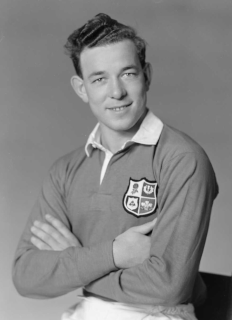
(Pictured: Karl Mullen, captain of the British Lions rugby union team, 1950)


Leave a comment

Birth of Mick Galwey, Gaelic Football & Rugby Union Player

Michael Joseph Galwey, Gaelic football and rugby union player, is born on October 8, 1966, in Currow, County Kerry. As a 19-year-old he wins an All-Ireland Senior Football Championship with the Kerry Gaelic football team in 1986, before turning to rugby union. He is thus the only winner of an “All-Ireland” in both rugby union and Gaelic football. He also holds County Championship medals in Senior, Junior and Minor grades. His nickname ‘Gaillimh’ comes from the name of the Irish town Galway, in the Irish language.

Before becoming a rugby player Galwey plays Gaelic football with Kerry. His first success at intercounty level comes in 1986 when he is part of the Kerry team that wins that year’s All-Ireland. He plays in the semi-final win over Meath. The following year he wins a Munster Under 21 Championship medal and later plays in the All-Ireland final but his side loses out to Donegal. In 1989 he plays his second and last championship game with Kerry in the Munster Championship first round win over Limerick, a game that he also captains the side in.

At club level Galwey plays with his local Currow club. The club produces three other senior Irish Rugby Internationals – Moss Keane, Mick Doyle and Tommy Doyle, an All-Ireland Minor winner in 1962, along with an U-20 Irish Rugby International, JJ Hanrahan. He plays a key part in helping Currow win their first Kerry Junior Football Championship in 1988 when they beat Rathmore in the final.

Galwey also plays with the St. Kieran’s divisional team. In 1988 he helps them win their first and to date only Kerry Senior Football Championship title.

After making the switch to rugby union, Galwey is a key figure in Shannon RFC‘s side during their four in a row winning streak of All-Ireland League titles in the late 1990s. Throughout his career he proves to be a leader who can inspire and motivate players around him to punch above their collective weights. He instills a “don’t panic” and professional attitude in his Shannon team which later becomes the hallmarks of Munster Rugby during his tenancy as captain. He is seen as a legend of the sport in his native Munster, particularly in Limerick.

Galwey’s involvement in the Irish national squad is more of a mixed bag. Making his debut in 1991 against France, his 11-year international career is rarely without controversy. Owing to the selection decisions of various national coaches and selectors, he becomes the most dropped player in international history. He fights his way back onto the Irish squad, becoming the team’s captain ten years after he made his debut. In the 1993 Five Nations Championship match against England, he rounds off a fine display in the 17–3 defeat by scoring the only try of the game. His efforts are rewarded later that year when he is selected for the Lions tour to New Zealand.

Galwey plays for the Ireland national rugby sevens team at the inaugural 1993 Rugby World Cup Sevens.

Galwey’s rugby record includes 41 caps for Ireland, four times as captain and scorer of three tries; 1993 Lions tour to New Zealand; 130 caps for Munster, 85 as captain, 1 Celtic League; 10 Munster senior cups and 6 All-Ireland Leagues with Shannon R.F.C.; 113 games for Shannon in the All-Ireland League, scoring 28 tries.

Galwey has coached Shannon to two All-Ireland League victories and two Munster Senior Cups.


Leave a comment

Birth of Tony Ward, Former Rugby Union & Association Football Player

Anthony Joseph Patrick Ward, Irish former rugby union and association football player during the 1970s and 1980s commonly referred to as Tony Ward, is born in Dublin on October 8, 1954. He plays rugby as a fly-half for, among others, Munster, Leinster, Ireland, the British & Irish Lions and the Barbarians. He is selected 1979 European rugby player of the year.

Ward wins 19 caps for Ireland between 1978 and 1987. He makes his international debut against Scotland at Lansdowne Road on January 21, 1978 at the age of 23. He helps Ireland win 12–9 and during the 1978 Five Nations Championship he scores 38 points, a record for a debutant. He makes one major tour with Ireland, to Australia in 1979. During his career as an Ireland international he scores 113 points, including 29 penalties, 7 conversions and 4 drop goals. He plays his last game for Ireland on June 3, 1987 in a 32–9 win over Tonga during the 1987 Rugby World Cup.

Leinsterman Ward also inspires Munster to a legendary win over New Zealand, scoring two drop goals and a conversion in a 12–0 victory at Thomond Park on October 31, 1978. To date Munster are the only Irish provincial men’s team ever to beat the All-Blacks, although having played them far more frequently than any other province and joining dozens of smaller Welsh clubs and English regions who defeated mid-week All Black teams over the same period.

Ward also plays one Test game for the British & Irish Lions during the 1980 South Africa tour. He sets a Lions Test record by scoring 18 points, including 5 penalties and a drop goal. It is also a record for any player against South Africa.

Ward is the first ever recipient of a European Rugby Player of the Year award for his performances in the 1979 Five Nations Championship.

Ward also plays association football for both Shamrock Rovers and Limerick United. In his last season with Rovers, 1974–75, he scores 6 league goals. He plays for Limerick United in the 1981–82 UEFA Cup and in 1982 he helps them win the FAI Cup.

While playing rugby Ward is a geography and PE teacher at St. Andrews School in Booterstown, Dún Laoghaire–Rathdown. During the 1990s, he is a highly valued and well respected coach for St. Andrews.

Since retiring as a sportsman, Ward has worked as a sports journalist, most notably with the Irish Independent, and as a rugby commentator for Raidió Teilifís Éireann (RTÉ). He starts as a co-commentator for the 1988 Five Nations Championship, and remains in that role for many years.

Ward is currently involved in St. Gerard’s School in Bray, County Wicklow, where he is coaching the Senior Rugby team and has been doing so for a number of years. He constantly downplays his fame and success and does not even want to be in the room if another coach plays video footage of his legendary tries.


Leave a comment

Death of Moss Keane, Gaelic & Rugby Union Footballer

Maurice Ignatius “Moss” Keane, Gaelic footballer and a rugby union footballer who plays for Ireland and the British & Irish Lions, dies in Portarlington, County Laois, on October 5, 2010. The great Scottish rugby commentator Bill McClaren refers to Keane in his prime, “Maurice Ignatius Keane. Eighteen and a half stone of prime Irish beef on the hoof, I don’t know about the opposition but he frightens the living daylights out of me.”

Born at Currow, County Kerry on July 27, 1948, Keane starts out as a Gaelic footballer, playing at college level for University College Cork and in the process winning a number of medals including three Sigerson Cups, one Cork County Championship and a Munster Club Championship. He also plays in an All-Ireland Club Final. He represents Kerry Gaelic footballer’s at U-21 and Junior level as a full back, winning Munster Championships at both levels, playing in an All -Ireland at Junior level. In 2011 the Kerry County Board names the cup for the winners of the Intermediate Shield after him.

Keane then discovers rugby through a friend in college, playing for the UCC junior rugby team as ‘Moss Fenton,’ during the Gaelic Athletic Association‘s (GAA) ban on foreign games. When asked his first thoughts about rugby he answers, “It was like watching a pornographic movie – very frustrating for those watching and only enjoyable for those participating.” He makes his international debut for Ireland on January 19, 1974 against France in Paris, a game Ireland loses 9–6 in the 1974 Five Nations Championship.

Keane becomes the third Irish forward after Willie John McBride and Fergus Slattery to reach 50 international appearances. He scores his one and only test try in a 22–15 victory over Scotland in February 1980. He plays his 51st and final international against Scotland on March 3, 1984 in Dublin. Ireland loses the match 32–9. He is also a part of the famous Munster side that defeats the All Blacks in Thomond Park in 1978.

Keane tours New Zealand with Phil Bennett‘s British & Irish Lions in 1977, making one Test appearance, and is also a key man in Ireland’s 1982 Five Nations Championship win and their historic Triple Crown victory in 1982.

In 2005 Keane writes, with Billy Keane (no kin), his autobiography, called Rucks, Mauls and Gaelic Football.

Having gained a master’s degree in dairy science, Keane works for the Department of Agriculture during his rugby playing career and retires in July 2010. He keeps active playing golf on a weekly basis. In 1993 he is the victim of a vicious mugging.

In 2009 it is reported that Keane is being treated for colorectal cancer. He dies at the age of 62 on October 5, 2010. His funeral takes place on October 7 in St. Michael’s Church in Portarlington. Former Ireland international players, including Willie John McBride, Ollie Campbell, Tony Ward, Mick Galwey, Dick Spring, Donal Lenihan, Donal Spring and Ciaran Fitzgerald are in attendance. His coffin is adorned with the jerseys of Ireland, Munster, UCC, Kerry and Currow.

Many tributes are made including Taoiseach Brian Cowen saying, “one of the great gentleman of Irish sport would be sadly missed by his many fans and admirers worldwide. Moss Keane was one of the finest rugby players Ireland has ever produced. He was among rugby’s best known characters and a legend of the game at home and abroad.” Describing him as one of Irish rugby’s “most genuine characters and legends of the game,” the Irish Rugby Football Union (IRFU) pays tribute to Keane, “Moss had ability on the field that no one could doubt from his record at club, provincial and international level.” IRFU President Caleb Powell says, “UCC, Lansdowne, Munster, Ireland and the British & Irish Lions all benefited from his presence and ensured that his reputation will live long in the memories of not only Irish rugby, but world rugby.”

Keane is survived by his wife Anne and his two daughters Sarah and Anne Marie.


Leave a comment

Birth of Willie John McBride, Rugby Union Footballer

William James McBride, former rugby union footballer better known as Willie John McBride, is born at Toomebridge, County Antrim, Northern Ireland on June 6, 1940. He plays as a lock for Ireland and the British and Irish Lions. He plays 63 tests for Ireland including eleven as captain, and tours with the Lions five times, a record that gives him 17 Lions test caps. He also captains the most successful ever Lions side, which tours South Africa in 1974.

Owing to his father’s death when he is four years old, McBride spends most of his spare time helping out on his family farm. Because of this he does not start playing rugby until he is seventeen. He is educated at Ballymena Academy and plays for the school’s First XV. After he leaves he joins Ballymena R.F.C.

In 1962 McBride is selected to play for Ireland. His first Test on February 10, 1962 is against England at Twickenham Stadium. Later that year he is selected to tour South Africa with the British and Irish Lions.

McBride continues to play for Ireland throughout the 1960s and plays for Ireland when they first defeat South Africa in 1965, and when Ireland defeats Australia in Sydney, the first time a Home Nations team had defeated a major southern hemisphere team in their own country. He is again selected for the Lions in 1966, this time touring New Zealand and Australia. He tours South Africa with the Lions again in 1968.

McBride is selected to play for the Lions in their 1971 tour of New Zealand. Despite being criticized by some as being “over the hill,” he is made pack leader and helps the Lions to a test series win over New Zealand, their first and last series win over New Zealand. He receives an MBE in 1971 for services to rugby football.

McBride’s leadership qualities lead to his appointment as captain of the British and Irish Lions in their 1974 tour to South Africa. The test series is won 3–0, with one match drawn, the first Lions series ever won in South Africa. It is one of the most controversial and physical test match series ever played. At the time there are only substitutions if a doctor agrees that a player is physically unable to continue and there are no video cameras and sideline officials to keep the punching, kicking and head butting to a minimum. If the South Africans are to resort to foul play then the Lions decide “to get their retaliation in first.” The signal for this is to call “99,” which is a signal for the Lions to clobber their nearest rival players.

In 1975 as his international career is ending McBride plays his last game for Ireland at Lansdowne Road. The game is against France, and near the end of the match he scores his first test try for Ireland. It is the crowning moment of a great playing career. His last international game is against Wales on March 15, 1975. After retiring from playing the game, McBride coaches the Irish team and is manager of the 1983 Lions tour to New Zealand. Despite the test results being mainly poor, team camaraderie is high and some good wins are recorded in other games.

In 1997 McBride is an inaugural inductee into the International Rugby Hall of Fame. He has been asked to present test jerseys and give motivational speeches to Lions players prior to matches. In 2004 he is named in Rugby World magazine as “Rugby Personality of the Century.” He is a major supporter of the Wooden Spoon Society.

McBride is awarded a CBE in the 2019 New Year Honours list for services to Rugby Union.


Leave a comment

Birth of Ollie Campbell, Former Rugby Union Player

seamus-oliver-campbell

Seamus Oliver “Ollie” Campbell, former rugby union player, is born in Dublin on March 5, 1954. He plays fly-half for the Ireland national rugby union team from 1976 to 1984. He is most well known for his role in orchestrating Ireland’s Triple Crown victory at the 1982 Five Nations Championship, breaking a drought of over 30 years. He has been described as Ireland’s most complete fly-half since Jack Kyle.

Campbell is educated at Belvedere College, a famous Irish rugby school in Dublin, where he is on the teams that win the Leinster Schools Rugby Senior Cup twice in a row in 1971 and 1972. He plays for Old Belvedere R.F.C. at club level and represents Leinster at provincial level, although prior to the professional era. While playing for Old Belvedere, he travels to the United States in 1978, where he plays in New York City against the Old Maroon Rugby Club.

Campbell wins a total of 22 caps for Ireland from 1976–1984, scoring 217 test points. His international career is more brief than this span suggests, however, as he plays only four full seasons for Ireland from 1980–1984. Of his career totals, he wins 22 caps and scores 182 points in the Five Nations tournament. He tours twice with Ireland, to Australia in 1979 and to South Africa in 1981.

Campbell wins his first cap for Ireland at the age of 21 against Australia in 1976, but does not secure another cap with Ireland until 1979 during Ireland’s 1979 tour to Australia. He sets an Irish record on the 1979 tour to Australia when he scors 60 points, 19 of them in Brisbane which is an Irish record for points in a match against Australia.

The defining moment in Campbell’s career comes in 1982, with Campbell as the architect-in-chief of Ireland’s 1982 Triple Crown victory, Ireland’s first since 1949. Ireland enters the tournament winless in its past eight matches. Campbell starts the 1982 Five Nations by scoring eight points in Ireland’s 20–12 win against Wales, and also playing a major hand in all three of Ireland’s tries. He then scores another eight points in the following match, a 16–15 win against England. In Ireland’s third match, he kicks all of Ireland’s 21 points, including a career best 6 penalties, against Scotland at Lansdowne Road to secure the Triple Crown. He is the leading scorer in the 1982 Five Nations with 46 points.

In the 1983 Five Nations Championship, Campbell leads Ireland to a joint Five Nations Championship shared with France. He is again the tournament’s leading scorer with 52 points, and scores 21 points against England to set an Irish record for most points against England in a Five Nations match. He plays his last match for Ireland in 1984 against Wales.

Campbell is also capped seven times for the British & Irish Lions. He earns three caps in the 1980 Lions tour to South Africa, where he is the Lions’ leading scorer in the last two tests with six and five points respectively. He earns another four caps in the 1983 Lions tour to New Zealand, where he is the Lions’ leading scorer in the four test matches with 15 points. He scores 184 points in total for the Lions.

Campbell retires from rugby in 1986 following two years of struggles with hamstring injuries. In 2007 he is presented with the Newbridge RFC Legend in Rugby Award along with the Irish Rugby Squad which won the 1982 Triple Crown and elected an Honorary Life Member of Newbridge RFC. He has worked in the family clothing business since retirement from rugby in 1984.

Old Belvedere’s sportsground on Anglesea Road in Dublin is renamed Ollie Campbell Park in his honour in 2019.