seamus dubhghaill

Promoting Irish Culture and History from Little Rock, Arkansas, USA


Leave a comment

Birth of Evie Hone, Painter & Stained Glass Artist

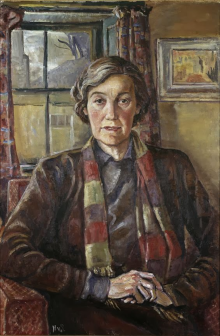
Eva Sydney Hone RHA, Irish painter and stained glass artist usually known as Evie, is born at Roebuck Grove, County Dublin, on April 22, 1894. She is considered to be an early pioneer of cubism, although her best known works are stained glass. Her most notable pieces are the East Window in the Chapel at Eton College, which depicts the Crucifixion, and My Four Green Fields, which is now in the Government Buildings in Dublin.

Hone is the youngest daughter of Joseph Hone, of the Hone family, and Eva Eleanor (née Robinson), daughter of Sir Henry Robinson and granddaughter of Arthur Annesley, 10th Viscount Valentia. Her mother dies two days after her birth. She is related to artists Nathaniel Hone and Nathaniel Hone the Younger.

Shortly before her twelfth birthday, Hone suffers from polio (infant paralysis), suffering a fall while helping to decorate the Taney parish church for Easter. Her resulting ill health leads to her seeking treatment in Harley Street, Marylebone, Central London. She is educated by a governess, continuing her education in Switzerland, and goes on tours to Spain and Italy before moving to London in 1913. Her three sisters all marry British Army officers, and all are widowed in World War I.

Hone studies at the Byam Shaw School of Art in London and then under Bernard Meninsky at the Central School of Arts and Crafts. She meets Mainie Jellett when both are studying under Walter Sickert at the Westminster Technical Institute. She works under André Lhote and Albert Gleizes in Paris before returning to become influential in the modern movement in Ireland and becoming one of the founders of the Irish Exhibition of Living Art. She is considered an early pioneer of Cubism but in the 1930s turns to stained glass, which she studies with Wilhelmina Geddes.

Hone is extremely devout. She spends time in an Anglican Convent in 1925 at Truro in Cornwall and converts to Catholicism in 1937. This possibly influences her decision to begin working in stained glass. Initially, she works as a member of the An Túr Gloine stained glass co-operative before setting up a studio of her own in Rathfarnham.

Hone’s most important works are probably the East Window, depicting the Crucifixion, for the Chapel at Eton College, Windsor (1949–1952) and My Four Green Fields, now located in Government Buildings, Dublin. This latter work, commissioned for the Irish Government’s Pavilion, wins first prize for stained glass in the 1939 New York World’s Fair. It graces CIÉ‘s Head Office in O’Connell Street from 1960 to about 1983. The East Window of Eton College is commissioned following the destruction of the building after a bomb is dropped in 1940 on the school during World War II. She is commissioned to design the East Window in 1949, and the new window is inserted in 1952. This work is featured on an Irish postage stamp in 1969. From December 2005 to June 2006, an exhibition of her work is on display at the National Gallery of Ireland. Saint Mary’s church in Clonsilla also features her stained glass windows.

Despite ill health, Hone continues to produce a huge number of small stained glass panels as well as oils, watercolours, and gouache landscapes. In 1953, she is represented at the Contemporary Irish Art exhibition at Aberystwyth, Wales, and at the Tate gallery in London, receiving as well an honorary LLD from Trinity College Dublin (TCD). In 1954, she is elected an honorary member of the Royal Hibernian Academy (RHA).

Unmarried, Hone dies on March 13, 1955, while entering her parish church at Rathfarnham. She is survived by two of her sisters. Over 20,000 people visit a memorial exhibition of her work at University College Dublin (UCD), Earlsfort Terrace, Dublin, in 1958.

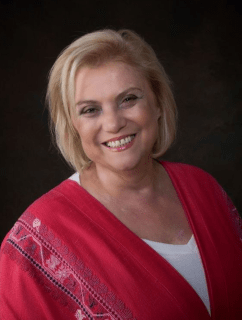
(Pictured: Portrait of Evie Hone by Hilda van Stockum)

Leave a comment

Bombings of King’s Cross and Euston Railway Stations

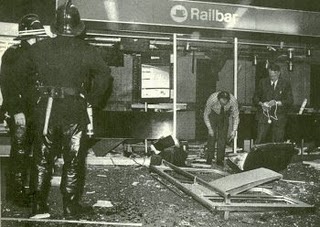
On September 10, 1973, the Provisional Irish Republican Army (IRA) bombs the King’s Cross railway station and Euston railway station, two mainline railway stations in Central London. The blasts wound 13 civilians, some of whom are seriously injured, and also causes large-scale but superficial damage. This is a second wave of bombing attacks launched by the IRA in England in 1973 after the Old Bailey car bombing earlier in the year which had killed one and injured around 200 civilians.

In 1971, during the Troubles, after two years engaged in violence based on a defensive strategy in Irish communal districts of Northern Ireland, the Provisional IRA launches an offensive against the United Kingdom. At a meeting of the IRA Army Council in June 1972 the organization’s Chief of Staff, Seán Mac Stíofáin, first proposes making bombing attacks in England. The Army Council does not at first agree to the suggestion, but in early 1973 after its negotiations with the British Government for a truce the previous year had failed to advance the political objective of the removal of Northern Ireland from the United Kingdom by the application of the threat of violence, it re-engages its paramilitary campaign and sanctions Mac Stíofáin’s proposal. Mac Stíofáin had put the strategy forward on the basis that extending the urban paramilitary violence of the Northern Ireland state into England would help to relieve pressure being exerted by the British Army on the IRA’s strongholds of Irish communal support in districts in the province, such as west Belfast and Derry, by diverting British security strength from them back into England, while at the same time increasing strategic pressure upon the British Government to resolve the conflict by political concessions to the IRA’s demands. He also believes that a successful bombing campaign in London, as the capital city of the United Kingdom, will offer substantial propaganda value for paramilitary Irish Republicanism, and provide a morale boost to its supporters.

The effects of the previous 1973 Old Bailey bombing appear to give some credence to the idea of the propaganda value of extending violence into London as, although it is considered almost routine in Northern Ireland by the mid-1970s and draws only brief media notice, being carried out instead in London, a global capital city, makes the event world news headlines. However, although the bombing of the Old Bailey is successfully carried out, and gains media attention, increasing political pressure upon the British Government to address the issue of the conflict in Northern Ireland with more urgency, it is costly to the IRA, as 10 out of the 11-man active service unit that carry it out are arrested by the British police while trying to leave England before the bombs they had planted detonate. Drawing the tactical lesson that large teams are a security liability, for the second wave of bombings in England later in 1973, instead of sending a large team to carry it out with orders to withdraw back to Ireland immediately afterwards, smaller detached “cell” units of 3-4 personnel are sent to carry out the operation, with instructions to remain in England afterward and wage a campaign of bombings around England upon a variety of targets.

There are bombings on September 8, 1973, including one at London Victoria station which injures four civilians.

On September 10, 1973, a bomb (with no warning issued beforehand) explodes at King’s Cross railway station in the booking hall at 12:24 p.m. when a youth of around 16 to 17 years of age walks up to the entrance of the station’s old booking hall and throws a bag into it which contains a 3 lb. (1.4 kg) device, which detonates, shattering glass throughout the hall and throwing a baggage trolley several feet into the air. The youth then flees into the station’s crowd and escapes the scene.

Approximately 45 minutes after the attack at King’s Cross, after a telephone call warning to the Press Association five minutes beforehand by a man with an Irish accent, a second bomb detonates in a snack bar at Euston railway station, injuring another eight civilians. One witness at Euston says, “I saw a flash and suddenly people were being thrown through the air – it was a terrible mess, they were bleeding and screaming.” A total of 13 civilians are injured in the two attacks. The Metropolitan Police issue a photofit picture of a 5 ft. 2 in. (157 cm) tall youth they are seeking in regard to the King’s Cross attack.

On September 12, 1973, two more bombs explode, one in Oxford Street and another in Sloane Square, targeting retail shopping centres. Police subsequently announce that they are looking for five people in connection with this second wave of bomb attacks in England.

Judith Ward is later wrongly convicted of having been involved in the late 1973 London bombings, along with the M62 coach bombing. She is later acquitted. No one else is brought to trial for this IRA bombing campaign.


Leave a comment

Premiere of Oliver Goldsmith’s Play “The Good-Natur’d Man”

The Good-Natur’d Man, a play written by Oliver Goldsmith in 1768, is first performed at Central London’s Covent Garden on January 29, 1768. The play is written in the form of a comedy with Mary Bulkley as Miss Richland. It is released at the same time as Hugh Kelly‘s False Delicacy, staged at Drury Lane Theatre. The two plays go head-to-head, with Kelly’s proving the more popular. Goldsmith’s play is a middling success, and the printed version of the play becomes popular with the reading public.

Although his birth date and year and birthplace are not known with any certainty, it is believed that Goldsmith is born on November 10, 1728, in Kilkenny West, County Westmeath. He is an Anglo-Irish essayist, poet, novelist, dramatist, and eccentric, made famous by such works as the series of essays The Citizen of the World, or, Letters from a Chinese Philosopher (1762), the poem The Deserted Village (1770), the novel The Vicar of Wakefield (1766), and the play She Stoops to Conquer (1773).

Goldsmith is the son of an Anglo-Irish clergyman, the Rev. Charles Goldsmith, curate in charge of Kilkenny West. At about the time of his birth, the family moves into a substantial house at nearby Lissoy, where he spends his childhood. Much has been recorded concerning his youth, his unhappy years as an undergraduate at Trinity College Dublin, where he received the BA degree in February 1749, and his many misadventures before he leaves Ireland in the autumn of 1752 to study in the medical school at Edinburgh. By this time his father has died, but several of his relations support him in his pursuit of a medical degree. Later on, in London, he comes to be known as Dr. Goldsmith, Doctor being the courtesy title for one who holds the Bachelor of Medicine, but he takes no degree while at Edinburgh nor, so far as anyone knows, during the two-year period when, despite his meagre funds, which are eventually exhausted, he somehow manages to make his way through Europe. The first period of his life ends with his arrival in London, bedraggled and penniless, early in 1756.

Goldsmith’s rise from total obscurity is a matter of only a few years. He works as an apothecary‘s assistant, school usher, physician, and as a hack writer, reviewing, translating, and compiling. Much of his work is for Ralph Griffiths‘s Monthly Review. It remains amazing that this young Irish vagabond, unknown, uncouth, unlearned, and unreliable, is yet able within a few years to climb from obscurity to mix with aristocrats and the intellectual elite of London. Such a rise is possible because he has one quality, soon noticed by booksellers and the public, that his fellow literary hacks do not possess – the gift of a graceful, lively, and readable style.

Goldsmith’s rise begins with the Enquiry into the Present State of Polite Learning in Europe (1759), a minor work. Soon he emerges as an essayist, in The Bee and other periodicals, and above all in his Chinese Letters. These essays are first published in the journal The Public Ledger and are collected as The Citizen of the World in 1762. The same year brings his The Life of Richard Nash. Already he is acquiring those distinguished and often helpful friends whom he alternately annoys and amuses, shocks and charms – Samuel Johnson, Sir Joshua Reynolds, Thomas Percy, David Garrick, Edmund Burke, and James Boswell.

The obscure drudge of 1759 becomes in 1764 one of the nine founder-members of the famous The Club, a select body, including Reynolds, Johnson, and Burke, which meets weekly for supper and talk. Goldsmith can now afford to live more comfortably, but his extravagance continually runs him into debt, and he is forced to undertake more hack work. He thus produces histories of England and of ancient Rome and Greece, biographies, verse anthologies, translations, and works of popular science.

Goldsmith’s premature death on April 4, 1774, may be partly due to his own misdiagnosis of a kidney infection. He is buried in Temple Church in London. A monument is originally raised to him at the site of his burial, but this is destroyed in an air raid in 1941. A monument to him survives in the centre of Ballymahon, also in Westminster Abbey with an epitaph written by Samuel Johnson.

Among Goldsmith’s papers is found the prospectus of an encyclopedia, to be called the Universal dictionary of the arts and sciences. He wishes this to be the British equivalent of the Encyclopédie and it is to include comprehensive articles by Samuel Johnson, Edmund Burke, Adam Smith, Edward Gibbon, Sir Joshua Reynolds, Sir William Jones, Charles James Fox and Dr. Charles Burney. The project, however, is not realised due to Goldsmith’s death.

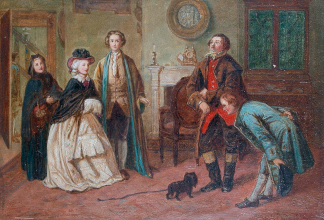
(Pictured: “Mr Honeywell introduces the bailiffs to Miss Richland as his friends,”a scene from the play “The Good-Natur’d Man” by Oliver Goldsmith, oil on panel by William Powell Frith)


Leave a comment

Birth of Christina Noble, Children’s Rights Campaigner & Charity Worker

Christina Noble OBE, Irish children’s rights campaigner, charity worker and writer, is born on December 23, 1944, in Dublin. She is the founder of the Christina Noble Children’s Foundation in 1989.

Noble’s mother dies when she is ten years old. She is sent to an orphanage and dishonestly told that her three siblings were dead. She escapes and lives rough in Dublin, where she is gang raped. Her baby son is put up for adoption against her will. After discovering the state had lied about the death of her siblings, she locates her brother in England. She moves there to live with him after she turns eighteen. This is where she meets and marries her husband and has three children, Helenita, Nicolas and Androula. She is a victim of domestic violence.

In 1989, Noble visits Vietnam and begins to care for homeless children, after a recurring dream, during the Vietnam War. This leads her to create the Christina Noble Children’s Foundation in the same year. To date, she and the Foundation have helped over 700,000 children in Vietnam and Mongolia.

Noble appears as a castaway on the BBC Radio programme Desert Island Discs on June 15, 1997. She is the subject of This Is Your Life in 2002 when she is surprised by Michael Aspel at a fundraising fashion show and auction in Central London. Despite being from Ireland, she is made an Officer of the Order of the British Empire (OBE). She is a recipient of the 2014 Women of the Year Prudential Lifetime Achievement Award.

A film about her, Noble, is released on May 8, 2015. The director is Stephen Bradley.


Leave a comment

Birth of Gerald O’Donovan, Priest & Writer

CREATOR: gd-jpeg v1.0 (using IJG JPEG v62), default quality

Gerald O’Donovan, Irish priest and writer born Jeremiah Donovan, is born in Kilkeel, County Down on July 15, 1871.

O’Donovan is the son of a pier builder. He attends Ardnaree College in Killala and St. Patrick’s College, Maynooth. He leaves Maynooth after ordination for the Diocese of Clonfert in 1895 and is appointed as a Roman Catholic priest to Loughrea, County Galway between 1896 and 1904. He is an enthusiastic advocate of the Gaelic League and the Irish Cooperative Association and promotes his views in articles and lectures. His literary friends include Lady Gregory, W. B. Yeats and George Moore. He is in charge of decorating St. Brendan’s Cathedral, Loughrea in 1901, the financing provided by O’Donovan’s close friend Edward Martyn. He quit Loughrea in 1904 after the arrival of a new bishop, Thomas O’Dea.

O’Donovan moves to London but failing to find work as a priest, he leaves the Catholic priesthood in May 1908. He becomes a subwarden at Toynbee Hall in the East End in March 1910. In October that year, he marries Florence Emily Beryl Verschoyle (1886–1968), the daughter of an Irish Protestant colonel fifteen years his junior. They have three children, two daughters and a son.

In 1913, O’Donovan publishes his first and best-known novel, Father Ralph, which draws in large part on his own life. Around this time, he changes his first name from Jeremiah to Gerald. Another novel titled Waiting is published in 1914. He joins the war effort in 1915 and rises to become head of the Italian section at the Ministry of Information in 1918. There he meets his secretary and future lover, English novelist Rose Macaulay.

O’Donovan publishes a few more novels after the war: How They Did It (1920), Conquest (1920), Vocations (1921), and The Holy Tree (1922). The clandestine affair with Macaulay continues for nearly two decades. In 1939, the pair are on holiday in the Lake District when they meet with a motoring accident, which damages O’Donovan’s health. He dies of cancer in Albury, Surrey three years later, on July 26, 1942. His letters to Macaulay had been destroyed the previous year when her flat in Central London was bombed during the Blitz.

In her novel The Towers of Trebizond, Macaulay features a woman character (Laurie) torn between her attraction to Christianity and her adulterous love for a married man. This is considered to reflect the author’s relationship with O’Donovan.


Leave a comment

Irish Republican Army Bombings in Central London

regent-street-london-1977

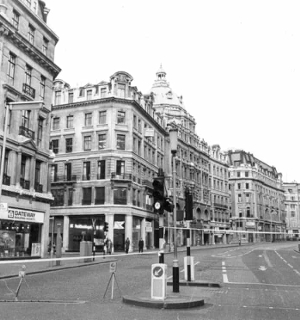
At least seven bombs explode in Central London on January 29, 1977. One person is injured. The Irish Republican Army (IRA) later claims responsibility.

Hundreds of police seal off the Oxford Street area as Selfridges department store is set ablaze and one man is injured. The explosions occur over a two-mile area within 50 minutes. The bombs wreck buildings in Oxford Street, Regent Street, and Wardour Street, causing hundreds of thousands of pounds worth of damage and burying a taxi under the rubble, injuring the driver. Another man is trapped in a basement in Selfridges after the blast.

The attacks come less than 72 hours before the IRA commemoration of the Bloody Sunday massacre in Londonderry and, according to the police, bear all the hallmarks of the IRA. The bombs, left in doorways of shops and offices, are similar to those used in firebomb attacks on the centre of Belfast and Londonderry over the previous four years.

Hundreds of police are drafted into the Oxford Street area within minutes of the first blast, shortly after midnight. Police using sniffer dogs examine hundreds of cars stretched along Oxford Street and residents are warned to evacuate by police and fire officers using bullhorns. Dozens of fire engines respond to the resulting blaze in the huge department store.

A two-mile area around Oxford Street is cordoned off by police roadblocks shortly after the first explosions. Scotland Yard and the Fire Brigade are unable to keep pace with the bombs and fires as news reports flood in.

The first explosions occur in Wardour Street where two bombs blow out the front of a publishing office and a travel agency, hurling glass and furniture into the street. Within 20 minutes, three other bombs explode in Oxford Street, Regent Street, Poland Street and in the side-streets of Soho. The fire brigade simultaneously fights two major fires within a mile of each other, in Selfridges and in a building in Berwick Street, Soho. Debris from the bombs is littered around as bomb squad officers and police patrols begin examining all suspicious cars and packages in the area. Several bomb squad officers are standing within yards of a building when the fourth bomb, fortunately a small one, goes off.

The Assistant Commissioner for Crime, Jock Wilson, joins Bomb Squad officers in a special mobile control unit. A senior police officer says that many of the bombs are crammed through letterboxes in the business premises. However, the bomb at Selfridges is placed in the basement, police believe, on previous afternoon.

(Pictured: Police cordon off Regent Street following IRA bombs in the West End, London, January 1977. Photograph: ANL/REX/Shutterstock)


Leave a comment

The Hyde Park and Regent’s Park Bombings

The Hyde Park and Regent’s Park bombings occur on July 20, 1982, in London. Members of the Provisional Irish Republican Army (IRA) detonate two bombs during British military ceremonies in Hyde Park and Regent’s Park, both in Central London.

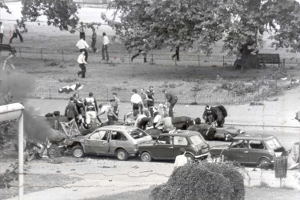
At 10:40 AM, a nail bomb explodes in the boot of a blue Morris Marina parked on South Carriage Drive in Hyde Park. The bomb comprises 25 lbs. of gelignite and 30 lbs. of nails. It explodes as soldiers of the Household Cavalry, Queen Elizabeth II‘s official bodyguard regiment, are passing. They are taking part in their daily Changing of the Guard procession from their barracks in Knightsbridge to Horse Guards Parade. Three soldiers of the Blues & Royals are killed outright, and another, their standard-bearer, dies from his wounds three days later. The other soldiers in the procession are badly wounded, and a number of civilians were injured. Seven of the regiment’s horses are also killed or had to be euthanised because of their injuries. Explosives experts believe that the Hyde Park bomb is triggered by remote by an IRA member inside the park.

The second attack happens at about 12:55 PM, when a bomb explodes underneath a bandstand in Regent’s Park. Thirty Military bandsmen of the Royal Green Jackets are on the stand performing music from Oliver! to a crowd of 120 people. It is the first in a series of advertised lunchtime concerts there. Six of the bandsmen are killed outright and the rest are wounded. A seventh dies of his wounds on August 1. At least eight civilians are also injured. The bomb had been hidden under the stand some time before and triggered by a timer. Unlike the Hyde Park bomb, it contains no nails and seems to be designed to cause minimal harm to bystanders.

A total of 22 people are detained in hospital as a result of the blasts. The IRA claims responsibility for the attacks by deliberately mirroring Prime Minister Margaret Thatcher‘s words a few months before when Britain entered the Falklands War. They proclaimed that “The Irish people have sovereign and national rights which no task or occupational force can put down.” Reacting to the bombing, Thatcher states, “These callous and cowardly crimes have been committed by evil, brutal men who know nothing of democracy. We shall not rest until they are brought to justice.” The bombings have a negative impact on public support in the United States for the Irish republican cause.

In October 1987, 27-year-old Gilbert “Danny” McNamee, from County Armagh, is sentenced at the Old Bailey to 25 years in prison for his role in the Hyde Park bombing and others, despite his plea that he is not guilty. He is released from HM Prison Maze in late 1998 under the Good Friday Agreement.

On May 19, 2013, 61-year-old John Anthony Downey, from County Donegal, is charged with murder in relation to the Hyde Park bomb and intending to cause an explosion likely to endanger life. He appears at the Old Bailey on January 24, 2014, for the beginning of his trial and enters a not guilty plea. On February 25, 2014, it is revealed that Downey’s trial has collapsed after the presiding judge has ruled upon a letter sent by the Police Service of Northern Ireland to Downey in 2007, assuring him that he would not face criminal charges over the attack. Although the assurance is made in error and the police realise the mistake, it is never withdrawn, and the judge rules that therefore the defendant has been misled and prosecuting him would be an abuse of executive power. Downey is one of 187 IRA suspects who receive secret on-the-run letters guaranteeing them unofficial immunity from prosecution.

A memorial marks the spot of the Hyde Park bombing and the troop honours it daily with an eyes-left and salute with drawn swords. A plaque commemorating the victims of the second attack also stands in Regent’s Park.