Fitzpatrick attends grammar school in Ireland before coming to the United States in 1882, at the age of eleven, settling in Chicago. Following completion of his formal education, he goes to work as a horseshoer, becoming involved in the International Journeyman Horseshoers’ Union (IJHU), with which he remains affiliated for the next three decades.
Fitzpatrick serves variously as the President, Treasurer, and business agent for the Chicago local of the IJHU, being selected as a delegate to conventions of the union as well as its representative to the American Federation of Labor (AFL). This connection is instrumental in his appointment as the organizer of the Chicago Federation of Labor, city affiliate of the AFL, in 1902. Additionally, he is elected President of that organization in 1906 and remains in the capacity of President and Organizer throughout the ensuing half century.
Fitzpatrick is widely regarded as a progressive voice in the trade union movement, active in political fights beyond the ordinary hours-and-wages concerns which have traditionally dominated the union movement. He is active in the defense campaign on behalf of accused bomber Thomas Mooney, and is active in helping to organize packing house workers and steel workers in 1919.
Fitzpatrick is also an advocate of independent labor politics and is one of the organizers of the Illinois Labor Party as well as its local affiliate, the Cook County Labor party. In November 1919, he runs for mayor of Chicago on the ticket of the Cook County Labor Party and receives a substantial vote of 60,000 of the 580,000 ballots cast. Bolstered by the degree of support which the new organization receives from voters, Fitzpatrick calls a national convention of local Labor Party movements, which is held in Chicago on November 22, 1919.
Fitzpatrick remains as President of the Chicago Federation of Labor until his death in 1946, with the exception of a single year, 1908, when Charles M. Dold serves as head of the organization.
Clancy is one of eleven children and the eldest of four boys born to Johanna McGrath and Bob Clancy. During World War II he serves as a flight engineer in the Royal Air Force in India. After his demobilization, Clancy works as a baker in London. In 1947 he emigrates to Toronto, Canada with his brother Tom Clancy. The following year, the two brothers move to Cleveland, Ohio to stay with relatives. Later, they attempt to move to California, but their car breaks down and they relocate to the New York City area instead.
After moving to Greenwich Village in 1951, both Patrick and Tom devote themselves primarily to careers in the theater. In addition to appearing in various Off-Broadway productions and television shows, they produce and star in plays at the Cherry Lane Theatre in Greenwich Village and at a playhouse in Martha’s Vineyard. After losing money on some unsuccessful plays, the brothers begin singing concerts of folk songs after their evening acting jobs are over. They soon dub these concerts “Midnight Specials” and the “Swapping Song Fair.” Patrick and Tom are often joined by other prominent folk singers of the day, including Pete Seeger, Woody Guthrie, and Jean Ritchie.
In 1956 their younger brother, Liam Clancy, immigrates to New York, where he teams up with Tommy Makem, whom he had met while collecting folk songs in Ireland. The two begin singing together at Gerde’s Folk City, a club in Greenwich Village. Patrick and Tom sing with them on occasion, usually in informal folk “sing-songs” in the Village. Around the same time, Patrick founds Tradition Records with folk-song collector and heiress Diane Hamilton, and in 1956 the Clancy Brothers and Tommy Makem release their first album, The Rising of the Moon, with only Patrick’s harmonica as musical accompaniment. However, the Clancys and Makem do not become a permanent singing group until 1959.
In the late 1950s, Clancy with his brothers and Makem begin to take singing more seriously as a permanent career, and soon they record their second album, Come Fill Your Glass with Us. This album proves to be more successful than their debut album, and they begin receiving job offers as singers at important nightclubs, including the Gate of Horn in Chicago and the Blue Angel in New York City. The group garners nationwide fame in the United States after an appearance on The Ed Sullivan Show, which leads to a contract with Columbia Records in 1961. Over the course of the 1960s, the Clancy Brothers and Tommy Makem record approximately two albums a year for Columbia. By 1964, Billboard magazine reports that the group was outselling Elvis Presley in Ireland.
The group performs together on stage, recordings, and television to great acclaim in the United States, Ireland, the United Kingdom, Canada, and Australia until Tommy Makem leaves to pursue a solo career in 1969. They continue performing first with Bobby Clancy and then with Louis Killen until Liam leaves in 1976 also to pursue a solo career. In 1977 after a short hiatus, the group reforms with Patrick, Tom, and Bobby Clancy and their nephew Robbie O’Connell. Liam returns in 1990 after the death of Tom Clancy.
In 1968, after two decades in North America, Clancy returns to live in Carrick-on-Suir, where he purchases a dairy farm and breeds exotic cattle. When not on tour or working on his farm, he spends much of his time fishing, reading, and doing crossword puzzles. In the late 1990s, he is diagnosed with a brain tumor. The tumor is successfully removed, but he is also stricken with terminal lung cancer around the same time. He continues performing until his failing health prevents him from doing so any longer.
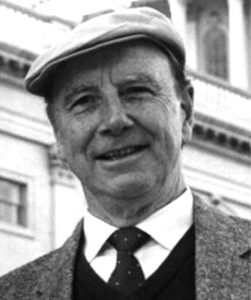
Patrick Clancy dies at home of lung cancer on November 11, 1998, at the age of 76. He is buried, wearing his trademark white cap, in the tiny village of Faugheen, near Carrick-on-Suir.
O’Mahony is born in 1816 in Kilbeheny, County Limerick. His father and uncle were members of the Society of United Irishmen and took part in the Irish Rebellion of 1798. On the death of an elder brother, he inherits a property which yields £300 per annum. He enters Trinity College, Dublin, where he studies Sanskrit, Hebrew, and Irish. He becomes an accomplished Gaelic scholar, and later teaches Greek and Latin, and contributes articles to Irish and French journals. He leaves Trinity without getting a degree.
In 1843, O’Mahony joins Daniel O’Connell‘s movement for the Repeal of the Acts of Union 1800, but quickly becomes dissatisfied with the lack of progress and joins the Young Ireland movement which William Smith O’Brien leads and takes part in the failed Young Ireland Rebellion of 1848. His participation in the rebellion obligates him to leave Ireland, and he settles for a time in Paris, where he lives in great poverty. In 1854, he joins John Mitchel in New York City, and takes part in the Emigrant Aid Association, the Emmet Monument Association, and other Irish organisations.
In 1857, O’Mahony publishes History of Ireland, by Geoffrey Keating, D. D., translated from the Original Gaelic, and Copiously Annotated (New York, 1857). O’Mahony’s notes are copied from John O’Donovan‘s translations of Annals of the Four Masters, and it is on this ground that Hodges & Smith procures an injunction against the sale of the book in the United Kingdom. The mental strain to which O’Mahony is subjected in the preparation of this work, which brings him no pecuniary gain, affects his reasoning and he is removed by his friends for a short time to a lunatic asylum.
In 1860, O’Mahony organises the Fenian Brotherhood, also known as the Irish Republican Brotherhood. The object of the association is to secure the freedom of Ireland. The name is probably derived from O’Mahony’s Gaelic studies, the Fenians having been a military body in pagan Ireland, celebrated in the songs of Ossian. The organisation of the new society is completed at conventions that are held in Chicago in 1864 and in Cincinnati in January 1865.
At the time of the Cincinnati convention, O’Mahony holds the rank of colonel of the 69th Regiment of New York State Militia, recruited mainly from the ranks of the Brotherhood, which has also furnished a large proportion of Thomas Francis Meagher‘s Irish Brigade, Michael Corcoran‘s legion, and Irish regiments engaged in the American Civil War. The rapid growth in membership of the Fenian Brotherhood renders it impossible for O’Mahony to retain the colonelcy of the 69th regiment, which he has held for some time. He resigns in order to give all his attention to the spread of Fenianism.
The close of the civil war in the spring of 1865 gives a great impetus to the Fenians, owing to the number of Irish American soldiers that are disbanded and anxious to see service elsewhere. Money pours into the Fenian exchequer. Many differences occur between O’Mahony and James Stephens and the Central Council relative to the policy to be pursued for the attainment of their object, but O’Mahony remains president of the organisation for several years. He does not take any part personally in the attempted insurrection in Ireland or in the raids on Canada, although his advice counts for much in these enterprises.
He devotes the last years of his life to literary pursuits, but suffers from ill health, and he has a hard struggle to secure the bare means for subsistence. However, visionary may have been his objectives, he is honest, and although thousands have passed through his hands, he is often at a loss for a dollar. When his poverty is discovered, he declines to receive assistance in any form. He dies in New York City on February 7, 1877, and soon after his death his remains are returned to Ireland and interred with the honors of a public funeral in Glasnevin Cemetery in Dublin.
Flatley begins dancing lessons at age 11 and, at age 17, is the first American to secure a World Irish Dance title at the World Irish Dance Championships, the Oireachtas Rince na Cruinne. He is also an accomplished flautist, having won twice in the All-Ireland Fleadh Cheoil Concert Flute competitions from 1975-1976.
Flatley is taught dance by Dennis Dennehy at the Dennehy School of Irish Dance in Chicago. After graduating from Brother Rice High School, on Chicago’s Southwest Side, he opens a dance school but later closes it to focus on performing.
In 1978 and 1979 Flatley tours with Green Fields of America and then with The Chieftains in the 1980s. In May 1989, Flatley sets a Guinness Book world record for tapping speed at 28 taps per second, and subsequently breaks his own record in 1998 with 35 taps per second.
Flatley creates and choreographs the original Riverdance and leads the show to great success as the intermission act in the Eurovision Song Contest staged in Ireland on April 30, 1994. Flatley abruptly leaves the show over creative control disputes in October 1995.
Shortly after the Riverdance split, Flatley creates Lord of the Dance, which plays mostly in arenas and stadiums instead of stage theaters. He also puts together a dance production called Feet of Flames in 1998. Flately’s Irish dance show Celtic Tiger opens in July 2005. The show explores the history of the Irish people and Irish emigration to the United States, fusing a wide range of dance styles, including jazz.
Flatley returns to the stage in 2009 for a limited run of the “Hyde Park” version of Feet of Flames in Taiwan. His return is met with multiple standing ovations and the run of shows has to be extended to meet the demand for tickets.
Flatley premiers Lord of the Dance: Dangerous Games at the celebrated Palladium Theatre on London’s West End in 2014 and moves to the Dominion Theatre in 2015 where he makes his final appearance on the West End stage before revisiting another sold out Wembley Arena for his final performance in the United Kingdom.
Flatley embarks on his final tour on February 19, 2016 and performs on stage for the last time at The Colosseum at Caesar’s Palace in Las Vegas, NV, on March 17, 2016. He continues as the show’s creator, producer, and choreographer.
The first aircraft, an Irish Air Corps Aero Anson A43, lands at the newly opened Rineanna Airfield, which is later to become known as Shannon International Airport, on May 18, 1939.
Transatlantic aviation in the Shannon Estuary first commences with a seaplane base at Foynes. In October 1935, the Irish Government makes a decision to initiate a survey to find suitable bases for the operation of seaplanes and land planes on a transatlantic service. The Department of Defence, which provides technical advice on aviation to the Civil Aviation Section of the Department of Industry, is given the task.
On November 21, 1935, a survey party sets out and surveys sites as far north as Athlone and south to Askeaton. Among the sites for a seaplane base to be considered are the Shannon just below Limerick, Lough Derg, Lough Corrib, Tralee Bay, Kenmare Bay, Lough Ree, and Valentia. Foynes, near the mouth of the Fergus River, is finally selected due to its sheltered anchorage and its proximity to long open stretches of water.
The first priority is drainage to remove surface water from the site and to construct embankments to prevent flooding of the airfield due to its proximity to the tidal River Shannon. Several hundred men are employed to dig narrow lateral drains for the approximately 135 miles of pipes which are laid in parallel lines 50 feet apart over almost the entire area of the airfield site. They also excavate catchment drains to collect water from the surface of the site.
At this time all indications are that regular aerial travel between Europe and the United States will be initially by flying boat and accordingly, the base at Rineanna is designed to cater to both land planes and flying boats. Construction work commences to build embankments and a breakwater to provide for a seaplane base and to protect the airfield site from flooding from the River Shannon.
Developments in aviation during World War I ensure land planes and not flying boats are to be the future of aviation, therefore the mooring basin and the east breakwater which are being constructed for flying boats at Rineanna are never quite finished. Construction of the embankments continue to protect the site from the River Shannon and to form a drainage lagoon for surface water from the western headland of the airport site.
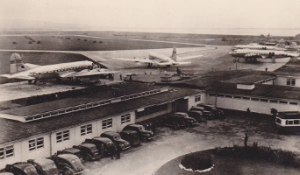
When World War II ends, the airport is ready to be used by the many new post-war commercial airlines of Europe and North America. On September 16, 1945, the first transatlantic proving flight, a Pan AmDC-4, lands at Shannon from New York City. On October 24, the first scheduled commercial flight, an American Overseas Airlines DC-4, passes through Shannon Airport. An accident involving President Airlines on September 10, 1961 results in the loss of 83 lives. The Douglas DC-6 aircraft crashes into the River Shannon while leaving Shannon Airport for Chicago.
The number of international carriers rises sharply in succeeding years as Shannon becomes well known as the gateway between Europe and the Americas as limited aircraft range necessitates refueling stops on many journeys. Shannon becomes the most convenient stopping point before and after a trip across the Atlantic. Additionally, during the Cold War, many transatlantic flights from the Soviet Union stop here for refueling, because Shannon is the westernmost non-NATO airport.
Shannon Airport is one of Ireland’s three primary airports, along with Dublin Airport and Cork Airport, and includes the longest runway in Ireland at 10,495 feet. It is a designated emergency landing site for the Space Shuttle during the U.S. shuttle program. In 2015, 1.715 million passengers pass through the airport, making it the third busiest airport in the country after Dublin and Cork. Shannon Airport is in Shannon, County Clare, and mainly serves Limerick, Ennis, Galway, and the south-west of Ireland.




 seamus dubhghaill