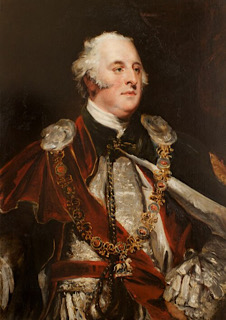
In 1786, Pratt’s father is created Earl Camden, at which point he becomes known by one of his father’s subsidiary titles as Viscount Bayham.
In 1793, Pratt is sworn of the Privy Council. In 1794 he succeeds his father as 2nd Earl Camden, and the following year he is appointed Lord Lieutenant of Ireland by Pitt.
Pratt resigns from office in June 1798, to be replaced with Charles Cornwallis, 1st Marquess Cornwallis, who oversees the military defeat of the rebellion. In 1804, Pratt becomes Secretary of State for War and the Colonies under Pitt, and in 1805 Lord President of the Council, an office he retains until 1806. He is again Lord President from 1807 to 1812, after which date he remains for some time in the cabinet without office. In 1812 he is created Earl of Brecknock and Marquess Camden.
The enforced resignation from the Cabinet of Robert Stewart, Viscount Castlereagh, the stepson of his sister Frances (Lady Londonderry), to whom he has always been personally close, in September 1809, leads to a series of bitter family quarrels, when it becomes clear that Pratt has known for months of the plan to dismiss Stewart, but has given him no warning. Stewart himself regards Pratt as “a weak friend,” not an enemy, and they are eventually reconciled. Other members of the Stewart family, however, never forgive Pratt for what they regard as his disloyalty.
Pratt marries Frances, daughter of William Molesworth, in 1785. She dies at Bayham Abbey, Sussex, in July 1829. He survives her by eleven years and dies at Seal, Kent, on October 8, 1840, aged 81. He is succeeded by his only son, George.
Cuffe is the son of John Otway Cuffe, 2nd Earl of Desart, and Catherine, daughter of Maurice O’Connor. He succeeds in the earldom in November 1820, aged two, on the early death of his father. He is educated at Eton College and enters Christ Church, Oxford in 1836 but takes no degree.
Cuffe marries Lady Elizabeth Lucy Campbell, daughter of John Campbell, 1st Earl Cawdor, in 1842. They have three sons and a daughter. He dies at the age of 46 at his home in Belgravia, City of Westminster, Greater London on April 1, 1865, due to a fall suffered during an attack of paralysis. He is buried in Castleinch Cemetery, Kilkenny, County Kilkenny. He is succeeded in the earldom by his son, William. The Countess of Desart dies in April 1898, aged 76.
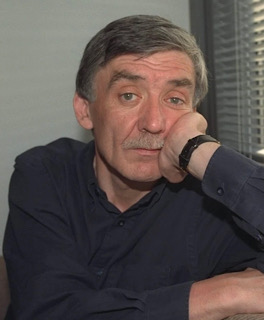
O’Callaghan is born into a family with a Fenianparamilitary history. His paternal grandfather had taken the Anti-Treaty side during the Irish Civil War, and his father had been interned by the Irish Government at the Curragh Camp in County Kildare for IRA activity during World War II.
By the late 1960s, O’Callaghan ceases to practise his Catholic faith, adopts atheism and has become interested in the theories of Marxist revolutionary politics, which finds an outlet of practical expression in the sectarian social unrest in Northern Ireland at the time, centered on the activities of the Northern Ireland Civil Rights Association. In 1969, communal violence breaks out in Northern Ireland and believing that British imperialism is responsible, he joins the newly founded Provisional IRA at the age of 17.
Soon afterward, O’Callaghan is arrested by local Gardaí after he accidentally detonates a small amount of explosives, which cause damage to the homes of his parents and their neighbours. After demanding, and receiving, treatment as a political prisoner, he quietly serves his sentence.
After becoming a full-time paramilitary with the IRA, in the early to mid-1970s O’Callaghan takes part in over seventy operations associated with Irish Republican political violence including bomb materials manufacture, attacks on IRA targets in Northern Ireland, and robberies to provide funding for the organisation.
In 1976, O’Callaghan ends his involvement with the IRA after becoming disillusioned with its activities. He later recalls that his disenchantment with the IRA began when one of his compatriots openly hoped that a female police officer who had been blown up by an IRA bomb had been pregnant so they could get “two for the price of one.” He is also concerned with what he perceives as an undercurrent of ethnic hatred in its rank and file toward the Ulster Scots population. He leaves Ireland and moves to London. In May 1978, he marries a Scottish woman of Protestantunionist descent. During the late 1970s, he runs a successful mobile cleaning business. However, he is unable to fully settle into his new life, later recalling, “In truth there seemed to be no escaping from Ireland. At the strangest of times I would find myself reliving the events of my years in the IRA. As the years went on, I came to believe that the Provisional IRA was the greatest enemy of democracy and decency in Ireland.”
In 1979, O’Callaghan is approached by the IRA seeking to recruit him again for its paramilitary campaign. In response, he decides to turncoat against the organisation and becomes an agent within its ranks for the Irish Government. He decides to become a double agent even though he knows that even those who hate the IRA as much as he now does have a low opinion of informers. However, he feels it is the only way to stop the IRA from luring teenagers into their ranks and training them to kill.
Soon after being approached by the IRA to re-join, O’Callaghan returns to Tralee from London, where he arranges a clandestine meeting with an officer of the Garda Special Detective Unit in a local cemetery, at which he expresses his willingness to work with it to subvert the IRA from within. At this point, he is still opposed to working with the British Government. A few weeks later, he makes contact with Kerry IRA leader Martin Ferris and attends his first IRA meeting since 1975. Immediately afterward, he telephones his Garda contact and says, “We’re in”.
During the 1981 hunger strike in the Maze Prison, O’Callaghan attempts to start his own hunger strike in support of the Maze prisoners but is told to desist by the IRA for fear it will detract focus from the prisoners. He successfully sabotages the efforts of republicans in Kerry from staging hunger strikes of their own.
In 1984, O’Callaghan notifies the Garda of an attempt to smuggle seven tons of AK-47assault rifles from the United States to Ireland aboard a fishing trawler named Valhalla. The guns are intended for the arsenal of the Provisional IRA’s units. As a result of his warning, a combined force of the Irish Navy and Gardaí intercept the boat that received the weaponry, and the guns are seized. The seizure marks the complete end of any major attempt by the IRA to smuggle guns out of the United States.
In 1983, O’Callaghan claims to be tasked by the IRA with placing 25 lbs. of Frangex in the Dominion Theatre in London, in an attempt to kill Prince Charles and Princess Diana who are due to attend a charity pop music concert there. A warning is phoned into the Garda, and the Royal couple are hurriedly ushered from the theatre by their police bodyguard during the concert. The theatre had been searched before the concert and a second search following the warning reveals no device.
In 1985, O’Callaghan is elected as a Sinn Féin councillor for Tralee Urban District Council, and unsuccessfully contests a seat on Kerry County Council.
After becoming disillusioned with his work with the Irish Government following the murder of another of its agents within the IRA, which it had failed to prevent despite O’Callaghan’s warnings of the threat to him, and sensing a growing threat to himself from the organisation which had become suspicious of his own behaviour, he withdraws from the IRA and leaves Ireland to live in England, taking his wife and children with him. His marriage ends in a divorce in 1987, and on November 29, 1988, he walks into a police station in Tunbridge Wells, Kent, England, where he presents himself to the officer on duty at the desk, confesses to the murder of Ulster Defence Regiment (UDR) Greenfinch (female member) Eva Martin and the murder of D.I. Peter Flanagan during the mid-1970s, and voluntarily surrenders to British prosecution.
Although the Royal Ulster Constabulary (RUC) offers him witness protection as part of the informer policy, O’Callaghan refuses it and is prosecuted under charges of two murders and 40 other crimes, to all of which he pleads guilty, committed in British jurisdiction with the IRA. Having been found guilty, he is sentenced to a total of 539 years in prison. He serves his sentence in prisons in Northern Ireland and England. While in jail, he publishes his story in The Sunday Times. He is released after being granted the royal prerogative of mercy by Queen Elizabeth II in 1996.
In 1998, O’Callaghan publishes an autobiographical account of his experiences in Irish Republican paramilitarism, entitled The Informer: The True Life Story of One Man’s War on Terrorism (1998).
In 2002, O’Callaghan is admitted to Nightingale Hospital, Marylebone, an addiction and rehab center where he undergoes a rehabilitation program for alcohol dependency. His identity and past activities are not revealed to the other patients. He lives relatively openly in London for the rest of his life, refusing to adopt a new identity. He is befriended in the city by the Irish writer Ruth Dudley Edwards, and works as a security consultant, and also occasional advisor to the Ulster Unionist Party (UUP) on how to handle Irish republicanism in general, and Sinn Féin in particular.
In 2006, O’Callaghan appears in a London court with regard to an aggravated robbery that occurs in which he is the victim.
In 2015, O’Callaghan publishes James Connolly: My Search for the Man, the Myth & his Legacy (2015), a book containing a critique of the early 20th century Irish revolutionary James Connolly, and what he considers to be his destructive legacy in Ireland’s contemporary politics.
O’Callaghan dies by drowning after suffering a heart attack at the age of 63 while in a swimming pool in Kingston, Jamaica, on August 23, 2017, while visiting his daughter. A memorial service is held in his memory on March 21, 2018, at St. Martin’s-in-the-Fields, a Church of England parish church at the northeast corner of Trafalgar Square in the City of Westminster, London. The service is attended by representatives from Ulster Unionist parties and the Irish Government.
FitzGerald marries Charlotte Boyle Walsingham in London on August 3, 1791. Together they live at Boyle Farm, Thames Ditton. In 1806, his wife succeeds to the Baron de Ros, the premier baron in the Peerage of England, as 20th Baroness de Ros. The family then takes the surname FitzGerald-de Ros. The couple has 13 children in 21 years, of which nine survive to adulthood.
He returns to England to be brigade major of the 2nd Infantry Brigade at Aldershot in 1886. He becomes deputy assistant adjutant general at Horse Guards in 1892, and deputy assistant adjutant general at Aldershot in 1894. He takes part in the Fourth Anglo-Ashanti War in 1895 and becomes assistant adjutant general at Horse Guards in 1897.
Stopford takes part in the Second Boer War as military secretary to General Sir Redvers Buller and later military secretary to the general officer commanding Natal, for which he is knighted as a Knight Commander of the Order of St. Michael and St. George in November 1900. After his return to Britain, he is appointed deputy adjutant general at Aldershot in 1901, and chief staff officer for I Corps with the temporary rank of brigadier general, on April 1, 1902. Two years later, he is appointed director of military training at Horse Guards. Promoted to major general in February 1904, he is Major-General commanding the Brigade of Guards and general officer commanding (GOC) of the London District from 1906. He is promoted to lieutenant general in September 1909.
On August 5, 1914, a day after the British entry into World War I, he is appointed GOC First Army, part of Home Forces, a position he holds until he takes command of IX Corps the following year.
As GOC of IX Corps, Stopford is blamed for the failure to attack following the landing at Suvla Bay in August 1915, during the Gallipoli campaign. He chose to command the landing from HMS Jonquil, anchored offshore, but sleeps as the landing is in progress. He is quickly replaced on August 15 by Major-General Sir Julian Byng.
After almost 50 years of military service, Stopford retires from the army in 1920.
Stopford dies at the age of 75 on May 4, 1929, at Marylebone, City of Westminster, Greater London, England. He is buried in the Holy Trinity and St. Andrew’s Churchyard in Ashe, Basingstoke and Deane borough, Hampshire, England.
Pery is the son of William Cecil Pery, 1st Baron Glentworth, and his first wife, Jane Walcott, daughter of John Minchin Walcott. He is educated at Trinity College Dublin (TCD). He marries Alice Mary Ormsby, the daughter of Henry Ormsby of County Mayo, by his wife Mary Hartstonge, in 1783, and they have at least eight children. Alice Mary is the heiress of her uncle, Sir Henry Hartstonge, 3rd Baronet, who leaves her substantial property in the south of Ireland.
Pery is elected to the Parliament of Ireland as the Member of Parliament for Limerick City in 1786 and holds the seat until 1794, when he inherits his father’s barony and takes his seat in the Irish House of Lords. As a politician, he is a vocal Unionist. He holds the office of Keeper of the Signet and Privy Seal of Ireland between 1795 and 1797. In 1797, he is invested as a Privy Counsellor. He subsequently holds the office of Clerk of the Crown and Hanaper of Ireland between 1797 and 1806. In 1800, he is created Viscount Limerick of the City of Limerick.
Pery’s eldest son and heir, Henry Hartstonge Pery, Viscount Glentworth, predeceases him on August 7, 1834, and thus Pery is succeeded in his titles by Henry’s eldest son, William Henry Tenison Pery. One of Pery’s daughters, Theodosia, marries the Whig politician and Chancellor of the Exchequer, Thomas Spring Rice, 1st Baron Monteagle of Brandon.
Cluney tours briefly with the band Dark Lady supporting Jake Burns and the Big Wheel, notably at the Marquee Club in Wardour Street, Soho, City of Westminster, London, but then spends five years back in Belfast teaching guitar until Stiff Little Fingers is reformed. He is a regular songwriting contributor for the group’s first four albums, taking over lead vocal duties on his own compositions. He leaves the group amid some acrimony in 1993.
Cluney moves to Rochester, Minnesota, in 1997, keeping up his involvement in music, playing guitar with several regional rock bands.
Cluney completes a feature-length film in 2009 and tours the United Kingdom for the first time in fifteen years, as the opening for The Damned and The Alarm on their 341 tour. He subsequently tours the next two years, as a solo artist, and in 2013 forms XSLF with former bandmate Jim Reilly, and friend, Ave Tsarion.
Cluney currently lives in Rochester with his wife, Carol, while touring frequently throughout the United Kingdom (including Northern Ireland), Ireland and Europe with his nephew David Cluney who also plays the guitar.
Born in Derry in 1677, Farquhar is one of seven children born to William Farquhar, a clergyman of modest means. The author of “Memoirs of Mr. George Farquhar,” a biographical sketch prefixed to certain 18th-century editions of his works, claims that he “discovered a Genius early devoted to the Muses. When he was very young, he gave Specimens of his Poetry; and discovered a Force of Thinking, and Turn of Expression, much beyond his years.”
Farquhar is educated at Foyle College and later enters Trinity College Dublin at age seventeen as a sizar under the patronage of the Bishop of Dromore, who may have been related to Farquhar’s mother. He may have initially intended to follow his father’s profession and become a clergyman but is “unhappy and rebellious as a student” and leaves college after two years to become an actor. His 18th-century biographer claims that the departure is because “his gay and volatile Disposition could not long relish the Gravity and Retirement of a College-life,” but another story of uncertain veracity has him being expelled from Trinity College due to a “profane jest.” The two accounts are not necessarily mutually exclusive.
Farquhar joins a company performing on the Dublin stage, probably through his acquaintance with the well-known actor Robert Wilks. However, he is reportedly not that impressive as an actor. It is said that “his voice was somewhat weak” and that “his movements [were] stiff and ungraceful.” But he is well received by audiences and thought to continue in this career “till something better should offer.” Some of the roles reportedly played by Farquhar are Lennox in William Shakespeare‘s Macbeth, Young Bellair in The Man of Mode by George Etherege, Lord Dion in Philaster by Francis Beaumont and John Fletcher, and Guyomar in The Indian Emperour by John Dryden.
During one of the performances in the Dryden play, an accident on stage puts an end to Farquhar’s acting career. As Guyomar, he is supposed to “kill” Vasquez, one of the Spanish generals in the drama. Forgetting to exchange his sword for a foil before enacting this scene, he severely wounds Price, the actor playing Vasquez. Although Price recovers, Farquhar resolves after this mishap to give up acting for good.
Farquhar then leaves for London, “possibly with a draft of his first play in his portmanteau.” Some writers tie his move to that of his friend Wilks, who had received an offer from the manager of Drury Lane to come to London and join that theatre. Wilks is also credited with encouraging Farquhar’s efforts at writing plays.
Farquhar’s first comedy, Love and a Bottle, premieres in 1698 and is well received by the audience. Called a “licentious piece” by one scholar and cited as proof that Farquhar had “absorbed the stock topics, character-types, and situations of Restoration comedy” by another, the play deals with Roebuck, “An Irish Gentleman of a wild roving Temper” who is “newly come to London.” The general character of the play can be evaluated by considering that in the opening scene, Roebuck tells his friend Lovewell that he has left Ireland due to getting a woman pregnant with twins and to Roebuck’s father trying to force Roebuck to marry the woman; however, Roebuck remarks, “Heav’n was pleas’d to lessen my Affliction, by taking away the She-brat.”
After the favourable reception of Love and a Bottle, Farquhar decides to devote himself to playwriting. He also at this point receives a commission in the regiment of the Earl of Orrery, so his time for the next few years is divided between the vocations of soldier and dramatist. It is also at about this time that he discovers Anne Oldfield, who is reading aloud a scene from The Scornful Lady at her aunt’s tavern. Impressed, he brings her to the notice of Sir John Vanbrugh, and this leads to her theatrical career, during which she is the first performer of major female roles in Farquhar’s last comedies.
In 1700, Farquhar’s The Constant Couple is acted at Drury Lane and proves a great success, helped considerably by his friend Wilks’ portrayal of the character of Sir Henry Wildair. The playwright follows up with a sequel, Sir Harry Wildair, the following year, and in 1702 writes the comedies The Inconstant and The Twin Rivals. Also in 1702, he publishes Love and Business, a collection that includes letters, verse, and A Discourse Upon Comedy.
The next year, Farquhar marries Margaret Pemell, “a widow with three children, ten years his senior,” who reportedly tricks him into the marriage by pretending to have a great fortune. His 18th century biographer records that “though he found himself deceived, his Circumstances embarrassed, and his Family increasing, he never upbraided her for the Cheat but behaved to her with all the Delicacy and Tenderness of an indulgent Husband.” He is engaged in recruiting for the army, due to the War of the Spanish Succession, for the next three years, writing little except The Stage Coach in collaboration with Peter Motteux, an adaptation of a French play. He draws on his recruiting experience for his next comedy, The Recruiting Officer (1706). However, he has to sell his army commission to pay debts, reportedly after the Duke of Ormonde advises him to do so, promising him another but failing to keep his promise.
Early in 1707, Farquhar’s friend Wilks visits him. Farquhar is ill and in distress, and Wilks is said to have “cheered him with a substantial present and urged him to write another comedy.” This comedy, The Beaux’ Stratagem, is given its première on March 8, 1707. It is known from Farquhar’s own statement prefacing the published version of the play that he wrote it during his sickness:
“The reader may find some faults in this play, which my illness prevented the amending of; but there is great amends made in the representation, which cannot be match’d, no more than the friendly and indefatigable care of Mr. Wilks, to whom I chiefly owe the success of the play.”
Ellen Kean, one of the finest English actresses of her day, dies in Bayswater, City of Westminster, England on August 20, 1880. She is known as Ellen Tree until her marriage in 1842, after which she is known both privately and professionally as Mrs. Charles Kean and always appears in productions together with her husband.
Kean is born Eleanora Tree in Ireland on December 12, 1805, the third of four daughters of Cornelius Tree, an official of the East India Company in London. Her three sisters become actresses, but, unlike Ellen, retire from the stage when they marry. Her professional stage debut is in a musical version of Twelfth Night in London in 1822 as Olivia alongside her sister Maria as Viola. She gains experience touring in the provinces, and from 1826 is a regular member of the companies at the Theatre Royal, Drury Lane and Theatre Royal Haymarket, making a success in The Wonder and The Youthful Queen. At the Royal Opera House at Covent Garden, she takes on the roles of William Shakespeare‘s Romeo to the Juliet of Fanny Kemble, Françoise de Foix in Francis I, and Lady Townley in The Provoked Husband.
In 1832, by now established as a leading actress, Tree accepts an engagement in Hamburg, Germany, where a junior member of the company is Charles Kean. He had made an undistinguished debut at Drury Lane in 1827, and he and Tree had acted together in 1828 in a play called Lovers’ Vows and later in Othello. In the German season they fall in love but are persuaded by family and friends not to marry in haste. Tree returns to London and resumes her successful West End career, including a considerable success in Ion in another breeches role. At the end of 1836, Tree goes to the United States, where she tours in Shakespeare for more than three years, playing heroines such as Rosalind, Viola and Beatrice, among other roles. By the time of her return to England in 1839, she has made a profit of £12,000 on the tour, equivalent to at least £1 million in modern terms.
By 1841 Charles Kean has established himself as a successful actor, and he and Tree appear together in Romeo and Juliet at the Theatre Royal Haymarket. They are married the next year, and she at once switches her professional name from Ellen Tree to Mrs. Charles Kean. For the next nine years they appear together at the Haymarket, making a joint visit to the United States in 1846. In 1850, Kean takes over the management of the Princess’s Theatre in London. The Times called this “the most important period of Mrs. Kean’s career…. Hitherto she had been the Rosalind and the Viola of the stage; henceforward her name was to be associated with characters of a more matronly type” in roles including Lady Macbeth and Gertrude in Hamlet. The same writer also credits her for “the good taste and artistic completeness” of Kean’s productions. Ellen Terry, who makes her first stage appearance as the boy Mamillius in The Winter’s Tale, remembers Kean “as Hermione wearing a Greek wreath round her head and a crinoline with many layers of petticoats.”
Charles Kean dies in 1868, and his widow retires from the stage, living quietly in Bayswater, in the City of Westminster, where she dies at the age of 73 on August 20, 1880. The Times in its obituary says, “Mrs. Kean is not to be numbered with the greatest votaries of the English stage, but her acting was distinguished by considerable power, tenderness and refinement.” She is buried in a vault alongside her husband at Catherington, Hampshire.
(Pictured: “Charles Kean and Wife Ellen Tree” by Mathew Brady Studio (1844-1894), modern albumen print from wet plate collodion negative, National Portrait Gallery, Smithsonian Institution)



 seamus dubhghaill