Two acts are passed in 1800 with the same long title: An Act for the Union of Great Britain and Ireland. The short title of the act of the British Parliament is Union with Ireland Act 1800, assigned by the Short Titles Act 1896. The short title of the act of the Irish Parliament is Act of Union (Ireland) 1800, assigned by a 1951 act of the Parliament of Northern Ireland, and hence not effective in the Republic of Ireland, where it was referred to by its long title when repealed in 1962.
Before these acts, Ireland has been in personal union with England since 1542, when the Irish Parliament passes the Crown of Ireland Act 1542, proclaiming King Henry VIII of England to be King of Ireland. Since the 12th century, the King of England has been technical overlord of the Lordship of Ireland, a papal possession. Both the Kingdoms of Ireland and England later come into personal union with that of Scotland upon the Union of the Crowns in 1603.
In 1707, the Kingdom of England and the Kingdom of Scotland are united into a single kingdom: the Kingdom of Great Britain. Upon that union, each House of the Parliament of Ireland passes a congratulatory address to Queen Anne, praying her: “May God put it in your royal heart to add greater strength and lustre to your crown, by a still more comprehensive Union.” The Irish Parliament is both before then subject to certain restrictions that made it subordinate to the Parliament of England and after then, to the Parliament of Great Britain; however, Ireland gains effective legislative independence from Great Britain through the Constitution of 1782.
By this time access to institutional power in Ireland is restricted to a small minority: the Anglo-Irish of the Protestant Ascendancy. Frustration at the lack of reform among the Catholic majority eventually leads, along with other reasons, to a rebellion in 1798, involving a French invasion of Ireland and the seeking of complete independence from Great Britain. This rebellion is crushed with much bloodshed, and the motion for union is motivated at least in part by the belief that the union will alleviate the political rancour that led to the rebellion. The rebellion is felt to have been exacerbated as much by brutally reactionary loyalists as by United Irishmen (anti-unionists).
Furthermore, Catholic emancipation is being discussed in Great Britain, and fears that a newly enfranchised Catholic majority will drastically change the character of the Irish government and parliament also contributes to a desire from London to merge the Parliaments.
According to historian James Stafford, an Enlightenment critique of Empire in Ireland lays the intellectual foundations for the Acts of Union. He writes that Enlightenment thinkers connected “the exclusion of the Irish Kingdom from free participation in imperial and European trade with the exclusion of its Catholic subjects, under the terms of the ‘Penal Laws’, from the benefits of property and political representation.” These critiques are used to justify a parliamentary union between Britain and Ireland.
Complementary acts are enacted by the Parliament of Great Britain and the Parliament of Ireland.
The Parliament of Ireland gains a large measure of legislative independence under the Constitution of 1782. Many members of the Irish Parliament jealously guard that autonomy (notably Henry Grattan), and a motion for union is legally rejected in 1799. Only Anglicans are permitted to become members of the Parliament of Ireland though the great majority of the Irish population are Roman Catholic, with many Presbyterians in Ulster. Under the Roman Catholic Relief Act 1793, Roman Catholics regain the right to vote if they own or rent property worth £2 annually. Wealthy Catholics are strongly in favour of union in the hope for rapid religious emancipation and the right to sit as MPs, which only comes to pass under the Roman Catholic Relief Act 1829.
From the perspective of Great Britain’s elites, the union is desirable because of the uncertainty that follows the French Revolution of 1789 and the Irish Rebellion of 1798. If Ireland adopts Catholic emancipation willingly or not, a Roman Catholic Parliament could break away from Britain and ally with the French, but the same measure within the United Kingdom would exclude that possibility. Also, in creating a regency during King George III‘s “madness”, the Irish and British Parliaments give the Prince Regent different powers. These considerations lead Great Britain to decide to attempt the merger of both kingdoms and Parliaments.
The final passage of the Act in the Irish House of Commons turns on an about 16% relative majority, garnering 58% of the votes, and similar in the Irish House of Lords, in part per contemporary accounts through bribery with the awarding of peerages and honours to critics to get votes. The first attempt is defeated in the Irish House of Commons by 109 votes to 104, but the second vote in 1800 passes by 158 to 115.
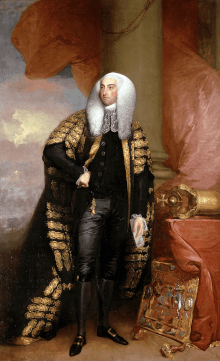
When appointed Lord Chancellor of Ireland in 1789, FitzGibbon is granted his first peerage as Baron FitzGibbon, of Lower Connello in the County of Limerick, in the Peerage of Ireland that year. This does not entitle him to a seat in the British House of Lords, only in the Irish House of Lords. His later promotions come mostly in the Peerage of Ireland, being advanced to a Viscountcy in 1793 and the Earldom of Clare in 1795. He finally achieves a seat in the British House of Lords in 1799 when created Baron FitzGibbon, of Sidbury in the County of Devon, in the Peerage of Great Britain.
As Lord Chancellor for Ireland, FitzGibbon is a renowned champion of the Protestant Ascendancy and an opponent of Catholic emancipation. He despises the Parliament of Ireland‘s popular independent Constitution of 1782. He is also personally and politically opposed to the Irish politician Henry Grattan who urges a moderate course in the Irish Parliament and is responsible for defeating Grattan’s efforts to reform the Irish land tithe system under which Irish Catholic farmers (and all non-Anglican farmers) are forced to financially support the minority Anglican Church of Ireland. These are not fully repealed until 1869 when the Church of Ireland is finally disestablished, although Irish tithes are commuted after the Tithe War (1831–1836).
FitzGibbon opposes the Irish Roman Catholic Relief Act 1793 personally but apparently recommends its acceptance in the House of Lords, being forced out of necessity when that Act had been recommended to the Irish Executive by the British Cabinet led by William Pitt the Younger. Pitt expects Ireland to follow the British Roman Catholic Relief Act 1791 and allow Catholics to vote again and hold public offices. At the same time, FitzGibbon apparently denounces the policy this Act embodies, so it is probably safe to say that FitzGibbon’s own beliefs and principles conflict with his obligations as a member of the Irish executive of the time.
FitzGibbon’s role in the recall, soon after his arrival, of the popular pro-Emancipation Lord Lieutenant of Ireland, William Fitzwilliam, 4th Earl of Fitzwilliam, is debatable. Although he is probably politically opposed to the Lord Lieutenant of Ireland, Fitzwilliam is apparently recalled, because of his own independent actions. Fitzwilliam is known to be friendly to the Ponsonby family and is generally a Foxite liberal Whig. His close association with and patronage of Irish Whigs led by Grattan and Ponsonby during his short tenure, along with his alleged support of an immediate effort to secure Catholic emancipation in a manner not authorized by the British cabinet is likely what leads to his recall. Thus, if anyone is to blame in the short-lived “Fitzwilliam episode” it is Henry Grattan and the Ponsonby brothers – presumably William Ponsonby, later Lord Imokilly, and his brother George Ponsonby — not to mention Lord Fitzwilliam himself. Irish Catholics at the time and later naturally see things very differently and blame hardline Protestants such as FitzGibbon.
Irish Catholics and FitzGibbon apparently agree on one point – Irish political and economic union with Great Britain, which eventually takes place in 1801. Pitt wants Union with Ireland concomitantly with Catholic emancipation, commutation of tithes, and the endowment of the Irish Catholic priesthood. Union is opposed by most hardline Irish Protestants, as well as liberals such as Grattan. FitzGibbon is a strong supporter of the Union since 1793 but refuses to have Catholic emancipation with the Union.
In the end, FitzGibbon’s views wins out, leading to the Union of Ireland with Great Britain to form the United Kingdom of Great Britain and Ireland without any concessions for Ireland’s Catholic majority, or for that matter, Catholics in the rest of the new United Kingdom. He later claims that he has been duped by the way in which the Act is passed and is bitterly opposed to any concessions during the short remainder of his life.
FitzGibbon’s role as Lord Chancellor of Ireland during the period of the 1798 rebellion is questionable. According to some, he supports a hardline policy which uses torture, murder and massacre to crush the rebellion, or that as Lord Chancellor, he has considerable influence on military affairs, and that martial law cannot be imposed without his consent. Others allege that as Lord Chancellor, he has no say in military affairs. His former side is displayed by sparing the lives of the captured United Irish leaders in return for their confession of complicity and provision of information relating to the planning of the rebellion. However, this willingness of the prisoners to partake of the agreement is spurred by the execution of the Sheares brothers on July 14, 1798.
In contrast to the leniency shown to the largely upper-class leadership, the full weight of military repression is inflicted upon the common people throughout the years 1797–98 with untold thousands suffering imprisonment, torture, transportation and death. Fitzgibbon ss inclined to show no mercy to unrepentant rebels and in October 1798 he expressed his disgust upon the capture of Wolfe Tone that he had been granted a trial and his belief that Tone should have been hanged as soon as he set foot on land.
FitzGibbon is quick to recognise that sectarianism is a useful ally to divide the rebels and prevent the United Irishmen from achieving their goal of uniting Protestant, Catholic and Dissenter, writing in June 1798, “In the North nothing will keep the rebels quiet but the conviction that where treason has broken out the rebellion is merely popish.”
FitzGibbon is noted by some as a good, improving landlord to both his Protestant and Catholic tenants. Some claim that the tenants of his Mountshannon estate call him “Black Jack” FitzGibbon. However, there is no evidence to support this claim, although there is little to no evidence on his dealings as a landlord. Irish nationalists and others point out that while he might have been interested in the welfare of his own tenants on his own estate, he treats other Irish Catholics very differently. Without further evidence, his role as a Protestant landowner in mainly Catholic Ireland is of little importance against his known dealings as Lord Chancellor.
FitzGibbon dies at his home, 6 Ely Place near St. Stephen’s Green, Dublin, on January 28, 1802, and is buried in the churchyard at St. Peter’s Church, Aungier Street, Dublin. A hero to Protestant hardliners, but despised by the majority Catholic population, his funeral cortege is the cause of a riot and there is a widespread story that a number of dead cats are thrown at his coffin as it departs Ely Place.
(Pictured: “Portrait of John FitzGibbon, 1st Earl of Clare,” painting by Gilbert Stuart, 1789)
O’Connell had rejected a suggestion from “friends of emancipation,” and from the English Roman Catholic bishop, John Milner, that the fear of Catholic advancement might be allayed if the Crown were accorded the same right exercised by continental monarchs: a veto on the confirmation of Catholic bishops. O’Connell insists that Irish Catholics would rather “remain forever without emancipation” than allow the government “to interfere” with the appointment of their senior clergy. Instead, he relies on their confidence in the independence of the priesthood from Ascendancy landowners and magistrates to build his Catholic Association into a mass political movement. On the basis of a “Catholic rent” of a penny a month (typically paid through the local priest), the Association mobilises not only the Catholic middle class, but also poorer tenant farmers and tradesmen. Their investment enables O’Connell to mount “monster” rallies that stay the hands of authorities and embolden larger enfranchised tenants to vote for pro-emancipation candidates in defiance of their landlords.
O’Connell’s campaign reaches its climax when he himself stands for parliament. In July 1828, he defeats a nominee for a position in the British cabinet, William Vesey-FitzGerald, in a County Clare by-election, 2057 votes to 982. This makes a direct issue of the parliamentary Oath of Supremacy by which, as a Catholic, he will be denied his seat in the Commons.
As Lord Lieutenant of Ireland, Wellington’s brother, Richard Wellesley, had attempted to placate Catholic opinion, notably by dismissal of the long-serving Attorney-General for Ireland, William Saurin, whose rigid Ascendancy views and policy made him bitterly unpopular, and by applying a policy of prohibitions and coercion against not only the Catholic Ribbonmen but also the Protestant Orangemen. But now both Wellington and his Home Secretary, Robert Peel, are convinced that unless concessions are made, a confrontation is inevitable. Peel concludes, “though emancipation was a great danger, civil strife was a greater danger.” Fearing insurrection in Ireland, he drafts the Relief Bill and guides it through the House of Commons. To overcome the vehement opposition of both the King and of the House of Lords, Wellington threatens to resign, potentially opening the way for a new Whig majority with designs not only for Catholic emancipation but also for parliamentary reform. The King initially accepts Wellington’s resignation and the King’s brother, Ernest Augustus, Duke of Cumberland, attempts to put together a government united against Catholic emancipation. Though such a government would have considerable support in the House of Lords, it would have little support in the Commons and Ernest abandons his attempt. The King recalls Wellington. The bill passes the Lords and becomes law.
The key, defining, provision of the Acts is its repeal of “certain oaths and certain declarations, commonly called the declarations against transubstantiation and the invocation of saints and the sacrifice of the mass, as practised in the Church of Rome,” which had been required “as qualifications for sitting and voting in parliament and for the enjoyment of certain offices, franchises, and civil rights.” For the Oath of Supremacy, the act substitutes a pledge to bear “true allegiance” to the King, to recognise the Hanoverian succession, to reject any claim to “temporal or civil jurisdiction” within the United Kingdom by “the Pope of Rome” or “any other foreign prince … or potentate,” and to “abjure any intention to subvert the present [Anglican] church establishment.”
This last abjuration in the new Oath of Allegiance is underscored by a provision forbidding the assumption by the Roman Church of episcopal titles, derived from “any city, town or place,” already used by the United Church of England and Ireland. (With other sectarian impositions of the Act, such as restrictions on admittance to Catholic religious orders and on Catholic-church processions, this is repealed with the Roman Catholic Relief Act 1926.)
The one major security required to pass the Act is the Parliamentary Elections (Ireland) Act 1829. Receiving its royal assent on the same day as the relief bill, the act disenfranchises Ireland’s forty-shilling freeholders, by raising the property threshold for the county vote to the British ten-pound standard. As a result, “emancipation” is accompanied by a more than five-fold decrease in the Irish electorate, from 216,000 voters to just 37,000. That the majority of the tenant farmers who had voted for O’Connell in the Clare by-election are disenfranchised as a result of his apparent victory at Westminster is not made immediately apparent, as O’Connell is permitted in July 1829 to stand unopposed for the Clare seat that his refusal to take the Oath of Supremacy had denied him the year before.
In 1985, J. C. D. Clark depicts England before 1828 as a nation in which the vast majority of the people still believed in the divine right of kings, and the legitimacy of a hereditary nobility, and in the rights and privileges of the Anglican Church. In Clark’s interpretation, the system remained virtually intact until it suddenly collapsed in 1828, because Catholic emancipation undermined its central symbolic prop, the Anglican supremacy. He argues that the consequences were enormous: “The shattering of a whole social order. … What was lost at that point … was not merely a constitutional arrangement, but the intellectual ascendancy of a worldview, the cultural hegemony of the old elite.”
Clark’s interpretation has been widely debated in the scholarly literature, and almost every historian who has examined the issue has highlighted the substantial amount of continuity before and after the period of 1828 through 1832.
Eric J. Evans in 1996 emphasises that the political importance of emancipation was that it split the anti-reformers beyond repair and diminished their ability to block future reform laws, especially the great Reform Act of 1832. Paradoxically, Wellington’s success in forcing through emancipation led many Ultra-Tories to demand reform of Parliament after seeing that the votes of the rotten boroughs had given the government its majority. Thus, it was an ultra-Tory, George Spencer-Churchill, Marquess of Blandford, who in February 1830 introduced the first major reform bill, calling for the transfer of rotten borough seats to the counties and large towns, the disfranchisement of non-resident voters, the preventing of Crown officeholders from sitting in Parliament, the payment of a salary to MPs, and the general franchise for men who owned property. The ultras believed that a widely based electorate could be relied upon to rally around anti-Catholicism.
In Ireland, emancipation is generally regarded as having come too late to influence the Catholic-majority view of the union. After a delay of thirty years, an opportunity to integrate Catholics through their re-emerging propertied and professional classes as a minority within the United Kingdom may have passed. In 1830, O’Connell invites Protestants to join in a campaign to repeal the Act of Union and restore the Kingdom of Ireland under the Constitution of 1782. At the same, the terms under which he is able to secure the final measure of relief may have weakened his repeal campaign.
George Ensor, a leading Protestant member of the Catholic Association in Ulster, protests that while “relief” bought at the price of “casting” forty-shilling freeholders, both Catholic and Protestant, “into the abyss,” might allow a few Catholic barristers to attain a higher grade in their profession, and a few Catholic gentlemen to be returned to Parliament, the “indifference” demonstrated to parliamentary reform will prove “disastrous” for the country.
Seeking, perhaps, to rationalise the sacrifice of his freeholders, O’Connell writes privately in March 1829 that the new ten-pound franchise might actually “give more power to Catholics by concentrating it in more reliable and less democratically dangerous hands.” The Young IrelanderJohn Mitchel believes that the intent is to detach propertied Catholics from the increasingly agitated rural masses.
In a pattern that had been intensifying from the 1820s as landlords clear land to meet the growing livestock demand from England, tenants have been banding together to oppose evictions and to attack tithe and process servers.
An Act for the better securing the dependency of the Kingdom of Ireland on the Crown of Great Britain (long title) is an Act passed by the Parliament of Great Britain which declares that it has the right to pass laws for the Kingdom of Ireland, and that the British House of Lords has appellate jurisdiction for Irish court cases. It becomes known as the Declaratory Act, and opponents in the Irish Patriot Party refer to it as the Sixth of George I, from the regnal year it is passed. Legal and political historians have also called it the Dependency of Ireland on Great Britain Act 1719 or the Irish Parliament Act, 1719. Prompted by a routine Irish lawsuit, it is aimed at resolving the long-running dispute between the British and the Irish House of Lords as to which is the final court of appeal from the Irish Courts. Along with Poynings’ Law, the Declaratory Act becomes a symbol of the subservience of the Parliament of Ireland, and its repeal is long an aim of Irish statesmen, which is finally achieved for Anglican Irish as part of the Constitution of 1782.
In 1709, the Irish Court of Exchequer hears a lawsuit between Maurice Annesley and his cousin Hester Sherlock over which of them have the right to possession of certain lands at Naas, County Kildare. The court finds in Annesley’s favour. Mrs. Sherlock appeals to the Irish House of Lords which upholds her appeal. Annesley then invokes the long-disputed jurisdiction of the British House of Lords to hear appeals from the Irish courts, and that house pronounces in his favour. The Court of Exchequer duly complies with the decree of the British House, but Mrs. Sherlock appeals again to the Irish house, which orders the Barons of the Exchequer to comply with its own decree and, when they refuse, imprison them for contempt of Court. The political uproar is out of all proportion to the importance of the lawsuit itself.
The bill has its second reading in the Commons on March 4, 1719, where it is chiefly opposed on the grounds that it appears to have no purpose beyond increasing the power of the House of Lords. Other objections include an argument that the preamble and the enacting section of the bill are contradictory, and that Ireland has historically had an independent judiciary. It is supported by Joseph Jekyll and Philip Yorke, and carries 140 votes to 83. It is then passed on March 26, 1719.
Section I of the Act notes that the Irish House of Lords had recently “assumed to themselves a Power and Jurisdiction to examine, correct and amend” judgements of the Irish courts, which it holds to be illegal. As such, it declares that the Kingdom of Ireland is subordinate to and dependent upon the British crown, and that the King, with the advice and consent of the Parliament of Great Britain, has “full power and authority to make laws and statutes of sufficient validity to bind the Kingdom and people of Ireland.” Section II declares that the House of Lords of Ireland has no jurisdiction to judge, affirm or reverse any judgement, sentence or decree made in any court within the Kingdom of Ireland, and that all proceedings before the House upon any such matter are declared to be null and void to all intents and purposes whatsoever.
The Irish House of Lords is understandably infuriated by the curtailment of its powers, and the Barons of the Exchequer, though they are soon released from custody, are subject to intense vilification. While many people think that the Irish House of Lords had brought about the crisis by its own high-handed behaviour, the “Sixth of George I” remains a source of grievance for decades.
By this time access to institutional power in Ireland was restricted to a small minority, the Anglo-Irish of the Protestant Ascendancy, and frustration at the lack of reform among the Catholic majority eventually led, along with other reasons, to the Irish Rebellion in 1798, involving a French invasion of Ireland and the seeking of complete independence from Great Britain. This rebellion was crushed with much bloodshed, and the subsequent drive for union between Great Britain and Ireland that passes in 1800 is motivated at least in part by the belief that the rebellion was caused as much by reactionary loyalist brutality as by the Society of United Irishmen.
Furthermore, Catholic emancipation is being discussed in Great Britain, and fears that a newly enfranchised Catholic majority will drastically change the character of the Irish government and parliament also contributes to a desire from London to merge the Parliaments.
Complementary acts have to be passed in the Parliament of Great Britain and in the Parliament of Ireland. The Parliament of Ireland had recently gained a large measure of legislative independence under the Constitution of 1782. Many members of the Irish Parliament jealously guard this autonomy and a motion for union is legally rejected in 1799.
Only Anglicans are permitted to become members of the Parliament of Ireland, though the great majority of the Irish population are Roman Catholic, with many Presbyterians in Ulster. In 1793 Roman Catholics regain the right to vote if they own or rent property worth £2 per acre. The Catholic hierarchy is strongly in favour of union, hoping for rapid emancipation and the right to sit as MPs, which is delayed after the passage of the acts until the passage of the Roman Catholic Relief Act 1829.
From the perspective of Great Britain, the union is desirable because of the uncertainty that followed the Irish Rebellion of 1798 and the French Revolution of 1789. If Ireland adopted Catholic Emancipation, willingly or not, a Roman Catholic Parliament could break away from Britain and ally with the French. Also the Irish and British Parliaments, when creating a regency during King George III‘s “madness”, gave the Prince Regent different powers. These considerations lead Great Britain to decide to attempt merger of the two kingdoms and their Parliaments.
The final passage of the Act in the Irish Parliament is achieved with substantial majorities, in part according to contemporary documents through bribery, namely the awarding of peerages and honours to critics to get their votes. Whereas the first attempt had been defeated in the Irish House of Commons by 109 votes against to 104 for, the second vote in 1800 produces a result of 158 to 115.
In the first Parliament of the United Kingdom of Great Britain and Ireland, the members of the House of Commons are not elected afresh. By royal proclamation authorised by the Act, all the members of the last House of Commons from Great Britain take seats in the new House, and from Ireland 100 members are chosen from the last Irish House of Commons: two members from each of the 32 counties and from the two largest boroughs, and one from each of the next 31 boroughs (chosen by lot) and from the University of Dublin. The other 84 Irish parliamentary boroughs are disfranchised, all being pocket boroughs, whose patrons receive £15,000 compensation for the loss of what is considered their property.
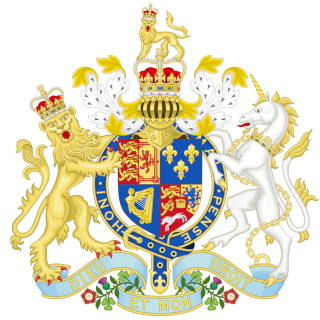
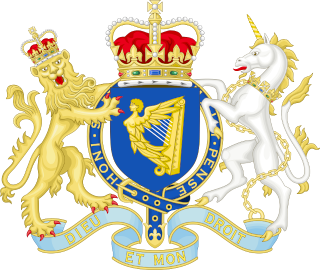
(Pictured: Coat of Arms of the United Kingdom from 1837 to 1952 used by Queen Victoria, King Edward VII, George V, Edward VIII and George VI)
The Dublin Society for Improving Husbandry, Manufactures and Other Useful Arts, which is originally founded on June 25, 1731, becomes the Royal Dublin Society on June 19, 1820.
The society is founded by members of the Dublin Philosophical Society, chiefly Thomas Prior. On July 1, 1731, at the second meeting of the Society, the designation “and Sciences” is added to the end of its name. The Society’s broad agenda is to stimulate economic activity and aid the creation of employment in Ireland. For the first few years of its existence, the Dublin Society concentrates on tillage technology, land reclamation, forestry, the production of dyestuffs, flax cultivation and other agricultural areas.
In 1738, following the publication of his pamphlet entitled Reflections and Resolutions Proper for the Gentlemen of Ireland, Samuel Madden initiates a grant or “premium” scheme to create incentives for improvements in Irish agricultural and arts. He proposes that a fund of £500 be raised for this purpose and he personally contributes £130. By 1740 the premium scheme has raised £900 and is adjudicated upon the following January and awarded to enterprises in earthenware, cotton, leatherwork, flax, surveying, as well as a number of painters and sculptors.
In 1761 the Irish Parliament votes for £12,000 to be given to the Dublin Society for the promotion of agriculture, forestry, arts and manufactures. This funding is used to increase the amount of premiums distributed by the Dublin Society. Further funds are given by Parliament to the Dublin Society on a sporadic basis until 1784 when an annual parliamentary vote of £5,000 is put in place and remains so until the dissolution of Grattan’s Parliament in 1800.
The “Royal” prefix is adopted in 1820 when George IV becomes Society patron.
The society purchases Leinster House, home of the Duke of Leinster, in 1815 and founds a natural history museum there. The society acquires its current premises at Ballsbridge in 1879 and has since increased from the original fifteen to forty acres. The premises consist of a number of exhibition halls, a stadium, meeting rooms, bars, restaurants, and RDS Simmonscourt Pavilion, a multi-purpose venue.
The Boyle Medal, named after Robert Boyle (1627–1691), is inaugurated in 1899 and is awarded jointly by the RDS and The Irish Times for scientific research of exceptional merit in Ireland. As of 2014 the medal has been awarded to 39 scientists.
Since the end of the Seven Years’ War in 1763, the British government has wished to increase the size of Irish regiments, the part of the British Army charged on the Irish exchequer rather than the British. In 1767, the Chatham Ministry appoints George Townshend, 4th Viscount Townshend, as Lord Lieutenant of Ireland and instructs him to secure the support of the Irish parliament for an Augmentation Bill to effect this increase. The British consider several possible concessions to win over the Irish Patriot Party, and at his speech from the throne, Townshend promises judicial tenure quamdiu se bene gesserint and hints at a Septennial Act.
Lucas again introduces heads of a Septennial Bill on October 20, 1767. Barry Maxwell introduces heads of a judicial tenure bill the same day. In November, the appointment of James Hewitt, 1st Baron Lifford, as Lord Chancellor of Ireland alienates the Undertakers who had hoped for the post. In addition, the British Privy Council adds a wrecking amendment to the judicial tenure bill, which causes the Irish parliament to reject the bill once returned to Dublin. The council also makes three amendments to Lucas’ bill – to the preamble, to extend the limit from seven to eight years, thus an Octennial Bill, and to bring forward the date of the next general election from 1774 to 1768. According to Francis Plowden, the Privy Council insists on the modification to eight years as a wrecking amendment, expecting that the Irish parliament will reject the bill on principle once any amendment has been made to it, and is disappointed when its amended bill is passed. William Edward Hartpole Lecky calls this “without foundation,” stating the actual reasons for eight years are that the Irish Parliament only meets every second year, and to reduce the chance of Irish and British general elections coinciding.
The Octennial Act reinvigorates the Commons, both with newly elected reformers and with MPs made more active by the prospect of imminent re-election. Changes include more assertiveness over supply bills and Poynings’ Law, easing the penal laws, and securing the Constitution of 1782. There are unsuccessful attempts to shorten the maximum duration, in 1773 by Sir William Parsons and in 1777 by Sir Edward Newenham.
Poynings’ Parliament is called by Sir Edward Poynings in his capacity as Lord Deputy of Ireland, appointed by King Henry VII of England in his capacity as Lord of Ireland. Coming in the aftermath of the divisive Wars of the Roses, Poynings’ intention is to make Ireland once again obedient to the English monarchy. Assembling the Parliament on December 1, 1494, he declares that the Parliament of Ireland is thereafter to be placed under the authority of the Parliament of England. This marks the beginning of Tudor direct rule in Ireland, although Henry VII is still forced to rely on Old English nobles (such as Gerald FitzGerald, 8th Earl of Kildare, despite his support for Lambert Simnel) as his deputies in Ireland through the intervening years.
The working of Poynings’ Law takes place in several steps. The first step is for the lieutenant governor and the Irish council, or Irish executive, to decide that a parliament is needed, usually for the purpose of raising funds. At this point the council and lieutenant write drafts of legislation to be proposed to the king and his council. After this has been completed, the lieutenant and council, according to the act, are required to certify the request for parliament “under the great seal of that land [Ireland],” and then forward it to England for approval. Once the request arrives in England, it is reviewed by the King and his council, and a formal licence approving the request for parliament and the draft bills are returned to Ireland. Once the licence is received in Ireland, the governor summons parliament and the bills are passed.
The two important aspects of the procedure presented by Poynings’ Law are transmission and certification. Both of these requirements place limits on various parties within the law-making process in Ireland. The combination of these processes creates a situation where bills can be sent, along with the request for parliament, and the king can amend and remove such bills as he wishes, however he cannot add new bills himself.
Furthermore, the two processes make it impossible for the Irish to add more bills or amendments to a request, after the initial licence request has been granted. This means that any additional bills or amendments that they wish to pass in parliament have to be re-sent along with an entirely new request for parliament. Clearly this creates severe inefficiencies in the legislative process and thus gives the executive in Ireland as well as the Crown an interest in relaxing procedure.
Poynings’ Law is a major rallying point for later groups seeking self-government for Ireland, particularly the Confederate Catholics in the 1640s and Henry Grattan‘s Patriot Party in the late 18th century, who consistently seek a repeal of Poynings’ Law. The Act remains in place until the Constitution of 1782 gives the Irish parliament legislative independence. The Acts of Union 1800 render most of the Constitution of 1782 and Poynings’ Law moot. Poynings’ Law is formally repealed as obsolete by the Statute Law Revision (Ireland) Act 1878.
In the century that followed the union of England and Scotland, Ireland gained effective legislative independence from Great Britain through the Constitution of 1782. However, access to institutional power in Ireland was restricted to a small minority, the so-called Anglo-Irish of the Protestant Ascendancy. Frustration at the lack of reform eventually led to a rebellion in 1798, involving a French invasion of Ireland and seeking complete independence from Great Britain. The rebellion was crushed with much bloodshed and the subsequent drive for union between Great Britain and Ireland that passed in 1800 was motivated at least in part by the belief that the rebellion was caused as much by loyalist brutality as by the United Irishmen.
Each Act had to be passed in the Parliament of Great Britain and the Parliament of Ireland. The final passage of the Act in the Irish Parliament was achieved with substantial majorities, achieved in part according to contemporary documents through bribery, namely the awarding of peerages and honours to critics to get their votes.