seamus dubhghaill

Promoting Irish Culture and History from Little Rock, Arkansas, USA


Leave a comment

Birth of Thomas Fitzsimons, U.S. Merchant & Statesman

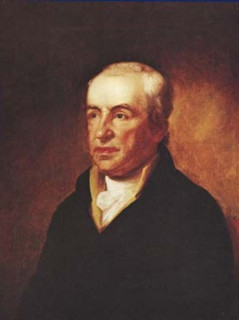
Thomas Fitzsimons, Irish-born American Founding Father, merchant, banker, and politician, is born in Ireland on October 11, 1741. His birthplace is variously given as Nobber, County Wicklow; Limerick, County Limerick; the north of Ireland; and Edenderry, County Offaly. He represents Pennsylvania in the Continental Congress, the Constitutional Convention and the United States House of Representatives.

In the mid-1750s, Fitzsimons’s family immigrates to Philadelphia, Pennsylvania, where his father dies soon thereafter. He has enough education that he begins work as a clerk in a mercantile house. He marries Catherine Meade on November 23, 1761, and forms a business partnership with her brother George. Their firm, which specializes in the West Indies trade, operates successfully for over 41 years.

The firm is soon hit by the new revenue measures created to help support the finances of the British Empire, including the much reviled Stamp Act of 1765. Concerned with these ideas, Fitzsimons becomes active in the Irish merchant community in Philadelphia. He is a founding member of the Friendly Sons of St. Patrick in 1771 and later, in 1774, a steering committee organized to protest the Coercive Acts.

When Pennsylvania begins mobilizing and organizing a militia to fight the British, Fitzsimons is soon involved. He serves as captain of a company of home guards under the command of Colonel John Caldwalader. Initially his company serves as part of the soldiers who man posts along the New Jersey coast. His unit later serves as part of the reserve at the Battle of Trenton in 1776. Later in the war, he serves on the Pennsylvania Council of Safety and heads a board to oversee the newly formed Pennsylvania Navy.

Fitzsimons enters active politics as a delegate to the Continental Congress in 1782 and 1783. He is a member of the Pennsylvania House of Representatives from 1786 until 1795. He is also a delegate to the U.S. Constitutional Convention in 1787. Although not a leading member of that convention, he supports a strong national government, the end of slavery, the United States Congress‘s powers to impose a tariff on imports and exports, the granting the House of Representatives, and power in equal to the United States Senate in making treaties. He is one of only two Catholic signers of the Constitution of the United States, the other being Daniel Carroll of Maryland.

After the Constitution is established, Fitzsimons serves in the first three sessions of the House of Representatives as a Federalist, where he favors protective tariffs and a strong navy, co-drafting the Naval Act of 1794 authorizing the original six frigates of the United States Navy. He fails to win re-election in 1794. This is partially attributed to public opinion turning against the Federalist Party over the forceful suppression of the Whiskey Rebellion. Although he never holds elective office again, he serves in 1798 as head of the committee of merchants overseeing the subscription-loan to build a warship at private expense for use in the Quasi-War.

In 1796, Fitzsimons, along with James Innes of Virginia, is appointed by President John Adams to serve as one of two American members on the five-man debt commission charged under Article VI of the Jay Treaty with examining the claims of British subjects unable to collect debts incurred by Americans prior to the American Revolution. Fitzsimons, Innes and Samuel Sitgreaves, who replaces Innes upon the latter’s death, become annoyed with the arguments used by their British counterparts to inflate the claims total. Fitzsimons and Sitgreaves angrily and permanently secede from the board in July 1799. The claims are eventually disposed of by a lump-sum payment, agreed upon by United States Minister to Britain Rufus King with British Foreign Secretary Robert Banks Jenkinson and approved by President Thomas Jefferson and the Senate in 1802.

While withdrawing from politics, Fitzsimons remains active in civic and business affairs. He serves as president of Philadelphia’s Chamber of Commerce, as a trustee of the University of Pennsylvania, Director of the Delaware Insurance Company and a director of the Bank of North America from 1781–1803. He is a founder of the bank and supports efforts to found Georgetown College. He also helps found the Insurance Company of North America.

Fitzsimons dies on August 26, 1811, in Philadelphia, where he is buried in the cemetery of St. Mary’s Roman Catholic Church, which is in present-day Independence National Historical Park.


Leave a comment

Founding of the Friendly Sons of St. Patrick

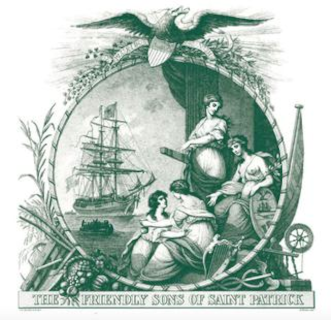
The Friendly Sons of St. Patrick, later the Friends Sons and Daughters of St. Patrick, officially The Society of The Friendly Sons of St. Patrick for the Relief of Emigrants from Ireland, an American charitable and social organization for Irish Americans is founded in Philadelphia, Pennsylvania, on Saint Patrick’s Day, March 17, 1771.

Among the founders are General Stephen Moylan, aide to George Washington and cavalry commander in the American Revolutionary War, and Thomas Fitzsimons, representative of Pennsylvania in the Continental Congress and signatory of the Constitution of the United States, both of whom were born in Ireland. Other founding members include Thomas Barclay, John Nixon, William West and George Meade. Other early members include John Leamy, Tench Francis, Jr., Commodore John Barry, General Anthony Wayne, General John Cadwalader, General William Irvine, General Richard Butler and General William Thompson. George Washington becomes an honorary member in 1782. Other honorary members include Robert Morris, Richard Bache and John Dickinson.

Originally founded as a charitable organization with the intent of aiding migrants from Ireland, the organization has since developed a focus on encouraging “greater interest in ties of friendship between America and Ireland,” in addition to sponsoring scholarships, cultural events, charity activities, and educational endowments.

On March 17, 1784, a group of New York City‘s Irish officers who had served in the Continental Army form the Society of the Friendly Sons of St. Patrick in the City of New York. Its founder and first president is Daniel McCormick, a merchant who is one of the first directors of the Bank of New York.

Branches of the Society have also been founded in cities such as Cincinnati, Detroit, Providence, San Diego and Spokane. The Cincinnati branch has an active glee club which has performed hundreds of benefit and goodwill performances for over 25 years.

Each branch operates independently. Originally all-male, the Philadelphia branch first admits women in 2016. The New York branch admits women to its annual pre-St. Patrick’s Day fundraising dinner for the first time in 2018, and votes to amend its by-laws on January 10, 2020, in order to permit women to apply for membership.


Leave a comment

Death of Thomas Addis Emmet, Lawyer & Politician

Thomas Addis Emmet, Irish and American lawyer and politician, dies at his home in New York on November 14, 1827, following a seizure while in court. He is a senior member of the revolutionary republican group Society of United Irishmen in the 1790s and Attorney General of New York 1812–1813.

Emmett is born in the Hammond’s Marsh area of Cork, County Cork, on April 24, 1764, the son of Dr. Robert Emmet from County Tipperary (later to become State Physician of Ireland) and Elizabeth Mason of County Kerry, both of whose portraits are today displayed at Cork’s Crawford Art Gallery. He is the elder brother of Robert Emmet, who is executed for leading the Irish Rebellion of 1803, becoming one of Ireland’s most famous republican martyrs. His sister, Mary Anne Holmes, holds similar political beliefs.

Emmet is educated at Trinity College, Dublin and is a member of the committee of the College Historical Society. He later studies medicine at the University of Edinburgh and is a pupil of Dugald Stewart in philosophy. After visiting the chief medical schools on the continent, he returns to Ireland in 1788. However, the sudden death of his elder brother, Christopher Temple Emmet (1761–1788), a student of great distinction, induces him to follow the advice of Sir James Mackintosh to forsake medicine for the law as a profession.

Emmet is a man of liberal political sympathies and becomes involved with a campaign to extend the democratic franchise for the Irish Parliament and to end discrimination against Catholics. He is called to the Irish bar in 1790 and quickly obtains a practice, principally as counsel for prisoners charged with political offenses. He also becomes the legal adviser of the Society of the United Irishmen.

When the Dublin Corporation issues a declaration of support of the Protestant Ascendancy in 1792, the response of the United Irishmen is their nonsectarian manifesto which is largely drawn up by Emmet. In 1795 he formally takes the oath of the United Irishmen, becoming secretary in the same year and a member of the executive in 1797. As by this time the United Irishmen had been declared illegal and driven underground, any efforts at peaceful reform of government and Catholic emancipation in Ireland are abandoned as futile, and their goal is now the creation of a non-sectarian Irish republic, independent from Britain and to be achieved by armed rebellion. Although Emmet supports this policy, he believes that the rebellion should not commence until French aid has arrived, differing from more radical members such as Lord Edward FitzGerald.

British intelligence infiltrates the United Irishmen and manages to arrest most of their leaders on the eve of the rebellion. Though not among those taken at the house of Oliver Bond on March 12, 1798, Emmet is arrested about the same time and is one of the leaders imprisoned initially at Kilmainham Gaol and later in Scotland at Fort George until 1802. Upon his release he goes to Brussels where he is visited by his brother Robert in October 1802 and is informed of the preparations for a fresh rising in Ireland in conjunction with French aid. However, at that stage France and Britain are briefly at peace, and the Emmets’ pleas for help are turned down by Napoleon.

Emmet receives news of the failure of his brother’s rising in July 1803 in Paris, where he is in communication with Napoleon. He then emigrates to the United States and joins the New York bar where he obtains a lucrative practice.

After the death of Matthias B. Hildreth, Emmet is appointed New York State Attorney General in August 1812 but is removed from office in February 1813 when the opposing Federalist Party obtains a majority in the Council of Appointment.

Emmet’s abilities and successes become so acclaimed, and his services so requested that he becomes one of the most respected attorneys in the nation, with United States Supreme Court Justice Joseph Story declaring him to be “the favourite counsellor of New York.” He argues the case for Aaron Ogden in the landmark United States Supreme Court case of Gibbons v. Ogden, 22 U.S. 1 (1824) relating to the Commerce and Supremacy clauses of the United States Constitution.

Emmet dies on November 14, 1827, while conducting a case in court regarding the estate of Robert Richard Randall, the founder of Sailors’ Snug Harbor, a home for needy seamen in Staten Island, New York. He is buried in St. Mark’s Church in-the-Bowery churchyard in the East Village, New York City, where a large white marble monument marks his grave.


Leave a comment

John Armstrong, Sr. Appointed Brigadier General in the Continental Army

John Armstrong, Sr., an Irish American civil engineer and soldier, is appointed a brigadier general in the Continental Army on March 1, 1776. He also serves as a major general in the Pennsylvania Militia during the American Revolutionary War.

Armstrong is born on October 13, 1717, in Brookeborough, County Fermanagh, parents not determined, who married in 1704. He is one of approximately fifteen children born to his parents that included: Margaret Armstrong (1737–1817), who marries Rev. George Duffield (1732–90), and Rebecca Armstrong (1738–1828), who marries James Turner (1737–1803).

Armstrong is educated in Ireland and becomes a civil engineer before emigrating to Pennsylvania, with his brother-in-law, John Lyon, around 1740. He comes to Pennsylvania as a surveyor for the Penn family, the proprietary owners of the colony. In 1750, he lays out the first plat or plan for the town of Carlisle, Pennsylvania, and is one of its first settlers. He is later appointed surveyor for the newly established Cumberland County.

In 1756, during the Seven Years’ War, Armstrong leads the Kittanning Expedition. In 1758, he leads 2,700 Pennsylvania provincial troops on the Forbes Expedition, the approach of which compels the French to vacate and blow-up Fort Duquesne. He becomes a good friend to the other militia commander in this expedition, Colonel George Washington.

James Smith writes that in the fall of 1763, “I went on the Susquehannah campaign, against the Indians, under the command of General Armstrong. In this route we burnt the Delaware and Monsey towns, on the West Branch of the Susquehannah, and destroyed all their corn.”

In the early stages of the American Revolutionary War (1775-83), Armstrong is a brigadier general in the Pennsylvania militia. On March 1, 1776, the Continental Congress appoints him to that same rank in the Continental Army. He is sent south to begin preparations for the defense of Charleston, South Carolina. He contributes his engineering talents to the construction of defenses that enable them to withstand the Battle of Sullivan’s Island later that year. When General Charles Lee arrives to take command, Armstrong returns to his duties with the main army and with the Pennsylvania militia. Pennsylvania names him major general in charge of the state militia. This ends his service in the Continental Army, but not the war or his cooperation with General George Washington.

At the Battle of Brandywine on September 11, 1777, Armstrong’s militia holds the far left of the American line. They also guard the army’s supplies. After a hard day’s fighting, the Americans are forced to withdraw, or face being surrounded. He brings the supplies and his militia out from Pyle’s Ford after dark.

In the Battle of Germantown on October 4, Armstrong leads the American right. His mission is to skirt the British left flank and attack there and in their rear. Despite delays and the troubles some units have in moving, the overall attack is going well, until the center is held up at the Benjamin Chew House. The attack then collapses after a friendly fire incident in the fog in which General Adam Stephen‘s men fire on Anthony Wayne‘s troops causing their withdrawal. Armstrong, whose men have advanced nearly to the center of Germantown but are not greatly involved in the fight later complains that it was “…. a glorious victory fought for, and eight tenths won, …. mysteriously lost, for to this moment no one man can …. give any good reason for the flight.”

After Germantown, Armstrong is granted permission to give up active command. At aged sixty, his health is declining, and old wounds are troubling him. He serves until April 4, 1778.

After his service in the War ends, Armstrong returns home to Carlisle, where he is elected to the Continental Congress by the Pennsylvania Assembly. As a delegate from 1779 to 1780, he is a strong supporter of Washington and the army. He is firm in his support for a new United States Constitution and is returned to the Congress of the Confederation during its final days in 1787 and 1788.

Throughout his life Armstrong serves in a number of local or civic offices. One of these, the Carlisle school board, leads him to originally oppose Dr. Benjamin Rush‘s proposal to start a college in the town. He later relents and becomes a member of the first Board of Trustees for Dickinson College from 1783 to 1794.

In 1747, Armstrong marries Rebecca Lyon Armstrong (1719–97), daughter of Archibald Lyon and Ann Lyon. Together, they are the parents of:

Armstrong dies at his home in Carlisle, Pennsylvania, on March 9, 1795, and is buried in the Old Carlisle Cemetery. In 1800, when Pennsylvania creates a new county with its seat at Kittanning, it is named Armstrong County in his honor.


Leave a comment

Birth of Thomas Addis Emmet, Lawyer, Politician & Revolutionary

Thomas Addis Emmet, Irish and American lawyer and politician, is born in the Hammond’s Marsh area of Cork, County Cork, on April 24, 1764. He is a senior member of the revolutionary republican group Society of United Irishmen in the 1790s and Attorney General of New York 1812–1813.

Emmet is a son of Dr. Robert Emmet from County Tipperary (later to become State Physician of Ireland) and Elizabeth Mason of County Kerry, both of whose portraits are today displayed at Cork’s Crawford Art Gallery. He is the elder brother of Robert Emmet, who is executed for leading the Irish Rebellion of 1803, becoming one of Ireland’s most famous republican martyrs. His sister, Mary Anne Holmes, holds similar political beliefs.

Emmet is educated at Trinity College, Dublin and is a member of the committee of the College Historical Society. He later studies medicine at the University of Edinburgh and is a pupil of Dugald Stewart in philosophy. After visiting the chief medical schools on the continent, he returns to Ireland in 1788. However, the sudden death of his elder brother, Christopher Temple Emmet (1761–1788), a student of great distinction, induces him to follow the advice of Sir James Mackintosh to forsake medicine for the law as a profession.

Emmet is a man of liberal political sympathies and becomes involved with a campaign to extend the democratic franchise for the Irish Parliament and to end discrimination against Catholics. He is called to the Irish bar in 1790 and quickly obtains a practice, principally as counsel for prisoners charged with political offenses. He also becomes the legal adviser of the Society of the United Irishmen.

When the Dublin Corporation issues a declaration of support of the Protestant Ascendancy in 1792, the response of the United Irishmen is their nonsectarian manifesto which is largely drawn up by Emmet. In 1795 he formally takes the oath of the United Irishmen, becoming secretary in the same year and a member of the executive in 1797. As by this time the United Irishmen had been declared illegal and driven underground, any efforts at peaceful reform of government and Catholic emancipation in Ireland are abandoned as futile, and their goal is now the creation of a non-sectarian Irish republic, independent from Britain and to be achieved by armed rebellion. Although Emmet supports this policy, he believes that the rebellion should not commence until French aid has arrived, differing from more radical members such as Lord Edward FitzGerald.

British intelligence infiltrates the United Irishmen and manages to arrest most of their leaders on the eve of the rebellion. Though not among those taken at the house of Oliver Bond on March 12, 1798, Emmet is arrested about the same time and is one of the leaders imprisoned initially at Kilmainham Gaol and later in Scotland at Fort George until 1802. Upon his release he goes to Brussels where he is visited by his brother Robert in October 1802 and is informed of the preparations for a fresh rising in Ireland in conjunction with French aid. However, at that stage France and Britain are briefly at peace, and the Emmets’ pleas for help are turned down by Napoleon.

Emmet receives news of the failure of his brother’s rising in July 1803 in Paris, where he is in communication with Napoleon Bonaparte. He then emigrates to the United States and joins the New York bar where he obtains a lucrative practice.

After the death of Matthias B. Hildreth, Emmet is appointed New York State Attorney General in August 1812 but is removed from office in February 1813 when the opposing Federalist Party obtains a majority in the Council of Appointment.

Emmet’s abilities and successes become so acclaimed, and his services so requested that he becomes one of the most respected attorneys in the nation, with United States Supreme Court Justice Joseph Story declaring him to be “the favourite counsellor of New York.” He argues the case for Aaron Ogden in the landmark United States Supreme Court case of Gibbons v. Ogden, 22 U.S. 1 (1824) relating to the Commerce and Supremacy clauses of the United States Constitution.

Emmet dies on November 14, 1827, while conducting a case in court regarding the estate of Robert Richard Randall, the founder of Sailors’ Snug Harbor, a home for needy seamen in Staten Island, New York. He is buried in St. Mark’s Church in-the-Bowery churchyard in the East Village, New York City, where a large white marble monument marks his grave.


Leave a comment

Death of John Dunlap, Printer of the Declaration of Independence

John Dunlap, Irish printer who printed the first copies of the United States Declaration of Independence and one of the most successful Irish American printers of his era, dies in Philadelphia, Pennsylvania on November 27, 1812.

Dunlap is born in 1747 in Strabane, County Tyrone, in what is now Northern Ireland. When he is ten years old, he goes to work as an apprentice to his uncle, William Dunlap, a printer and bookseller in Philadelphia. In 1766, William Dunlap leaves the business in the care of his nephew, who eventually purchases the business. Initially he makes a living by printing sermons, broadsides and handbills. In November 1771, he begins the publication of the Pennsylvania Packet, or General Advertiser, a weekly newspaper. In 1773 he marries Elizabeth Hayes Ellison.

During the American Revolutionary War, Dunlap becomes an officer in the First Troop Philadelphia City Cavalry and sees action with George Washington at the battles of Trenton and Princeton. He continues in the First City Troop after the war, rising to the rank of major, and leading Pennsylvania’s cavalry militia to help suppress the Whiskey Rebellion in 1794.

In 1776, Dunlap secures a lucrative printing contract for the Continental Congress. In July 1776, fighting between the American colonists and the British forces had been going on for over a year. On July 2, the Second Continental Congress votes on the Lee Resolution to secede. Two days later, they approve the final wording of a public declaration regarding their decision, which ultimately comes to be known as the Declaration of Independence. President of Congress John Hancock signs the fair copy with Secretary of Congress Charles Thomson attesting it. That evening Hancock orders Dunlap to print broadside copies of the declaration. He prints perhaps 200 broadsides, since known as the Dunlap broadsides, which are the first published versions of the Declaration.

Dunlap also prints items for Pennsylvania’s revolutionary government. In 1777 he takes over the printing of the Journals of the Continental Congress from Robert Aitken, but loses the contract in 1779 after printing in his newspaper a letter from Thomas Paine that leaks news of the secret French aid to the Americans.

In 1784, Dunlap’s paper becomes a daily with a new title: the North American and United States Gazette. It is not the first daily in the United States as the Pennsylvania Evening Post is the first in 1783, but it becomes the first successful daily.

Continuing to serve the changing needs of the government, Dunlap and his partner David Claypoole print the Constitution of the United States on September 19, 1787 for use by the Constitutional Convention, and later publish it for the first time in the Pennsylvania Packet.

Dunlap’s major financial success comes from real estate speculation. During the American Revolutionary War, he purchases property confiscated from Loyalists who refuse to take Pennsylvania’s new loyalty oath. After the war, he purchases land in Kentucky. By 1795, when he is forty-eight, he is able to retire with a sizable estate. Retirement does not agree with him, however. According to his friend, Dr. Benjamin Rush, he becomes a drunkard in his final years. He dies in Philadelphia on November 27, 1812.


Leave a comment

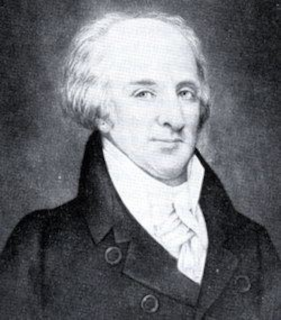
Death of Thomas Fitzsimons, U.S. Merchant & Statesman

thomas-fitzsimons

Thomas Fitzsimons, American merchant and statesman of Philadelphia, Pennsylvania, dies in Philadelphia on August 26, 1811. He represents Pennsylvania in the Continental Congress, the Constitutional Convention and the United States House of Representatives.

Fitzsimons is born in Ireland in 1741. In the mid-1750s his family immigrates to Philadelphia, where his father dies soon thereafter. He has enough education that he begins work as a clerk in a mercantile house. He marries Catherine Meade on November 23, 1761 and forms a business partnership with her brother George. Their firm, which specializes in the West Indies trade, operates successfully for over 41 years.

The firm is soon hit by the new revenue measures created to help support the finances of the British Empire, including the much reviled Stamp Act of 1765. Concerned with these ideas, Fitzsimons becomes active in the Irish merchant community in Philadelphia. He is a founding member of the Friendly Sons of St. Patrick in 1771 and later, in 1774, a steering committee organized to protest the Coercive Acts.

When Pennsylvania begins mobilizing and organizing a militia to fight the British, Fitzsimons is soon involved. He serves as captain of a company of home guards under the command of Colonel John Caldwalader. Initially his company serves as part of the soldiers who man posts along the New Jersey coast. His unit later serves as part of the reserve at the Battle of Trenton in 1776. Later in the war, he serves on the Pennsylvania Council of Safety and heads a board to oversee the newly formed Pennsylvania Navy.

Fitzsimons enters active politics as a delegate to the Continental Congress in 1782 and 1783. He is a member of the Pennsylvania House of Representatives from 1786 until 1795. He is also a delegate to the U.S. Constitutional Convention in 1787. Although not a leading member of that convention, he supports a strong national government, the end of slavery, the United States Congress‘s powers to impose a tariff on imports and exports, the granting the House of Representatives, and power in equal to the United States Senate in making treaties. He is one of only two Catholic signers of the Constitution of the United States, the other being Daniel Carroll of Maryland.

After the Constitution is established, Fitzsimons serves in the first three sessions of the House of Representatives as a Federalist, where he favors protective tariffs and a strong navy, co-drafting the Naval Act of 1794 authorizing the original six frigates of the United States Navy. He fails to win re-election in 1794. This was partially attributed to public opinion turning against the Federalist Party over the forceful suppression of the Whiskey Rebellion. Although he never holds elective office again, he serves in 1798 as head of the committee of merchants overseeing the subscription-loan to build a warship at private expense for use in the Quasi-War.

In 1796, Fitzsimons, along with James Innes of Virginia, is appointed by President John Adams to serve as one of two American members on the five-man debt commission charged under Article VI of the Jay Treaty with examining the claims of British subjects unable to collect debts incurred by Americans prior to the American Revolution. Fitzsimons, Innes and Samuel Sitgreaves, who replaces Innes upon the latter’s death, become annoyed with the arguments used by their British counterparts to inflate the claims total. Fitzsimons and Sitgreaves angrily and permanently secede from the board in July 1799. The claims are eventually disposed of by a lump-sum payment, agreed upon by United States Minister to Britain Rufus King with British Foreign Secretary Robert Banks Jenkinson and approved by President Thomas Jefferson and the Senate in 1802.

While withdrawing from politics, Fitzsimons remains active in civic and business affairs. He serves as president of Philadelphia’s Chamber of Commerce, as a trustee of the University of Pennsylvania, Director of the Delaware Insurance Company and a director of the Bank of North America from 1781–1803. He is a founder of the bank and supports efforts to found Georgetown College. He also helps found the Insurance Company of North America.

Fitzsimons dies on August 26, 1811, in Philadelphia, where he is buried in the cemetery of St. Mary’s Roman Catholic Church, which is in present-day Independence National Historical Park.

Leave a comment

Death of Andrew Johnson, 17th President of the United States

andrew-johnson

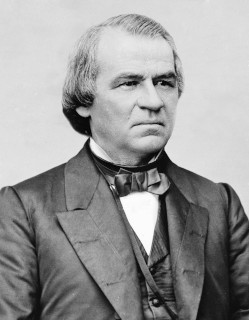
Andrew Johnson, the 17th President of the United States (1865 – 1869), dies on July 31, 1875, at his daughter Mary’s farm near Elizabethton, Tennessee after suffering two strokes.

Johnson assumes the presidency at the time of the assassination of Abraham Lincoln as he is Lincoln’s Vice President. He is a Democrat who runs with Lincoln on the National Union ticket, coming to office as the American Civil War concludes. He favors quick restoration of the seceded states to the Union without protection for the former slaves. This leads to conflict with the Republican-dominated Congress, culminating in his impeachment by the House of Representatives in 1868. He is acquitted in the Senate by one vote. His main accomplishment as president is the Alaska Purchase.

Johnson is born in poverty in Raleigh, North Carolina on December 29, 1808. His grandfather emigrated to the United States from County Antrim in what is now Northern Ireland. He never attends school and is apprenticed as a tailor and works in several frontier towns before settling in Greeneville, Tennessee. He serves as alderman and mayor there before being elected to the Tennessee House of Representatives in 1835. After brief service in the Tennessee Senate, he is elected to the U.S. House of Representatives in 1843, where he serves five two-year terms.

On October 17, 1853, Johnson becomes the 15th Governor of Tennessee serving for four years until November 3, 1857. He is elected by the legislature to the United States Senate on October 8, 1857. During his congressional service, he seeks passage of the Homestead Act of 1862 which is enacted soon after he leaves his Senate seat in 1862.

Southern slave states secede to form the Confederate States of America, which includes Tennessee, but Johnson remains firmly with the Union. He is the only sitting senator from a Confederate state who does not resign his seat upon learning of his state’s secession. In 1862, Lincoln appoints him as military governor of Tennessee after most of it has been retaken. In 1864, he is a logical choice as running mate for Lincoln, who wishes to send a message of national unity in his re-election campaign. Their ticket easily wins the election. He is sworn in as Vice President on March 4, 1865. He gives a rambling speech, after which he secludes himself to avoid public ridicule. Six weeks later, the assassination of Lincoln elevates him to the presidency.

Johnson implements his own form of Presidential Reconstruction, a series of proclamations directing the seceded states to hold conventions and elections to reform their civil governments. Southern states return many of their old leaders and pass Black Codes to deprive the freedmen of many civil liberties, but Congressional Republicans refuse to seat legislators from those states and advance legislation to overrule the Southern actions. Johnson vetoes their bills, and Congressional Republicans override him, setting a pattern for the remainder of his presidency.

Johnson opposes the Fourteenth Amendment which gives citizenship to former slaves. In 1866, he goes on an unprecedented national tour promoting his executive policies, seeking to break Republican opposition. As the conflict grows between the branches of government, Congress passes the Tenure of Office Act in 1867 restricting his ability to fire Cabinet officials. He persists in trying to dismiss Secretary of War Edwin Stanton but ends up being impeached by the House of Representatives and narrowly avoiding conviction in the Senate. He does not win the 1868 Democratic presidential nomination and leaves office the following year.

Johnson returns to Tennessee after his presidency and gains some vindication when he is elected to the Senate in 1875, making him the only former president to serve in the Senate. In late July 1875, convinced some of his opponents are defaming him in the Ohio gubernatorial race, he decides to travel there to give speeches. He begins the trip on July 28 and breaks the journey at his daughter Mary’s farm near Elizabethton, where his daughter Martha is also staying. That evening he suffers a stroke but refuses medical treatment until the following day. When he does not improve two doctors are sent for from Elizabethton. He seems to respond to their ministrations but suffers another stroke on the evening of July 30 and dies early the following morning at the age of 66.

President Ulysses S. Grant has the “painful duty” of announcing the death of the only surviving past president. Northern newspapers, in their obituaries, tend to focus on Johnson’s loyalty during the war, while Southern ones pay tribute to his actions as president. Johnson’s funeral is held on August 3 in Greeneville. He is buried with his body wrapped in an American flag and a copy of the U.S. Constitution placed under his head, according to his wishes. The burial ground is dedicated as the Andrew Johnson National Cemetery in 1906 and, with his home and tailor’s shop, is part of the Andrew Johnson National Historic Site.


Leave a comment

Adoption of the Articles of Confederation

articles-of-confederation

The Articles of Confederation and Perpetual Union, the first written constitution of the United States is adopted by the Second Continental Congress on November 15, 1777. A number of the members of the Congress hail from Ireland including Secretary of the Congress Charles Thomson who is born in Maghera, County Derry in 1729. Thomson is the permanent Secretary of the Continental Congress for more than fifteen years. At least three signatories to the Declaration of Independence are Irish – James Smith, George Taylor, and Matthew Thornton.

The Articles of Confederation is approved, after much debate between July 1776 and November 1777, by the Second Continental Congress and sent to the states for ratification. The Articles come into force on March 1, 1781, after being ratified by all thirteen states. A guiding principle of the Articles is to preserve the independence and sovereignty of the states. The weak central government established by the Articles receives only those powers which the former colonies had recognized as belonging to king and parliament.

The document provides clearly written rules for how the states’ “league of friendship” is to be organized. During the ratification process, the Congress looks to the Articles for guidance as it conducts business, directs the war effort, conducts diplomacy with foreign nations, addresses territorial issues and deals with Native American relations. Little changes politically once the Articles of Confederation go into effect, as ratification does little more than legalize what the Continental Congress had already been doing. That body is renamed the Congress of the Confederation however most Americans continue to call it the Continental Congress, since its organization remains the same.

As the Confederation Congress attempts to govern the continually growing American states, delegates discover that the limitations placed upon the central government render it ineffective at doing so. As the government’s weaknesses become apparent, especially after Shays’ Rebellion, some prominent political thinkers in the fledgling nation begin asking for changes to the Articles. Their hope is to create a stronger national government.

Initially, some states meet to deal with their trade and economic problems. However, as more states become interested in meeting to change the Articles, a meeting is set in Philadelphia on May 25, 1787. This becomes the Constitutional Convention. It is quickly agreed that changes will not work, and instead the entire Articles needs to be replaced. On March 4, 1789, the government under the Articles is replaced with the federal government under the Constitution of the United States. The new Constitution provides for a much stronger federal government by establishing a chief executive (the President), courts, and taxing powers.


Leave a comment

Death of William Paterson, U.S. Senator & New Jersey Governor

william-paterson

William Paterson, Irish-born American jurist, one of the framers of the Constitution of the United States, United States senator (1789–90), and governor of New Jersey (1790–93), dies in Albany, New York on September 9, 1806. He also serves as an Associate Justice of the Supreme Court of the United States from 1793 to 1806.

Paterson is born on December 24, 1745, in County Antrim, to Richard Paterson, an Ulster Protestant. He immigrates with his parents to New Castle, Pennsylvania in 1747, eventually settling in Princeton, New Jersey. At the age of 14, he begins college at the College of New Jersey (now Princeton University), graduating in 1763. After graduating, he studies law with the prominent lawyer Richard Stockton and is admitted to the bar in 1768. He also stays connected to his alma mater and helps found the Cliosophic Society with Aaron Burr.

Paterson serves twice in the Provincial Congress of New Jersey (1775–76), is a delegate to the state constitutional convention (1776), and from 1776 to 1783 is attorney general of New Jersey.

In 1787 Paterson heads the New Jersey delegation to the federal Constitutional Convention, where he plays a leading role in the opposition of the small states to representation according to population in the federal legislature. As an alternative to James Madison‘s large-state Virginia Plan, he submits the small-state New Jersey Plan, also called the Paterson Plan, which advocates an equal vote for all states. The issue is finally resolved with the compromise embodied in the bicameral Congress —representation by population in the House of Representatives, and equality of states in the Senate.

Paterson is instrumental in securing ratification of the final document in New Jersey and is elected one of the state’s first two U.S. senators. He resigns his seat in 1790 and serves as governor of New Jersey until 1793, when he is named an associate justice of the United States Supreme Court.

On September 9, 1806, Paterson, aged 60, dies from the lingering effects of a coach accident suffered in 1803 while on circuit court duty in New Jersey. He is on his way to the spa at Ballston Spa, New York, to “take the waters”, when he dies at the Manor of Rensselaerswyck home of his daughter, Cornelia, and son-in-law, Stephen Van RensselaerStephen Van Rensselaer, in Albany, New York. He is laid to rest in the Van Renssalaer family vault. When the city acquires the property, his remains are relocated to Albany Rural Cemetery in Albany County, New York. Also buried there are Associate Justice Rufus W. Peckham and President Chester A. Arthur.

The city of Paterson, New Jersey and William Paterson University are named for William Paterson.

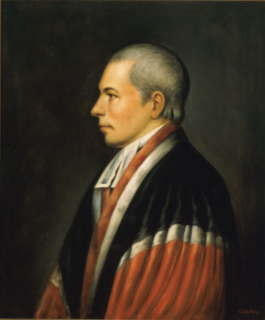
(Pictured: Portrait of William Paterson (1745–1806) when he was a Supreme Court Justice (1793–1806). This image is from a copy by C. Gregory Stapoko(1913-2006) of the original by James Sharples(1751-1811))