seamus dubhghaill

Promoting Irish Culture and History from Little Rock, Arkansas, USA


Leave a comment

The Execution of Fenian Michael Barrett

Michael Barrett, Irish activist and a member of the Fenians, is executed on May 26, 1868, for his part in the Clerkenwell Gaol explosion in December 1867. From all the evidence, it is likely he is not guilty. He is the last man to be publicly hanged in England.

Barrett is born in 1841 in Drumnagreshial in the Ederney area of County Fermanagh. As a young man and in search of work, he moves to Glasgow where, at the age of 27, he joins the Irish Republican Brotherhood (IRB), often referred to as Fenians. In the 1860s, the IRB is a political movement that dominates Irish Republican politics and defies the Catholic Church, middle-class nationalists who advocate milder approaches and Irish Unionists. Tens of thousands of Irishmen in both Ireland and Great Britain are recruited into its ranks.

The Clerkenwell bombing is the most infamous action carried out by the Fenians in mainland Britain. It results in a long-lived backlash that foments much hostility against the Irish community in Britain.

The events that lead up to the bombing start with the arrest in November 1867 of Ricard O’Sullivan Burke, a senior Fenian arms agent who planned the “prison-van escape” in Manchester a few months earlier. O’Sullivan-Burke is subsequently imprisoned on remand in the Middlesex House of Detention, Clerkenwell. On December 13, an attempt to rescue him is made by blowing a hole in the prison wall. The explosion is seriously misjudged. It demolishes not only a large section of the wall, but also a number of tenement houses opposite in Corporation Lane (now Corporation Row), killing 12 people and wounding up to 120 more.

The bombing has a traumatic effect on British working-class opinion. The radical, Charles Bradlaugh, condemns the incident in his newspaper, the National Reformer, as an act “calculated to destroy all sympathy, and to evoke the opposition of all classes.”

The day before the explosion, Prime Minister Benjamin Disraeli bans all political demonstrations in London in an attempt to put a stop to the weekly meetings and marches that are being held in support of the Fenians. He fears that the ban might be challenged, but the explosion has the effect of turning public opinion in his favour.

Months earlier, Barrett had been arrested in Glasgow for illegally discharging a firearm and allegedly false evidence is used to implicate him in the Clerkenwell Prison explosion. In court, he produces witnesses who testify that he had been in Scotland on the date of the incident. The main case against him rests on the evidence of Patrick Mullany, a Dubliner known to have given false testimony before and whose price is a free passage to Australia, who tells the court that Barrett had informed him that he had carried out the explosion with an accomplice by the name of Murphy. After two hours of deliberation the jury pronounces Barrett guilty. On being asked if he has anything to say before sentence is passed, he delivers an emotional speech from the dock.

Many people, including a number of radical MPs, press for clemency. In Fermanagh, Barrett’s aged mother walks several miles in the snow to appeal to the local Irish Conservative Party MP, Captain Mervyn Edward Archdale, a staunch Orangeman, who rejects her.

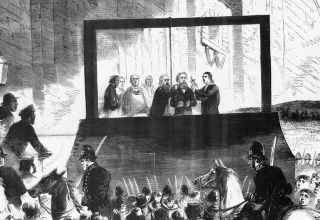
Barrett is executed outside the walls of Newgate Prison on May 26, 1868, before a crowd of two thousand who boo, jeer and sing “Rule, Britannia!” and “Champagne Charlie” as his body drops. His execution is the last public hanging to take place in England. The hangman is William Calcraft.

Until their transfer to the City of London Cemetery, Barrett’s remains lay for 35 years in a lime grave inside the walls of Newgate Prison. When the prison is demolished in 1903 his remains are taken to their present resting place. Today the grave is a place of Fenian pilgrimage and is marked by a small plaque.

After the explosion, the Prime Minister Disraeli advocates the suspension of the Habeas Corpus Act 1862 in Great Britain, as is already the case in Ireland. Greater security measures are quickly introduced. Thousands of special constables are enrolled to aid the police and at Scotland Yard a special secret service department is established to meet the Fenian threat. Although a number of people are arrested and brought to trial, Barrett is the only one to receive the death sentence.

Within days of the explosion, the Liberal Party leader, William Ewart Gladstone, then in opposition, announces his concern about Irish Nationalist grievances and says that it is the duty of the British people to remove them. Later, he says that it is the Fenian action at Clerkenwell that turned his mind towards Home Rule. When Gladstone discovers at Hawarden later that year that Queen Victoria had invited him to form a government, he famously states, “my mission is to pacify Ireland.”


Leave a comment

Prince Charles & the Duchess of Cornwall Visit Ireland

Britain‘s Prince Charles and the Duchess of Cornwall arrive at Shannon Airport in Ireland on Tuesday, May 19, 2015, to start their historic four-day visit to Ireland. The Prince of Wales says he is excited by the prospect of his first visit to the Republic of Ireland in 13 years.

The couple are welcomed at NUI Galway by the Tánaiste (Deputy Prime Minister) Joan Burton, among the guests are Gerry Adams and Martin McGuinness.The highlight of Tuesday’s engagements is the historic handshake between the Prince and Gerry Adams. This is the first time a member of the British royal family and the Sinn Féin President have formerly engaged. They shake hands and speak briefly at a reception in NUI Galway, where the prince makes the first of two scheduled speeches.

Charles and Camilla then go on to visit the Burren in County Clare, fulfilling one of Charles’ life-long goals, by exploring the karst landscape for almost an hour.

They conclude their first day by dining with the President of Ireland, Michael D. Higgins, and his wife Sabina, at Lough Cutra Castle in south County Galway. They dine on blanched Highgrove asparagus to start, followed by pan-seared halibut, with panna cotta and poached Highgrove rhubarb for dessert.

Their packed itinerary for Wednesday begins with a trip to Lissadell House with a civic reception and a viewing of the Niland Collection at The Model contemporary arts centre in Sligo. Mayor of Sligo, Seán MacManus, formerly of Sinn Féin, attends the reception. MacManus’ son was killed in a gun battle with security forces in Northern Ireland in 1992.

The prince then visits the Institute of Technology, Sligo, and the couple has lunch at Lissadell. They then visit the grave of W. B. Yeats and attend a service at St. Columba’s Church, in Drumcliff. The royal couple takes part in a tree-planting and unveil a plaque. The theme of this service and the tree-planting is peace and reconciliation.

The prince then visits Mullaghmore Harbour on Wednesday afternoon. On August 27, 1979, his great-uncle, Lord Louis Mountbatten, is killed in a bomb attack executed by the Irish Republican Army (IRA). Mountbatten holidayed every summer at Classiebawn Castle near the harbor. He had, along with family and friends, embarked on a lobster-potting and angling expedition when a bomb on board was detonated just a few hundred yards from the harbor. He died of his injuries, along with his grandson Nicholas Knatchbull (14), Paul Maxwell (15), from County Fermanagh, and Lady Brabourne (83), his eldest daughter’s mother-in-law.

Charles and Camilla conclude their Wednesday itinerary with a trip to the Sligo races.

On Thursday and Friday, Charles and Camilla travel to Northern Ireland. Their engagements include a reception and a concert featuring a selection of local performers at Hillsborough Castle. They make a trip to Mount Stewart House and gardens to mark the completion of a three-year restoration programme. They also visit the Corrymeela Community, Northern Ireland’s oldest peace and reconciliation centre, which is celebrating its 50th anniversary in 2015.

(From: “History is made as Prince Charles fulfills life-long dream in Ireland” by Cathy Hayes, IrishCentral, http://www.irishcentral.com, May 20, 2015 | Pictured: The Prince of Wales and the Duchess of Cornwall at Mullaghmore pier on May 20, 2015)


Leave a comment

Death of Brian O’Neill, High King of Ireland

Brian O’Neill (Irish: Brian Chatha an Dúna Ó Néill), the High King of Ireland from 1258 to 1260, is defeated and killed by the forces of Roger des Auters at the Battle of Down on May 14, 1260.

O’Neill is the son of Niall Roe O’Neill, and grandson of Áed in Macáem Tóinlesc. His wife is Nuala O’Connor (Ní Conchobair), a daughter of Rory O’Connor (Irish: Ruaidrí Ua Conchobair), the last High King of Ireland before the Norman invasion. Therefore, through his mother, he is descended from Brian Boru (Irish: Brian Bóramha).

In 1230, Hugh O’Neill (Irish: Aedh Ó Néill), king of Tyrone, dies and is succeeded by Donnell MacLaughlin. MacLaughlin, however, is removed in 1238 by the Justiciar of Ireland, Maurice FitzGerald, 2nd Lord of Offaly, and Hugh de Lacy, 1st Earl of Ulster, who install “the son of O’Neill”, presumed to have been Brian, and take the hostages of the Cenel Owen and Cenel Connell. However, it may have been Brian’s cousin Donnell, who afterwards is killed by MacLaughlin. After this, O’Neill claims the kingship of the O’Neill dynasty as well as Tyrone, possibly with the aid of Hugh de Lacy, 1st Earl of Ulster.

In revenge, O’Neill with the aid of Melaghlin O’Donnell, king of Tyrconnell, defeat MacLoughlin and ten of his closest kinsmen at the Battle of Camergi, somewhere within Tyrone north of Omagh, in 1241. This ends the long rivalry between the MacLoughlin’s and O’Neill’s, with the MacLoughlin’s afterwards excluded from the kingship of Tyrone and Ailech.

In 1244, Henry III of England sends letters to various Gaelic Irish lords, including O’Neill, requesting their aid in a military campaign against the Kingdom of Scotland. In the end the issue is sorted out diplomatically. Copies of the letter are also distributed to O’Neill’s sub-chiefs including his tánaiste, Hugh Boy O’Neill.

A consequence of this infighting between the rival factions of the Cenél Eoghain allows the Normans to advance deeper into Gaelic Ulster, however, in 1243 de Lacy dies. Thus the Earldom of Ulster reverts to the English Crown and is taken over by royal administrators. John FitzGeoffrey, the king’s chief governor in Ireland, erects a bridge across the River Bann and builds castles at Coleraine and Ballyroney in Iveagh. From here FitzGeoffrey is able to penetrate deeper into Tyrone.

Despite ending MacLoughlin aspirations to the kingship, O’Neill forms a marriage alliance with them, however, this results in a war with the O’Donnells of Tyrconnell. Subsequently in 1248 O’Neill backs the king of Tyrconnell, Rory O’Cannon (Irish: Ruaidri Ua Canannáin), against the claims of O’Donnell. O’Cannon had been set up in the kingship by FitzGerald, however, rather than backing him, enters Tyrconnell and removes him in favour of Gofraid O’Donnell.

O’Cannon, who had been expelled to Tyrone, and O’Neill once again lead their forces into Tyrconnell to confront O’Donnell, however they are defeated and O’Cannon is killed.

That same year, John FitzGeoffrey, who replaced FitzGerald as Justiciar in 1246, enters Tyrone and takes the submission and hostages of O’Neill. A resolution had been adopted at a meeting of the Cenel Owen that “since the power of the Foreigners was over the Gaeidhel of Erinn, to give hostages to the Foreigners, and to make peace with them, for the sake of their country.”

In 1249, the king of Connacht, Felim O’Connor, is given refuge from the Normans by O’Neill. In 1252, O’Neill and his brother give their submissions to the Justiciar of Ireland, who had marched to Armagh with a large force. A Rory O’Neill is given as hostage.

In 1253, as a sign of defiance against his vassal status with the Earldom of Ulster, O’Neill withholds his tribute to it and raids Iveagh, destroying the castle at Ballyroney. He also launches an offensive against the Normans in Leinster. That same year, the son of Maurice FitzGerald leads his forces into Tyrone to attack O’Neill, however he fails to take his submission or hostages and after battle suffers a heavy defeat at the hands of O’Neill.

In 1255, O’Neill makes a pact with Felim O’Connor’s son Hugh, whereby allowing Hugh free rein in the Kingdom of Breifne, he would aid O’Neill against the Normans of the earldom who are eroding his territory.

In 1257, the king of Tyrconnell, Gofraid O’Donnell, is mortally wounded in battle against the FitzGeralds and O’Neill uses this opportunity to try to exact Tyrconnell’s submission. As the Cenel Connell discuss what to do, Gofraid’s youngest brother, Donnell Óg, returns from fosterage and is conferred the chieftainship of Tyrconnell. He refuses to submit O’Neill stating the Scottish proverb “Every man should have his own world.”

FitzGerald in 1252 had built a castle at Caoluisce, on the banks of Lough Erne, near modern day Belleek, County Fermanagh, Northern Ireland, however, in 1258 it is the site where O’Neill, in the presence of his ally O’Connor, is inaugurated as “King of the Gael of Erin.” While he receives hostages from O’Connor and from O’Brien of Thomond, along with several other minor Kings from Meath and Munster, his claim is not recognised by those of the Irish closest to him including the other O’Neill factions, the O’Donnell’s of Tyrconnell, the MacMahon’s of Airgíalla, and the O’Rourkes of Breifne. The following year O’Donnell leads an attack into Tyrone.

In 1260, O’Neill, along with his O’Connor allies, launch an attack on the Normans of the Earldom of Ulster at Drumderg, near its capital at Downpatrick in modern County Down, Northern Ireland. The Normans levy the town, and with the aid of forces brought by Sir Roger des Auters, O’Neill and his allies are decisively defeated at the subsequent Battle of Down. The Annals of Inisfallen state that the forces recruited by the Normans consist mostly of native Irish and that the Normans play only a minor role.

In the battle, O’Neill is killed along with many other Irish nobles including over a dozen members of the O’Cahans. O’Neill’s head is cut off by the Normans and sent to King Henry III of England, a sign of how dangerous his coalition is believed to be.

After this battle, O’Neill becomes known in Irish as Brian Chatha an Dúna, meaning “Brian of the Battle of Down.”

After O’Neill’s death, the kingship of the Cenel Owen, and with it Tyrone, is taken by his cousin’s son, Hugh Boy O’Neill, ancestor of the Clandeboye O’Neill’s, who also has the support of the earldom of Ulster. Upon Hugh’s death in 1283 O’Neill’s son Donnell seizes the kingship, which until 1295 is highly contested between him and his second-cousin Niall Culanach O’Neill and Hugh Boy’s son Brian, until he wins outright control by killing his opponents.


Leave a comment

IRA Kidnaps & Holds Hostage 42 Prominent Loyalist Activists

On February 7, 1922, the Irish Republican Army (IRA) in Northern Ireland kidnaps and holds hostage forty-two prominent loyalist activists in Fermanagh and Tyrone in response to the January 14 arrest of the Monaghan county football team, who were traveling to play Derry in the final of the Ulster Championship game.

A party of eighteen armed B-Specials, a part-time auxiliary police force which is almost 100% Protestant, when traveling by train to Enniskillen, are stopped at Clones railway station in County Monaghan by an IRA group. The B-Specials react immediately by shooting Commander Fitzpatrick. His colleagues retaliate by fatally shooting four Specials and arresting the survivors. Trouble in the North is at a boiling point and in the three days after the Clones incident thirty people are murdered in Belfast.

Intense negotiations between Secretary of State for the Colonies Winston Churchill and Chairman of the Provisional Government of the Irish Free State Michael Collins helps to secure the release of the Monaghan footballers and the Fermanagh and Tyrone loyalists, but for some time the British suspend the evacuation of troops from Ireland. Following the incident, Churchill, who is leading the UK effort on the transfer of power following the Anglo-Irish Treaty, writes to his wife Clementine in what might be termed an understatement, “Ireland is sure to bring us every form of difficulty and embarrassment.”

Collins and James Craig, Prime Minister of Northern Ireland, have further discussions in Dublin in early February 1922 but the meeting breaks down over the question of the boundary revision. Craig informs reporters that he has the assurance of the British Government that the Boundary Commission will make only slight changes. He complains that the maps which Collins had produced led him to the assumption that Collins had already been promised almost half of Northern Ireland. Craig agrees to minor changes but if North and South fail to agree, there will be no change at all. Collins issues a statement which refuses to admit any ambiguity and says that majorities must rule.

The British and the Provisional Government finally agreed that an Irish Free State Agreement Bill will legalise the Treaty and the transfer of power to the Provisional Government and will authorise the election of a Provisional Parliament to enact the Free State Constitution. Final ratification of the Treaty is deferred until the British confirm the Free State Constitution. Only then will Northern Ireland be allowed to exclude itself formally from the Free State.

(From: “OTD in 1922 – The IRA Kidnaps More Than Forty Loyalists Activists and ‘B’ Specials,” Stair na hÉireann | History of Ireland, https://stairnaheireann.net | Picture: Colour image of the IRA patrolling Grafton Street, Dublin, during the Irish Civil War in 1922, 1916 Easter Revolution in Colour)


1 Comment

The Mahon’s Hotel Bombing

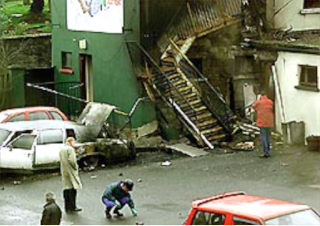
A Continuity Irish Republican Army (IRA) bomb explodes at Mahon’s Hotel in Irvinestown, County Fermanagh, Northern Ireland, on February 6, 2000, less than 24 hours before the Ulster Unionist Party’s Ken McGuinness is due to visit. The Continuity IRA is the only republican organisation which has not called a ceasefire.

The bombing follows repeated warnings from senior police officers on both sides of the Northern Ireland border that republican dissidents continue to pose a threat. Both the Continuity IRA and Real IRA have been recruiting and rearming in preparation for a campaign to wreck the Northern Ireland peace process.

The splinter republican organisation is behind a bomb attack on the Killyhevlin Hotel in Enniskillen in July 1996. The attack follows a week-long marching stand-off at Drumcree.

In September 1997, it places at bomb in Markethill, in County Armagh, just 24 hours after Sinn Féin joins the political negotiations which lead to the Good Friday Agreement.

In January 1998, a Continuity IRA bomb wrecks a club in County Fermanagh. The explosion coincides with a series of loyalist attacks, which follow the murder of the Portadown Loyalist Volunteer Force (LVF) leader Billy Wright.

The latest explosion in Irvinestown comes in a week when the new political institutions are facing suspension because of the stalemate over paramilitary arms decommissioning. This attack by the Continuity IRA looks deliberately timed to add to the peace process’s troubles.

BBC Northern Ireland political editor Stephen Grimason says the bomb will not help the current situation. “We are hearing an argument reinforced from unionists that if these things are left lying around then people will use them,” he says. “So the anti-agreement unionists will be using this as a weapon. But I would have thought it will harden the attitudes of the Ulster Unionist Council and the Ulster Unionist executive, meeting tonight on the issue of weapons,” he adds.

Grimason adds that unionists in general will want to hear about the forensics of the bomb and if there was a Semtex booster charge used. “They will use that as another means of saying that this is all the IRA,” he says. But he adds that there will be those who will see this as a move against Sinn Féin President Gerry Adams because it removes the room for manoeuvre that he has.

BBC Northern Ireland chief security correspondent Brian Rowan says the bomb contained one to two kilos of high explosive, but that the security forces had not yet revealed what type it is. He says the bomb had the appearance of the Continuity IRA which in “times of trouble made more trouble.” He adds, “They would see this as a reminder that they are still out there and as a reminder to other republicans that there is an alternative to the mainstream IRA, and to the peace process strategy. It is about damaging a process that this organisation very much opposes, a process in which they believe republicans principles have been sold out.”

Rowan says security sources believe in some areas the Real IRA, Continuity IRA and the more mainstream Irish National Liberation Army (INLA) co-operate in attacks. INLA prisoners have been released under the Good Friday Agreement early prisoner release scheme, following the INLA’s ceasefire declaration.

“In the Fermanagh area security forces believe the Continuity IRA is operating alone and there is a pattern of activity over a period of years. There is nothing to suggest it was any other group.” He says there is nothing coming from republicans or security sources at this time to suggest that the IRA has any intention of actual decommissioning in the “immediate period ahead.”

(From: “Bombing follows dissident pattern,” BBC News, http://www.news.bbc.co.uk, February 7, 2000 | Photo: RUC forensic experts examine the scene of the bomb attack at Mahons Hotel in Irvinestown, Northern Ireland, Associated Press)


Leave a comment

Death of Anti-Treaty IRA Volunteer Michael Cull

Michael Cull, an anti-Treaty Irish Republican Army (IRA) Volunteer from Roscommon, is killed during a raid on Ballyconnell, County Cavan, on January 6, 1923.

Ballyconnell is a small town in western County Cavan. According to the 1911 census it is populated by 125 families, or in the region of 600 people, and is according to local pro-Treaty TD Seán Milroy, “in the values of country towns, a very considerable centre of county life.” Since 1921 it has been wedged up against the new border with County Fermanagh and Northern Ireland to the north and the Arigna Mountains to the south and west. As the Irish Civil War rages south of the border, and with no effective police or military presence, Ballyconnell is particularly vulnerable to the depredations of armed groups of various allegiance.

Cull is part of a contingent of 50-70 anti-Treaty fighters holed up in the Arigna Mountains. As well as guerrilla attacks against the forces of the Irish Free State, one of their most frequent actions, out of necessity, is raids on civilian targets for supplies.

Cull, according to the local newspaper, is holding up Ovens’ hardware and grocery shop in Ballyconnell when he is shot dead by a plain clothes Free State officer. The National Army later derisively refers to “the shooting of a looter named Cull … He and others were raiding in Ballyconnell when a couple of officers who were in the area got in touch with them. This gang of Irregulars have been in the mountains for several months past.”

Cull’s death is by no means the end of Ballyconnell’s troubles. The anti-Treaty column based in the Arigna Mountains, composed of Volunteers from Roscommon, Leitrim and Cavan (which includes Cull’s brother James) and led by Ned Bofin, visits a ferocious revenge on the small town for the death of Cull.

Almost exactly a month later, on the morning of February 5, 1923, at about 7:00 a.m., fifty well-armed anti-Treaty IRA fighters descend on Ballyconnell from the hills in a military lorry and several cars. The guerrillas, armed with rifles and three machine guns, stop the train to nearby Ballinamore so that word cannot get out to adjacent Free State garrisons. They then go in search of those they hold responsible for Cull’s death.

At Oven’s grocery, the proprietor, William Ovens, is shot through the thigh and badly wounded. One of his employees, William Ryan, is dragged out and shot dead. According to the local press, the guerrillas shouted, “Was it you who shot Cull?” at Ryan before they shot him. His 80-year-old father follows the fighters through the streets, shouting “murder, murder.”

Sean McGrath, an Irish language teacher originally from Galway, is also dragged out of bed and shot dead, apparently for no other reason than that he is lodging at the home of Free State supporter John Dunn.

The guerrillas proceed to bomb and burn out three shops, including the car dealership and the Post Office, and to smash the windows of the other premises with shots and rifle butts. The Ulster Bank branch is robbed of £200 and two Ford cars are seized. After a rampage of 35 minutes, the IRA column re-mount their vehicles and head back toward the Arigna Mountains, leaving the little town partially in flames, pockmarked with bullet holes and mourning the death of two of its citizens.

According to the pro-Treaty National Army, “Our troops in Belturbet got word of the raid, and immediately set out in all their transport. They were joined en route by two Fords of troops from Cavan, and all proceeded to Ballyconnell, where they arrived shortly after 9 o’clock. They followed the Irregulars past Ballinamore but failed to get in touch with them.”

(From: “The Tragedies of Ballyconnell” by John Dorney, The Irish Story (www.theirishstory.com), June 19, 2014 | Pictured: The main street of Ballyconnell in the early 20th century)


Leave a comment

Death of IRA Volunteer Fergal O’Hanlon

Fergal O’Hanlon (Irish: Feargal Ó hAnnluain), a volunteer in the Pearse Column of the Irish Republican Army (IRA), is killed on January 1, 1957, while taking part in an attack on Royal Ulster Constabulary (RUC) barracks.

Born into a staunchly republican family on February 2, 1936, in Ballybay, County Monaghan, O’Hanlon is a draughtsman employed by Monaghan County Council. He is a Gaelic footballer and a keen Irish language activist. A devout Catholic, he considers becoming a priest and spends one year at the seminary in St. Macartan’s. He joins the IRA in 1956.

At the age of 20, O’Hanlon is killed on January 1, 1957, along with Seán South while taking part in an attack on the Royal Ulster Constabulary barracks in Brookeborough, County Fermanagh, during the border campaign. Several other IRA members are wounded in the botched attack. The IRA flees the scene in a dumper truck. They abandon it near the border. They leave South and O’Hanlon, both then unconscious, in a cow byre, and crossed into the Republic of Ireland on foot for help for their comrades. The wounded IRA men are treated as “car crash victims” by sympathetic staff in the Mater Misericordiae Hospital in Dublin.

The events and personalities are sympathetically recalled in Dominic Behan‘s ballad “The Patriot Game.” O’Hanlon is mentioned in the song “Seán South of Garryowen” (“Brave Hanlon by his side”).

O’Hanlon’s mother remains firmly committed to the IRA and is hurt by the suggestion that there was an alternative to IRA activity or that her son was anything other than an Irish hero.

A marble monument now stands at the spot where South and O’Hanlon lost their lives. An annual lecture has been held in memory of O’Hanlon since 1982, and approximately 500 people attended a 50th commemoration of the men’s deaths in January 2007 in Limerick.

In 1971, a monument is unveiled to O’Hanlon in his hometown on a hill overlooking the Clones Road on which he had made his last journey home. A Gaelic football team is founded in Monaghan in 2003 and called the Fergal O’Hanlons.

O’Hanlon’s brother, Eighneachán Ó hAnnluain, is elected a Sinn Féin abstentionist TD in the 1957 Irish general election to Dáil Éireann. His sister, Pádraigín Uí Mhurchadha, is a Sinn Féin Councillor on Monaghan Urban Council.


Leave a comment

Birth of Lady Louisa Conolly

Lady Louisa Conolly, an English-born Irish noblewoman, is born on December 5, 1743, perhaps at Goodwood House in Westhampnett, Chichester, West Sussex, England. She is the third of the famous Lennox sisters and is notable among them for leading a wholly uncontroversial life filled with good works.

Born Lady Louisa Augusta Lennox, she and her sisters are portrayed in Stella Tillyard‘s book Aristocrats: Caroline, Emily, Louisa, and Sarah Lennox and in the BBC television series based on it. The Lennox sisters are the daughters of Charles Lennox, 2nd Duke of Richmond, and Lady Sarah Cadogan. The 2nd Duke’s father, Charles Lennox, 1st Duke of Richmond, is an illegitimate son of King Charles II of England.

Conolly is still a child when her parents die within a year of each other in 1750 and 1751. After this, she is brought up by her much older sister Emily FitzGerald, Duchess of Leinster, in Kildare. In 1758, at age 15, she marries Thomas Conolly (1738–1803), grand-nephew of William Conolly, Speaker of the Irish House of Commons. Her husband, a wealthy landowner and keen horseman, is also a successful politician who is elected to Parliament as early as 1759. The couple lives in the Palladian mansion Castletown House in County Kildare, the decoration of which she directs throughout the 1760s and 1770s. The Conolly summer residence, Cliff House, on the banks of the River Erne between Belleek, County Fermanagh, and Ballyshannon, County Donegal, is demolished as part of the Erne Hydroelectric scheme, which constructs the Cliff and Cathaleen’s Fall hydroelectric power stations. Cliff hydroelectric power station is constructed on the site of Cliff House and is commissioned in 1950.

The Conollys, themselves unhappily childless, at that point take up the welfare of young children from disadvantaged backgrounds as a lifelong project, contributing both money and effort towards initiatives which enable foundlings and vagabonds to acquire productive skills and support themselves. They develop one of the first Industrial Schools where boys learn trades, and she takes active personal interest in mentoring the students. In middle age, she also virtually adopts her niece Emily Napier (1783–1863), the daughter of her sister Lady Sarah Lennox. Emily, who spends long months with her aunt in Kildare, marries Sir Henry Bunbury, 7th Baronet, and moves to Suffolk, although she remains close to her aunt until her death.

Thomas Conolly dies on April 27, 1803. Upon his death, a major part of his estates, which includes Wentworth Castle, passes to a distant relative, Frederick Vernon. Conolly receives the Castletown House and estate, as also certain liquid investments and valuable urban properties, which enable her to live in comfort and continue her activities until her own death on August 6, 1821, of an abscess on her hip. She wills these substantial properties to a great-nephew, Edward Michael Pakenham, grandson of Thomas’ sister Harriet, later the MP for Donegal.

In 1999, a 6-part miniseries called Aristocrats, based on the lives of Conolly and her sisters, airs in the UK.

(Pictured: “Lady Louisa Conolly” by George Romney, 1776)


Leave a comment

Birth of Neil Hannon, Northern Irish Singer & Songwriter

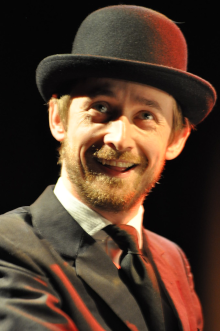
Edward Neil Anthony Hannon, Northern Irish singer and songwriter, is born in Derry, County Londonderry, on November 7, 1970. He is the creator and front man of the chamber pop group The Divine Comedy, and is the band’s sole constant member. He is the writer of the theme tunes for the television sitcoms Father Ted and The IT Crowd.

Hannon is the son of Brian Hannon, a Church of Ireland minister in the Diocese of Derry and Raphoe and later Bishop of Clogher. He spends some of his youth in Fivemiletown, County Tyrone, before moving with his family to Enniskillen, County Fermanagh, in 1982. While there he attends Portora Royal School.

Hannon enjoys synthesizer-based music as a youngster. He identifies The Human League and Orchestral Manoeuvres in the Dark (OMD) as “the first music that really excited [him].” In the late 1980s he develops a fondness of the electric guitar, becoming an “indie kid.”

Hannon is founder and mainstay of The Divine Comedy, a band which achieves their biggest commercial success in the last half of the 1990s with the albums Casanova (1996), A Short Album About Love (1997), and Fin de Siècle (1998). He continues to release albums under The Divine Comedy name, the most recent being Office Politics (2019). In 2000 he and Joby Talbot contribute four tracks for Ute Lemper‘s collaboration album, Punishing Kiss.

In 2004 Hannon plays alongside the Ulster Orchestra for the opening event of the Belfast Festival at Queen’s University Belfast. In 2005, he contributes vocals to his long-time collaborator Joby Talbot’s soundtrack for the movie version of The Hitchhiker’s Guide to the Galaxy.

In 2006 it is announced that Hannon is to lend his vocal ability to the Doctor Who soundtrack CD release, recording two songs – “Love Don’t Roam” for the 2006 Christmas special, “The Runaway Bride“, and a new version of “Song For Ten”, originally used in 2005’s “The Christmas Invasion.” On January 12, 2007, The Guardian website’s “Media Monkey” diary column reports that Doctor Who fans from the discussion forum on the fan website Outpost Gallifrey are attempting to organise mass downloads of the Hannon-sung “Love Don’t Roam,” which is available as a single release on the UK iTunes Store. This is in order to attempt to exploit the new UK Singles Chart download rules, and get the song featured in the Top 40 releases.

The same year Hannon adds his writing and vocal talents to the Air album Pocket Symphony, released in the United States on March 6, 2007. He is featured on the track “Somewhere Between Waking and Sleeping,” for which he writes the lyrics. This song had been originally written for and sung by Charlotte Gainsbourg on her album, 5:55. Though it is not included in its 2006 European release, it is added as a bonus track for its American release on April 24, 2007.

Hannon wins the 2007 Choice Music Prize for his 2006 album, Victory for the Comic Muse. He wins the 2015 Legend Award from the Oh Yeah organisation in Belfast.

Hannon is credited with composing the theme music for the sitcoms Father Ted and The IT Crowd, the former theme composed for the show and later reworked into “Songs of Love,” a track on The Divine Comedy’s breakthrough album Casanova. Both shows are created or co-created by Graham Linehan. A new Divine Comedy album, Bang Goes the Knighthood, is released in May 2010.

Hannon has collaborated with Thomas Walsh, from the Irish band Pugwash, to create a cricket-themed pop album under the name The Duckworth Lewis Method. The first single, “The Age of Revolution,” is released in June 2009, and a full-length album is released the following week. The group’s second album, Sticky Wickets, comes out in 2013.

Hannon contributes to a musical version of Swallows and Amazons, writing the music while Helen Edmundson writes the book and lyrics, which premiers in December 2010 at the Bristol Old Vic.

In April 2012 Hannon’s first opera commission, Sevastopol, is performed by the Royal Opera House. It is part of a program called OperaShots, which invites musicians not typically working within the opera medium to create an opera. Sevastopol is based upon Leo Tolstoy‘s Sevastopol Sketches. Hannon’s second opera for which he writes music, In May, premiers in May 2013 in Lancaster and is shown in 2014 with overwhelming success.

The world premiere of “To Our Fathers in Distress,” a piece for organ, is performed on March 22, 2014, in London, at the Royal Festival Hall. It is inspired by Hannon’s father, Rt. Revz. Brian Hannon, who suffers from Alzheimer’s disease.

Hannon’s partner is Irish musician Cathy Davey. The couple live in the Dublin area. He is previously married to Orla Little, with whom he has a daughter, Willow Hannon. With Davey, Hannon is a patron of the Irish animal charity My Lovely Horse Rescue, named after the Father Ted Eurovision song for which he wrote the music.

Politically, Hannon describes himself as being “a thoroughly leftie, Guardian-reading chap, but of the champagne socialist variety.”


1 Comment

The Great Portlaoise Escape

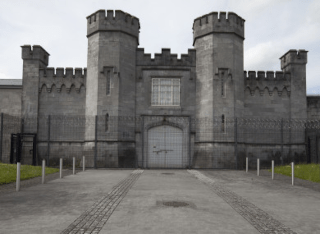
Nineteen republican prisoners blast their way out of Portlaoise Prison in County Laois on August 18, 1974.

The escape is a timely reminder of the determination, tenacity and ingenuity with which Irish Republican Army (IRA) Volunteers throughout the country fight against British rule in Ireland. It is also a reminder to the Fine Gael/Labour Coalition Government in Leinster House that their collaboration with the British and their attempts to defeat republicanism will not be an easy task.

The determination of republicans to escape from Portlaoise is demonstrated by the escape. In May 1974, an underground escape was planned but the 80-foot tunnel was uncovered and the prisoners’ hopes were dashed. However, almost immediately plans swung into place for a more daring escape operation.

A member of the Escape Committee spots a weakness in the jail security in the area of the prison where the laundry house is situated. The laundry leads to an outside stairway and down into the courtyard, where the Governor’s House and Warders’ Mess are located.

The prisoners discover that they can gain access to the laundry area quite easily. It is a doorway at the top of the courtyard which leads out onto the streets of Portlaoise town itself that give the prisoners hope that their plan will work. However, the Escape Committee decides that they need explosives to get through this gate and send word outside to this effect. The IRA on the outside, agreeing that the plan is “viable,” send in the materials and the plan is on.

The date for the escape is set for August 18, 1974 and planning proceeds inside the prison. The prisoners set themselves to work making prison guard uniforms. The idea is that when the escapees are running through the courtyard, the troops on the roof of the jail will not be able to distinguish between the escapees and the real guards and so will not open fire. This pre-planning proves to be a brilliant ploy as it gives those escaping vital seconds to clear the courtyard and make good their escape.

On the Friday before the plan is to proceed, a number of republicans are arrested in Portlaoise. This seems a bad omen and raises questions as to whether the authorities are suspicious that an escape is planned. However, the Escape Committee and those involved in the operation decide to press ahead with the plan anyway.

Sunday, August 18 duly arrives. According to prisoners who are in Portlaoise Prison at the time, no one can eat anything that day as the tension is unbearable. At 12:30 p.m., the designated time to put the plan into action, arrives and Liam Brown approaches the guard at the gate of the lower landing and asks to be let in. This is the signal for the first team of escapees to rush forward and get the key to the laundry. The guard is quickly overpowered and gives up the key with little resistance.

With this first stage of the plan successfully completed, the escapees open the door to the stairwell and rush through to the courtyard, followed by up to 25 other prisoners. As the prisoners race to the top of the yard to place the bomb at the outside gate, the soldiers on the roof are confused by the uniforms and cannot open fire.

The bomb then explodes, blasting the door to pieces. As the prisoners make the final dash for freedom, the soldiers fire warning shots over the heads of the fleeing republicans. Some of the prisoners drop to the ground fearing the worst but as the guards race from their mess they call on the soldiers to stop firing.

Those who are captured are brought into the Wing again and the governor demands a head count. The prisoners, however, refuse to comply, adding to the confusion and thwarting the prison authorities’ attempts to identify the escapees. It is only after the guards threaten to send in the riot squad several hours later that the prisoners allow a head count to be taken. When they realise that 19 men had escaped, the joy the prisoner experience is immense as they thought only 14 had got away.

In an attempt to capture the escapees, the Dublin Government launches a statewide search operation. Every outhouse in County Wexford is searched. The Irish Naval Service is even called in and put on the alert. The searches go on for over a week but to no avail. The nineteen men had gotten clean away.

Those who escape are Liam Brown, Paddy Devenny and Micky Nolan from Belfast; Tom McFeely and Ian Milne from County Derry; Thomas McGinty and Eddie Gallagher from County Donegal; Patrick Thornberry, Kevin McAllister and Martin McAllister from County Armagh; Francis Hughes and Kevin Mallon from County Tyrone; Oliver McKiernan from County Fermanagh; Bernard Hegarty and Sam O’Hare from County Louth; Michael Kinsella and Seán Kinsella from County Monaghan; Seán Morris from County Meath; and Tony Weldon from Dublin.

(From: “30 years on: The Great Portlaoise Escape,” An Phoblacht, http://www.anphoblacht.com, August 26, 2004)