Con Houlihan, Irish sportswriter, is born on December 6, 1925, in Castleisland, County Kerry. Despite only progressing to national journalism at the age of 46, he becomes “the greatest and the best-loved Irish sports journalist of all.”
Over a lengthy career, Houlihan covers many Irish and international sporting events, from Gaelic football and hurling finals, to soccer and rugby World Cups, the Olympic Games and numberless race meetings inside and outside Ireland.
Houlihan is a journalist with the Irish Press group writing for The Irish Press, Evening Press and sometimes The Sunday Press, until the group’s demise in 1995. He writes the “Tributaries” column and Evening Press back sports page “Con Houlihan” column.
Houlihan dies on the morning of August 4, 2012, in St. James’s Hospital in Dublin. Often considered one of Ireland’s finest writers, he leaves behind a legacy of immense sports journalism that spans over 60 years. A minute’s silence is observed in his memory ahead of Kerry GAA‘s All-Ireland Senior Football Championship quarter-final defeat to Donegal GAA at Croke Park the following day. His last column, in which he wishes Irish Olympic boxer Katie Taylor well, is published the day after his death. His funeral takes place on August 8, 2012.
Ireland’s president, Michael D. Higgins, leads the tributes to Houlihan, describing him as a “most original writer, with a unique style based on his extensive knowledge of literature, politics, life and sport.” He adds, “He had that special quality and ability to identify with the passion, pain and celebration of Irish community life.”
A bronze bust of Houlihan is unveiled in his hometown of Castleisland in 2004. In 2011, another sculpture is erected outside The Palace bar in Dublin.
O’Shannon is awarded lifetime membership of the Irish Film & Television Academy in 2010, to which he says it is “particularly gratifying that it occurs before I pop my clogs”.
The Irish radio and television broadcaster Terry Wogan describes O’Shannon as possibly the greatest Irish television journalist of the 20th century.
O’Shannon first becomes a journalist with The Irish Times on leaving the Royal Air Force in 1947. Later he joins the Irish state broadcasting service Raidió Teilifís Éireann (RTÉ).
In July 1972, O’Shannon records a notable television interview with 31-year-old Muhammad Ali, when Ali is in Dublin to compete at Croke Park in a bout with Alvin Lewis.
O’Shannon receives a Jacob’s Award for his 1976 TV documentary, Even the Olives are Bleeding, which details with the activities of the “Connolly Column” in the Spanish Civil War. Two years later he is honoured with a second Jacob’s Award for his television biography Emmet Dalton Remembers (1978).
In 1978, O’Shannon leaves RTÉ to join Canadian company Alcan which is setting up an aluminum plant at Aughinish, County Limerick, in 1978. He is head-hunted to become its Director of Public Affairs, an important post at a time when there are environmental concerns about the effects of aluminum production. He admits that he is attracted by the salary, “five times what RTÉ were paying me,” but he also later says that one reason for the move is that he had become unhappy with working at RTÉ, stating in an interview that: “The real reason I got out of RTÉ was that they wouldn’t let me do what I wanted to do journalistically.” He had submitted proposals to the station’s editors for television documentary series on the Irish Civil War, and also one on the wartime Emergency period, but they had been rejected. While he enjoys the social life with lavish expenses which his public relations duties involve, his friends believe that he misses the varied life and travel of journalism. He retires early from Aughinish in 1992, and returns to making television documentaries with RTÉ.
O’Shannon’s wife, Patsy, whom he met while they were working at The Irish Times office in London, dies in 2006. They had been married for more than 50 years.
On January 12, 2007, O’Shannon announces his retirement at the age of 80. In a 2008 television documentary, he admits that throughout his marriage he had been a serial womaniser and had repeatedly engaged in extra-marital affairs unbeknownst to his wife.
After weakening health for two years, and spending his last days in a hospice at Blackrock, O’Shannon dies at the Beacon Hospital in Dublin on October 22, 2011, in his 84th year. His body is reposed at Fanagans Funeral Home in Dublin on October 25, followed by a funeral the following day at Glasnevin Cemetery Chapel, where his remains are cremated afterward.
Director General of RTÉNoel Curran says O’Shannon had brought into being “some of the great moments in the RTÉ documentary and factual schedule over the past five decades.” In tribute, RTÉ One shows the documentary Cathal O’Shannon: Telling Tales on November 10, 2011. It had originally aired in 2008 to mark his 80th birthday
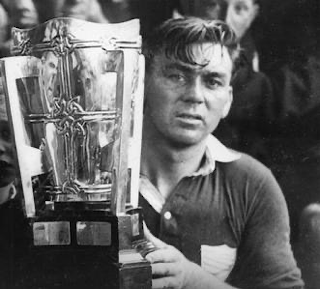
Mackey is born in Castleconnell, County Limerick, on July 12, 1912. Educated at Castleconnell National School, he receives no secondary schooling and subsequently joins the Electricity Supply Board where he spends forty-seven years as a van driver with the company at Ardnacrusha, County Clare. He also spends five years as a member of the Irish Army.
Mackey first arrives on the inter-county scene at the age of seventeen when he first links up with the Limerick minor team, before later lining out with the junior side. He makes his senior debut in the 1930–31 National Hurling League. He goes on to play a key part for Limerick during a golden age for the team, and wins three All-Ireland medals, five Munster medals and five National Hurling League medals. An All-Ireland runner-up on two occasions, he also captains the team to two All-Ireland victories.
Mackey’s brother, John, also shares in these victories while his father, John “Tyler” Mackey, is a one-time All-Ireland runner-up with Limerick.
Mackey represents the Munster GAA inter-provincial team for twelve years, winning eight Railway Cup medals during the period. At club level, he wins fifteen championship medals with Ahane.
Throughout his inter-county career, Mackey makes 42 championship appearances for Limerick. His retirement comes following the conclusion of the 1947 All-Ireland Senior Hurling Championship.
In retirement from playing, Mackey becomes involved in team management and coaching. As trainer of the Limerick senior team, he guides them to the 1955 Railway Cup Hurling Championship. He also serves as a selector on various occasions with both Limerick and Munster. He also serves as a referee.
Mackey is widely regarded as one of the greatest hurlers in the history of the game. He is the inaugural recipient of the All-Time All Star Award. He is repeatedly voted onto teams made up of the sport’s greats, including at centre-forward on the Hurling Team of the Century in 1984 and the Hurling Team of the Millennium in 2000. In 2021, the trophy given to the winning Munster Senior Hurling Championship team is named in Mackey’s honour.
Mackey is married to Kathleen “Kitty” Kennedy (1914–2003) and the couple has five children: Paddy, Michael, Greg, Audrey and Ruth.
In declining health for some years, Mackey suffers a series of strokes toward the end of his life. He dies in Dooradoyle, County Limerick, on September 13, 1982. All his medals and trophies are on display in the GAA Museum in Croke Park. A stand in the Limerick Gaelic Grounds is named after him.
O’Toole is the second son among five children of John O’Toole and Bridie O’Toole (née Doran). Of farming stock on both sides, he is educated at the local national school at Ballycumber and at a Dublinsecondary school. When in the mid-1890s he moves to Dublin, he joins the Benburb Gaelic Football Club at Donnybrook, where his teammates include the future nationalist parliamentarian Thomas M. Kettle, who is killed in 1916 near Ginchy, France, during World War I. The proprietor of two newsagents’ shops near his home in Mount Pleasant Square, he soon becomes his club’s delegate to the Dublin county committee of the Gaelic Athletic Association about 1899. Founded in 1884 by Michael Cusack, the GAA by the late 1890s is insolvent and almost moribund, having been riven by rival nationalist factions. However, a group of younger officials which includes O’Toole is determined not to allow the Association to die, and at its annual congress in Thurles on September 22, 1901, stages what is in effect a palace coup. Alderman James Nowlan of Kilkenny, County Kilkenny, a labour activist and Gaelic League enthusiast, is elected president, and in a contest for the post of secretary, O’Toole defeats Cusack.
O’Toole holds the post of chief officer of the GAA until his death almost thirty years later. During this period, despite major political and military turmoil, including the world war, the Irish War of Independence, and the Irish Civil War, he is instrumental in turning the Association into the biggest Irish sports body, and some leading members, such as Michael Collins and Harry Boland, play major political roles between 1913 and 1923. Essentially a backroom administrator, O’Toole rarely appears in public apart from GAA events, one notable exception being on November 25, 1913, at the foundation meeting of the Irish Volunteers at the Rotunda Rink, Dublin, where he is one of the platform party. After the suppression of the 1916 Easter Rising, he goes into hiding temporarily in his native Wicklow. From then until the cessation of hostilities in mid-1921 he manages to evade the notice of the authorities though he is always a close associate of Sinn Féin leaders. He plays a big part in reviving the fortunes of the GAA after the Irish Civil War and is a principal organiser of the Tailteann Games in 1924 and 1928. His career, however, is cut short at the age of 56 by his sudden death at his desk on July 17, 1929.
For most of his life O’Toole resides in a house provided by the GAA beside Croke Park, the Association’s headquarters and principal stadium. He marries Bridget Doyle, a shopkeeper of Dublin. They have four sons and four daughters.
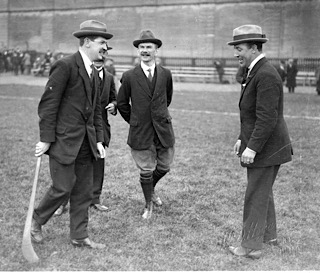
(From: “O’Toole, Luke” by Marcus de Búrca, Dictionary of Irish Biography, http://www.dib.ie, October 2009 | Pictured: Michael Collins, Luke O’Toole and Harry Boland in 1921, Image credit: GAA)
Gaelic footballerBernard Brogan Jnr is born on April 3, 1984, in Castleknock, Dublin. Born into a famous footballing family, he is the son of former All-Ireland winning and All Star player Bernard Brogan Snr and is the brother of former Dublin players Alan and Paul. His uncle Jim is also a former inter-county footballer for Dublin. Alongside most of his family, he attends St. Declan’s College on Navan Road.
Brogan scores his first point for Dublin against Fermanagh in the 2007 National Football League (NFL). He makes his Championship debut for Dublin as a late sub in Dublin’s quarter-final win over Meath. He makes his first start for Dublin in the semi-final against Offaly but is substituted in the 45th minute. He regains his position for the final against Laois at Croke Park, scoring 1–01 in Dublin’s 3–14 to 1-14 Leinster title winning game. Along with brother Alan, he is nominated for an All Star Award in 2007 as half forward.
In 2008, Brogan wins the Dublin AFL Division 1 title with St. Oliver Plunketts/Eoghan Ruadh, scoring 1–05 in the final at Parnell Park. It is the first league title in the club’s history. With Dublin he wins the 2008 O’Byrne Cup by beating Longford in the final.
In 2009, Brogan wins another Leinster title with Dublin, but his season ends with defeat to Kerry in the All-Ireland quarter-final.
After an exceptional season for Dublin on the full forward line in 2010, Brogan is awarded an All Star and is named as 2010 Vodafone Footballer of the Year.
In 2011, Brogan wins an All-Ireland title with Dublin, the team’s first All-Ireland since 1995. He scores six points in the final against Kerry. He later reveals his celebrations were cut short as he had to do a drug test straight after the game. He passes with flying colours and resumes his celebrations.
In 2012, Brogan wins another Leinster title when Dublin beats Meath in the final. Then he misses an absolute sitter in the All-Ireland semi-final against Mayo. The miss haunts Brogan as Dublin loses the game by a narrow margin.
Brogan wins the 2013 NFL with Dublin against Tyrone at Cork. He scores five frees in the game. He then wins another Leinster title against Meath and is part of the Dublin team that wins the 2013 All-Ireland Senior Football Championship Final, defeating Mayo by 2–12 to 1-14. Brogan scores 2–03 in the match, is All-Ireland final man of the match and The Sunday Game names him their man of the match and includes him on their team of the year. He is then awarded an All Star for his performances in 2013.
Brogan wins the 2014 NFL with Dublin, but his season comes to an abrupt end when Donegal defeats Dublin in that year’s All-Ireland semi-final, a momentous result that sends shockwaves through the sport.
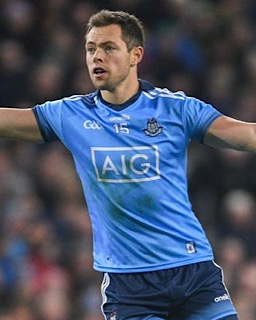
On October 24, 2019, Brogan announces his retirement from inter-county football. In total he plays 116 games for Dublin, league and championship, scoring 36 goals and 344 points (452), making him Dublin’s third top scorer of all time, behind Dean Rock (14-419; 461 in 89 games) and Jimmy Keaveney (30-402; 492 in 104 games).
In 2021, Brogan presents an episode of Shoulders of Giants, commissioned by Irish broadcaster RTÉ. In the programme, he charts the life and times of the former Dublin Gaelic footballer, and later manager, Kevin Heffernan, as well as the legacy he left Dublin football. The programme airs on RTÉ on December 12, 2021.
The Irish Business Against Litter (IBAL) organisation launches a major anti-litter initiative on October 30, 2001, which will hold every town in Ireland accountable for its cleanliness.
IBAL is a pressure group supported by private business which promotes the equating of environmental cleanliness with economic prosperity. It includes a range of commercial bodies, including Waterford Foods, the Irish Hotels Federation, and major banks, oil companies, building societies, brewers and distillers.
The group’s latest initiative, the “All-Ireland Anti-Litter League,” involves twenty-nine towns being assessed for litter and then ranked in a league-type table.
Towns from 29 counties, including three in Northern Ireland, are to be gauged according to international standards with each town being awarded a litter rating of up to 100 points with 85 points deemed “litter-free status.” Towns are to be assessed for varying levels of rubbish including chewing gum, graffiti, flypostings and weeds.
The founding chairman of IBAL, Tom Cunningham, says the aim is to send a message to the country as a whole, through this pilot project, that “the success of two of our biggest revenue sources – food and tourism – hinge on a perception of hygiene and cleanliness.”
Cunningham says at the launch of the initiative in Dublin‘s Croke Park that this is not a “name and shame campaign” but more a novel means of “energising Local Authorities through a spirit of inter-community rivalry.”
The IBAL chairman speaks of the importance of combatting litter in view of the changing tourist market. He says next year (2002) Ireland will look to Continental markets to compensate for the shortfall in U.S. visitors and that “these tourists are typically litter conscious as we will discover to our cost if we don’t clean up our towns.”
The initiative is planned to run until September 2002, to coincide with the Gaelic Athletic Association (GAA) finals. Results of the first monitoring are expected in January 2002.
(From: “League tables to rate town litter problems” by Maurice Coffey, The Irish Times, http://www.irishtimes.com, October 30, 2001)
Hogan is one of four sons and three daughters of Patrick Hogan, farmer, and Margaret Hogan (née Galvin). His family are staunch nationalists who have been heavily involved in the land struggle. He is the brother of Major General Daniel (Dan) Hogan, who is Chief of Staff of the Defence Forces in the 1920s. On November 19, 1920, Hogan is elected company commander of the Irish Republican Army (IRA) in the Grangemockler area, where he is working on the family farm.
A dedicated footballer, Hogan is the established full back on the Tipperary county football team. During the Irish War of Independence very few championships are completed, and challenge matches are the chief attraction. Following the success of a Kildare–Dublin challenge match, a challenge is organised between Tipperary and Dublin at Croke Park, Dublin, on November 21, 1920.
The day before the match, Hogan travels on the train with the other members of the team. A number of the players, including Hogan, become involved in a fight with soldiers from the Royal Lincolnshire Regiment before throwing them from the train. On arrival at (Kingsbridge) Heuston Station, they quickly go their separate ways anticipating arrest. Michael and Thomas “Tommy” Ryan, the two IRA members on the team, decide to stay at Philip Shanahan‘s pub in Monto that night, rather than Barry’s Hotel as planned. There they learn that “there is a ‘big job coming off” the following day but are unaware of the details.
On the morning of the match, fourteen members of the British intelligence service are assassinated by the IRA. This leads to concerns about the match and the safety of spectators, and the Dublin brigade of the IRA urges that the game be cancelled. Shanahan informs the team of the shooting of the British agents. Ryan claims that Dan Breen advised them it would be better not to attend the match, but instead to return to Tipperary. Leading Gaelic Athletic Association (GAA) officials Jim Nowlan, Dan MacCarthy and Luke O’Toole decide the match should proceed, arguing that a postponement would associate the IRA’s activities with the GAA.
Dublin and Tipperary are two of the best teams in the country at the time (and later contest the 1920 All-Ireland Senior Football Championship final when it is eventually played in 1922), so despite the events of the morning, a large crowd of some 10,000 people are in attendance.
At 3:00 p.m., not long after the match has started, a British military plane flies over and drops a flare, signaling British forces to converge on the ground. Black and Tans enter Croke Park and open fire on the crowd.
Hogan drops to the ground and is crawling to safety when a bullet hits him in the mouth. Tom Ryan, a young spectator from Wexford, enters the pitch to pray beside the dying Hogan and is also fatally shot. Another player, Jim Egan, is wounded, but survives. In all, fourteen people are killed and dozens are wounded and injured. The events of that day come to be known as “Bloody Sunday.”
Hogan’s body is returned to Grangemockler for burial on November 24, 1920. A huge crowd attends the funeral. He is buried in his football colours in a coffin draped with the tricolour. The GAA commemorates him by naming the main stand at Croke Park after him and erecting a monument to his memory at Grangemockler. His football jersey is in the South Tipperary County Museum in Clonmel.
Best known as a centre half-forward, Purcell plays in most outfield positions during his career. In 2009, he is named in the Sunday Tribune‘s list of the “125 Most Influential People in GAA History.”
Purcell’s footballing career spans three decades, from the 1940s to the 1960s. He forms a successful on-field partnership with Frank Stockwell at Galway, culminating in the team winning their fourth All-Ireland championship in 1956 and leading to their nickname as the “Terrible Twins.”
Further successes in which Purcell is involved include winning the National Football League title in 1957, three Railway Cups, one of which he captains, the 1950 Sigerson Cup, appearances with the Combined Universities side and ten county titles with the Tuam Stars, including seven in a row from 1954 to 1960.
Purcell’s involvement in the GAA continues long after his playing days as he serves in a number of positions as team mentor and administrator in Galway.
Purcell dies on August 27, 2005, at the age of 76, following a short illness at the Blackrock Clinic, County Dublin. He is buried in the Athenry Road graveyard at Tuam.
Purcell marries Rita Shannon in 1961. They have four daughters and two sons before the marriage ends. His son, Robert Purcell, marries Tessa Robinson, daughter of former Irish PresidentMary Robinson, in 2005. His grandson, Simon Carr, is a professional tennis player. Another grandson, Sam McCartan, has played Gaelic football at senior level for Westmeath. His teenage grandson, Rory Purcell, dies in 2022.
Ó Muircheartaigh grows up on the family farm and is educated locally in Dingle. In September 1945, he begins studying at Coláiste Íosagáin in Ballyvourney in the County CorkGaeltacht where he trains to be a teacher. It is at this all-Irish language school that his name changes from Michael Moriarty to the Irish version Mícheál Ó Muircheartaigh. He says that Irish is his stronger language. In September 1948, he begins the final year of his teacher training at St. Patrick’s College of Education in Drumcondra, Dublin.
In early March 1949, Ó Muircheartaigh, along with ten other students from the college, and several from other colleges, do a test commentary on a hurling match at Croke Park. Each student has to commentate for five minutes in Irish and the most successful is to be selected for further commentary work. Up to this point, he has never seen a game of hurling before in his life. He is the one selected and his first assignment is to provide an all-Irish commentary on the 1949 Railway Cup final on Saint Patrick’s Day.
Ó Muircheartaigh graduates from St. Patrick’s College a little later and also completes a Bachelor of Arts degree from University College Dublin (UCD) in 1952. He also completes a Higher Diploma in Education in 1953. He teaches economics, accountancy and Irish in both primary and secondary schools throughout Dublin, the majority of which are run by the Christian Brothers. He continues teaching up until the 1980s, when he becomes a full-time broadcaster with RTÉ.
For the early part of his broadcasting career, Ó Muircheartaigh commentates on Minor GAA matches, in the Irish language. He also replaces the legendary Michael O’Hehir when he is not available to commentate. Eventually when O’Hehir is forced to retire in the mid-1980s Ó Muircheartaigh takes over as the station’s premier radio commentator. He develops his own inimitable style of commentary, and his accent is unmistakably that of a native Irish speaker. He is a true lover of Gaelic Athletic Association, and it is reflected in the enthusiasm he brings to matches. His unusual turn of phrase makes him a much-loved broadcaster and often imitated character. He becomes particularly famous in Ireland for his unusual turns of phrase in the heat of the moment while commentating. Towards the end of his life, he commentates on RTÉ Radio 1. In 2004, he publishes his autobiography, From Dún Sion to Croke Park.
On March 5, 1988, Ó Muircheartaigh presents the Saturday Live show on RTÉ 1. In 1990, he holds an impromptu interview with Britain’s Prince Edward, after his greyhound had won at the English Greyhound Derby qualifier when he was commentating.
Ó Muircheartaigh’s commentaries for RTÉ Radio 1’s Sunday Sport show win him a Jacob’s Award in 1992. He is also the Parade Grand Marshal for the 2007 St. Patrick’s Festival, having been given the honour by the chairman of the festival in recognition and appreciation of his unique contribution to Irish culture. He is the Parade Grand Marshal for the 2011 St. Patrick’s Parade in Toronto, Ontario, Canada, also in recognition and appreciation of his unique contribution to Irish culture.
On September 16, 2010, Ó Muircheartaigh announces his retirement from broadcasting. The last All-Ireland he commentates on is the 2010 All-Ireland Senior Football Championship Final on September 19, 2010.
On October 29, 2010, it is announced that the 2nd International Rules test at Croke Park would be Ó Muircheartaigh’s final broadcast as commentator on RTÉ Radio 1. The following day he commentates his final commentary alongside RTÉ’s pundit and former Meath footballer Bernard Flynn.
Ó Muircheartaigh is contracted to officiate at the 2011–2012 Volvo Ocean Race finish in Galway where he commentates on the finish to the round-the-world race, giving it a uniquely Irish conclusion. Sailing is his longtime hobby.
Ó Muircheartaigh writes a weekly sports column for Foinse, the Irish-language newspaper free with the Irish Independent each Wednesday. He is invited to read out a piece in Irish and in English at an event called “Laochra” in Croke Park on April 24, 2016, to commemorate the 100th anniversary of the Easter Rising.
In 2007, Ó Muircheartaigh is awarded the UCD Foundation Day Medal. His nephew by marriage, John McGuire, has presented several programmes on RTÉ.
Ó Muircheartaigh dies in hospital in Dublin at the age of 93 on June 25, 2024.
Ó Muircheartaigh is awarded an honorary doctorate by NUI Galway in 1999 for his lifetime service to broadcasting. Shortly after his 90th birthday, he is awarded the only GAA GPA All Stars Award of 2020. No further All Stars can be awarded as competition is suspended due to the COVID-19 pandemic and only completed that December.
Connell is ordained priest by Archbishop John Charles McQuaid on May 19, 1951. He takes up a teaching post at the Department of Metaphysics at the University College Dublin. He is appointed Professor of General Metaphysics in 1972 and in 1983 becomes the Dean of the Faculty of Philosophy and Sociology. The College’s Department of Metaphysics is abolished after his departure.
Connell is appointed Archbishop of Dublin by the Holy See in early 1988. He is consecrated at St. Mary’s Pro-Cathedral, Dublin on March 6, 1988. He is created Cardinal-Priest by Pope John Paul II at the Consistory in Rome on February 21, 2001, with the TitulusS. Silvestri in Capite. Archbishops of Armagh, who hold the higher title of Primate of All Ireland, are more frequently appointed Cardinal than Archbishops of Dublin. The last Archbishop of Dublin to have been a cardinal is Cardinal Edward MacCabe, who was appointed in 1882. A large Irish contingent from Church and State, along with family and friends of the Cardinal, attend the installation which for the first time takes place at the front of the entrance to St. Peter’s Basilica.
On April 26, 2004, Connell retires as archbishop, handing the diocese to the coadjutor bishop, Diarmuid Martin. All bishops submit their resignation to the Pope on their 75th birthday. Connell’s is accepted shortly after his 78th birthday.
It is Connell’s failure, when Archbishop of Dublin in 1988–2004, to address adequately the abuse scandals in Dublin that lead the Vatican to assign Archbishop Martin as his replacement in the country’s largest diocese. The Murphy Report finds that Connell had handled the affair “badly” as he was “slow to recognise the seriousness of the situation.” It does praise him for making the archdiocesan records available to the authorities in 2002 and for his 1995 actions in giving the authorities the names of 17 priests who had been accused of abuse, although it says the list is incomplete as complaints were made against at least 28 priests in the archdiocese.
From 1988 Connell also continues to insure his archdiocese against liability from complainants, while claiming to the Murphy Commission that the archdiocese is “on a learning curve” in regard to child abuse. He arranges for compensation payments to be made from a “Stewardship Trust” that is kept secret from the archdiocese’s parishioners until 2003. In 1996 he refuses to help a victim of Paul McGennis and does not pass on what he knows about McGennis to her, or to the police. He apologises for this in 2002.
Desmond Connell dies in Dublin at the age of 90 on February 21, 2017, exactly sixteen years after his creation as Cardinal.