seamus dubhghaill

Promoting Irish Culture and History from Little Rock, Arkansas, USA


Leave a comment

Death of Erskine Hamilton Childers, 4th President of Ireland

Erskine Hamilton Childers, Fianna Fáil politician who serves as the 4th President of Ireland, dies on November 17, 1974. He also serves as Tánaiste and Minister for Health from 1969 to 1973, Minister for Transport and Power from 1959 to 1969, Minister for Posts and Telegraphs from 1951 to 1954 and 1966 to 1969. He served as a Teachta Dála (TD) from 1938 to 1973.

Childers is born on December 11, 1905, in the Embankment Gardens, London, to a Protestant family originally from Glendalough, County Wicklow. He is educated at Gresham’s School, Holt, and the University of Cambridge. In 1922, when Childers is sixteen, his father, Robert Erskine Childers, is executed by the new Irish Free State on politically inspired charges of gun-possession. After attending his father’s funeral, Childers returns to Gresham’s, then two years later he goes on to Trinity College, Cambridge.

After finishing his education, Childers works for a period in a tourism board in Paris. In 1931, Éamon de Valera invites him to work for his recently founded newspaper, The Irish Press, where Childers becomes advertising manager. He becomes a naturalised Irish citizen in 1938. That same year, he is first elected as a Fianna Fáil Teachta Dála (TD) for Athlone–Longford. He remains in the Dáil Éireann until 1973, when he resigns to become President.

Childers joins the cabinet in 1951 as Minister for Posts and Telegraphs in the de Valera government. He then serves as Minister for Lands in de Valera’s 1957–59 cabinet, as Minister for Transport and Power under Seán Lemass, and, successively, as Transport Minister, Posts and Telegraphs Minister, and Health Minister under Jack Lynch. He becomes Tánaiste in 1969.

Fine Gael TD Tom O’Higgins, who had almost won the 1966 presidential election, is widely expected to win the 1973 election when he is again the Fine Gael nominee. Childers is nominated by Fianna Fáil at the behest of de Valera, who pressures Jack Lynch in the selection of the presidential candidate. He is a controversial nominee, owing not only to his British birth and upbringing but to his Protestantism. However, on the campaign trail his personal popularity proves enormous, and in a political upset, Childers is elected the fourth President of Ireland on May 30, 1973, defeating O’Higgins by 635,867 votes to 578,771.

Childers quickly gains a reputation as a vibrant, extremely hard-working president, and becomes highly popular and respected. However, he has a strained relationship with the incumbent government, led by Taoiseach Liam Cosgrave of Fine Gael. Childers had campaigned on a platform of making the presidency more open and hands-on, which Cosgrave views as a threat to his own agenda as head of government. Childers considers resigning from the presidency but is convinced to remain by Cosgrave’s Minister for Foreign Affairs and Trade, Garret FitzGerald.

Though frustrated about the lack of power he has in the office, Childers’ daughter Nessa believes that he plays an important behind-the-scenes role in easing the Northern Ireland conflict, reporting that former Prime Minister of Northern Ireland Terence O’Neill meets secretly with her father at Áras an Uachtaráin on at least one occasion.

Prevented from transforming the presidency as he desired, Childers instead throws his energy into a busy schedule of official visits and speeches, which is physically taxing. On November 17, 1974, just after making a speech to the Royal College of Physicians of Ireland in Dublin, Childers suffers a heart attack. He dies the same day at Mater Misericordiae University Hospital.

Childers’s state funeral in St. Patrick’s Cathedral, Dublin is attended by world leaders including the Louis Mountbatten, 1st Earl Mountbatten of Burma (representing Queen Elizabeth II), the Prime Minister of the United Kingdom and leader of the Opposition, and presidents and crowned heads of state from Europe and beyond. He is buried in the grounds of the Church of Ireland Derralossary church in Roundwood, County Wicklow.


Leave a comment

Birth of Irish Republican Army Officer Liam Lynch

Liam Lynch, officer in the Irish Republican Army during the Irish War of Independence and the commanding general of the Irish Republican Army during the Irish Civil War, is born in the townland of Barnagurraha, County Limerick, on November 9, 1893.

In 1910, at the age of 17, he starts an apprenticeship in O’Neill’s hardware trade in Mitchelstown, where he joins the Gaelic League and the Ancient Order of Hibernians. Later he works at Barry’s Timber Merchants in Fermoy. In the aftermath of the 1916 Easter Rising, he witnesses the shooting and arrest of David, Thomas and Richard Kent of Bawnard House by the Royal Irish Constabulary. After this, he determines to dedicate his life to Irish republicanism. In 1917 he is elected First Lieutenant of the Irish Volunteer Company, which resides in Fermoy.

In Cork in 1919, Lynch re-organises the Irish Volunteers, the paramilitary organisation that becomes the Irish Republican Army (IRA), becoming commandant of the Cork No. 2 Brigade of the IRA during the guerrilla Irish War of Independence. He is captured, along with the other officers of the Cork No. 2 Brigade, in a British raid on Cork City Hall in August 1920. He provides a false name and is released three days later. In September 1920, he and Ernie O’Malley command a force that takes the British Army barracks at Mallow. The arms in the barracks are seized and the building is partially burned. In April 1921, the IRA is re-organised into divisions based on regions. Lynch’s reputation is such that he is made commander of the 1st Southern Division.

The war formally ends with the signing of the Anglo-Irish Treaty between the Irish negotiating team and the British government in December 1921. Lynch is opposed to the Treaty, on the ground that it disestablishes the Irish Republic proclaimed in 1916 in favour of Dominion status for Ireland within the British Empire. He becomes Chief of Staff of the IRA in March 1922, much of which is also against the Treaty.

Although Lynch opposes the seizure of the Four Courts in Dublin by a group of hardline republicans, he joins its garrison in June 1922 when it is attacked by the newly formed National Army. This marks the beginning of the Irish Civil War. The ‘Munster Republic’ falls in August 1922, when Free State troops land by sea in Cork and Kerry. The Anti-Treaty forces then disperse and pursue guerrilla tactics.

Lynch contributes to the growing bitterness of the war by issuing what are known as the “orders of frightfulness” against the Provisional government on November 30, 1922. This General Order sanctions the killing of Free State Teachta Dála (TDs) and Senators, as well as certain judges and newspaper editors in reprisal for the Free State’s killing of captured republicans. Lynch is heavily criticised by some republicans for his failure to co-ordinate their war effort and for letting the conflict peter out into inconclusive guerrilla warfare. Lynch makes unsuccessful efforts to import mountain artillery from Germany to turn the tide of the war.

In March 1923, the Anti-Treaty IRA Army Executive meets in a remote location in the Nire Valley. Several members of the executive propose ending the civil war. However, Lynch opposes them and narrowly carries a vote to continue the war.

On April 10, 1923, a National Army unit is seen approaching Lynch’s secret headquarters in the Knockmealdown Mountains. Lynch is carrying important papers that could not fall into enemy hands, so he and his six comrades begin a strategic retreat. To their surprise, they run into another unit of 50 soldiers approaching from the opposite side. Lynch is hit by rifle fire from the road at the foot of the hill. Knowing the value of the papers they carry, he orders his men to leave him behind.

When the soldiers finally reach Lynch, they initially believe him to be Éamon de Valera, but he informs them, “I am Liam Lynch, Chief-of-Staff of the Irish Republican Army. Get me a priest and doctor, I’m dying.” He is carried on an improvised stretcher manufactured from guns to “Nugents” pub in Newcastle, at the foot of the mountains. He is later brought to the hospital in Clonmel and dies that evening. He is laid to rest two days later at Kilcrumper Cemetery, near Fermoy, County Cork.


Leave a comment

De Valera Rejects Churchill’s Statement About Irish Ports

In a statement before Dáil Éireann on November 7, 1940, Taoiseach Éamon de Valera rejects Prime Minister of the United Kingdom Winston Churchill’s statement about Irish ports stating that there can be no question of handing over Irish ports for use by British forces while the country is partitioned. This move helps ensure Ireland’s neutrality during World War II.

In the House of Commons of the United Kingdom on November 5, Churchill bemoans the fact that the Irish ports had been returned to the Free State government in 1938:

“The fact that we cannot use the South and West Coasts of Ireland to refuel our flotillas and aircraft and thus protect the trade by which Ireland as well as Great Britain lives, is a most heavy and grievous burden and one which should never have been placed on our shoulders, broad though they be.”

De Valera responds to Churchill’s statement two days later, on November 7:

“I would have refrained from making any comment upon it were it not that it has been followed by an extensive Press campaign by Britain itself, and re-echoed in the United States of America, the purport of the campaign being that we should surrender or lease our ports to Britain for the conduct of the war…

We have chosen the policy of neutrality in this war because we believed that it was the right policy for our people. It is the policy which has been accepted, not merely by this House, but by our people as a whole, and nobody who realises what modern war means, and what it means particularly for those who have not sufficient air defences, will have the slightest doubt that that policy was the right one, apart altogether from any questions of sympathy on one side or the other…

There can be no question of the handing over of these ports so long as this State remains neutral. There can be no question of leasing these ports. They are ours. They are within our sovereignty, and there can be no question, as long as we remain neutral, of handing them over on any condition whatsoever. Any attempt to bring pressure to bear on us by any side—by any of the belligerents—by Britain—could only lead to bloodshed.”


Leave a comment

Charles Haughey Acquitted of Conspiring in the Arms Crisis

Charles Haughey, former Minister for Finance, and three others including former Minister for Agriculture Neil Blaney, are acquitted on October 23, 1970, of charges that they had conspired to illegally import arms and ammunition into Ireland for the Irish Republican Army (IRA), an incident known as the Arms Crisis.

The Garda Special Branch informs the Minister for Justice Micheál Ó Móráin and Taoiseach Jack Lynch that a plot to import arms exists and includes government members, however Lynch takes no action until the Special Branch makes opposition leader Liam Cosgrave aware of the plot. Cosgrave tells Lynch he is aware of the plot and will announce it in the Dáil the next day if he does not act. Lynch subsequently requests that Haughey and Blaney resign from the Cabinet. Both men refuse, saying they had done nothing illegal. Lynch then asks President Éamon de Valera to terminate their appointments as members of the government, a request that de Valera is required to grant by convention. Haughey and Blaney are subsequently tried in court along with Captain James Kelly, a former intelligence captain in the Irish Army, and Albert Luykx, a former Flemish Nationalist and businessman, who allegedly used his contacts to buy the arms.

The verdict, reached by jury after two hours and 10 minutes of deliberation, leads to political repercussions for the Government of Taoiseach Jack Lynch. Lynch had dismissed the Haughey from his Cabinet post the previous May on the allegation of illegal gunrunning.

Witnesses declare during the 14‐day trial that the arms, imported from the Continental Europe, were ultimately destined for the Roman Catholic minority in Northern Ireland. However, the defense contends that the arms had been brought in with the knowledge and approval of the current Minister for Agriculture, Jim Gibbons, who was serving as Minister for Defence at the time.

The jury rules that the prosecution had failed to prove its case.  Haughey is carried from the High Court after the acquittal, as are the three other defendants.

Although cleared of wrongdoing, it appears as if Haughey’s political career is finished. Blaney eventually resigns from Fianna Fáil but Haughey remains. He spends his years on the backbenches building support within the grassroots of the party. During this time, he remains loyal to the party and serves the leader but after the debacle of the Arms Crisis neither man trusts the other.

(Pictured: Charles Haughey with Neil Blaney at the 1970 at the Arms Trial)


Leave a comment

Birth of Eoin O’Duffy, Political Activist & Police Commissioner

Eoin O’Duffy, Irish political activist, soldier, police commissioner and organizer of the infamous Blueshirts, is born in Castleblayney, County Monaghan, on October 20, 1892.

O’Duffy does an apprenticeship as an engineer in Wexford before working as an engineer and architect in Monaghan. In 1919 he becomes an auctioneer. He is a leading member of the Gaelic Athletic Association in Ulster in the 1910s. In 1912 he is appointed secretary of the Ulster provincial council. He is also a member of Harps’ Gaelic Football Club.

O’Duffy joins the Irish Republican Army (IRA) in 1917 and is the leader of the Monaghan Brigade of the IRA during the Irish War of Independence and in this capacity becomes Chief of Staff of the IRA in 1922. He is one of the Irish activists who along with Michael Collins accepts the Anglo-Irish Treaty and fights as a general in the Irish Civil War on the pro-Treaty side.

Professionally, O’Duffy becomes the second Commissioner of the Garda Síochána, the police force of the new Irish Free State, after the Civic Guard Mutiny and the subsequent resignation of Michael Staines. He holds this post until 1933, when he is dismissed by Éamon de Valera. In his political life O’Duffy is an early member of Sinn Féin, founded by Arthur Griffith. He is elected as a Teachta Dála (TD) for his home county of Monaghan during the 1921 election.

After a split in 1923 he becomes associated with Cumann na nGaedheal and becomes head of a veteran’s group then known as the Army Comrades Association. O’Duffy changes its name to “National Guard” and begins to stage fascist-style rallies and adopts a fascist salute. Its members begin to wear blue uniform shirts and become known as the Blueshirts. When government opposition groups form Fine Gael in September 1933, he becomes its first president, reaching the apex of his political power.

Subsequently, the government bans O’Duffy’s National Guard, as well as the group he creates to replace it, the Young Ireland Association, which he in turn replaces with the League of Youth, but their blue shirts indicate its continued fascist ideology. Fine Gael’s other leaders soon tire of his inflammatory rhetoric and the frequent violent behavior of the Blueshirts but are still surprised when their opposition causes him to resign his party leadership in September 1934. He is then ousted as leader of the Blueshirts as well but does retain a small loyal following.

An anti-communist, O’Duffy is attracted to the various authoritarian nationalist movements on the Continent. In 1936, he raises the Irish Brigade to fight for Francisco Franco during the Spanish Civil War as an act of Catholic solidarity and is inspired by Benito Mussolini‘s Italy to found the National Corporate Party. He offers to Nazi Germany the prospect of raising an Irish Brigade to fight in Operation Barbarossa during World War II on the Eastern Front against the Soviet Union, but this is not taken up.

Eoin O’Duffy takes no further part in Irish politics and dies in Dublin on November 30, 1944. In spite of his later politics, he is given a state funeral for his earlier contributions to the Irish government. He is buried in Dublin’s Glasnevin Cemetery.


Leave a comment

Birth of Michael Collins, Revolutionary Leader & Politician

Michael Collins, soldier and politician who was a leading figure in the struggle for, and achievement of Irish independence in the early 20th century, is born near Clonakilty, County Cork, on October 16, 1890.

Michael Collins is born to a successful farmer, Michael John Collins, and Mary Anne O’Brien. When the couple marries, she is twenty-three years old, and he is sixty. The couple have eight children, with Michael being the youngest.

Raised in a beautiful but remote part of southwest Ireland, Collins is educated at local primary schools. At the Lisavair National School, Collins is inspired by his teacher, Denis Lyons, a member of a secret organization, the Irish Republican Brotherhood (IRB), whose aim is to gain Ireland’s independence from Great Britain. Collins is also influenced by the stories of local men who had taken part in the Irish Rebellion of 1798, a conflict that sparks a feud between the Irish Protestants and Catholics. From these stories Collins learns of Irish pride, rebellion, executions, and the general harsh treatment imposed on his country by the British.

In 1906 Collins goes to London to enter the civil service as a postal clerk. For ten years Collins lives in London, where he becomes active in various Irish organizations, including the Gaelic League, a society that promotes the use of the Irish language. Also, during this time, Collins is influenced by the writings of Arthur Griffith, an Irish nationalist who founded the Irish political party Sinn Féin. In 1909 Collins himself becomes a member of the IRB, and later becomes the IRB treasurer for the South of England.

Collins returns to Ireland in 1916 to take part in the Easter Rising, a rebellion against British rule. After the rebellion is crushed, Collins is interned in North Wales along with most of the other rebels from the IRB. When the internees are released in December 1916, he goes to Dublin, where his sharp intelligence and dynamic energy soon secure him a leadership position in the reviving revolutionary movement.

After their victory in the general election of December 1918, the revolutionaries establish an Irish parliament, Dáil Éireann, in January 1919. The Dáil officially announces an Irish Republic and sets up an executive to take over the government of the country. British attempts to crush the Republican movement are met with guerrilla warfare from the Irish Republican Army (IRA).

Collins plays the most important role in this struggle. As director of intelligence of the IRA, he cripples the British intelligence system in Ireland and replaces it with an effective Irish network. At the same time, he performs other important military functions, heads the IRB, and, as minister of finance in the Republican government, successfully raises and hands out large sums of money on behalf of the rebel cause. Despite constant efforts, the British are unable to capture Collins or stop his work. The “Big Fellow” becomes an idolized and near-legendary figure in Ireland, and he wins a reputation in Britain and abroad for ruthlessness, resourcefulness, and daring.

After the truce of July 1921, Collins reluctantly agrees to Irish president Éamon de Valera‘s request to serve on the peace-making talks headed by Arthur Griffith. During the autumn negotiations in London, the British government firmly rejects any settlement that involves recognition of the republic. Instead, its representatives offer Dominion status for Ireland with the right of exclusion for loyalist Northern Ireland. Collins decides to accept these terms, in the belief that rejection would mean renewal of the war and quick defeat for Ireland, and that the proposed treaty will soon lead to unity and complete freedom for his country. Using these arguments, he and Griffith persuade their side to sign the treaty on December 6, 1921, and Dáil Éireann to approve it on January 7, 1922.

De Valera and many Republicans refuse to accept the agreement, however, believing that it means a betrayal of the republic and a continued domination by Britain. As the British evacuate southern Ireland, Collins and Griffith do their best to maintain order and enforce the treaty signed with the British. They find their efforts frustrated by the opposition of an armed Republican minority. Collins seeks desperately to satisfy the forces that oppose the treaty without abandoning the treaty altogether, but he finds it impossible to make a workable compromise.

In late June 1922, after the population had supported the settlement in an election, Collins agrees to use force against the opposition. This action sparks a civil war, a bitter conflict in which the forces of the infant Irish Free State eventually overcome the extreme Republicans in May 1923. However, Collins does not live to see the end of the war. He is killed in an ambush in West Cork on August 22, 1922, just ten days after the death of Arthur Griffith.

Much of Collins’s success as a revolutionary leader is due mainly to his realism and extraordinary efficiency. He also possesses an amazing vision and humanity in his character, however, which appeals to friend and foe alike. The treaty that costs him his life does not end the argument, as he had hoped, but it does make possible the peaceful gaining of full political freedom for most of Ireland.


Leave a comment

Long Kesh Prison Hunger Strike Ends

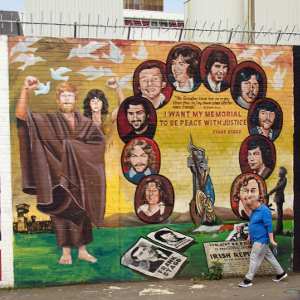
The Irish Republican Army (IRA) hunger strike is called off at Long Kesh prison – later known as HM Prison Maze – on October 3, 1981. While the IRA does not win immediate concessions, in some ways it is a Pyrrhic victory for Margaret Thatcher’s government. It galvanises support and membership for the IRA and generates huge sympathy for the strikers in the United States where fund-raising is a major priority. The death of the first hunger striker, Bobby Sands, creates a martyr and an iconic figure.

In January 1981, prison authorities begin to supply the prisoners with officially issued civilian clothing, whereas the prisoners demand the right to wear their own clothing. On February 4, the prisoners issue a statement saying that the British government has failed to resolve the crisis and declares their intention of a hunger strike. The hunger strike begins on March 1, when Bobby Sands, the IRA’s former officer commanding (OC) in the prison, refuses food. Unlike the first hunger strike the previous year, the prisoners join one at a time and at staggered intervals, which they believe would arouse maximum public support and exert maximum pressure on Prime Minister Margaret Thatcher.

The republican movement initially struggles to generate public support for the second hunger strike. The Sunday before Sands begins his strike, 3,500 people march through west Belfast. During the first hunger strike four months earlier, the marchers had numbered 10,000. Five days into the strike, Independent Republican MP for Fermanagh and South Tyrone Frank Maguire dies, resulting in a by-election. There is debate among nationalists and republicans regarding who should contest the election. After negotiations they agree not to split the nationalist vote by contesting the election and Sands stands as an Anti H-Block candidate against Ulster Unionist Party candidate Harry West. Following a high-profile campaign, the election takes place on April 9, and Sands is elected to the British House of Commons with 30,492 votes to West’s 29,046.

Sands’ election victory raises hopes that a settlement can be negotiated, but Thatcher stands firm in refusing to give concessions to the hunger strikers. The world’s media descends on Belfast, and several intermediaries visit Sands in an attempt to negotiate an end to the hunger strike, including Síle de Valera, granddaughter of Éamon de Valera, Pope John Paul II‘s personal envoy John Magee, and European Commission of Human Rights officials. With Sands close to death, the government’s position remains unchanged.

On 5 May, Sands dies in the prison hospital on the 66th day of his hunger strike, prompting rioting in nationalist areas of Northern Ireland. More than 100,000 people line the route of his funeral, which is conducted with full IRA military honours. Margaret Thatcher shows no sympathy for his death.

In the two weeks following Sands’ death, hunger strikers Francis Hughes, Raymond McCreesh and Patsy O’Hara die. Following the deaths of Joe McDonnell and Martin Hurson, the families of some of the hunger strikers attend a meeting on July 28 with Catholic priest Father Denis Faul. The families express concern at the lack of a settlement to the priest, and a decision is made to meet with Gerry Adams later that day. The following day Adams holds a meeting with six of the hunger strikers to outline a proposed settlement on offer from the British government should the strike be brought to an end. The six men reject the settlement, believing that accepting anything less than the “Five Demands” would be a betrayal of the sacrifice made by Bobby Sands and the other hunger strikers who had died.

The hunger strike begins to break on July 31, when the mother of Paddy Quinn insists on medical intervention to save his life. The following day Kevin Lynch dies, followed by Kieran Doherty on August 2, Thomas McElwee on August 8 and Michael Devine on August 20. On September 6, the family of Laurence McKeown becomes the fourth family to intervene and asks for medical treatment to save his life, and Cahal Daly issues a statement calling on republican prisoners to end the hunger strike.

The strike is called off at 3:15 PM on October 3, 1981. Three days later, James Prior, the new Secretary of State for Northern Ireland, announces partial concessions to the prisoners including the right to wear their own clothes at all times. The only one of the “Five Demands” still outstanding is the right not to do prison work. Following sabotage by the prisoners and the Maze Prison escape in 1983, the prison workshops are closed, effectively granting all of the “Five Demands” but without any formal recognition of political status from the government.

(Pictured: A Belfast mural of the Long Kesh hunger strikers)


Leave a comment

Death of Hunger Striker Thomas Patrick Ashe

Thomas Patrick Ashe, a member of the Gaelic League, the Irish Republican Brotherhood (IRB), and a founding member of the Irish Volunteers, dies on September 25, 1917, at Mater Misericordiae Hospital in Dublin following a hunger strike.

Ashe is born in Lispole, County Kerry, on January 12, 1885. He enters De La Salle Training College, Waterford in 1905 and begins a teaching career as principal of Corduff National School, Lusk, County Dublin, in 1908.

Ashe plays a major part in the 1916 Easter Rising outside the capital city commanding the Fingal battalion of the Irish Volunteers. He is commandant of the 5th battalion of the Dublin brigade, a force of 60–70 men engaging British forces around north County Dublin during the rising. They are armed only with a few rounds, about a dozen service rifles, a dozen Mausers, and a dozen Martini carbines. Some of Ashe’s men are armed only with a shotgun against the well-equipped army regulars.

Ashe’s battalion wins a major victory in Ashbourne, County Meath, where they engage a much larger force. They capture a significant quantity of arms and up to twenty Royal Irish Constabulary (RIC) vehicles. Eleven RIC members, including County Inspector Alexander Gray, and two volunteers are killed during the 5-1/2-hour battle. Twenty-four hours after the rising collapses, Ashe’s battalion surrenders on the orders of Patrick Pearse. On May 8, 1916, Ashe and Éamon de Valera are court-martialled and sentenced to death. The sentences are commuted to penal servitude for life. Ashe is imprisoned in Frongoch internment camp and Lewes Prison in Lewes, East Sussex, England.

De Valera, Ashe, and Thomas Hunter lead a prisoner hunger strike on May 28, 1917. With accounts of prison mistreatment appearing in the Irish press and mounting protests in Ireland, Ashe and the remaining prisoners are freed on June 18, 1917, by David Lloyd George as part of a general amnesty.

Upon his release, Ashe returns to Ireland and begins a series of speaking engagements. In August 1917, he is arrested and charged with sedition for a speech that he makes in Ballinalee, County Longford, where Michael Collins is also speaking. He is detained at the Curragh but is then transferred to Mountjoy Prison in Dublin. He is convicted and sentenced to two years hard labour. Ashe and other prisoners, including Fionán Lynch and Austin Stack, demand prisoner of war status.

On September 20, 1917, Ashe again goes on hunger strike. He dies at Mater Misericordiae Hospital on September 25, 1917, after being force fed by prison authorities. At the inquest into his death, the jury condemns the staff at the prison for the “inhuman and dangerous operation performed on the prisoner, and other acts of unfeeling and barbaric conduct.” His body lies in state at Dublin City Hall and is buried in Glasnevin Cemetery in Dublin.

The Ashe Memorial Hall built in 1928, housing the Kerry County Museum, in Tralee is named after him while Nelson Street, also in Tralee, is renamed Ashe Street. Ashe is a relative of Catherine Ashe, the paternal grandmother of American actor Gregory Peck, who emigrates to the United States in the 19th century.


Leave a comment

The Funeral of Michael Collins

Michael Collins, soldier and politician who is a leading figure in the struggle for, and achievement of Irish independence in the early 20th century, is laid to rest in Dublin‘s Glasnevin Cemetery on August 28, 1922.

Collins is shot and killed by anti-Treaty ambushers as his Free State Army convoy approaches Béal na Bláth, an isolated crossroads in County Cork, on August 22, 1922, during the Irish Civil War.

Collins’s body is transported by sea from Cork to Dublin. He lay in state for three days in Dublin City Hall where tens of thousands of mourners filed past his coffin to pay their respects, including many British soldiers departing Ireland who had fought against him. His funeral mass on August 28, 1922, takes place at Dublin’s St. Mary’s Pro-Cathedral where a number of foreign and Irish dignitaries are in attendance. According to a report in The New York Times, the seven-mile journey from the cathedral to his final resting place in Glasnevin Cemetery is lined with half a million mourners, almost one fifth of the country’s population at the time, and many of whom likely differed with him on his Treaty vote.

No official inquiry is ever undertaken into Collins’s death and consequently there is no official version of what happened, nor are there any authoritative, detailed contemporary records.

In this vacuum, independent investigations and conspiracy theorists have put forward a number of suspects as having executed or ordered his death, including an anti-Treaty sharpshooter, members of his own escort, the British Secret Intelligence Service, or Éamon de Valera himself.

De Valera is alleged to have declared in 1966, “It is my considered opinion that in the fullness of time history will record the greatness of Michael Collins; and it will be recorded at my expense.”

An annual commemoration ceremony takes place each year in August at the ambush site at Béal na Bláth, organised by The Béal na mBláth Commemoration Committee. In 2009, former President of Ireland Mary Robinson gives the oration. In 2010, the Minister for Finance Brian Lenihan, Jnr. becomes the first Fianna Fáil person to give the oration. In 2012, on the 90th anniversary of the death of Collins, Taoiseach Enda Kenny gives the oration, the first serving head of government to do so. There is also a remembrance ceremony in Glasnevin Cemetery every year at Collins’s gravesite on the anniversary of his death.

RIP Big Fellow!


Leave a comment

Birth of Cathal Brugha, Revolutionary & Politician

Cathal Brugha, Irish revolutionary and politician, is born in Dublin on July 18, 1874. He is active in the Easter Rising, the Irish War of Independence, and the Irish Civil War and is the first Ceann Comhairle (chairman) of Dáil Éireann as well as the first President of Dáil Éireann, then the title of the chief of government.

Born Charles William St. John Burgess, Brugha is the tenth of fourteen children and is educated at the Jesuit Belvedere College but is forced to leave at the age of sixteen because of the failure of his father’s business.

In 1899 Brugha join the Gaelic League, and he subsequently changes his name from Charles Burgess to Cathal Brugha. He meets his future wife, Kathleen Kingston, at an Irish class in Birr, County Offaly and they marry in 1912. They have six children, five girls and one boy. Brugha becomes actively involved in the Irish Republican Brotherhood (IRB) and in 1913 he becomes a lieutenant in the Irish Volunteers. He leads a group of twenty Volunteers to receive the arms smuggled into Ireland in the Howth gun-running of 1914.

He is second-in-command at the South Dublin Union under Commandant Éamonn Ceannt in the Easter Rising of 1916. On the Thursday of Easter Week, being badly wounded, he is unable to leave when the retreat is ordered. Brugha, weak from loss of blood, continues to fire upon the enemy and is found by Eamonn Ceannt singing “God Save Ireland” with his pistol still in his hands. He is initially not considered likely to survive. He recovers over the next year but is left with a permanent limp.

Brugha is elected speaker of Dáil Éireann at its first meeting on January 21, 1919, and he reads out the Declaration of Independence in Irish, which ratifies “the establishment of the Irish Republic.” On the following day, he is appointed president of the ministry pro tempore. He retains this position until April 1, 1919, when Éamon de Valera takes his place.

In October 1917 Brugha becomes Chief of Staff of the Irish Republican Army and holds that post until March 1919. He is elected as a Sinn Féin MP for the County Waterford constituency at the 1918 general election. In January 1919, Sinn Féin MPs refuse to recognise the Parliament of the United Kingdom and instead assemble at the Mansion House in Dublin as a revolutionary parliament called Dáil Éireann. Due to the absence of Éamon de Valera and Arthur Griffith, Brugha presides over the first meeting of Dáil Éireann on January 21, 1919.

Brugha has differences with Michael Collins, who, although nominally only the IRA’s Director of Intelligence, has far more influence in the organisation as a result of his position as a high-ranking member of the Irish Republican Brotherhood, an organisation that Brugha sees as undermining the power of the Dáil and especially the Ministry for Defence. Brugha opposes the oath of allegiance required for membership of the IRB and, in 1919, his proposition that all Volunteers should swear allegiance to the Irish Republic and the Dáil is adopted.

At a top-level IRA meeting in August 1920, Brugha argues against ambushes of Crown forces unless there is first a call to surrender, but it is dismissed as unrealistic by the brigade commanders present. Brugha also has the idea of moving the front line of the war to England but is opposed by Collins.

On January 7, 1922, Brugha votes against the Anglo-Irish Treaty. During the Treaty debates, he points out that Collins has only a middling rank in the Department of Defence, which supervises the IRA even though Arthur Griffith hails him as “the man who had won the war.” He leaves the Dáil and is replaced as Minister for Defence by Richard Mulcahy.

In the months between the Treaty debates and the outbreak of Civil War, Brugha attempts to dissuade his fellow anti-treaty army leaders including Rory O’Connor, Liam Mellows and Joe McKelvey from taking up arms against the Free State. When the IRA occupies the Four Courts, he and Oscar Traynor call on them to abandon their position. When they refuse, Traynor orders the occupation of the area around O’Connell Street in the hope of easing the pressure on the Four Courts and of forcing the Free State to negotiate.

On June 28, 1922, Brugha is appointed commandant of the forces in O’Connell Street. The outbreak of the Irish Civil War ensues in the first week of July when Free State forces commence shelling of the anti-treaty positions.

Most of the anti-Treaty fighters under Oscar Traynor escape from O’Connell Street when the buildings they are holding catch fire, leaving Brugha in command of a small rearguard. On July 5, he orders his men to surrender but refuses to do so himself. He then approaches the Free State troops, brandishing a revolver. He sustains a bullet wound to the leg which severs a major artery.

Cathal Brugha dies on July 7, 1922, eleven days before his 48th birthday. He has been re-elected as an anti-Treaty Teachta Dála (TD) at the 1922 Irish general election but dies before the Dáil assembles. He is buried in Glasnevin Cemetery.