seamus dubhghaill

Promoting Irish Culture and History from Little Rock, Arkansas, USA


Leave a comment

Execution of Irish Republican Liam Mellows

liam-mellows

Liam Mellows, Irish republican and Sinn Féin politician, is executed by firing squad by Free State forces on December 8, 1922, in reprisal for the shooting of Teachta Dála (TD) Seán Hales.

Mellows is born at Hartshead Military Barracks, Ashton-Under-Lyne, Lancashire, England, to William Joseph Mellows, a British Army non-commissioned officer, and Sarah Jordan, of Inch, County Wexford. His family moves to 10 Annadale Avenue, Fairview, Dublin, in February 1895 when Sergeant Mellows is transferred there, however Liam remains in Wexford with his grandfather Patrick Jordan due to ill health. He attends the military school in Wellington Barracks in Cork and the Portobello garrison school in Dublin but ultimately refuses a military career much to his father’s disappointment, instead working as a clerk in several Dublin firms, including the Junior Army & Navy Stores on D’Olier Street.

A nationalist from an early age, Mellows approaches Thomas Clarke, who recruits him to Fianna Éireann, an organisation of young republicans.

Mellows is introduced to socialism when he meets James Connolly at Countess Markiewicz’s residence, recuperating after his hunger strike. He is active in the Irish Republican Brotherhood (IRB) and is a founder member of the Irish Volunteers, being brought onto its Organising Committee to strengthen the Fianna representation. He is arrested and jailed on several occasions under the Defence of the Realm Act. Eventually escaping from Reading Gaol, he returns to Ireland to command the “Western Division” of the Irish Republican Army (IRA) during the Easter Rising of 1916.

Mellows leads roughly 700 Volunteers in abortive attacks on Royal Irish Constabulary stations at Oranmore and Clarinbridge in County Galway and takes over the town of Athenry. However, his men are very badly armed and supplied and they disperse after a week, when British troops and the cruiser HMS Gloucester are sent west to attack them.

After this insurrection fails, Mellows escapes to the United States, where he is arrested and detained without trial in The Tombs in Lower Manhattan, New York, on a charge of attempting to aid the German side in World War I. After his release in 1918, he works with John Devoy and helps to organise Éamon de Valera’s fund-raising visit to America in 1919–1920.

Mellows returns to Ireland to become Irish Republican Army “Director of Supplies” during the Irish War of Independence, responsible for buying arms. At the 1918 general election of December, he is elected to the First Dáil as a Sinn Féin candidate for both East Galway and for North Meath. He considers the Anglo-Irish Treaty as signed to be a betrayal of the Irish Republic. A conference of 9 TDs is deputed to meet privately on January 5, 1922, to resolve the dispute and to achieve a unified front by compromise. The four other anti-Treaty TDs say there is agreement but Mellows does not and is seen thereafter by pro-Treaty TDs as one of their most implacable opponents. The following day the Dáil votes to approve the Treaty by a majority of 64 to 57.

Mellows is one of the more strident TDs on the approach to the Irish Civil War. In June 1922, he and fellow republicans Rory O’Connor, Joe McKelvey and Richard Barrett, among others, enters the Four Courts, which has been occupied by anti-Treaty forces since April. However, they are bombarded by pro-Treaty Free State forces and surrender after two days. Mellows has a chance to escape along with Ernie O’Malley but does not take it. Imprisoned in Mountjoy Gaol, Mellows, O’Connor, McKelvey and Barrett are executed by firing squad on December 8, 1922, in reprisal for the shooting of TD Seán Hales. Mellows is buried in Castletown cemetery, County Wexford, a few miles from Arklow. An annual commemoration ceremony is held at his grave site, in which a wreath is laid by a member of the Liam Mellows Commemoration committee.

Mellows is commemorated by statues in Oranmore and Eyre Square in Galway, in the official name of the Irish Defence Forces army barracks at Renmore and in the naming of Mellows Bridge in Dublin. Mellows Avenue in Arklow is named in his honour. He is also commemorated in the names of two hurling clubs, one in Galway and one in Wexford, and by Unidare RFC in Ballymun and their “Liam Mellows Perpetual Cup.”


Leave a comment

Execution of John Atherton, Anglican Bishop of Waterford & Lismore

john-atherton-execution-pamphlet

John Atherton, Anglican Bishop of Waterford and Lismore in the Church of Ireland, is executed on December 5, 1640, on a charge of immorality.

Atherton is born in 1598 in Somerset, England. He studies at Oxford University and joins the ranks of the Anglican clergy. In 1634 he becomes Bishop of Waterford and Lismore in the Church of Ireland. In 1640 he is accused of buggery with a man, John Childe, his steward and tithe proctor. They are tried under a law that Atherton himself had helped to institute. They are both condemned to death, and Atherton is executed in St. Stephen’s Green, Dublin. Reportedly, he confesses to the crime immediately before his execution, although he had proclaimed his innocence before that.

More recently, some historical evidence has been developed that shows Atherton might have been a victim of a conspiracy to discredit him and his patrons. This is attributable to Atherton’s status as an astute lawyer, who seeks to recover lost land for the relatively weak Protestant Church of Ireland during the 1630s. Unfortunately for Atherton, this alienates him from large landowners, who then allegedly use his sexuality to discredit him.

English Puritan, Congregationalist and Independent activists, as well as English and Scottish Presbyterian activists, contemporaneously campaign to abolish Episcopacy (bishops) within the embattled Church of England, Church of Scotland and Church of Ireland, notionally expediting the political interest in Atherton’s downfall.

Posthumous accusations of sexual wrongdoing also include allegations of “incest” with his sister-in-law, and infanticide of the resultant child, as well as zoophilia with cattle. However, these allegations begin to be circulated several months after his death in an anonymous pamphlet, and may have been intended to further discredit the bishop’s campaign to restore the finances of the Church of Ireland.

(Pictured: Anonymous pamphlet of the hangings of John Atherton and John Childe, 1641)


Leave a comment

Death of Poet & Revolutionary Denny Lane

Denny Lane, author, poet and member of the revolutionary Young Ireland party, dies in Cork, County Cork, on November 29, 1895.

Lane is born in Riverstown, near Glanmire in County Cork, on December 4, 1818. Although a Catholic, Lane graduates from the mainly Protestant Trinity College, Dublin, where he joins the College Historical Society, becomes a friend of Charles Gavan Duffy and Thomas Davis. He is called to the bar from Inner Temple, but soon becomes involved in the political activities surrounding Daniel O’Connell, joining the Repeal Association.

The young men become increasingly impatient with the slow pace of O’Connell’s repeal campaign and soon begin to contemplate armed insurrection. Davis, along with John Dillon and Charles Duffy, found The Nation, the newspaper of the movement in 1842. In its pages the idea of total separation from England is soon openly suggested, and Lane becomes one of the paper’s contributors. He contributes articles and later poems to the paper, his best known poems being Carrig Dhoun and Kate of Araglen which are written under the pen name “Domhnall na Glanna” or “Domhnall Gleannach.”

Finally, in 1846, the issue of physical force split the Young Irelanders from O’Connell’s Repeal Association. Lane supports the split. Davis, Lane, and small group of their friends soon become known by the name which has survived to this day: the Young Ireland Party.

Lane and his college classmate Michael Joseph Barry are the most prominent Young Irelanders in Cork, and are interned in Cork City Gaol after the Young Ireland Rebellion of 1848. Lane spends four months in prison. After his release, he returns to Cork and does not appear to have much political involvement thereafter.

Lane takes over his father’s distillery in Cork and later starts several industrial businesses near the city, with mixed success. He takes an interest in technology and industrial innovation. He is on the boards of the Macroom Railway Company and the Blackrock and Passage Railway Company, and also involved in Cork’s School of Art, School of Music, and Literary & Scientific and Historical & Archaeological societies. He stands for Parliament in the 1876 Cork City by-election, but the Home Rule vote is split with John Daly, so that unionist William Goulding is elected.

(Pictured: An 1889 bust of Denny Lane sculpted by John Lawlor)


Leave a comment

Death of Aeneas Coffey, Inventor & Distiller

Aeneas Coffey, Irish inventor and distiller, dies in England on November 26, 1852. He is born in Calais, France, to Irish parents in 1780. He is educated at Trinity College, Dublin, and enters the excise service around 1799–1800 as a gauger. He marries Susanna Logie in 1808, and they have a son, also named Aeneas, who may have been their only child.

According to British customs and excise records, Coffey is a remarkable man with widespread interests and multiple talents who rises quickly through the excise service ranks. He is appointed sub-commissioner of Inland Excise and Taxes for the district of Drogheda in 1813. He is appointed Surveyor of Excise for Clonmel and Wicklow in 1815. In 1816 he is promoted to the same post at Cork. By 1818 he is Acting Inspector General of Excise for the whole of Ireland and within two years is promoted to Inspector General of Excise in Dublin.

Coffey is a strong, determined upholder of the law, but aware of its shortcomings. He survives many nasty skirmishes with illegal distillers and smugglers, particularly in County Donegal in Ulster and in the west of Ireland, where moonshining is most rife. On several occasions he proposes to the government simple, pragmatic solutions to rules and regulations which have hampered legal distillers. Not all of his ideas are accepted. Between 1820 and 1824 he submits reports and gives evidence to Parliamentary Commissions of Inquiry on many aspects of distilling, including formalising the different spellings of Irish whiskey and Scotch whisky. His 1822 report is solidly backed by the Irish distillers. He believes in making it viable to distill legally, and illegal distilling might largely disappear.

He assists the government in the drafting of the 1823 Excise Act which makes it easier to distill legally. It sanctions the distilling of whiskey in return for a licence fee of £10, and a set payment per gallon of proof spirit. It also provides for the appointment of a single Board of Excise, under Treasury control, for the whole of the United Kingdom, replacing the separate excise boards for England, Scotland and Ireland. The 1823 Excise Act also provides for not more than four assistant commissioners of excise to transact current business in Scotland and Ireland, under the control of the board in London. Coffey resigns from government excise service at his own request in 1824.

Between his Dublin education and his work as an excise officer, Coffey has ample opportunity to observe the design and workings of whiskey stills, as Ireland is the world’s leading producer of whiskey in the 19th century, and Dublin is at the center of that global industry. This is how Coffey becomes familiar with a design differing from the traditional copper pot alembic still commonly used in Ireland, the continuous, or column, still. First patented by a Cork County distillery in 1822, the column still remains a relatively inefficient piece of equipment, although it points the way towards a cheaper and more productive way to distill alcohol. It is that last point that captures Coffey’s imagination. He makes his own modifications to existing column still designs, so as to allow a greater portion of the vapors to re-circulate into the still instead of moving into the receiver with the spirit. The result is more efficient, producing a lighter spirit at higher alcohol content. Coffey patents his design in 1830, and it becomes the basis for every column still used ever since.

On his retirement from service, Coffey goes into the Irish distilling business. For a short time he runs the Dodder Bank Distillery, Dublin and Dock Distillery in Grand Canal Street, Dublin, before setting up on his own as Aeneas Coffey Whiskey Company in 1830. The development of the Coffey still makes distillation of his own whiskey much more economical.

Nothing is known of the final years and last resting place of Aeneas Coffey. His only son, also called Aeneas Coffey, emigrates to South Africa and manages a distillery. He marries but his wife dies childless. He returns to England and spends his final years near London.


Leave a comment

Execution of Robert Erskine Childers

During the Irish Civil War, British writer and Irish republican Robert Erskine Childers is executed by the Irish Free State government at the Beggars Bush Barracks in Dublin on November 24, 1922.

The London-born son of a British scholar and an Irish mother, Childers is a lifelong Protestant, itself an anomaly since Irish nationalism maps strongly to Catholicism. In his early years his loyalty was with the British Empire. In his twenties, Childers volunteers for the Second Boer War, and he later says the rank savagery and underlying injustice of England’s war “changed the whole current of my life and made me a Liberal and a Nationalist.”

Laying down the sword, Childers takes up the pen and writes several books of military history. He also writes a novel, The Riddle of the Sands, that has a claim of being the first spy novel. The Riddle of the Sands has never gone out of print since it was published in 1903.

Both in fiction and nonfiction, Childers’ warnings against the German challenge to British hegemony are prophetic, but he is himself becoming a man divided. In 1914 he runs German guns to Irish nationalists aboard his yacht Asgard and then signs up for the royal navy when World War I erupts. The British crackdown on the Easter Rising during the war completes his radicalization. He moves to Dublin and turns his eloquence against the British.

Childers is swept into the tragedy of the Irish War of Independence and the Irish Civil War that follows. Although both he and Michael Collins are in the delegation that produces the contentious Anglo-Irish Treaty, Childers breaks with Collins over it and backs the Irish Republican Army (IRA) nationalists who fight the Irish Free State.

After Collins’s assassination, emergency laws promulgate the death sentence for anyone caught armed without authorization. Childers is a writer, not a partisan, but he is arrested in early November with a small sidearm, a gift Collins had given him back when they were on the same side. It is a time of bloody justice, and they throw the book at him.

Childers knows as well as Collins had that the internecine conflict would have to end. He faces his execution with awe-inspiring forgiveness. Summoning his 16-year-old son to prison the night before his execution, Childers extracts a promise from the boy that he will find everyone who signed his death warrant and shake their hands. This son, young Erskine Hamilton Childers, eventually becomes President of Ireland.

Childers himself likewise shakes the hands of his own firing squad, one by one. His last words, reported in a number of slightly different variations, are lightheartedly addressed to them: “Take a step or two forwards, lads. It will be easier that way.”


Leave a comment

Death of C.S. Lewis, Novelist & Poet

Clive Staples Lewis, novelist, poet, academic, medievalist, literary critic, essayist, lay theologian, broadcaster, lecturer, and Christian apologist, dies in Oxford, England, on November 22, 1963.

Lewis is born in Belfast on November 29, 1898. When he is seven, his family moves into “Little Lea,” the family home of his childhood, in the Strandtown area of East Belfast. He was schooled by private tutors until age 9, when his mother dies from cancer. His father then sends him to live and study at Wynyard School in Watford, Hertfordshire. The school closes soon afterwards due to a lack of pupils. He then attends Campbell College in the east of Belfast about a mile from his home, but leaves after a few months due to respiratory problems. He is then sent to the health-resort town of Malvern, Worcestershire, where he attends the preparatory school Cherbourg House. It is during this time that Lewis abandons his childhood Christian faith and becomes an atheist. In September 1913, he enrolls at Malvern College, where he remains until the following June. After leaving Malvern, he studies privately with William T. Kirkpatrick, his father’s old tutor and former headmaster of Lurgan College.

Lewis holds academic positions at both Oxford University (Magdalen College, 1925–1954) and Cambridge University (Magdalene College, 1954–1963). He is best known for his works of fiction, especially The Screwtape Letters, The Chronicles of Narnia, and The Space Trilogy, and for his non-fiction Christian apologetics, such as Mere Christianity, Miracles, and The Problem of Pain.

Lewis and fellow novelist J.R.R. Tolkien are close friends. They both serve on the English faculty at Oxford University, and are active in the informal Oxford literary group known as the Inklings. According to Lewis’s memoir Surprised by Joy, he is baptised in the Church of Ireland, but fell away from his faith during adolescence. He returns to Anglicanism at the age of 32, owing to the influence of Tolkien and other friends, and he becomes an “ordinary layman of the Church of England.” His faith profoundly affects his work, and his wartime radio broadcasts on the subject of Christianity bring him wide acclaim.

Lewis writes more than 30 books, which have been translated into more than 30 languages and have sold millions of copies. The books that make up The Chronicles of Narnia have sold the most and have been popularised on stage, TV, radio, and cinema. His philosophical writings are widely cited by Christian apologetics from many denominations.

In early June 1961, Lewis begins suffering from nephritis, which results in blood poisoning. His illness causes him to miss the autumn term at Cambridge, though his health gradually begins improving in 1962 and he returns that April. His health continues to improve and he is fully himself by early 1963. On July 15 of that year he falls ill and is admitted to hospital. At 5:00 PM the following day he suffers a heart attack and lapses into a coma, unexpectedly awaking the following afternoon. After he is discharged from the hospital he is too ill to return to work. As a result, he resigns from his post at Cambridge in August. His condition continues to decline, and in mid-November he is diagnosed with end-stage renal failure. On November 22, exactly one week before his 65th birthday, he collapses in his bedroom at 5:30 PM and dies a few minutes later. He is buried in the churchyard of Holy Trinity Church, Headington, Oxford.

Media coverage of Lewis’s death is almost completely overshadowed by news of the assassination of U.S. President John F. Kennedy, which occurs on the same day approximately 55 minutes following Lewis’s collapse, as does the death of English writer Aldous Huxley, author of Brave New World.

In 2013, on the 50th anniversary of his death, Lewis is honoured with a memorial in Poets’ Corner in Westminster Abbey. His works enter the public domain in 2014 in countries where copyright expires 50 years after the death of the creator, such as Canada.


Leave a comment

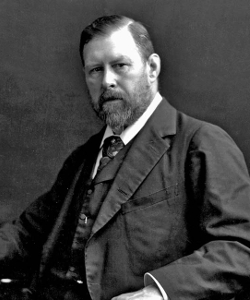
Birth of Irish Author Abraham “Bram” Stoker

Abraham “Bram” Stoker, Irish author best known today for his 1897 Gothic fiction novel Dracula, is born on November 8, 1847 in Clontarf, Dublin. During his lifetime, he is better known as the personal assistant of actor Henry Irving and business manager of the Lyceum Theatre, London, which Irving owns.

Stoker’s father, Abraham Stoker, is a civil servant and his mother, Charlotte Mathilda Blake Thornley, is a charity worker and writer. Stoker is a sickly child and is bedridden with an unknown illness until he starts school at the age of seven, when he makes a complete recovery. Growing up his mother tells him a lot of horror stories which may have influence on his later writings.

In 1864 Stoker enters Trinity College, Dublin. While attending college he begins working as an Irish civil servant. He also works part time as a free lance journalist and drama critic. In 1876 he meets Henry Irving, a famous actor, and they soon become friends. Not long after that, Stoker meets and falls in love with an aspiring actress named Florence Balcombe whom he marries on December 4, 1878 at St. Anne’s Parish Church, Dublin. In 1878 he accepts a job working in London as Irving’s personal secretary.

On December 9, Stoker and his new wife move to England to join Irving. His first book The Duties of Clerks of Petty Sessions in Ireland though written while he is still in Dublin, is published in 1879. On December 30, 1879 Stoker and his wife have their only child, a son Noel. While in England Stoker also writes several novels and short stories. His first book of fiction, Under the Sunset, is published in 1881.

Stoker visits the English coastal town of Whitby in 1890, a visit that is said to be part of the inspiration for Dracula. Before writing Dracula, he meets Ármin Vámbéry, a Hungarian writer and traveller. Dracula likely emerges from Vámbéry’s dark stories of the Carpathian Mountains. Stoker then spends several years researching European folklore and mythological stories of vampires.

Dracula is an epistolary novel, written as a collection of realistic but completely fictional diary entries, telegrams, letters, ship’s logs, and newspaper clippings, all of which add a level of detailed realism to the story, a skill which Stoker develops as a newspaper writer. At the time of its publication, Dracula is considered a “straightforward horror novel” based on imaginary creations of supernatural life.

The original 541-page typescript of Dracula is believed to have been lost until it is found in a barn in northwestern Pennsylvania in the early 1980s. It consists of typed sheets with many emendations, plus handwritten on the title page is “THE UN-DEAD.” The author’s name is shown at the bottom as Bram Stoker. The typescript is purchased by Microsoft co-founder Paul Allen.

After suffering a number of strokes, Abraham “Bram” Stoker dies at No. 26 St. George’s Square, London on April 20, 1912. Some biographers attribute the cause of death to tertiary syphilis, others to overwork. He is cremated and his ashes are placed in a display urn at Golders Green Crematorium in north London.


Leave a comment

Birth of Footballer Johnny Giles

Michael John “Johnny” Giles, former association footballer and manager, is born in Ormond Square, Dublin, on November 6, 1940. He is best remembered for his time as a midfielder with Leeds United F.C. in the 1960s and 1970s. After retiring from management in 1985, Giles serves as the senior analyst on RTÉ Sport‘s coverage of association football from 1986 until 2016. The Football Association of Ireland (FAI) votes Giles as the greatest Irish player of the last 50 years at the UEFA Jubilee Awards in 2004.

After winning an FA Cup winner’s medal under Matt Busby at Manchester United F.C., Giles moves to Leeds in 1963 where he plays in midfield alongside captain Billy Bremner. The duo goes on to form a central midfield partnership which is one of the best in English club football. Their pairing helps yield several major trophies in the most successful era in Leeds’ history. By a strange coincidence, Giles and Bremner both score exactly 115 goals for the club.

In his later years in football, Giles pursues a managerial career which sees him installed as player-manager and manager of, among others, West Bromwich Albion F.C., the Republic of Ireland national football team, Vancouver Whitecaps F.C. and Shamrock Rovers F.C. Despite having an outstanding knowledge of the game, Giles personally never likes being a manager. He becomes disillusioned with aspects of the job, such as suffering at the hands of non-committal boardrooms and leaves management permanently in 1985. He later declares that he has no regrets about quitting managerial life.

Subsequently, after repeated encouragement from childhood friend Eamon Dunphy, Giles inadvertently enters the world of football punditry in 1986. He goes on to establish himself as the highly respected senior analyst on RTÉ Sport. In addition, he writes two columns per week for the Irish Evening Herald newspaper and offers his opinions about the game on radio station, Newstalk 106.

Giles resides in the Harborne area of the city of Birmingham, England. To coincide with his 70th birthday, Giles compiles a first ever autobiography chronicling his life in and outside of football which is released in November 2010. The autobiography, titled A Football Man, becomes the best-selling book in the Republic of Ireland.


Leave a comment

Death of Thomas “Buck” Whaley

Thomas Whaley, Irish gambler and member of the Irish House of Commons commonly known as Buck Whaley or Jerusalem Whaley, dies on November 2, 1800, in England.

Whaley is born in Dublin on December 15, 1766, the eldest surviving son of the landowner, magistrate and former Member of Parliament Richard Chapell Whaley. At the age of sixteen, he is sent to Europe on the Grand tour, accompanied by a tutor. He settles in Paris for some time, maintaining both a country residence and town house, but is forced to leave Paris when his cheque for the amount of £14,000, to settle gambling debts accrued in one night of gambling, is refused by his bankers. Following his return to Dublin, Whaley, at the age of eighteen, is elected to the Irish House of Commons in 1785 representing the constituency of Newcastle in County Dublin.

While dining with William FitzGerald, 2nd Duke of Leinster at Leinster House, wagers totaling £15,000 are offered that Whaley cannot travel to Jerusalem and back within two years and provide proof of his success. The reasoning of those offering the bets is based on the belief that, as the region was part of the Ottoman Empire and had a reputation for widespread banditry, it will be too dangerous for travelers, and it will be unlikely that Whaley can complete the journey.

Whaley embarks from Dublin on October 8, 1788. He sails first to Deal, Kent, where he is joined by a companion, a Captain Wilson, and then on to Gibraltar. In Gibraltar, his party is joined by another military officer, Captain Hugh Moore. The party sets sail for the port of Smyrna, although Wilson is prevented from travelling any further due to rheumatic fever. The remaining pair make an overland journey from there to Constantinople, arriving in December.

The British ambassador in Constantinople introduces Whaley to the Vizier Cezayirli Gazi Hasan Pasha. Taking a liking to Whaley, Hasan Pasha provides him with permits to visit Jerusalem. Whaley’s party leaves Constantinople on January 21, 1789, by ship and sail to Acre, Israel. He encounters the Wāli of Acre and Galillee, Ahmad Pasha al-Jazzar. Al-Jazzar, notoriously known as “The Butcher” in the region he rules, takes a liking to Whaley and, though he dismisses the documents issued in Constantinople as worthless, he permits Whaley to continue his journey.

Whaley and his companions make their way overland to Jerusalem, arriving on January 28. During his visit, he stays at a Franciscan monastery, the Convent of Terra Sancta. It is a signed certificate from the superior of this institution, along with detailed observations of the buildings of Jerusalem, that provide the proof needed to prove the success of his journey. They stay for little over a month before returning overland to Ireland.

Whaley arrives back in Dublin in the summer of 1789 to great celebrations and collects the winnings of the wager. The trip costs him a total of £8,000, leaving him a profit of £7,000.

Following his Jerusalem exploit, Whaley remains in Dublin for two years and later spends time in London and travelling in Europe, including Paris during the Revolutionary period. Due to mounting debts, he is forced to sell much of his estate in the early 1790s and these financial problems also lead to his departure from Dublin.

Thomas Whaley dies on November 2, 1800, in the Cheshire town of Knutsford, while travelling from Liverpool to London. The cause of death is attributed to rheumatic fever, although a popular story circulated in Ireland is that he is stabbed in a jealous rage by one of two sisters, both of whom are objects of his attentions.


Leave a comment

Birth of Richard Brinsley Sheridan, Playwright & Satirist

Richard Brinsley Butler Sheridan, Irish satirist, playwright and poet, and long-term owner of the London Theatre Royal, Drury Lane, is born on October 30, 1751, in Dublin, where his family has a house on then fashionable Dorset Street.

While in Dublin Sheridan attends the English Grammar School in Grafton Street. The family moves permanently to England in 1758 where he is a pupil at Harrow School from 1762 to 1768. After his period in Harrow School, his father employs a private tutor to directs his studies.

In 1775, Sheridan’s first play, The Rivals, is produced at London’s Covent Garden Theatre. It is a failure on its first night. He casts a more capable actor in the lead for its second performance, and it is a smash which immediately establishes the young playwright’s reputation and the favour of fashionable London. It has gone on to become a standard of English literature.

Shortly after the success of The Rivals, Sheridan and his father-in-law, Thomas Linley the Elder, a successful composer, produce the opera, The Duenna. This piece is accorded such a warm reception that it plays for seventy-five performances.

The following year, Sheridan, his father-in-law, and one other partner purchase a half-interest in the Drury Lane theatre and, two years later, buy out the other half. Sheridan is the manager of the theatre for many years and later becomes sole owner with no managerial role.

His most famous play, The School for Scandal (Drury Lane, May 8, 1777), is considered one of the greatest comedies of manners in English. It is followed by The Critic (1779), an updating of the satirical Restoration comedy The Rehearsal. He has a rivalry with his fellow playwright Richard Cumberland and includes a parody of Cumberland in The Critic. In 1778, Sheridan writes The Camp, which comments on the ongoing threat of a French invasion of Britain.

In 1780, Sheridan enters Parliament as the ally of Charles James Fox on the side of the American Colonials in the political debate of that year. He remains in Parliament for 32 years.

On February 24, 1809, despite the much-vaunted fire safety precautions of 1794, the theatre burns down. On being encountered drinking a glass of wine in the street while watching the fire, Sheridan is famously reported to have said, “A man may surely be allowed to take a glass of wine by his own fireside.”

When he fails to be re-elected to Parliament in 1812, his creditors close in on him and his last years are harassed by debt and disappointment. On hearing of his debts, the United States Congress offers Sheridan £20,000 in recognition of his efforts to prevent the American Revolutionary War. The offer is refused.

In December 1815 Sheridan becomes ill and is largely confined to bed. He dies in poverty on July 7, 1816, and is buried in the Poets’ Corner of Westminster Abbey. His funeral is attended by dukes, earls, lords, viscounts, the Lord Mayor of London, and other notables.