seamus dubhghaill

Promoting Irish Culture and History from Little Rock, Arkansas, USA


1 Comment

Birth of Barrister Alexander Martin Sullivan

alexander-martin-sullivan

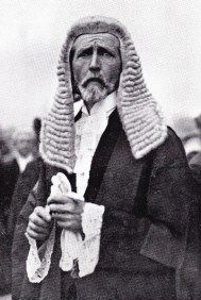
Alexander Martin Sullivan, Irish lawyer best known as the leading counsel for the defence in the 1916 treason trial of Roger Casement, is born in Dublin on January 14, 1871. He is the last barrister in either Ireland or England to hold the rank of Serjeant-at-Law, hence his nickname The Last Serjeant.

A younger son of A.M. Sullivan and Frances Donovan, Sullivan is educated at Ushaw College, Belvedere College, Trinity College, Dublin and King’s Inns. He is called to the Irish Bar in 1892 and practises on the Munster Circuit.

Sullivan is appointed an Irish KC in 1908 and King’s Third Serjeant-at-law (Ireland) in 1912 advancing to Second Serjeant in 1913 and First Serjeant in 1919, the last holder of that position.

A moderate constitutional nationalist and supporter of the Irish Parliamentary Party, Sullivan is a prominent campaigner for the recruitment of Irishmen into the British Army during World War I. His opposition to Sinn Féin republicanism and his prominent role in conducting prosecutions on behalf of the Crown during the Irish War of Independence lead to at least one attempt on his life. As a result, he relocates to England in 1921 and establishes a career at the English Bar, having previously been called to the Middle Temple in 1899. He subsequently becomes a Bencher and Treasurer of Middle Temple. By courtesy, he is always referred to as Serjeant Sullivan, even though that rank no longer exists in England.

Sullivan remains a member of the Irish Bar and returns at least once to appear in the celebrated case of Croker v Croker, where the children of the former leader of Tammany Hall, Richard “Boss” Croker attempt to overturn his will, which leaves his entire estate to their stepmother.

Sullivan is noted as a fearless advocate, who brings to his English practice the robust manners he had learned in the Irish county courts. He does not hesitate to interrupt the judge, and if he feels that he is not receiving a fair hearing, he is quite capable of walking out of Court.

In 1916 Sullivan is retained as lead counsel in the trial of Sir Roger Casement for treason. No English barrister will defend Casement, and Sullivan is persuaded to take the case by George Gavan Duffy, whose wife Margaret is Sullivan’s sister. Despite his rank of Serjeant at law and King’s Counsel at the Irish bar he is only ranked as a junior barrister in England. As the facts relied on by the prosecution are largely undisputed, Sullivan is limited to arguing a technical defence that the Treason Act 1351 only applies to acts committed “within the realm” and not outside it. The Act’s terms had however been expanded by case law over the previous 560 years, and the defence is rejected by the trial judges and by the Court of Criminal Appeal.

Sullivan writes two books: Old Ireland in 1927 and The Last Serjeant in 1952. He retires from legal practice in 1949. He dies on January 9, 1959.


Leave a comment

Birth of Actress Máire O’Neill

maire-oneill

Mary Agnes “Molly” Allgood, actress of stage and film under the stage name of Máire O’Neill, is born at 40 Middle Abbey Street in Dublin on January 12, 1885.

Allgood is one of eight children of compositor George and french polisher Margaret (née Harold) Allgood. Her father is sternly Protestant and against all music, dancing and entertainment, while her mother is a strict Catholic. After her father dies in 1896, she is placed in an orphanage. She is apprenticed to a dressmaker and her brother Tom becomes a Catholic priest.

Maud Gonne sets up Inghinidhe na hÉireann (Daughters of Ireland) in 1900 to educate women about Irish history, language and the arts, and Allgood and her sister Sara join the association’s drama classes around 1903. Their acting teacher, William “Willie” Fay, enrolls them in the National Theatre Society, later known as the Abbey Theatre. Allgood is part of the Abbey Theatre from 1906-1918 where she appears in many productions. In 1904 she is cast in a play by Irish playwright Teresa Deevy called Katie Roche where she plays the part of Margaret Drybone. There are 38 performances in this production.

In 1905 Allgood meets Irish playwright John Millington Synge, and they fall in love, a relationship regarded as scandalous because it crosses the class barriers of the time. In September 1907 he has surgery for the removal of troublesome neck glands, but a later tumour is found to be inoperable. They become engaged before his death in March 1909. Synge writes the plays The Playboy of the Western World and Deirdre of the Sorrows for Allgood.

In June 1911 Allgood marries G. H. Mair, drama critic of the Manchester Guardian, and later Assistant Secretary of the British Department of Information, Assistant Director of the League of Nations Secretariat in Geneva, and head of the League of Nations office in London, with whom she has two children. He dies suddenly on January 3, 1926. Six months later she marries Arthur Sinclair, an Abbey actor. They have two children, but the marriage ends in divorce.

Under her professional name Maire O’Neill, Allgood appears in films from 1930-53, including Alfred Hitchcock‘s film version of Seán O’Casey‘s play Juno and the Paycock (1930). She makes her American debut in New York City in 1914 in the play General John Regan at the Hudson Theatre.

Allgood dies at the age of 66 in Park Prewett Hospital, Basingstoke, England, on November 2, 1952, where she is receiving treatment after being badly burned in a fire at her London home.

Joseph O’Connor‘s 2010 novel, Ghost Light, is loosely based on Allgood’s relationship with Synge.


Leave a comment

Birth of Robert Blair “Paddy” Mayne

robert-blair-paddy-mayne

Robert Blair “Paddy” Mayne, British Army soldier, solicitor, Ireland rugby union international, amateur boxer, and a founding member of the Special Air Service (SAS), is born in Newtownards, County Down, on January 11, 1915.

Mayne attends school at Regent House School, a school for students aged 4 to 18. While at Regent he discovers his skill and love for the game of rugby. He also enjoys cricket and golf and becomes a marksman with the rifle club. He goes on to Queen’s University Belfast to study law. At university he takes up boxing and becomes the Irish Universities Heavyweight Champion in August 1936. He also wins the Scrabo Golf Club President’s cup in 1937. He graduates from Queen’s University in 1939.

During 1938, Mayne travels to Africa on the 1938 British Lions Tour to South Africa. He plays on a team that tours around Africa playing other local clubs. While traveling, it is discovered that Mayne has a wild side and on various occasions finds himself in trouble. His “go to” is to trash the hotel rooms of his teammates. The team includes some of the best players from around Ireland and Britain.

In 1939, with outbreak of World War II, Mayne joins the Supplementary Reserves in Newtownards and receives a commission in the Royal Artillery. He serves in several units in Ireland and England, generally with light and heavy anti-aircraft units. He volunteers for the No. 11 (Scottish) Commando unit which is sent to the Middle East. There he sees action during the Syria-Lebanon campaign. Specifically, during the Battle of the Litani River, he draws attention from Captain David Stirling who is forming the new Special Air Service (SAS). Sterling recruits Mayne for the new SAS while he is in jail for striking his commanding officer.

From November 1941 to the end of 1942, Mayne is involved in several raids behind enemy lines with the SAS. He uses jeeps to go to various Axis bases and begin blowing up planes and fuel dumps. It is claimed that he personally destroyed 100 planes during these missions. In addition to serving in the Middle East, he serves as well in Sicily, Italy, Belgium, the Netherlands, Germany, Norway and France. In most of these locations he works with the resistance behind the enemy lines. In France he helps to train the French Resistance.

By the end of the war, Mayne has been promoted to the rank of Lieutenant Colonel and has also received the British Army’s Distinguished Service Order with three bars, which means he received the award four times. After the war he joins the British Antarctic Survey in the Falkland Islands. He returns home to Newtownards when back issues, which started while he was serving in the Middle East, become more difficult for him.

Mayne is initiated into Eklektikos Lodge No. 542 in Newtownards in 1945. He is a very enthusiastic mason and joins a second lodge in Newtownards, Friendship Lodge No. 447. On the evening of December 13, 1955, he attends a meeting of Friendship Lodge and then joins some of his masonic brothers at a local bar. At about 4:00 AM on December 14, he is found dead in his Riley RM roadster in Mill Street, Newtownards, having reportedly collided with a farmer’s vehicle.

At his funeral hundreds of mourners turn out to pay their respects and to see him interred in a family plot in the town’s old Movilla Abbey graveyard. After his death his masonic jewel is preserved for many years by an old school friend before it is presented to Newtownards Borough Council where it is displayed in the Mayoral Chamber of the Council Offices.


Leave a comment

Birth of Mother Frances Mary Teresa Ball

frances-teresa-ball

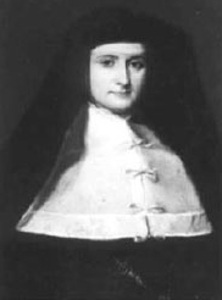
Mother Frances Mary Teresa Ball, foundress of the Irish Branch of the Institute of the Blessed Virgin Mary (IBVM), is born in Dublin on January 9, 1794.

Ball is the youngest of six children born to John and Mable Clare Bennet Ball. Her father is a wealthy silk weaver. Catholicism is still suppressed in Ireland at this time. She is therefore sent to England at the age of nine to the Bar Convent in York. Henry James Coleridge describes her as “a bright, quiet, high-spirited girl, fond of fun, and with much depth of character.” In these times students do not return home for Easter, Christmas or summer holidays. They stay at the school, and live like religious people, until they leave school, usually in their late teens.

In 1807, her eldest sister, Cecilia is professed at the Ursuline convent in Cork. Ball travels from Dublin to Cork for the ceremony, where she meets Mary Aikenhead. Cecilia Ball takes the name of Sister Francis Regis and is within a few years made Superior of the convent in Cork. Upon the death of her father in 1808, Ball returns to Dublin. She is expected to make an admirable wife for the son and heir of some rich Catholic Dublin merchant family.

In June 1814, under the direction of Dr. Daniel Murray, Archbishop of Dublin, Ball returns to York and enters the novitiate of the Institute of the Blessed Virgin Mary. There she receives her religious training, and makes her profession in September 1816, taking, in religion, the name of Mary Teresa.

Recalled by Archbishop Murray, Ball returns to Dublin in 1821 with two novices to establish the Irish Branch of the Institute of the Blessed Virgin Mary for the instruction of children. They stay with Mary Aikenhead and the Irish Sisters of Charity in Stanhope Street while Rathfarnham House is being renovated. In 1822 she opens the first institution of the order in Ireland, in Rathfarnam House, four miles from Dublin. She decides to call the house “Loreto” after the village in Italy to which the Nazareth house of the Holy Family is said to have been miraculously transported.

Ball is a woman of great piety and administrative ability. Her energies are devoted to the establishment of schools and to the development of the sisterhood which now has members in many countries. The first offshoot is planted in Navan, County Meath, in the year 1833. The year 1840 is marked by the erection of the first church in Ireland dedicated to the Sacred Heart, in Loretto Abbey, Rathfarnham. In addition to the boarding and day schools the sisters conduct orphanages.

For almost forty years after bringing the IBVM to Ireland, Ball establishes a wide network of convents and schools across Ireland, as well as in India, Mauritius and Canada. The nuns are usually called Sisters of Loreto after the shrine at Loreto, Marche in Italy.

Mother Mary Teresa Ball dies at Rathfarnham Abbey on May 19, 1861, after a long illness.


Leave a comment

Death of Actor Peter Caffrey

peter-caffrey

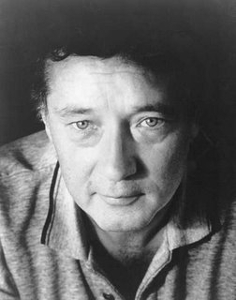
Peter Caffrey, Irish actor best known for playing Padraig O’Kelly on Series 1-4 of Ballykissangel, dies in Shrewsbury, England, on January 1, 2008.

Caffrey is also well regarded for his role as a transvestite in the film Night Train, and for his role as an unlikely protagonist in I Went Down. He is also known for playing the role of the judge in the Irish comedy Father Ted on the episode A Song For Europe and for voicing a popular Christmas radio advertisement for Barry’s Tea in 1994.

Caffrey is born in Dublin on April 18, 1949. He studies at a seminary for two years before switching to an English degree. He works for a year as a primary school teacher, before becoming involved with Dublin’s Project Theatre. He appears in nearly thirty television and film roles, and also has a solid theatre career in both Dublin and London. After moving to London in 1983 he becomes a familiar face on UK television, with minor roles in Casualty, The Bill and Peak Practice. His success in Ballykissangel comes after overcoming oral cancer for which he is diagnosed in 1990, and, despite suffering a stroke in 2000 which leaves him paralysed on the right side, he manages to play a similarly afflicted character in the unreleased film Sweet Dancer in 2005.

Caffrey never fully recovers from the stroke and dies at the age of 58 on January 1, 2008, in Shrewsbury. His body is returned to Ireland for cremation in Mount Jerome Cemetery and Crematorium, Dublin, on January 8, 2008. Caffrey is survived by three sisters, Linda, Carol, and Sheila. His brother David pre-deceases him in July 2007.

Caffrey marries Brenda Banks in 1980 but the marriage ends in divorce in 1990.


Leave a comment

Funeral of Loyalist Billy Wright

billy-wright-funeral

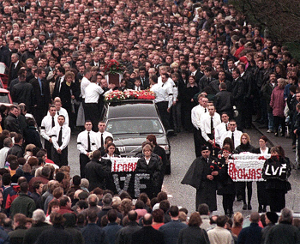
Thousands of Ulster loyalists pack the streets of Portadown, County Armagh, on December 30, 1997, for the funeral of Loyalist Volunteer Force (LVF) commander William Stephen “Billy” Wright.

Wright, born in Wolverhampton, England on July 7, 1960, is a prominent Ulster loyalist paramilitary during the ethno-nationalist conflict in Northern Ireland known as The Troubles. He joins the Ulster Volunteer Force (UVF) in 1975 and becomes commander of its Mid-Ulster Brigade in the early 1990s, taking over from Robin “The Jackal” Jackson. According to the Royal Ulster Constabulary, Wright is involved in the sectarian killings of up to 20 Catholics, although he is never convicted for any. It is alleged that Wright, like his predecessor, serves as a double agent of the British security forces.

Wright attracts considerable media attention at the Drumcree standoff, where he supports the Orange Order‘s desire to march its traditional route through the Catholic/Irish nationalist area of Portadown. In 1994, the UVF and other paramilitary groups call ceasefires. However, in July 1996, Wright’s unit breaks the ceasefire and carries out a number of attacks, including a sectarian killing. For this, Wright and his Portadown unit of the Mid-Ulster Brigade are stood down by the UVF leadership. He is expelled from the UVF and threatened with execution if he does not leave Northern Ireland. Wright ignores the threats and, along with many of his followers, defiantly forms the breakaway Loyalist Volunteer Force (LVF).

In March 1997 Wright is sent to the HM Maze Prison for having threatened the life of a woman. While imprisoned, Wright continues to direct the LVF’s activities. On December 27 of that year, he is assassinated at the prison by Irish National Liberation Army (INLA) prisoners as he is led out to a van for a visit with his girlfriend. The LVF carries out a wave of sectarian attacks in retaliation.

Owing to his uncompromising stance as an upholder of Ulster loyalism and opposition to the Northern Ireland peace process, Wright is regarded as a cult hero, cultural icon, and martyr figure by hardline loyalists. His image adorns murals in loyalist housing estates and many of his devotees have tattoos bearing his likeness.

Wright’s funeral procession moves at a snail’s pace on a grey and windy day. Groups of mourners take turns carrying the coffin. Women carry a wreath that simply says “Billy.” Twenty men with tight haircuts and white shirts with black armbands flank the cortège. There is heavy security. Troops stand guard on bridges and Royal Ulster Constabulary (RUC) Land Rovers prowl the housing estates. A spotter plane flies overhead. A lone piper plays “Abide with Me” before a banner bearing the letters “LVF.”

Wright is buried at Seagoe Cemetery, Portadown, Northern Ireland.


Leave a comment

Constance Markievicz Elected to British House of Commons

constance-markievicz

Constance Markievicz, while detained in Holloway Prison for her part in conscription activities, becomes the first woman to be elected to the House of Commons of the United Kingdom on December 28, 1918.

Markievicz, an Irish nationalist, who is elected for the Dublin St. Patrick’s constituency, refuses to take her seat in the House of Commons along with 72 other Sinn Féin MPs. Instead, her party, which wins the majority of Irish seats in Westminster, establishes the Dáil, a breakaway Dublin assembly, and triggers the Irish War of Independence.

Markievicz, who inherits the title of “countess” from her noble Polish husband, and 45 other MPs are in jail when the first meeting takes place on January 21, 1919. They are described in Gaelic as being “imprisoned by the foreign enemy” when their names are read out during roll call at the Mansion House.

The 27 MPs who attend the Dáil’s first session ratify the Proclamation of the Irish Republic of Easter 1916, which had not been adopted by an elected body but merely by the Easter rebels claiming to act in the name of the Irish people. They also claim there is an “existing state of war, between Ireland and England” in a Message to the Free Nations of the World.

When Markievicz is released in April 1919, she becomes Minister for Labour. Having also been part of the suffragette movement, her deep political convictions contrast deeply with Nancy Astor, Viscountess Astor, the first woman to sit in the House of Commons. She believes Astor, a Tory who is elected in a 1919 Plymouth by-election after her husband is forced to give up the seat when he becomes a peer, is “out of touch.”

Her political views are also influenced by Irish poet William Butler Yeats, who is a regular visitor to the family home, Lissadell House in County Sligo. She becomes involved in the women’s suffrage movement after studying art in London, where she meets and marries Count Casimir Markievicz. In 1903, the couple, who has one son, settles in Dublin, where she becomes involved in nationalist politics. She joins both Sinn Féin and Inghinidhe na hÉireann.

Like Astor, Markievicz has an irrepressible personality and is in no mood to play coy and simply blend in. She comes to her first Sinn Féin meeting wearing a satin ball-gown and a diamond tiara after attending a function at Dublin Castle, the seat of British rule in Ireland.

Markievicz spends a year in the Dáil before walking out along with Éamon de Valera, the future dominant figure in Irish politics, after opposing the Anglo-Irish Treaty. The document, which grants southern Ireland independence but keeps the north as part of the UK, splits Sinn Féin and triggers the Irish War of Independence.

Following the conflict, which the Pro-Treaty forces win, Markievicz is elected again to the Dáil, but does not take her seat in protest. In 1927, she is elected for a third time as part of de Valera’s new party Fianna Fáil, which pledges to return to the Irish parliament. But before she can take her seat, she dies at age 59 on July 15, 1927, of complications related to appendicitis.


Leave a comment

Alan Brodrick Appointed Lord Chief Justice of the Court of Queen’s Bench

alan-brodrick

Alan Brodrick, 1st Viscount Midleton, a leading Anglo-Irish lawyer and politician of the early eighteenth century, is appointed Lord Chief Justice of the Court of Queen’s Bench on December 24, 1709. He is a man of great gifts, but so hot-tempered and passionate that even Jonathan Swift is said to have been afraid of him.

Brodrick is the second son of Sir St. John Brodrick of Ballyannan, near Midleton in County Cork, by his wife Alice, daughter of Laurence Clayton of Mallow, County Cork. His father receives large land grants during The Protectorate, and thus the family has much to lose if the land issue in Ireland is settled to the satisfaction of dispossessed Roman Catholics. He is educated at Magdalen College, Oxford and the Middle Temple, being called to the English bar in 1678. He and his relatives flee Ireland during the Glorious Revolution. They are attainted under the rule of King James II in Ireland. In exile in England, Brodrick argues for a speedy reconquest.

In 1690 Brodrick returns to Dublin and is given the legal office of Third Serjeant. He also becomes Recorder of Cork. He is dismissed as Serjeant in 1692, apparently on the ground that there is no work for him to do. While complaining bitterly about his dismissal, he admits privately that his post has been a superfluous one.

As a prominent Whig supporter of the outcome of the Glorious Revolution he is not always in agreement with court policies in Ireland, which he considers too lenient on the Jacobites. The dismissal of the First Serjeant, John Osborne, at the same time as Brodrick is due to his even stronger opposition to Court policy. Despite this he often holds Irish government offices and aspires to manage the Irish Parliament for English ministers. He represents Cork City in the Irish Parliament, which meets in 1692 and holds this seat until 1710. He is a vocal opponent of court policies, until the new Whig Lord Deputy of Ireland, Lord Henry Capell, decides to appoint him Solicitor-General for Ireland in 1695. He promotes penal laws against Catholics, whilst also supporting greater powers for the Irish Parliament.

Brodrick is Speaker of the Irish House of Commons from September 21, 1703. After promoting resolutions critical of the Lord Lieutenant of Ireland he loses his post as Solicitor-General in 1704. From 1707 until 1709 he is Attorney-General for Ireland. He becomes Chief Justice of Ireland in 1710 and is replaced as Speaker on May 19, 1710, but again holds the office in the next Parliament (November 25, 1713 – August 1, 1714), where he also represents County Cork. He is appointed Lord Chancellor of Ireland in 1714 and is ennobled in the Peerage of Ireland in 1715, as the 1st Baron Brodrick. He is advanced to the rank of 1st Viscount Midleton in 1717.

Brodrick feuds with his successor as Speaker William Conolly, as they are rivals to be the leading figure in Irish politics. Despite intrigues in England, he loses out and resigns as Lord Chancellor in 1725. He leaves behind him a legacy of bitterness and ill-will for which he is not really responsible as the Irish peers choose to blame him for the loss of their powers under the Sixth of George I, rather than their own misjudgment in imprisoning the Barons of the Exchequer.


Leave a comment

Birth of Poet Charles Wolfe

charles-wolfe

Charles Wolfe, Irish poet, is born at Blackhall, County Kildare, on December 14, 1791. He is chiefly remembered for “The Burial of Sir John Moore after Corunna” which achieves popularity in 19th century poetry anthologies.

Wolfe is the youngest son of Theobald Wolfe of Blackhall and his wife Frances, who is also his cousin and daughter of the Rev. Peter Lombard of Clooncorrick Castle, Carrigallen, County Leitrim. He is a brother of Peter Wolfe, High Sheriff of Kildare. His father is the godfather, but widely believed to be the natural father, of Theobald Wolfe Tone and the first cousin of Arthur Wolfe, 1st Viscount Kilwarden.

Not long after he is born, his father dies, and the family moves to England. In 1801, Wolfe is sent to a school in Bath but is sent home a few months later due to ill health. From 1802 to 1805, he is tutored by a Dr. Evans in Salisbury before being sent to Hyde Abbey School, Winchester. In 1808, his family returns to Ireland, and the following year he enters Trinity College, Dublin, graduating in 1814.

Wolfe is ordained as a Church of Ireland priest in 1817, first taking the Curacy of Ballyclog in County Tyrone before transferring almost immediately to Donaghmore, County Tyrone. There he develops a close friendship and deep respect for the Rev. Thomas Meredith, Rector of nearby Ardtrea, and a former Fellow of Trinity College Dublin. Wolfe writes two epitaphs for Meredith, one on his memorial in the parish church of Ardtrea, and another intended for his tomb.

Wolfe is best remembered for his poem “The Burial of Sir John Moore after Corunna”, written in 1816 and much collected in 19th and 20th century anthologies. The poem first appears anonymously in the Newry Telegraph of April 19, 1817, and is reprinted in many other periodicals. But it is forgotten until after his death when Lord Byron draws the attention of the public to it. Wolfe’s only volume of verse, Poetical Remains, appears in 1825 with “The Burial of Sir John Moore” and fourteen other verses of an equally high standard.

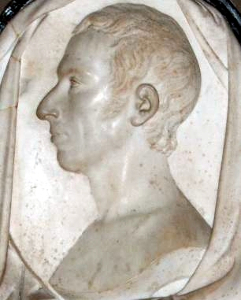
Wolfe remains at Donaghmore until 1820 but, rejected by the woman for whom he gave up his academic career, and with Meredith, his only real friend in County Tyrone, now dead, he moves to Southern France. Shortly before his death he returns to Ireland and lives at Cobh, County Cork, where he dies at the age of 31 of consumption, which he catches from a cow. He is buried in Cobh at Old Church Cemetery. There is also a plaque to his memory in the church at Castlecaulfield, the village where he lives whilst Curate at Donaghmore, as well as a marble monument to him at St. Patrick’s Cathedral, Dublin.

(Pictured: Bas-relief of Charles Wolfe in St. Patrick’s Cathedral, Dublin)


Leave a comment

Birth of Actress Fionnghuala Flanagan

fionnula-flanagan

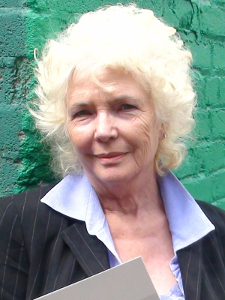
Fionnghuala Manon “Fionnula” Flanagan, Irish actress and political activist, is born in Dublin on December 10, 1941.

Flanagan is the daughter of Rosanna (née McGuirk) and Terence Niall Flanagan, an Irish Army officer and Communist who had fought in the International Brigade in the Spanish Civil War against General Francisco Franco. Although her parents are not Irish speakers, they want Fionnula and her four siblings to learn the Irish language, thus she grows up speaking English and Irish fluently. She is educated in Switzerland and England. She trains extensively at the Abbey Theatre in Dublin and travels throughout Europe before settling in Los Angeles, California in early 1968.

Flanagan comes to prominence in Ireland in 1965 as a result of her role as Máire in the Telefís Éireann production of the Irish language play An Triail, for which she receives the Jacob’s Award in Dublin for her “outstanding performance.” With her portrayal of Gerty McDowell in the 1967 film version of Ulysses, she establishes herself as one of the foremost interpreters of James Joyce. She makes her Broadway debut in 1968 in Brian Friel‘s Lovers, then appears in The Incomparable Max (1971) and such Joycean theatrical projects as Ulysses in Nighttown and James Joyce’s Women (1977-1979), a one-woman show written by Flanagan and directed for the stage by Burgess Meredith. It is subsequently filmed in 1983, with Flanagan both producing and playing all six main female roles.

Flanagan is a familiar presence in American television, as she has appeared in several made-for-TV movies including The Legend of Lizzie Borden (1975) starring Elizabeth Montgomery, Mary White (1977), The Ewok Adventure (1984) and A Winner Never Quits (1986). She wins an Emmy Award for her performance as Clothilde in the 1976 network miniseries Rich Man, Poor Man. Her weekly-series stints include Aunt Molly Culhane in How the West Was Won (1977), which earns her a second Emmy Award nomination. She does multiple appearances on Murder, She Wrote. She plays Lt. Guyla Cook in Hard Copy (1987), and as Kathleen Meacham, wife of a police chief played by John Mahoney in H.E.L.P. (1990).

Flanagan makes guest appearances in three of the Star Trek spin-offs – Star Trek: Deep Space Nine episode “Dax,” Star Trek: The Next Generation episode “Inheritance,” and Star Trek: Enterprise episode “Fallen Hero.”

Flanagan guest-stars in several episodes of Lost as Eloise Hawking, a recurring character. She appears in such films as The Others opposite Nicole Kidman, Divine Secrets of the Ya-Ya Sisterhood as the eldest Teensy and Waking Ned. She appears in television series and stage productions including the Emmy-nominated miniseries Revelations, starring Bill Pullman and Natascha McElhone, and in Transamerica, starring Felicity Huffman. From 2006–08, she plays Rose Caffee, the matriarch of an Irish American Rhode Island family on the Showtime drama Brotherhood.