seamus dubhghaill

Promoting Irish Culture and History from Little Rock, Arkansas, USA


Leave a comment

Formation of the Independent Orange Order

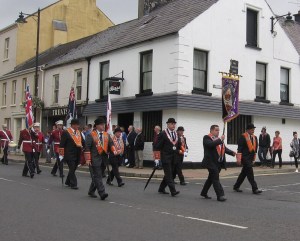
independent-orange-orderThe Independent Orange Order, a Protestant fraternal organisation, is formed in Belfast on June 11, 1903 by Thomas Sloan and others associated with the Belfast Protestant Association, who have been expelled from the Orange Order because they voice opposition to it being used for party political ends by Ulster Unionists. Originally it is associated with the labour movement, but it soon realigns itself with traditional unionist politics.

It takes its name in memory of King William of Orange of the house of Orange who fights at the Battle of the Boyne, brings about the Glorious Revolution and the Bill of Rights giving the Westminster parliament ultimate power of the country rather than the Monarch. The Independent Order is small compared to the main organisation with 1,500 to 2,000 members. It is largely based around north County Antrim in Northern Ireland but has lodges around the world, including England, Scotland, and Australia. Its annual main Twelfth of July demonstration is held in a north Antrim town or village.

The first notable effect after the formation of the Independent Order is a more liberal interpretation of the rules of the “Old Order.” In the early years of the Institution, many suffer the full wrath of the “powers that be,” who are opposed to any splitting of the Orange Order. Jobs are lost, homes are burned, and their headquarters in Belfast is bombed.

Independent Orangeism today maintains that it is essential for the Orange Institution to be kept free from politics and to guard the principles of Reformation Protestantism. They often express alarm when they believe these principles are endangered by conciliatory politicians. They are opposed to ecumenism and, while being opposed to Orangeism being linked to the Ulster Unionist Party, they are not apolitical and tend to work alongside unionist politicians and parties.

The Institution also promotes Ulster Protestant history and proclaims the principle of “Liberty of Conscience.” They declare their right to think and act independently without direction from political or clerical masters, they seek to strengthen the position of Orangeism, and they often warn of the danger of the development of a social and cultural Orangeism devoid of Protestant principle.


Leave a comment

Birth of Irish Folk Singer Christy Moore

Christopher Andrew “Christy” Moore, Irish folk singer, songwriter, and guitarist, is born in Newbridge, County Kildare, on May 7, 1945.

After attending Newbridge College, Moore works as a bank employee and has a desire to express himself using traditional music. During a twelve-week bank strike in 1966, he goes to England, as do many striking officials, but he does not return when the strike is settled. Doing general labouring work, he frequents the folk clubs and the Irish music pubs where he meets Séamus Ennis, Margaret Barry, Luke Kelly, Martin Byrnes, and many other traditional musicians.

Moore’s first album, Paddy on the Road, a minor release of 500 copies, is recorded with Dominic Behan in 1969. In 1972, his first major release, Prosperous, brings him together with three musicians, Liam O’Flynn, Andy Irvine, and Dónal Lunny, who shortly thereafter form the Irish folk music band Planxty. For a short time, they called themselves “CLAD,” an acronym of their names, but soon decide on Planxty.

After leaving Planxty in 1975, Moore continues his solo career, reforming his old band on occasion. He also forms the band Moving Hearts with Lunny and five other musicians in 1980. In 1987, he appears on Gay Byrne‘s The Late Late Show performing with The Dubliners for their 25th anniversary. In 2000, he publishes his autobiography, One Voice.

Moore’s earlier years of heavy drinking, sleeping dysfunctional hours, continual traveling, and often eating takeout foods results in a decline in health and several operations. Moore’s battle with alcohol and subsequent heart operations takes their toll. At the end of the 1990s, Moore reduces his workload for medical reasons.

Moore releases his first new studio album in four years on April 17, 2009, entitled Listen, and promotes it through a series of live gigs. In December 2011, he releases the album, Folk Tale. His most recent album, Where I Come From, is released in November 2013 and features a new protest song called Arthur’s Day. The album peaks at No. 3 on the Irish album charts.

Moore is best known for his political and social commentary which reflects a left-wing, Irish republican perspective, despite the fact that his mother was a Fine Gael county councillor and parliamentary candidate in Kildare. He supports the republican H-Block protestors with the albums H-Block in 1978, the launch of which is raided by the police, and The Spirit of Freedom. He also records songs by hunger striker Bobby Sands, including Back Home in Derry. Moore ceases support of the military activities of the Irish Republican Army (IRA) in 1987 as a result of the Enniskillen bombing.

Political songs Moore has performed throughout his career include Mick Hanly’s On the Blanket about the protests of republican prisoners, Viva la Quinta Brigada about Irish volunteers who fought against the Fascists in the Spanish Civil War, and Minds Locked Shut about Bloody Sunday in Derry.

In 2007, Moore is named Ireland’s greatest living musician in RTÉ‘s People of the Year Awards.


Leave a comment

Death of Diarmait Mac Murchada, Irish King of Leinster

diarmait-mac-murchada

Diarmait Mac Murchada, Irish King of Leinster whose appeal to the English for help in settling an internal dispute leads to the Anglo-Norman invasion and conquest of Ireland by England, dies on May 1, 1171, of “an insufferable and unknown disease.”

Mac Murchada is born around 1110, the son of Donnchad mac Murchada, King of Leinster and Dublin. His father is killed in battle in 1115 by his cousin Sigtrygg Silkbeard, king of the Dublin Vikings, and is buried by them in Dublin along with the body of a dog which is considered to be a huge insult.

After the death of Énna Mac Murchada, his older brother, Mac Murchada unexpectedly becomes King of Leinster. This is opposed by the High King of Ireland, Toirdelbach Ua Conchobair, who fears that Mac Murchada will become a rival. Toirdelbach sends one of his allied Kings, the belligerent Tigernán Ua Ruairc, to conquer Leinster and oust the young Mac Murchada. Ua Ruairc goes on a brutal campaign slaughtering the livestock of Leinster and thereby trying to starve the province’s residents. Mac Murchada is ousted from his throne but is able to regain it with the help of Leinster clans in 1132. Two decades of an uneasy peace followed between Ua Conchobair and Mac Murchada. In 1152 he even assists the High King in a raid of the land of Ua Ruairc who has become a renegade.

As King of Leinster, between 1140–70, Mac Murchada commissions Irish Romanesque churches and abbeys at Baltinglass, Glendalough, Ferns, and Killeshin. He sponsors convents at Dublin, two at Aghade, County Carlow, and at Kilculliheen near Waterford city. He also sponsors the successful career of churchman St. Lorcán Ua Tuathail and presides at the synod of Clane in 1161 when Ua Tuathail is installed as archbishop of Dublin.

In 1166, Ireland’s new High King and Mac Murchada’s only ally, Muirchertach Ua Lochlainn, has fallen and a large coalition led by Mac Murchada’s arch enemy, Tigernán Ua Ruairc, marches on Leinster. The High King deposes Mac Murchada from the throne of Leinster, and he flees to Wales and from there to England and France seeking the support of Henry II of England in the recruitment of soldiers to reclaim his kingship. Henry authorises Mac Murchada to seek help from the soldiers and mercenaries in his kingdom. Those who agreed to help include Richard de Clare (Strongbow) and half-brothers Robert FitzStephen and Maurice FitzGerald.

In Mac Murchada’s absence, Ruaidrí Ua Conchobair, son of Mac Murchada’s former enemy, the High King Toirdelbach Ua Conchobair, has become the new High King of Ireland.

Mac Murchada brings an advance party of adventurers back to Ireland in 1167, recaptures Wexford, and waits for Strongbow to arrive. From his base in Wales, Strongbow launches an offensive in 1170, capturing Waterford and Dublin, taking control of the East coast, much to the dismay of the Gaelic Chieftains and Ua Conchobair. To cement the alliance, Mac Murchada marries his daughter, Aoife, to Strongbow, in Christ Church Cathedral in Dublin 1170.

The Irish Chieftains do not allow the invaders to settle, however, and they are continually attacked and harassed. It begins to appear likely that they will be driven from Ireland. However, they receive support from Henry II, who has become concerned about the amount of power and influence that Strongbow is amassing in Ireland. The subsequent domination of South Wales by the Normans is a result of the need to keep supply lines into Eastern Ireland open.

Mac Murchada dies on May 1, 1171, leaving Strongbow to declare himself King of Leinster. Mac Murchada is buried in the Cathedral graveyard of Ferns village.


1 Comment

The 1996 Docklands Bombing

docklands-bombing

The Docklands bombing, also known as the Canary Wharf bombing or the South Quay bombing, occurs on February 9, 1996, marking the end of the Irish Republican Army‘s (IRA) seventeen-month ceasefire.

At about 7:01 PM on February 9, the Provisional Irish Republican Army detonates a large bomb in a small lorry about 80 yards from South Quay Station on the Docklands Light Railway in the Canary Wharf financial district of London. The bomb, containing 500 kg of ammonium nitrate fertilizer and sugar and a detonating cord made of semtex, PETN, and RDX high explosives, is placed directly under the point where the tracks cross Marsh Wall.

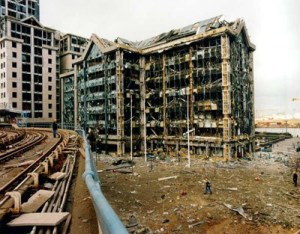
The IRA sends telephone warnings 90 minutes prior to the detonation and the area is evacuated. However, two men working in the newsagents shop directly opposite the explosion, Inam Bashir and John Jeffries, are not evacuated in time and are killed in the explosion. Thirty-nine people require hospital treatment as a result of the blast and falling glass. A portion of the South Quay Plaza is destroyed, and the explosion leaves a crater ten metres wide and three metres deep. The shockwave from the blast causes windows to rattle five miles away.

Approximately £100 million worth of damage is done by the blast. The Midland Bank building is damaged beyond economic repair and is demolished. South Quay Plaza I and II are severely damaged and require complete rebuilding. The station itself is extensively damaged, but both it and the bridge under which the bomb is exploded are reopened within weeks.

The bombing marks the end of a 17-month IRA ceasefire during which Irish, British, and American leaders work for a political solution to the troubles in Northern Ireland. IRA member James McArdle is convicted of conspiracy to cause explosions and sentenced to 25 years in prison, but murder charges are dropped. McArdle is released under the terms of the Good Friday Agreement in June 2000 with a royal prerogative of mercy from Queen Elizabeth II.

dockland-bombing-damage

The IRA describes the deaths and injuries as a result of the bomb as “regrettable,” but says that they could have been avoided if police had responded promptly to “clear and specific warnings.” Commissioner of the Metropolitan Police Sir Paul Condon says, “It would be unfair to describe this as a failure of security. It was a failure of humanity.”

Gerry Adams, the leader of Sinn Féin, the political wing of the IRA, speaks of the need to continue the peace process. British Prime Minister John Major says there is now “a dark shadow of doubt” where optimism has existed.

On February 28, Prime Minister Major and Taoiseach of the Republic of Ireland John Bruton, announce that all-party talks will be resumed in June. Major’s decision to drop the demand for IRA decommissioning of weapons before Sinn Fein is allowed into talks leads to criticism from the press, which accuse him of being “bombed to the table.”


Leave a comment

Éamon de Valera Escapes from Lincoln Gaol

boland-collins-devalera

Éamon de Valera, along with Seán McGarry and Seán Milroy, escape from Lincoln Gaol in Lincoln, Lincolnshire, England on February 3, 1919.  The escape plot is engineered by fellow Sinn Féin members Harry Boland and Michael Collins (pictured to the left of de Valera).

After his participation as a leader of the Easter Rising of 1916, de Valera is arrested and sentenced to death for his role in the uprising, but the sentence is later commuted due to his American citizenship. Following his release from prison in 1916, he quickly gains fame on the Irish political scene, ultimately becoming the leader of Sinn Féin. He also gains notoriety amongst the British political elites, which ensures his eventual re-arrest and imprisonment in Lincoln Gaol.

De Valera is sent to Lincoln Gaol presumably for his participation in a “German Plot” against the British. Once incarcerated at Lincoln, de Valera, wanting to embarrass the English, quickly begins to plan his escape with the assistance of Milroy and McGarry. Irish Republicans on the outside, including Boland and Collins, also assist in the planning.

Open fields surrounded by barbed wire are to the rear and east of the prison. The Republicans hope to use this to their advantage by sneaking de Valera through a rear door. The plans are sung in Gaelic to de Valera through a window in his cell by a fellow Irish inmate in order to confuse the guards. The first song tells him of the escape route and the second gives him instructions to obtain a copy of the master-key for the prison.

De Valera, being a deeply religious man, is active in the prison’s chapel from the beginning of his internment. Using his connections within the chapel, over time he manages to steal candles from the altar. While Mass is being read, he “borrows” the master-key of the chaplain and makes an impression of it in the candle wax. The mould is then wrapped in paper and tossed over the prison wall so a duplicate can be made.

The key is duplicated and smuggled back into the prison concealed in a cake and the escape begins on the evening of February 3, 1919. While Collins and other members of Sinn Féin cut through the barbed wire, a group of Irish girls are sent to flirt with the prison guards to ensure they are preoccupied. With the guards’ attention diverted, de Valera, wrapped in a fur coat, McGarry, and Milroy are able to walk to the back door of the prison and, after some difficulty with the key, walk away from the prison.

They stroll down Wragby Road to the Adam & Eve Pub where a taxi driver, unaware of who his passengers are, awaits them. De Valera is swiftly moved to the railway station where they split up. Collins and Boland catch a train to London from St. Mark’s while the rest drive to Worksop where another innocent taxi driver drives them to Sheffield. De Valera then returns to Ireland briefly before traveling on to the United States. The prison officials, realizing that the men will be virtually impossible to locate, concede defeat after a one-day search of the city.

The escape from Lincoln Gaol is major news and is covered in all the national papers. Prison officials blame the escape on the ability of special prisoners to interact with the general prison population. The escape proves to be an important moment in Irish history – when a cake, a wax key, and some pretty Irish girls help spring the future Irish president from Lincoln Gaol.


Leave a comment

Creation of The Honourable The Irish Society

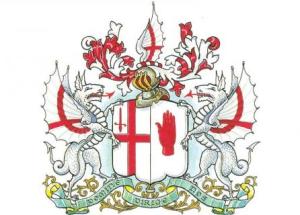
irish-society-coat-of-arms

On January 28, 1613, The Honourable The Irish Society, a consortium of livery companies of the City of London, is created by Royal Charter of James I of England to undertake the Plantation in the North West of Ulster that is then being driven by the English Crown.

Following the Gaelic defeat in the Nine Years’ War in 1603 and the Flight of the Earls in 1607, northwest Ulster is left open to colonisation. James I sets out to defend against a future attack from within or without. He finds that the town of Derry can become either a great asset as a control over the River Foyle and Lough Swilly, or it can become an inviting back door should the people of the area turn against him. He pressures the guilds of the City of London to fund the resettlement of the area, including the building of a new walled city. This results in the creation of the Society.

The city of Derry is renamed Londonderry in recognition of the London origin of the Irish Society. County Coleraine is enlarged and renamed County Londonderry after its new county town. The rural area of the county is subdivided between the Great Twelve livery companies, while the towns and environs of Londonderry and Coleraine are retained by the Irish Society.

In January 1635, the Irish Society, as well as the City of London, are found guilty of mismanagement and neglect of Derry plantation. They are sentenced to a fine of £70,000 and forfeiture of Derry property. The Society is suppressed in 1637 but is revived by Oliver Cromwell in 1650 and again after the Restoration by Londonderry’s 1662 royal charter.

The Society is involved in several controversies over the years including a dispute over fishing rights with the Church of Ireland and Bishop of Derry and a lawsuit brought by The Skinners’ Company in 1832 over the distribution of profits. The Society also has some disputes with the corporations over ownership and development of property. During the 17th and 18th centuries, four of the twelve livery companies sell their estates, with the Irish Society requiring a bond of indemnity in each case. Leases to middlemen granted by the remaining companies expire at various times during the nineteenth century, after which the companies “enormously increased the rental.”

The Society finances the building of the Guildhall in Derry. Construction begins in 1887 and it is opened in July 1890, at a cost of £19,000.

The Society remains in existence today as a relatively small grant-giving charitable body. Its educational grants are funded by its remaining property, including the Walls of Derry, a tourist attraction and heritage site, and fisheries on the River Bann. The Society is based in London, but maintains a “representative” resident in County Londonderry.


Leave a comment

King Henry VIII Marries Anne Bolen

henry-viii-anne-bolen

England’s King Henry VIII, Lord of Ireland and self-declared King of Ireland, marries Anne Boleyn on January 25, 1533, after a secret marriage November 14, 1532. On May 23, 1533, Thomas Cranmer, Archbishop of Canterbury, declares Henry’s first marriage to Catherine of Aragon to be null and void. Five days later, he declares Henry and Anne’s marriage to be valid.

Soon thereafter, Pope Clement VII, who had refused to annul the marriage of Henry and Anne, decrees sentences of excommunication against Henry and Cranmer. As a result of this marriage and these excommunications, the first break between the Church of England and Rome takes place and the Church of England is brought under the King’s control.

Anne is crowned Queen of England on June 1, 1533, and on September 7, she gives birth to a daughter who is christened Elizabeth, in honour of Henry’s mother, Elizabeth of York, and who becomes the future Queen Elizabeth I. Henry is disappointed to have a daughter rather than a son but hopes a son will follow and professes to love Elizabeth.

The king and queen are not pleased with married life. The royal couple enjoys periods of calm and affection but Anne refuses to play the submissive role expected of her. Henry dislikes Anne’s constant irritability and violent temper. After a miscarriage in 1534, Henry sees her failure to give him a son as a betrayal. As early as Christmas 1534, Henry is discussing with Archbishop Cranmer and Thomas Cromwell, his chief minister, the chances of leaving Anne without having to return to Catherine.

In January 1536, the Henry is thrown from his horse in a tournament and is badly injured. It seems for a time that the king’s life was in danger. When news of this accident reaches the queen, who is again pregnant and aware of the consequences if she fails to give birth to a son, she is sent into shock and miscarries a male child that is about 15 weeks old. This is seen by most historians as the beginning of the end of the royal marriage.

Anne’s downfall comes shortly after she has recovered from her miscarriage. Henry has Anne investigated for high treason in April 1536. On May 2, she is arrested and sent to the Tower of London where she is tried before a jury of peers, which includes Henry Percy, her first husband, and her own uncle, Thomas Howard. Anne is found guilty on May 15 and is beheaded on Tower Green at 8:00 AM on May 19, 1536, at the age of 36.


Leave a comment

Death of Irish Songwriter Percy French

percy-french

Percy French, one of Ireland’s foremost songwriters and entertainers of his day, dies of pneumonia in Formby, England, on January 24, 1920.

French is born at Cloonyquin House, near Tulsk, County Roscommon. He is educated at Foyle College, Derry, and writes his first successful song, Abdul Abulbul Amir, while studying at Trinity College Dublin in 1877. The song is sold for £5 to an unscrupulous publisher and later becomes hugely popular and is falsely claimed by other authors.

He graduates from Trinity as a civil engineer in 1881 and joins the Board of Works in County Cavan as an “Inspector of Drains.” It is said that he writes his best songs during this period. French is also a prolific painter of landscape watercolours and during this period he considers art to be his true vocation. When he becomes well-known later in his life, his paintings from his time as a civil engineer become fashionable and sought after.

When the Board of Works reduces its staff around 1887, French turns to journalism as the editor of The Jarvey, a weekly comic paper. Upon the failure of the paper, he embarks on a long and successful career as a songwriter and entertainer. It is around this time that he marries Ethel Kathleen Armitage-Moore, second daughter of William Armytage-Moore, brother of Countess of Annesley. Tragically, at the age of 20, she dies during childbirth along with her daughter.

percy-french-statue

French becomes renowned for composing and singing comic songs and gains considerable distinction with such songs as Phil the Fluther’s Ball, Slattery’s Mounted Foot, and The Mountains of Mourne. One of his most famous songs is Are Ye Right There Michael, a song that ridicules the state of the rail system in rural County Clare. The song causes such embarrassment to the rail company that it lead to an ultimately unsuccessful libel action against French. It is said that he arrives late for the libel hearing and, when questioned by the judge on his lateness, he responds, “Your honour, I travelled by the West Clare Railway,” which results in the case being thrown out.

French takes ill while performing in Glasgow and dies of pneumonia on January 24, 1920, at the age of 65 at the home of his cousin, Canon Richardson of Green Lea, in Formby. He is buried in the churchyard of St. Luke’s Parish Church, Formby in Merseyside. A statue of him sitting on a park bench can be found in the town center of Ballyjamesduff in honour of him and his famous song, Come Back Paddy Reilly to Ballyjamesduff.


1 Comment

Death of Terence Bellew MacManus in San Francisco

terrence-bellew-macmanus

Terence Bellew MacManus, an Irish rebel and Young Irelander, dies in San Francisco, California, on January 15, 1861.

MacManus is born in 1811 in Tempo, County Fermanagh, Ireland, and was educated in parochial schools. As a young man he moves to the major port of Liverpool, where he becomes a successful shipping agent. In 1848 he returns to Ireland, where he becomes active in the Repeal Association, which seeks to overturn the Act of Union between Great Britain and Ireland. After joining the Irish Confederation, he is among those who take part with William Smith O’Brien and John Blake Dillon in the July 1848 Young Ireland Rebellion in Ballingarry, County Tipperary, where the only substantial armed action occurs. MacManus and the other leaders are charged and convicted of treason and sentenced to death for their actions.

Due to public outcry for clemency, the men’s sentences are commuted to deportation for life. MacManus, along with O’Brien, Thomas Francis Meagher, and Patrick O’Donoghue, is transported to Van Diemen’s Land in Tasmania, Australia in 1849. They are assigned to different settlements to reduce their collaboration in the new land; however, the Irish men continue to meet secretly.

In 1852 MacManus and Meagher escape from Australia and make their way to San Francisco, California, where MacManus settles. Meagher goes on to New York City. Like other immigrants, the Irish revolutionaries carry their issues to the United States. A Captain Ellis, of a ship that is supposed to carry O’Brien to freedom, also emigrates to San Francisco. MacManus holds a lynch court of Ellis among Irish emigrants for his betrayal of O’Brien in his escape attempt from Van Diemen’s Land. The court-martial acquits Ellis for lack of evidence.

Failing to re-establish his career as a shipping agent, MacManus lives in San Francisco and dies in poverty in 1861. It is after his death, however, that he performs his most valuable service to the cause of Irish freedom. On learning of his death, American Fenian leaders decide to return his body to Ireland for burial. This foreshadows the treatment given to Jeremiah O’Donovan Rossa at his famous funeral in 1915. Crowds of Irish gather in New York as Archbishop John Hughes, like MacManus born in Ulster, blesses MacManus’ body. Thousands greet his body when it arrives in Cork and crowds gather at rail stations all the way to Dublin.

The church, in the person of Archbishop of Dublin Paul Cullen, refuses permission for his body to lie-in-state at any church in Dublin. Thus, for a week MacManus’ body lies in the Mechanics’ Institute, while thousands pass by paying their respects. But Father Patrick Lavelle, a Fenian supporter, defies Cullen and performs the funeral ceremony on November 10, 1861. A crowd estimated at 50,000 follow the casket to Dublin’s Glasnevin Cemetery, and hundreds of thousands line the streets. The MacManus funeral is a seminal moment for the Fenian movement. It invigorates the nationalist movement in Ireland, just as Rossa’s funeral does 54 years later.

MacManus is notable for his statement in court in 1848 where he explains his actions by saying, “It was not because I loved England less, but because I loved Ireland more.”


Leave a comment

Death of Irish Actor Barry Fitzgerald

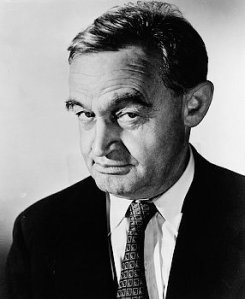
© Copyright 2010 CorbisCorporation

Barry Fitzgerald, Irish stage, film, and television actor, dies on January 14, 1961.

Fitzgerald is born William Joseph Shields in Walworth Road, Portobello, Dublin, Ireland, on March 10, 1888. He is the older brother of Irish actor Arthur Shields. He goes to Skerry’s College in Dublin before going on to work in the civil service while also working at the Abbey Theatre.

Unknown to many, Fitzgerald is also a patriot. In 1916 he is a member of the Irish Volunteers and is prepared to fight in the Easter Rising on Easter Sunday when the orders are countermanded. On Easter Monday the revolution is on again, and Shields goes to the Abbey Theatre and retrieves his rifle from under the stage. He goes around the corner to Liberty Hall and joins with James Connolly’s Irish Citizen Army.

He then marches to the General Post Office on Sackville Street where he fights before evacuating on Friday. He is sent to Stafford Prison in England with another famous rebel, Michael Collins, and from there they are both sent to the Frongoch internment camp in Wales. Both return to Dublin by the end of 1916, Collins to terrorise the British and Shields to return to the Abbey Theatre stage.

By 1929, he turns to acting full-time. He is briefly a roommate of famed playwright Sean O’Casey and stars in such plays as O’Casey’s Juno and the Paycock and the premiere of The Silver Tassie.

Fitzgerald goes to Hollywood to star in another O’Casey work, The Plough and the Stars (1936), directed by John Ford. He has a successful Hollywood career in such films as The Long Voyage Home (1940), How Green Was My Valley (1941), And Then There Were None (1945), The Naked City (1948), and The Quiet Man (1952). Fitzgerald achieves a feat unmatched in the history of the Academy Awards. He is nominated for both the Best Actor Oscar and the Best Supporting Actor Oscar for the same performance, as Father Fitzgibbon in Going My Way (1944). He wins the Best Supporting Actor Award. This feat will likely never be matched as the Academy Award rules have since been changed to prevent this. During World War II, Oscar statues are made of plaster rather than gold due to wartime metal shortages. Being an avid golfer, Fitzgerald later breaks the head off his Oscar statue while practicing his golf swing.

Fitzgerald has two stars on the Hollywood Walk of Fame, one for films located at 6220 Hollywood Blvd. and one for television located at 7001 Hollywood Blvd.

Fitzgerald returns to live in Dublin in 1959. He dies of heart failure on January 14, 1961, and is buried at Deansgrange Cemetery in Dublin.