seamus dubhghaill

Promoting Irish Culture and History from Little Rock, Arkansas, USA


Leave a comment

Coalition Government’s Cabinet Meets in London

On July 23, 1920, the Lloyd George Coalition Government holds a Cabinet meeting in London, part of the post-war peacetime governance under a coalition mainly of Liberals and Conservatives, addressing issues of reconstruction, Ireland, and war reparations.

The Coalition Government, led by Prime Minister David Lloyd George, is in power from 1918 to 1922 following the end of World War I, continuing the wartime alliance that has included Liberals and Conservatives. By 1920, the Cabinet is navigating Spain’s post-war reconstruction, the political unrest in Ireland, social welfare issues, and economic stabilization following wartime disruption. This period also sees preparation for negotiations over Germany’s reparations and engagement with international diplomacy after the Treaty of Versailles.

During this period, in addition to Lloyd George, the peacetime Cabinet includes key ministers including Bonar Law (Chancellor of the Exchequer and Leader of the House of Commons), Austen Chamberlain (Chancellor of the Exchequer until January 1920; replaced by Sir Robert Horne on trade matters), Arthur Balfour (Secretary of State for Foreign Affairs), Winston Churchill (Secretary for War and Air) and George Curzon (Lord President of the Council and Leader of the House of Lords).

The Coalition Cabinet keeps detailed minutes and memoranda, which are recorded in the CAB 23 series as “Cabinet Conclusions,” starting from November 1919 into the interwar years. These records summarize discussions and decisions but are not verbatim transcriptions.

While the specific agenda for July 23 is not directly cited in the sources, relevant Cabinet business during July 1920 includes:

  1. Reconstruction and Post-War Economy: Addressing unemployment, social welfare of returning servicemen, and government budgetary priorities.
  2. Ireland and Home Rule Legislation: Oversight of the Government of Ireland Act 1920, which has received royal assent earlier in the year, establishing separate parliaments for Northern and Southern Ireland.
  3. International Diplomacy and Reparations: Review of ongoing negotiations concerning German reparations after World War I, potentially preparing for discussions later in London and Paris.

Regarding Ireland, the Cabinet is divided on how to proceed. Some Liberal ministers and Dublin Castle officials are in favour of offering dominion status to Ireland. Conservative ministers argue that the Government must crush the insurgency and proceed with the Government of Ireland Bill. Debate continues after the meeting, with Walter Long warning of “the gravest consequences in Ulster” if the Government changes course.

In summary, the Coalition Cabinet convenes on July 23, 1920, in the context of post-war governance, with ministers like Lloyd George, Bonar Law, Curzon, Balfour, and Churchill participating. While exact meeting details require consulting official CAB series records, the issues at hand involve post-World War I economic recovery, Irish affairs, and international obligations stemming from the Treaty of Versailles.

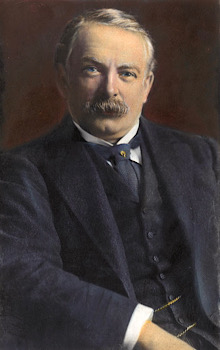
(Pictured: Prime Minister of the United Kingdom David Lloyd George)

Leave a comment

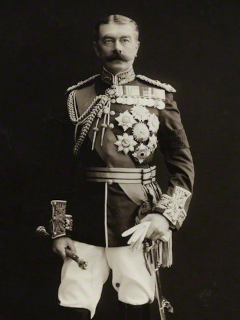
Death of Horatio Herbert Kitchener, 1st Earl Kitchener

Horatio Herbert Kitchener, 1st Earl Kitchener, Irish-born senior British Army officer and colonial administrator, drowns in the sinking of the HMS Hampshire west of Orkney, Scotland, on June 5, 1916. He wins notoriety for his imperial campaigns, especially his scorched earth policy against the Boers, his expansion of Lord Robertsinternment camps during the Second Boer War and his central role in the early part of World War I.

Kitchener is born in Ballylongford near Listowel, County Kerry, son of army officer Henry Horatio Kitchener and Frances Anne Chevallier, daughter of John Chevallier, a priest, of Aspall Hall, and his third wife, Elizabeth. The family moves to Switzerland when he is young, where he is educated at Montreux, then at the Royal Military Academy, Woolwich. He joins a French field ambulance unit in the Franco-Prussian War but is returned to England after he comes down with pneumonia.

Kitchener is credited in 1898 for winning the Battle of Omdurman and securing control of the Sudan for which he is made Baron Kitchener of Khartoum. As Chief of Staff (1900–1902) in the Second Boer War he plays a key role in Lord Roberts’ conquest of the Boer Republics, then succeeds Roberts as commander-in-chief, by which time Boer forces have taken to guerrilla warfare and British forces imprison Boer civilians in concentration camps. His term as Commander-in-Chief (1902–09) of the Army in India sees him quarrel with another eminent proconsul, the Viceroy Lord Curzon, who eventually resigns. He then returns to Egypt as British Agent and Consul General.

In 1914, at the start of World War I, Kitchener becomes Secretary of State for War, a Cabinet Minister. One of the few to foresee a long war, lasting for at least three years, and with the authority to act effectively on that perception, he organises the largest volunteer army that Britain had ever seen, and oversees a significant expansion of materials production to fight on the Western Front. Despite having warned of the difficulty of provisioning for a long war, he is blamed for the shortage of shells in the spring of 1915, one of the events leading to the formation of a coalition government and is stripped of his control over munitions and strategy.

On June 5, 1916, Kitchener is making his way to Russia on HMS Hampshire to attend negotiations with Tsar Nicholas II. At the last minute, Admiral Sir John Jellicoe changes the HMS Hampshire‘s route on the basis of a misreading of the weather forecast and ignoring (or not being aware of) recent intelligence and sightings of German U-boat activity in the vicinity of the amended route. Shortly before 7:30 PM the same day, steaming for the Russian port of Arkhangelsk during a Force 9 gale, HMS Hampshire strikes a mine laid by the newly launched German U-boat U-75 and sinks 1.5 miles west of the Orkney. Only twelve men survive. Amongst the dead are Kitchener and all ten members of his entourage. He is seen standing on the quarterdeck during the approximately twenty minutes that it takes the ship to sink. His body is never recovered.