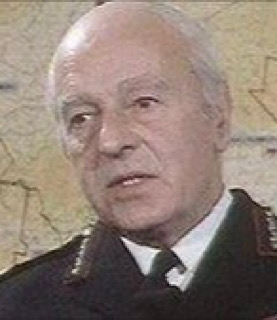
Shillington originally plans to join the Northern Ireland Civil Service, however he wants a more varied career. He joins the Royal Ulster Constabulary on February 8, 1933, as a cadet officer. He completes his training at the Newtownards depot in County Down. He is promoted to district inspector in 1935, and serves as officer in charge of D District in Belfast. In 1944, he is promoted to 1st Class District Inspector and is posted to Derry, County Londonderry.
In 1953, after nine years in Derry, Shillington is promoted to County Inspector and returns to Belfast. There, he joins the Inspector General’s Headquarters and serves in an administrative post. On January 16, 1961, he is appointed Commissioner of Belfast City.
In 1969, Shillington is appointed Deputy Inspector-General of the RUC, as second-in-command to the Inspector-General, Anthony Peacocke, who, like Shillington, had been educated at Sedbergh and Cambridge. When the Battle of the Bogside breaks out in Derry in August 1969, he requests permission to use CS gas for the first time in the United Kingdom. When that does not halt the rioting, he requests that the British Army be brought in. He telephones Peacocke on August 13 in order to persuade him of this. Peacocke, who has long denied the need for army involvement, eventually agrees, but his reputation never recovers and following the publication of the Hunt Report in October he resigns as Inspector-General.
Shortly thereafter, Sir Arthur Young is seconded from the City of London Police to be the last Inspector-General and the first Chief Constable of the RUC. James Callaghan, then Home Secretary, sends him to implement the Hunt Report. Young’s measures introduce the standard British rank system for police officers in Northern Ireland and disbands the Ulster Special Constabulary (USC). Shillington remains as Young’s deputy, and when the latter returns to the mainland in 1970 he succeeds him to become the RUC’s second Chief Constable.
Shillington marries Mary (Peggy) Bulloch in 1935. They have two sons and a daughter. He dies on August 14, 2001, at the age of 90, in a County Armagh nursing home.
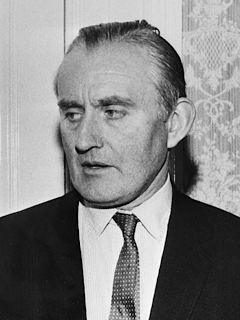
In 1924, James Clark Snr. changes the family name to Chichester-Clark by deed poll, thus preventing the old Protestant Ascendancy name Chichester, his wife’s maiden name, from dying out. On his mother’s side the family are descended from the Donegall Chichesters and are the heirs of the Dawsons of Castledawson, who had originally held Moyola Park.
Chichester-Clark marries widow Moyra Haughton (née Morris) in 1959. Lady Moyola’s first husband, Capt. Thomas Haughton from Cullybackey, had been killed in the RAF Nutts Corner air crash in January 1953. She, while pregnant, is seriously injured in the crash and suffers a broken neck. He and his wife have two daughters (Tara and Fiona), in addition to Moyra’s son Michael from her previous marriage. Lady Moyola is a cousin of Colonel Sir Michael McCorkell, Lord Lieutenant of County Londonderry (1975–2000). Chichester-Clark serves as his Vice Lord-Lieutenant.
Chichester-Clark is an officer in the 1st Battalion, Irish Guards, part of 24th Infantry Brigade attached to British 1st Infantry Division, and participates briefly in the Anzio landings. He is injured on February 23, 1944, by an 88m shell as he and his Platoon Sergeant take their first look at the ground in the “gullies” to the west of the Anzio–Albano Laziale road. His company is all but wiped out, and he spends most of the war in hospital recovering from injuries, the effects of which stay with him throughout his life.
Following the war, Chichester-Clark’s military career takes him from the dull duties of the post-war occupation of Germany, to Canada as aide-de-camp to Harold Alexander, 1st Earl Alexander of Tunis, then Governor General of Canada. The popularity and competence of his senior officer makes this uneventful two-year period of his life the most remarkable element of his pre-parliamentary career. On returning from Canada, he continues in the Army for several years, refusing promotion to seniority before retiring a major in 1960.
In an uncontested by-election in 1960, Chichester-Clark takes over the South Londonderry seat in the Northern Ireland Parliament that had been held by his grandmother, Dame Dehra Parker, since 1933. As Dehra Chichester, she is an MP for the county of Londonderry until 1929 when she stands down for a first time. Chichester-Clark’s father replaces her in 1929 when the county is split, but he suddenly dies in 1933. Dehra, by then remarried, willingly returns to Northern Ireland from England, and wins the ensuing by-election.
Chichester-Clark retains the seat for the remainder of the Parliament’s existence, and so the South Londonderry area is represented by three generations of the same family for the entire period of the Northern Ireland House of Commons. Between 1929 and the last election in 1969, the family is challenged for the seat on only two occasions, the second being in 1969, when future Westminster MP Bernadette Devlin stands, attracting 39% of the vote.
Chichester-Clark makes his maiden speech on February 8, 1961, during the Queen’s speech debate.
For the remainder of Basil Brooke, 1st Viscount Brookeborough‘s premiership, Chichester-Clark remains on the back benches. It is not until 1963, when Terence O’Neill becomes Prime Minister of Northern Ireland, that he is appointed assistant whip, and a month later when William Craig is promoted to the Ministry of Home Affairs, he takes over as Government Chief Whip. Accounts of the period are that he enjoys the Whip’s office more than any other he is to subsequently hold in politics. This despite including references to anti O’Neill MP and future Democratic Unionist Party (DUP) Westminster MP, John McQuade, and the occasional “good row.” From the outset, O’Neill takes the unusual decision to allow Chichester-Clark to attend and speak at all cabinet meetings while Chief Whip. Proving a competent parliamentary party administrator, O’Neill adds Leader of the House of Commons to Chichester-Clark’s duties in October 1966, a promotion that makes him a full member of the Cabinet. He is also sworn into the Privy Council of Northern Ireland in 1966.
In 1967, O’Neill sacks his Minister of Agriculture, Harry West, for ministerial impropriety, and Chichester-Clark is appointed in his place, a position he retains for two quiet years. On April 23, 1969, he resigns from the Cabinet one day prior to a crucial Parliamentary Party meeting, claiming that he disagrees with the Prime Minister’s decision to grant universal suffrage in local government elections at that time. He states that he disagrees not with the principle of one man one vote but with the timing of the decision, having the previous day expressed doubts over the expediency of the measure in Cabinet. It has since been suggested that his resignation was in order to accelerate O’Neill’s own resignation, and to improve his own position in the jostling to succeed him.
O’Neill “finally walked away” five days later on April 28, 1969. In order to beat his only serious rival, Brian Faulkner, Chichester-Clark needs the backing of O’Neill-ite MPs elected at the 1969 Northern Ireland general election, to which end he attends a tea party in O’Neill’s honour only days after causing his resignation.
Chichester-Clark beats Faulkner in the 1969 Ulster Unionist Party leadership election by one vote on May 1, 1969, with his predecessor using his casting vote in the tied election for his distant cousin because “Faulkner had been stabbing him in the back for a lot longer.” Although Faulkner believes, until his death, that he is the victim of an upper-class conspiracy to deny him the premiership, he becomes a high profile and loyal member of Chichester-Clark’s cabinet.
Chichester-Clark’s premiership is punctuated by civil unrest that erupts after August 1969. He suffers from the effects of the Hunt Report, which recommends the disbandment of the Ulster Special Constabulary, which his Government accepts to the consternation of many Unionists.
In April 1970, Chichester-Clark’s predecessor and another Unionist MP resign their seats in the Northern Ireland House of Commons. The by-election campaigns are punctuated by major liberal speeches by senior government figures like Brian Faulkner, Jack Andrews and the Prime Minister himself. Ian Paisley‘s Protestant Unionist Party (PUP), however, takes both seats in the House of Commons. Later that same month the O’Neill-ite group, the New Ulster Movement, becomes the Alliance Party of Northern Ireland, and his party begins passing votes of no confidence in him.
As the civil unrest grows, the British Government, particularly the Home Secretary, James Callaghan, becomes increasingly involved in Northern Ireland’s affairs, forcing Chichester-Clark’s hand on many issues. These include the disbanding of the “B” Specials of the Ulster Special Constabulary and, importantly, the handing over of operational control of the security forces to the British ArmyGeneral Officer Commanding Northern Ireland.
On March 9, 1971, the Provisional Irish Republican Army lures three off-duty soldiers from a pub in Belfast to a lane way outside the city, where they kill them. Chichester-Clark flies to London on March 18, 1971, to request a new security initiative from the new British prime ministerEdward Heath, who offers an extra 1,300 troops, and resists what he sees as an attempt by Chichester-Clark to gain political control over them. Chichester-Clark resigns on March 20.
On March 23, 1971, Brian Faulkner is elected UUP leader in a vote by Unionist MP’s, defeating William Craig by twenty-six votes to four. He is appointed prime minister the same day.
On July 20, 1971, Chichester-Clark is created a life peer as Baron Moyola, of Castledawson in the County of Londonderry, his title taken from the name of his family’s estate. He endorses the Good Friday Agreement in the 1998 Northern Ireland Good Friday Agreement referendum. He remains quiet about his political career in his retirement. Lady Moyola, however, says that her husband does enjoy the time – contrary to popular opinion – and that he thinks of life as an MP as akin to that of an army welfare officer.
Chichester Clark dies on May 17, 2002, at the age of 79, following a short illness. His funeral takes place at Christ Church in Castledawson on May 21. He is the last surviving Prime Minister of Northern Ireland.
The Royal Irish Constabulary (RIC), the police force in Ireland from 1822 until 1922, when all of the island was part of the United Kingdom, is disbanded on August 17, 1922, and replaced by the Garda Síochána.
A separate civic police force, the unarmed Dublin Metropolitan Police (DMP), patrols the capital and parts of County Wicklow, while the cities of Derry and Belfast, originally with their own police forces, later have special divisions within the RIC. For most of its history, the ethnic and religious makeup of the RIC broadly matches that of the Irish population, although Anglo-IrishProtestants are overrepresented among its senior officers.
The Peace Preservation Act 1814, for which Sir Robert Peel is largely responsible, and the Irish Constabulary Act 1822 forms the provincial constabularies. The 1822 act establishes a force in each province with chief constables and inspectors general under the United Kingdom civil administration for Ireland controlled by the Dublin Castle administration.
The RIC’s existence is increasingly troubled by the rise of the Home Rule campaign in the early twentieth century period prior to World War I.
In January 1922, the British and Irish delegations agree to disband the RIC. Phased disbandments begin within a few weeks with RIC personnel both regular and auxiliary being withdrawn to six centres in southern Ireland. On April 2, 1922, the force formally ceases to exist, although the actual process is not completed until August 17. The RIC is replaced by the Civic Guard (renamed as the Garda Síochána the following year) in the Irish Free State and by the Royal Ulster Constabulary (RUC) in Northern Ireland.
According to a parliamentary answer in October 1922, 1,330 ex-RIC men join the new RUC in Northern Ireland. This results in an RUC force that is 21% Roman Catholic at its inception in 1922. As the former RIC members retire over the subsequent years, this proportion steadily falls.
Just thirteen men transfer to the Garda Síochána. These include men who had earlier assisted Irish Republican Army (IRA) operations in various ways. Some retire, and the Irish Free State pays their pensions as provided for in the terms of the Anglo-Irish Treaty agreement. Others, still faced with threats of violent reprisals, emigrate with their families to Great Britain or other parts of the British Empire, most often to join police forces in Canada, Australia, New Zealand, South Africa and Southern Rhodesia. A number of these men join the Palestine Police Force, which is recruiting in the UK at the time.
O’Connell had rejected a suggestion from “friends of emancipation,” and from the English Roman Catholic bishop, John Milner, that the fear of Catholic advancement might be allayed if the Crown were accorded the same right exercised by continental monarchs: a veto on the confirmation of Catholic bishops. O’Connell insists that Irish Catholics would rather “remain forever without emancipation” than allow the government “to interfere” with the appointment of their senior clergy. Instead, he relies on their confidence in the independence of the priesthood from Ascendancy landowners and magistrates to build his Catholic Association into a mass political movement. On the basis of a “Catholic rent” of a penny a month (typically paid through the local priest), the Association mobilises not only the Catholic middle class, but also poorer tenant farmers and tradesmen. Their investment enables O’Connell to mount “monster” rallies that stay the hands of authorities and embolden larger enfranchised tenants to vote for pro-emancipation candidates in defiance of their landlords.
O’Connell’s campaign reaches its climax when he himself stands for parliament. In July 1828, he defeats a nominee for a position in the British cabinet, William Vesey-FitzGerald, in a County Clare by-election, 2057 votes to 982. This makes a direct issue of the parliamentary Oath of Supremacy by which, as a Catholic, he will be denied his seat in the Commons.
As Lord Lieutenant of Ireland, Wellington’s brother, Richard Wellesley, had attempted to placate Catholic opinion, notably by dismissal of the long-serving Attorney-General for Ireland, William Saurin, whose rigid Ascendancy views and policy made him bitterly unpopular, and by applying a policy of prohibitions and coercion against not only the Catholic Ribbonmen but also the Protestant Orangemen. But now both Wellington and his Home Secretary, Robert Peel, are convinced that unless concessions are made, a confrontation is inevitable. Peel concludes, “though emancipation was a great danger, civil strife was a greater danger.” Fearing insurrection in Ireland, he drafts the Relief Bill and guides it through the House of Commons. To overcome the vehement opposition of both the King and of the House of Lords, Wellington threatens to resign, potentially opening the way for a new Whig majority with designs not only for Catholic emancipation but also for parliamentary reform. The King initially accepts Wellington’s resignation and the King’s brother, Ernest Augustus, Duke of Cumberland, attempts to put together a government united against Catholic emancipation. Though such a government would have considerable support in the House of Lords, it would have little support in the Commons and Ernest abandons his attempt. The King recalls Wellington. The bill passes the Lords and becomes law.
The key, defining, provision of the Acts is its repeal of “certain oaths and certain declarations, commonly called the declarations against transubstantiation and the invocation of saints and the sacrifice of the mass, as practised in the Church of Rome,” which had been required “as qualifications for sitting and voting in parliament and for the enjoyment of certain offices, franchises, and civil rights.” For the Oath of Supremacy, the act substitutes a pledge to bear “true allegiance” to the King, to recognise the Hanoverian succession, to reject any claim to “temporal or civil jurisdiction” within the United Kingdom by “the Pope of Rome” or “any other foreign prince … or potentate,” and to “abjure any intention to subvert the present [Anglican] church establishment.”
This last abjuration in the new Oath of Allegiance is underscored by a provision forbidding the assumption by the Roman Church of episcopal titles, derived from “any city, town or place,” already used by the United Church of England and Ireland. (With other sectarian impositions of the Act, such as restrictions on admittance to Catholic religious orders and on Catholic-church processions, this is repealed with the Roman Catholic Relief Act 1926.)
The one major security required to pass the Act is the Parliamentary Elections (Ireland) Act 1829. Receiving its royal assent on the same day as the relief bill, the act disenfranchises Ireland’s forty-shilling freeholders, by raising the property threshold for the county vote to the British ten-pound standard. As a result, “emancipation” is accompanied by a more than five-fold decrease in the Irish electorate, from 216,000 voters to just 37,000. That the majority of the tenant farmers who had voted for O’Connell in the Clare by-election are disenfranchised as a result of his apparent victory at Westminster is not made immediately apparent, as O’Connell is permitted in July 1829 to stand unopposed for the Clare seat that his refusal to take the Oath of Supremacy had denied him the year before.
In 1985, J. C. D. Clark depicts England before 1828 as a nation in which the vast majority of the people still believed in the divine right of kings, and the legitimacy of a hereditary nobility, and in the rights and privileges of the Anglican Church. In Clark’s interpretation, the system remained virtually intact until it suddenly collapsed in 1828, because Catholic emancipation undermined its central symbolic prop, the Anglican supremacy. He argues that the consequences were enormous: “The shattering of a whole social order. … What was lost at that point … was not merely a constitutional arrangement, but the intellectual ascendancy of a worldview, the cultural hegemony of the old elite.”
Clark’s interpretation has been widely debated in the scholarly literature, and almost every historian who has examined the issue has highlighted the substantial amount of continuity before and after the period of 1828 through 1832.
Eric J. Evans in 1996 emphasises that the political importance of emancipation was that it split the anti-reformers beyond repair and diminished their ability to block future reform laws, especially the great Reform Act of 1832. Paradoxically, Wellington’s success in forcing through emancipation led many Ultra-Tories to demand reform of Parliament after seeing that the votes of the rotten boroughs had given the government its majority. Thus, it was an ultra-Tory, George Spencer-Churchill, Marquess of Blandford, who in February 1830 introduced the first major reform bill, calling for the transfer of rotten borough seats to the counties and large towns, the disfranchisement of non-resident voters, the preventing of Crown officeholders from sitting in Parliament, the payment of a salary to MPs, and the general franchise for men who owned property. The ultras believed that a widely based electorate could be relied upon to rally around anti-Catholicism.
In Ireland, emancipation is generally regarded as having come too late to influence the Catholic-majority view of the union. After a delay of thirty years, an opportunity to integrate Catholics through their re-emerging propertied and professional classes as a minority within the United Kingdom may have passed. In 1830, O’Connell invites Protestants to join in a campaign to repeal the Act of Union and restore the Kingdom of Ireland under the Constitution of 1782. At the same, the terms under which he is able to secure the final measure of relief may have weakened his repeal campaign.
George Ensor, a leading Protestant member of the Catholic Association in Ulster, protests that while “relief” bought at the price of “casting” forty-shilling freeholders, both Catholic and Protestant, “into the abyss,” might allow a few Catholic barristers to attain a higher grade in their profession, and a few Catholic gentlemen to be returned to Parliament, the “indifference” demonstrated to parliamentary reform will prove “disastrous” for the country.
Seeking, perhaps, to rationalise the sacrifice of his freeholders, O’Connell writes privately in March 1829 that the new ten-pound franchise might actually “give more power to Catholics by concentrating it in more reliable and less democratically dangerous hands.” The Young IrelanderJohn Mitchel believes that the intent is to detach propertied Catholics from the increasingly agitated rural masses.
In a pattern that had been intensifying from the 1820s as landlords clear land to meet the growing livestock demand from England, tenants have been banding together to oppose evictions and to attack tithe and process servers.
Margaret Mary Edith (May) Tennant (née Abraham), promoter of workers’ rights and public health, is born April 5, 1869 at Rathgar, County Dublin, the only daughter of Dr. George Whitley Abraham, a lawyer in the civil service, and his wife, Margaret, daughter of Cornelius Curtain.
Abraham is educated at home by her father. Following his death in 1887, finding herself in financial straits, she moves to London, where she takes lodgings in Bloomsbury and works for Lady Emilia Dilke. Dilke is a social reformer and an advocate of trade unions for women, and as her secretary Margaret gains first-hand experience of the exploitative and unsanitary conditions afflicting women working in industry, a cause that she devotes the next decade to ameliorating. She is treasurer of the Womens’ Trade Union League, where she negotiates with employers on behalf of league members, organises meetings, and sends deputations to the House of Commons. From 1881 she coordinates a successful campaign to render regular government inspections of laundries mandatory (legislation is passed to this effect in 1908).
Abraham’s dedication to her work soon attracts wider recognition, and in 1891 she is appointed an assistant commissioner to undertake field inquiries for the Royal Labour Commission. In this capacity she travels incessantly throughout England and Ireland, gathering information and writing reports on often appalling working conditions. It is mainly because of this work that in 1893 the home secretary appoints her the first female factory inspector in England. Her new position marks a career shift from agitator to skillful and effective administrator. Traveling incessantly, the inspectors target illegal overtime, poor sanitation, and dangerous trades. In her first year alone she brings eighty prosecutions for illegal overtime.
In 1895 Abraham serves on a departmental committee at the Home Office on dangerous trades, where she meets Harold John Tennant, liberal MP for Berwickshire. The couple are married the following year, and have four sons and one daughter.
By 1896 Tennant is the superintending inspector of five more women inspectors, and her extensive experience in workers’ rights and public health is reflected in the book she publishes in that year, The law relating to factories and workshops, which runs to six editions. She finds it increasingly difficult to balance the pressures of her work with the demands of her private life, and she resigns her post soon after her marriage. However, she remains a committed social activist, serving as chairman of the Industrial Law Committee and on the Royal Commission on Divorce (1909). She is also an original member and treasurer of the Central Committee on Women’s Employment (1914–39).
During the World War I Tennant is chief adviser on women’s welfare to the Ministry of Munitions and director of the Women’s Department of the National Service Department. In recognition of her services the British government awards her the Companion of Honour in 1917, the same year that her eldest son, Harry, dies while on active service. Between the wars she turns her attention to women’s health, campaigning to improve maternal mortality and nursing care.
During the World War II, despite her failing health, Tennant works for the RAF Benevolent Fund. She is a member of the Central Consultative Council of Voluntary Organisations and the National Association for Prevention of Tuberculosis, chairman of the maternal health committee, governor of Bedford College, and a JP. She is also a director of the Mysore and Champion Reef Gold Mines, an enterprise of her husband’s family, and in this capacity travels to India and New Zealand in the mid-1920s.
The Tennants have homes in Edinglasserie, Aberdeenshire, and at 12 Victoria Square, London, as well as a restored country house, Great Maytham, at Rolvenden in Kent. She is a noted authority on gardening, and is director of The Gardener’s Chronicle (other interests included fishing, tennis, and gambling). After her husband’s death in 1935 she moves to a smaller house named Cornhill at Great Maytham, where she dies on July 11, 1946. Some of her correspondence is in the British Library, London.
(From: “Tennant (née Abraham), Margaret Mary Edith (May),” contributed by Sinéad Sturgeon and Georgina Clinton, Dictionary of Irish Biography, http://www.dib.ie)
On January 31, 1972, the day after Bloody Sunday, British Home SecretaryReginald Maudling announces a tribunal of inquiry “into the circumstances of the march and the incidents leading up to the casualties which resulted.”
The official British Army position, backed by Maudling in the House of Commons, is that the paratroopers reacted to gun and nail bomb attacks from suspected Irish Republican Army (IRA) members. Apart from the soldiers, all eyewitnesses — including marchers, local residents, and British and Irish journalists present — maintain that soldiers fired into an unarmed crowd or were aiming at fleeing people and those tending the wounded, whereas the soldiers themselves were not fired upon. No British soldier is wounded by gunfire or reports any injuries, nor are any bullets or nail bombs recovered to back up their claims.
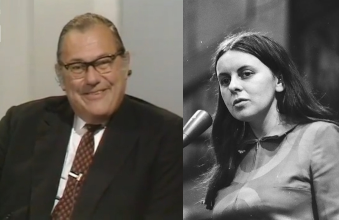
In the days following Bloody Sunday, Bernadette Devlin, the independent Irish nationalistMember of Parliament (MP) for Mid Ulster, expresses anger at what she perceives as British government attempts to stifle accounts being reported about the shootings. Having witnessed the events firsthand, she is infuriated that the Speaker of the House of Commons, Selwyn Lloyd, consistently denies her the chance to speak in Parliament about the shootings, although parliamentary convention decrees that any MP witnessing an incident under discussion will be granted an opportunity to speak about it in Parliament. Devlin slaps Reginald Maudling and calls him a “murdering hypocrite” when he makes a statement to Parliament that the British Army had fired only in self-defence. She is temporarily suspended from Parliament as a result.
An inquest into the deaths is held in August 1973. The city’s coroner, Hubert O’Neill, a retired British Army major, issues a statement at the completion of the inquest. He declares:
“This Sunday became known as Bloody Sunday and bloody it was. It was quite unnecessary. It strikes me that the Army ran amok that day and shot without thinking what they were doing. They were shooting innocent people. These people may have been taking part in a march that was banned but that does not justify the troops coming in and firing live rounds indiscriminately. I would say without hesitation that it was sheer, unadulterated murder. It was murder.”
(Pictured: Home Secretary Reginald Maudling (left) and Member of Parliament for Mid Ulster Bernadette Devlin)
In 1778, English Catholics are relieved of the restrictions on land inheritance and purchase. A savage reaction to these concessions produces the Gordon Riots of 1780, and the whole history of Catholic Emancipation is one of struggle against great resistance. In 1791 the Roman Catholic Relief Act repeals most of the disabilities in Great Britain, provided Catholics take an oath of loyalty. In 1793 the army, the navy, the universities, and the judiciary are opened to Catholics, although seats in Parliament and some offices are still denied. These reforms are sponsored by William Pitt the Younger, who hopes thereby to split the alliance of Irish Catholics and Protestants. But Pitt’s attempt to secure a general repeal of the Penal Laws is thwarted by George III. Pope Pius VII consents to a royal veto on episcopal nominations if the Penal Laws are repealed, but the move fails. In Ireland the repeal of Poynings’ Law in 1782 is followed by an act (1792) of the Irish Parliament relaxing the marriage and education laws and an act (1793) allowing Catholics to vote and hold most offices.
The Roman Catholic Relief Act 1829 permits members of the Catholic Church to sit in the parliament at Westminster and to hold all but a handful of public offices. O’Connell had won a seat in a by-election for Clare in 1828 against an Anglican. Under the then extant penal law, O’Connell as a Catholic, is forbidden to take his seat in Parliament. Peel, the Home Secretary, until then is called “Orange Peel” because he always supports the Orange (anti-Catholic) position. Peel now concludes, “Though emancipation was a great danger, civil strife was a greater danger.” Fearing a revolution in Ireland, Peel draws up the Catholic Relief Bill and guides it through the House of Commons. To overcome the vehement opposition of both the House of Lords and King George IV, the Duke of Wellington works tirelessly to ensure passage in the House of Lords and threatens to resign as Prime Minister if the King does not give Royal Assent.
With the Universities Tests Act 1871, which opens the universities to Roman Catholics, Catholic Emancipation in the United Kingdom is virtually complete.
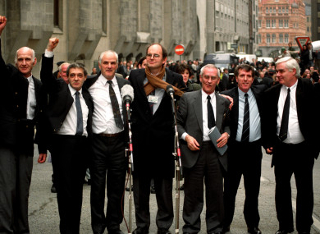
The Birmingham Six – Paddy Joe Hill, Hugh Callaghan, Richard McIlkenny, Gerry Hunter, Billy Power and Johnny Walker – are released from jail on March 14, 1991, after their convictions for the murder of 21 people in two pubs are quashed by the Court of Appeal.
The Birmingham pub bombings take place on November 21, 1974, and are attributed to the Provisional Irish Republican Army. Explosive devices are placed in two central Birmingham pubs – the Mulberry Bush at the foot of the Rotunda and the Tavern in the Town, a basement pub in New Street. Up until this point, the resulting explosions collectively are the most injurious attacks in Great Britain since World War II. Ten people at the Mulberry Bush and eleven at the Tavern in the Town are killed and 182 people are injured. A third device, outside a bank in Hagley Road, fails to detonate.
Five of the six are taken into custody on the evening of November 21. The men agree to be taken to Morecambe police station for forensic tests. The following morning, after the forensic tests and questioning at the hands of the Morecambe police, the men are transferred to the custody of West Midlands Serious Crime Squad police unit. Hugh Callaghan is taken into custody on the evening of November 22.
On May 12, 1975, the six men are charged with murder and conspiracy to cause explosions. The trial begins on June 9, 1975, at the Crown Court sitting at Lancaster Castle. After legal arguments the statements made in November are deemed admissible as evidence. The unreliability of these statements is later established. Forensic scientist Dr. Frank Skuse uses positive Griess test results to claim that Hill and Power had handled explosives. Callaghan, Hunter, McIlkenny and Walker all had tested negative. The jury finds the six men guilty of murder. On August 15, 1975, they are each sentenced to 21 life sentences.
In March 1976 their first application for leave to appeal is dismissed by the Court of Appeal. Their second full appeal, in 1991, is allowed. New evidence of police fabrication and suppression of evidence, the successful attacks on both the confessions and the 1975 forensic evidence causes the Crown to decide not to resist the appeals. The Court of Appeal states that “in the light of the fresh scientific evidence, which at least throws grave doubt on Dr. Skuse’s evidence, if it does not destroy it altogether, these convictions are both unsafe and unsatisfactory.” On March 14, 1991, the six walk free.
In 2001, a decade after their release, the six men are awarded compensation ranging from £840,000 to £1.2 million.
The success of the appeals and other miscarriages of justice cause the Home Secretary to set up a Royal Commission on Criminal Justice in 1991. The commission reports in 1993 and leads to the Criminal Appeal Act 1995 which establishes the Criminal Cases Review Commission in 1997. Superintendent George Reade and two other police officers are charged with perjury and conspiracy to pervert the course of justice but are never prosecuted. During the inquest into the bombings in 2016, Hill states that he knows the identities of three of the bombers who are still “free men” in Ireland.



 seamus dubhghaill