seamus dubhghaill

Promoting Irish Culture and History from Little Rock, Arkansas, USA


Leave a comment

Birth of Andrew Cooney, Irish Republican & Medical Doctor

Andrew Cooney, Irish republican and medical doctor, is born on April 22, 1897, in Ballyphillip, Nenagh, County Tipperary.

Cooney is the second of three children of John Cooney and Mary Ann Cooney (née Gleeson), middling farmers. While his grandfather, Patrick Cooney, from nearby Garrykennedy, is reputed to have been a member of the Irish Republican Brotherhood (IRB) and an Irish National Land League activist, his father does not have any inclination towards radical politics. He is educated at Lissenhall national school and St. Joseph’s CBS, Nenagh. In October 1916, he commences studies in medicine at University College Dublin (UCD) just as the Irish War of Independence is getting underway. He plays briefly with the College’s hurling club.

In 1917, Cooney joins the Third Battalion of the Dublin Brigade of the Irish Republican Army (IRA). A year later he is jailed for two months in Mountjoy Prison and Crumlin Road Gaol, Belfast, for illegal drilling. Joining the IRB at the end of 1918, he assists in the December 1918 election by protecting candidates and acts as a guard at sittings of the First Dáil. On June 26, 1920, he plays a major role in the attack on Borrisokane Royal Irish Constabulary (RIC) barracks. He takes part in the Bloody Sunday operations of November 21, 1920, at 28 Upper Pembroke Street where a number of British agents are killed and attends Croke Park afterwards. He then goes on the run as a full-time Volunteer and serves with the Dublin Brigade active service unit (ASU).

After the Anglo-Irish truce of July 1921, Cooney is appointed Officer Commanding (O/C) of the 1st Kerry Brigade, IRA, reorganising it and forming a flying column. Opposing the Anglo-Irish Treaty of 1921, he does not immediately break with GHQ, who sends him to organise the 1st Eastern Division. Later in January 1922, the Chief of Staff, Eoin O’Duffy, asks him to become O/C of the 3rd Eastern Division, but later rescinds the appointment. In March 1922 he is appointed O/C of the 1st Eastern Division of the anti-Treaty IRA during the Irish Civil War.

That same year he is captured by Free State forces and interned in Mountjoy Prison, where he becomes O/C of the prisoners in C Wing. He accepts responsibility for an attempted escape bid on October 10, 1922, in which a fellow prisoner, Peadar Breslin, is killed and another man is wounded. After sojourns in Newbridge and Arbour Hill Prison, he is moved with the other leaders to Kilmainham Gaol, where he spends forty-one days on hunger strike. Removed to Harepark Camp, the Curragh, on January 1, 1924, he is among the last to be released on May 29, 1924.

Cooney succeeds Frank Aiken as Chief of Staff of the IRA on November 18, 1925. Central to the reorganisation scheme he puts in place is the need to secure American funds for the IRA and to combat Frank Aiken’s fundraising work in the United States since December 1925 on behalf of the embryo Fianna Fáil organisation. Receiving permission on April 21, 1926, he departs on a fund-raising trip to the United States but returns to Ireland in October. He resigns as chief of staff in favour of Maurice Twomey but retains his position as chairman of the IRA executive until November 21, 1927, when he obtains leave to complete his medical studies.

After internship in the Mater Hospital, Dublin, Cooney finds temporary employment in London, but remains in touch with GHQ. On September 27, 1929, he marries the German-educated Frances (‘Frank’) Brady, daughter of a wealthy Belfast linen family and former Cumann na mBan activist and hunger-striker. The marriage is not a success. Failing to secure employment due to police harassment and the loyalty test then in force, he and his wife are obliged to emigrate to London, where he practises as a GP, still maintaining his IRA links. Their only child, Seán, is born there in 1931. He returns to Ireland in August 1932, after Fianna Fáil’s accession to power.

An intimate friend of Maurice Twomey, who is still Chief of Staff, Cooney remains in the upper echelons of the IRA and attends its conventions. Signifying his standing in republican circles, he is chosen to unveil, inter alia, the Fenian memorial in Glasnevin Cemetery and the Seán Treacy plaque in Talbot Street, Dublin, and is a regular speaker at commemorations. In March 1940, he attempts to intercede with Éamon de Valera on behalf of hunger-striking republicans, and is later arrested, but released.

After the discovery of a German spy ring in the hospitals commission’s subsidiary, the Dublin Hospitals Bureau, Cooney is forced to resign in April 1942 on refusing to take a loyalty pledge to the state. He returns to private practice. He becomes active in the unsuccessful campaign to save Charlie Kerins, Chief of Staff, from being hanged in 1944. In anticipation of emigrating, he finally resigns from the IRA in 1944, though military and police surveillance continue until March 1945.

In August 1945, Cooney joins the United Nations Relief and Rehabilitation Administration, working with displaced persons in the American zone in Germany, and gains rapid promotion. After joining the International Refugee Organisation (UNRRA’s successor) on July 1, 1947, he becomes the chief medical officer of an area including the American sector of Berlin and containing 150,000 displaced persons. He later holds a similar post in Bavaria.

Appointed a part-time member of the hospitals commission by the inter-party government in September 1949 and in severe financial straits, Cooney emigrates alone to the United States on December 2, 1950, and never returns. While employed in a tuberculosis sanatorium in New Jersey, he obtains by examination his licence to practise medicine in Maryland on January 14, 1954. Admitted a member of the American College of Chest Physicians, again by examination, on November 23, 1954, he secures, at the age of 57, his first ever permanent post in medicine, in a similar hospital in Pikesville, Maryland. His republican activities continue through Clan na Gael during his U.S. years, and he is a frequent speaker at commemorative events.

Cooney suffers a stroke in December 1961 that confines him to a wheelchair. He dies at the age of 71 on August 4, 1968, at Carroll County General Hospital, Carroll County, Maryland. He is buried in Youghalarra, Nenagh, County Tipperary.

(Pictured: Liam Lynch with some of his Divisional Staff and Officers of the Brigades, including the 1st Southern Division, who attend as delegates to the Army Convention at the Mansion House, Dublin, on April 9, 1922. Cooney is first on the right in the 3rd row back.)


Leave a comment

Birth of Seán Hales, Political Activist & Member of Dáil Éireann

Seán Hales, Irish political activist and member of Dáil Éireann from May 1921 to December 1922, is born in Ballinadee, Bandon, County Cork, on March 30, 1880.

Hales is born John Hales, eldest child of five sons and four daughters of Robert Hales, a farmer, and Margaret (née Fitzgerald) Hales. He is educated at Ballinadee national school and Warner’s Lane school, Bandon. After leaving school he goes to work on his father’s farm. He plays hurling with Valley Rovers GAA club and is the Munster champion in the 56-lb. weight-throwing competition. From an early age he follows in his father’s footsteps and becomes involved in the republican movement.

Hales joins the Irish Volunteers in 1915 and becomes captain of the Ballinadee company in 1916. Arrested under the Defence of the Realm Act after the 1916 Easter Rising, he is imprisoned in Frongoch internment camp in Wales. After his release, in April 1917 he becomes executive of the short-lived Liberty League promoted by Count George Plunkett. When the League merges with Sinn Féin, he helps reorganise the Volunteers. With his brothers, Tom, William, and Donal, he continues his father’s fight on behalf of evicted tenants and becomes involved with the anti-British Bandon People’s Food Committee and the anti-landlord Unpurchased Tenants’ Association. He helps in the Sinn Féin takeover of The Southern Star newspaper and is a member of the new board of directors. In 1919 he becomes battalion commander of the first (Bandon) battalion 3rd Cork Brigade of the Irish Republican Army, the name by which the Irish Volunteers increasingly became known. He leads the attack on Timoleague Royal Irish Constabulary (RIC) barracks in February 1920, and the ambush of an Essex Regiment patrol at Brinny in August 1920. The military patrol at Brinny manages to surprise the ambushers and Lieutenant Tim Fitzgerald of Bandon is the first Volunteer to be killed in action in west Cork. Hales then commands the assault on two truckloads of British troops at Newcestown Cross in which a British officer is killed and several soldiers are wounded.

Hales is appointed section commander of the west Cork flying column in 1920 and takes part in the major action at Crossbarry on March 19, 1921. In retaliation for the burning of the Hales home in March 1921, he leads a contingent of Volunteers and burns Castle Bernard, the residence of the Earl of Bandon. The occupant, Lord Bandon, is held hostage until General Strickland, the British OC in Cork, guarantees he will not execute Volunteers in Cork prison. The British authorities yield and there is an end to the policy of executing prisoners of war in the Cork area.

At the 1921 Irish elections, Hales is elected to the Second Dáil as a Sinn Féin member for the Cork Mid, North, South, South East and West constituency.

At the 1922 Irish general election, Hales is elected to the Third Dáil as a pro-Treaty Sinn Féin Teachta Dála (TD) for the same constituency. He receives 4,374 first preference votes (7.9%). Shortly afterward, the Irish Civil War breaks out between the pro-Treaty faction, who are in favour of setting up the Irish Free State and the anti-Treaty faction, who would not accept the abolition of the Irish Republic.

On December 7, 1922, Hales is killed by anti-Treaty IRA men as he leaves the Dáil. Another TD, Pádraic Ó Máille, is also shot and badly wounded in the incident. His killing is in reprisal for the Free State’s execution of anti-treaty prisoners. In revenge for Hales’ killing, four republican leaders, Joe McKelvey, Rory O’Connor, Liam Mellows and Richard Barrett, are executed the following day, December 8, 1922.

Hales is given a military funeral to the family burial place at St. Patrick’s Cemetery, Bandon.

According to information passed on to playwright Ulick O’Connor, an anti-Treaty IRA volunteer named Owen Donnelly of Glasnevin is responsible for the killing of Hales. Seán Caffrey, an anti-treaty intelligence officer told O’Connor that Donnelly had not been ordered to kill Hales specifically but was following the general order issued by Liam Lynch to shoot all deputies and senators they could who had voted for the Public Safety Act (September 28, 1922) which established military courts with the power to impose the death penalty.

A commemorative statue of Hayes is unveiled at Bank Place in Bandon in 1930.


Leave a comment

Birth of Irish Sports Broadcaster Jimmy Magee

Jimmy Magee, Irish sports broadcaster known as The Memory Man, is born on January 31, 1935, in New York City. He spends over half a century in sports broadcasting, and presents radio and television coverage of the Olympic Games since 1968 and the FIFA World Cup since 1966. By the time of his retirement he is the longest-serving sports commentator in the English-speaking world.

Magee is born to Patrick (Paddy) Magee and his wife Rose (née Mackin). The family returns to Ireland shortly after his birth. He and his three siblings are subsequently raised in Cooley, County Louth. As a child he is influenced by the sports commentary of the legendary Gaelic games broadcaster Michael O’Hehir. He recalls commentating as a seven-year-old for his next-door neighbour on a variety of imaginary games that the young Magee is also playing in. He also speaks of making up his own radio commentary in a field at a young age.

After being educated locally, Magee secures a full-time clerical post with Dundalk, Newry and Greenore Railway. While still working at the Railway he begins his broadcasting career. He starts out as a reporter for the Radio Éireann programme Junior Sports Magazine. Other contributors on the programme are Jim Tunney and Peter Byrne, former football correspondent with The Irish Times. On leaving his Railway job, he presents a number of sponsored radio programmes before concentrating on sport. He is a producer, presenter and script writer for Radio Éireann’s sponsored programmes in the 1950s and 1960s.

Magee and his wife Marie are married on October 11, 1955, and have five children: Paul, a soccer player with Shamrock Rovers F.C. (winning the League of Ireland Cup in 1977), who died of motor neuron disease, in May 2008, Linda (b. 1959), June (b. 1961), Patricia (b. 1962), and Mark (b. 1970).

Magee joins Raidió Teilifís Éireann in 1956. In 1966 he covers his first World Cup for RTÉ Radio. He does likewise for the 1970 FIFA World Cup before transferring to television for the 1974 FIFA World Cup finals. In all he provides commentary at eleven World Cups – his latest commentary coming at the 2010 FIFA World Cup in South Africa.

Magee’s column or quiz appears in every single publication of the Sunday World since the first edition in 1973.

Magee is also a staple of RTÉ’s coverage of the Olympic Games. Beginning at the 1968 Summer Olympics in Mexico City, he attends the eleven subsequent Olympic games as a commentator with RTÉ. In 2012, he commentates on the boxing for RTÉ at the 2012 Summer Olympics in London, including Katie Taylor‘s gold medal-winning fight. At the 2016 Summer Olympics, he provides commentary on the football.

From 1987 to 1998 Magee hosts Know Your Sport, a sports-themed quiz show, along with George Hamilton. His broadcasting career also sees him provide commentary for over 200 international football games, 30 European Cup finals, multiple Tour de France cycle races, World Athletic Championships and boxing. He also narrates numerous videos on sport in general such as The Purple and Gold, Meath Return to Glory, etc.

A freelancer, Magee works for Channel 4 in 1994 and signs for UTV in 1995 on a three-year contract where a lifetime ambition of commentating on All-Ireland Finals is achieved. He commentates on three finals in both hurling and football.

Magee launches his memoir, Memory Man, in 2012. Some of his one-liners in commentaries have become famous or infamous, what are affectionately known in the broadcasting industry as Colemanballs after the famed commentating clangers of BBC broadcaster David Coleman.

In the emotionally trying year of 1989, Magee’s mother and wife die within months of each other, Marie dying at the young age of 54.

Magee dies on September 20, 2017, after a short illness. Many tributes are made to him including Taoiseach Leo Varadkar who says, “His commentaries were legendary and based on a breadth of sporting knowledge that was peerless.” RTÉ Head of Sport Ryle Nugent says, “It’s hard to put it into words, the man meant an inordinate amount to so many people, I think he was the soundtrack to many generations.”

In 1972 Magee wins a Jacob’s Award for his radio sports commentaries. In 1989, he is the subject of a special tribute show on The Late Late Show. At the 2012 Summer Olympics in London, the International Olympic Committee presents him with a replica of its torch.


4 Comments

Death of Tom Aherne, Irish Footballer & Hurler

Thomas Aherne, Irish footballer and hurler also referred to as Bud Aherne, dies on December 30, 1999. He plays football for Belfast Celtic F.C. and Luton Town F.C. and is a dual internationalist, playing for both Ireland teams – the IFA XI and the FAI XI. In 1949 he is a member of the FAI XI that defeats England 2–0 at Goodison Park, becoming the first non-UK team to beat England at home. As a hurler he also plays one game for Limerick.

Aherne is born in Limerick, County Limerick, on January 26, 1919. As a youth, he initially emerges as a prominent hurler with Treaty Sarsfields and also plays one game for Limerick. However, he subsequently decides to concentrate on football and begins his senior career with Limerick United where his teammates include Davy Walsh. During World War II, he serves in the Irish Army and is stationed at Crosshaven. His impressive performances in the League of Ireland attract attention and in 1946 he is signed by Belfast Celtic.

While at Belfast Celtic, Aherne plays alongside Jackie Vernon, Billy McMillan, Robin Lawler and Johnny Campbell and helps them win the Irish Cup in 1947 and an Irish League title in 1948. He is also at Celtic during the infamous Boxing Day riot which breaks out during a game against local rivals Linfield F.C. In March 1949, he leaves Celtic and signs for Luton Town. However, in May 1949, he temporarily rejoins Celtic for their final tour before the club disbands. Together with McMillan, Campbell, Lawlor, guest player Mick O’Flanagan and manager Elisha Scott, he goes on the Celtic tour of North America. The highlight of the 10-game tour comes on May 29 when Celtic beats the reigning British champions, Scotland, 2–0.

Aherne signed for Luton Town for a fee of £6,000 and makes his English Football League debut on March 19 in a 2–1 away defeat to Tottenham Hotspur. Despite the fact he is over 30 when he joins Luton, he quickly establishes himself as a regular. He plays competitive football into his late thirties and is ever-present during the 1954–55 season when Luton wins promotion to Division One. After playing 288 games for Luton, including 267 in the league, he retires after a hairline fracture of the ankle ends his career. Even then he continues to play for a local league team, Luton Celtic, into his forties.

When Aherne begins his international career in 1946 there are in effect, two Ireland teams, chosen by two rival associations. Both associations, the Belfast-based Irish Football Association and the Dublin-based Football Association of Ireland, claim jurisdiction over the whole of Ireland and select players from the whole island. As a result, several notable Irish players from this era, including Aherne play for both teams.

Between 1946 and 1953 Aherne makes 16 appearances for the FAI XI. He makes his FAI debut in June 1946 during an Iberian tour, playing in both the 3–1 defeat to Portugal on June 16 and then helping the FAI XI gain a surprise 1–0 victory against Spain on June 23. He remains a regular in the FAI XI throughout the late 1940s and early 1950s and is featured prominently in the qualifying rounds for the 1950 FIFA World Cup. He is also a member of the FAI XI team that defeats England 2–0 at Goodison Park, becoming the first non-UK team to beat England at home.

On November 16, 1953, during a 1–1 draw with France, Aherne briefly becomes involved in controversy. Although only a friendly, the game quickly becomes heated and at one point, with Aherne chasing Raymond Kopa down the tunnel after play had been stopped for a foul. Kopa allegedly runs for his life after upsetting Aherne once too often. The FAI selectors are not impressed, and Aherne is told a repeat will end his international career. As it turns out, he makes only one more appearance for the FAI XI. That comes on October 4, 1953, in 5–3 defeat against France during a qualifier for the 1954 FIFA World Cup.

Between 1946 and 1950, Aherne also makes six appearances for the IFA XI. These include two Victory Internationals played in early 1946. On February 2 at Windsor Park, he makes his debut for the IFA XI in a 3–2 defeat to Scotland. Then on May 4 he helps the IFA XI defeat Wales 1–0 at Ninian Park. On September 28, 1946, he also plays for the IFA XI in a heavy defeat to England. The highlight of his career with the IFA XI comes on October 4, 1947, when he helps them gain a 2–0 win against Scotland.

Ahern makes his last appearance for the IFA XI in a 0–0 draw with Wales on March 8, 1950. As well as being part of the 1950 British Home Championship, the game also doubles up as a qualifier for the 1950 FIFA World Cup. Aherne, together with Con Martin, Reg Ryan and Davy Walsh, is one of four players from the Republic, included in the IFA XI that day and as a result he plays for two different associations in the same FIFA World Cup tournament. This situation eventually leads to intervention by FIFA and as a result Aherne becomes one of the last four Republic-born players to play for the IFA XI.

After retiring as a player Aherne settles in Luton where he coaches the Luton Town youth team, works in the local car industry and runs a very successful licensed premises. He also continues to visit Limerick regularly and remains healthy and active until he is diagnosed with Alzheimer’s disease in the mid-1990s. He dies on December 30, 1999, at the age of 80 and is survived by his wife, Eileen, two sons, Pat and Brian, and three daughters, Maura, Trisha and Catherine.


Leave a comment

Birth of Thomas Kilroy, Playwright & Novelist

Thomas F. Kilroy, Irish playwright and novelist, is born on September 23, 1934, in Green Street, Callan, County Kilkenny. He is a difficult writer to categorize, having written plays ranging from the conventional The Death and Resurrection of Mr. Roche to more technically innovative and avant-garde works such as Talbot’s Box and The Secret Fall of Constance Wilde. Nevertheless, common thematic concerns run throughout many of his plays, including the issue of personal and cultural—specifically, Irish versus English—identity and the mythologizing of the past. Best known as a playwright, he is also the author of the Booker Prize-shortlisted novel The Big Chapel (1971).

Kilroy is the son of Thomas and Mary (née Devine) Kilroy. He attends St. Kieran’s College and plays hurling for the school team, captaining the senior team in 1952. He studies at University College Dublin, where his first play, The Death and Resurrection of Mr. Roche, is produced to great success at the Olympia Theatre. In his early career he is play editor at the Abbey Theatre in Dublin. In the 1980s, he sits on the board of Field Day Theatre Company, founded by Brian Friel and Stephen Rea in 1980, and is Director of its touring company.

In 1978, Kilroy is appointed Professor of English at University College Galway, a post from which he resigns in 1989 to concentrate on writing.

In 2008, Kilroy receives the Irish PEN Award, given to honour an Irish-born writer who has made an outstanding contribution to Irish literature.

While some of Kilroy’s plays hit a lighter note than others, the common thread in most of them is his attempt to address some of the social upheavals that have occurred in Ireland in the past and present. This has been a concern of his since he was in his twenties and wrote in the 1959 essay “Groundwork for an Irish Theatre” that his contemporaries were “inclined to shirk the painful, sometimes tragic problems of a modern Ireland which is undergoing considerable social and ideological stress.” Although he has not been one of Ireland’s most prolific playwrights, his plays may certainly be considered important contributions to the modern stage.

Kilroy now lives in County Mayo and is a member of the Irish Academy of Letters, the Royal Society of Literature, and Aosdána.

The Thomas Kilroy Collection, his personal archive, is deposited at the James Hardiman Library at the National University of Ireland Galway (NUI Galway). Kilroy addresses the launch event in March 2011, which is attended by, amongst others, Brian Friel and the future President of Ireland Michael D. Higgins.


Leave a comment

Death of John Cowley, Actor & Animal Welfare Activist

John Ultan Cowley, actor and animal welfare activist, dies on February 13, 1998, in Navan, County Meath. He is best known for his role as pater familias, Tom Riordan, in the long-running RTÉ Television drama series, The Riordans.

Cowley is born September 8, 1923, in Ardbraccan, Navan, County Meath, the third child of Patrick Cowley, a small farmer, and his wife Margaret. Educated at the local national school, he leaves at the age of thirteen to work on the family farm. He also works with a horse and cart drawing stones from a local quarry. He is an enthusiastic amateur actor and learns his trade in the fit ups of the forties and fifties. Moving to England, he gets parts in television shows such as Z-Cars and No Hiding Place. During the 1950s and 60s, he is also very active in theatre, and has a long association with the Globe theatre company in Dún Laoghaire, which he joins in 1956. He also plays in the Abbey, Gate and Olympia theatres, travels Europe in 1960–61 with John Millington Synge‘s The Playboy of the Western World, and stars in the early Hugh Leonard play I Loved You Last Summer.

Cowley is best known for his portrayal of the bluff countryman Tom Riordan in RTÉ’s rural drama, The Riordans. First airing on January 4, 1965, it runs until May 28, 1979. One of RTÉ’s most successful programmes, it has a huge audience and a considerable social impact through its treatment of controversial topics such as divorce, contraception, and mixed marriages. When it ends in 1979 Cowley is bitterly disappointed and accuses RTÉ of throwing him on the scrap heap. After this he continues to work in theatre and has occasional appearances on screen, including a part in Jim Sheridan‘s The Field (1991) and the British espionage television series, The Avengers.

Cowley also writes poetry and a play, A Fool and His Money. His other hobbies include a passion for history (particularly the 1798 period), hurling, Gaelic football, boxing, and swimming. A patron and a founder member of the Irish Council Against Blood Sports in 1967, he is a leading opponent of hare coursing, popularising the cause through an appearance on The Late Late Show in 1967.

In 1953 Cowley marries Annie D’Alton, an actor who later appears with him in The Riordans, two years after the death of her first husband, the dramatist Louis D’Alton. They have one son.

Cowley dies in Navan on February 13, 1998. His wife precedes him in death in March 1983.


Leave a comment

Birth of Cork GAA Hurler Christy Ring

Nicholas Christopher Michael Ring, better known as Christy Ring, an Irish hurler whose league and championship career with the Cork GAA senior team spans twenty-four years from 1939 to 1963, is born in Kilboy, Cloyne, County Cork, on October 12, 1920. His 24-year career record earns him a reputation as the greatest hurler of all time.

Ring establishes many championship records, including career appearances (65), scoring tally (33-208), and number of All-Ireland medals won (8), however, these records are subsequently bested by Brendan Cummins, Eddie Keher, and Henry Shefflin respectively. Ring is widely regarded as one of the greatest hurlers in the history of the game, with many former players, commentators, and fans rating him as the number one player of all time.

Ring first excels at hurling following encouragement from his local national school teachers Michael O’Brien and Jerry Moynihan. He first appears on the Cloyne GAA minor team at the age of twelve before later winning a county minor championship medal with the nearby St. Enda’s team. A Cork Junior Hurling Championship medal with Cloyne follows, however, a dispute with club officials sees Ring join Glen Rovers GAA in Blackpool in 1941. Over the next twenty-six years with the club, Ring wins one Munster Senior Club Hurling Championship medal and fourteen county senior championship medals. As a Gaelic footballer with the Glen’s sister club, St. Nicholas’ GAA, he also wins a county senior championship medal. He retires from club hurling at the age of forty-six following a victory over University College Cork GAA in the 1967 championship quarter-final. Over the course of his senior championship career Ring estimates that he played in 1,200 games.

Ring makes his debut on the inter-county scene at the age of sixteen when he is picked on the Cork minor panel for the All-Ireland final. In spite of victory, he is denied an All-Ireland Minor Hurling Championship medal as he is Cork’s last non-playing substitute. Still eligible for the grade in 1938, Ring collects a set of All-Ireland and Munster Minor Hurling Championship medals as a member of the starting fifteen. An unsuccessful year with the Cork junior hurlers follows before he makes his senior debut during the 1939-40 league. Over the course of the next quarter century, Ring wins eight All-Ireland medals, including a record four consecutive championships from 1941 to 1944, a lone triumph in 1946 and three additional consecutive championships from 1952 to 1954. The only player to lift the Liam MacCarthy Cup three times as captain, he is denied a record-breaking ninth All-Ireland medal in 1956 in what is his last All-Ireland final appearance. Ring also wins nine Munster medals, four National Hurling League medals, and is named Hurler of the Year at the age of thirty-eight. He plays his last game for Cork in June 1963. After indicating his willingness to line out for the team once again in 1964, Ring fails to be selected for the Cork team, a move which effectively brings his inter-county career to an end.

After being chosen as a substitute on the Munster GAA inter-provincial team in 1941, Ring is an automatic choice on the starting fifteen for the following twenty-two years. He scores 42-105 as he wins a record eighteen Railway Cup medals during that period, in an era when his skill and prowess draw crowds of up to 50,000 to Croke Park for the annual final on Saint Patrick’s Day. Ring’s retirement from the game is often cited as a contributory factor in the decline of the once prestigious championship.

In retirement from playing Ring becomes involved in team management and coaching. As a mentor to the St. Finbarr’s College senior team, he guides them to their first two All-Ireland and Harty Cup triumphs in 1963 and 1969. At club level Ring is instrumental as a selector with Glen Rovers when they claim their inaugural All-Ireland title in 1973, having earlier annexed the Munster and county senior championship titles. It is with the Cork senior team that he enjoys his greatest successes as a selector. After an unsuccessful campaign in his first season on the selection panel in 1973, Ring is dropped the following year before being reinstated in 1975. Over the next three years Cork claims three successive All-Ireland titles.

Ring is most famous for his scoring prowess, physical strength, and career longevity. He remains the only player to have competed at inter-county level in four different decades. Often the target of public attention for his hurling exploits, in private Ring is a shy and reserved individual. A teetotaller and non-smoker throughout his life, he is also a devout Roman Catholic.

On Friday, March 2, 1979, Ring has a scheduled appointment with his doctor and former teammate Dr. Jim Young in Cork city centre. As he is walking past the Cork College of Commerce on Morrisson’s Island at 3:30 PM he suffers a massive heart attack and collapses. He is taken by ambulance to the South Infirmary Hospital but is pronounced dead on arrival.

Ring’s sudden death and the scenes which follow at his funeral are unprecedented in Cork since the death of the martyred Lord Mayor of Cork Tomás Mac Curtain in 1920. He is posthumously honoured by being named on the Hurling Team of the Century in 1984 and the Hurling Team of the Millennium in 2000, while he is also named as the Century’s Best Hurler in The Irish Times.


Leave a comment

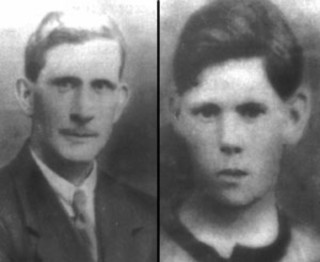
The Murders of Patrick & Harry Loughnane

Brothers Patrick and Harry Loughnane, both members of the Irish Republican Army (IRA), are abducted and killed by Black and Tans at Kinvara, County Galway on November 26, 1920.

County Galway sees its share of controversial incidents during the Irish War of Independence. Most of these incidents are carried out by Crown Forces, specifically the Royal Irish Constabulary (RIC) and a new force, the Auxiliaries, created in order to help the RIC in dealing with militant republicanism.

Patrick Loughnane, aged 29, is a local IRA leader and Sinn Féin secretary. He was also active in the local Gaelic Athletic Association (GAA). His younger brother Harry, aged 22, is president of the local Sinn Féin club and a goalkeeper with Beagh Hurling Club.

While working on the family farm in Shanaglish, County Galway, the two brothers are arrested by the Auxiliaries. Not a word is heard from the boys until a week after their arrest when a group of Auxiliaries call Mrs. Loughnane to inform her that her sons had escaped capture. This raises fear and suspicion among the brothers’ family and friends and a search is organised. Ten days after they had been arrested, their bodies are found in a muddy pond near Ardrahan.

Exactly what happened to the two brothers will never be known, however, witnesses, including others arrested at the same time tell a tale of merciless brutality. After being arrested the brothers are beaten for hours in Gort Bridewell and then tied to the tailgate of a lorry, bound to each other, and dragged along the roads to Drumharsna Castle, the headquarters of the Black and Tans, where they are beaten again. At 11:00 PM that night they are taken from Drumharsna Castle to Moy O’Hynes wood where they are shot. Witnesses recount on Saturday morning, Harry is still alive and is heard moaning. On Sunday morning, the Auxiliaries take the bodies to Umbriste near Ardrahan where they are set on fire. After failing to bury the bodies because of the rocky ground they throw them into a muddy pond and, to make their discovery more difficult, throw dirty oil into the water.

After the bodies are discovered, they are examined by a local doctor. The letters “IV” are carved into the charred flesh in several places, two of Harry’s fingers are missing, his right arm is broken and hung over his shoulder. Both of Patrick’s legs and wrists are broken. The doctor believes it possible that hand grenades had been put into their mouths and exploded.

A memorial to the two brothers is later built on the spot where they died.

(From: Stair na hÉireann | History of Ireland, http://www.stairnaheireann.net)


Leave a comment

Republican Prisoner Denny Barry Dies on Hunger Strike

Irish Republican prisoner Denis “Denny” Barry dies on hunger strike in Newbridge internment camp on November 20, 1923, shortly after the Irish Civil War.

Barry is born into a farming family in Riverstick, ten miles south of Cork city, on July 15, 1883. He enjoys Gaelic culture and sport and is a prominent member of the Ballymartle hurling club. He later joins the famous Blackrock National Hurling Club where he wins four senior county championships in a row during the years of 1910 to 1913.

In 1913, Barry joins the newly formed Irish Volunteers. He is a member of the first Cork brigade and has been politically active in Sinn Féin. In 1915, he moves to Kilkenny to take up employment there, where he continues his volunteer activities. Shortly after the Easter Rising in 1916, he is arrested in Kilkenny in a British Government crackdown and sent to Frongoch internment camp in North Wales. In 1917 he becomes election agent for W. T. Cosgrave in the Kilkenny by-election, one in which Cosgrave is successfully elected. However, just six years later he finds himself imprisoned by Cosgrave’s own government.

In 1922 Barry is imprisoned in Newbridge camp in Kildare and takes part in the hunger strike of 1923. On November 20, 1923, after 34 days protesting against the harsh regime and undignified conditions, he dies but even in death he is still refused dignity.

Barry’s body is not released to his family and is instead, on the orders of Minister of Defence, Richard Mulcahy, buried in the grounds of Newbridge internment camp. The Barry family takes legal action against this and eventually receives the body, but this is not the last of their troubles.

Upon their arrival in Cork with Barry’s body, the Bishop of Cork, Daniel Cohalan, instructs his priests not to allow Barry’s funeral in any church. Ironically just a few short years before, Bishop Cohalan had been a strong vocal supporter of Terence MacSwiney, Sinn Féin Lord Mayor of Cork, who died on hunger strike in Brixton Prison.

Shortly after MacSwiney’s death, Bishop Cohalan’s attitude towards the Irish Republican Army (IRA) changes and he issues a decree condemning the IRA in which he states, “Anyone who shall within the diocese of Cork organise or take part in an ambush or in kidnapping or otherwise, shall be guilty of murder or attempted murder and shall incur by the very fact the censure of excommunication.”

On December 10, 1922, Bishop Cohalan preaches publicly his support for the Anglo-Irish Treaty which establishes the Irish Free State, and he urges his flock to do the same. This leads to an even greater wedge between the Catholic Church and many IRA members, yet it is the incident with Barry that seriously taints the Bishop of Cork and the Catholic Church in republican eyes.

Because of Bishop Cohalan’s stern objection to Barry’s body being permitted into a Catholic church, his body has to lay in state in the Cork Sinn Féin headquarters on the Grand Parade in Cork city. He is then taken in a funeral procession to St. Finbarr’s Cemetery where he is buried in the Republican plot next to Terence MacSwiney, whose funeral Bishop Cohalan had presided over three years previously. In place of a priest is David Kent, Sinn Féin Teachta Dála for Cork and brother of Thomas Kent, who was executed for his part in the 1916 Rising. Kent gives an oration, recites the Rosary and sprinkles holy water on the grave.

On November 28, 1923, the day Barry is buried, Bishop Cohalan sends an open letter to The Cork Examiner publicly denying a Christian burial for Barry and urging all men of the cloth to stay away from any such attempts for such a funeral. He goes so far as to write to the Bishop of Kildare and Leighlin, Dr. Patrick Foley, to enquire about Barry getting the last sacraments. Barry did indeed receive the last rites from a Fr. Doyle who was serving as prison chaplain, and this does not impress the Bishop of Cork.

Barry’s funeral precession through Cork City draws massive crowds with people from all walks of Cork’s political, social and sporting life attending to pay their respects to this man who had been at the heart of the revolution in Cork during the last decade of his life. The IRA, Cumann na mBan and Na Fíanna Éireann march in military formations with the funeral party.

Two days after Barry’s death another IRA prisoner, Andrew O’Sullivan, from Cork dies and the strike is called off the following day. Women prisoners are then released while men remain in prison until the following year.

A memorial to Barry is unveiled in Riverstick in 1966.


Leave a comment

Body of Jack Lynch Moved to Church of St. Paul of the Cross

On October 21, 1999, President Mary McAleese leads mourners at the removal of the body of former Taoiseach and Fianna Fáil leader, Jack Lynch, from Dublin’s Royal Hospital, where he had died the previous day, to the Church of St. Paul of the Cross, Mount Argus.

Jack Lynch, in full John Mary Lynch, is born on August 15, 1917, in Cork, County Cork. He serves as Taoiseach of Ireland from 1966 to 1973 and from 1977 to 1979.

Lynch studies law and enters the civil service with the Department of Justice in 1936. He eventually decides on a legal career, is called to the bar in 1945, resigns from the civil service, and practices on the Cork circuit. He already enjoys a national reputation as a sports hero as he had won five All-Ireland medals as a Cork hurler and another as a footballer.

Lynch joins Fianna Fáil and wins a seat in Dáil Éireann, the lower house of the Oireachtas, in 1948. He works closely with Éamon de Valera in opposition (1948–51), and de Valera appoints him a Parliamentary Secretary in 1951–1954, Minister for the Gaeltacht in 1957, and Minister for Education in 1957–1959. When Seán Lemass succeeds de Valera as Taoiseach in 1959, he makes Lynch Minister for Industry and Commerce and in 1965–1966 Minister for Finance.

Lemass’s retirement in 1966 causes an internal party conflict over the succession that leads to Lynch’s selection as a compromise candidate, a position he reluctantly accepts. In November 1966 he becomes leader of Fianna Fáil and Taoiseach. In June 1969 he becomes the only Fianna Fáil leader other than de Valera to win an overall majority in a general election.

In 1969–1973 Lynch plays an important role when civil unrest leads to the collapse of the government of Northern Ireland and poses a threat to the stability of the Irish state. He fires two cabinet ministers who are suspected of involvement in smuggling arms to the Provisional Irish Republican Army (IRA). He also creates a consensus in Irish party politics on a policy of conciliation and cooperation with the British government in seeking a solution to the Northern Ireland problem based on establishing power-sharing between the unionist majority and the Roman Catholic minority.

In 1972 Lynch wins an 83% majority in a referendum on Ireland’s entry into the European Economic Community and, on January 1, 1973, Ireland becomes a member. Although he is defeated in the 1973 Irish general election, he again demonstrates his remarkable popularity at the polls in 1977 when Fianna Fáil wins their largest and their last overall majority. In December 1979, however, discouraged by challenges to his authority from party colleagues, he resigns his leadership and soon after retires from politics. He serves on a number of corporate boards after his retirement.

Lynch dies in the Royal Hospital, Donnybrook, Dublin on October 20, 1999, at the age of 82. He is honoured with a state funeral which is attended by the President Mary McAleese, Taoiseach Bertie Ahern, former Taoisigh John Bruton, Albert Reynolds and Charles Haughey, and various political persons from all parties. The coffin is then flown from Dublin to Cork where a procession through the streets of the city draws some of the biggest crowds in the city’s history. Following the Requiem Mass celebrated in his home parish of the Cathedral of St. Mary and St. Anne, his friend and political ally, Desmond O’Malley, delivers the graveside oration, paying tribute to Lynch’s sense of decency. He is buried in St. Finbarr’s Cemetery, Cork.