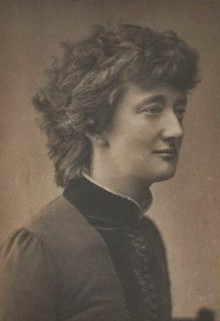
In the 1890s Stopford Green becomes interested in Irish history and the nationalist movement as a result of her friendship with John Francis Taylor. She is vocal in her opposition to English colonial policy in South Africa during the Boer Wars and supports Roger Casement‘s Congo Reform movement. Her 1908 book The Making of Ireland and its Undoing argues for the sophistication and richness of the native Irish civilisation. She is active in efforts to make the prospect of Home Rule more palatable to Ulster Unionists. She is closely involved in the Howth gunrunning.
Stopford Green moves to Dublin in 1918 where her house at 90 St. Stephen’s Green becomes an intellectual centre. She supports the pro-Treaty side in the Irish Civil War and is among the first nominees to the newly formed Seanad Éireann in 1922, where she serves as an independent member until her death in Dublin on May 28, 1929, two days shy of her 82nd birthday. She is one of four women elected or appointed to the first Seanad in 1922.
Vicars is born on July 27, 1862 in Leamington Spa, Warwickshire, England, and is the youngest child of Colonel William Henry Vicars of the 61st Regiment of Foot and his wife Jane (nee Gun-Cunninghame). This is his mother’s second marriage, the first being to Pierce O’Mahony by whom she has two sons. He is very attached to his Irish half-brothers and spends much time at their residences. On completing his education at Magdalen College School, Oxford and Bromsgrove School he moves permanently to Ireland.
Vicars quickly develops an expertise in genealogical and heraldic matters and makes several attempts to be employed by the Irish heraldic administration of Ulster King of Arms, even offering to work for no pay. In 1891 he is one of the founder members of the County Kildare Archaeological Society and remains its honorary secretary until his death.
Vicars first attempts to find a post in the Office of Arms when in 1892 he applies unsuccessfully for the post of Athlone Pursuivant on the death of the incumbent, Bernard Louis Burke. In a letter dated October 2, 1892 his half-brother Pierce Mahony writes that Sir Bernard Burke, Ulster King of Arms, is dying and urges him to move at once. Burke dies in December 1892, and Vicars is appointed to the office by letters patent dated February 2, 1893. In 1896 he is knighted, in 1900 he is appointed Commander of the Royal Victorian Order (CVO) and in 1903 he is elevated to Knight Commander of the Order (KCVO). He is also a fellow of the Royal Society of Antiquaries of Ireland and a trustee of the National Library of Ireland.
In 1897 Vicars publishes An Index to the Prerogative Wills of Ireland 1536 -1810, a listing of all persons in wills proved in that period. This work becomes very valuable to genealogists after the destruction of the source material for the book in 1922 when the Public Record Office at the Four Courts is destroyed at the start of the Irish Civil War.
Vicars’ career is very distinguished until 1907 when it is hit by the scandal of the theft of the Irish Crown Jewels. As Registrar of the Order of St. Patrick, he has custody of the insignia of the order, also known as the “crown jewels.” They are found to be missing on July 6, and a Crown Jewel Commission is established in January 1908 to investigate the disappearance. Vicars and his barrister Tim Healy refuse to attend the commission’s hearings. The commission’s findings are published on January 25, 1908 and he is dismissed as Ulster five days later.
On November 23, 1912, the Daily Mail publishes serious false allegations against Vicars. The substance of the article is that Vicars had allowed a woman reported to be his mistress to obtain a copy of the key to the safe and that she had fled to Paris with the jewels. In July 1913 he successfully sues the paper for libel. The paper admits that the story is completely baseless and that the woman in question does not exist. He is awarded damages of £5,000.
Vicars leaves Dublin and moves to Kilmorna, near Listowel, County Kerry, the former seat of one of his half-brothers. He marries Gertrude Wright in Ballymore, County Westmeath on July 4, 1917. He continues to protest his innocence until his death, even including bitter references to the affair in his will.
In May 1920 up to a hundred armed men break into Kilmorna House and hold Vicars at gunpoint while they attempt to break into the house’s strongroom. On April 14, 1921, he is taken from Kilmorna House, which is set afire, and shot dead in front of his wife. According to the communiqué issued from Dublin Castle, thirty armed men took him from his bed and shot him, leaving a placard around his neck denouncing him as an informer. On April 27, as an official reprisal, four shops are destroyed by British Armed Forces in the town of Listowel. The proclamation given under Martial law and ordering their demolition states:
“For any outrage carried out in future against the lives or property of loyalist officials, reprisals will be taken against selected persons known to have rebel sympathies, although their implication has not been proved.”
Kathleen Daly is born into a prominent Fenian family, the third daughter of Edward and Catherine Daly. Her paternal uncle, John Daly, is at the time imprisoned for his political activities in Chatham and Portland Prisons in England. He is released in 1896 and returns home to Limerick. When Tom Clarke, who had been imprisoned with her uncle, is released in 1898 he travels to Limerick to receive the Freedom of the City and stays with the Daly family.
In 1901 Daly decides to emigrate to the United States to join Tom, who had been there since 1900, having secured work through his Fenian contacts. They marry on July 16, 1901, in New York City. Through his contacts in the Clan na Gael and the Irish Republican Brotherhood (IRB), Tom Clarke continues to be involved in nationalist activity. Kathleen joins the Gaelic League while in the United States and they return to Ireland in November 1907.
In 1914 Clarke becomes a founder member of Cumann na mBan. Her husband forbids her permission to take an active part in the 1916 Easter Rising as she has orders regardless of how the events pan out. As Tom Clarke is the first signatory of the Proclamation of the Irish Republic, he is chosen to be executed for his part in the Easter Rising. Her younger brother, Ned Daly, is also executed for taking part in the rising. She visits both of them before they are executed. After the Rising, Michael Collins establishes contact with her while in prison in his attempts to re-build the IRB network. She also sets up the Irish National Aid Fund to aid those who had family members killed or imprisoned as a result of the Easter Rising, closely aided by Sorcha MacMahon.
Clarke becomes a member of Sinn Féin and in 1917 is elected a member of the party’s Executive. During the German Plot she is arrested and imprisoned in Holloway Prison for eleven months. During the Irish War of Independence, she serves as a District Judge on the Republican Courts in Dublin. In 1919 she is elected as an Alderman for the Wood Quay and Mountjoy Wards of Dublin Corporation and serves until the Corporation is abolished in 1925.
Clarke is elected unopposed as a Sinn Féin TD to the Second Dáil at the 1921 elections for the Dublin Mid constituency. She is not re-elected at the 1922 general election, however, and supports the Anti-Treaty forces during the Irish Civil War. In 1926 she becomes a founder member of Fianna Fáil and has to resign from Cumann na mBan. She is re-elected to the short-lived 5th Dáil at the June 1927 election as a Fianna Fáil member for the Dublin Mid constituency but loses her seat at the September 1927 election and does not regain it. She is elected as one of six Fianna Fáil Senators to the Free State Seanad for nine years at the 1928 Seanad election under the leadership of Joseph Connolly. She remains a member of the Seanad until it is abolished in 1936.
In 1930 Clarke is elected to the re-constituted Dublin Corporation for Fianna Fáil along with Robert Briscoe, Seán T. O’Kelly, Thomas Kelly and Oscar Traynor. She serves as the first Fianna Fáil Lord Mayor of Dublin as well as the first female Lord Mayor, from 1939 to 1941. She opposes the Constitution of Ireland as she feels that several of its sections would place women in a lower position that they had been afforded in the Proclamation of the Irish Republic. She is criticised by many in the Fianna Fáil organisation as a result and, while she resigns from the Thomas Clarke Cumann, she remains a member of the Fianna Fáil Ard Chomhairle.
While Clarke does not support the Irish Republican Army (IRA) bombing in England during World War II, she appeals for those sentenced to death by the Irish Government to be given clemency. Ultimately this leads to her breaking with the party completely after her term as Lord Mayor finishes in 1941. She declines to stand as a Fianna Fáil candidate at the 1943 general election.
Gifford is the second youngest of 12 children born to Frederick Gifford, a solicitor and a Roman Catholic, and Isabella Julia Burton Gifford, a Protestant. The boys are baptised as Catholics and the girls as Protestant, but effectively the children are all raised as Protestants with the girls attending Alexandra College in Earlsfort Terrace.
Gifford returns to Dublin in 1908 and, with great difficulty, tries to earn a living as a caricaturist, publishing her cartoons in The Shanachie, Irish Life, Meadowstreet and The Irish Review, which is edited from 1913 by Joseph Plunkett. She considers emigrating but gives up the idea. Nora Dryhurst, a journalist from London, brings her to the opening of the new bilingual school Scoil Éanna in Ranelagh, Dublin. It is here that she meets Plunkett for the first time. He is a friend of her brother-in-law, another of the future leaders of the 1916 Easter Rising, Thomas MacDonagh, who is married to her sister Muriel.
Gifford’s growing interest in the Roman Catholic religion leads to the deepening of Gifford and Plunkett’s relationship as she begins to discuss Catholic mystical ideas with him. Plunkett proposes to her in 1915, and she accepts and takes formal instruction in Catholic doctrine. She is received into the Catholic Church in April 1916. The couple plans to marry on Easter Sunday that year, in a double wedding with his sister and her fiancé.
After the Rising, Gifford’s brother-in-law Thomas MacDonagh is shot with Patrick Pearse and Thomas Clarke by firing squad on May 3. That day, she hears that Plunkett is to be shot at dawn. She purchases a ring in a jeweler’s shop in Dublin and, with the help of a priest, persuades the military authorities to allow them to marry. She and Joseph are married on the night of May 3 in the chapel of Kilmainham Gaol, a few hours before he is executed.
Grace Plunkett decides to devote herself through her art to the promotion of Sinn Féin policies and resumes her commercial work to earn a living. She is elected to the Sinn Féin executive in 1917.
During the Irish Civil War, Plunkett is arrested with many others in February 1923 and interned at Kilmainham Gaol for three months. She paints pictures on the walls of her cell, including one of the Blessed Virgin and the Christ Child. She is released in May 1923.
When the Civil War ends, Plunkett has no home of her own and little money. Like many Anti-Treaty Republicans, she is the target of social ostracism and has difficulty finding work. Her talent as an artist is her only real asset and her cartoons are published in various newspapers and magazines. She moves from one apartment to another and eats in the city-centre restaurants but has no wish to remarry. Her material circumstances improve in 1932 when she receives a Civil List pension from Éamon de Valera‘s Fianna Fáil government. She lives for many years in a flat in Nassau Street with a balcony overlooking the sports ground of Trinity College.
Plunkett’s in-laws refuse to honour her husband’s will, in which he leaves everything to his widow. Legally, the will is invalid because there is only one witness, rather than the required two, and the marriage takes place after the will is made, automatically revoking it. For years she receives nothing, so she begins legal proceedings against her in-laws in 1934. The Count and Countess Plunkett settle out of court, and she is paid £700, plus costs.
At around this time Plunkett joins the Old Dublin Society, where she meets the noted Irish harpsichord maker Cathal Gannon. When Cathal marries, she gives him and his wife Margaret a present of two single beds and a picture. From the late 1940s onwards, her health declines. In 1950 she is brought to St. Vincent’s Hospital. She convalesces in a nursing home, which she does not like, mainly because it restricts her freedom.
Grace Gifford Plunkett dies suddenly on December 13, 1955, in her apartment in South Richmond Street, Portobello. Her body is removed to St. Kevin’s Church, Harrington Street and among the attendees at her funeral is PresidentSeán T. O’Kelly. She is buried with full military honours close to the republican plot in Glasnevin Cemetery.
The first regiment of the Irish National Army, sometimes unofficially referred to as the Free State army or the Regulars, is set up in Dublin on January 31, 1922.
Conflict arises between the National Army and the anti-Treaty components of the IRA, which does not support the government of the Irish Free State. On June 28, 1922, the National Army commences an artillery bombardment of anti-Treaty IRA forces who are occupying the Four Courts in Dublin, thus beginning the Irish Civil War.
The National Army is greatly expanded in size to fight the civil war against the anti-Treaty IRA, in a mostly counter-insurgency campaign that is brought to a successful conclusion in May 1923. From October 1, 1924, the Army is reorganised into a smaller, better regulated force. The term “National Army” is superseded by the legal establishment of the Defence Forces as the Irish Free State’s military force.
Molony is born in Dublin on January 15, 1883, to Michael Molony, a grocer, and Catherine McGrath. Her mother dies early in her life. Her father later remarries, but both became alcoholics, something which influences her years later.
Molony is central to the school meals activism of the movement. With Maud Gonne, Marie Perolz and others, she organises the supply of daily school meals to children in impoverished areas, and pressures Dublin Corporation and other bodies to provide proper meals to the starved children of Dublin city.
Molony also has a career as an actress and is a member of the Abbey Theatre. However, her primary commitment is to her political work. She is a strong political influence, credited with bringing many into the movement, including Constance Markievicz and Dr. Kathleen Lynn.
As a labour activist, Molony is a close colleague of Markievicz and of James Connolly. In November 1915 Connolly appoints her secretary of the Irish Women Workers’ Union, in succession to Delia Larkin. This union had been formed during the strike at Jacob’s Biscuit Factory that was part of the 1913 Dublin lock-out. She manages the union’s shirt factory in Liberty Hall, founded to give employment to the strikers put out of work and blacklisted after the strike. She is friendly with the family of Thomas MacDonagh and his wife, Muriel, and is the godmother of their daughter Barbara, whose godfather is Patrick Pearse.
Fianna Éireann, the cadet body of the Irish Volunteers, is founded by Constance Markievicz in Molony’s home at 34 Lower Camden Street, Dublin, on August 16, 1909. Markievicz works closely with Molony and Bulmer Hobson in organising the fledgling Fianna. It is during this period of working together in building the Fianna that Molony and Hobson grow close and became romantically linked. However, the relationship does not last.
Molony is a prominent member of Cumann na mBan, the republican women’s paramilitary organisation formed in April 1914 as an auxiliary of the Irish Volunteers. Members of Cumann na mBan train alongside the men of the Irish Volunteers in preparation for the armed rebellion against the English forces in Ireland.
During the 1916 Easter Rising, Molony is one of the Citizen Army soldiers who attacks Dublin Castle. During the defence of City Hall, her commanding officer, Sean Connolly, is killed and she is captured and imprisoned until December 1916.
After the Irish Civil War, Molony becomes the second female president of the Irish Trades Union Congress. She remains active in the republican cause during the 1930s, particularly with the Women’s Prisoner’s Defense League and the People’s Rights Association.
Molony retires from public life in 1946 but continued to work for women’s labour rights. She dies in Dublin on January 28, 1967.
Under the Irish Republic‘s Dáil Constitution adopted in 1919, Dáil Éireann continues to exist after it has ratified the Anglo-Irish Treaty. In protest at the ratification, Éamon de Valera resigns the presidency of the Dáil then seeks re-election from among its members in order to clarify his mandate, but Arthur Griffith defeats him in the vote and assumes the presidency.
The Provisional Government takes office two days later on January 16, 1922, when British administration hands over Dublin Castle to Collins in person. At this time, Westminster has not formally appointed the new Irish ministers or conferred their government with any powers.
The handover of Dublin Castle to the Provisional Government is one of the earliest and most remarkable events in the short life of the Provisional Government. For centuries Dublin Castle is the symbol, as well as the citadel, of British rule in Ireland. The transfer of its Castle administration to the representatives of the Irish people is greatly welcomed in Dublin. It is regarded as a significant outward and visible sign that British rule is ending.
By mid-1922, Collins in effect lays down his responsibilities as Chairman of the Provisional Government to become Commander-in-Chief of the Irish Army, a formal structured uniformed army that forms around the pro-Treaty Irish Republican Army (IRA). As part of those duties, he travels to his native County Cork. En route home on August 22, 1922, at Béal na Bláth, he is killed in an ambush. Arthur Griffith dies of a cerebral haemorrhage ten days prior to Collins’ assassination. After Collins’ and Griffith’s deaths in August 1922, W. T. Cosgrave becomes both Chairman of the Provisional Government and President of Dáil Éireann, and the distinction between the two posts becomes irrelevant.
(Pictured: The Provisional Government of Ireland with President Arthur Griffith (front row center) and his cabinet and party includng Michael Collins (to Griffith’s right) likely taken at the Mansion House in February 1922)
Seven Republican fighters, all from County Kildare, are executed in the Glasshouse in the Curragh Camp on December 19, 1922. The Glasshouse is a small stone and brick military prison where the military usually houses their own prisoners. It consists of two floors enclosed within a twelve foot high walled enclosure with cells for 64 prisoners. During the Irish Civil War, and afterwards, it is used as a punishment block for Republican prisoners.
The seven, Patrick Bagnall, Patrick Mangan, Joseph Johnston, Bryan Moore, Patrick Nolan, Stephen White and James O’ Connor, are all veteran Irish Republican Army (IRA) men and belong to a column of ten which operates against railways, goods trains and some shops in the vicinity of Kildare. Five of them are involved in the derailment of engines at Cherryville on December 11 when they make a serious attempt to dislocate the whole railway service on the Great Southern and Western Railway. Two engines are taken out of a shed at Kildare and sent down the line by Cherryville. One engine runs out of steam and does no harm, while the other overturns and blocks the line for a considerable time.
The column is also responsible for an ambush on National troops at the Curragh Siding on November 23 when a large party of troops are returning to Dublin after escorting prisoners to the Curragh Camp. On their return journey the troops are fired on at the Curragh Siding and two are wounded. In the confusion a policeman is accidentally shot by a National soldier.
The seven, along with Commandant Thomas Behan, are found in a dug-out at Mooresbridge, on the edge of the Curragh, on the night of December 13. They are under the command of Commandant Bryan Moore, a veteran IRA officer, and comprise a section of the 6th Battalion Column. They are armed with rifles bought from a soldier stationed in Naas Barracks.
When they surrender, Behan is struck with a rifle butt, breaking his arm. When the captives are ordered into the back of a truck he cannot climb aboard because of his arm. He is struck again on the head with a rifle butt and dies at the scene.
The remaining seven men are charged before a Military Committee with being in possession, without proper authority, of ten rifles, 200 rounds of ammunition, four bomb detonators and one exploder. They are found guilty and sentenced to death. Father Donnelly, chaplain to the troops, administers to the seven volunteers before their executions. They are executed one by one by firing squad on the morning of December 19 and are buried in the yard adjacent to the Glasshouse.
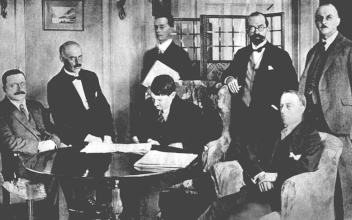
The Anglo-Irish Treaty, commonly known as The Treaty and officially the Articles of Agreement for a Treaty Between Great Britain and Ireland, is signed in the early morning hours of December 6, 1921 by representatives of the Irish government appointed by PresidentÉamon de Valera and those negotiating for the government of the United Kingdom of Great Britain and Ireland, ending the Irish War of Independence against Great Britain. It is then, and remains, one of the most debated moments in Irish history.
The Treaty provides for the establishment of the Irish Free State within a year as a self-governing dominion within the “community of nations known as the British Empire“, a status “the same as that of the Dominion of Canada.” It also provides Northern Ireland, which had been created by the Government of Ireland Act 1920, an option to opt out of the Irish Free State, which it exercises.
The agreement is signed in London by representatives of the British government, which includes Winston Churchill and Prime MinisterDavid Lloyd George, who are old masters at the game of politics, and by representatives of the Irish Republic including Michael Collins and Arthur Griffith, who have nowhere near the political acumen of the British delegation. De Valera, a shrewd, experienced politician, may have been the only man in all of Ireland who might have matched them, but he refuses to join the negotiations.
The Irish representatives have plenipotentiary status acting on behalf of the Irish Republic, though the British government declines to recognise that status. As required by its terms, the Treaty is approved by “a meeting” of the members elected to sit in the House of Commons of Southern Ireland and separately by the British Parliament. In reality, Dáil Éireann, the legislative assembly for the de facto Irish Republic, first debates then approves the treaty. Members then proceed with the “meeting.” Though the Treaty is narrowly approved, the split leads to the Irish Civil War, which is won by the pro-treaty side.
The Irish Free State as contemplated by the Treaty comes into existence when its constitution becomes law on December 6, 1922 by a royal proclamation.
(Pictured: Michael Collins signs the Anglo-Irish Treaty on December 6, 1921)
Carney is educated at St. Patrick’s Christian Brothers School in Donegall Street in Belfast, later teaching at the school. She enrolls at Hughes Commercial Academy around 1910, where she qualifies as a secretary and shorthand typist, one of the first women in Belfast to do so. However, from the start she is looking towards doing more than just secretarial work.
In 1912 Carney is in charge of the women’s section of the Northern Ireland Textile Workers’ Union in Belfast, which she founds with Delia Larkin in 1912. During this period, she meets James Connolly and becomes his personal secretary. She becomes Connolly’s friend and confidant as they work together to improve the conditions for female labourers in Belfast. Carney then joins Cumann na mBan, the women’s auxiliary of the Irish Volunteers, and attends its first meeting in 1914.
Carney is present with Connolly in Dublin‘s General Post Office (GPO) during the Easter Rising in 1916. She is the only woman present during the initial occupation of the building. While not a combatant, she is given the rank of adjutant and is among the final group to leave the GPO. After Connolly is wounded, she refuses to leave his side despite direct orders from Patrick Pearse and Connolly. She leaves the GPO with the rest of the rebels when the building becomes engulfed in flames. They make their new headquarters in nearby Moore Street before Pearse surrenders.
After her capture, Carney is held in Kilmainham Gaol before being moved to Mountjoy Prison and finally to an English prison. By August 1916 she is imprisoned in HM Prison Aylesbury alongside Nell Ryan and Helena Molony. The three request that their internee status be revoked so that they could be held as normal prisoners with Countess Markievicz. Their request is denied, however Carney and Molony are released two days before Christmas 1916.
Following the Irish Civil War, Carney becomes much more disillusioned with politics. She is very critical and outspoken of Éamon de Valera and his governments.
In 1928 she marries George McBride, a Protestant Orangeman and former member of the Ulster Volunteers. Ironically, the formation of the Ulster Volunteers prompts the formation of the Irish Volunteers, of which Carney was a member. She alienates anyone in her life that does not support her marriage to McBride.
A number of serious health problems limit Carney’s political activities in the late 1930s. She dies in Belfast on November 21, 1943, and is buried in Milltown Cemetery. Her resting place is located years later, and a headstone is erected by the National Graves Association, Belfast. Because she married a Protestant and former Orangeman, she is not allowed to have his name on her gravestone due to the religious differences.
In 2013, the Seventieth Anniversary of Carney’s death is remembered by the Socialist Republican Party. Almost one hundred people attend as a short parade follows, marking and commemorating the work she did for the cause. She is placed in high esteem among the other hundreds of radical women, who stand up for what they believe in, regardless of the consequences they face.





 The
The 
 seamus dubhghaill