seamus dubhghaill

Promoting Irish Culture and History from Little Rock, Arkansas, USA


Leave a comment

Laying of the Foundation Stone of Parliament House

parliament-house

The foundation stone of Parliament House in College Green is laid on February 3, 1729, by Thomas Wyndham, 1st Baron Wyndham, the Lord Chancellor of Ireland. Parliament House is initially home to the Parliament of Ireland and later houses the Bank of Ireland. It is the world’s first purpose-built bicameral parliament house. The current parliament building is Leinster House.

The building is home to the two Houses of Parliament, serving as the seat of both chambers, the House of Lords and House of Commons, of the Parliament of the Kingdom of Ireland for most of the 18th century until that parliament is abolished by the Acts of Union 1800, when Ireland becomes part of the United Kingdom of Great Britain and Ireland.

In the 17th century, parliament settles at Chichester House, a town house in Hoggen Green (later College Green) formerly owned by Sir George Carew, Lord President of Munster and Lord High Treasurer of Ireland, which had been built on the site of a nunnery disbanded by King Henry VIII at the time of the dissolution of the monasteries. Carew’s house, named Chichester House after its later owner Sir Arthur Chichester, is a building of sufficient importance to have become the temporary home of the Kingdom of Ireland’s law courts during the Michaelmas law term in 1605. Most famously, the legal documentation facilitating the Plantation of Ulster is signed there on November 16, 1612.

Chichester House is in a dilapidated state, allegedly haunted and unfit for official use. In 1727 parliament votes to spend £6,000 on a new building on the site. It is to be the world’s first purpose-built two-chamber parliament building.

The then ancient Palace of Westminster, the seat of the English before 1707 and, later, British Parliament, is a converted building. The House of Commons‘s odd seating arrangements is due to the chamber’s previous existence as a chapel. Hence MPs face each other from former pews.

The design of the new building, one of two purpose-built Irish parliamentary buildings (along with Parliament Buildings, Stormont), is entrusted to an architect, Edward Lovett Pearce, who is a member of parliament and a protégé of the Speaker of the Irish House of Commons, William Conolly of Castletown House. During construction, Parliament moves into the Blue Coat Hospital on Dublin‘s Northside.

The original, domed House of Commons chamber is destroyed by fire in the 1790s, and a less elaborate new chamber, without a dome, is rebuilt in the same location and opened in 1796, four years before the Parliament’s ultimate abolition.

Pearce’s designs come to be studied and copied both at home and abroad. The Viceregal Apartments in Dublin Castle imitate his top-lit corridors. The British Museum in Bloomsbury in London copies his colonnaded main entrance. His impact reaches Washington, D.C., where his building, and in particular his octagonal House of Commons chamber, is studied as plans are made for the United States Capitol building. While the shape of the chamber is not replicated, some of its decorative motifs are, with the ceiling structure in the Old Senate Chamber and old House of Representatives chamber (now the National Statuary Hall) bearing a striking resemblance to Pearce’s ceiling in the House of Commons.

(Pictured: Architectural drawing of the front of Parliament House by Peter Mazell based on the drawing by Rowland Omer, 1767)


Leave a comment

Birth of Lionel Cranfield Sackville, Lord Lieutenant of Ireland

lionel-cranfield-sackville

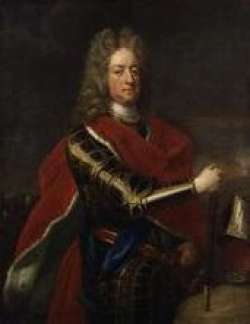
Lionel Cranfield Sackville, 1st Duke of Dorset, English political leader and Lord Lieutenant of Ireland, is born in Dorset, United Kingdom on January 18, 1688.

Sackville is the son of Charles Sackville, 6th Earl of Dorset and 1st Earl of Middlesex, and the former Lady Mary Compton, younger daughter of James Compton, 3rd Earl of Northampton. Styled Lord Buckhurst from birth, he succeeds his father as 7th Earl of Dorset and 2nd Earl of Middlesex in 1706 and is created Duke of Dorset in 1720.

Perhaps because he had been on a previous diplomatic mission to Hanover, Sackville is chosen to inform George I of his accession to the Crown in August 1714. George I initially favours him and numerous offices and honours are given to him: Privy Councillor, Knight of the Garter, Groom of the Stool, Lord Steward, Governor of Dover Castle and Lord Warden of the Cinque Ports. At George I’s coronation he carries the sceptre. At the coronation of George II, he is Lord High Steward and carries St. Edward’s Crown. He quarrels with the King in 1717 and is told his services are no longer required, but he is made a Duke three years later.

Sackville serves twice as Lord Lieutenant of Ireland, from 1731 to 1737 and again from 1751 to 1755. In 1739, at the foundation of the Foundling Hospital, he is one of that charity’s original governors. His first term as Lord Lieutenant is uneventful. His second takes place at a time of acute political tension between the two main factions in the Irish Government, one led by Henry Boyle, the Speaker of the Irish House of Commons, the other by George Stone, the Anglican Archbishop of Armagh. Sackville, now heavily influenced by his son George Sackville, makes the mistake of openly backing the archbishop. He is unable to oust Boyle from power and is accused of being the archbishop’s tool. He becomes extremely unpopular, leading to his eventual recall.

Sackville’s last years are uneventful, apart from a riot in 1757 caused by the passage of the Militia Act to raise an army for the Seven Years’ War, in which he narrowly escapes injury. He dies at Knole, a country house in west Kent, on October 9, 1765, and is buried at Withyham in East Sussex.

(Pictured: Oil on canvas Portrait of Lionel Sackville, 1st Duke of Dorset (1688-1765) by Godfrey Kneller (1646-1723), 1719, currently displayed at Commonwealth Secretariat, Marlborough House, London)


Leave a comment

Execution of Thomas Russell, United Irishmen Co-founder

thomas-russell

Thomas Paliser Russell, co-founder and leader of the Society of United Irishmen, is executed for his part in Robert Emmet‘s rebellion on October 21, 1803.

Born in Dromahane, County Cork to an Anglican family, Russell joins the British army in 1783 and serves in India. He returns to Ireland in 1786 and commences studies in science, philosophy and politics. In July 1790 he meets Theobald Wolfe Tone in the visitors’ gallery in the Irish House of Commons and they become firm friends.

In 1790 Russell resumes his military career as a junior officer in the 64th Regiment of Foot and is posted to Belfast. The French Revolution in 1789 is warmly greeted in Belfast as are its ideals of liberty, equality, and fraternity. With his keen mind and radical ideas, Russell soon becomes a confidante of Henry Joy McCracken, James Hope, Samuel Neilson and others who are to play a prominent role in the United Irish movement. With them he develops ideas of parliamentary reform, to include the bulk of the people, and Catholic emancipation.

Russell leaves the army in July 1791 and attends a convention of the Whig Club in Belfast to mark Bastille Day. The convention is addressed by William Drennan, who proposes a brotherhood promoting separation from England and co-operation with the increasingly radical Cisalpine Club in the pursuit of political and social reforms. However, Russell notes the lack of trust between Dissenters and Catholics which is due to fears that Catholic radicalism can be bought off by religious concessions. Informing Wolfe Tone of his observations, within weeks leads to Wolfe Tone’s publication of Argument on Behalf of the Catholics of Ireland to address these suspicions. The pamphlet is extremely well received and provides the impetus for the founding of the Society of United Irishmen in Belfast on October 18, 1791.

Pressure from Dublin Castle later forces the United Irish movement to become a clandestine organisation as the would-be revolutionaries seek to continue their slow progress towards challenging the occupying British.

In 1795 Russell, Andrew Henderson, Henry Joy McCracken and Samuel Neilson lead a band of United Irishmen to the top of Cavehill overlooking the town of Belfast where they swear an oath “never to desist in our effort until we have subverted the authority of England over our country and asserted her independence” prior to Wolfe Tone’s exile to the United States. The event is noted in Dublin Castle although there is no immediate move to disband or arrest the members of the United Irishmen.

In 1796, Russell publishes an ambitious and far-sighted document, Letter to the People of Ireland, which lays out his vision of social and economic reform for the Irish nation. In addition to his stance on religious freedom, he makes clear his anti-slavery views in the Northern Star on March 17, 1792.

Russell takes an active part in organising the Society of United Irishmen becoming the United Irish commander in County Down. However, the outbreak of the French Revolution in 1793 leads to an ongoing campaign against the United Irishmen and in 1796 he is arrested and imprisoned as a “state prisoner” in Dublin. In March 1799 he and the other state prisoners are transferred to Fort George in Scotland, an extensive fortress some miles north of Inverness built in the wake of the failed Jacobite rebellion of 1745-46. He is released on condition of exile to Hamburg in June 1802 following a brief cessation in the war with France.

Not content to sit things out in Hamburg, Russell soon makes his way to Paris where he meets Robert Emmet who is planning another insurrection pending the French renewal of the war against England. He agrees to return to Ireland in March 1803 to organise the North in conjunction with James Hope. However, he meets with little success as much of the north is subdued following the suppression of the Irish Rebellion of 1798 and displays little appetite for a renewed outbreak. Finally, finding some support in the vicinity of Loughinisland, he prepares to take to the field on July 23, 1803, the date set by Emmett.

However, the plan is badly thought out and quickly collapses, forcing Russell to flee to Dublin before a shot is fired in anger. He manages to hide for a number of weeks, but Dublin is a hard place in which to hide in the days following the failure of Emmett’s rebellion as the shocked authorities have launched a massive campaign of raids and arrests in an effort to finally eradicate the United Irishmen.

Thomas Russell is promptly arrested and sent to Downpatrick Gaol where he is executed by hanging then beheaded on October 21, 1803.


Leave a comment

Birth of James Butler, 2nd Earl of Ormond

james-butler-2nd-earl-of-ormond

James Butler, 2nd Earl of Ormond, a noble in the Peerage of Ireland, is born in Kilkenny CastleKilkenny on October 4, 1331. He is Lord Justice of Ireland in 1359, 1364, and 1376, and a dominant political leader in Ireland in the 1360s and 1370s. He is usually called The Noble Earl, being a great-grandson, through his mother, of King Edward I of England.

Butler is the son of James Butler, 1st Earl of Ormond and Lady Eleanor de Bohun. He is given in ward on September 1, 1344 to Maurice FitzGerald, 1st Earl of Desmond for the fine of 2306 marks and afterward to John Darcy, 1st Baron Darcy de Knayth.

On May 15, 1346, Butler marries Elizabeth Darcy, daughter of Sir John Darcy and Joan de Burgh. They have five children: James Butler, 3rd Earl of Ormond (1362-1405), Thomas Butler (1359-1396), Justice of Cork, Eleanor Butler (1350-1392), Joan Butler (1360-1393), and Ralph Butler (1356-1367).

In 1362, Butler slays six hundred of Art Óg Mac Murchadha Caomhánach‘s followers at Tiscoffin in what is now County Kilkenny. On April 22, 1364, he is appointed Lord Deputy of Ireland to Lionel of Antwerp, 1st Duke of Clarence. Clarence, from his first arrival in Ireland, places great trust in him, and for a few years it seems that as Deputy he is almost all-powerful.

In the 1360s Butler clashes with Maurice FitzGerald, 4th Earl of Kildare. In 1364 the Irish House of Commons sends a delegation to England, headed by Kildare, to complain of misgovernment, and to ask for the removal of “corrupt” officials, some of whom have links to Butler. A number of these officials are removed, but Butler’s position is not seriously threatened.

Butler is Lord Justice by July 24, 1376, with a salary of £500 per year, in which office he is continued by King Richard II of England. On April 2, 1372, he is made constable of Dublin Castle, with the fee of £18 5s per year. He is summoned to the Parliaments held by Richard II.

James Butler dies October 18, 1382 at Knocktopher Castle in Kilkenny, Leinster, near which he had founded a priory for Carmelite friars in 1356. He is buried in St. Canice’s Cathedral, Kilkenny.


2 Comments

Birth of Sir Lucius O’Brien, 3rd Baronet

lucius-obrien-3rd-baronet

Sir Lucius Henry O’Brien, 3rd Baronet PC (Ire), Irish baronet and politician for 34 years, is born on September 2, 1731.

O’Brien is the son of Sir Edward O’Brien, 2nd Baronet and his wife Mary Hickman, inheriting the baronetcy upon the death of his father in 1765. He is educated at Trinity College, Dublin and enters the Middle Temple in 1753, later becoming a barrister.

In 1761, O’Brien enters the Irish House of Commons as the member for Ennis, sitting until 1768. Subsequently he successfully runs for Clare, a seat previously held by his father, holding it until 1776. He is then again elected for Ennis, but following the unseating of Hugh Dillon Massy as Member of Parliament for Clare, he returns to represent that constituency in 1778. In the election of 1783, he becomes the representative for Tuam. He is sworn of the Privy Council of Ireland in 1786. He serves for the latter constituency until 1790, when he is re-elected for Ennis. He holds this seat finally until his death on January 15, 1795.

O’Brien is elected a Fellow of the Royal Society in 1773.

O’Brien marries Anne French, the daughter of Robert French, in 1768 and has by her seven children, three sons and four daughters. He is succeeded in the baronetcy as well as in the constituency of Ennis by his oldest son Edward.

O’Brien’s grandson James FitzGerald (1818–1896) is a prominent politician in New Zealand.


Leave a comment

Birth of John Blaquiere, 1st Baron de Blaquiere

john-blaquiere

John Blaquiere, 1st Baron de Blaquiere, British soldier, diplomat and politician of French descent, is born on May 15, 1732. He serves as Chief Secretary for Ireland between 1772 and 1776. He is the fifth son of Jean de Blaquiere, a French merchant who had emigrated to England in 1685, and his wife Marie Elizabeth de Varennes.

Blaquiere at first serves in the Army, in the 18th Dragoons, later renumbered the 17th Dragoons, where he achieves the rank of Lieutenant Colonel. In 1771 he is appointed Secretary of Legation at the British Embassy in Paris, a post he holds until 1772. The latter year Simon Harcourt, 1st Earl Harcourt, the British Ambassador in Paris, is appointed Lord Lieutenant of Ireland, and Blaquiere joins him as Chief Secretary for Ireland. He is admitted to the Privy Council of Ireland the same year and made a Knight Companion of the Order of the Bath two years later.

Blaquiere is to remain Chief Secretary until December 6, 1776. He is elected to the Irish House of Commons for Old Leighlin in 1773, a seat he holds until 1783. After representing Enniskillen for a few months in 1783, he sits then for Carlingford from 1783 to 1790, for Charleville from 1790 to 1798 and for Newtownards from 1798 until the Act of Union comes into force in 1801. He is created a Baronet, of Ardkill in County Londonderry, in 1784, and is raised to the Peerage of Ireland as Baron de Blaquiere, of Ardkill in the County of Londonderry, in 1800, for his support for the Act of Union. Lord de Blaquiere also sits as a Member of the British House of Commons for Rye from 1801 to 1802 and for Downton from 1802 to 1806. He is elected a Fellow of the Royal Society in 1803.

Lord de Blaquiere marries Eleanor, daughter of Robert Dobson, in 1775. They have four sons, including Peter de Blaquière, and three daughters. Lord de Blaquiere dies at the age of 80 in Bray, County Wicklow, on August 27, 1812. He is succeeded in his titles by his eldest son, John. Lady de Blaquiere dies at Regent’s Park, Marylebone, London, in December 1833.


Leave a comment

Joshua Dawson Sells the Mansion House

mansion-house-dublin

On December 25, 1715, Joshua Dawson, Irish public servant, land developer and politician, sells the Mansion House with its gardens and park to Dublin Corporation for £3,500 plus 40 shillings per annum and a “loaf of double refined sugar of six pounds weight” which is to be paid to the Dawsons every Christmas.

Dawson is born in 1660 at the family seat, which becomes Castledawson, County Londonderry, the son of Thomas Dawson, Commissary of the Musters of the Army in Ireland. He resides in County Londonderry and Dublin. His ancestral family had owned land and lived in the area where, in 1710, he founds Dawson’s Bridge, named after the bridge over the River Moyola, which becomes present-day Castledawson. In his estate he builds Moyola House in 1713.

Dawson is appointed clerk to the Chief Secretary of Ireland, Matthew Prior, in 1697. In that role he petitions for the establishment of a Paper & Patent Office. He becomes the Collector of Dublin in 1703, and holds the office of Chief Secretary for Ireland to the Lords Justices from 1710 under Queen Anne. He is a Member of Parliament (MP) in the Irish House of Commons for Wicklow Borough from 1705 to 1714.

Dawson develops an area of Dublin in 1705-1710 which includes the setting out and construction of the streets of Dawson Street, Anne Street, Grafton Street and Harry Street. These streets are named after, respectively, himself, Queen Anne (widow of William III), and Henry FitzRoy, 1st Duke of Grafton, the son of Charles II and cousin of Queen Anne. This development includes the construction of the Mansion House in Dawson Street in 1710 which is purchased in 1715 to be the official residence of the Lord Mayor of Dublin, which it has remained for 300 years.

(Pictured: Mansion House, official residence of the Lord Mayor of Dublin)


Leave a comment

Alan Brodrick Appointed Lord Chief Justice of the Court of Queen’s Bench

alan-brodrick

Alan Brodrick, 1st Viscount Midleton, a leading Anglo-Irish lawyer and politician of the early eighteenth century, is appointed Lord Chief Justice of the Court of Queen’s Bench on December 24, 1709. He is a man of great gifts, but so hot-tempered and passionate that even Jonathan Swift is said to have been afraid of him.

Brodrick is the second son of Sir St. John Brodrick of Ballyannan, near Midleton in County Cork, by his wife Alice, daughter of Laurence Clayton of Mallow, County Cork. His father receives large land grants during The Protectorate, and thus the family has much to lose if the land issue in Ireland is settled to the satisfaction of dispossessed Roman Catholics. He is educated at Magdalen College, Oxford and the Middle Temple, being called to the English bar in 1678. He and his relatives flee Ireland during the Glorious Revolution. They are attainted under the rule of King James II in Ireland. In exile in England, Brodrick argues for a speedy reconquest.

In 1690 Brodrick returns to Dublin and is given the legal office of Third Serjeant. He also becomes Recorder of Cork. He is dismissed as Serjeant in 1692, apparently on the ground that there is no work for him to do. While complaining bitterly about his dismissal, he admits privately that his post has been a superfluous one.

As a prominent Whig supporter of the outcome of the Glorious Revolution he is not always in agreement with court policies in Ireland, which he considers too lenient on the Jacobites. The dismissal of the First Serjeant, John Osborne, at the same time as Brodrick is due to his even stronger opposition to Court policy. Despite this he often holds Irish government offices and aspires to manage the Irish Parliament for English ministers. He represents Cork City in the Irish Parliament, which meets in 1692 and holds this seat until 1710. He is a vocal opponent of court policies, until the new Whig Lord Deputy of Ireland, Lord Henry Capell, decides to appoint him Solicitor-General for Ireland in 1695. He promotes penal laws against Catholics, whilst also supporting greater powers for the Irish Parliament.

Brodrick is Speaker of the Irish House of Commons from September 21, 1703. After promoting resolutions critical of the Lord Lieutenant of Ireland he loses his post as Solicitor-General in 1704. From 1707 until 1709 he is Attorney-General for Ireland. He becomes Chief Justice of Ireland in 1710 and is replaced as Speaker on May 19, 1710, but again holds the office in the next Parliament (November 25, 1713 – August 1, 1714), where he also represents County Cork. He is appointed Lord Chancellor of Ireland in 1714 and is ennobled in the Peerage of Ireland in 1715, as the 1st Baron Brodrick. He is advanced to the rank of 1st Viscount Midleton in 1717.

Brodrick feuds with his successor as Speaker William Conolly, as they are rivals to be the leading figure in Irish politics. Despite intrigues in England, he loses out and resigns as Lord Chancellor in 1725. He leaves behind him a legacy of bitterness and ill-will for which he is not really responsible as the Irish peers choose to blame him for the loss of their powers under the Sixth of George I, rather than their own misjudgment in imprisoning the Barons of the Exchequer.


Leave a comment

Death of Thomas “Buck” Whaley

Thomas Whaley, Irish gambler and member of the Irish House of Commons commonly known as Buck Whaley or Jerusalem Whaley, dies on November 2, 1800, in England.

Whaley is born in Dublin on December 15, 1766, the eldest surviving son of the landowner, magistrate and former Member of Parliament Richard Chapell Whaley. At the age of sixteen, he is sent to Europe on the Grand tour, accompanied by a tutor. He settles in Paris for some time, maintaining both a country residence and town house, but is forced to leave Paris when his cheque for the amount of £14,000, to settle gambling debts accrued in one night of gambling, is refused by his bankers. Following his return to Dublin, Whaley, at the age of eighteen, is elected to the Irish House of Commons in 1785 representing the constituency of Newcastle in County Dublin.

While dining with William FitzGerald, 2nd Duke of Leinster at Leinster House, wagers totaling £15,000 are offered that Whaley cannot travel to Jerusalem and back within two years and provide proof of his success. The reasoning of those offering the bets is based on the belief that, as the region was part of the Ottoman Empire and had a reputation for widespread banditry, it will be too dangerous for travelers, and it will be unlikely that Whaley can complete the journey.

Whaley embarks from Dublin on October 8, 1788. He sails first to Deal, Kent, where he is joined by a companion, a Captain Wilson, and then on to Gibraltar. In Gibraltar, his party is joined by another military officer, Captain Hugh Moore. The party sets sail for the port of Smyrna, although Wilson is prevented from travelling any further due to rheumatic fever. The remaining pair make an overland journey from there to Constantinople, arriving in December.

The British ambassador in Constantinople introduces Whaley to the Vizier Cezayirli Gazi Hasan Pasha. Taking a liking to Whaley, Hasan Pasha provides him with permits to visit Jerusalem. Whaley’s party leaves Constantinople on January 21, 1789, by ship and sail to Acre, Israel. He encounters the Wāli of Acre and Galillee, Ahmad Pasha al-Jazzar. Al-Jazzar, notoriously known as “The Butcher” in the region he rules, takes a liking to Whaley and, though he dismisses the documents issued in Constantinople as worthless, he permits Whaley to continue his journey.

Whaley and his companions make their way overland to Jerusalem, arriving on January 28. During his visit, he stays at a Franciscan monastery, the Convent of Terra Sancta. It is a signed certificate from the superior of this institution, along with detailed observations of the buildings of Jerusalem, that provide the proof needed to prove the success of his journey. They stay for little over a month before returning overland to Ireland.

Whaley arrives back in Dublin in the summer of 1789 to great celebrations and collects the winnings of the wager. The trip costs him a total of £8,000, leaving him a profit of £7,000.

Following his Jerusalem exploit, Whaley remains in Dublin for two years and later spends time in London and travelling in Europe, including Paris during the Revolutionary period. Due to mounting debts, he is forced to sell much of his estate in the early 1790s and these financial problems also lead to his departure from Dublin.

Thomas Whaley dies on November 2, 1800, in the Cheshire town of Knutsford, while travelling from Liverpool to London. The cause of death is attributed to rheumatic fever, although a popular story circulated in Ireland is that he is stabbed in a jealous rage by one of two sisters, both of whom are objects of his attentions.


Leave a comment

John Ponsonby Re-elected Speaker of the Irish House of Commons

John Ponsonby, Irish politician styled The Honourable from 1724, is unanimously re-elected Speaker of the Irish House of Commons on October 22, 1761.

Ponsonby is born on March 29, 1713, the second son of Brabazon Ponsonby, 1st Earl of Bessborough. In 1739, he enters the Irish House of Commons for Newtownards, becoming its speaker in 1756. He also serves as First Commissioner of the Revenue and he becomes a member of the Privy Council of Ireland in 1746. In 1761, he is elected for Kilkenny County and Armagh Borough, and sits for the first. In 1768, he stands also for Gowran and Newtownards, and in 1776 for Carlow Borough, but chooses each time Kilkenny County, which he represents until 1783. Subsequently Ponsonby is again returned for Newtownards and sits for this constituency until his death in 1787.

Belonging to one of the great families which at this time monopolizes the government of Ireland, Ponsonby is one of the principal “undertakers,” men who control the whole of the king’s business in Ireland, and he retains the chief authority until George Townshend, 1st Marquess Townshend, becomes lord-lieutenant in 1767. A struggle for supremacy follows between the Ponsonby faction and the party dependent on Townshend, one result of this being that Ponsonby resigns the speakership in 1771.

In 1743, Ponsonby marries Lady Elizabeth Cavendish, daughter of William Cavendish, 3rd Duke of Devonshire, a connection which is of great importance to the Ponsonbys. His older brother, William Ponsonby, 2nd Earl of Bessborough, had married the Duke’s eldest daughter in 1739. His sons, William Ponsonby, 1st Baron Ponsonby of Imokilly, and George Ponsonby, are also politicians of distinction. His daughter Catherine marries Richard Boyle, 2nd Earl of Shannon, and is mother to Henry Boyle, 3rd Earl of Shannon.

John Ponsonby dies on August 16, 1787.