Cahill is born in Belfast on May 19, 1920. He is educated at St. Mary’s Christian Brothers’ Grammar School. At age 14 he leaves school to assist in his father’s print shop. Soon after, he joins the Catholic Young Men’s Society, which campaigns on social issues with a focus on eradicating moneylenders from working-class areas of Belfast, as they often charge usurious interest rates. At the age of seventeen, he joins Na Fianna Éireann, a republican-orientated Scouting movement. Na Fianna Eireann is regarded as the “Junior Irish Republican Army.”
Cahill joins the local Clonard-based ‘C’ Company of the Belfast Brigade of the Irish Republican Army in 1938. Four years later, during an anniversary march by the IRA for the Easter Rising, he gets into a shootout with five other IRA men against four Royal Ulster Constabulary (RUC) officers. Several men are wounded, and Constable Patrick Murphy is killed. Cahill and four of the other men spend time in prison in Belfast. The IRA declares a formal ceasefire in 1945. Afterwards, republican prisoners begin to be released. Cahill is released in October 1949.
The IRA launches a new campaign in 1956. The IRA border campaign attacks ten targets in six counties, damaging bridges, courthouses and border roads. By 1957, three RUC officers and seven republicans have been killed during the campaign. Cahill is arrested and interned in January 1957 with several other republicans. He is released from internment in April 1961. Following his release from prison, he is disappointed at the direction of the IRA and resigns from the organisation around 1962.
In 1969, Cahill is a key figure in the founding of the Provisional Irish Republican Army. During his time in the Provisional IRA, he helps import weapons and raise financial support. He serves as the Chief of Staff in 1972 but is arrested the following year when a ship importing weapons is intercepted.
After his release, Cahill continues to serve on the IRA Army Council and leads all financial dealings for Sinn Féin. In the 1990s, the IRA and Sinn Féin begin to work on seeking peace. Cahill serves on the council that calls a cessation on July 21, 1996. He attends several of the talks that finally lead to the Good Friday Agreement on April 10, 1998. Shortly after the agreement is made, he resigns as treasurer of Sinn Féin. To honour his service, he is made honorary Sinn Féin Vice-President for life. He serves the Republican movement in Ireland all his life, as one of the longest-serving political activists in Ireland of any political party.
Cahill dies at age 84 in Belfast on July 23, 2004. He had been diagnosed with asbestosis, which he probably developed while working at the Harland & Wolff shipyards in his twenties. He and several other former shipyard workers later sue the company for their exposure to the dangerous substances but only win minimal compensation.
Paisley is born on April 6, 1926, in Armagh, County Armagh. He becomes a Protestant evangelical minister in 1946 and remains one for the rest of his life. In 1951, he co-founds the fundamentalist Free Presbyterian Church of Ulster and is its leader until 2008. He becomes known for his fiery speeches and regularly preaches and protests against Catholicism, ecumenism and homosexuality. He gains a large group of followers who are referred to as “Paisleyites.”
Paisley becomes involved in Ulster unionist/loyalist politics in the late 1950s. In the mid-late 1960s he leads and instigates loyalist opposition to the Catholic civil rights movement in Northern Ireland. This leads to the outbreak of the Troubles in the late 1960s, a conflict that engulfs Northern Ireland for the next thirty years. In 1970, he becomes Member of Parliament for North Antrim and the following year he founds the Democratic Unionist Party (DUP), which he leads for almost forty years. In 1979, he becomes a Member of the European Parliament.
In 2005, Paisley’s DUP becomes the largest unionist party in Northern Ireland, displacing the Ulster Unionist Party (UUP), which has dominated unionist politics since 1905. In 2007, following the St. Andrews Agreement, the DUP finally agrees to share power with republican party Sinn Féin and consent to all-Ireland governance in certain matters. He and Sinn Féin’s Martin McGuinness become First Minister and deputy First Minister respectively in May 2007. He steps down as First Minister and DUP leader in May 2008 and leaves politics in 2011. He is made a life peer in 2010 as Baron Bannside.
In November 2011, Paisley announces to his congregation that he is retiring as a minister. He delivers his final sermon to a packed attendance at the Martyrs’ Memorial Hall on December 18, 2011, and finally retires from his religious ministry on January 27, 2012.
Paisley dies in Belfast on September 12, 2014. He is buried in Ballygowan, County Down on September 15 following a private funeral and a public memorial for 800 invited guests is held in the Ulster Hall on October 19. An obituary in The New York Times reports that late in life Paisley had moderated and softened his stances against Roman Catholics but that “the legacies of fighting and religious hatreds remained.”
McCracken is born in Belfast on August 31, 1767, into two of the city’s most prominent Presbyterian industrial families. He is the son of a shipowner, Captain John McCracken and Ann Joy, daughter of Francis Joy, of French Huguenot descent. The Joy family makes their money in linen manufacture and founds theNews Letter. He is the older brother of political activist and social reformer Mary Ann McCracken, with whom he shares an interest in Irish traditional culture.
In 1792, McCracken helps organise the Belfast Harp Festival which gathers aged harpists from around Ireland and helps preserve the Irish airs by having them transcribed by Edward Bunting. Bunting, who lodges in the McCracken’s Rosemary Lane home, is a classically trained musician.
McCracken becomes interested in republican politics from an early age and along with other Protestants forms the Society of United Irishmen in 1795 which quickly makes him a target of the authorities. He regularly travels throughout the country using his business as a cover for organising other United Irish societies but is arrested in October 1796 and imprisoned in Kilmainham Gaol in Dublin. While imprisoned with other leaders of the United Irishmen, he falls seriously ill and is released on bail in December 1797.
Following the outbreak of the Irish Rebellion of 1798 in Leinster in May 1798, the County Antrim organisation meets on June 3 to decide on their response. The meeting ends inconclusively with a vote to wait for French aid being passed by a narrow margin. A new meeting of delegates is held in Templepatrick on June 5 where McCracken is elected general for Antrim, and he quickly begins planning military operations.
McCracken formulates a plan for all small towns in Antrim to be seized after which rebels will converge upon Antrim town on June 7 where the county’s magistrates are to hold a crisis meeting. Although the plan meets initial success and McCracken leads the rebels in the attack on Antrim, the Catholic Defenders group whom he expects assistance from are conspicuous by their absence. The mainly Ulster Scots rebels led by McCracken are defeated by the English forces and his army melts away.
Although McCracken initially escapes with James Hope, James Orr, and James Dickey and is supported in his month-long period of hiding by his sister Mary Ann, a chance encounter with men who recognize him from his cotton business leads to his arrest. He is offered clemency if he testifies against other United Irishmen leaders, but he refuses to turn on his compatriots.
McCracken is court martialed and hanged at Corn Market, Belfast, on land his grandfather had donated to the city, on July 17, 1798. According to historian Guy Beiner, his corpse is spared the indignity of decapitation in order not to provoke renewed agitation. He is buried in the Parish Church of St. George in Belfast, but a few years later the grave is demolished.
McCracken’s remains are believed to have been re-interred by Francis Joseph Bigger in 1909 at Clifton Street Cemetery, Belfast, alongside his sister Mary Ann. His illegitimate daughter Maria, whose mother is speculated to have been Mary Bodell, is raised by her aunt Mary Ann McCracken.
Potter is born in Belfast on September 22, 1918, to a Presbyterian family who, oddly, lives on the Falls Road, a republican (Catholic) stronghold. His father is a church organist and piano tuner who has been blind since childhood. His mother is, in Potter’s own words, “a raging alcoholic.” He escapes a rather grim childhood when he goes to live with an aunt in Kent, England.
Potter had already started composing chamber and vocal music before the war. Now, established in Dublin, he chooses the orchestra as his principal means of expression. His early pieces, such as Rhapsody under a High Sky and Overture to a Kitchen Comedy, show that he has absorbed Vaughan Williams’ pastoral style and his love of folk music. In 1952, both pieces are awarded Radio Éireann‘s “Carolan Prize” for orchestral composition by the adjudicatorArnold Bax. A year later Potter repeats this success when his Concerto da Chiesa, a concerto for piano and orchestra, also wins the Carolan Prize.
In 1955 Potter is appointed Professor of Composition at the Royal Irish Academy of Music, where he becomes an effective administrator and inspiring teacher.
In the 1960s, Potter turns to ballet, writing four orchestral scores for the Cork Ballet company. The first of these, Careless Love, becomes the composer’s own favourite of all his compositions. Several years later, following a successful battle with alcoholism, he writes what some regard as his magnum opus, Sinfonia “de Profundis” (1969). The première is given at the Gaiety Theatre, Dublin on March 23, 1969, in a performance by the RTÉ Symphony Orchestra under the baton of Albert Rosen. The Irish Times refers to the concert as a “major national event.” In December 1969, he receives a Jacob’s Award for the composition.
Potter’s last substantial work, an opera entitled The Wedding, receives its first public performance in Dublin in 1981, almost a year after his death.
Potter dies suddenly at his home in Greystones, County Wicklow on July 5, 1980, at the age of 61. He is buried in the nearby Redford cemetery.
As a young man, O’Connor embraces the Republican movement early on as he is encouraged by the American Revolution overseas. After his oldest brother Daniel gets into debt, his brother Roger buys out his inheritance. The family’s political and financial conflicts are only deepened when their sister Anne commits suicide, after having been forbidden by the family from marrying a Catholic man she was in love with.
In 1796, O’Connor joins the Society of United Irishmen and determines, on its platform, to contest what had been his uncle Lord Longueville’s Irish parliamentary seat in Antrim. In January 1797, to the “free electors” of the county he commends the “entire abolition of religious distinctions” and the “establishment of a National Government,” while protesting the “invasion” of the country by English and Scottish troops and the continuation of the continental war. Arrests, including his own in February for seditious libel, frustrate his attempts to canvass. With Lord Edward FitzGerald and others in the leadership in Dublin his thoughts turn to securing “fraternal” French support for a revolutionary insurrection.
O’Connor is released in 1802 under the condition of “banishment,” He travels to Paris, where he is regarded as the accredited representative of the United Irishmen by Napoleon who, in February 1804, appoints him General of Division in the French army. General Louis-Alexandre Berthier, Minister of War, directs that O’Connor is to join the expeditionary army intended for the invasion of Ireland at Brest. When the plan falls through, O’Connor retires from the army.
In 1807, although more than twice her age, O’Connor marries Alexandrine Louise Sophie de Caritat de Condorcet, known as Eliza, the daughter of the scholar the Marquis de Condorcet and Sophie de Condorcet. Following his marriage he borrows money from fellow exile William Putnam McCabe to acquire a country residence. His tardiness in repaying the debt to McCabe, whose own investments into cotton spinning in Rouen had failed, results in a lawsuit. Cathal O’Bryne suggests that the debt is behind O’Connor’s later suggestion to Richard Robert Madden that McCabe had been a double agent, a charge to which, Madden notes, the French government lends no credence.
O’Connor offers his services to Napoleon during the Hundred Days. After Napoleon’s defeat he is allowed to retire, becoming a naturalised French citizen in 1818. He supports the 1830 revolution which creates the July Monarchy, publishing a defence of events in the form of an open letter to General Gilbert du Motier, Marquis de Lafayette. After the revolution he becomes mayor of Le Bignon-Mirabeau. The rest of his life is spent composing literary works on political and social topics. He and his wife continue the efforts of her mother, who is herself an accomplished translator of Thomas Paine and Adam Smith, to publish her father’s works in twelve volumes between 1847 and 1849.
O’Connor’s wife give birth to five children, three sons and two daughters, almost all of whom predecease him. Only one son, Daniel, marries and has issue. Daniel marries Ernestine Duval du Fraville, a daughter of Laurent-Martin Duval, Baron Duval du Fraville, in 1843. She dies at Cannes in 1877.
O’Connor dies on April 25, 1852. His widow dies in 1859.
O’Connor’s descendants continue to serve as officers in the French army and still reside at Château Dubignon. Through his only surviving son, Daniel, he is a grandfather of two boys, Arthur O’Connor (1844–1909), who serves in the French army, and Fernand O’Connor (1847–1905), a Brigade General who serves in Africa and is made a Knight of the Legion of Honour. His grandson, Arthur, marries Marguerite de Ganay (1859–1940), a daughter of Emily and Etienne, Marquis de Ganay, in 1878. They have two daughters, Elisabeth O’Connor, the wife of Alexandre de La Taulotte, and Brigitte Emilie Fernande O’Connor (1880–1948), who in 1904 marries the Comte François de La Tour du Pin (1878–1914), who is killed ten years later at the First Battle of the Marne.
MacSwiney Brugha is the daughter of the former Lord Mayor of Cork Terence MacSwiney and his wife Muriel Frances Murphy. Her father dies on hunger strike when she is two years old. Her father is in jail when she is born and does not see her until she is brought to see him when she is three months old. Her family’s republican and political activities leave a strong mark on her life.
Following the death of her father, her mother moves to Dublin. MacSwiney Brugha goes to live with Madame O’Rahilly, widow of The O’Rahilly, and sees her mother intermittently. Although as a child her parents decide she would speak the Irish language, her father’s death and her mother’s health results in her move to Germany in 1923 and there she is moved around a lot. She learns German and speaks no English and little or no Irish. In 1930 she is moved to Grainau in Bavaria, where she attends school. Her aunt, Mary MacSwiney, a legal guardian of hers, eventually comes to collect her and takes her back to Ireland. This causes a court case when it is claimed her aunt had kidnapped her. As a result of the court case her aunt is given custody, and she and her mother became estranged.
MacSwiney Brugha attends Scoil Íte and then St. Louis Secondary School in Monaghan where, in 1936, she completes her Leaving Certificate and gets a scholarship to University College Cork to study arts. In 1937 she plays the lead role in a play, The Revolutionist, published in 1914 and written by her father and produced by her aunt. She returns to Germany in 1938 to keep up her German and graduates with a first-class honours degree. She goes on to get her higher diploma and becomes a teacher. She spends some time teaching in Scoil Íte and then goes to Dublin in 1942 to get a master’s degree. She meets Ruairí Brugha while in Dublin. His father, Cathal Brugha, was killed in the Irish Civil War in 1922. They marry on July 10, 1945. The marriage produces four children: Deirdre, Cathal, Traolach and Ruairí.
MacSwiney Brugha’s husband has a strong political career with her support. He is a senator, a TD, and a member of the European Parliament. She leads her Fianna Fáilcumann and volunteers with the aid agency Gorta. With her husband as Official Opposition Spokesman on Northern Ireland from 1975 to 1977, the couple are very much involved in creating the policy of developing conciliation rather than aimed more at ending partition which they previously have been focused on.
At the age of 85 and after her sight has failed MacSwiney Brugha dictates her story to her daughter-in-law, Catherine Brugha. History’s Daughter: A Memoir from the Only Child of Terence MacSwiney is launched in 2005. Her own story is recorded in Irish Life and Lore. Her story is also the subject of a radio production. She dies unexpectedly at her home in Clonskeagh, County Dublin, at the age of 93 on May 20, 2012. She is buried in Glasnevin Cemetery.
Fianna Fáil leader Micheál Martin describes her as having made a “strong and valued” contribution to the development of Fianna Fáil while Gerry Adams says she “made her mark” on Irish history.
(Pictured: Máire MacSwiney Brugha on her wedding day, July 10, 1945)
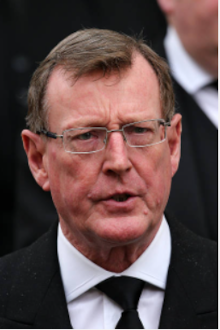
The 860-ruling Unionist Party council had been scheduled to meet on Saturday, May 13, but postponed the session for a week to allow Trimble to broaden his support among unionists still opposed to the deal. The council is expected to vote on resuming participation in a joint executive, which had been suspended on February 11 after the Irish Republican Army (IRA) failed to initiate disarmament.
The postponement of the unionist council meeting means a scheduled restart of devolution two days later will also be postponed. Great Britain and Ireland had offered to restore the Northern Ireland Assembly and a power-sharing executive composed of unionist, nationalist and republican members by May 22.
Great Britain and Ireland are co-sponsors of the 1998 Good Friday Agreement on reconciliation between the Catholic and Protestant communities. Trimble tells news media he is ready to support a return to sharing power with Sinn Féin, the IRA’s political wing, after receiving assurances on the arms issue.
Earlier in the month, the IRA broke the stalemate with an offer to put its arms arsenals beyond use under international supervision. The IRA offer fell short of a pledge to submit its weapons to destruction, as was understood from previous talks on the issue, but both Great Britain and Ireland back the compromise and press for its acceptance by unionists and nationalists as well.
Great Britain’s Northern Ireland SecretaryPeter Mandelson describes the postponement as the “correct decision.” He says, “David Trimble has been clarifying some issues and driving a hard bargain over others. Now he needs time to present the outcome to his party.” He says he is confident that Trimble will be successful and the way will then be paved for the return to power-sharing.
However, hard-line Ulster Unionist leader Jeffrey Donaldson says he does not believe that weapons will be put beyond use. “What we actually need to know and hear from the IRA is are they going to decommission their weapons?” Donaldson, a member of the British parliament, says in a BBC interview. “We haven’t had any clarification from the IRA.”
British Prime MinisterTony Blair says in parliament on Wednesday, May 17, the IRA offer to put its weapons “beyond use” is “an important confidence-building measure” but only the start of a process of silencing the guns. “We need to make progress until the time when these weapons are indeed completely, verifiably, beyond use,” Blair says.
(From: “Unionist leader says he will back Ulster deal,” UPI Archives, http://www.upi.com/archives, May 18, 2000)
Dan Breen and Seán Treacy rescue their comrade Seán Hogan from a Dublin-Cork train at Knocklong, County Limerick, on May 13, 1919, in what becomes known as the Knocklong Ambush. Two policemen guarding Hogan are killed.
One of the most famous photographs (left) of the Irish War of Independence (1919-21) is taken at Breen’s wedding in June 1921. Breen is already burnishing his reputation as the romantic guerilla campaigner three years before the publication of his bestselling autobiography My Fight for Irish Freedom. On his lap there is a Luger pistol, an incongruity in a wedding photograph, but in keeping with his penchant for self-mythologising. In the background on the left is his best man Hogan who is dressed in the uniform of the Irish Volunteers. Unlike Breen, he looks shy and awkward, his body tilted as if to convey how ill at ease with himself he is.
Had Hogan shown the same diffidence in May 1919, he might have saved himself and his comrades a great deal of trouble. He is the youngest of those involved in the Soloheadbeg ambush on January 21, 1919, the event that is viewed in retrospect as the event that starts the Irish War of Independence.
Hogan is only 18, according to most reports, but to date no birth certificate has been found for him. His youth may explain his lack of caution in early May 1919 when he slips his minder after a dance in Kilshenane, County Tipperary, and ends up, not in the arms of his sweetheart Bridie O’Keeffe, but in the embrace of the Royal Irish Constabulary (RIC). He escorts O’Keeffe back to her relative’s farmhouse where she is spending the night. He sleeps on the sofa. When he wakes up, the house is surrounded. He flees, but is picked up by the RIC in a laneway near the house. He, along with the others involved in the Soloheadbeg ambush, are the most wanted men in Ireland. He faces interrogation and possible execution.
The Knocklong ambush, which occurs on May 13, 1919, saves Hogan from such a fate, but it comes at a terrible price for all those involved. He is put on the 6:00 p.m. train from Thurles to Cork where he is due to be interrogated in the military prison. Knocklong Station, just over the border in County Limerick, is chosen as the place for the escape attempt because of its distance from the nearest RIC barracks.
Four volunteers of the Irish Republican Army (IRA) East Limerick Brigade get on the train at Emly in order to signal to the men waiting at Knocklong Station the carriage in which Hogan is being detained. He is being escorted to Cork by four RIC men. They face five volunteers, three of whom are armed. A ferocious gun battle ensues, lasting 14 minutes. Constable Michael Enright (30), from Ballyneety, County Limerick, is shot dead immediately.
Sgt. Peter Wallace and Treacy, another of those involved at Soloheadbeg, wrestle over Treacy’s gun. Wallace, who is a huge man, shoots Treacy in the throat before the gun is turned on Wallace, who later dies from his wounds. Hogan smashes his mangled chains in the head of another of his armed guards who is then thrown out of the window of the train. The last remaining guard picks up a rifle and opens fire on the IRA party through the carriage window wounding three volunteers waiting on the platform, including Breen. Hogan is taken immediately to a butcher’s shop where his chains are smashed with a cleaver, setting him free.
Knocklong becomes an exalted event in the iconography of Irish republicanism. At Soloheadbeg, eight armed and ready volunteers faced two unwary policemen. It was not a fair fight. Hogan’s rescue from the train at Knocklong demands organisation, courage and daring of the highest order.
Hogan continues to serve in the Irish War of Independence and on the anti-Treaty side in the Irish Civil War (1922-23). By the time hostilities cease in 1923, he is only 23, but has spent the previous five years in armed combat. The toll on his mind and body are huge. In 1924, he is admitted to St. Bricin’s Military Hospital suffering from “attacks of restlessness and depression – inability to concentrate his mind on anything.” His wife at the time, Christina, runs a nursing home in Tipperary, where her patients include many shellshocked Irish veterans of World War I. The couple later separates.
Hogan’s fortunes change with the change of government in 1932 bringing to power Fianna Fáil, a party which Hogan supports. He is given a job in the Board of Works, but his mental health continues to deteriorate. He complains of the “nerves and all the ailments that go with them.” His circumstances are such that he spends two years living in the family home of Séumas Robinson, the officer commanding at Soloheadbeg.
In early 2019, Robinson’s daughter, Dimphne Brennan, tells The Irish Times, “He had nowhere else to go. He never got over what happened. His nerves were shattered. We were all just kids and we didn’t disturb him in his room. He didn’t talk to us.”
Hogan dies on Christmas Eve 1968 from a cerebral hemorrhage and chronic bronchitis. At the funeral reception, his estranged widow supposedly tells a niece of Hogan, “Well, but wasn’t that some waste of a life.”
Hogan and Christina are buried 50 paces from each other in St. Michael’s Cemetery in Tipperary, divided in death as they were in life. Seán Hogan: His Life: A Troubled Journey, by John Connors, is published by Tipp Revolution.
(From: “Knocklong ambush, on May 13th, 1919 involved a 14-minute gun battle” by Ronan McGreevy, The Irish Times, http://www.irishtimes.com, May 20, 2019)
The oath, pledging allegiance to the Constitution and fidelity to George V as King of Ireland, is required by the Anglo-Irish Treaty signed in 1921, and has been the symbolic focus of Irish republican opposition to the Treaty in the 1922–23 Irish Civil War. When Fianna Fáil is founded in 1926 by veterans of the losing anti-Treaty side in the Civil War, abolishing the oath is a core aim. It is a main item in the manifesto for its successful 1932 Irish general election campaign, after which it forms a minority government whose first action is to introduce the Constitution (Removal of Oath) Bill 1932. Seanad Éireann has more ex-unionists and others conciliatory towards the United Kingdom and vote to reject the bill unless the Treaty can be amended by agreement. After the 1933 Irish general election, the Fianna Fáil majority government is able to override the Seanad and enact the law.
As well as amending the Constitution, the 1933 act also amends the Constitution of the Irish Free State (Saorstát Eireann) Act 1922, which had both created the Constitution in Irish law and also prohibited any Constitutional amendment incompatible with the Treaty. Since the Free State cannot unilaterally amend the Treaty, Fianna Fáil amends the 1922 act to remove the Treaty’s precedence over the Constitution. Later constitutional amendments are also incompatible with the terms of the Treaty, in particular by weakening and ultimately abolishing the office of Governor-General of the Irish Free State. There is legal controversy over whether the Oireachtas has the power to amend the 1922 act, because it had been passed by the Third Dáil sitting as a constituent assembly before the Oireachtas had come into being. In 1935 the Judicial Committee of the Privy Council (JCPC) in London rules that, in British law, the Oireachtas does have the power, under the Statute of Westminster 1931. Irish jurisprudence takes issue with many of the assumptions underlying the 1935 decision.
Emmet is a son of Dr. Robert Emmet from County Tipperary (later to become State Physician of Ireland) and Elizabeth Mason of County Kerry, both of whose portraits are today displayed at Cork’s Crawford Art Gallery. He is the elder brother of Robert Emmet, who is executed for leading the Irish Rebellion of 1803, becoming one of Ireland’s most famous republican martyrs. His sister, Mary Anne Holmes, holds similar political beliefs.
Emmet is a man of liberal political sympathies and becomes involved with a campaign to extend the democratic franchise for the Irish Parliament and to end discrimination against Catholics. He is called to the Irish bar in 1790 and quickly obtains a practice, principally as counsel for prisoners charged with political offenses. He also becomes the legal adviser of the Society of the United Irishmen.
When the Dublin Corporation issues a declaration of support of the Protestant Ascendancy in 1792, the response of the United Irishmen is their nonsectarian manifesto which is largely drawn up by Emmet. In 1795 he formally takes the oath of the United Irishmen, becoming secretary in the same year and a member of the executive in 1797. As by this time the United Irishmen had been declared illegal and driven underground, any efforts at peaceful reform of government and Catholic emancipation in Ireland are abandoned as futile, and their goal is now the creation of a non-sectarian Irish republic, independent from Britain and to be achieved by armed rebellion. Although Emmet supports this policy, he believes that the rebellion should not commence until French aid has arrived, differing from more radical members such as Lord Edward FitzGerald.
British intelligence infiltrates the United Irishmen and manages to arrest most of their leaders on the eve of the rebellion. Though not among those taken at the house of Oliver Bond on March 12, 1798, Emmet is arrested about the same time and is one of the leaders imprisoned initially at Kilmainham Gaol and later in Scotland at Fort George until 1802. Upon his release he goes to Brussels where he is visited by his brother Robert in October 1802 and is informed of the preparations for a fresh rising in Ireland in conjunction with French aid. However, at that stage France and Britain are briefly at peace, and the Emmets’ pleas for help are turned down by Napoleon.
Emmet receives news of the failure of his brother’s rising in July 1803 in Paris, where he is in communication with Napoleon Bonaparte. He then emigrates to the United States and joins the New York bar where he obtains a lucrative practice.
After the death of Matthias B. Hildreth, Emmet is appointed New York State Attorney General in August 1812 but is removed from office in February 1813 when the opposing Federalist Party obtains a majority in the Council of Appointment.





 seamus dubhghaill