seamus dubhghaill

Promoting Irish Culture and History from Little Rock, Arkansas, USA


Leave a comment

Birth of Anne Bushnell, Jazz & Blues Singer

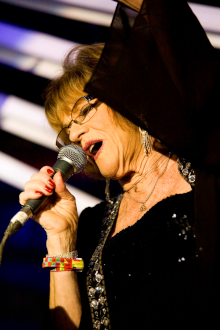
Anne Bushnell, Irish jazz and blues singer and cabaret performer, is born Anne Kavanagh in the Rotunda Hospital, Dublin, on March 28, 1939.

Bushnell is one of four children of John Kavanagh and Evelyn (née Ledwidge). Her father is a motor mechanic with a business on Arnott Street, Portobello, with the family living in Milltown. She dances on the stage of the Theatre Royal as a child and is a junior Irish champion dancer. She attends the St. Louis convent school in Rathmines, where she performs in plays and musicals and sings in the school choir. The nuns disapprove of her musical influences and try to dissuade her interest in jazz and “the music of the night.” Due to the family’s financial circumstances, she leaves school at the age of 16 and takes a job as a typist. She marries Tony Bushnell in April 1961. He is a salesman who shares her interest in music. The couple moves to Templeogue, and have a daughter, Suzanne, and a son, Paul. Paul is now a session musician based in Los Angeles, and Suzanne sings with a female vocal harmony group, Fallen Angels.

Bushnell continues to perform in amateur musicals, and from the early 1960s she sings with an Irish céilí band. With help from her husband’s musical family, she sings in Dublin jazz clubs from 1967, emerging as a well-respected jazz and blues vocalist and cabaret performer. She competes in the national song contest in 1968 singing Ballad to a Boy and becomes a resident singer in the RTÉ Light Orchestra. By the late 1960s, she is one of the busiest singers in Ireland, singing jingles for radio and TV commercials, and featuring on showband records as a backing singer. She is a regular guest on RTÉ television variety shows from 1970, including hosting Girls, girls, girls.

From 1972 to 1974, Bushnell is part of a group called Family Pride, which is a group of session musicians who record together regularly. They compete in the 1973 national song contest, playing in Dublin venues and on radio shows. The group has two top ten Irish hits. Their 1973 album, Family Pride, is not a chart success, however. She represents Ireland at a number of international contests and festivals as a solo artist, releasing a few singles and an unsuccessful album with CBS Records, Are You Ready (1977). She is a backing singer for two of Ireland’s entries to the Eurovision Song Contest in 1974 and 1980. She is a regular in stage musicals from the mid to late 1970s, in productions such as the tribute shows to Jacques Brel (1974) and Bing Crosby (1978), sometimes performing alongside her brother John Kavanagh. From the late 1970s she appears in pantomimes with Maureen Potter.

In 1984 Bushnell stars in a musical based on the life of Édith Piaf, No Regrets, written specially for her by Leland Bardwell. She is lauded for capturing Piaf’s stage presence and husky voice. The show suffers when it has to move from the Gaiety Theatre to the National Stadium. She reworks it into a successful one-woman show called The Little Sparrow and also devises a one-woman tribute to Judy Garland. Her cabaret act in the late 1980s is highly successful, featuring big numbers by Brel, Garland, and Piaf. Due to her talent at singing blues and jazz, she is awarded the freedom of New Orleans by its mayor in 1986.

Bushnell struggles with depression brought on initially by an underactive thyroid and later exacerbated by her father’s death and her husband’s unemployment in the late 1980s. Disheartened by the lack of recognition in Ireland and her family’s financial difficulties, she considers emigrating or returning to her career as a typist. To aid with her depression, she takes up painting in 1992, holding a number of exhibitions in Dublin. She continues to sing regularly until her death, often at events for charity. She is awarded the Cheshire Foundation award in 1994 for her charitable work. She also appears in the film Agnes Browne.

Bushnell dies of cancer on April 21, 2011, in Tallaght University Hospital, County Dublin, and is cremated at Mount Jerome Crematorium.

Leave a comment

Death of D. P. Moran, Journalist, Activist & Theorist

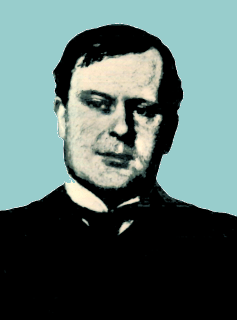
David Patrick Moran (Irish: Dáithí Pádraig Ó Móráin), better known as simply D. P. Moran, Irish journalist, activist and cultural-political theorist, dies on January 31, 1936. He is known as the principal advocate of a specifically Gaelic Catholic Irish nationalism during the early 20th century. Associated with the wider Celtic Revival, he promotes his ideas primarily through his journal, The Leader, and compilations of his articles such as the book The Philosophy of Irish Ireland.

Moran is born in Manor, a townland in Waterford, the youngest of twenty children born to James Moran, a builder, and Elizabeth Moran (née Casey). One of his brothers goes on to serve on the defense team of Patrick O’Donnell.

Moran is educated at Castleknock College, near Dublin, before working as a journalist in London, where he is a member of the Irish Literary Society. His brand of nationalism and concept of the decolonisation of Ireland is of a homogeneous Irish-speaking and Roman Catholic nation, promoting the revival of the Irish language and of Gaelic games in Irish cultural life. He often employes disparaging terms (West Brits, shoneens, sourfaces) in reference to Unionists and/or non-Catholics.

Despite the failure of the 1893 Home Rule Bill and the division of the Irish Parliamentary Party (IPP) in 1891, nationalists take heart from Douglas Hyde‘s 1892 speech, entitled “The Necessity for De-anglicising Ireland.” Moran builds upon this thesis and provides a wider ideology for enthusiasts, particularly after the re-unification of most of the nationalist parties from 1900.

In his 1905 text The Philosophy of Irish-Ireland, Moran argues that to be Irish requires:

  • the use of the Irish language
  • membership in the Roman Catholic Church
  • an anti-materialist outlook on life
  • the playing of only Gaelic games

Though a sponsor of the use of Irish, he never becomes fluent in the language himself. He emphasises the use of English in 1908–09 as “an active, vigilant, and merciless propaganda in the English language.” In the longer term, when Irish becomes again the language of the people, its use enables a de facto censorship of any foreign and unwelcome ideas written in English.

While Moran argues that the idea of “the Gael” is one that can assimilate others, he also feels that it will be hard if not impossible for members of the Church of Ireland who support the British Empire to ever qualify as Irish, being “resident aliens.” This extends to Anglo-Irish literature. He rejects the Abbey Theatre and questions Yeats‘ genius. He once speaks out against the influence Britain has over Irish Universities, stating, “We are all Palemen now.” In the matter of religious differences, Daniel O’Connell had said in 1826 that “the [Roman] Catholics of Ireland are a nation.” Moran moves beyond that, affirming in 1901 that “…the Irish Nation is de facto a Catholic nation.” He is virulent in his opposition to female suffrage.

Moran’s articles frequently contrast “Belfast” with “Ireland,” yet hope that Belfast can eventually change and assimilate. He feels that Ulster unionists should “… be grateful to the Irish nation for being willing to adopt them.” His paper publishes numerous articles by the future TD Arthur Clery (writing under the pen name “Chanel”), who advocates partition on the grounds that Ulster unionists are a separate nation, but Moran himself disagrees and refuses to concede the legitimacy of a northern Protestant identity.

When Irish republicans initiate the Irish War of Independence in 1919, widescale anti-Catholic rioting breaks out in Belfast in 1920 and 1922. Moran identifies this as being caused by Orangeism, which he describes as “a sore and a cancer” in Ireland. He also alleges that “bigotry on the part of Catholics in the Six Counties is immediately due to Orange bigotry.”

Moran is initially a supporter of the Irish Parliamentary Party, believing that the separatism advocated by Arthur Griffith‘s Sinn Féin is impracticable; however, he opposes John Redmond‘s support of the British World War I effort.

Moran supports the Anglo-Irish Treaty agreed in 1921–22 and sees the partition of Ireland as beneficial for a truly Irish culture in the Irish Free State. This causes a sea-change in his opinions; from now on Northern Ireland can be safely ignored, along with what he sees as the English evils of “free thought, free trade, and free literature.” He claims Irish life and culture has to be protected from foreign influences, including the twin evils of the music hall and the English press. The new jazz music of the 1920s and other imported cultural elements are deprecated as “imported debasement and rot.”

On January 9, 1901, Moran marries Theresa Catherine, daughter of Thomas Francis O’Toole, a former Parnellite mayor of Waterford. They have four sons and one daughter.

Moran dies suddenly at his home in Skerries, Dublin, on January 31, 1936. His daughter, Nuala, who has written for the paper since the early 1920s, generally on artistic and social matters, takes over the running of the paper on his death, though it is then much diminished in size and influence. Nuala, who never marries, retains control of The Leader until it ceases publication in 1971.


Leave a comment

The Conradh na Gaeilge Bans All Forms of Jazz Music

On November 6, 1929, Conradh na Gaeilge (English: Gaelic League) announces expulsion for anyone who attends “foreign jazz dances.”

Conradh na Gaeilge, a cultural organisation which promotes the Irish language, implements a ban against all forms of jazz music. Taken by the executive of the Conradh na Gaeilge, it is an issue, which has festered for many months prior to the ban and will for some time afterward.

It is claimed that jazz music has taken hold in Ireland in the wake of World War I and has spread from Dublin to the music halls which have sprung up in towns and villages across the country. Detractors claim that jazz music and dancing is just a “passing phase” and that it is the “natural reaction” to the post-war phase that Ireland finds itself in.

All branches of Conradh na Gaeilge are sent a warning as to their conduct going forward with particular regard to attending or promoting jazz. The idea is to follow the Gaelic Athletic Association’s bans on the playing of foreign games, something which has proved popular across the country. While the debate had begun earlier in 1929 in Wexford and other centres, it is in Leitrim that the most vocal opponents of jazz are to be found. Here the parish priest of Cloone, Fr. Conferey, openly criticises jazz from the pulpit and tells the people that they should sing Irish songs only. In nearby Mohill it is reported that 3,000 people demand that jazz be banned and they carry banners with slogans such as “Down with Jazz” and “Out with paganism.”

Ultimately, the ban sparks outrage across the country but it speaks volumes about post-independent Ireland and attitudes towards culture and pastimes, which are not Irish.

(From: Gaelic League Bans ‘Jazz’ – 6 November 1929, Sunday Independent, Irish Newspaper Archives, http://www.irishnewsarchives.com, November 10, 1929)


Leave a comment

Birth of Radiohead Guitarist Ed O’Brien

ed-obrien-radiohead

Edward John O’Brien, English guitarist, member of the alternative rock band Radiohead and grandson of a Tipperary emigrant, is born in Oxford, Oxfordshire, England on April 15, 1968. In 2010, Rolling Stone names him the 59th greatest guitarist of all time. Along with the other members of Radiohead, he is inducted into the Rock and Roll Hall of Fame in 2019.

O’Brien grows up listening to post-punk acts such as Siouxsie and the Banshees, Adam and the Ants, Depeche Mode, The Police and David Bowie. His earliest guitar influence is Andy Summers of The Police, particularly his use of delay and chorus effects on “Walking on the Moon.” His other influences include Peter Buck of R.E.M., Paul Weller of The Jam, Johnny Marr of The Smiths, John McGeoch of Magazine and Siouxsie and the Banshees, and The Edge of U2. He attends Abingdon School, an independent school for boys, in Oxfordshire, England, where he meets the other members of Radiohead. In 1985, they formed On a Friday, the name referring to the band’s usual rehearsal day in the school’s music room. O’Brien also studies economics at the University of Manchester.

In 1991, On a Friday sign a six-album record contract with EMI and changes their name to Radiohead. They find early success with their 1992 single “Creep“. Their third album, OK Computer (1997), propels them to international fame and is often acclaimed as one of the best albums of all time. O’Brien becomes depressed during the extensive OK Computer tour. After the tour, he returns to Oxford and falls further into depression.

Radiohead’s next albums, Kid A (2000) and Amnesiac (2001), are recorded simultaneously and mark a dramatic change in sound, incorporating influences from electronic music, classical music, jazz and krautrock. O’Brien keeps an online diary of Radiohead’s progress during the recording and initially struggles with the band’s change in direction. At the suggestion of Michael Brook, creator of the Infinite Guitar, he begins using sustain units, which allow guitar notes to be sustained infinitely. He combines these with looping and delay effects to create synthesiser-like sounds. By 2011, Radiohead has sold more than 30 million albums worldwide.

O’Brien releases solo music under the name EOB. His first solo track, the ambient composition “Santa Teresa,” is released on October 4, 2019. His first solo album, Earth, is announced in December 2019 and is due for release in April 2020 on Capitol Records. Recording for Earth begins in late 2017 and ends in early 2019. It is produced by Flood, Catherine Marks, and Adam “Cecil” Bartlett and is mixed by Alan Moulder, with contributions from drummer Omar Hakim, The Invisible members Nathan East and Dave Okumu, folk singer Laura Marling, Portishead guitarist Adrian Utley, Wilco drummer Glenn Kotche and Radiohead bassist Colin Greenwood. He begins a North American tour in February 2020.

O’Brien lives in London with his wife, Susan Kobrin, who worked for Amnesty International. The couple have a son, Salvador, born in January 2004, and a daughter, Oona, born in 2006. He is a cricket fan and supports Manchester United Football Club. Around 2000, he gives up alcohol and takes up meditation. In 2011, he and his family move to Brazil and live for a year on a farm near Ubatuba. In 2020, he announces that he believes he has contracted COVID-19 but is recovering in isolation.


Leave a comment

Birth of Barney McKenna, Founding Member of The Dubliners

File source: https://commons.wikimedia.org/wiki/File:Barney_001.jpg

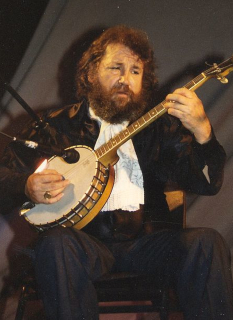
Bernard Noël “Banjo Barney” McKenna, Irish musician and a founding member of The Dubliners, is born on December 16, 1939 in Donnycarney, Dublin. He plays the tenor banjo, violin, mandolin, and melodeon. He is most renowned as a banjo player.

McKenna plays the banjo from an early age, initially because he cannot afford to buy the instrument of his choice, a mandolin. He is a member of The Dubliners from 1962 and is the only living member of the original formation at the time of his death. Prior to joining the Dubliners, he spends a few months in The Chieftains. In addition to his work on traditional Irish music, he also plays jazz on occasion.

McKenna uses GDAE tuning on a 19-fret tenor banjo, an octave below fiddle/mandolin and, according to musician Mick Moloney, is single-handedly responsible for making the GDAE-tuned tenor banjo the standard banjo in Irish music.

McKenna remains a great favourite with live audiences, and some of the loudest and most affectionate applause follows the tunes and songs on which he is the featured performer. He is well known for his unaccompanied renditions of songs such as “South Australia” and “I Wish I Had Someone to Love Me.” His banjo solos on tunes such as “The Maid Behind the Bar,” “The High Reel” and “The Mason’s Apron,” where he is usually accompanied by Eamonn Campbell on guitar, are often performed to cries of “C’mon Barney!” from audience or band members. Another featured spot in Dubliners performances is the mandolin duet that he plays with John Sheahan, again with Eamonn Campbell providing guitar accompaniment. As he often points out to the audience, “It’s an Irish duet, so there’s three of us going to play it.”

McKenna’s tendency to relate funny, and often only marginally believable, stories is legendary amongst Dubliners fans and friends. These anecdotes become known as Barneyisms, and his friend and former Dubliners bandmate Jim McCann collects them for the book An Obstacle Confusion: The Wonderful World of Barney McKenna.

McKenna dies unexpectedly on the morning of April 5, 2012 after collapsing in the kitchen of his home in Howth, County Dublin. He is buried at St. Loman’s Cemetery in Trim, County Meath, on April 9, 2012. Initially it is unclear whether The Dubliners will continue their 50th Anniversary Tour in the wake of McKenna’s death. However they soon confirm that they would “do their best to honour all the concert dates for the rest of the year [2012].”


Leave a comment

Birth of Singer-Songwriter Van Morrison

Sir George Ivan Morrison, best known as Van Morrison, Northern Irish singer-songwriter, instrumentalist and producer, is born on August 31, 1945 in Bloomfield, Belfast, Northern Ireland. He is the only child of George Morrison, a shipyard electrician, and Violet Stitt Morrison, who had been a singer and tap dancer in her youth.

Known as “Van the Man,” Morrison starts his professional career when, as a teenager in the late 1950s, he plays a variety of instruments including guitar, harmonica, keyboards and saxophone for various Irish showbands, covering the popular hits of the time. He rises to prominence in the mid-1960s as the lead vocalist of the Northern Irish R&B band Them, with whom he records the garage band classic “Gloria.” His solo career begins under the pop-hit oriented guidance of Bert Berns with the release of the hit single “Brown Eyed Girl” in 1967. After Berns’ death, Warner Bros. Records buys out his contract and allows him three sessions to record Astral Weeks (1968). Though this album gradually garners high praise, it is initially a poor seller.

Moondance (1970) establishes Morrison as a major artist, and he builds on his reputation throughout the 1970s with a series of acclaimed albums and live performances. He continues to record and tour, producing albums and live performances that sell well and are generally warmly received, sometimes collaborating with other artists, such as Georgie Fame and The Chieftains.

Much of Morrison’s music is structured around the conventions of soul music and R&B, such as the popular singles “Brown Eyed Girl,” “Jackie Wilson Said (I’m in Heaven When You Smile),” “Domino” and “Wild Night.” An equal part of his catalogue consists of lengthy, loosely connected, spiritually-inspired musical journeys that show the influence of Celtic tradition, jazz and stream of consciousness narrative, such as the album Astral Weeks and the lesser-known Veedon Fleece and Common One. The two strains together are sometimes referred to as “Celtic soul.”

Van Morrison has received six Grammy Awards, the 1994 Brit Award for Outstanding Contribution to Music, and has been inducted into both the Rock and Roll Hall of Fame and the Songwriters Hall of Fame. In 2016, he is knighted for his musical achievements and his services to tourism and charitable causes in Northern Ireland.

(Pictured: Van Morrison performing at Glasgow Royal Concert Hall on January 26, 2015 | Image: Getty)