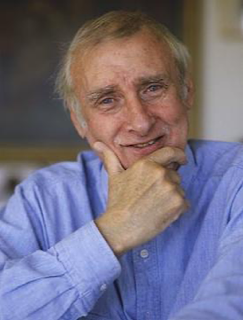
Milligan is the son of an Irish father, Leo Alphonso Milligan, a regimental sergeant major in the British Indian Army, and English mother, Florence Mary Winifred (née Kettleband). He is raised in India and Burma (Myanmar). He is educated at the Convent of Jesus and Mary, Poona, and later at St. Paul’s High School, Rangoon. He moves to England with his family in 1933. He serves in the army during World War II and, when he is wounded in combat, begins a struggle with manic-depressive illness that lasts the rest of his life. Toward the end of the war, he meets Harry Secombe, and they work together entertaining the troops. After the war the pair, along with Peter Sellers and Michael Bentine, begin spending time at the Grafton Arms pub, where they develope their comedy routines. BBC radio begins broadcasting the group’s work in 1951, as Crazy People, and in 1952 it is renamed The Goon Show. As such it continues until early 1960 (though Bentine soon leaves the show) and becomes a cult classic.
Milligan later acts onstage and in small parts in movies—including Monty Python’s Life of Brian (1979)—and writes numerous books of poems, war memoirs, the play The Bedsitting Room (with John Antrobus; first performed 1962), and a number of television series. He also supports a multitude of causes, especially those involving the environment. Because his father is Irish and he is born in India—and despite his years of military service—the British government does not consider him a citizen. Rather than take an oath of allegiance, he takes Irish citizenship. Nonetheless, he is made an honorary Commander of the British Empire in 1992 and is given an honorary knighthood in 2000.
Milligan dies from kidney failure, at the age of 83, on February 27, 2002, at his home on Dumb Woman’s Lane near Rye, East Sussex. On the day of his funeral, March 8, 2002, his coffin is carried to St. Thomas Church in Winchelsea, East Sussex, and is draped in the flag of Ireland. He had once quipped that he wanted his headstone to bear the words: “I told you I was ill.” He is buried at St. Thomas’ churchyard but the Chichester diocese refuses to allow this epitaph. A compromise is reached with the Gaelic translation of “I told you I was ill,” Dúirt mé leat go mé breoite, and in English, “Love, light, peace.” The additional epitaph Grá mhór ort Shelagh can be read as “Great love for you Shelagh.”
According to a letter published in the Rye and Battle Observer in 2011, Milligan’s headstone is removed from St. Thomas’ churchyard in Winchelsea and moved to be alongside the grave of his wife, but is later returned.
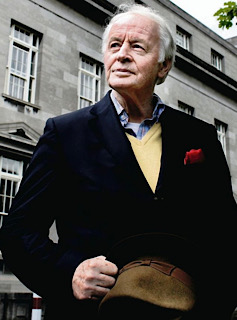
O’Connor is a well-known intellectual figure in contemporary Irish affairs and expresses strong opinions against censorship and the war on drugs. He contributes a regular poetry column to the Irish daily, the Evening Herald, also writes a column for the Sunday Mirror and a sporting column for TheSunday Times, as well as broadcasting on RTÉ.
O’Connor is also known for the autobiographical The Ulick O’Connor Diaries 1970-1981: A Cavalier Irishman (2001), which details his encounters with well-known Irish and international figures, ranging from political (Jack Lynch and Paddy Devlin) to the artistic (Christy Brown and Peter Sellers). It also documents the progress of the Northern Ireland peace process during the same time, and the progress of the Northern Ireland Assembly. Although he travels extensively, he lives in his parental home in Dublin’s Rathgar. He is a member of Aosdána.
In 1990, Cusack, in the role of Masha, joins two of her sisters, Niamh (as Irina) and Sorcha (as Olga), and her father, Cyril Cusack (as Chebutykin) for a well-received production of Anton Chekhov‘s tragicomedy Three Sisters in a new version by Frank McGuinness, directed by Adrian Noble at the Gate Theatre, Dublin, before transferring to the Royal Court Theatre in London. The production also features Niamh’s husband, Finbar Lynch, as Solenyi and Lesley Manville as Natasha. The production wins the three real-life sisters the Irish Life Award in 1992.
One of Cusack’s best known stage roles is Our Lady of Sligo by Sebastian Barry in 1998, in which she plays the principal role of Mai O’Hara in performances in Ireland, on Broadway and at the National Theatre. For this she wins the 1998 Evening Standard Theatre Award for Best Actress, the 1998 Critics’ Circle Theatre Award for Best Actress and her fourth Olivier Award nomination for Best Actress. In 2006-07 she stars with Rufus Sewell in Tom Stoppard‘s Rock ‘n’ Roll at the Royal Court Theatre in London which transfers to the West End and Broadway, winning Cusack her fifth Olivier Award nomination and her second Tony Award nomination.
In 2015, Cusack returns to Ireland’s Abbey Theatre, where she begins her theatre career. She appears in the world première of Mark O’Rowe‘s play Our Few and Evil Days, acting opposite long-time collaborator Ciarán Hinds. She wins the Irish Times Irish Theatre Award for Best Actress.
Cusack stars with Peter Sellers in the film Hoffman (1970). She guest stars in an episode of The Persuaders! (1971), a TV series starring Tony Curtis and Roger Moore, as Jenny Lindley, a wealthy heiress who suspects that a man claiming to be her dead brother is in fact an impostor. In 1975, she makes three appearances in the TV series Quiller as the character Roz.
Further starring roles include lead roles in Oliver’s Travels (1995), Have Your Cake and Eat It (1997) for which Cusack wins the Royal Television Society‘s RTS Award for Best Actress and Frank McGuinness’s The Hen House (1989) for BBC Television. She stars in the title role of George du Maurier‘s Trilby (1976), in an adaptation for the BBC’s Play of the Month, with Alan Badel as Svengali. She also stars in the BBC mini-series North & South (2004, from the novel by Elizabeth Gaskell) as Mrs. Thornton. She stars in the BBC sitcom Home Again (2006) and appears in the TV series Camelot (2011), which runs for one season. She has featured roles in the mini-series The Deep (2014) and the series Marcella (2016), an eight-episode murder mystery.
Along with other actresses, including Paola Dionisotti, Fiona Shaw, Juliet Stevenson and Harriet Walter, Cusack contributes to a book by Carol Rutter called Clamorous Voices: Shakespeare’s Women Today (1994). The book analyses modern acting interpretations of female Shakespearean roles.
Cusack marries British actor Jeremy Irons in 1978, and they have two sons, Samuel James and Maximilian Paul. Prior to marrying Irons, she gives birth to a son in 1967 and places the boy for adoption. In 2007, a journalist for the Irish Sunday Independent, Daniel McConnell, reveals that Cusack is the mother of left-wing general election candidate and now member of Irish parliament Richard Boyd Barrett. The two have since been reunited.
Cusack is a patron of the Burma Campaign UK, the London-based group campaigning for human rights and democracy in Burma. In 1998, she is named, along with her husband, in a list of the biggest private financial donors to the British Labour Party. In August 2010, she signs the “Irish artists’ pledge to boycott Israel” initiated by the Palestine Solidarity Campaign.
(Pictured: Sinéad Cusack reciting poetry for the British Library in October 2021)