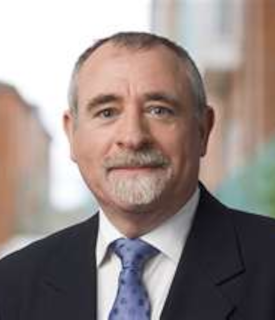
He is elected in 1985 as a Workers’ Party member of Dublin City Council for Crumlin–Kimmage area, and is re-elected at subsequent local elections until 2011, when he is forced to resign his seat due to dual mandate. He is finally elected at the 1989 Irish general election. He joins with Workers’ Party members who form Democratic Left in 1992. He unexpectedly loses his seat at the 1992 Irish general election. Labour’s Pat Upton is unexpectedly returned on the first count, with Byrne finally losing the last seat to Fianna Fáil‘s Ben Briscoe by five votes after a marathon 10-day count.
He loses his seat again at the 1997 Irish general election. Although the Labour Party and the Democratic Left merge in 1999, he is not selected to contest the Dublin South-Central by-election which follows Pat Upton‘s death later that year. Upton’s sister Mary is elected for the Labour Party.
Byrne contests the 2002 Irish general election on the Labour Party ticket as Mary Upton’s running-mate but is unsuccessful. Along with Upton, he contests the Dublin South-Central constituency at the 2007 Irish general election advocating a Labour Party/Fine Gael government but misses the final seat by 69 votes. He is nominated by the Labour Party to contest the Seanad election in the Labour panel but is not elected. In 2009, he is re-elected to Dublin City Council. At the 2011 Irish general election he is re-elected to the Dáil, after a fourteen-year absence.
In January 2015, Byrne becomes involved in an altercation with Sinn Féin TD, Jonathan O’Brien. During ministers’ questions, O’Brien criticises TánaisteJoan Burton over homelessness in Ireland, citing the experiences of his brother, a recovering heroin addict. Byrne asks of O’Brien, “Why doesn’t his good family give him a home?” This infuriates O’Brien. The Irish TimesjournalistMiriam Lord criticizes Byrne, remarking that “You sense the relief rising in the chamber. They don’t like it when the real world intrudes. These sort of things don’t really happen to TDs.”
Muriel Enid Gifford is born at 12 Cowper Road, Rathmines, on December 18, 1884. She is the fourth daughter and eighth child of twelve of Frederick and Isabella Gifford. As a child, she suffers at different times from rheumatic fever and phlebitis. She attends Alexandra College and spends a brief time in England training to as a poultry instructor. Returning to Ireland, she trains at Sir Patrick Dun’s Hospital, Dublin, as a student nurse, but her health suffers from the work.
Along with her sisters, MacDonagh is active in the Irish Women’s Franchise League and Inghinidhe na hÉireann, a nationalist organisation. She is involved in the school meals programme of 1910 to 1911, takes part in a 1914 Women’s Franchise League fundraiser, appearing in a tableau vivant as Maeve, the Warrior Queen. Less ardently feminist than her sisters, she takes delight in inviting home activists and artists for a “proper meal.” In an outgoing family, she is shy and reserved, known for her gentle manner. In 1908, she is introduced to Thomas MacDonagh by suffragette journalist Nannie Dryhurst along with her sisters, Grace and Sidney, on a visit to St. Enda’s School. Dryhurst advises Thomas to “fall in love with one of these girls and marry her,” to which he replies laughingly, “That would be easy; the only difficulty would be to decide which one.” The Gifford sisters remain acquaintances with Thomas until the autumn of 1911, when the couple has a short and intense courtship. They meet secretly in galleries and museums and have copious correspondence. When he is appointed assistant lecturer to University College Dublin (UCD) in December 1911, they marry on January 3, 1912. They have one son, Donagh MacDonagh, and one daughter, Barbara MacDonagh Redmond. The family lives first at 32 Baggot Street, and later at 29 Oakley Road, Rathmines.
MacDonagh suffers with poor health and depression, which leads to periods of convalescence and confinement. When her husband is arrested after the Easter Rising, she is unable to see him before his execution on May 3, 1916, which heightens the intensity of her bereavement. Devastated by his death and estranged from her parents due to their disapproval of his involvement in the Rising, she briefly lives with the Plunketts at Larkfield, Kimmage, and then with relatives of her husband in Thurles, County Tipperary. She later returns to Dublin to rent rooms in a Plunkett family property, 50 Marlborough Road. With two young children to support, she is nearly destitute, but like the other widows and orphans of the executed leaders of the Rising, they are aided by the Irish Volunteers Dependents’ Fund, in her case with £250. She also serves as an officer and committee member on this aid association. Her husband had named her as his literary executor, and she prepares a collected edition of his poetry that is published in October 1916. The success of this volume, and his bestselling Literature in Ireland, published at the time he is executed, ease her financial difficulties somewhat.
MacDonagh dies while swimming in the sea during a holiday with other 1916 widows and orphans in Skerries, County Dublin, on July 9, 1917. She almost does not attend the holiday, as her son is in hospital having been injured in a fall. It is believed that she is attempting to swim to Shenick Island from Skerries, possibly to place a tricolour flag on the island’s Martello tower. Her body is found near Loughshinny Beach and, as there is no water in her lungs, it is concluded that she died of heart failure and not drowning. As there is great interest in the 1916 widows and their families, her funeral at Glasnevin Cemetery attracts a large crowd of mourners estimated at 5,000 in the funeral procession.
Following MacDonagh’s death, there is a legal custody battle between the Giffords and the MacDonaghs over Donagh and Barbara. Their aunt Mary MacDonagh, a nun known as Sister Francesca and with whom MacDonagh had grown close, wins custody. Even though several of her siblings offer to take the children, she places them in a foster home.
On the centenary of MacDonagh’s death, a festival takes place in Skerries in her memory.
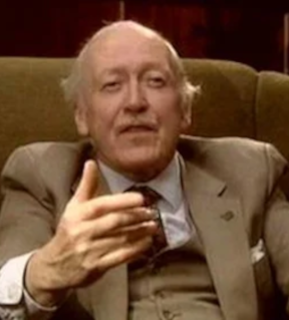
Dowling is born in Kimmage, Dublin, on September 7, 1929, the sixth of four sons and three daughters of William Dowling, a ship’s captain, and his wife Mary (née Kelly). His father is violent toward the family and leaves when he is a toddler. Helped by money provided by a priest, the Dowlings move in 1934 from the basement of his maternal uncle’s flat in Merrion Square, Dublin, to a house in Mount Merrion, County Dublin. In 1942, financial necessity forces the family’s move to a smaller residence in Marlborough Road, Donnybrook, Dublin.
Dowling is educated at St. Mary’s College in Rathmines, Dublin, having previously attended KilmacudNational School and CBS Dún Laoghaire, both in County Dublin. He is a bright student, but with his fees in arrears, the dean of studies induces him to leave school early in September 1945 for a clerkship with the Standard Life Assurance Company. A few years later, he finds his vocation when he accompanies a girlfriend to the academy of acting run by Brendan Smith. He signs up in 1948 for a two-year course during which he performs in and stage-manages academy plays and stage-manages for Smith’s professional company. Upon quitting Standard Life in June 1950, he spends a year touring Ireland with Smith’s company, both as an actor and the touring group’s manager.
Dowling comes to prominence in the 1950s for his role as Christy Kennedy in the long-running radio soap opera, The Kennedys of Castleross, and as a member of the Abbey Theatre company. He returns to the Abbey as artistic director from 1987 to 1990.
Following two months in the United States in 1969 lecturing and directing at Loyola University Chicago, he spends periods during 1972–74 directing for the Missouri Repertory Theatre and lecturing and directing at the University of Missouri – Kansas City. On extended leave from the Abbey, he directs in various American theatres throughout 1975, the year he married Olwen O’Herlihy, daughter of the Irish actor Dan O’Herlihy. After his request for six months leave each year is refused, he quits the Abbey in 1976, having done over a hundred major roles for the company.
Dowling marries actress Brenda Doyle in 1952. They have four daughters, including actress Bairbre Dowling, before divorcing in 1975. In 1975, he marries Olwen O’Herlihy, with whom he has a son.
Politician Richard Boyd Barrett is the biological son of Dowling and recording artist and actress Sinéad Cusack from a 1966 relationship while both are at the Abbey Theatre. Boyd Barrett is adopted as an infant. Dowling contacts Boyd Barrett after his connection with Cusack is publicly revealed in 2007. Their relationship is made known after his death.
Dowling dies on May 10, 2013, in Massachusetts General Hospital due to complications arising from surgery. Following a funeral service at the First Congregational Church of Chester, his remains are interred in the nearby cemetery.
Dowling receives honorary doctorates from Westfield State University in Massachusetts, and from Kent State University, John Carroll University and the College of Wooster, all in Ohio. His papers, from 1976 onward, are housed at the Kent State University and John Carroll University libraries.
The attack seems to be part of a general “hit-up” by the Republicans in the city. Other military barracks around the city are also attacked in the same week.
The Barracks’ orderly clerk is attending the morning parade, where National Army soldiers, mostly unarmed, are listening to the orders of the day, read by the regimental sergeant major. When he hears machine gun fire, the clerk first believes it to be practice firing. Then he sees puffs of dust spring up from the ground as bullets land around him. He throws himself to the ground.
Another soldier tells The Irish Times, “The first outburst crashed in on us just like a flash of lightning and did most of the damage. All of us that could crawled around for cover, it was simply death to walk in the square at that time.”
The IRA has occupied the upper stories and roofs of the houses across the Grand Canal, at the rear of the barracks. From there, they rake the parade square with gunfire. The sound is deafening to the stricken soldiers. One says, “It seemed as if marbles were being rained down from an immense height.”
A total of eighteen soldiers are hit. One is killed instantly and fourteen wounded, seven of whom require surgery. As the firing starts, a butcher’s van owned by one R. McGurk of Harold’s Cross is making a delivery to the barracks. The storm of bullets peppers the unfortunate deliverymen, killing their horse and mortally wounding the driver. According to the soldier, “the whole thing lasted about 15 minutes, the rest of the soldiers came out then and started some Lewis guns going.”
One hundred soldiers had been lined up on the square shoulder to shoulder. The National Army believes the IRA used a Lewis machine gun and tells the press there were up to forty attackers armed with rifles and machine guns. But in fact, IRA reports show that their squad, a party from the Dublin Brigade active service unit (ASU), led by William Roe, has only eleven men, broken up into four parties, with only two of the parties firing ninety rounds with a Thompson submachine gun and fifteen with a “Peter the Painter” Mauser automatic.
The IRA volunteers make their escape across country, through the villages of Kimmage and Crumlin, pursued by Irish Free State troops. They are seen carrying two badly wounded men of their own. The Army later claims the two were killed in the firefight, but there is no indication that this is true.
(From: “Wellington Barracks, Dublin, 1922 – A Microcosm of the Irish Civil War” by John Dorney, The Irish Story, http://www.theirishstory.com, June 2010)
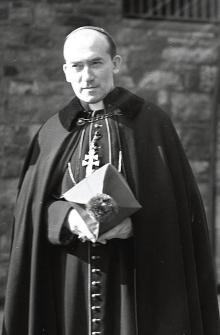
Ordained in 1924, the theology in which McQuaid is trained is conservative — strongly neo-scholastic and hostile to modernism and liberalism. His hatred of the French Revolution is expressed in several pastorals and speeches throughout his career. He also regards Protestantism as a fundamental error from which Irish Catholics should be quarantined as much as possible.
Appointed Dean of Studies at Blackrock College, McQuaid becomes a prominent figure in Catholic education and chairs the Catholic Headmasters’ Association for several years. In 1931 he is appointed president of Blackrock College, in which capacity he becomes acquainted with Éamon de Valera, the future Irish Taoiseach whose sons attend the school. In 1936 while drafting a new Irish constitution, de Valera consults McQuaid, although he rejects McQuaid’s draft “One, True Church” clause which states, among other things, that the Catholic Church is the one true church in Ireland.
When McQuaid is appointed Archbishop of Dublin in 1940, the appointment of a priest from the regular clergy causes considerable surprise. Irish government archives reveal that de Valera, as is suspected at the time, presses McQuaid’s claims at the Vatican. However, it is doubtful whether the Vatican needs much persuasion. There is a dearth of potential episcopal talent and McQuaid has an outstanding reputation as a Catholic educationalist.
Once appointed, McQuaid proves to be one of the ablest administrators in the history of the Irish Church. In the first two years of his episcopate, he sets up the Catholic Social Service Conference to alleviate the poverty and distress in Dublin which is aggravated by the war, and the Catholic Social Welfare Bureau to help the thousands of Irish emigrants going to Britain for war work. These two organizations fill a much-needed gap and continue to exist after the war. The expansion of Dublin city and its suburbs during his episcopate requires the building of new churches, schools, and hospitals. Meeting these demands also necessitates a considerable increase in the number of clergies, secular and regular, whose numbers more than double in the period from 1941 to 1972.
Given his previous career, the importance McQuaid assigns to education is not surprising. He is critical of the low priority accorded to education by successive governments and is particularly critical of the poor and pay conditions of teachers. His intervention in the primary teachers’ strike in 1946 is poorly received by the government and marks the souring of his relationship with de Valera. During his episcopate the number of primary schools increases by a third while the number of secondary schools more than double but, as with social welfare, the government increasingly assumes a dominant role in education from the 1960s onwards. Almost immediately after his appointment in 1940, he takes a hardline stand against the attendance of Catholic students at Trinity College Dublin (TCD). The ban lasts until 1970, when the increase in student numbers renders it untenable and he accedes reluctantly.
McQuaid has a formidable list of achievements in health care, especially maternity and pediatric services, physical and mental handicap services, and the treatment of alcoholism. It is ironic, therefore, that the most controversial episode of his career occurs in this area — the Irish hierarchy’s rejection in 1951 of a free mother-and-child health service. This leads to the resignation of the Minister for Health, Dr. Noël Browne, and is a watershed in Church-State relations in Ireland. With Irish tuberculosis and infant mortality statistics ranking among the highest in the world, the hierarchy, and particularly McQuaid, lose considerable support by lining up with the conservative medical establishment to resist efforts at socialized medicine.
From various pastorals that McQuaid issues at the time, it is clear that he does not see the need for the Second Vatican Council. As its deliberations proceed, his unease grows, and he becomes increasingly preoccupied with the issue of episcopal power and independence that he believes are being threatened by the Council. In the areas of liturgical reform, greater lay participation, and ecumenism, he is slow in implementing the Vatican II reforms. His views on ecumenism had always been lukewarm and had led to allegations that he was anti-Protestant. His personality and policies are criticized by a more assertive Dublin laity, but being a shy, reserved man who increasingly feels the isolation of office, he never responds to such comments. In 1968 the reaction to Humanae vitae causes open rebellion in the Dublin diocese, the force of which catches him unaware. His last pastoral as archbishop in 1971 betrays his anger and bemusement at the response to Humanae vitae in Dublin.
McQuaid’s substantial archives are released by the Dublin Diocesan Archives in the late 1990s. In 1999 journalist John Cooney publishes a hostile biography of McQuaid, which makes controversial allegations of sexual abuse against McQuaid. The allegations are based on tenuous evidence gathered by McQuaid’s nemesis from the 1951 Mother and Child controversy, Dr. Noël Browne, who had died in 1997. No corroborating evidence is produced or has since emerged.
Joseph Mary Plunkett, Irish nationalist, poet, journalist, and a leader of the 1916 Easter Rising, is born at 26 Upper Fitzwilliam Street in Dublin on November 21, 1887.
Both his parents come from wealthy backgrounds, and his father, George Noble Plunkett, has been made a papal count. Despite being born into a life of privilege, young Joe Plunkett does not have an easy childhood.
Plunkett contracts tuberculosis at a young age. This is to be a lifelong burden. His mother is unwilling to believe his health is as bad as it is. He spends part of his youth in the warmer climates of the Mediterranean and North Africa. He spends time in Algiers where he studies Arabic literature and language and composes poetry in Arabic. He is educated at the Catholic University School and by the Jesuits at Belvedere College in Dublin and later at Stonyhurst College, in Lancashire, England, where he acquires some military knowledge from the Officers’ Training Corps. Throughout his life, Plunkett takes an active interest in Irish heritage and the Irish language and also studies Esperanto. He is one of the founders of the Irish Esperanto League. He joins the Gaelic League and begins studying with Thomas MacDonagh, with whom he forms a lifelong friendship. The two are both poets with an interest in theatre, and both are early members of the Irish Volunteers, joining their provisional committee. Plunkett’s interest in Irish nationalism spreads throughout his family, notably to his younger brothers George and John, as well as his father, who allows his property in Kimmage, south Dublin, to be used as a training camp for young men who wish to escape conscription in Britain during the First World War. Men there are instead trained to fight for Ireland.
Sometime in 1915 Plunkett joins the Irish Republican Brotherhood (IRB) and soon after is sent to Germany to meet with Roger Casement, who is negotiating with the German government on behalf of Ireland. Casement’s role as emissary is self-appointed, and, as he is not a member of the IRB, the organisation’s leadership wishes to have one of their own contact Germany to negotiate German aid for an uprising the following year. Plunkett is seeking, but not limiting himself to, a shipment of arms. Casement, on the other hand, spends most of his energies recruiting Irish prisoners of war in Germany to form a brigade to fight instead for Ireland. Some nationalists in Ireland see this as a fruitless endeavour, and prefer to seek weapons. Plunkett successfully gets a promise of a German arms shipment to coincide with the rising.
Plunkett is one of the original members of the IRB Military Committee that is responsible for planning the Easter Rising, and it is largely his plan that is followed. Shortly before the rising is to begin, Plunkett is hospitalised following a turn for the worse in his health. He has an operation on his neck glands days before Easter and has to struggle out of bed to take part in what is to follow. Still bandaged, he takes his place in the General Post Office with several other of the rising’s leaders, including Patrick Pearse and Tom Clarke, though his health prevents him from being terribly active. His energetic aide-de-camp is Michael Collins.
Following the surrender Plunkett is held in Kilmainham Gaol, and faces a court-martial. Seven hours before his execution by firing squad at the age of 28, he is married in the prison chapel to his sweetheart Grace Gifford, a Protestant convert to Catholicism, whose sister, Muriel, had years before also converted and married his best friend Thomas MacDonagh, who is also executed for his role in the Easter Rising. Plunkett is executed by firing squad on May 4, 1916, and is the fourth and youngest signatory of the Proclamation of the Irish Republic to be executed.
The main railway station in Waterford City is named after Plunkett as is Joseph Plunkett Tower in Ballymun. Plunkett barracks in the Curragh Camp, County Kildare is also named after him.




 seamus dubhghaill