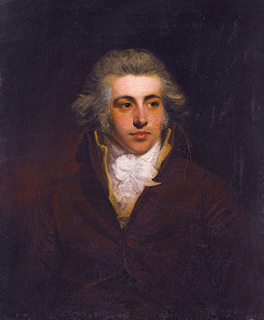
FitzGerald marries Charlotte Boyle Walsingham in London on August 3, 1791. Together they live at Boyle Farm, Thames Ditton. In 1806, his wife succeeds to the Baron de Ros, the premier baron in the Peerage of England, as 20th Baroness de Ros. The family then takes the surname FitzGerald-de Ros. The couple has 13 children in 21 years, of which nine survive to adulthood.
The battle consists of ten days of fighting in the countryside around Kilmallock in County Limerick, in which the National Army of the Irish Free State, advancing south from Limerick city, find their path blocked by anti-Treaty IRA troops, dug into a number of villages at Bruff, Bruree and Patrickswell. The fighting end with the retreat of the anti-Treaty fighters and the occupation of Kilmallock by Free State forces.
The prelude to the battle is the fall of Limerick city to Free State forces. The Republican forces in the city under Liam Deasy withdraw from their positions after a week of fighting and concentrate in Kilmallock and the nearby towns of Bruff and Bruree. The Free State forces, advancing south from the city, find their path blocked by the Republicans dug in at the three hilltop towns.
The National Army’s attempt to break through this position produces the only “line battle” of the war with the two sides facing each other along clear front-lines. The Kilmallock-Bruff-Bruree triangle sees some of the war’s most intense fighting.
Whereas in the fighting in Dublin, Limerick and Waterford, Free State troops equipped with artillery overcome Anti-Treaty resistance relatively easily, at Kilmallock they have a much harder time. The main reason for this is that the Free State troops, most of whom are new recruits, are facing some of the best of the IRA forces without an advantage in numbers or firepower. General Eoin O’Duffy complains of shortage of arms and ammunition. He estimates that while his forces have about 1,300 rifles, the Republicans could muster over 2,000. He is also critical of the quality of the troops at his disposal, whom he describes as, “a disgruntled, undisciplined and cowardly crowd.”
The Republicans know this and are confident of success. Nevertheless, the Republican commanders have their own issues with logistical support and lack of co-operation between forces from different counties. Deasy’s command includes Volunteers from counties Limerick itself, Cork and Kerry, all of whom have their own commanders. They have three improvised armoured cars, some mortars and heavy machine guns but no artillery.
O’Duffy draws up plans for the advance on Kilmallock with the assistance of his second-in-command Major GeneralW. R. E. Murphy who had been a lieutenant colonel in World War I. His experience in the trenches has a major effect on his approach – pre-disposing him to cautious advances and use of trenches for cover.
The Republican forces have the better of the first clashes. On Sunday, July 23, Free State forces take Bruff and begin their advance on Kilmallock, but are twice beaten back by determined Republican resistance. The following day, the Republicans manage to retake Bruff in a counter-attack, taking 76 prisoners. As a result of this setback, O’Duffy calls off the advance for the time being and waits for reinforcements.
National Army forces quickly retake Bruff after reinforcements arrive. However, things get worse for the National Army as the week goes on. They make slow progress in taking the Republican strongpoints, and their casualties also mount. On Tuesday, July 25, a unit of the Dublin Guard under Tom Flood is ambushed on a narrow road. They fight their way clear, but only after losing four men. Three more Free State soldiers are killed two days later. On July 30, Major General Murphy launches an attack to take Bruree. The Dublin Guards attack the town from the southeast, supported by armoured cars and an 18-pound field gun. The Republicans hold out for five hours until Free State artillery is brought into action. At least 13 Free State soldiers and nine Anti-Treaty fighters are killed in the action and more are wounded before the Free State troops secure Bruree.
The Republican commander, Deasy, knows how important Bruree is to the defence of Kilmallock and draws up plans to recapture the town using three armoured cars, trench mortars and machine guns. On August 2, Republicans capture Patrickswell south of Limerick. The armoured cars then attack Bruree, taking Free State forces by surprise. One car attacks Commandant Flood’s headquarters at the Railway Hotel. The Commandant and his men manage to escape out the back of the building under the cover of Lewis gun fire. The second armoured car rams the front door of another post in the school house, which persuades the twenty-five troops inside to surrender.
However, when Free State reinforcements, along with armoured cars arrive, the Republican counter-attack stalls. The Free State reinforcements are led by Commandant General Seamus Hogan, who personally leads his forces, riding in the armoured car nicknamed “The Customs House.” Having failed to secure the surrender of the town, Republican forces retreat.
Having held Bruree against a Republican counterattack, Free State forces prepare to capture Kilmallock itself, but anticipate there will be heavy fighting. Republican Adjutant General Con Moloney comments on August 2, “Up to yesterday we have had the best of the operations there [the Kilmallock area]. There will, I fear, be a big change there now as the enemy have been reinforced very considerably.” In the 3rd Western Division area they have all but disbanded, unwilling to fight Free Staters, destroy roads, and now discouraged by the Catholic church.
On Thursday, August 3, a force of 2,000 Free State troops, backed up by armoured cars and artillery, advance on Kilmallock from Bruree, Dromin and Bulgaden. Seven hundred troops arrive the next day with an armoured car and a field gun. By Saturday, the town is surrounded by Free State forces. The Dublin Guard are also on hand to prevent Republican forces from escaping. Three miles away, Free State artillery is deployed and shells Republican forces on Kilmallock Hill and Quarry Hill. The two hills are soon controlled by Free State forces.
The National Army has, therefore, assembled sufficient force to smother resistance at Kilmallock. They are still, however, expecting hard fighting before they take the town. To their surprise, when the Free State troops enter the town, they encounter only light resistance from a Republican rearguard (volunteers from Cork). Most of the Republican troops have already abandoned their positions and retreated to Charleville.
They departed not because the Free State troops are stronger, but because they have been outflanked by Free State seaborne landings on the coasts of County Kerry and County Cork on August 2 and 8 respectively. The landings in Cork and Kerry force Commandant General Deasy to release units from this area to return home to their own areas. Although the landings in Cork occur after the retreat from Kilmallock, the subsequent loss of brigades from Cork adds to Commandant General Deasy’s problems. The final phase of the fighting in County Limerick comes when the Free State advance south is held up at Newcastle West. Another day of heavy fighting ensues in which the National Army troops have to bring up armoured cars and artillery to dislodge the Republicans, who reportedly lose up to 12 men before they retreat in the direction of Cork.
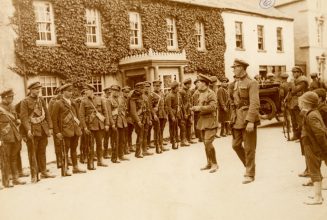
(Pictured: National Army troops lined up for a roll call during the Irish Civil War with local children casting an eye over the proceedings)
Pack is born on October 7, 1775 in Kilkenny, County Kilkenny, the younger son of Rev. Thomas Pack, Dean of Ossory, and Catherine Pack (née Sullivan), of St. Andrew’s parish, Dublin. In June 1790, he enters Trinity College Dublin (TCD), aged 15, but does not take his degree. His elder brother, Thomas Pack, previously attends TCD, but dies in December 1786.
Promoted to lieutenant colonel in December 1800, Pack commands the 71st (Highland) Regiment of Foot and takes part in the expedition to the Cape of Good Hope in 1806. He then takes part in General John Whitelocke‘s expedition to South America and is captured after an unsuccessful attack on Montevideo. His fellow-prisoner is William Carr Beresford, later 1st Viscount Beresford, and the two men remain friends for the rest of their lives. Refusing to give their parole to General Santiago de Liniers, they escape from La Plata in a boat, meeting a British cruiser at sea. Pack later takes part in the successful attack on Montevideo on February 9, 1807.
Pack is posted to Portugal in 1808 and is present at the Battle of Roliça on August 17 and the Battle of Vimeiro on August 21. In 1809, he takes part in the Walcheren Campaign and, promoted to colonel in July 1810, he is made aide-de-camp to George III. Returning to Portugal in 1810, he serves under Beresford, commanding a Portuguese brigade, and takes part in the Battle of Bussaco on September 27, 1810. Promoted to brigadier general in January 1812, he takes part in the Siege of Ciudad Rodrigo and is present at the Battle of Salamanca on July 22, 1812. In June 1813, he is promoted to major general and later is present at the battles of Vitoria (June 21, 1813), Nivelle (November 10, 1813), Nive (December 10-13, 1813), Orthez (February 27, 1814) and the final French defeat at Toulouse (April 10, 1814). In January 1815, he is made a Knight Commander of the Order of the Bath (KCB) in recognition of his services in the Peninsula.
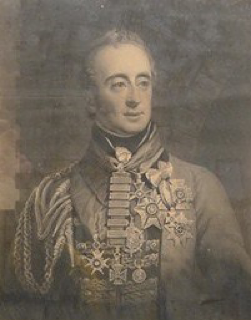
In July 1816, Pack marries Lady Elizabeth Louisa de la Poer Beresford, daughter of George Beresford, 1st Marquess of Waterford. They have two sons and two daughters. His descendants adopted “Pack-Beresford” as their family name. He dies on July 24, 1823, at Lord Beresford’s house in Upper Wimpole Street, London. A monument to him is later erected in St. Canice’s Cathedral, Kilkenny. A portrait by G. L. Saunders is in family possession; another by Charles Turner, showing Pack wearing his numerous orders and decorations, is in the National Portrait Gallery, London. A collection of his papers is held by the University of Southampton.
Byrne is born on March 20, 1780, at Ballylusk, Monaseed, County Wexford, the eldest son of Patrick Byrne, a middling Catholic farmer, and Mary (née Graham). He joins the United Irishmen in the spring of 1797 and, although only seventeen, becomes one of the organisation’s most active agents in north Wexford.
When rebellion engulfs his home district on May 27, 1798, Byrne assumes command of the local Monaseed corps and rallies them at Fr. John Murphy‘s camp on Carrigrew Hill on June 3. They fight at the rebel victory at Tubberneering on June 4 and the unsuccessful attempt to capture Arklow five days later. After the dispersal of the main rebel camp at Vinegar Hill on June 21, he accompanies Murphy to Kilkenny but begins the retreat to Wexford four days later. Heavily attacked at Scollagh Gap, he is one of a minority of survivors who spurn the proffered amnesty and join the rebel forces in the Wicklow Mountains. He is absent when the main force defeats a cavalry column at Ballyellis on June 30 but protects the wounded who are left in Glenmalure when the rebels launch a foray into the midlands the following week. He takes charge of the Wexfordmen who regain the mountains and fight a series of minor actions in the autumn and winter of 1798 under the militant Wicklow leader Joseph Holt. On November 10, he seizes an opportunity to escape into Dublin, where he works as a timber-yard clerk with his half-brother Edward Kennedy.
Byrne is introduced to Robert Emmet in late 1802 and immediately becomes a prominent figure in his insurrection plot. He is intended to command the many Wexford residents of the city during the planned rising of 1803. On July 23, 1803, he assembles a body of rebels at the city quays, which disperse once news is received that the rising has miscarried. At Emmet’s request, he escapes to Bordeaux in August 1803 and makes his way to Paris to inform Thomas Addis Emmet and William James MacNeven of the failed insurrection. In his Paris diary, the older Emmet recalls passing on “the news brought by the messenger” to Napoleon Bonaparte‘s military advisors.
Byrne enlists in the newly formed Irish Legion in December 1803 as a sub-lieutenant and is promoted to lieutenant in 1804 but only sees garrison duty. The regiment eventually moves to the Low Countries, and is renamed the 3rd Foreign Regiment in 1808, the year he is promoted to captain. He campaigns in Spain until 1812, participating in counterinsurgency against Spanish guerillas. He fights in Napoleon’s last battles and is appointed Chevalier de la Légion d’Honneur on June 18, 1813. With Napoleon’s defeat in 1815, the former Irish Legion, with its undistinguished and somewhat unfortunate history, is disbanded.
Though a supporter of Napoleon during the Hundred Days, Byrne is not involved in his return, yet he is included in an exclusion order from France which he successfully appeals. In November 1816, he swears the oath of loyalty to the now Royal Order of the Legion of Honour and becomes a naturalised French subject by royal decree on August 20, 1817. He becomes a half-pay captain but is recalled for active service in 1828 and serves as a staff officer in the French expeditionary force in Morea in support of Greek independence (1828–1830). His conduct on this campaign leads to his promotion as chef de bataillon (lieutenant-colonel) of the 56th Infantry Regiment in 1830.
After five years of service in garrisons around France, including counterinsurgency duty in Brittany, Byrne retires from the army in 1835. On December 24, 1835, he marries a Scottish woman, Frances “Fanny” Horner, at the British Embassy Chapel in Paris. They live in modest circumstances in various parts of Paris and remain childless. Though it is unclear when he is awarded the Chevalier de St Louis, having initially applied for it unsuccessfully in 1821, this distinction is mentioned in his tomb inscription, under his Legion of Honour. John Mitchel, who visits him regularly in Paris in the late 1850s, recalls Byrne sporting the rosette of the Médaille de Sainte Hélène, awarded in 1857 to surviving veterans of Napoleon’s campaigns.
An early list of Irish Legion officers describes Byrne as an upright and disciplined man, with little formal instruction but aspiring to improve himself. He becomes fully fluent in French but also learns Spanish and his language skills are a useful asset in various campaigns. Because of his suspected Bonapartist leanings, he is under police surveillance for some time after the Bourbon Restoration. He does, however, cultivate a wide social circle in Paris over the years. Various references throughout his writings testify to an inquisitive and cultured mind. He intended publishing a lengthy criticism of Gustave de Beaumont‘s Irlande, sociale, politique et religieuse (1840), claiming that it misrepresented the 1798 rebellion, but he withdraws it after meeting the author, not wishing to prejudice the reception of such an important French work on “the sufferings of Ireland.”
A lifelong nationalist, Byrne acts as Paris correspondent of The Nation in the 1840s and is a well-known figure in the Irish community there. He works in the 1850s on his notably unapologetic and candid Memoirs, an early and significant contribution to the Irish literature of exile. This autobiography is acclaimed by nationalists when published posthumously by his wife in 1863, with a French translation swiftly following in 1864. His detailed testimony of key battles of the 1798 rebellion in the southeast and Emmet’s conspiracy are written with the immediacy of an eyewitness and make them an invaluable contribution to that period of Irish history.
Byrne dies on January 24, 1862, in Paris, and is buried in Montmartre Cemetery. On November 25, 1865, John Martin writes of him: “In truth he was a beautiful example of those natures that never grow old. A finer, nobler, gentler, kindlier, gayer, sunnier nature never was than his, and to the last he had the brightness and quickness and cheeriness of youth”.
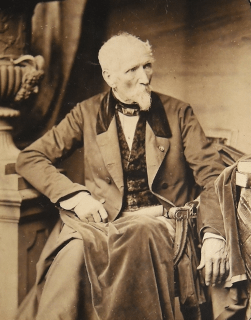
Byrne’s engaging and dispassionate Memoirs have ensured his special status among Irish nationalists. Because of his longevity he is the only United Irishman to have been photographed. His wife had sketched him in profile in middle age, and the photograph taken almost three decades later shows the same, strong features though those of a frail, but dignified man of 79 years.
(From: “Byrne, Miles” by Ruan O’Donnell and Sylvie Kleinman, Dictionary of Irish Biography, http://www.dib.ie, October 2009, last revised August 2024 | Pictured: Photograph of Miles Byrne taken in Paris in 1859)
The regiment’s 916 men are organized into 10 companies designated with the letters A–I and K. Most of the companies are organized in Orleans Parish, although Company D is from Tensas Parish, Company C from St. Landry Parish, and Company A from Union Parish and Sabine Parish. The unit’s first colonel is Isaac Seymour, its first lieutenant colonel is Louis Lay, and its first major is Samuel L. James. Over half of the unit’s men with known places of birth are born outside of the United States, primarily from Ireland. In its early days, the unit has a reputation for being disorderly and hard to control. Seymour has to publicly rebuke several officers in late 1861 for drunkenness.
On May 23, 1862, the regiment sees action in the Battle of Front Royal and captures two Union battle flags in a skirmish at Middletown the next day. May 25 sees the regiment engage in the First Battle of Winchester, where MacArthur is killed, and on June 9 it fights in the Battle of Port Republic, in which 66 of its men are killed or wounded. MacArthur’s role as major is then filled by Nathaniel G. Offutt. After Port Republic, Jackson’s men are transferred to the Virginia Peninsula to take part in the Seven Days Battles, and the 6th Louisiana skirmishes at Hundley’s Corner on June 26 before fighting in the Battle of Gaines’ Mill the next day. Seymour leads the brigade at Gaines’ Mill, since Richard Taylor is ill. The Louisianans, known as the Louisiana Tigers, become bogged down in Boatswain’s Swamp, are repulsed with loss, and withdraw from the battle. Seymour is killed during the charge and is replaced by Strong. Offutt takes over Strong’s position as lieutenant colonel, and William Monaghan becomes colonel.
Moving north with Jackson in August, the regiment fights in the Manassas Station Operations at Bristoe Station, Virginia on August 26 and Kettle Run, Virginia the following day. At Kettle Run, the regiment holds off a Union advance while the 8th Louisiana burns a bridge, and then the two regiments, joined by the 60th Georgia Infantry Regiment and the 5th Louisiana Infantry Regiment, fight against the Union Army‘s Excelsior Brigade and the brigade of Colonel Joseph Bradford Carr. It then fights in the Second Battle of Bull Run on August 29-30, 1862. At Second Bull Run, it is part of the brigade of Colonel Henry Forno. On the first day of the battle, Forno’s brigade helps repulse James Nagle‘s Union brigade. On the morning on 30 August 30, it is sent to the rear for supplies and does not rejoin the fighting that day.
After Second Bull Run, the 6th Louisiana fights in the Battle of Chantilly on September 1, 1862, where the Louisiana brigade is routed with the 5th, 6th, 8th, and 14th Louisiana regiments suffering the heaviest casualties in the Confederate army, and on September 17 sees action in the Battle of Antietam. At Antietam, the regiment is part of Harry T. Hays‘s brigade. During the fighting, Hays’s brigade charges toward the Miller’s Cornfield and is cut to pieces, with the brigade suffering 61 percent casualties. The 6th Louisiana loses 52 men killed or wounded, including Colonel Strong, who is killed and replaced with Offutt. All 12 officers of the 6th Louisiana that see action at Antietam are killed or wounded. Monaghan becomes lieutenant colonel and is replaced as major by Joseph Hanlon. Offutt in turn resigns on November 7 and is replaced by Monaghan. Hanlon becomes lieutenant colonel, and Manning is promoted to major. The regiment is held in reserve at the Battle of Fredericksburg on December 13, 1862, and is not directly engaged, although it does come under Union artillery fire.
An inspection in January 1863 rates the 6th Louisiana as having “poor” discipline and moderately good at performance in drills. Along with the 5th Louisiana Infantry, the regiment contests a Union crossing of the Rappahannock River on April 29, 1863. Union troops are able to force a crossing, and the 6th Louisiana has 7 men killed, 12 wounded, and 78 captured. It then fights in the Second Battle of Fredericksburg on May 3, 1863, where 27 of the unit’s men are captured. While part of the regiment is captured, most of the unit is able to withdraw from the field in better condition than the other Confederate units positioned near it. It then fights at the Battle of Salem Church the next day. Altogether, the 6th Louisiana Infantry sustains losses of 14 killed, 68 wounded, and 99 captured at the Battle of Chancellorsville. It next sees combat on June 14, 1863, in the Second Battle of Winchester, where it joins its brigade of other Louisiana units in capturing a Union fort.,
At the Battle of Gettysburg on July 1-3, 1863, the 6th Louisiana is still in Hays’ brigade. On July 1, the brigade is part of a Confederate charge that sweeps the Union XI Corps from the field, although it is less heavily engaged than some of the other participating Confederate brigades. Entering the town of Gettysburg, the brigade captures large numbers of disorganized Union troops. On the evening of the following day, the brigade is part of a failed attack against the Union position on Cemetery Hill. It then spends July 3, the final day of the battle, skirmishing. The Confederates, who are defeated at Gettysburg, withdraw from the field on July 4. The regiment takes 232 men into the fighting at Gettysburg and suffers 61 casualties.
Back in Virginia, the 6th Louisiana fights in the Bristoe campaign in October 1863 and is overrun in the Second Battle of Rappahannock Station on November 7, losing 89 men captured. In the spring of 1864, it fights in Ulysses S. Grant‘s Overland Campaign. On May 5, 1864, in the Battle of the Wilderness, the regiment helps repulse a Union attack, after Hays’ brigade had been repulsed and badly bloodied earlier in the battle. It then fights in the Battle of Spotsylvania Court House on May 9-19, 1864. On May 12, the regiment is part of its brigade’s fighting at the Mule Shoe. The brigade is badly wrecked at the Mule Shoe, and only 60 men are present at the 6th Louisiana’s roll call the next morning. From June through October, it is detached as part of Jubal Early‘s command to fight in the Valley campaigns of 1864. Monaghan is killed in battle in late August and is not replaced as colonel. At the Battle of Cedar Creek in October 1864, one company of the 6th Louisiana sees both men present shot. After the battle, the 5th, 6th, and 7th are consolidated into a single company when the brigade is reorganized due to severe losses. Taking part in the Siege of Petersburg, the 6th Louisiana’s survivors fight at the Battle of Hatcher’s Run on February 6, 1865, and at the Battle of Fort Stedman on March 25.
The 6th Louisiana’s remnants end their military service when Robert E. Lee‘s Confederate army surrenders on April 9, after the Battle of Appomattox Court House. At the time of the surrender, the 6th Louisiana has been reduced to 52 officers and men. Over the course of its existence, 1,146 men serve in the unit. Of that total, 219 are combat deaths, 104 die of disease, one man drowns, five die accidentally, one man is executed, and at least 232 desert. Desertions are particularly heavy in three companies that primary consist of men born outside of the United States.
(Pictured: National colors of the “Orleans Rifles” or Company H, Sixth Louisiana Infantry Regiment during the American Civil War)
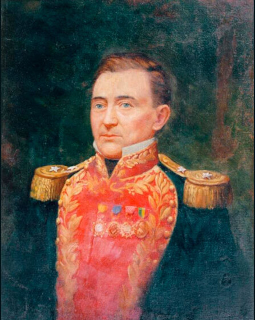
Wright is born to Joseph Wright and Mary Montgomery. At the age of eleven, he is sent to the Royal Naval College at Portsmouth, regarded at the time as the finest in the world, where he is educated to become an officer.
At the age of fourteen, following his junior officer training, Wright embarks on a sea voyage on board HMS Newcastle under the captaincy of Lord George Stuart. On this vessel he sails to the east coast of the United States where he is engaged in blockading activities in the squadron of Admiral John Borlase Warren. In 1817 he returns to England, having attained the junior officer’s rank of midshipman.
Although Wright passes the lieutenant‘s examination, promotional opportunities are diminishing in the Royal Navy, and he is not given a commission like many young junior officers in Britain. Collectively, he and others decide to enlist in Simón Bolívar’s revolutionary army and sail for South America in support of the uprisings against Spanish colonial rule. In November 1817, he enlists as an officer in the British Legions of Simón Bolívar, under the patronage of Luis Lopez Mendez, Bolivar’s agent in London. Originally setting off from the River Thames in November 1817, several snags delay the departure until January 2, 1818. They depart from Fowey harbor and sail on a brigantine named Dowson, under naval commander Captain Dormer, with 200 other volunteers armed with valuable weapons and ammunition. They land in the Saint Thomas Island after several weeks. Admiral Luis Brión arrives with his squadron on the Island of St Thomas and Pigott and the Rifle Corps are shipped on Patriot vessels to Margarita Island off the coast of Venezuela, arriving on April 21, 1818.
They are sent to Guayana and then to Angostura, beginning the campaign in the Apure. At Angostura (present-day Ciudad Bolívar), Wright first meets Simón Bolívar, for whom he develops a deep admiration. Bolívar opens the liberating campaign in Apure. During 1818–1819, one of the earliest battles with Wright partaking as an officer is at Trapiche de Gamarra on March 27, 1819. These encounters inspire Bolívar to begin his New Granada campaign and the march 1,500 miles over the Andes Mountains. Wright accompanies Bolívar on the legendary crossing on which 25% of the British/Irish troops die.
Wright takes part in the entire land campaign to liberate the northern countries of South America, and fights in numerous land battles with Bolívar’s army. He plays leading roles in the Battle of Vargas Swamp, and later in the victory at the Battle of Boyacá in August 1819, after which he is promoted to captain. In 1820, he returns with his Rifles regiment to the coastal plains to campaign in the jungles east of the Magdalena against the Spanish based on Santa Marta. The Rifles Corp are then transported by sea to Maracaibo, and on June 21, 1821, take part in Simon Bolívar’s decisive victory in the Battle of Carabobo. Cartagena is also seized, and the Rifles are brought in boats up the Magdalena River en route to Popayán. They form part of the forces led by Bolívar in the second of his famed Andean campaigns. After the successful battle at Bomboná on 7 April 7, 1822, Wright is twice mentioned in Bolívar’s order of the day for his exceptional skill and courage. Again, he is promoted and from February 1822 he is an acting lieutenant colonel.
In early 1824, Bolívar realizes that, despite the Patriot Army success on land, unless the South American revolutionary armies can control the seas off their coasts, they will forever be under sea blockade from imperial Spain. He appoints Wright to the newly fledged United Pacific Naval Squadron.
After Guayaquil seizes independence, John Illingworth Hunt is appointed as Commanding General of the Maritime Department. Immediately he takes care of organizing everything concerning the Navy. Thus, in 1823, the first Ecuadorian naval force is formed.
Wright, who in February 1824 is promoted to captain, becomes Commodore of the South Squadron, and embarks on the brig Chimborazo, and conducts patrols along the Peruvian coast with seven transports properly equipped and ready to assist in the transfer of troops, when Bolívar’s army would require it. Following Bolivar’s defeat of the royalist forces at the Battle of Junín on August 6, 1824, Wright is instructed to proceed to Callao with a squadron of five ships and is placed under the orders of Admiral Martin Guisse, head of the United Squadron. The Gran Colombian units, forming this squadron, participate in some naval actions against the royalists and also in the blockade of Callao, the last Spanish stronghold in South America.
Bolívar installs Wright as a Commodore of the Pacific Southern Squadron. He is appointed to command a small fleet of ships in support of Admiral Martin Guisse and joins the Patriotic naval force blockading off Callao. Along with Admiral Guisse and a handful of other former Royal Navy officers, they spearhead the blockade of Callao that successfully fights the Spanish naval squadron sent to lift the blockade of the besieged city. The blockade holds and Callao capitulates in early 1826, ending Spanish rule in South America.
The revolutionary independence struggles end with the unfolding liberation of South America countries, and Wright settles in Ecuador where he helps establish the Ecuadorian Navy and helps create the Ecuadorian naval school that is named in his honor.
The downfall and expulsion of the Spanish colonial power leads to land disputes and new wars among the South American home nations that once were united against Spain. In 1827, Peruvian PresidentJosé de la Mar invades Bolivia and then invades Ecuador. Wright takes up the cause of defending his new adopted homeland. His navy fights two battles with the Peruvians in the Gulf of Guayaquil.
Ecuador declares itself a republic in 1830, though the region is completely unsettled with Peru and Colombia both claiming parts of Ecuador as part of their territory. At this time Wright goes back in the Navy with his own flag officer’s pendant. He is also appointed to the army with the rank of General of Brigade in 1830. Two unconstitutional presidents, Vincente Rocafuerte and Valdivieso, declare themselves in office. Wright and Flores lead Rocafuerte’s army into a decisive battle that takes place at Minarica in 1835. This action is decisive, and they defeat General Barriga, who is Valdivieso’s appointed General. The victory guarantees the stability and future of Ecuador, with Rocafuerte becoming Ecuador’s president.
In 1835, Wright is Comandante del Apostadero, later changed to Comandancia General de la Marina (Commander-in-Chief of the Navy) for many years. He does not found the Ecuadorian Naval School, as often incorrectly cited. The college is named in his honor. He is the commanding officer of the Ecuadorian Naval Squadron before Ecuador becomes a Republic, as such he is considered a founding father of the Ecuadorian Navy. In this year he is also promoted to Army General of Division.
In 1843, Wright becomes the Governor of Guayaquil. This is the premier military position in the city.
In 1845, a military coup plot overthrows the liberal government supported by Wright and he goes into exile for fifteen years in Chile and Peru. In Chorrillos, Peru, he befriends the Ecuadorian exile Eloy Alfaro and exerts a massive influence on him as a mentor. Alfaro later becomes President of Ecuador from 1897 to 1913. Wright returns from exile in 1860 and opposes Gabriel García Moreno until his death in 1868.
Sackville then enters the army. He is elected Grandmaster of the Grand Lodge of Ireland in 1751, serving in this post for two years. He marries Diana Sambrooke, daughter of John Sambrooke and Elizabeth Forester, on September 3, 1754. They have two sons and three daughters.
In 1747 and 1748, Sackville again joins the Duke of Cumberland. He becomes colonel of the 7th Irish horse and serves in Holland. There is a break in his military career between wars (1750-1755) when he serves as first secretary to his father.
In June 1758 Sackville is second in command of a British expedition led by Marlborough which attempts an amphibious Raid on St. Malo. While it fails to take the town as instructed, the raid is still considered to be largely successful as a diversion. Follow-up raids are considered against Le Havre, Caen and other targets in Normandy, but no further landings are attempted, and the force returns home. Later in 1758 they join the allied forces of Duke Ferdinand of Brunswick in Germany. When Marlborough dies, Sackville becomes Commander of the British contingent of the army, although still under the overall command of the Duke of Brunswick.
In the Battle of Minden on August 1, 1759, British and Hanoverian infantry of the centre make an advance on the French cavalry and artillery in that sector. As the disrupted French begin to fall back on Minden, Ferdinand calls for a British cavalry charge to complete the victory, but Sackville withholds permission for their advance repeatedly. For this action, he is cashiered and sent home. John Manners, Marquess of Granby, replaces him as commander of the British contingent for the remainder of the war.
Sackville refuses to accept responsibility for refusing to obey orders. Back in England, he demands a court-martial and makes it a large enough issue that he obtains his demand in 1760. The court finds him guilty, and the verdict not only upholds his discharge, but rules that he is “…unfit to serve His Majesty in any military Capacity whatever.” The king has his name struck from the Privy Council rolls.
Sackville is a Member of Parliament at intervals from 1733. He serves terms in both the Dublin and the Westminster bodies, sometimes simultaneously, but does not take sides in political wrangles. Between 1750 and 1755 he serves as Chief Secretary for Ireland, during his father’s second term as Lord Lieutenant of Ireland.
On November 10, 1775, Sackville is appointed Secretary of State for the Colonies replacing William Legge, 2nd Earl of Dartmouth in the post. He becomes a target for the opposition and is eventually persuaded to step down in exchange for a peerage, and in February 1782 he is made Baron Bolebrooke, in the County of Sussex, and Viscount Sackville, of Drayton in the County of Northamptonshire. His political career ends with the fall of the North government in March 1782.
The controversy over Sackville’s handling of the war continues. Some members are opposed to his taking a seat in the House of Lords, an almost unprecedented incident. In spite of this he is admitted to the Lords, where he is staunchly defended by Edward Thurlow, 1st Baron Thurlow, and his declining health soon makes the issue irrelevant. He retires to his country home at Stoneland Lodge and dies there on August 26, 1785. He maintains to his dying day that he had not been a coward at Minden. Following his death, a defence of his reputation, The character of the late Viscount Sackville, is written by Richard Cumberland.
(Pictured: “George Germain,” 1766 painting by George Romney (1734-1802))



 seamus dubhghaill