seamus dubhghaill

Promoting Irish Culture and History from Little Rock, Arkansas, USA


Leave a comment

Dáil Éireann Approves the Anglo-Irish Treaty

second-all-ireland-dail

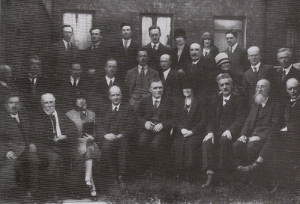
Dáil Éireann votes to approve the Anglo-Irish Treaty on January 7, 1922, following a debate through late December 1921 and into January 1922. The vote is 64 in favour, 57 against, with the Ceann Comhairle and three others not voting. The Sinn Féin party splits into opposing sides in the aftermath of the Treaty vote, which leads to the Irish Civil War from June 1922 until May 1923. The treaty is signed in London on December 6, 1921.

Two elections take place in Ireland in 1921, as a result of the Government of Ireland Act 1920 to establish the House of Commons of Northern Ireland and the House of Commons of Southern Ireland. The election is used by the Irish Republic as the basis of membership of the Second Dáil. The general election to the Northern Ireland House of Commons occurs on May 24, 1921. Of 52 seats, forty are won by unionists, six by moderate Irish nationalists, and six by Sinn Féin. No actual polling takes place in the Southern Ireland constituencies, as all 128 candidates are returned unopposed. Given the backdrop of the increasingly violent War of Independence, any candidates opposed to Sinn Féin, and their supporters can expect to be harassed by the Irish Republican Army (IRA). Supporters of the Irish Labour Party stand aside to allow the constitutional situation to run its course. Of these 128, 124 are won by Sinn Féin, and four by independent unionists representing the University of Dublin constituency. Only the Sinn Féin candidates recognise the Second Dáil and five of these have been elected in two constituencies, one in each part of Ireland, so the total number of members who assemble in the Second Dáil is 125.

During the Second Dáil, the government of the Irish Republic and the British government of David Lloyd George agree to hold peace negotiations. On September 14, 1921, the Dáil ratifies the appointment of Arthur Griffith, Michael Collins, Robert Barton, Eamonn Duggan, and George Gavan Duffy as envoys plenipotentiary for the peace conference in England. These envoys eventually sign the Anglo-Irish Treaty on December 6. After almost a month of acrimonious debate the treaty is formally ratified by Dáil Éireann on January 7, 1922.

To satisfy the requirements of the British constitution, the treaty also has to be ratified by the House of Commons of Southern Ireland. Thus, Irish nationalists end their boycott of the home rule parliament to attend the southern House of Commons as MPs. This they do alongside the four Unionist MPs who had refused to recognise the Dáil. In this way the treaty is ratified a second time in Dublin, this time unanimously as the anti-Treaty TDs refuse to attend.

Under the terms of the Anglo-Irish Treaty a provisional parliament, considered by nationalists to be the Third Dáil, is elected in the 1922 general election on June 16. Collins and Éamon de Valera agree a pact between the pro- and anti-Treaty wings of Sinn Féin, and this pact and the elections are endorsed by the Second Dáil. The new assembly is recognised both by nationalists and the British Government and so replaces both the Parliament of Southern Ireland and the Second Dáil with a single body. The anti-Treaty groups of IRA members, TDs, and their supporters are still bitterly opposed the settlement, despite the election result, and this leads to the Irish Civil War.

(Pictured: Second All-Ireland Dáil Éireann, elected in 1921)


1 Comment

Execution of “Half-Hanged MacNaghten”

half-hanged-macnaghten

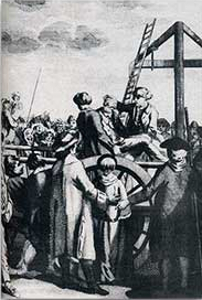
John MacNaghten, Anglo-Irish land owner, gambler, and convicted murderer also known as “Half-Hanged MacNaghten,” is hanged at Strabane jail on December 15, 1761, for his involvement in the killing of Mary Anne Knox, daughter of Andrew Knox MP.

MacNaghten is born into a landed Anglo-Irish family and attends Raphoe Royal school in County Donegal. In 1740, he inherits his family estate worth £500 a year and that same year enters Trinity College, Dublin. MacNaghten marries the sister-in-law of the first earl of Massereene. However, he is quickly enamoured of the extravagant lifestyle of Ascendancy Dublin where he becomes a popular and colourful character. He develops an addiction to gambling and squanders away a large part of his inheritance, running up substantial gaming debts and by 1750 is threatened with arrest.

Following the death of his wife in childbirth, he is appointed to the lucrative post of tax collector for Coleraine but gambles away £800 of the King’s money. His estate is sequestered and by 1760 he is penniless.

He gains support trying to help overcome his addiction from a childhood friend, Andrew Knox. Knox is a wealthy land-owner and Member of Parliament (MP) for Donegal who lives on an estate at Prehen about two miles outside the city of Derry. Mary Ann, Knox’s 15-year-old daughter, is already a substantial heiress, having received some £6,000, and would collect a further legacy if her brother dies without issue. MacNaghten and Mary Ann develop a relationship as the former visits Prehen regularly. Nonetheless by 1761 their relationship has run into difficulties.

The practice of abduction and marriage is prevalent in 18th century Ireland among young men of social standing but with little property and, within their society, it is tolerated. So, on November 10, 1761, MacNaghten and his followers attempt to abduct Mary Ann from a carriage on a family journey to Dublin Parliament with the intention of eloping with her. The attempt fails miserably as MacNaghten shoots and mortally wounds her by mistake. He is taken to Lifford Courthouse in County Donegal, where a court finds MacNaghten guilty of murder and he is sentenced to execution by hanging.

At Strabane jail on December 15, 1761, MacNaghten hurls himself from the gallows with such force that the rope breaks. He has the sympathy of the crowd who believe this is divine intervention for a man distraught with grief over the death of his love. Despite the belief that MacNaghten could not be hanged a second time, he fails to use the cover of a sympathetic crowd to make good his escape. Rather he defies the public mood of the people with the never-to-be-forgotten words, “I vow that no one will ever speak of me as Half-Hanged MacNaghten.” He returns himself to the jurisdiction of the hangman and, with a new rope, is dispatched into the arms of eternity.

John McNaghton is buried at Patrick Street graveyard, Strabane, County Tyrone.


Leave a comment

Birth of Activist & Feminist Hanna Sheehy-Skeffington

hanna-sheehy-skeffington

Johanna Mary “Hanna” Sheehy-Skeffington, Republican activist and feminist, is born in Kanturk, County Cork, on May 24, 1877.

Sheehy is the eldest daughter of Elizabeth McCoy and David Sheehy, an ex-Fenian and Member of Parliament (MP) for the Irish Parliamentary Party, representing South Galway. One of her uncles, Father Eugene Sheehy, is known as the Land League Priest, and his activities land him in prison. He is also one of Éamon de Valera‘s teachers in Limerick. When Hanna’s father becomes an MP in 1887, the family moves to Drumcondra, Dublin.

Sheehy is educated at the Dominican Convent on Eccles Street, where she is a prize-winning pupil. She then enrolls at St. Mary’s University College, a third level college for women established by the Dominicans in 1893, to study modern French and German. She sits for examinations at Royal University of Ireland and receives a Bachelor of Arts degree in 1899, and a Master of Arts Degree with first-class honours in 1902. This leads to a career as a teacher in Eccles Street and an examiner in the Intermediate Certificate examination.

Sheehy marries Francis Skeffington in 1903, and they both take the surname Sheehy Skeffington, which they do not hyphenate but use as a double name. In 1908, they found the Irish Women’s Franchise League, a group aiming for women’s voting rights.

Sheehy-Skeffington gets into numerous scuffles with the law. She is jailed in 1912 for breaking windows of government buildings in support of suffrage as part of an IWFL campaign. That same year she also throws a hatchet at visiting British Prime Minister Herbert Asquith. She loses her teaching job in 1913 when she is arrested and imprisoned for three months after throwing stones at Dublin Castle and assaulting a police officer in a feminist action. While in jail she goes on hunger strike and is released under the Prisoner’s Temporary Discharge of Ill Health Act but is soon rearrested.

Being free from her teaching job enables Sheehy-Skeffington to devote more time to the fight for suffrage. She is influenced by James Connolly and during the 1913 lock-out works with other suffragists in Liberty Hall, providing food for the families of the strikers.

She strongly opposes participation in World War I which breaks out in August 1914 and is prevented by the British government from attending the International Congress of Women held in The Hague in April 1915. The following June her husband is imprisoned for anti-recruiting activities. He is later shot dead during the 1916 Easter Rising after having been arrested by British soldiers.

Sheehy-Skeffington refuses compensation for her husband’s death, which is offered on condition of her ceasing to speak and write about the murder. Rather, she travels to the United States to publicise the political situation in Ireland. In October 1917, she is the sole Irish representative to League for Small and Subject Nationalities where, along with several other contributors, she is accused of pro-German sympathies. She publishes British Militarism as I Have Known It, which is banned in the United Kingdom until after the World War I. Upon her return to Britain she is once again imprisoned, this time in Holloway prison. After release, Sheehy-Skeffington attends the 1918 Irish Race Convention in New York City and later supports the anti-Treaty Irish Republican Army (IRA) during the Irish Civil War.

In 1926, Sheehy-Skeffington becomes a founding member of Fianna Fáil and is elected to the party’s Ard Comhairle. During the 1930s, she is assistant editor of An Phoblacht. In January 1933, she is arrested in Newry for breaching an exclusion order banning her from Northern Ireland. At her trial she says, “I recognize no partition. I recognize it as no crime to be in my own country. I would be ashamed of my own name and my murdered husband’s name if I did…Long live the Republic!” She is sentenced to a month’s imprisonment.

Sheehy-Skeffington is a founding member of the Irish Women Workers’ Union and an author whose works deeply oppose British imperialism in Ireland. Her son, Owen Sheehy-Skeffington, becomes a politician and Irish Senator.

Hanna Sheehy-Skeffington dies in Dublin on April 20, 1946, at the age of 68 and is buried with her husband in Glasnevin Cemetery, Dublin.


Leave a comment

Bernadette Devlin Elected MP for Mid Ulster Constituency

Bernadette Devlin, Irish socialist and republican political activist, is elected Member of Parliament (MP) for the Mid Ulster constituency on April 17, 1969, standing as the Independent Unity candidate.

Devlin is born in Cookstown, County Tyrone to a Roman Catholic family and attends St. Patrick’s Girls Academy in Dungannon. She is studying Psychology at Queen’s University Belfast in 1968 when she takes a prominent role in a student-led civil rights organisation, People’s Democracy. Devlin is subsequently excluded from the university.

She stands unsuccessfully against James Chichester-Clark in the Northern Ireland general election of 1969. When George Forrest, the MP for Mid Ulster, dies, she fights the subsequent by-election on the “Unity” ticket, defeating Forrest’s widow Anna, the Ulster Unionist Party candidate, and is elected to the Parliament of the United Kingdom. At age 21, she is the youngest MP at the time, and remains the youngest woman ever elected to Westminster until the May 2015 general election when 20-year-old Mhairi Black succeeds to the title.

After engaging on the side of the residents in the Battle of the Bogside, she is convicted of incitement to riot in December 1969, for which she serves a short jail term.

Having witnessed the events of Bloody Sunday, Devlin is infuriated that she is consistently denied the floor in the House of Commons by the Speaker Selwyn Lloyd, despite the fact that parliamentary convention decrees that any MP witnessing an incident under discussion would be granted an opportunity to speak about it. Devlin slaps Reginald Maudling, the Home Secretary in the Conservative government, across the face when he states in the House of Commons that the paratroopers had fired in self-defence on Bloody Sunday.

Devlin helps to form the Irish Republican Socialist Party, a revolutionary socialist breakaway from Official Sinn Féin, with Seamus Costello in 1974. She serves on the party’s national executive in 1975 but resigns when a proposal that the Irish National Liberation Army become subordinate to the party executive is defeated. In 1977, she joins the Independent Socialist Party, but it disbands the following year.

Devlin stands as an independent candidate in support of the prisoners at Long Kesh prison in the 1979 European Parliament elections in Northern Ireland and wins 5.9% of the vote. She is a leading spokesperson for the Smash H-Block Campaign, which supports the hunger strikes of 1980 and 1981.

On January 16, 1981, Devlin and her husband, Michael McAliskey, are shot by members of the Ulster Defence Association (UDA), who break into their home near Coalisland, County Tyrone. Devlin is shot fourteen times in front of her children. British soldiers are watching the McAliskey home at the time but fail to prevent the assassination attempt. The couple are taken by helicopter to a hospital in nearby Dungannon for emergency treatment and then transported to the Musgrave Park Hospital, Military Wing, in Belfast, under intensive care. The attackers, all three members of the South Belfast UDA, are captured by the army patrol and subsequently jailed.

In 1982, she twice fails in an attempt to be elected to the Dublin North–Central constituency of Dáil Éireann. In 2003, she is barred from entering the United States and is deported on the grounds that the United States Department of State has declared that she “poses a serious threat to the security of the United States,” apparently referring to her conviction for incitement to riot in 1969.

On May 12, 2007, she is the guest speaker at éirígí‘s first Annual James Connolly commemoration in Arbour Hill, Dublin. She currently co-ordinates a not-for-profit community development organisation based in Dungannon, the South Tyrone Empowerment Programme, and works with migrant workers to improve their treatment in Northern Ireland.


Leave a comment

Birth in Belfast of Ian Paisley

ian-paisley

Ian Richard Kyle Paisley, loyalist politician and Protestant religious leader from Northern Ireland is born on April 6, 1926, in Armagh, County Armagh.

Paisley becomes a Protestant evangelical minister in 1946 and remains one for the rest of his life. In 1951, he co-founds the fundamentalist Free Presbyterian Church of Ulster and is its leader until 2008. Paisley becomes known for his fiery speeches and regularly preaches and protests against Catholicism, ecumenism and homosexuality. He gains a large group of followers who are referred to as “Paisleyites.”

Paisley becomes involved in Ulster unionist/loyalist politics in the late 1950s. In the mid-late 1960s he leads and instigates loyalist opposition to the Catholic civil rights movement in Northern Ireland. This leads to the outbreak of The Troubles in the late 1960s, a conflict that engulfs Northern Ireland for the next thirty years. In 1970, he becomes Member of Parliament for North Antrim and the following year he founds the Democratic Unionist Party (DUP), which he leads for almost forty years. In 1979, he becomes a Member of the European Parliament.

Throughout the Troubles, Paisley is seen as a firebrand and the face of hard-line unionism. He opposes all attempts to resolve the conflict through power-sharing between unionists and Irish nationalists/republicans, and all attempts to involve the Republic of Ireland in Northern affairs. His efforts help bring down the Sunningdale Agreement of 1974. He also opposes the Anglo-Irish Agreement of 1985, with less success. His attempts to create a paramilitary movement culminate in Ulster Resistance. Paisley and his party also oppose the Northern Ireland peace process and Good Friday Agreement of 1998.

In 2005, Paisley’s DUP becomes the largest unionist party in Northern Ireland, displacing the Ulster Unionist Party (UUP), which has dominated unionist politics since 1905. In 2007, following the St. Andrews Agreement, the DUP finally agrees to share power with republican party Sinn Féin and consent to all-Ireland governance in certain matters. Paisley and Sinn Féin’s Martin McGuinness become First Minister and deputy First Minister respectively in May 2007. Paisley steps down as First Minister and DUP leader in May 2008 and leaves politics in 2011. Paisley is made a life peer in 2010 as Baron Bannside.

In November 2011, Paisley announces to his congregation that he is retiring as a minister. He delivers his final sermon to a packed attendance at the Martyrs’ Memorial Hall on December 18, 2011, and finally retires from his religious ministry on January 27, 2012.

Paisley dies in Belfast on September 12, 2014. He is buried in Ballygowan, County Down on September 15 following a private funeral and a public memorial for 800 invited guests is held in the Ulster Hall on October 19. An obituary in The New York Times reports that late in life Paisley had moderated and softened his stances against Roman Catholics but that “the legacies of fighting and religious hatreds remained.”


Leave a comment

Death of Politician & Journalist Timothy Michael Healy

Timothy Michael “Tim” Healy, Irish nationalist politician, journalist, author, barrister, and one of the most controversial Irish Members of Parliament (MPs) in the House of Commons of the United Kingdom of Great Britain and Ireland, dies in Chapelizod, County Dublin, on March 26, 1931.

Healy is born in Bantry, County Cork, the second son of Maurice Healy, clerk of the Bantry Poor Law Union, and Eliza Healy (née Sullivan). His father is transferred in 1862 to a similar position in Lismore, County Waterford. Timothy is educated at the Christian Brothers school in Fermoy, and is otherwise largely self-educated, in 1869, at the age of fourteen, he goes to live with his uncle Timothy Daniel Sullivan in Dublin.

Healy then moves to England in 1871, working first as a railway clerk and then from 1878 in London as parliamentary correspondent of The Nation, writing numerous articles in support of Charles Stewart Parnell, the newly emergent and more militant home rule leader, and his policy of parliamentary obstructionism. Healy takes part in Irish politics and becomes associated with Parnell and the Irish Parliamentary Party. After being arrested for intimidation in connection with the Irish National Land League, he is promptly elected as member of Parliament for Wexford Borough in 1880.

In Parliament, Healy becomes an authority on the Irish land question. The “Healy Clause” of the Land Act of 1881, which protects tenant farmers’ agrarian improvements from rent increases imposed by landlords, not only makes him popular throughout nationalist Ireland but also wins his cause seats in Protestant Ulster. He breaks with Parnell in 1886 and generally remains at odds with subsequent leaders of the Irish Parliamentary Party, though he is a strong supporter of proposals for Irish Home Rule. Meanwhile, he is called to the Irish bar in 1884 and becomes a queen’s counsel in 1899.

Dissatisfied with both the Liberals and the Irish Nationalists after the Easter Rising in 1916, Healy supports Sinn Féin after 1917. He returns to considerable prominence in 1922 when, on the urging of the soon-to-be Irish Free State’s Provisional Government of W.T. Cosgrave, the British government recommends to King George V that Healy be appointed the first “Governor-General of the Irish Free State,” a new office of representative of the Crown created in the 1921 Anglo-Irish Treaty and introduced by a combination of the Irish Free State Constitution and Letters Patent from the King.

Healy believes that he has been awarded the Governor-Generalship for life. However, the Executive Council of the Irish Free State decides in 1927 that the term of office of Governors-General will be five years. As a result, he retires from the office and public life in January 1928 and publishes his extensive two volume memoirs later in that year. Throughout his life he is formidable because he is ferociously quick-witted, because he is unworried by social or political convention, and because he knows no party discipline. Towards the end of his life, he becomes more mellowed and otherwise more diplomatic.

Healy dies on March 26, 1931, at the age of 75, in Chapelizod, County Dublin. He is buried in Glasnevin Cemetery in Dublin.


Leave a comment

John Redmond Elected Leader of the Irish Parliamentary Party

john-redmond-1917

John Edward Redmond, Irish nationalist politician, barrister, and Member of Parliament (MP) in the British House of Commons, is elected leader of the Irish Parliamentary Party on February 6, 1900.

Redmond is born at Ballytrent House, his grandfather’s old family mansion, in Kilrane, County Wexford. As a student at Clongowes Wood College, he exhibits the seriousness that many soon come to associate with him. After finishing at Clongowes, Redmond attends Trinity College, Dublin to study law, but his father’s ill health leads him to abandon his studies before taking a degree and, in 1876, goes to live with him in London. As a clerk in the House of Commons he increasingly identifies himself with the fortunes of Charles Stewart Parnell, one of the founders of the Irish Land League.

Redmond first attends political meetings with Parnell in 1879. Upon the death of his father, a Member of Parliament for Wexford, in 1880, Redmond writes to Parnell asking for adoption as the Nationalist Party, which becomes the Irish Parliamentary Party in 1882, candidate in the by-election to fill the open seat, but is disappointed to learn that Parnell has already promised the next vacancy to his secretary Timothy Healy. When a vacancy arises in New Ross, he wins election unopposed as the Parnellite candidate for the seat. He served as MP for New Ross from 1881 to 1885, for North Wexford from 1885 to 1891 and finally for Waterford City from 1891 until his death in 1918.

In 1890, the Irish Parliamentary Party splits over Parnell’s leadership when his long-standing adultery with Katharine O’Shea is revealed in a spectacular divorce case. Redmond stands by Parnell and works to keep the minority faction active. When Parnell dies in 1891, Redmond takes over leadership of the Parnellite faction of the split party, called the Irish National League (INL). The larger anti-Parnellite group forms the Irish National Federation (INF) under John Dillon.

Through the initiative of William O’Brien and his United Irish League (UIL), the INL and the INF re-unite on February 6, 1900, within the Irish Parliamentary Party. Redmond is elected its chairman, a position he holds until his death in 1918, a longer period than any other nationalist leader with the exceptions of Éamon de Valera and Daniel O’Connell.

The achievement of Home Rule is his life’s goal, having strongly supported William Gladstone’s Home Rule bills of 1886 and 1893. His best opportunity arises when the Irish Parliamentary Party holds the balance of power under H. H. Asquith in the period from 1910 onwards.  Opposition by the Ulster Unionists frustrates his plans, his main worry being that Home Rule will result in the permanent exclusion of at least some of the Ulster counties. He also fears that the activities of the Irish Volunteers might hinder the enactment of Home Rule. To guard against this eventuality, he secures the control of the organisation in June 1914.  He welcomes the Government of Ireland Act, 1914 as the only measure of Home Rule then possible. Its suspension for the duration of the war postpones addressing the issue of partition.

To ensure the success of the war effort and the speedier implementation of Home Rule, Redmond offers the services of the Irish Volunteers for the defence of the country, an offer rejected by the government. By encouraging the Volunteers to join the British army, he splits the organisation. The vast majority, totaling 170,000 and thereafter known as the National Volunteers, follow Redmond, many of them enlisting in the British army.  Those who aspire to an Irish republic or who have lost faith in Home Rule remain as the Irish Volunteers, their numbers now reduced to about 10,000.

Consequently, the 1916 Easter Rising takes him completely by surprise. Committed to keeping Ireland within the Union, he regards the Rising as treason and a “German intrigue.”  He has no sympathy with the leaders or their objective of a republic.  Nevertheless, he pleads for leniency in the House of Commons.

An operation in March 1918 to remove an intestinal obstruction appears to progress well at first, but then he suffers heart failure. He dies a few hours later at a London nursing home on March 6, 1918. One of the last things he says to the Jesuit Father who is with him to the end is, “Father, I am a broken-hearted man.”