After qualifying, Ryan works for several solicitors’ firms before establishing a private practice in Dame Street in Dublin, in which he remains an active partner until appointed to ministerial office in 1973.
In opposition, Ryan serves as Fine Gael Spokesperson on Health and Social Welfare (1966–70) and on Foreign Affairs and Northern Ireland (1970–73). During this period he is involved in several important pro bono legal cases, including the 1963 challenge in the High Court, and then, on appeal, in the Supreme Court of Ireland in 1964, by Gladys Ryan (no relation) on the constitutionality of the fluoridation of the water supply. While the court rules against Gladys Ryan, the case remains a landmark, for it establishes the right to privacy under the Constitution of Ireland (or, perhaps more precisely, the right to bodily integrity under Article 40.3.1.). The case also raises a legal controversy, owing to the introduction by Justice Kenny of the concept of unenumerated rights. Other notable cases involving Ryan include a challenge to the rules governing the drafting of constituency boundaries, and an unsuccessful attempt to randomise the order of candidates on ballot papers (owing to a preponderance of TDs with surnames from the first part of the alphabet).
Fine Gael comes to power in a coalition with the Labour Party in 1973, and Ryan becomes Minister for Finance. He presides over a tough four years in the National Coalition under Liam Cosgrave, during the 1970s oil crisis when, in common with most Western economies, Ireland faces a significant recession. He is variously lampooned as “Richie Ruin” on the Irish satire show Hall’s Pictorial Weekly, and as “Red Richie” for his government’s introduction of a wealth tax. Following the 1977 Irish general election Fine Gael is out of power, and he once again becomes Spokesperson on Foreign Affairs.
On being appointed to the European Court of Auditors in 1986, he resigns his seat and is succeeded by Chris O’Malley. He serves as a member of the Court of Auditors from 1986 to 1994, being replaced by Barry Desmond. After retirement, he continues in several roles, including as a Commissioner of Irish Lights (until 2004) and a time as Chairman of the Irish Red Cross in 1998.
Ryan is the father of the economist and academic Cillian Ryan. He dies in Dublin at the age of 90 on March 17, 2019. He is buried at Newlands Cross Cemetery and Crematorium in Dublin.
The official statement at the end of the four-hour meeting states that progress has been made in “areas of consultation and co-operation.” The Taoiseach says they discussed industry, tourism, electricity supply, and trade, as well as tariff concessions, and “measures taken by both governments to prevent the spread of foot-and-mouth disease from Britain.”
Afterward, O’Neill returns to Northern Ireland by a different route in order to avoid any possible demonstration. Paisley has been developing a high profile for himself with his attacks on O’Neill in recent months. But he misses the opportunity to protest on this occasion. The next day he issues a statement regretting O’Neill’s return home. “I would advise Mr. Lynch to keep him,” Paisley announces.
Five years earlier, in 1963, O’Neill becomes Prime Minister of Northern Ireland. From very early on, he tries to break down sectarian barriers between the two Northern communities. He also seeks to improve relations with the Republic of Ireland by eradicating the impasse in relations that has existed since the 1920s. He invites then-Taoiseach Seán Lemass to meet him at Stormont on January 14, 1965. Lemass courageously accepts the invitation. At their initial meeting, when they are briefly alone, Lemass says to O’Neill, ”I shall get into terrible trouble for this!” The Northern premier replies, ”No, Mr. Lemass, it is I who will get into terrible trouble.”
O’Neill makes his return visit to Dublin on February 9, 1965, and the two leaders agree to co-operate on tourism and electricity. It is Lemass who makes the most significant concessions, because the Constitution of Ireland does not recognise the existence of the North. Article 2 of the Constitution actually claims sovereignty over the whole island. Thus, by formally meeting the Prime Minister of Northern Ireland, O’Neill claims that Lemass accorded him “a de facto recognition.”
The Taoiseach then bolsters this at their follow-up meeting in Iveagh House, Dublin, three weeks later. ”The place card in front of me at Iveagh House bore the inscription, Prime Minister of Northern Ireland,” O’Neill proudly explains. Surely this is tantamount to formal recognition. But many Unionists still have grave reservations about dealing with the Republic of Ireland.
In 1966, Ian Paisley establishes the Protestant Unionist Party (PUP) to oppose O’Neill. He rouses sectarian tension by holding mass demonstrations at which he brands O’Neill as the “Ally of Popery.” Nevertheless, public opinion polls indicate support for O’Neill’s leadership from both communities in the North.
After Jack Lynch replaced Lemass as Taoiseach in late 1966, O’Neill continues with his efforts to improve relations with the Dublin government by inviting Lynch to Stormont Castle. The Taoiseach travels to Belfast by car on December 11, 1967. There is no formal announcement of his visit, but word is leaked to Paisley after the Taoiseach’s car crosses the border.
Paisley arrives at Stormont with his wife and a handful of supporters, just minutes before the Taoiseach. With snow on the ground, two of Paisley’s church ministers, Rev. Ivan Foster and Rev. William McCrea, begin throwing snowballs at Lynch’s car. The Royal Ulster Constabulary (RUC) promptly grabs the two ministers. While they are being bundled into a police car, Paisley is bellowing, “No Pope here!” Lynch asks his traveling companion, T. K. Whitaker, “Which one of us does he think is the Pope?”
Paisley demands to be arrested by the RUC, and actually tries to get into the police car with his two colleagues, but he is pulled away. The two clergymen are taken to an RUC station and quickly released. Lynch ridicules the protest. “It was a seasonal touch,” he says. “It reminds me of what happens when I go through a village at home and the boys come and throw snowballs.”
Paisley says he had come to protest against “the smuggling” of Lynch into Stormont. If he had known about the visit earlier, he says that he would have brought along 10,000 people to protest. Denouncing O’Neill, as a “snake in the grass,” he goes on to accuse Lynch of being “a murderer of our kith and kin.” In an editorial, the Unionist Newsletter proclaims that ”there is no doubt that Capt. O’Neill has the full support of his colleagues and of the country.”
O’Neill’s four formal meetings with Lynch and his predecessor contribute to a thaw in relations at the summit between Belfast and Dublin, but the whole process is exploited by others to fan the flames of Northern sectarianism.
People do not realise it in early 1968, but Northern Ireland is about to explode. On October 5, 1968, people gather in Derry for a civil rights march that has been banned by Stormont. When the march begins, it is viciously attacked by the RUC. This ignites a series of further protests, which ultimately leads to Bloody Sunday, and the eruption of the Troubles for the next quarter of a century.
(From: “Meetings helped thaw relations before the North exploded,” Irish Examiner, http://www.irishexaminer.com, January 8, 2018)
Alan Martin Dukes, former Fine Gaelpolitician, is born in Drimnagh, Dublin, on April 20, 1945. He holds several senior government positions and serves as a Teachta Dála (TD) from 1981 to 2002. He is one of the few TDs to be appointed a minister on their first day in the Dáil.
The Dukes family originally comes from the north of England. His grandfather serves with the Royal Engineers in World War I and settles in County Cork and then County Kerry afterward where he works with the Post Office creating Ireland’s telephone network.
Dukes is educated by the Christian Brothers at Coláiste Mhuire, Dublin, and is offered several scholarships for third level on graduation, including one for the Irish language. His interest in the Irish language continues to this day, and he regularly appears on Irish-language television programmes.
On leaving school he attends University College Dublin (UCD), where he captains the fencing team to its first-ever Intervarsity title.
In the 1979 European Parliament election, Dukes stands as a Fine Gael candidate in the Munster constituency. He has strong support among the farming community, but the entry of T. J. Maher, a former president of the IFA, as an independent candidate hurts his chances of election. Maher tops the poll.
This minority Fine Gael–Labour Partycoalition government collapses in February 1982 on the budget but returns to power with a working majority in December 1982. Dukes is again appointed to cabinet, becoming Minister for Finance less than two years into his Dáil career.
He faces a difficult task as finance minister. Ireland is heavily in debt while unemployment and emigration are high. Many of Fine Gael’s plans are deferred while the Fine Gael–Labour Party coalition disagrees on how to solve the economic crisis. The challenge of addressing the national finances is made difficult by electoral arithmetic and a lack of support from the opposition Fianna Fáil party led by Charles Haughey. He remains in the Department of Finance until a reshuffle in February 1986 when he is appointed Minister for Justice.
This is a difficult time for the country. Haughey’s Fianna Fáil runs on promises to increase spending and government services, and attacking the cutbacks favoured by Fine Gael. However, on taking office, the new Taoiseach and his finance minister Ray MacSharry immediately draw up a set of cutbacks including a spate of ward and hospital closures. This presents a political opportunity for the opposition to attack the government.
However, while addressing a meeting of the TallaghtChamber of Commerce, Dukes announces, in what becomes known as the Tallaght Strategy that: “When the government is moving in the right direction, I will not oppose the central thrust of its policy. If it is going in the right direction, I do not believe that it should be deviated from its course, or tripped up on macro-economic issues.”
This represents a major departure in Irish politics whereby Fine Gael will vote with the minority Fianna Fáil Government if it adopts Fine Gael’s economic policies for revitalising the economy. The consequences of this statement are huge. The Haughey government is able to take severe corrective steps to restructure the economy and lay the foundations for the economic boom of the nineties. However, at a snap election in 1989, Dukes does not receive electoral credit for this approach, and the party only makes minor gains, gaining four seats. The outcome is the first-ever coalition government for Fianna Fáil, whose junior partner is the Progressive Democrats led by former Fianna Fáil TD Desmond O’Malley.
Initially, Fianna Fáil’s Brian Lenihan Snr is the favourite to win. However, after several controversies arise, relating to the brief Fianna Fáil administration of 1982, and Lenihan’s dismissal as Minister for Defence midway through the campaign, the Labour Party’s Mary Robinson emerges victorious. To many in Fine Gael, the humiliation of finishing third is too much to bear and a campaign is launched against Dukes’ leadership. He is subsequently replaced as party leader by John Bruton.
Bruton brings Dukes back to the front bench in September 1992, shortly before the November 1992 Irish general election. In February 1994, Dukes becomes involved in a failed attempt to oust Bruton as leader and subsequently resigns from the front bench. Bruton becomes Taoiseach in December 1994 and Dukes is not appointed to cabinet at the formation of the government.
In 2001, Dukes backs Michael Noonan in his successful bid to become leader of Fine Gael.
After 21 years, Dukes loses his Dáil seat at the 2002 Irish general election. This contest sees many high-profile casualties for Fine Gael, including Deputy LeaderJim Mitchell, former deputy leader Nora Owen and others. Many local commentators feel that Dukes’ loss is due to a lack of attention to local issues, as he is highly involved in European projects and has always enjoyed a national profile.
He retires from frontline politics in 2002 and is subsequently appointed Director General of the Institute of International and European Affairs. He remains active within Fine Gael and serves several terms as the party’s vice-president. From 2001 to 2011, he is President of the Alliance française in Dublin, and in June 2004, the French Government appoints him an Officer of the Legion of Honour. In April 2004, he is awarded the Commander’s Cross of the Order of Merit of the Republic of Poland.
In December 2008, Dukes is appointed by Finance Minister Brian Lenihan Jnr as a public interest director on the board of Anglo Irish Bank. The bank is subsequently nationalised, and he serves on the board until the Irish Bank Resolution Corporation (IBRC) is liquidated in 2013.
Dukes has lived in Kildare since first being elected to represent the Kildare constituency in 1981. His wife Fionnuala (née Corcoran) is a former local politician and serves as a member of Kildare County Council from 1999 until her retirement in 2009. She serves as Cathaoirleach of the council from 2006 to 2007, becoming only the second woman to hold the position in the body’s one-hundred-year history. They have two daughters.
Reynolds is educated at Summerhill College in Sligo, County Sligo and works for a state transport company before succeeding at a variety of entrepreneurial ventures, including promoting dances and owning ballrooms, a pet-food factory, and newspapers. In 1974 he is elected to the Longford County Council as a member of Fianna Fáil. He enters Dáil Éireann, lower house of the Oireachtas, the Irish parliament, in 1977 as a member representing the Longford-Westmeath parliamentary constituency and becomes Minister for Posts and Telegraphs in Haughey’s Fianna Fáil government (1979–81). He is subsequently Minister of Industry and Commerce (1987–88) and Minister for Finance (1988–91) in Haughey’s third and fourth governments. He breaks with Haughey in December 1991. On January 30, 1992, Haughey retires as leader of Fianna Fáil at a parliamentary party meeting. Reynolds easily defeats his rivals Mary O’Rourke and Michael Woods in the party leadership election and succeeds Haughey as Taoiseach on February 11, 1992.
The Fianna Fáil–Progressive Democratscoalition that Reynolds inherits breaks up in November 1992 but, after the general election later that month, he surprises many observers by forming a new coalition government with the Labour Party in January 1993. He plays a significant part in bringing about a ceasefire between the Irish Republican Army (IRA) and unionist paramilitary groups in Northern Ireland in 1994, but he is less effective in maintaining his governing coalition. When this government founders in November 1994, he resigns as Taoiseach and as leader of Fianna Fáil, though he remains acting prime minister until a new government is formed the following month. He unsuccessfully seeks his party’s nomination as a candidate for the presidency of Ireland in 1997. He retires from public life in 2002.
Córas Iompair Éireann is formed as a private company by the Transport Act 1944 and incorporates the Great Southern Railways Company and Dublin United Transport Company, initially adopting the logo of the latter company. Great Southern Railways (GSR) is incorporated in 1925, having been Great Southern Railway since 1924. Essentially the GSR becomes – especially as it starts to broaden its business interests into road transport – a monopoly transport operator. The Transport Act 1950 amalgamates CIÉ and the Grand Canal Company and formally nationalises CIÉ, changing its structure from that of a private limited company to a corporation under a board appointed by the Minister for Transport. The Northern Ireland Great Northern Railway Act, 1958 transfers the lines of Great Northern Railway Board south of the border to CIÉ. Until 1986 CIÉ operates as a single legal entity, although it is internally organised into rail services and two bus divisions – Dublin City Services and Provincial Services. The vast majority of services are branded CIÉ, although long-distance provincial buses are branded “Expressway” and Dublin electric trains DART. In 1987, CIÉ reorganises into a holding company and three operating companies. In 1990 it sells its nine Great Southern Hotels, including its hotel in Derry, Northern Ireland, to Aer Rianta, the airports authority.
Since the enactment of the Transport (Re-organisation of Córas Iompair Éireann) Act, 1986 CIÉ has been the holding company for Bus Éireann, Dublin Bus and Iarnród Éireann/Irish Rail, the three largest internal transport companies in Ireland. It was originally to have operated the Luas tram system in Dublin, but that project was transferred to the newly created Railway Procurement Agency.
CIÉ is responsible for the overall strategy of the group. It owns all fixed assets used by the three companies, such as railway lines and stations, the latter being dealt with through the Group Property division. It also operates an international tour division, CIÉ Tours International. CIÉ’s vast number of advertising sites are organised through Commuter Advertising Network (CAN), since the mid-1990s employing an external company (currently Exterion Media Ireland) to manage them. There are also a number of shared services provided by CIÉ to its three operating companies.
Other than in the railway sector CIÉ is not a monopoly provider of public transport services as a number of other operators exist. However, under the Transport Act, 1932, these may not compete directly on any route for which CIÉ has been granted a licence. Legislation is enacted in 2013 to provide for the tendering of 10% of routes operated by Dublin Bus and Bus Éireann. This public competition includes these two operators, along with private operators such as Go-Ahead Ireland, and is completed in January 2019.
(Pictured: “The Broken Wheel” logo introduced in 1964 and modernised in 2000)
Colley is born in the Dublin suburb of Fairview on October 18, 1925, the son of Harry and Christina Colley. His father is a veteran of the 1916 Easter Rising and a former adjutant in the Irish Republican Army (IRA), who is elected to Dáil Éireann in 1944, as a Fianna Fáil candidate. He is educated at St. Joseph’s Secondary C.B.S. in Fairview, where one of his classmates and closest friends is Charles Haughey, who later becomes his political archrival. He studies law at University College Dublin (UCD) and qualifies as a solicitor in the mid-1940s. He remains friends with Haughey after leaving school and, ironically, encourages him to become a member of Fianna Fáil in 1951. Haughey is elected to Dáil Éireann in the 1957 Irish general election, ousting Colley’s father in the process. This puts some strain on the relationship between the two young men.
Colley is elected to the Dáil at the 1961 Irish general election, reclaiming his father’s old seat in the Dublin North-East constituency. Furthermore, he is elected in the same constituency as Haughey, thereby accentuating the rivalry. Thereafter, he progresses rapidly through the ranks of Fianna Fáil. He becomes a member of the Dáil at a time when a change from the older to the younger generation is taking place, a change facilitated by TaoiseachSeán Lemass.
Colley is active in the Oireachtas as chairman of some of the Joint Labour Committees, which are set up under the Labour Court, to fix legally enforceable wages for groups of workers who have not been effectively organised in trade unions. He is also leader of the Irish parliamentary delegation to the Consultative Assembly of the Council of Europe. His work as a backbencher is rewarded by his appointment as Parliamentary Secretary to the Minister for Lands in October 1964.
Following the return of Lemass’s government at the 1965 Irish general election, Colley joins the cabinet as Minister for Education. He introduces a plan to establish comprehensive schools, set up an advisory council on post-primary school accommodation in Dublin, and introduces a school psychological service.
Colley is promoted as Minister for Industry and Commerce in a cabinet reshuffle in July 1966, and he continues the government policy of economic expansion that had prevailed since the late 1950s.
In November 1966, Seán Lemass resigns suddenly as party leader. Colley contests the subsequent leadership election. He is the favoured candidate of party elders such as Seán MacEntee and Frank Aiken, the latter managing Colley’s campaign. Charles Haughey and Neil Blaney also declare their interest in the leadership; however, both withdraw when the Minister for Finance, Jack Lynch, announces his candidacy. Colley does not back down, and the leadership issue goes to a vote for the first time in the history of the Fianna Fáil party. The leadership election takes place on November 9, 1966, and Lynch beats Colley by 59 votes to 19. When the new Taoiseach announces his cabinet, Colley retains the Industry and Commerce portfolio.
In the wake of the Arms Crisis in 1970, a major reshuffle of the cabinet takes place, with four Ministers either removed, or resigned, or simply retired from the government due to the scandal. Colley remains loyal to the party leader and is rewarded by his appointment as Minister for Finance, the second most important position in government.
In 1973, Fianna Fáil are ousted after sixteen years in government when the national coalition of Fine Gael and the Labour Party come to power. Colley is appointed opposition Spokesman on Finance, in the new Fianna Fáil front bench. As the 1977 Irish general election approaches, Colley and Martin O’Donoghue are the main architects of Fianna Fáil’s election manifesto.
Fianna Fáil sweeps to power at the 1977 Irish general election, with a 20-seat Dáil majority, contrary to opinion polls and political commentators. Colley is re-appointed as Minister for Finance and Minister for the Public Service, and is also appointed as Tánaiste, establishing him firmly as the heir apparent to Taoiseach Jack Lynch.
In December 1979, Jack Lynch resigns unexpectedly as Taoiseach and as Fianna Fáil leader. Colley and Charles Haughey seek the leadership position and are evenly matched. A secret ballot is taken on December 7, 1979. The Minister for Foreign Affairs, Michael O’Kennedy, announces his support for Haughey on the eve of the election. This apparently swings the vote, and Haughey beats Colley by 44 votes to 38. Colley remains as Tánaiste but demands and receives a veto on Haughey’s ministerial appointments to the departments of Justice and Defence.
Fianna Fáil loses power at the 1981 Irish general election. Haughey delays naming a new opposition front bench, but Colley remains a key member of the Fianna Fáil hierarchy. The party regains office at the February 1982 Irish general election. He demands the same veto as before on Haughey’s Defence and Justice appointments but is refused. When it is revealed that Ray MacSharry is to be appointed Tánaiste in his stead, he declines another ministerial position. This effectively brings his front bench political career to an end, but he remains a vocal critic of the party leadership from the backbenches.
When the Fianna Fáil government collapses and are replaced by another coalition government after the November 1982 Irish general election, a number of TDs and Senators express lack of confidence in Haughey’s leadership once again. Several unsuccessful leadership challenges take place in late 1982 and early 1983, with Colley now supporting Desmond O’Malley and the Gang of 22 who oppose Haughey.
Colley dies suddenly on September 17, 1983, aged 57, while receiving treatment for a heart condition at Guy’s Hospital, Southwark, London. He is survived by his wife, three sons, and four daughters, one of whom, Anne Colley, becomes a TD as a member of the Progressive Democrats party.
Barry is first elected to Dáil Éireann as a Fine Gael Teachta Dála (TD) for the Cork City South-East constituency at the 1969 Irish general election. He goes go on to win a Dáil seat at eight successive general elections, changing constituency to Cork City in 1977 and Cork South-Central in 1981. When Fine Gael comes to power following the 1973 Irish general election, he is appointed Minister for Transport and Power. In 1976, he becomes Minister for Education. In 1979, after Garret FitzGerald becomes leader of Fine Gael, he is elected deputy leader. From June 1981 to March 1982, he serves as Minister for the Environment.
From December 1982 to 1987, Barry is Minister for Foreign Affairs. In this capacity he is heavily involved in the negotiations which result in the 1985 Anglo-Irish Agreement. He also becomes the first joint chairman of the Anglo-Irish Intergovernmental Conference, established under the Agreement by the Irish and British governments. Following the Labour Party‘s withdrawal from the coalition government in 1987, he becomes Tánaiste, for a brief period. He is the first member of Fine Gael to hold the office of Tánaiste.
When FitzGerald resigns as Fine Gael leader after the 1987 Irish general election, Barry is one of three candidates, along with Alan Dukes and John Bruton, who contest the party leadership. Dukes is the eventual victor.
Barry dies in Cork at the age of 88 on August 26, 2016, following a short illness. Irish PresidentMichael D. Higgins says Barry will be deeply missed. “His view of Irish history was a long one and he brought all that wisdom to bear in his contributions to achieving the Anglo-Irish Agreement. As a person he was immensely popular across all parties and, of course, he had a deep commitment to Cork city and its heritage.”
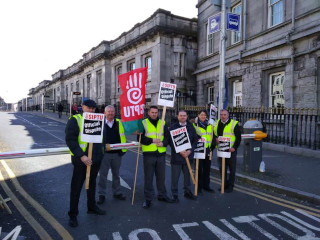
Tens of thousands of people have to make alternative travel arrangements on March 24, 2017 due to a strike at Bus Éireann over the company’s implementation of cost-reduction measures without union agreement. The bus and coach operator warns that the strike will worsen the company’s financial situation, which it describes as perilous.
Iarnród Éireann, the operator of the national railway network, says some Intercity services are affected by the dispute due to picketing. It says there is significant disruption, with some services cancelled and others curtailed. But Iarnród Éireann says special late-night trains for football fans returning from the Republic of Ireland vs. Wales match will operate to Cork, Limerick and Galway.
The Minister for TransportShane Ross says that he will “categorically” not be intervening during the strike and calls on both sides to get back to the talks. He says an industrial relations dispute is not a matter for the minister and that both parties should go to the Workplace Relations Commission and the Labour Court for talks. He adds that the only reason people are calling on him to intervene is to pay taxpayers’ money and he says he will not be doing that. He says the company needs to reform and that can be done maturely through talks by the two sides.
Dublin Bus services operate as normal. GO-BE, the joint venture company between Bus Éireann and Go-Bus, suspends its services between Cork and Dublin and the Dublin Airport. While it is not meant to be affected by the dispute, it is understood there are issues at its base in Cork and the service is suspended. Aircoach, which has a sizable part of the market for the Cork to Dublin route, contracts ten buses from a private bus operator to meet the additional demand.
The general manager of the Irish Citylink private bus service says the company has increased their departures by 25% on the Dublin to Galway route and other services around the country to meet demands. Irish Citylink usually has 100 daily departures on services that include 14 different towns on the “off motorway route” to Dublin from Galway, but has around 25 additional buses out to meet demands.
The Services, Industrial, Professional and Technical Union (SIPTU) issues a number of steps to its members to assist in ending the strike by Bus Éireann workers. Earlier, a SIPTU official says the blame for the strike must be laid at the door of management and the Minister for Transport Shane Ross.
Divisional Organiser Willie Noone says staff had “no other choice” but to strike in an attempt to protect their livelihoods, but acknowledges that it is unfortunate for commuters. He says that the unions had worked hard to keep staff at work to this point given the anger at company proposals to cut pay.
National Bus and Rail Union General Secretary Dermot O’Leary says disputes such as that at Bus Éireann are solved by discussions sitting around a table behind closed doors and that is where his union would like to be. He acknowledges the strike will exacerbate financial problems at Bus Éireann, but says his members have demanded for many weeks this action be taken in response to what the company has done since January.
Stephen Kent, Chief Commercial Officer with Bus Éireann, apologises to customers for the “highly regrettable” inconvenience caused by the strike. He says the company has run out of time and absolutely needs to implement the cost-cutting measures it has put forward. He adds that the company is doing everything it can to minimise all non-payroll costs and has eliminated all discretionary spending and that the issues at Bus Éireann can only be resolved through discussion with the workforce but they need to deliver work practice changes that will deliver urgently needed savings.
The strike represents a serious escalation of the Bus Éireann row, which could push the company over the edge. It lost €9.4m in 2016 and a further €50,000 a day in January 2017. But each strike day will cost another half a million, which the company insists is unsustainable. Management says that it had to proceed with unilateral implementation of cuts due to the financial crisis, and because unions would not agree to any reductions in take-home pay or unnecessary overtime. However, the unions have accused the company of seeking to introduce so-called yellow-pack terms and conditions in a race to the bottom, to groom the company for privatisation.
The strike affects businesses as well as disrupts the travel plans of 110,000 passengers each day, though not all are stranded. The National Transport Authority reminds passengers that there are alternative private operators on many routes. If Bus Éireann passengers defect to them, they may never return, further damaging revenue at the State-owned company. No further talks are planned as of this date.
Childers is educated at Gresham’s School, Holt, and the University of Cambridge, hence his striking British upper-class accent. On November 24, 1922, when he is sixteen, his father, Robert Erskine Childers, is executed by the new Irish Free State on politically inspired charges of gun-possession. The pistol he had been found with had been given to him by Michael Collins. Before his execution, in a spirit of reconciliation, the elder Childers obtains a promise from his son to seek out and shake the hand of every man who had signed his death warrant.
Following his father’s funeral, he returns to Gresham’s, then two years later he goes on to Trinity College, Cambridge. He returns to Ireland in 1932 and becomes advertising manager of The Irish Press, the newly founded newspaper owned by the family of Éamon de Valera.
Childers is nominated as the presidential candidate of Fianna Fáil at the behest of de Valera, who pressures Jack Lynch in the selection of the presidential candidate. He is a controversial nominee, owing not only to his British birth and upbringing but to his Protestantism. However, on the campaign trail his personal popularity proved enormous, and in a political upset at the 1973 Irish presidential election, he is elected the fourth President of Ireland on May 30, 1973, defeating Tom O’Higgins by 635,867 (52%) votes to 578,771 (48%). He becomes the second Protestant to hold the office, the first being Douglas Hyde (1938–1945).
Prevented from transforming the presidency as he desires, Childers instead throws his energy into a busy schedule of official visits and speeches, which is physically taxing.
In the 1977 general election he is elected to the 21st Dáil for the new constituency of Dublin Ballyfermot. With the party’s loss of power in 1977, the new leader, Garret FitzGerald appoints Mitchell to the Party’s Front Bench as spokesman on Labour. At the 1981 general election Mitchell is elected for the Dublin West and Fine Gael dramatically increases its number of seats, forming a coalition government with the Labour Party. On his appointment as Taoiseach, Garret FitzGerald causes some surprise by excluding some of the older conservative ex-ministers from his cabinet. Instead, young liberals like Mitchell are appointed, with Mitchell receiving the high-profile post of Minister for Justice, taking responsibility for policing, criminal and civil law reform, penal justice, etc. The Fine Gael-Labour government collapses in January 1982 but regains power in December of that year. Mitchell again is included in a FitzGerald cabinet, as Minister for Transport.
As Minister for Transport, Mitchell grants the aviation license to a fledgling airline called Ryanair on November 29, 1985. This is granted despite strong opposition by Ireland’s national carrier Aer Lingus. The issue of the license breaks Aer Lingus’ stranglehold on flights to London from the Republic of Ireland.
Mitchell, who is seen as being on the social liberal wing of Fine Gael, is out of favour with John Bruton when he becomes Fine Gael leader in 1990. When Bruton forms the Rainbow Coalition in December 1994, Mitchell is not appointed to any cabinet post.
Mitchell contests and wins Dáil elections in 1977, 1981, (February and November) 1982, 1987, 1989, 1992, 1997. He runs for his party as its candidate to become a member of the European Parliament in the 1994 and 1998 elections. He also is director of elections for Austin Currie, the Fine Gael candidate, in the 1990 presidential election.
In 2001, Bruton is deposed as Fine Gael leader and replaced by Michael Noonan. Mitchell serves as his deputy from 2001 to 2002. He also chairs the key OireachtasPublic Accounts Committee. The Committee’s work under his chairmanship is widely praised for its inquiry into allegations of corruption and wide-scale tax evasion in the banking sector.
Though regarded in politics as one of Fine Gael’s “survivors,” who holds onto his seat amid major boundary changes, constituency changes and by attracting working class votes in a party whose appeal is primarily middle class, Mitchell loses his Dublin Central seat in the 2002 general election. That election witnesses a large-scale collapse in the Fine Gael vote, with the party dropping from 54 to 31 seats in Dáil Éireann. Although Mitchell suffers from the swing against Fine Gael in Dublin, he is not aided by the fact that Inchicore, which is considered his base in the constituency has been moved to Dublin South-Central. He chooses not to run in that constituency as his brother, Gay, is a sitting Teachta Dála (TD) running for re-election for that constituency.
Mitchell earlier has a liver transplant in an attempt to beat a rare form of cancer which had cost the lives of a number of his siblings. Though the operation is successful, the cancer returns. Although he appears to be making a recovery, Jim Mitchell ultimately dies of the disease on December 2, 2002.
His former constituency colleague and rival, Taoiseach Bertie Ahern, describes Jim Mitchell as having made an “outstanding contribution to Irish politics.”






 seamus dubhghaill