seamus dubhghaill

Promoting Irish Culture and History from Little Rock, Arkansas, USA


Leave a comment

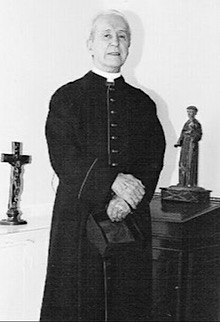
Death of Malachi Martin, Irish American Catholic Priest

Malachi Brendan Martin, also known under the pseudonym of Michael Serafian, Irish-born American Traditionalist Catholic priestbiblical archaeologistexorcistpalaeographerprofessor, and writer on the Catholic Church, dies in New York City on July 27, 1999.

Martin is born on July 23, 1921, in BallylongfordCounty Kerry, to a middle-class family in which the children are raised speaking Irish at the dinner table. His parents, Conor and Katherine Fitzmaurice Martin, have five sons and five daughters. Four of the five sons become priests, including his younger brother, Francis Xavier Martin.

Martin attends Belvedere College in Dublin, then studies philosophy for three years at University College Dublin (UCD). On September 6, 1939, he becomes a novice with the Society of Jesus. He teaches for three years, spending four years at Milltown Park, Dublin, and is ordained in August 1954.

Upon completion of his degree course in Dublin, Martin is sent to the Catholic University of Leuven in Belgium, where he takes a doctorate in archaeologyOriental history, and Semitic languages. He starts postgraduate studies at both the Hebrew University of Jerusalem and at the University of Oxford. He specializes in intertestamentary studiesJesus in Jewish and Islamic sources, Ancient Hebrew and Arabic manuscripts. He undertakes additional study in rational psychologyexperimental psychologyphysics, and anthropology.

Martin participates in the research on the Dead Sea Scrolls and publishes 24 articles on Semitic palaeography. He does archaeological research and works extensively on the Byblos syllabary in Byblos, in Tyre, and in the Sinai Peninsula. He assists in his first exorcism while working in Egypt for archaeological research. In 1958, he publishes a work in two volumes, The Scribal Character of the Dead Sea Scrolls.

Martin’s years in Rome coincide with the beginning of the Second Vatican Council (1962–65), which is to transform the Catholic Church in a way that the initially liberal Martin begins to find distressing. He becomes friends with Monsignor George Gilmary Higgins and Father John Courtney Murray.

In Rome, Martin becomes a professor at the Pontifical Biblical Institute, where he teaches Aramaic, Hebrew, palaeography, and Sacred Scripture. He also teaches theology, part-time, at Loyola University Chicago‘s John Felice Rome Center. He works as a translator for the Eastern Orthodox Churches and Ancient Oriental Churches Division of the Secretariat for Promoting Christian Unity under Bea. He becomes acquainted with Jewish leaders, such as Rabbi Abraham Joshua Heschel, in 1961 and 1962. He accompanies Pope Paul VI on a trip to Jordan in January 1964. He resigned his position at the Pontifical Institute in June 1964.

In 1964, Martin requests a release from his vows and from the Jesuit Order. He receives a provisional release in May 1965 and a dispensation from his vows of poverty and obedience on June 30, 1965. Even if dispensed from his religious vow of chastity, he remains under the obligation of chastity if still an ordained secular priest. He maintains that he remains a priest, saying that he had received a dispensation from Paul VI to that effect.

Martin moves to New York City in 1966, working as a dishwasher, a waiter, and taxi driver, while continuing to write. He co-founds an antiques firm and is active in communications and media for the rest of his life.

In 1967, Martin receives his first Guggenheim Fellowship. In 1970, he publishes the book The Encounter: Religion in Crisis, winning the Choice Book Award of the American Library Association. He then publishes Three Popes and the Cardinal: The Church of Pius, John and Paul in its Encounter with Human History (1972) and Jesus Now (1973). In 1970, he becomes a naturalized U.S. citizen.

In 1969, Martin receives a second Guggenheim Fellowship, allowing him to write his first of four bestsellersHostage to the Devil: The Possession and Exorcism of Five Living Americans (1976). In the book, he calls himself an exorcist, claiming he assisted in several exorcisms. According to McManus Darraugh, William Peter Blatty “wrote a tirade against Malachi, saying his 1976 book was a fantasy, and he was just trying to cash in.” Darraugh also says that Martin became “an iconic person in the paranormal world.”

Martin serves as religious editor for the National Review from 1972 to 1978. He is interviewed twice by William F. Buckley, Jr. for Firing Line on PBS. He is an editor for the Encyclopædia Britannica.

Martin is a periodic guest on Art Bell‘s radio program, Coast to Coast AM, between 1996 and 1998. The show continues to play tapes of his interviews on Halloween.

Martin’s The Keys of This Blood: The Struggle for World Dominion between Pope John Paul II, Mikhail Gorbachev, and the Capitalist West is published in 1990. It is followed in 1996 by Windswept House: A Vatican Novel.

The Vatican restores Martin’s faculty to celebrate Mass in 1989, at his request. He is strongly supported by some Traditionalist Catholic sources and severely criticized by other sources, such as the National Catholic Reporter. He serves as a guest commentator for CNN during the live coverage of the visit of Pope John Paul II to the United States in October 1995.

On July 27, 1999, Martin dies in Manhattan of an intracerebral haemorrhage, four days after his 78th birthday. It is caused by a fall in his Manhattan apartment. The documentary Hostage to the Devil claims that Martin says he was pushed from a stool by a demonic force.

Martin’s funeral takes place in St. Anthony of Padua Catholic Church in West Orange, New Jersey, before burial at Gate of Heaven Cemetery, in Hawthorne, New York.


Leave a comment

Birth of Edward Maturin, Novelist & Poet

Edward Maturin, novelist and poet, is born in Dublin on June 18, 1812. He is naturalised as an American and works as a professor of Greek. His fiction and poetry generally deal with historical themes, while his work as a Gothic novelist often has an Irish background.

The Maturin family is descended from a Huguenot clergyman who fled to Ireland after the revocation of the Edict of Nantes. Edward’s father, Reverend Charles Robert Maturin, is curate of St. Peter’s Church, Dublin, and well known as a preacher, as well as a poet and Gothic novelist. Born the second son, Edward enters Trinity College Dublin at the age of fifteen and graduates at twenty. Immediately afterward he emigrates to the United States in 1832 with letters of introduction from the poet Thomas Moore and other Irish writers. Having studied law under Charles O’Conor, he is called to the bar but later becomes professor of Greek at South Carolina College and applies for American naturalisation in 1837. He marries Harriet Lord Gailiard in 1842 and has three children by her. In 1848, he returns to New York, where for upward of thirty years he fills professorships in Greek, Latin and belles-lettres. His mastery of Greek is such that he is selected in 1850 by the American Bible Union as one of their revisers and works on the gospel of St. Mark.

All of Maturin’s work is written in the United States and for the most part concentrates on historical themes or Irish fantasy. His first book contains the interconnected stories of Sejanus and Other Roman Tales (1839) and is dedicated to Washington Irving. They concern incidents during the reigns of the Roman emperors from Tiberius to Nero. Self-consciously literary, the dialogue is written in an imitation of Shakespearean English. This is followed by the two-volume romance, Montezuma, the Last of the Aztecs (1845) and then two works on Spanish themes. The long series of “Spanish Ballads” that originally appears in The United States Magazine and Democratic Review during 1845 are eventually collected with his other poems in Lyrics of Spain and Erin (1850). They are followed by the romance Benjamin, the Jew of Grenada (1847), a story of the fall of the Moslem empire in Spain.

After his move to New York, Maturin’s prose work becomes more Gothic. It includes The Irish Chieftain, or The Isles of Life and Death (1848) which is later to be dismissed as “a wild story without foundation in history … melodramatic, sentimental, extravagant,” and the two-volume Eva, or the Isles of Life and Death (1848). His later Bianca, a tale of Erin and Italy (1852) is set in more modern times but is equally condemned as “an outlandish story, full of murders, characters – mostly illegitimate – with terrible secrets, a duel between brothers, banshees, mysterious lady-prophetesses, fee-faw-fum.” A final offering is his four-act play Viola (1858).

Maturin dies in New York City on May 25, 1881.

(Pictured: “Montezuma: The Last of the Aztecs” by Edward Maturin, Paine & Burgess, New York, 1845)


Leave a comment

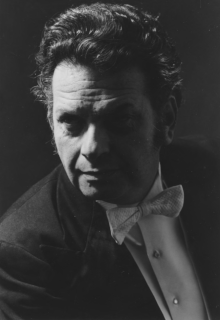
Death of Albert Rosen, Czech/Irish-Naturalized Conductor

Albert Rosen, Austrian-born and Czech/Irish-naturalised conductor associated with the National Symphony Orchestra of Ireland, the Wexford Festival Opera, the National Theatre in Prague and J. K. Tyl Theatre in Plzeň (Pilsen), dies of lung cancer in Dublin on May 23, 1997. He has a strong affinity with the works of Czech composers such as Bedřich Smetana, Antonín Dvořák, Bohuslav Martinů, and Leoš Janáček.

Rosen is born in Vienna on February 14, 1924. His mother is Czech, while his father’s family is Austrian-Jewish. After Anschluss of Austria in 1938 they move to Bratislava, and after the Slovak version of Nuremberg Laws comes to force in September 1941, he escapes discrimination and genocide via the Danube and the sea to Israel (then Mandatory Palestine). There he works in the Shaʽar_HaGolan kibbutz, manually and as an amateur chorus master, until 1945, when he returns to Bratislava.

In 1946–47 Rosen studies piano, composition and conducting at the Vienna Academy of Music with Joseph Marx and Hans Swarowsky, and continues to study conducting at the Prague Conservatory under Pavel Dědeček and Alois Klíma (1947–48). He starts his career in J. K. Tyl Theatre in Plzeň (Pilsen) as a correpetiteur, assistant conductor and chorus master (1949–52) and conductor (1953–59), participating on the production of 11 operas, 19 ballets and, as the composer of stage music, 17 dramas. In 1960 he is engaged by National Theatre in Prague, to be appointed in 1964 the chief conductor of Smetana Theatre, the National Theatre’s opera stage. He holds this position until 1971, conducting 11 ballets and 9 opera productions.

In 1965 Rosen comes to Ireland for the first time to conduct the National Symphony Orchestra (under its former name, the Radio Telefís Éireann Symphony Orchestra) at the Wexford Festival Opera. This leads to regular appearances at the festival until 1994, conducting 18 Wexford productions, more than anyone else. In 1969 he becomes the orchestra’s chief conductor, until he becomes principal guest conductor in 1981. In 1994 he is honoured with the title Conductor Laureate of the orchestra.

Rosen’s operatic repertoire includes standard works such as Carmen (Bizet), Tosca and Madama Butterfly (Puccini), Il trovatore and Don Carlos (Verdi), Lohengrin (Wagner), Lucrezia Borgia (Donizetti), Otello and L’italiana in Algeri (Rossini), Káťa Kabanová (Janáček), La Wally (Catalani), The Bartered Bride (Smetana), and Salome (Richard Strauss). He also conducted unusual works such as Smetana’s The Two Widows and The Kiss, and Dvořák’s Rusalka, The Devil and Kate and The Jacobin.

In October 1978, in Dublin and Cork, Rosen conducts the National Symphony Orchestra in only the second and third performances of André Tchaikowsky‘s 2nd Piano Concerto, Op. 4, which are the first performances with the composer as soloist. He is to record the work in 1982, again with Tchaikowsky at the piano, but the composer becomes ill and the recording is cancelled. His other work with the NSO includes standard orchestral repertoire as well as major pieces such as Olivier Messiaen‘s Turangalîla-Symphonie and Gustav Mahler‘s Symphony No. 8 (Symphony of a Thousand). In 1992, the orchestra tours ten cities in Germany, having a major success with Die Fledermaus in Stuttgart.

Rosen makes his American debut at the San Francisco Opera in 1980, in Janáček’s Jenůfa. In Australia, he is chief conductor of the West Australian Symphony Orchestra from 1983 until 1985, and the Adelaide Symphony Orchestra in 1986. He conducts the British premiere of Nikolai Rimsky-Korsakov‘s opera Christmas Eve with English National Opera in 1988. He becomes music director of the Irish National Opera in 1993.

Rosen often conducts the National Youth Orchestra of Ireland during the 1990s, in challenging works such as the tone poems and An Alpine Symphony of Richard Strauss. Other opera orchestras he conducts included those of the Welsh National Opera, Scottish Opera, Vancouver Opera, San Diego Opera, and the Dublin Grand Opera Society.

Rosen becomes an Irish citizen by naturalisation. His own conducting students include John Finucane.

Rosen dies at the age of 73 in Dublin on May 23, 1997, of lung cancer.


Leave a comment

Death of John McCormack, Renowned Irish Tenor

Papal Count John Francis McCormack, KSG, KSS, KHS, Irish tenor celebrated for his performances of the operatic and popular song repertoires, and renowned for his diction and breath control, dies in Booterstown, Dublin, on September 16, 1945.

McCormack is born on June 14, 1884, in Athlone, County Westmeath, the second son and fifth of the 11 children of Andrew McCormack and his wife Hannah Watson. His parents are both from Galashiels, Scotland, and work at the Athlone Woolen Mills, where his father is a foreman. He is baptised in St. Mary’s Church, Athlone, on June 23, 1884.

McCormack receives his early education from the Marist Brothers in Athlone and later attends Summerhill College, Sligo. He sings in the choir of the old St. Peter’s Church in Athlone under his choirmaster Michael Kilkelly. When the family moves to Dublin, he sings in the choir of St. Mary’s Pro-Cathedral where he is discovered by Vincent O’Brien. In 1903 he wins the coveted gold medal of the Dublin Feis Ceoil. He marries Lily Foley in 1906 and they have two children, Cyril and Gwen.

In March 1904, McCormack becomes associated with James Joyce, who at the time has singing ambitions himself. He persuades Joyce to enter the Feis Ceoil that year, where the not yet famous writer is awarded the Bronze Medal.

Fundraising activities on his behalf enable McCormack to travel to Italy in 1905 to receive voice training by Vincenzo Sabatini, father of the novelist Rafael Sabatini, in Milan. Sabatini finds McCormack’s voice naturally tuned and concentrates on perfecting his breath control, an element that becomes part of the basis of his renown as a vocalist.

In 1906, McCormack makes his operatic début at the Teatro Chiabrera, Savona. The next year, he begins his first important operatic performance at Covent Garden in Pietro Mascagni‘s Cavalleria rusticana, becoming the theatre’s youngest principal tenor. In 1909, he begins his career in the United States.

In February 1911, McCormack plays Lieutenant Paul Merrill in the world premiere of Victor Herbert‘s opera Natoma with Mary Garden in the title role. Later that year, he tours Australia after Dame Nellie Melba engages him, then at the height of his operatic career, aged 27, as a star tenor for the Melba Grand Opera Season. He returns for concert tours in subsequent years.

By 1912, McCormack is beginning to become involved increasingly with concert performances, where his voice quality and charisma ensures that he becomes the most celebrated lyric tenor of his time. He does not, however, retire from the operatic stage until after his performance of 1923 in Monte Carlo, although by then the top notes of his voice have contracted. Famous for his extraordinary breath control, he can sing 64 notes on one breath in Mozart‘s “Il mio tesoro” from Don Giovanni, and his Handelian singing is just as impressive in this regard.

McCormack makes hundreds of recordings, his best-known and most commercially successful series of records being those for the Victor Talking Machine Company during the 1910s and 1920s. He is Victor’s most popular Red Seal recording artist after tenor Enrico Caruso. In the 1920s, he sings regularly on radio and later appears in two sound films, Song o’ My Heart (1930), playing an Irish tenor, and as himself appearing in a party scene in Wings of the Morning (1937), the first British three-strip Technicolor feature.

McCormack is one of the first artists to record the popular ballad “I Hear You Calling Me” written in 1908 by Harold Harford and Charles Marshall. He records it twice for Odeon Records starting in 1908 and a further four times for Victor between 1910 and 1927, becoming his best seller. He is the first artist to record the famous World War I song “It’s a Long Way to Tipperary” in 1914. He also records a best-selling version of another popular World War I tune, “Keep the Home Fires Burning,” in 1917. He also sings songs expressive of Irish nationalism and endorses the Irish Nationalist estrangement from the United Kingdom. He is associated particularly with the songs of Thomas Moore, notably “The Harp That Once Through Tara’s Halls,” “The Minstrel Boy,” “Believe Me If All (Those Endearing Young Charms),” and “The Last Rose of Summer.” Between 1914 and 1922, he records almost two dozen songs with violin accompaniment provided by Fritz Kreisler, with whom he also tours. He records songs of Hugo Wolf for the Hugo Wolf Society in German. In 1918, he records the song “Calling Me Home to You.”

In 1917, McCormack becomes a naturalised citizen of the United States. In June 1918, he donates $11,458 toward the U.S. World War I effort. By then, his career is a huge financial success, earning millions in his lifetime from record sales and appearances.

By 1920, Edwin Schneider has become McCormack’s accompanist and the two are “inseparable.” When Schneider retires, Gerald Moore takes over as accompanist from 1939 to 1943.

In 1927, McCormack moves into Moore Abbey, Monasterevin, County Kildare, and adopts a very opulent lifestyle by Irish standards. He also owns apartments in London and New York. He hopes that one of his racehorses, such as Golden Lullaby, would win The Derby, but this never occurs.

McCormack also purchases Runyon Canyon in Hollywood in 1930 from Carman Runyon. He sees and likes the estate while there filming Song o’ My Heart (1930), an early all-talking, all-singing picture. He uses his salary for this movie to purchase the estate and builds a mansion he calls ‘San Patrizio,’ after Saint Patrick. He and his wife live in the mansion until they return to England in 1938.

McCormack tours often, and in his absence, the mansion is often let to celebrities such as Janet Gaynor and Charles Boyer. The McCormacks make many friends in Hollywood, among them Errol Flynn, Will Rogers, John Barrymore, Basil Rathbone, Ronald Colman, Charles E. Toberman and the Dohenys. After his farewell tour of America in 1937, the McCormacks deed the estate back to Carman Runyon expecting to return to the estate at a later date. World War II intervenes and he does not return.

McCormack originally ends his career at the Royal Albert Hall in London, during 1938. However, one year after that farewell concert, he is back singing for the Red Cross and in support of the war effort. He gives concerts, tours, broadcasts and records in this capacity until 1943 when poor health finally forces him to retire permanently.

Ill with emphysema, McCormack purchases a house near the sea, “Glena,” Booterstown, Dublin. After years of increasingly poor health, and a series of infectious illnesses, including influenza and pneumonia, he dies at his home in Booterstown on September 16, 1945. He is buried in Deans Grange Cemetery, St. Patrick’s section, plot reference E/120.


Leave a comment

Birth of Cornelius Ryan, Journalist & Author

cornelius-ryan

Cornelius Ryan, Irish journalist and author mainly known for his writings on popular military history, is born in Dublin in June 5, 1920. He is especially known for his World War II books The Longest Day: 6 June 1944 D-Day (1959), The Last Battle (1966), and A Bridge Too Far (1974).

Ryan is educated at Synge Street CBS, Portobello, Dublin. He is an altar boy at St. Kevin’s Church, Harrington Street and studies the violin at the Irish Academy of Music in Dublin. He is a boy scout in the 52nd Troop of the Catholic Boy Scouts of Ireland and travels on their pilgrimage to Rome on the liner RMS Lancastria in 1934. He moves to London in 1940 and becomes a war correspondent for The Daily Telegraph in 1941.

Ryan initially covers the air war in Europe, flying along on fourteen bombing missions with the Eighth and Ninth United States Army Air Forces (USAAF). He then joins General George S. Patton‘s Third Army and covers its actions until the end of the European war. He transfers to the Pacific theater in 1945 and then to Jerusalem in 1946.

Ryan emigrates to the United States in 1947 to work for Time, where he reports on the postwar tests of atomic weapons carried out by the United States in the Pacific. He then reports for Time on the Arab-Israeli war in 1948. This is followed by work for other magazines, including Collier’s Weekly and Reader’s Digest.

Ryan marries Kathryn Morgan, a novelist, and becomes a naturalized citizen of the United States in 1951.

On a trip to Normandy in 1949 Ryan becomes interested in telling a more complete story of Operation Overlord than has been produced to date. He begins compiling information and conducting over 1,000 interviews as he gathers stories from both the Allies and the Germans, as well as the French civilians.

In 1956 Ryan begins to write down his World War II notes for The Longest Day: 6 June 1944 D-Day, which tells the story of the D-Day Invasion of Normandy, published three years later in 1959. It is an instant success, and he assists in the writing of the screenplay for the 1962 film of the same name. Darryl F. Zanuck pays the author U.S.$175,000 for the screen rights to the book.

Ryan’s 1957 book One Minute to Ditch! is about the successful ocean ditching of a Pan American Boeing 377 Stratocruiser. He had written an article about the ditching for Collier’s in their December 21, 1956, issue and then expanded it into the book.

Ryan’s next work is The Last Battle (1966), about the Battle of Berlin. The book contains detailed accounts from all perspectives: civilian, American, British, Russian and German. It deals with the fraught military and political situation in the spring of 1945, when the forces of the western allies and the Soviet Union contend for the chance to liberate Berlin and to carve up the remains of Germany.

This work was followed by A Bridge Too Far (1974), which tells the story of Operation Market Garden, the ill-fated assault by allied airborne forces on the Netherlands culminating in the Battle of Arnhem. It is made into a major 1977 film of the same name.

Ryan is awarded the French Legion of Honour and an honorary Doctor of Literature degree from Ohio University, where the Cornelius Ryan Collection is housed in the Alden Library. He is diagnosed with prostate cancer in 1970 and struggles to finish A Bridge Too Far during his illness. He dies in Manhattan on November 23, 1974, while on tour promoting the book, only two months after publication. He is buried in the Ridgebury Cemetery in northern Ridgefield, Connecticut.

Four years after his death, Ryan’s struggle with prostate cancer is detailed in A Private Battle, written by his widow, from notes he had secretly left behind for that purpose.