seamus dubhghaill

Promoting Irish Culture and History from Little Rock, Arkansas, USA


Leave a comment

The Copley Street Riot

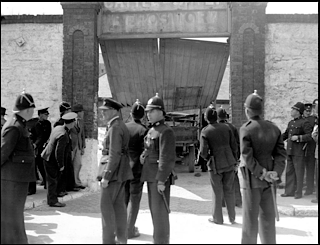
The Copley Street riot occurs on August 13, 1934, at the Copley Street Repository, Cork, County Cork, after Blueshirts opposed to the collection of annuities from auctioned cattle ram a truck through the gate of an ongoing cattle auction. The Broy Harriers open fire and one man, 22 year old Michael Lynch, is killed and several others injured.

Following the Irish War of Independence (1919–21), Britain relinquishes its control over much of Ireland. However, aspects of the Anglo-Irish Treaty, which had marked the end of the war, lead to the Irish Civil War (1922–23). The aftermath leaves Ireland with damaged infrastructure and hinders its early development.

Éamon de Valera, who had voted against the Anglo-Irish treaty and headed the Anti-Treaty movement during the civil war, comes to power following the 1932 Irish general election and is re-elected in 1933. While the treaty stipulates that the Irish Free State should pay £3.1 million in land annuities to Great Britain, and despite advice that an economic war with Britain could have catastrophic consequences for Ireland (as 96% of exports are to Britain), de Valera’s new Irish government refuses to pay these annuities – though they continue to collect and retain them in the Irish exchequer.

This refusal leads to the Anglo-Irish trade war (also known as the “Economic War”), which persists until 1935, when a new treaty, the Anglo-Irish Trade Agreement, is negotiated in 1938. During this period, a 20% duty is imposed on animals and agricultural goods, resulting in significant losses for Ireland. Specifically, poultry trade declines by 80%, butter trade by 50% and cattle prices drop by 50%. Some farmers are forced to kill and bury animals because they cannot afford to maintain them.

In 1933, Fine Gael emerges as a political party—a merger of Cumann na nGaedheal and the National Centre Party. Fine Gael garners substantial support from rural farmers who are particularly affected by the Economic War. They strongly object to the collection of land annuities by the Fianna Fáil government. The Blueshirts, a paramilitary organisation founded as the Army Comrades Association in 1932 and led by former Garda Commissioner Eoin O’Duffy, transforms into an agrarian protest organisation, mobilising against seizures, cattle auctions, and those tasked with collecting annuities.

O’Duffy, a key figure in Irish politics, encourages farmers to withhold payment of land annuities to the government. Arising from this stance, Gardaí start to seize animals and farm equipment, auctioning them to recover the outstanding funds. While seized cattle are auctioned, local farmers rarely participate. Instead, Northern Ireland dealers, often associated with the name O’Neill, are the primary buyers. These auctions are protected by the Broy Harriers, an armed auxiliary group linked to the police.

By 1934, tensions escalate, and a series of anti-establishment incidents are attributed to the Blueshirts. These incidents range from minor acts of violence, such as breaking windows, to more serious offenses like assault and shootings.

On August 13, 1934, an auction takes place at Marsh’s Yard on Copley Street in Cork, featuring cattle seized from farms in Bishopstown and Ballincollig. The police establish a cordon by 10:00 a.m., with 300 officers on duty. Lorries arrived at 11:00 a.m.

Around noon, three thousand protestors assemble. Within twenty-five minutes, an attempt is made to breach the yard gate by ramming it with a truck. According to Oireachtas records, there are approximately 20 men in the truck which they run against the gate. The Minister for Justice P. J. Ruttledge, says that the truck “with those people in it charged through those cordons of Guards; that several Guards jumped on to the lorry and tried to divert the driver by catching hold of the steering wheel and trying to twist it.” Some contemporary news sources suggest that the ramming truck knocked down the surrounding police cordon “like ninepins and crush[ed] a police inspector against a gate.” Later sources suggest that the senior officer (a superintendent) was injured in a fall, while attempting to avoid being struck, rather than being hit directly by the truck.

A man named Michael Lynch, wearing the distinctive blue shirt, and approximately 20 others reportedly manage to enter the yard. As soon as they enter the yard they are fired upon by armed “special branch” police detectives who are in the yard. Lynch later succumbs to his injuries at the South Infirmary. Thirty-six others are wounded. Despite the violence, the auction proceeds after a one-hour delay.

Following the shooting, a riot ensues, but when news of Lynch’s death reaches the participants, they cease rioting, kneel, and recited a Rosary.

The funeral of Michael Lynch occurs on August 15, 1934. The funeral procession is planned to depart from Saints Peter and Paul’s Church, Cork at 2:30 PM.

The occasion allows for a significant show of force for Eoin O’Duffy and the Blueshirts, and features Roman salutes and military drills. Farmers in Munster reportedly stop work for an hour, and Blueshirt members ask shopkeepers to close their businesses, as a show of respect for the “martyr.” Lynch is afforded a “full Blueshirt burial,” and the coffin is adorned with the flag of the Blueshirts (the Army Comrades Association).

According to the  Minister for Justice, at the funeral W. T. Cosgrave stands beside O’Duffy as the Blueshirt leader gives an oration saying, “We are going to carry on until our mission is accomplished […] those 20 brave men, whose deed will live for ever, not only in Cork but in every county in Ireland, broke through in the lorry […] all Blueshirts should try to emulate his bravery and nobleness. Every Blueshirt is prepared to go the way of Michael for his principles.”

The court grants the family £300 in 1935. This is appealed to the High Court, followed by the Supreme Court, which dismisses the case. In the Supreme Court, Henry Hanna describes the Broy Harriers as “an excrescence” upon the Garda Síochána.

When the matter is discussed in the Seanad in September 1934, and before a vote is taken to “[condemn] the action of the members of the special branch of the Gárda Síochána […] on Monday, the 13th August 1934,” the senators who support Éamon de Valera’s government walk out.

In August 1940, a memorial is unveiled on the tomb of Lynch in Dunbulloge Cemetery in Carrignavar, County Cork, consisting of a limestone Celtic cross and pedestal. The pedestal is engraved with a quote from the American orator, William Jennings Bryan: “The humblest citizen of all the land, when clad in the armour of a righteous cause is stronger than all the hosts of error.”

(Pictured: Aftermath of the ramming of Marsh’s Yard, Copley Street, that leads to the death of Michael Lynch and the Copley Street Riot on August 13, 1934)

Leave a comment

Death of Dr. Douglas Hyde, First President of Ireland

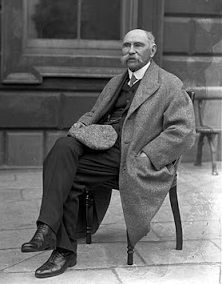
Dr. Douglas Hyde, Gaelic scholar and the first President of Ireland, dies in Dublin on July 12, 1949, at the age of 89.

Hyde is born at Longford House in Castlerea, County Roscommon, on January 17, 1860. In 1867, his father is appointed prebendary and rector of Tibohine, and the family moves to neighbouring Frenchpark, in County Roscommon. He is home schooled by his father and his aunt due to a childhood illness. While a young man, he becomes fascinated with hearing the old people in the locality speak the Irish language.

Rejecting family pressure to follow previous generations with a career in the Church, Hyde instead becomes an academic. He enters Trinity College, Dublin (TCD), where he gains a great facility for languages, learning Latin, Greek, Hebrew, French, and German, but his great passion in life is the preservation of the Irish language.

After spending a year teaching modern languages in Canada, Hyde returns to Ireland. For much of the rest of his life he writes and collects hundreds of stories, poems, and folktales in Irish, and translates others. His work in Irish helps to inspire many other literary writers, such as W. B. Yeats and Lady Gregory.

In 1892, Hyde helps establish the Gaelic Journal and in November of that year writes a manifesto called The necessity for de-anglicising the Irish nation, arguing that Ireland should follow her own traditions in language, literature, and even in dress.

In 1893, Hyde founds the Gaelic League (Conradh na Gaeilge) along with Eoin MacNeill and Fr. Eugene O’Growney and serves as its first president. Many of the new generation of Irish leaders who play a central role in the fight for Irish independence in the early twentieth century, including Patrick PearseÉamon de ValeraMichael Collins, and Ernest Blythe first become politicised and passionate about Irish independence through their involvement in the Gaelic League. Hyde does not want the Gaelic League to be a political entity, so when the surge of Irish nationalism that the Gaelic League helps to foster begins to take control of many in the League and politicize it in 1915, Hyde resigns as president.

Hyde takes no active part in the armed upheaval of the 1910s and 1920s, but does serve in Seanad Éireann, the upper house of the Irish Free State’s Oireachtas, as a Free State senator in 1925-26. He then returns to academia, as Professor of Irish at University College Dublin (UCD), where one of his students is future Attorney General and President of Ireland Cearbhall Ó Dálaigh.

In 1938, Hyde is unanimously elected to the newly created position of President of Ireland, a post he holds until 1945. Hyde is inaugurated on June 26, 1938, in the first inaugural ceremony in the nation’s history. Despite being placed in a position to shape the office of the presidency via precedent, Hyde by and large opts for a quiet, conservative interpretation of the office. In April 1940, he suffers a massive stroke and plans are made for his lying in state and state funeral, but to the surprise of everyone he survives, albeit paralysed and confined to a wheelchair. One of his last presidential acts is a visit to the German ambassador Eduard Hempel on May 3, 1945, to offer his condolences on the death of Adolf Hitler, a visit which remains a secret until 2005.

Hyde leaves office on June 25, 1945, opting not to nominate himself for a second term. He opts not return to his Roscommon home due to his ill-health, but rather moves into the former Secretary to the Lord Lieutenant’s residence in the grounds of Áras an Uachtaráin, where he lived out the remaining four years of his life.

Hyde dies in Dublin on July 12, 1949, at age 89. As a former President of Ireland he is accorded a state funeral which, as a member of the Church of Ireland, takes place in Dublin’s St. Patrick’s Cathedral. Since contemporary rules of the Roman Catholic Church in Ireland at the time prohibit Roman Catholics from attending services in non-Catholic churches, all but one member of the Catholic cabinet remain outside the cathedral grounds while Hyde’s funeral takes place. Hyde is buried in Frenchpark, County Roscommon at Portahard Church.


Leave a comment

The Statute of Westminster 1931 Receives Royal Assent

The Statute of Westminster 1931, an act of the Parliament of the United Kingdom that sets the basis for the relationship between the Dominions (now called Commonwealth realms) and the Crown, receives royal assent on December 11, 1931.

The statute increases the sovereignty of the self-governing Dominions of the British Empire from the United Kingdom. It also binds them all to seek each other’s approval for changes to monarchical titles and the common line of succession. The statute is effective either immediately or upon ratification. It thus becomes a statutory embodiment of the principles of equality and common allegiance to the Crown set out in the Balfour Declaration of 1926. As the statute removes nearly all of the British parliament’s authority to legislate for the Dominions, it is a crucial step in the development of the Dominions as separate, independent, and sovereign states.

The Irish Free State never formally adopts the Statute of Westminster, its Executive Council (cabinet) taking the view that the Anglo-Irish Treaty of 1921 has already ended Westminster‘s right to legislate for the Irish Free State. The Constitution of the Irish Free State gives the Oireachtas “sole and exclusive power of making laws.” Hence, even before 1931, the Irish Free State does not arrest British Army and Royal Air Force deserters on its territory, even though the UK believes post-1922 British laws give the Free State’s Garda Síochána the power to do so. The UK’s Irish Free State Constitution Act 1922 says, however, “[n]othing in the [Free State] Constitution shall be construed as prejudicing the power of [the British] Parliament to make laws affecting the Irish Free State in any case where, in accordance with constitutional practice, Parliament would make laws affecting other self-governing Dominions.”

Motions of approval of the Report of the Commonwealth Conference had been passed by Dáil Éireann and Seanad Éireann in May 1931 and the final form of the Statute of Westminster includes the Irish Free State among the Dominions the British Parliament cannot legislate for without the Dominion’s request and consent. Originally, the UK government wants to exclude from the Statute of Westminster the legislation underpinning the 1921 treaty, from which the Free State’s constitution had emerged. Executive Council President (Prime Minister) W. T. Cosgrave objects, although he promises that the Executive Council will not amend the legislation unilaterally. The other Dominions back Cosgrave and, when an amendment to similar effect is proposed at Westminster by John Gretton, parliament duly votes it down. When the statute becomes law in the UK, Patrick McGilligan, the Free State Minister for External Affairs, states, “It is a solemn declaration by the British people through their representatives in Parliament that the powers inherent in the Treaty position are what we have proclaimed them to be for the last ten years.” He goes on to present the statute as largely the fruit of the Free State’s efforts to secure for the other Dominions the same benefits it already enjoys under the treaty. The Statute of Westminster has the effect of granting the Irish Free State internationally recognised independence.

Éamon de Valera leads Fianna Fáil to victory in the 1932 Irish general election on a platform of republicanising the Free State from within. Upon taking office, he begins removing the monarchical elements of the Constitution, beginning with the Oath of Allegiance. De Valera initially considers invoking the Statute of Westminster in making these changes, but John J. Hearne advises him to not do so. Abolishing the Oath of Allegiance in effect abrogates the 1921 treaty. Generally, the British believe that this is morally objectionable but legally permitted by the Statute of Westminster. Robert Lyon Moore, a Southern Unionist from County Donegal, challenges the legality of the abolition in the Irish Free State’s courts and then appeals to the Judicial Committee of the Privy Council (JCPC) in London. However, the Free State has also abolished the right of appeal to the JCPC. In 1935, the JCPC rules that both abolitions are valid under the Statute of Westminster. The Irish Free State, which in 1937 is renamed Ireland, leaves the Commonwealth in 1949 upon the coming into force of The Republic of Ireland Act 1948.

The Statute of Westminster’s modified versions are now domestic law in Australia and Canada. It has been repealed in New Zealand and implicitly in former Dominions that are no longer Commonwealth realms.