At its peak the force has around 8,500 officers with a further 4,500 who are members of the RUC Reserve. During the Troubles (late 1960s-1998), 319 members of the RUC are killed and almost 9,000 injured in paramilitary assassinations or attacks, mostly by the Provisional Irish Republican Army, which by 1983 makes the RUC the most dangerous police force in the world in which to serve. During the same period, the RUC kills 55 people, 28 of whom are civilians.
The RUC is superseded by the Police Service of Northern Ireland (PSNI) in 2001. The former police force is renamed and reformed, as is provided for by the final version of the Police (Northern Ireland) Act 2000. The RUC has been accused by republicans and Irish nationalists of one-sided policing and discrimination, as well as collusion with loyalist paramilitaries. Conversely, it is praised as one of the most professional policing operations in the world by British security forces.
Allegations regarding collusion prompt several inquiries, the most recent of which is published by Police Ombudsman For Northern IrelandNuala O’Loan on January 22, 2007. The report identifies police, Criminal Investigation Department (CID) and Special Branch collusion with loyalist terrorists under 31 separate headings, in her report on the murder of Raymond McCord, Jr. and other matters, but no member of the RUC has been charged or convicted of any criminal acts as a result of these inquiries. Ombudsman O’Loan states in her conclusions that there is no reason to believe the findings of the investigation were isolated incidents.
The Dublin and Monaghan bombings of May 17, 1974 are a series of co-ordinated bombings in Dublin and Monaghan, Ireland. Three car bombs explode in Dublin at Parnell Street, Talbot Street and South Leinster Street during the evening rush hour and a fourth car bomb explodes in Monaghan, just south of the border with Northern Ireland, almost ninety minutes later. The bombs kill 33 civilians and a full-term unborn child, and injure almost 300. The bombings are the deadliest attack of the conflict known as the Troubles, and the deadliest attack in the Republic of Ireland‘s history. Most of the victims are young women, although the ages of the dead range from pre-born up to 80 years.
The Ulster Volunteer Force (UVF), an Ulster loyalistparamilitary group from Northern Ireland, claims responsibility for the bombings in 1993. It has launched a number of attacks in the Republic since 1969. There are allegations taken seriously by inquiries that elements of the British state security forces help the UVF carry out the bombings, including members of the Glenanne gang. Some of these allegations have come from former members of the security forces. The Irish parliament‘s Joint Committee on Justices calls the attacks an act of international terrorism involving British state forces. The month before the bombings, the British government lifts the UVF’s status as a proscribed organisation.
The bombings happen during the Ulster Workers’ Council strike. This is a general strike called by hardline loyalists and unionists in Northern Ireland who oppose the Sunningdale Agreement. Specifically, they oppose the sharing of political power with Irish nationalists and the proposed role for the Republic in the governance of Northern Ireland. The Republic’s government had helped bring about the Agreement. The strike brings down the Agreement and the Northern Ireland Assembly on May 28.
No one has ever been charged with the bombings. A campaign by the victims’ families leads to an Irish government inquiry under Justice Henry Barron. His 2003 report criticises the Garda Síochána‘s investigation and says the investigators stopped their work prematurely. It also criticises the Fine Gael/Labour Partygovernment of the time for its inaction and lack of interest in the bombings. The report says it is likely that British security force personnel or MI5 intelligence is involved but has insufficient evidence of higher-level involvement. However, the inquiry is hindered by the British government’s refusal to release key documents. The victims’ families and others are continuing to campaign to this day for the British government to release these documents.
(Pictured: Some of the damage caused by the second car bomb on Talbot Street, Dublin)
Born in 1958, Nugent’s adolescence comes at a time when Northern Ireland is exploding into turmoil. On March 20, 1973, at the age of 15, he is standing with a friend on the corner of Merrion Street and Grosvenor Road when a car pulls up beside them and one of the occupants asks them for directions. Another occupant of the vehicle then opens fire with a submachine gun. Nugent is seriously wounded after being shot eight times in the chest, arms and back by the Ulster loyalists in the car. His friend, Bernard McErlean, aged 16, is killed.
At some point afterwards, Nugent joins the Provisional IRA. At the age of sixteen he is arrested by the British Army and spends five months on remand in Crumlin Road Gaol. When he is eventually tried, the case against him is withdrawn and he is released. He becomes an active volunteer until his arrest and internment, without trial, on February 9, 1975.
Nugent spends nine months in Cage 4 at the Long Kesh Detention Centre until November 12, 1975. He is arrested and imprisoned again on May 12, 1976, following the hijacking of a bus. On September 14, 1976, he is sentenced to three years and becomes the first Republican prisoner convicted since the withdrawal of Special Category Status for those convicted through juryless courts, due to the new British policy of ‘criminalisation’ introduced that March. Among other things, this change in policy means convicted paramilitaries can no longer wear their own clothes. Viewing himself as a political prisoner and not a criminal, he refuses to wear the uniform saying the prison guards would have to “…nail it to my back.” This begins the blanket protest.
Nugent is soon joined by Jackie McMullan, the next prisoner to don the blanket, followed by six more Irish republican prisoners from the Beechmount area of Belfast. By Christmas 1976 the number of participants has risen to over forty prisoners. Most incoming republican prisoners emulate Nugent, and this starts five years of prison protests in pursuit of political status, which culminates in the 1981 Irish hunger strike and the death of eleven, including seven IRA and three Irish National Liberation Army prisoners.
Nugent, the father of four, is found dead of a heart attack at his home in Anderstown, Belfast on May 4, 2000.
The 32CSM is an Irish republican group that is founded by Bernadette Sands McKevitt. It does not contest elections but acts as a pressure group, with branches or cumainn organised throughout the traditional counties of Ireland. The organisation has been described as the “political wing” of the Real Irish Republican Army, but this is denied by both organisations. The group originates in a split from Sinn Féin over the Mitchell Principles.
The 32CSM is founded as the 32 County Sovereignty Committee on December 7, 1997, at a meeting of like-minded Irish republicans in Finglas in Dublin. Those present are opposed to the direction taken by Sinn Féin and other mainstream republican groups in the Northern Ireland peace process, which leads to the Belfast Agreement (also known as the Good Friday Agreement) the following year. The same division in the republican movement leads to the paramilitary group now known as the Real IRA breaking away from the Provisional Irish Republican Army at around the same time.
Most of the 32CSM’s founders have been members of Sinn Féin. Some had been expelled from the party for challenging the leadership’s direction, while others felt they had not been properly able to air their concerns within Sinn Féin at the direction its leadership had taken. Bernadette Sands McKevitt, wife of Michael McKevitt and a sister of hunger striker Bobby Sands, is a prominent member of the group until a split in the organisation.
Before the referendums on the 1998 Good Friday Agreement, the organisation lodges a legal submission with the United Nations challenging British sovereignty in Ireland. The referendums are opposed by the organisation, but are supported by 71% of voters in Northern Ireland and by 94% in the Republic of Ireland.
In 2015, the 32CSM organises a demonstration in Dundee, Scotland, in solidarity with the men convicted of shooting Constable Stephen Carroll, the first police officer to be killed in Northern Ireland since the formation of the PSNI. The organisation says the “Craigavon Two” are innocent and are victims of a miscarriage of justice.
The 32CSM once criticised the Real IRA’s military actions, with respect to the Omagh bombing. However, the group is currently considered a foreign terrorist organization (FTO) in the United States, because the group is considered to be inseparable from the Real IRA, which is designated as an FTO. At a briefing in 2001, a spokesman for the U.S. Department of State states that “evidence provided by both the British and Irish governments and open-source materials demonstrate clearly that the individuals who created the Real IRA also established these two entities to serve as the public face of the Real IRA. These alias organizations engage in propaganda and fundraising on behalf of and in collaboration with the Real IRA.” The U.S. Department of State’s designation makes it illegal for Americans to provide material support to the Real IRA, requires U.S. financial institutions to block the group’s assets and denies alleged Real IRA members visas into the United States.
The gates of Mountjoy Gaol are opened at 8:25 AM and news of the executions is read out to the distraught relatives of the dead. As many as 40,000 people gather outside the prison and many mournfully say the Rosary for the executed men.
By evening, the streets clear rapidly as the British-imposed curfew comes into effect at 9:00 PM each night. During this period, the city is a fearful place, patrolled by regular British troops and the much-feared paramilitary police, the Auxiliary Division, as people scurry home and await IRA retaliation for the hangings, which is not long in coming.
That very evening, IRA captain Peadar O’Meara sends as many as thirty-four IRA men out to attack police or military targets. They are armed with the standard urban guerrilla arms of easily hidden handguns and grenades. One young Volunteer, Sean Dolan, throws a grenade at a police station on nearby Merrion Square, which bounces back before it explodes, blowing off his own leg.
At around 8:00 PM, with the curfew fast approaching, a company of Auxiliaries based in Dublin Castle is sent to the area to investigate the explosion. It consists of one Rolls Royce armoured car and two trucks holding about sixteen men. Apparently, the Auxiliaries have some inside information as they head straight for the local IRA headquarters at 144 Great Brunswick Street, now Pearse Street. One later testifies in court that “I had been notified there were a certain number of gunmen there.”
The IRA is expecting the Auxiliaries. As soon as the Auxiliaries approach the building, fire is opened on them from three sides. What is described in newspapers as a “hail of fire” tears into the Auxiliaries’ vehicles. Five of the eight Auxiliaries in the first truck are hit in the opening fusillade, two of them fatally injured. The IRA fighters, however, are seriously outgunned. The Rolls Royce armoured car is impervious to small arms fire (except its tires, which are shot out) but mounts a Vickers heavy machine gun which sprays the surrounding houses with bullets. The uninjured Auxiliaries also clamber out of their trucks and return fire at the gun flashes from street corners and rooftops.
Civilian passersby fling themselves to the ground to avoid the bullets but four are hit, by which side it is impossible to tell. The British military court of inquiry into the incident finds that the civilians had been killed by persons unknown, if by the IRA then they were “murdered,” if hit by Auxiliaries the shootings were “accidental.”
The gunfire lasts only five minutes but in that time seven people, including the two Auxiliaries, are killed or fatally wounded and at least six more wounded. Three civilians lay dead on the street – Thomas Asquith is a 68-year-old caretaker, David Kelly is a prominent Sinn Féin member and head of the Sinn Féin bank, and Stephen Clarke, aged 22, is an ex-soldier and may have been the individual who tipped off the Auxiliaries about the whereabouts of the IRA meeting house. An internal IRA report notes that he is “under observation, as he was a tout for the enemy.” The wounded are spirited away by sympathetic fire brigade members and members of Cumann na mBan and treated at nearby Mercer’s Hospital.
Two IRA men are captured as they flee the scene. Thomas Traynor, a 40-year-old veteran of the Easter Rising, is carrying an automatic pistol, but claims to have had no part in the ambush itself. He had, he maintains, simply been asked to bring in the weapon to 144 Great Brunswick Street. The other is Joseph Donnelly a youth of just 17 years of age.
As most of the IRA fighters get away through houses, over walls and into backstreets, the Auxiliaries ransack St. Andrew’s Catholic Hall at 144 Great Brunswick Street but find little of value. Regular British Army troops quickly arrive from nearby Beggars Bush Barracks and cordon off the area, but no further arrests are made. Desultory sniping carries on in the city for several hours into the night.
(From: “The Pearse Street Ambush, Dublin, March 14, 1921” by John Dorney, The Irish Story (theirishstory.com), January 26, 2015)
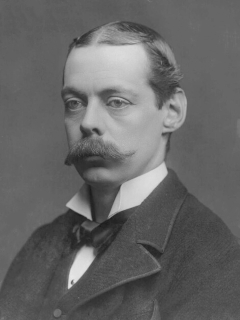
The Conservative Party in Ulster launches an anti-Home Rule campaign in February 1886. It joins with the Orange Order to organise a huge political rally which is addressed by Lord Churchill.
Protestants in Ulster are very concerned about the prospect of Irish Home Rule. They fear that an Irish parliament will put rural agricultural interests before the needs of the industrial North-East. They believe a Dublin parliament will introduce tariffs which will damage industries in the north. They also fear that they will be discriminated against because of their religion, outnumbered in a Dublin parliament by Catholic representatives.
Churchill has shown disdain for Ulster Unionists up until this time, in private at least, telling Lord Salisbury, “these foul Ulster Tories have always ruined our party,” but as 1886 begins he sees an opportunity to exploit their fears for political gain. He decides that should Prime MinisterWilliam Gladstone “went for Home Rule (for Ireland), the Orange Card would be the one to play. Please God may it turn out the ace of trumps and not the two.” This quote leads one to believe he has few real convictions regarding the issue.
“Ulster will fight, and Ulster will be right,” Lord Churchill proclaims to a crowd before he even arrives at Ulster Hall.
Lord Churchill gives a rousing speech at the rally. During his speech, he plays on Protestant fears of Dublin “Catholic” rule and encourages Ulster Protestants to organize against Home Rule, so it does not come upon them “as a thief in the night.” As a result, the Ulster Protestants begin to form paramilitary drilling units.
Churchill achieves a short-term political gain by his playing of the Orange Card, but his most lasting legacy is the unfounded fear of Irish Catholics that he helps to implant in the minds of Ulster Protestants, a tragedy for both traditions on the island. Those fears remain evident over a century later.
The start of 1992 witnesses an intensification in the campaign of violence being carried out by the Ulster Defence Association (UDA) under their UFF covername. However, the Inner Council of the UDA, which contains the six brigadiers that control the organisation, feel that one-off killings are not sending a strong enough message to republicans and so it sanctions a higher-profile attack in which a number of people will be killed at once. On this basis the go-ahead is given to attack Sean Graham bookmaker’s shop on the Irish nationalist Lower Ormeau Road, which is near the UDA stronghold of Annadale Flats. The bookmaker’s shop is chosen by West Belfast Brigadier and Inner Council member Johnny Adair because he has strong personal ties with the commanders of the Annadale UDA. A 1993 report commissioned by the Royal Ulster Constabulary (RUC) Special Branch also claims that Adair is the driving force behind the attack.
The attack occurs at 2:20 in the afternoon. A car parks on University Avenue facing the bookmakers and two men, wearing boilersuits and balaclavas, leave the car and cross the Ormeau Road to the shop. One is armed with a vz.58 Czechoslovak assault rifle and the other with a 9mm pistol. They enter the shop and unleash a total of 44 shots on the fifteen customers. Five Catholic men and boys are killed and nine others are wounded, one critically.
In a separate incident, a unit of the Ulster Volunteer Force (UVF) travels to the area at the time of the attack with the intention of killing a local Sinn Féin activist based on intelligence they had received that he returns home about that time every day. The attack is abandoned, however, when the car carrying the UVF members is passed by speeding RUC vehicles and ambulances. The UVF members, who had already retrieved their weapons for the attack, are said to be livid with the UDA for not coordinating with them beforehand and effectively spoiling their chance to kill a leading local republican.
A UDA statement in the aftermath of the attack claims that the killings are justified as the Lower Ormeau is “one of the IRA’s most active areas.” The statement also includes the phrase “remember Teebane”, suggesting that the killings are in retaliation for the Teebane bombing in County Tyrone less than three weeks earlier. In that attack, the IRA had killed eight Protestant men who were repairing a British Army base. The same statement had also been yelled by the gunmen as they ran from the betting shop.
On February 5, 2002 a plaque is erected on the side of the bookmaker’s shop in Hatfield Street carrying the names of the five victims and the Irish language inscription Go ndéana Dia trócaire ar a n-anamacha (“May God have mercy on their souls”). A small memorial garden is later added. The unveiling ceremony, which takes place on the tenth anniversary of the attack, is accompanied by a two-minute silence and is attended by relatives of the dead and survivors of the attack. A new memorial stone is laid on February 5, 2012 to coincide with the publication of a booklet calling for justice for the killings.
The UDA is formed in September 1971 during one of the most violent phases of The Troubles right after internment without trial is introduced when a number of Loyalist Defense groups combine together. They form a paramilitary wing, the UFF, in 1972 so the organisation can use the UFF name to carry out violent acts and kill people while keeping the UDA name legal by not involving the UDA name with attacks.
The UDA/UFF claim to be combating the Provisional Irish Republican Army (IRA) but approximately 85% of its victims are innocent Catholic civilians. The UDA carries out its first killing on April 20, 1972, when they shoot dead taxi driver Gerard Donnelly in Ardoyne, Belfast. In October, the group is responsible for the deaths of two small girls when they detonate a car bomb outside an Irish nationalist pub in Sailortown, Belfast. The girls killed are Clare Hughes, age 4, and Paula Strong, age 6.
On December 20, 1972, along the Strabane Old Road, Annie’s Bar is packed with customers watching a football match. At about 10:30 PM two men from the UDA burst into the bar, one of them carrying a Sterling submachine gun and the other holding a pistol. Both are wearing hoods to disguise their identities. The men instantly and indiscriminately spray the main room in the bar with bullets. The attack is reported to have lasted less than a minute, but it still manages to leave five people dead, and four others wounded. Those killed in the attack are all males and include, Charlie McCafferty (31), Frank McCarron (58), Charles Moore (31), Barney Kelly (26) and Michael McGinley (37). At the time this is the largest and most deadly attack carried out by the UDA. They do not carry out another attack of this size until February 1992, when they shoot dead five civilians and injure nine in the Sean Graham bookmakers’ shooting on the Ormeau Road in Belfast.
The year 1972 in Derry begins with the Bloody Sunday shooting which occurs in the Bogside area and ends with the Annie’s Bar shooting. Nobody is ever charged in connection with the Annie’s Bar murders, although in recent years relatives of those murdered have been calling for a fresh investigation to take place.
The attack is carried out by members from the UDA’s “North Antrim & Londonderry Brigade.” Although this is one of the UDA’s smaller brigades it also carries out the October 1993 Greysteel massacre which is the UDA’s worst ever attack, in which eight people are killed and 19 others are injured. The Greysteel shooting happens about 9-10 miles away from Annie’s Bar.
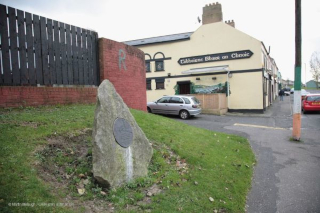
(Pictured: Annie’s Bar Memorial stone located at Strabane Old Road, Top of the Hill, Waterside, Derry, County Derry, Northern Ireland. Annie’s Bar is in the background. Photo taken by Martin Melaugh, November 20, 2008.)
Hume, 61, the Catholic head of the Social Democratic and Labor Party, is cited by the Nobel Committee in Oslo for having been the “clearest and most consistent of Northern Ireland’s political leaders in his work for a peaceful solution.”
Trimble, 54, the Protestant leader of the Ulster Unionist Party, is honored for having demonstrated “great political courage when, at a critical stage in the process, he advocated solutions which led to the peace agreement.”
The accord, signed on April 10 and known as the Good Friday Agreement, gives the 1.7 million residents of Northern Ireland a respite from the sectarian violence that has claimed more than 3,200 lives in the previous 30 years. It also opens the possibility of lasting stability for the first time since the establishment of Northern Ireland with partition from Ireland in 1921.
Forging concessions from fiercely antagonistic populations, the accord seeks to balance the Protestant majority’s wish to remain part of Britain with Catholic desires to strengthen ties to the Republic of Ireland to the south. The committee, seeing in Northern Ireland’s two warring groups a dispute with notable similarities to violent tribal confrontations elsewhere, expresses the hope that the accord will serve “to inspire peaceful solutions to other religious, ethnic and national conflicts around the world.”
Adams, in New York on a fund-raising trip for Sinn Féin, welcomes the Oslo announcement and particularly praises Hume, who is widely seen as having helped persuade the IRA to adopt a cease-fire and having eased Sinn Féin’s entry into the talks. “Indeed, there would be no peace process but for his courage and vision,” Adams says, adding, “No one deserves this accolade more.” He also wishes Trimble well and says the prize imposes on everyone the responsibility to “push ahead through the speedy implementation of the agreement.”
In the unforgiving politics of Northern Ireland, the Unionist dissidents and members of other Protestant parties who do not join in the peace talks attack both Trimble and Hume. Ian Paisley Jr., son of the head of the Democratic Unionist Party, calls the Nobel Committee’s decision a “farce” and says of the winners, “These people have not delivered peace, and they are not peacemakers.”
Trimble says he is “slightly uncomfortable” with the award because so many other people have been involved beside him in reaching the settlement and much remains to be done to put it in place. “We know that while we have the makings of peace, it is not wholly secure yet,” he tells the BBC from Denver, where he is on an 11-city North American tour to spur foreign investment in Ulster. “I hope it does not turn out to be premature.”
Hume receives word of the prize at his home in Londonderry and terms it “an expression of the total endorsement of the work of very many people.” He adds, “This isn’t just an award to David Trimble and myself. It is an award to all the people in Northern Ireland.”
In Washington, D.C., President Clinton says “how very pleased” he is, “personally and as President, that the Nobel Prize Committee has rewarded the courage and the people of Northern Ireland by giving the Nobel Peace Prize to John Hume and to David Trimble.” He adds “a special word of thanks” to George Mitchell, who issues a statement praising Hume and Trimble as “fully deserving of this honor.”
The peace talks began in the summer of 1996. They eventually draw the participation of 8 of the 10 Northern Irish parties, with many of the men around the table convicted murderers and bombers who had emerged from prison with a commitment to peaceful resolution to what for nearly a century have been referred to wearily as “the Troubles.” The paramilitary groups had also made the tactical decision that violence would not secure their goals; a shared conviction that gives these talks a chance for success that past fitful attempts at settlement lacked.
The peace talks move in a desultory manner until Blair takes office in May 1997 and highlights the cause of peace in Northern Ireland as an early commitment. At his and Ahern’s urging, the IRA declares a cease-fire in July, and by September Sinn Féin is permitted to join the talks.
Blair also gives Trimble and Adams unprecedented access to 10 Downing Street, and the Ulster Protestants report that they obtained from Clinton the most sympathetic hearing they ever had from an American President, allaying their longtime suspicions of Washington’s bias in favor of the Catholic minority.
(From: “2 Ulster Peacemakers Win the Nobel Prize,” The New York Times, Warren Hoge, October 17, 1998)
The operation sparks four days of violence in which 20 civilians, two IRA members and two British soldiers are killed. All of those arrested are Irish nationalists, the vast majority of them Catholic. Due to faulty intelligence, many have no links with the IRA. Ulster loyalistparamilitaries are also carrying out acts of violence, which are mainly directed against Catholics and Irish nationalists, but no loyalists are included in the sweep.
The introduction of internment, the way the arrests are carried out, and the abuse of those arrested, lead to mass protests and a sharp increase in violence. Amid the violence, about 7,000 people flee or are forced out of their homes. The interrogation techniques used on some of the internees are described by the European Commission of Human Rights in 1976 as torture, but the superior court, the European Court of Human Rights (ECHR), rules on appeal in 1978 that, although the techniques are “inhuman and degrading”, they do not, in this instance, constitute torture. It is later revealed that the British government had withheld information from the ECHR and that the policy had been authorized by British government ministers. In December 2014, in light of the new evidence, the Irish government asks the ECHR to revise its 1978 judgement. The ECHR declines the request in 2018.
Following the suspension of the Northern Ireland Government and Parliament, internment is continued by the direct rule administration until December 5, 1975. During this time 1,981 people are interned, 1,874 are nationalist while 107 are loyalist. The first loyalist internees are detained in February 1973.
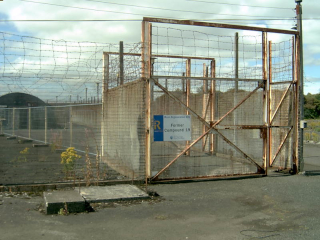
(Pictured: The entrance to Compound 19, one of the sections of Long Kesh internment camp)

 The Royal Ulster Constabulary (RUC), the police force in Northern Ireland from 1922 to 2001, is founded on June 1, 1922 as a successor to the Royal Irish Constabulary (RIC).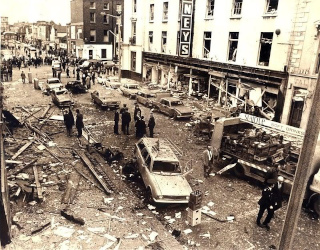




 seamus dubhghaill