seamus dubhghaill

Promoting Irish Culture and History from Little Rock, Arkansas, USA


Leave a comment

Death of Edward Parry, Church of Ireland Bishop of Killaloe

Edward Parry, Church of Ireland Bishop of KillaloeCounty Clare, dies in Dublin on July 20, 1650, after contracting the plague.

Parry is born c. 1599 in Madyn Dyswy, AmlwchAnglesey, Wales, the son of Rhys Parry, a merchant of NewryCounty Down. The name of his mother is disputed. His siblings are Arthur, Grace and Magdalen. He is educated in Newry. In 1616, he enrolls as a student of Trinity College Dublin (TCD) where he graduates with a BA in 1620. He obtains his MA there in 1623 and a fellowship on November 24, 1624. In 1630 he graduates as a Doctor of Divinity and later becomes Pro-Vice-Chancellor of the college.

In Anglican politics Parry is regarded as a Laudian. In 1627, he is appointed Prebendary of Tipperkevin, a living belonging to St Patrick’s Cathedral, Dublin. In 1630, he is Incumbent of St. Bride’s Church, Dublin, where several of his children are baptised. In 1634, he is made Treasurer of Christ Church Cathedral, Dublin and chaplain to Lancelot BulkeleyArchbishop of Dublin. In 1635, he is appointed one of the High Commission for Ecclesiastical Causes. In 1636, he is appointed Prebendary of Stagonyl, another living belonging to St Patrick’s Cathedral, Dublin. By patent dated April 28, he is presented to St. Olave’s in Waterford where he is installed on May 11, but is also licensed to hold his other preferments at the same time. In 1640, he resigns from St. Olave’s and is appointed Dean of Lismore, County Waterford. Some of the Deanery lands had been seized by Richard Boyle, 1st Earl of Cork and Parry tries to get them back but fails. His successor as Dean of Lismore is his first cousin, Robert Parry. In 1643, he is Archdeacon of GlendaloughCounty Wicklow.

On December 29, 1646, King Charles I of England in a letter states he favours Parry for the See of the Diocese of Killaloe, County Clare. On March 20, 1647, a patent is issued confirming his appointment as Bishop of Killaloe and he is consecrated at Christ Church Cathedral, Dublin, on March 28, 1647, by Lancelot Bulkeley, Archbishop of Dublin, assisted by the Bishops of Kildare and Cloyne. However, as this is in the middle of the Irish Rebellion he was unable to travel to his diocese and remains in Dublin, where he resides in Chichester House, St. Stephen’s Street, which later houses the Parliament of Ireland. In the Hearth Money Rolls the house is assessed for eight hearths so is quite large. On July 9, 1647, he signs the petition of the clergy praying to be allowed the use of the Liturgy, then abolished by order of the commissioners under Oliver Cromwell. On account of his good character and the smallness of the revenues of Killaloe, the King permits him to hold his former preferments in commendam.

Parry marries the daughter of John Price and by her has six children, who are John Parry, Bishop of OssoryBenjamin Parry, Bishop of Ossory, Edward Parry, Robert Parry, Mary Parry who marries John Bulkeley, and Elinor Parry who is a love and correspondent of John Locke and later marries Richard Hawkshaw.

Parry dies in his house in St. Stephen’s Street on July 20, 1650, at the age of 51, after contracting the plague which rages there, and is buried in St. Audoen’s Church, Dublin. His will dated July 17, 1650, is proved in the Prerogative Court, Dublin. Its terms are: (1) his body is to be interred in St. Audeon’s Church near the doors, with his face to the east, where he also desires the body of his wife to be translated, and laid by his side, (2) he gives to his eldest daughter, Mary Parry, alias Bulkeley, a little silver watch, and her mother’s dear-head ring, (3) to his other daughter “Eleynor Parry” other ornaments that belonged to her mother, (4) to his sister “Madelius Evans” five pounds, (5) to other beneficiaries are given legacies out of the fifty pounds due to him by William Usher, (6) to his cousin, Robert Parry, he leaves his lexicon and other books, (7) to his cousin, Richard Parry, he leaves a gold ring, (8) to his cousin, Mary Parry, wife of Richard, he leaves a money legacy, and (9) he appoints his cousin, Robert Parry, as overseer of his will.

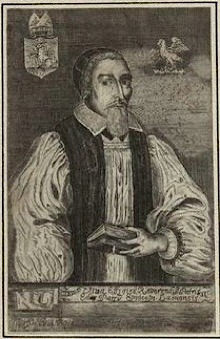
Parry writes a book entitled David restored; or an Antidote against the Prosperity of the Wicked, and the Afflictions of the Just, which is a sermon on the seventy-third Psalm. This is afterward published by his son, John Parry at Oxford in 1660. This work contains an engraved portrait of Edward Parry (above).

(Pictured: An engraved portrait by John Dickson of Dr. Edward Parry, Bishop of Killaloe, from a book authored by the bishop entitled “David restored; or an Antidote against the Prosperity of the Wicked, and the Afflictions of the Just”, published at Oxford in 1660.)

1 Comment

The Siege of Kilkenny Ends

map-of-kilkenny

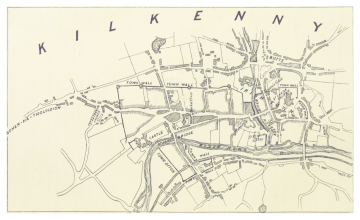
The Siege of Kilkenny ends on March 28, 1650 with the city and residents surrendering to Oliver Cromwell.

The Siege of Kilkenny takes place in what historian Patrick Little considers to be the most controversial period of the Cromwellian conquest of Ireland. The English ParliamentariansNew Model Army, commanded by Oliver Cromwell, takes the city of Kilkenny from the Irish Confederates but suffers more losses than they had in the Siege of Drogheda in September 1649.

After taking Cashel and setting his headquarters there, Cromwell marches to Kilkenny to issue a summons of surrender to the Irish Confederates holding the town. The envoy he sends there is captured and kept as a hostage. Upon this happening, Cromwell, absent siege weapons, has to return to Cashel to acquire them after being met with hostility. Cromwell is relying on an officer by the name of Tickle to betray the townspeople and relay the locations of the wall’s weakest points. Tickle’s treachery is uncovered by James Butler, 3rd Earl of Ormond and owner of Kilkenny Castle. Bulter intercepts the letters sent between Cromwell and Tickle which lead to Tickle’s execution.

Butler, learning of Cromwell’s intent, establishes 700 men and 100 horsemen to repel the puritan army. Facing this formidable force Cromwell decides to retreat to Cashel. In the space of time it takes Cromwell to acquire siege weapons and return to Kilkenny, a plague has struck. The plague is believed to have originated in Galway on a Spanish ship. Lord Castlehaven appoints James Walsh as Governor of the Castle and Sir Walter Butler as Governor of Kilkenny. In addition to this he provides 1,200 men to the Kilkenny cause. By the time Cromwell returns, the plague has decimated Kilkenny city. About 300 out of the original Garrison of 1,200 men remain to watch their posts.

On March 22, Cromwell arrives and stands a mile before Kilkenny with his men. Guns are set up on the adjacent hill and from the Black quarry, Cromwell issues a summons of surrender to Butler, Walsh and the Aldermen of Kilkenny. While the letters are traded back and fort, Cromwell sends a detachment to take Irishtown and they are defeated. A refusal letter is issued to Cromwell shortly thereafter. The artillery battery located on the adjacent hill begins to pound the south wall. A breach is made around noon and Cromwell gives orders to assault using the recently destroyed entry point, but after two attempts his men disobey as they have suffered heavy losses in the last battle. Soon after, Cromwell receives invitation from the mayor and townsmen of Irishtown asking him to stay in the town and in return he will allow his troops safe entry. Instead of replying, Cromwell sends a detachment of men led by Colonel Ewer to capture Irishtown, which is guarded by the townsmen. The townsmen flee their posts at the first sight of Colonel Ewer and his men. This results in the capturing of St. Canice’s Cathedral and parts of Irishtown. The Governor of Irishtown, Sir James Butler, surrenders not long after admitting that there is nothing he can do.

On March 27, the troops continue to attack Kilkenny to no success other than managing to breach the walls of the Franciscan abbey, causing more people to desert their posts. Governor Walsh arrives on horseback to drive Cromwell’s men from the wall. At the same time, small groups of Cromwell’s men attempt to cross St. Johns bridge to set fire to the front gates but they are killed by the garrison guards. It is at this point when reinforcements of 1,500 men from Henry Ireton arrive. Finally, Walsh calls for surrender under orders from Lord Castlehaven that were given previously. The orders are not to allow the townspeople to be exposed and massacred.

On March 28, 1650 the town of Kilkenny is handed over to Cromwell. The garrison and its leaders are marched out into the town where they are complimented by Cromwell for the gallantry in battle. Cromwell also admits that if it was not for the townspeople’s treachery, he would have passed Kilkenny and left it alone.


Leave a comment

The Siege of Limerick

Henry IretonOliver Cromwell’s son-in-law, lays siege to Limerick city on June 4, 1651. During the Irish Confederate Wars, Limerick is one of the last fortified cities held by an alliance of Irish Confederate Catholics and English Royalists against the forces of the Parliament of England.

By 1650, the Irish Confederates and their English Royalist allies have been driven out of eastern Ireland by the Cromwellian conquest of Ireland. They occupy a defensive position behind the River Shannon, of which Limerick is the southern stronghold. Oliver Cromwell himself leaves Ireland in May 1650, delegating his command of the English Parliamentarian forces to Henry Ireton. Ireton moves his forces north from Munster to besiege Limerick in October of that year. However, the weather is increasingly wet and cold and Ireton is forced to abandon the siege before the onset of winter.

Ireton returns on June 4, 1651 with 8,000 men, 28 siege artillery pieces and 4 mortars. He summons Hugh Dubh O’Neill, the Irish commander of Limerick to surrender, but is refused. The siege is on.

Limerick in 1651 is split into two sections, English town and Irish town, which are separated by the Abbey River. English town, which contains the citadel of King John’s Castle, is encircled by water, the Abbey River on three sides and the River Shannon on the other, in what is known as King’s Island. Thomond bridge is only one bridge onto the island and is fortified with bastioned earthworks. Irish town is more vulnerable, but is also more heavily fortified. Its medieval walls have been buttressed by 20 feet of earth, making it difficult to knock a breach in them. In addition, Irish town has a series of bastions along its walls, mounted with cannon which cover its approaches. The biggest of these bastions are at St. John’s Gate and Mungret gate. The garrison of the city is 2,000 strong and composed mainly of veterans from the Confederate’s Ulster army, commanded by Hugh Dubh O’Neill, who had distinguished themselves at the siege of Clonmel the previous year.

Because Limerick is very well fortified, Ireton does not risk an assault on its walls. Instead he secures the approaches to the city, cuts off its supplies and builds artillery earthworks to bombard the defenders. His troops take the fort at Thomond bridge, but the Irish destroy the bridge itself, denying the Parliamentarians land access to English town. Ireton then tries an amphibious attack on the city, a storming party attacking the city in small boats. They are initially successful, but O’Neill’s men counterattack and beat them off.

After this attack fails, Ireton resolves to starve the city into submission and builds two forts known as Ireton’s fort and Cromwell’s fort on nearby Singland Hill. An Irish attempt to relieve the city from the south is routed at the battle of Knocknaclashy. O’Neill’s only hope is now to hold out until bad weather and hunger force Ireton to raise the siege. To this end, O’Neill tries to send the town’s old men, women and children out of the city so that his supplies will last a little longer. However, Ireton’s men kill forty of these civilians and send the rest back into Limerick.

O’Neill comes under pressure from the town’s mayor and civilian population to surrender. The town’s garrison and civilians suffer terribly from hunger and disease, especially an outbreak of plague. In addition, Ireton finds a weak point in the defences of Irish town, and knocks a breach in them, opening the prospect of an all out assault.

Eventually in October 1651, six months after the siege started, part of Limerick’s garrison mutinies and turns some cannon inwards, threatening to fire on O’Neill’s men unless they surrender. Hugh Dubh O’Neill surrenders Limerick on October 27. The inhabitants lives and property are respected, but they are warned that they could be evicted in the future. The garrison is allowed to march to Galway, which is still holding out, but has to leave their weapons behind.

The lives of the civilian and military leaders of Limerick are excepted from the terms of surrender. A Catholic Bishop Terence Albert O’Brien, an Alderman and the English Royalist officer Colonel Fennell are hanged. O’Neill is also sentenced to death, but is reprieved by the Parliamentarian commander Edmund Ludlow and imprisoned instead in London. Former mayor Dominic Fanning is drawn, quartered, and decapitated, with his head mounted over St. John’s Gate.

Over 2,000 English Parliamentary soldiers die at Limerick, mostly from disease. Among them is Henry Ireton, who dies a month after the fall of the city. About 700 of the Irish garrison and an estimated 5,000 citizens die.

(Pictured: The Treaty Stone on which the treaty of Limerick may have been signed in 1691)