seamus dubhghaill

Promoting Irish Culture and History from Little Rock, Arkansas, USA


Leave a comment

Death of Edward Parry, Church of Ireland Bishop of Killaloe

Edward Parry, Church of Ireland Bishop of KillaloeCounty Clare, dies in Dublin on July 20, 1650, after contracting the plague.

Parry is born c. 1599 in Madyn Dyswy, AmlwchAnglesey, Wales, the son of Rhys Parry, a merchant of NewryCounty Down. The name of his mother is disputed. His siblings are Arthur, Grace and Magdalen. He is educated in Newry. In 1616, he enrolls as a student of Trinity College Dublin (TCD) where he graduates with a BA in 1620. He obtains his MA there in 1623 and a fellowship on November 24, 1624. In 1630 he graduates as a Doctor of Divinity and later becomes Pro-Vice-Chancellor of the college.

In Anglican politics Parry is regarded as a Laudian. In 1627, he is appointed Prebendary of Tipperkevin, a living belonging to St Patrick’s Cathedral, Dublin. In 1630, he is Incumbent of St. Bride’s Church, Dublin, where several of his children are baptised. In 1634, he is made Treasurer of Christ Church Cathedral, Dublin and chaplain to Lancelot BulkeleyArchbishop of Dublin. In 1635, he is appointed one of the High Commission for Ecclesiastical Causes. In 1636, he is appointed Prebendary of Stagonyl, another living belonging to St Patrick’s Cathedral, Dublin. By patent dated April 28, he is presented to St. Olave’s in Waterford where he is installed on May 11, but is also licensed to hold his other preferments at the same time. In 1640, he resigns from St. Olave’s and is appointed Dean of Lismore, County Waterford. Some of the Deanery lands had been seized by Richard Boyle, 1st Earl of Cork and Parry tries to get them back but fails. His successor as Dean of Lismore is his first cousin, Robert Parry. In 1643, he is Archdeacon of GlendaloughCounty Wicklow.

On December 29, 1646, King Charles I of England in a letter states he favours Parry for the See of the Diocese of Killaloe, County Clare. On March 20, 1647, a patent is issued confirming his appointment as Bishop of Killaloe and he is consecrated at Christ Church Cathedral, Dublin, on March 28, 1647, by Lancelot Bulkeley, Archbishop of Dublin, assisted by the Bishops of Kildare and Cloyne. However, as this is in the middle of the Irish Rebellion he was unable to travel to his diocese and remains in Dublin, where he resides in Chichester House, St. Stephen’s Street, which later houses the Parliament of Ireland. In the Hearth Money Rolls the house is assessed for eight hearths so is quite large. On July 9, 1647, he signs the petition of the clergy praying to be allowed the use of the Liturgy, then abolished by order of the commissioners under Oliver Cromwell. On account of his good character and the smallness of the revenues of Killaloe, the King permits him to hold his former preferments in commendam.

Parry marries the daughter of John Price and by her has six children, who are John Parry, Bishop of OssoryBenjamin Parry, Bishop of Ossory, Edward Parry, Robert Parry, Mary Parry who marries John Bulkeley, and Elinor Parry who is a love and correspondent of John Locke and later marries Richard Hawkshaw.

Parry dies in his house in St. Stephen’s Street on July 20, 1650, at the age of 51, after contracting the plague which rages there, and is buried in St. Audoen’s Church, Dublin. His will dated July 17, 1650, is proved in the Prerogative Court, Dublin. Its terms are: (1) his body is to be interred in St. Audeon’s Church near the doors, with his face to the east, where he also desires the body of his wife to be translated, and laid by his side, (2) he gives to his eldest daughter, Mary Parry, alias Bulkeley, a little silver watch, and her mother’s dear-head ring, (3) to his other daughter “Eleynor Parry” other ornaments that belonged to her mother, (4) to his sister “Madelius Evans” five pounds, (5) to other beneficiaries are given legacies out of the fifty pounds due to him by William Usher, (6) to his cousin, Robert Parry, he leaves his lexicon and other books, (7) to his cousin, Richard Parry, he leaves a gold ring, (8) to his cousin, Mary Parry, wife of Richard, he leaves a money legacy, and (9) he appoints his cousin, Robert Parry, as overseer of his will.

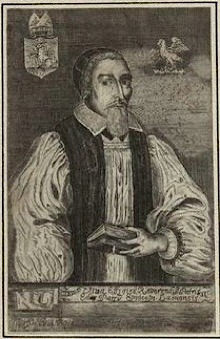
Parry writes a book entitled David restored; or an Antidote against the Prosperity of the Wicked, and the Afflictions of the Just, which is a sermon on the seventy-third Psalm. This is afterward published by his son, John Parry at Oxford in 1660. This work contains an engraved portrait of Edward Parry (above).

(Pictured: An engraved portrait by John Dickson of Dr. Edward Parry, Bishop of Killaloe, from a book authored by the bishop entitled “David restored; or an Antidote against the Prosperity of the Wicked, and the Afflictions of the Just”, published at Oxford in 1660.)


Leave a comment

Laying of the Foundation Stone of Parliament House

parliament-house

The foundation stone of Parliament House in College Green is laid on February 3, 1729, by Thomas Wyndham, 1st Baron Wyndham, the Lord Chancellor of Ireland. Parliament House is initially home to the Parliament of Ireland and later houses the Bank of Ireland. It is the world’s first purpose-built bicameral parliament house. The current parliament building is Leinster House.

The building is home to the two Houses of Parliament, serving as the seat of both chambers, the House of Lords and House of Commons, of the Parliament of the Kingdom of Ireland for most of the 18th century until that parliament is abolished by the Acts of Union 1800, when Ireland becomes part of the United Kingdom of Great Britain and Ireland.

In the 17th century, parliament settles at Chichester House, a town house in Hoggen Green (later College Green) formerly owned by Sir George Carew, Lord President of Munster and Lord High Treasurer of Ireland, which had been built on the site of a nunnery disbanded by King Henry VIII at the time of the dissolution of the monasteries. Carew’s house, named Chichester House after its later owner Sir Arthur Chichester, is a building of sufficient importance to have become the temporary home of the Kingdom of Ireland’s law courts during the Michaelmas law term in 1605. Most famously, the legal documentation facilitating the Plantation of Ulster is signed there on November 16, 1612.

Chichester House is in a dilapidated state, allegedly haunted and unfit for official use. In 1727 parliament votes to spend £6,000 on a new building on the site. It is to be the world’s first purpose-built two-chamber parliament building.

The then ancient Palace of Westminster, the seat of the English before 1707 and, later, British Parliament, is a converted building. The House of Commons‘s odd seating arrangements is due to the chamber’s previous existence as a chapel. Hence MPs face each other from former pews.

The design of the new building, one of two purpose-built Irish parliamentary buildings (along with Parliament Buildings, Stormont), is entrusted to an architect, Edward Lovett Pearce, who is a member of parliament and a protégé of the Speaker of the Irish House of Commons, William Conolly of Castletown House. During construction, Parliament moves into the Blue Coat Hospital on Dublin‘s Northside.

The original, domed House of Commons chamber is destroyed by fire in the 1790s, and a less elaborate new chamber, without a dome, is rebuilt in the same location and opened in 1796, four years before the Parliament’s ultimate abolition.

Pearce’s designs come to be studied and copied both at home and abroad. The Viceregal Apartments in Dublin Castle imitate his top-lit corridors. The British Museum in Bloomsbury in London copies his colonnaded main entrance. His impact reaches Washington, D.C., where his building, and in particular his octagonal House of Commons chamber, is studied as plans are made for the United States Capitol building. While the shape of the chamber is not replicated, some of its decorative motifs are, with the ceiling structure in the Old Senate Chamber and old House of Representatives chamber (now the National Statuary Hall) bearing a striking resemblance to Pearce’s ceiling in the House of Commons.

(Pictured: Architectural drawing of the front of Parliament House by Peter Mazell based on the drawing by Rowland Omer, 1767)


Leave a comment

First Known Meeting of the Parliament of Ireland

parliament-of-ireland-coat-of-arms

The Parliament of Ireland meets at Castledermot in County Kildare on June 18, 1264, the first definitively known meeting of this Irish legislature. There is some evidence to suggest that the word “parliament” may have been in use as early as 1234.

There is nothing new about parliamentary assemblies in Ireland. The Normans, who begin to settle in Ireland in 1169, are the first to give Ireland a centralised administration. The Irish legal system and courts of law are, in large measure, inherited from them. So too is the Irish legislature which is directly descended from the parliament which develops in medieval Ireland.

The Parliament of Ireland is formally founded in 1297 by the Justiciar, Sir John Wogan, to represent the Irish and Anglo-Norman population of the Lordship of Ireland. It exists in Dublin from 1297 until 1800 and is comprised of two chambers – the House of Commons and the House of Lords. The House of Lords consists of members of the Irish peerage and the bishops (after the Reformation, Church of Ireland bishops), while the Commons is directly elected, albeit on a very restricted franchise.

The main purpose of parliament is to approve taxes that are then levied by and for the Lordship of Ireland. Those who pay the bulk of taxation, the clergy, merchants, and landowners, naturally comprise the members. In 1541 the parliament votes to create the Kingdom of Ireland.

Over the centuries, the Irish parliament meets in a number of locations both inside and outside Dublin. The first meeting at Castledermot in June 1264 takes place some months earlier than the first English Parliament containing representatives of towns and cities. However, this Irish Parliament is a meeting of Irish nobles and bishops, not representatives of Irish people. Later, in the 15th century, Irish parliaments began to invite representatives of the people.

Among its most famous meeting places are Dublin Castle, the Bluecoat School, Chichester House and its final permanent home, the Irish Parliament House in College Green.